GP @ Caban Global Reach | Fintech & PE | Scaling capital access in Africa & frontier markets | Author, brain tumor survivor, dad | #FinTech #HealthTech
Joined April 2015
- Tweets 11,983
- Following 6,381
- Followers 6,806
- Likes 9,055
807 Photos and videos
Pinned Tweet

May 19
Most founders do not need more investor names.
They need a better capital route.
ScaleSignals helps founders understand which funders fit, what evidence they need, and how to approach them without wasting months.
Start here: Scalesignals.substack.com
5
8
158
Most raises do not fail when the investor says no.
They failed earlier.
When the route, evidence and fit were never properly prepared.
9
Building a company teaches you one brutal thing.
The market does not care how hard you worked.
It only responds to what you can prove.
5
11h
Most founders do not need more motivation.
They need a clearer view of what is actually blocking growth.
Energy is useful.
Evidence moves the business.
9
Jun 11
Stale investor lists are not just unhelpful. They are actively dangerous.
Funds in wind-down. GPs who have left. Mandates that have shifted.
The cost is not the wasted outreach.
It is the lost time inside the founder's runway.
Better to have no list than one that gives false confidence.
1
24
Jun 11
Governance is quietly becoming a competitive advantage in raises.
Moving earlier in DFI diligence. Earlier in debt. Earlier in strategic capital. Earlier in institutional.
The founders investing in governance ahead of the round are closing rounds faster than the founders investing in growth.
Full analysis today.
1
13
Jun 11
A better first message starts with better capital fit.
First sentence of a cold email tells the investor whether the founder did any work.
Generic opener — no meeting.
Specific reference, clear thesis fit, evidence relevant to the mandate — that earns the conversation.
The cold email is a fit signal.
1
35
Jun 10
Good outreach is not louder. It is better matched.
Most founders try to fix conversion by sending more messages.
The founders whose first messages convert are sending fewer messages with specifics that prove fit before asking for thirty minutes.
Match quality is upstream of message volume.
1
9
Jun 10
The Founder Proof Pack — what to bring to a serious capital conversation that is not the deck.
Company summary. Use of funds. Traction. Customer proof. Governance. Impact.
The document that closes the gap between the meeting and the term sheet.
Vantage members today.
1
17
Jun 10
A seed fintech founder should not be building one investor list.
Economics of seed fintech in 2026 require three parallel routes.
VC for equity. DFI for regulatory and impact. Strategic for distribution.
Running these as three processes cuts the raise time roughly in half.
1
26
Jun 9
Wrong capital routes destroy more raises than weak decks.
VC, debt, DFI, grant, family office, strategic — each underwrites a different kind of risk.
A good deck cannot fix being in the wrong category.
This morning's briefing on how to choose.
1
18
Jun 8
A founder told me last week he wished he had spent the first month of his last raise on capital route selection instead of outreach.
He raised £3M in eight months.
The right route work upfront would have cut it to four.
Capital route is the strategic decision. The deck is the execution.
1
12
Jun 8
More investor conversations often create more narrative drift.
Each meeting introduces feedback the founder absorbs into the next pitch.
By meeting fifteen they are pitching a hybrid built from objections of investors who never wrote the cheque.
If your deck has changed materially across the last ten meetings, the drift has already happened.
1
12
Jun 7
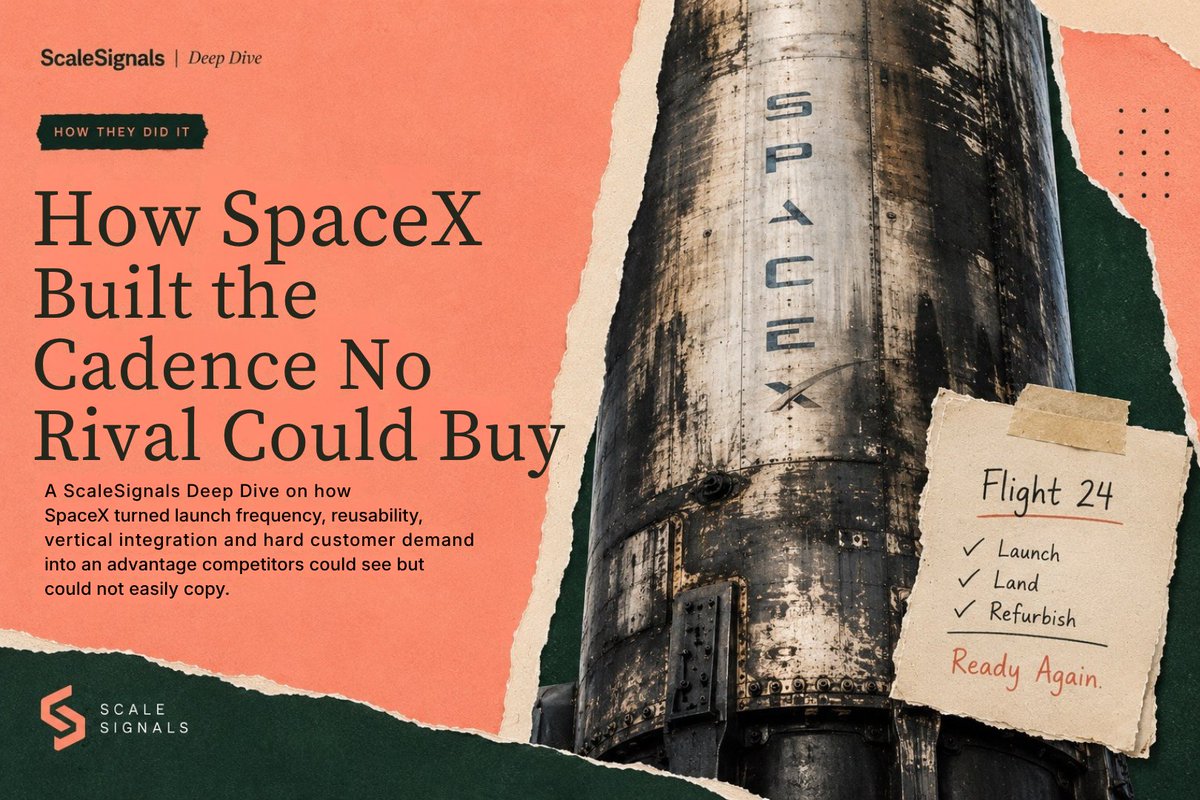
#SpaceX is not just a rocket story.
It's a cadence story.
Every launch created data, trust, learning, cost insight and capital confidence.
That is the real lesson for founders.
Build the proof loop competitors can see but cannot easily copy.
New ScaleSignals piece:
How SpaceX Built the Cadence No Rival Could Buy
@elonmusk
1
3
4
51
Jun 7
Here is the full ScaleSignals piece:
How SpaceX Built the Cadence No Rival Could Buy
scalesignals.substack.com/p/…
It is the first article in the new How They Built It series, where I break down how exceptional companies turn capital, timing, infrastructure, trust and operating discipline into hard-to-copy advantage.
1
38
Jun 7
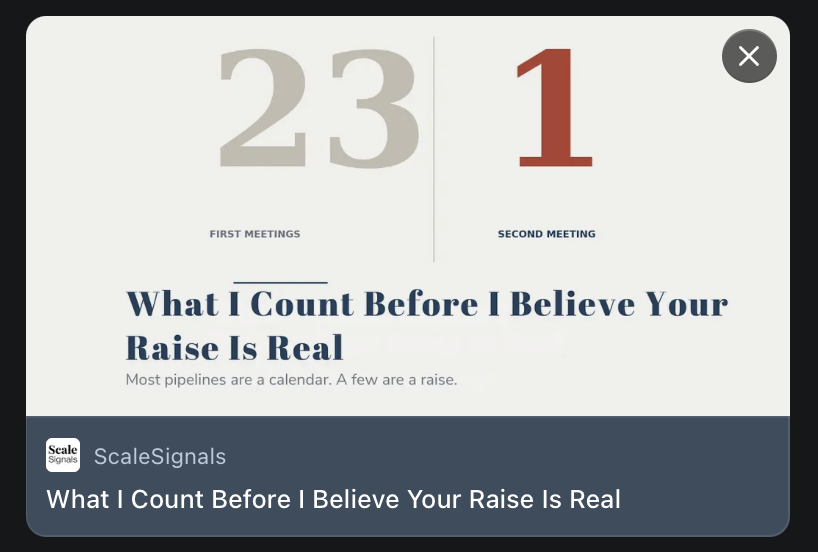
Most founders are optimising for meetings instead of alignment.
Twenty meetings is not a raise. Three aligned conversations are.
The shape of the calendar predicts the shape of the raise more reliably than the deck does.
1
17
Jun 6
The sharpest GPs pass faster than the rest of the market.
Fast passes come from funds where the decision is clear — fits cleanly or does not fit at all.
Slow passes come from genuinely difficult decisions — companies sitting on the edge of the mandate.
A slow maybe usually means a deal that should not have been in the room.
2
14
Jun 5
Revenue quality is replacing TAM as the first filter in many investor conversations.
TAM mattered when the constraint was finding large enough markets.
The current constraint is finding revenue defensible enough to support the next round.
The filter has moved.
2
19
Jun 4
Capital is spreading geographically.
More funds active outside Silicon Valley than at any point in the last decade.
But fit is getting harder, not easier — because route logic now matters more than list length.
Full analysis today.
2
16
Jun 4
Slow growth with strong evidence reads better in 2026 than fast growth with weak evidence.
Not what most founders are being told.
Startup media rewards velocity. Investors are rewarding defensibility.
The disconnect costs founders months.
2
15
Jun 4
Six recent rejections from a GP I work with.
None said no because the company was wrong.
All said no because they could see the fundraising timeline collapsing inside the founder's pipeline.
The signal that broke the deal was visible weeks earlier.
2
18