
On a mission to unlock the power of biotechnology and empower our global customers to get to milestones and market faster. Academics join for free! 🧫🧬👩🏻🔬
Joined June 2012
- Tweets 5,515
- Following 1,991
- Followers 9,964
- Likes 10,329
1,330 Photos and videos




Pinned Tweet

30 Nov 2022
What does it mean to be on #TeamScience? Find out what Benchlings have to say about our mission and culture — and above all, why we’re so passionate about helping scientists power new possibilities for humanity. youtu.be/KiBmXAGoMgU
8
9
37
Benchling retweeted

Jun 11
Head of AI @nlarusstone on the patterns @benchling uses to look at production traces.
4
5
19
5,586
Jun 11
Plan the perfect next experiment, in minutes. With Benchling AI's new Experimental Design skill, scientists can now:
✔️ Identify which variables actually drive results
✔️ Optimize conditions with confidence
✔️ Set up experiments with the right controls and metadata — generating AI-ready data from the start
✔️ Get AI-powered recommendations for what to test next
Design the right experiment faster, right in your workspace. benchling.com/ai/experimenta… #AIForScientists
1
284
Jun 10
What happens when AI can read, reason over, and write back to the scientific record?
On Decoding Bio, Benchling cofounder @daashu and Head of AI @nlarusstone talk about building an AI Scientist, closing the lab-in-the-loop, and why the future of discovery depends on more than just better models. decodingbio.substack.com/p/s…
1
6
977
Benchling retweeted
Jun 9
Watch the latest Max Agency with @hwchase17:
⏯️ YouTube: youtube.com/watch?v=RjpTrffS…
🎧 Apple Podcasts: podcasts.apple.com/us/podcas…
🎧 Spotify: open.spotify.com/episode/2bF…

2
6
2,796
Benchling retweeted
Jun 9
.@nlarusstone from @benchling on how they cross-check answers between models to get more out of each one.
3
9
21
5,239
Jun 5
Scientists shouldn't have to spend days turning data into decks.
With Benchling AI, you can generate analyses, visualizations, summaries, and even a presentation-ready PowerPoint from your data, in minutes. #AIForScientists
296
Benchling retweeted

Jun 4
Scientists can now trigger actions on Seqera Platform directly from @Benchling: launch and track @nextflowio pipelines, investigate results, and spin up interactive environments.
📚 Learn more: benchling.com/news/benchling…
1
4
302
Benchling retweeted
Jun 4
From bench to computational analysis with @benchling.🧬 Bioinformatics is a critical piece of the R&D knowledge graph, but it has historically lived in a silo, disconnected from the lab data that gives it meaning.🧵
1
3
6
456
Benchling retweeted
Jun 4
On the latest episode of Max Agency, @hwchase17
sat down with @nlarusstone, Head of AI at @benchling for a conversation on building agents for scientific work.
⏯️ YouTube: youtube.com/watch?v=RjpTrffS…
🎧 Apple Podcasts: podcasts.apple.com/us/podcas…
🎧 Spotify: open.spotify.com/episode/2bF…
4
10
27
16,014
Jun 3
Introducing the new Benchling AI, now built directly inside the notebook where scientists already work.
Now scientists can import data, run analyses, draft reports, build presentations, and more — all from within their notebook.
Try it out today, or read more: benchling.com/blog/the-eln-i…
1
400
Jun 1
“I have a very strong belief that science has to happen in the physical world.” Benchling cofounder @daashu spoke with @RandDWorld about what makes a real AI Scientist.
Lab automation will be key. An AI scientist needs a connection into the physical world, a data model that’s rich enough, and an interface that human scientists actually want to use. rdworldonline.com/benchling-…
1
233
Jun 1
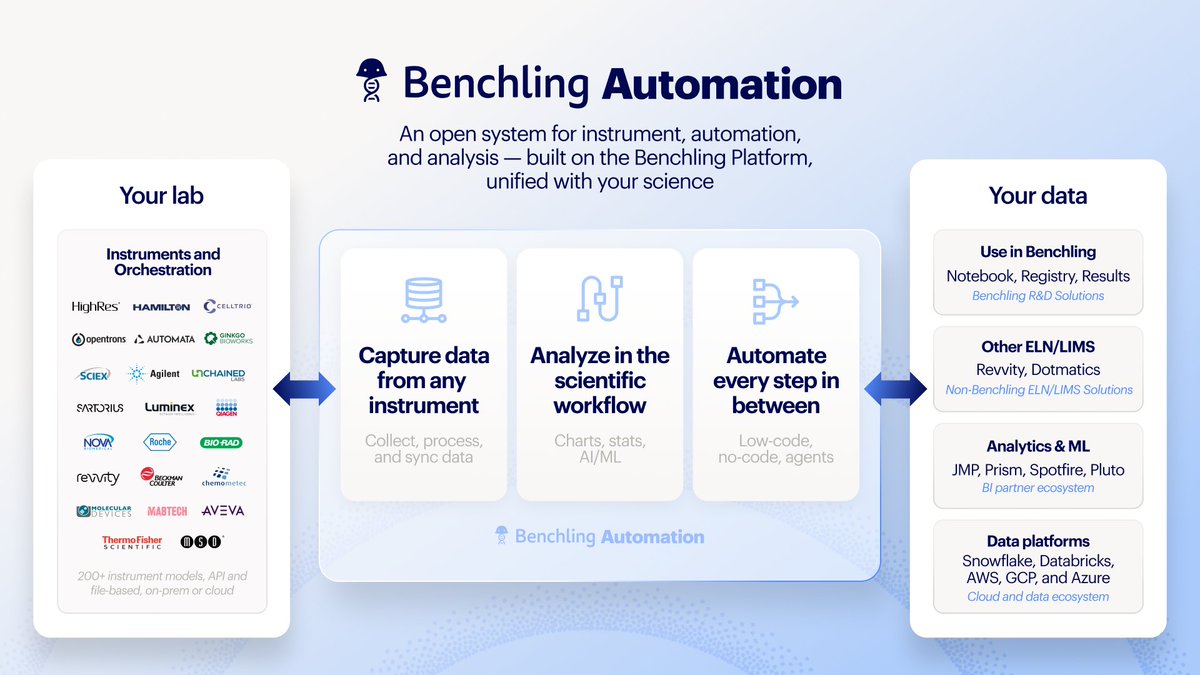
Benchling Automation is an open system for instrument, automation, and analysis — built on the Benchling Platform, unified with your science.
Plus, it works with the instruments and lab automation already in your lab, and the data platforms you use today, whether that’s Benchling or not. benchling.com/blog/benchling…
1
210
May 29
Lab automation shouldn’t stop when an instrument run ends.
That’s why we built Benchling Automation, a unified solution to automatically connect instrument data to scientific records.
We’re launching with partners across the workcells and instruments scientists are using today: @HighResBio, @automata_tech, @Ginkgo, @CellTrio, @opentrons, and @HamiltonCompany.
1
3
419
May 28
Today we’re launching Benchling Automation, a unified solution that connects lab instrument data directly to the scientific record.
Scientists can now:
✔️ Pull data from 200 instruments directly into Benchling
✔️ Run analytics automatically, with results delivered to notebooks
✔️ Automate workflows with flexible no-code and custom code options
We’re building an open ecosystem and launching with partners powering modern labs: @HighResBio, @automata_tech, @Ginkgo, @CellTrio, @opentrons, and @HamiltonCompany.
Available now: benchling.com/blog/benchling…
2
3
20
1,483
Benchling retweeted

May 27
Congrats to the @biohub team! Excited to embed this in the workflow of scientists everywhere.
@salcandido was kind enough to sit down with us and take us behind the scenes building ESMFold2: benchling.com/blog/behind-th…
May 27

Today we're announcing ESMFold2, an open scientific engine to power prediction, design, and discovery across protein biology.
The new model delivers state of the art performance on protein interactions, especially antibodies, a critical modality for therapeutics.
We have designed and validated miniprotein binders and single chain antibodies across five therapeutic targets that are important in cancer and immunology. We are seeing very high success rates, and affinities at levels consistent with therapeutic activity.
We’re also releasing an atlas of 6.8 billion proteins, and 1.1 billion predicted structures.
ESMFold2 is built on a state of the art language model that has been trained on billions of protein sequences.
A world model of protein biology emerges through language modeling.
We’ve used the techniques of mechanistic interpretability developed to understand large language models to understand the concepts ESM uses to represent proteins.
The model’s representation space has a compositional organization of features across scales, levels of complexity, and abstraction, that reflects and mirrors the understanding of protein biology developed through a century of empirical science.
This understanding emerges without prior knowledge, just from language modeling of protein sequences.
Language models are becoming a powerful substrate to understand and program biology.
The design of protein interactions is one of the most fundamental problems in biophysics, and has critical implications for the discovery of new medicines. A simple gradient based search with the model was able to discover high-affinity protein binders.
I'm excited by the potential this has to accelerate basic science and the understanding of proteins. And especially for the new avenues it opens up for therapeutic design and medicine.
1
3
20
2,961
May 27
ESMFold2 will be available on Benchling's Model Hub soon!
May 27
Today we're announcing ESMFold2, an open scientific engine to power prediction, design, and discovery across protein biology.
The new model delivers state of the art performance on protein interactions, especially antibodies, a critical modality for therapeutics.
We have designed and validated miniprotein binders and single chain antibodies across five therapeutic targets that are important in cancer and immunology. We are seeing very high success rates, and affinities at levels consistent with therapeutic activity.
We’re also releasing an atlas of 6.8 billion proteins, and 1.1 billion predicted structures.
ESMFold2 is built on a state of the art language model that has been trained on billions of protein sequences.
A world model of protein biology emerges through language modeling.
We’ve used the techniques of mechanistic interpretability developed to understand large language models to understand the concepts ESM uses to represent proteins.
The model’s representation space has a compositional organization of features across scales, levels of complexity, and abstraction, that reflects and mirrors the understanding of protein biology developed through a century of empirical science.
This understanding emerges without prior knowledge, just from language modeling of protein sequences.
Language models are becoming a powerful substrate to understand and program biology.
The design of protein interactions is one of the most fundamental problems in biophysics, and has critical implications for the discovery of new medicines. A simple gradient based search with the model was able to discover high-affinity protein binders.
I'm excited by the potential this has to accelerate basic science and the understanding of proteins. And especially for the new avenues it opens up for therapeutic design and medicine.
5
477
May 27
The BioHub ESM ecosystem is live and we went behind the scenes with the team that built it.
We sat down with @biohub to talk about what it actually took to build a world model for protein biology: the decisions, the tradeoffs, and what the ESM Atlas might reveal that no one has found yet. benchling.com/blog/behind-th…
1
3
8
1,165
May 27
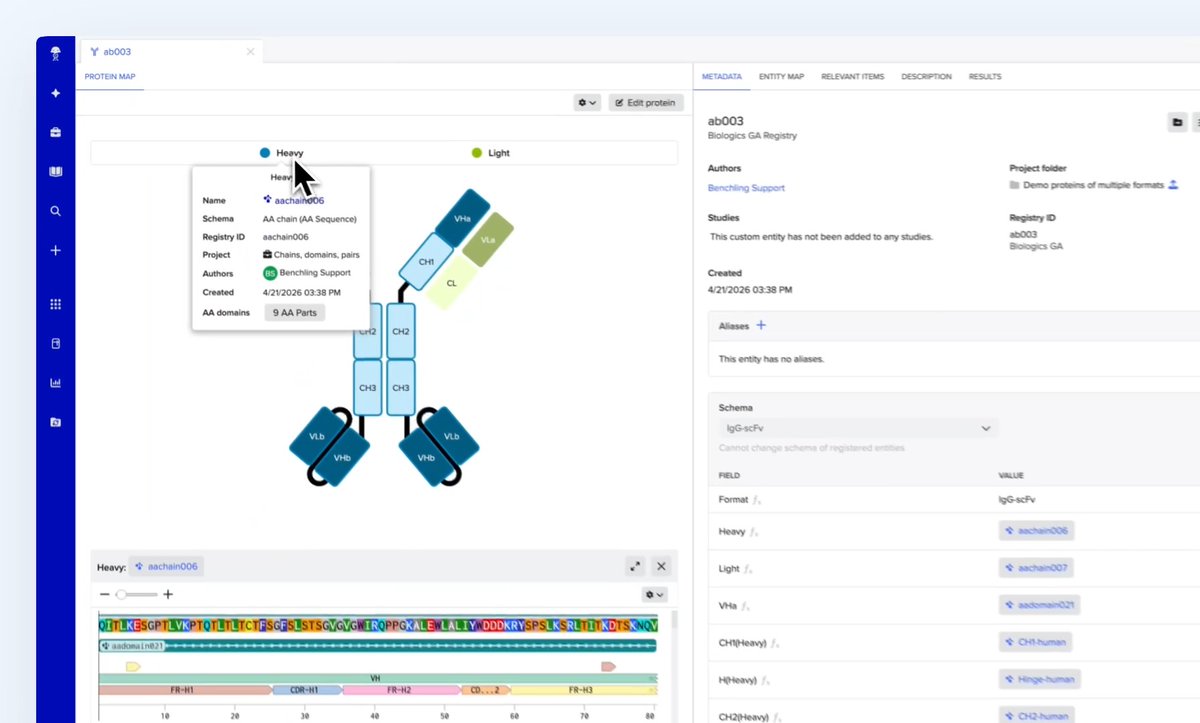
AI-driven antibody design isn’t going to work if your computational and ML teams don’t have structured data.
Most platforms don’t have a standard for capturing and storing antibody data across the growing number of formats. Benchling Biologics does.
Benchling is the only platform that connects the full DBTL loop for biologics, connecting your experimental data and assay results to every protein from the start.
👉 Available now. benchling.com/blog/benchling…
1
203