Associate professor of chemistry, MIT
- Tweets 163
- Following 288
- Followers 1,171
- Likes 253









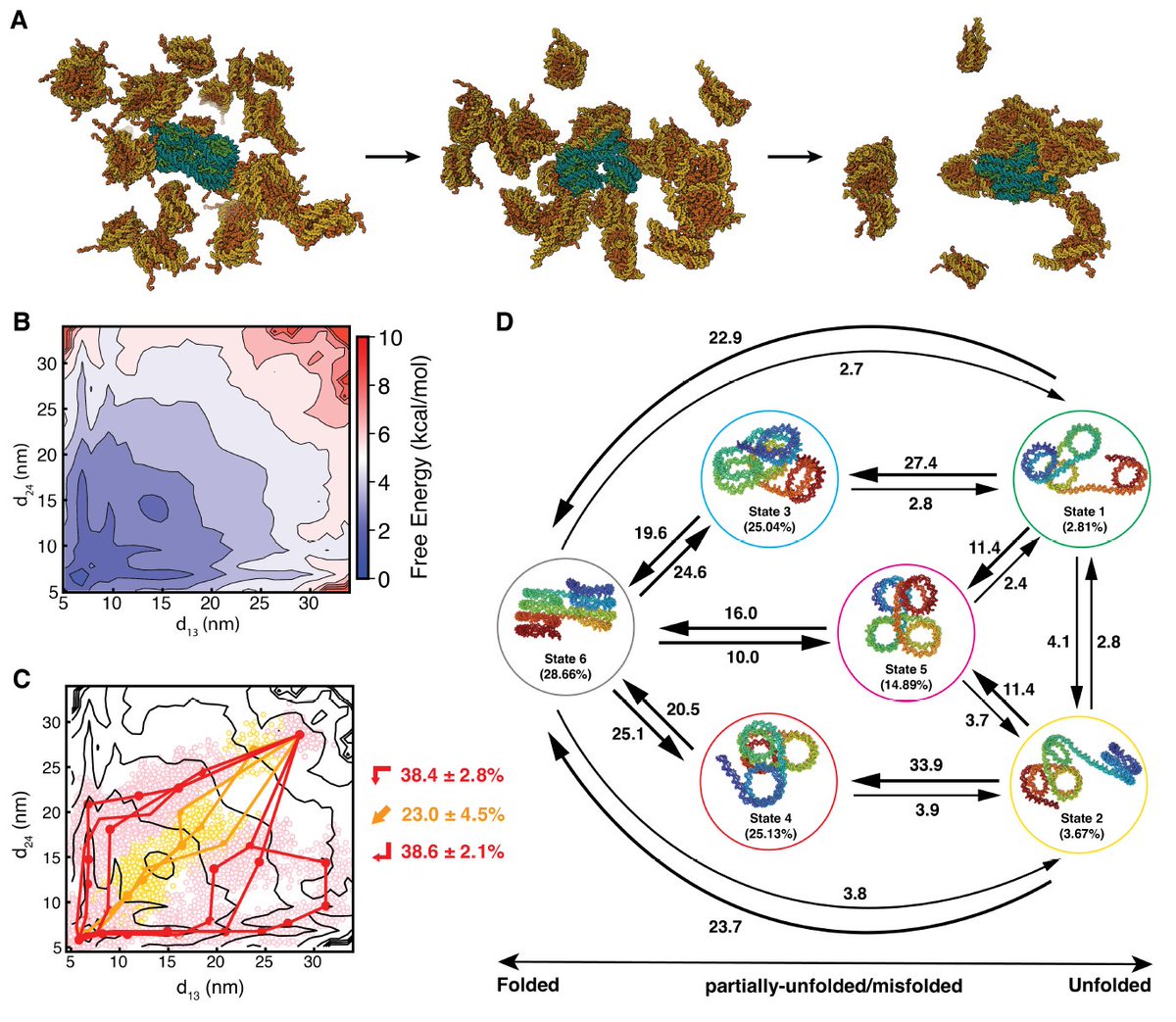
ALT Chromatin organization is essential for DNA packaging and gene regulation in eukaryotic genomes. While significant progresses have been made, the exact atomistic arrangement of nucleosomes remains controversial. Using a well-calibrated residue-level coarse-grained model and advanced dynamics modeling techniques, particularly the non-Markovian dynamics model, we map the free energy landscape of tetra-nucleosome systems, identify both metastable conformations and intermediate states in folding pathways, and quantify the folding kinetics. Our findings show that chromatin with 10n base pairs (bp) DNA linker lengths favor zigzag fibril structures. However, longer linker lengths destabilize this conformation. When the linker length is 10n 5 bp, chromatin loses unique conformations, favoring a dynamic ensemble of structures resembling folding intermediates. Embedding the tetra-nucleosome in a nucleosome condensate similarly shifts stability towards folding intermediates...