
Speculator.
Joined May 2014
- Tweets 21,919
- Following 737
- Followers 826
- Likes 13,750
2,573 Photos and videos










Pinned Tweet

4 Sep 2019
My fear of being mediocre far exceeds my fear of failure.
8
7
56
BKAT - 🐂 💸 🐻 retweeted

Jun 13
Just like that eth call right? RIGHT?
1
1
4
746



BKAT - 🐂 💸 🐻 retweeted

Mar 19
Operation chokepoint was a 100% real effort to de-bank the crypto industry, and I experienced it first-hand. Nobody who actually experienced it talks about it because it's embarrassing to get de-banked, but I don't care anymore and the story needs to be told. I will tell you exactly how it worked, about a dark practice called "subpoena-sniping," and what made it so evil.
In the past three years I have had over ten bank accounts and brokerages, and got kicked out of every single one except my last two, which I have been using for a while now. There was a day when both my main bank account AND my backup bank account were closed on the same day and I had to walk down a street full of banks in Beverly Hills just trying to get a new account opened so I could operate. The worst, by far, though, was Amex. They kicked me out and voided over 4 million points I never spent worth over $40k usd, which is why you should "always be dumping" your points (cc @stoolpresidente). But more on that later...
The way de-banking works is this: People in the political administration, could be the president or uppity members of congress like Elizabeth Warren, decide that they don't like a particular person or a particular industry (crypto, marijuana, etc...). They could call the banks and tell them to stop banking that industry explicitly, but that's actually not even necessary. Instead, they can have a regulator like the SEC just start issuing subpoenas to everyone's bank who works in that industry. Much less work and much lighter-touch (low-level employees at the SEC can issue a subpoena without much paperwork).
A bank's reaction to a subpoena from a federal agency is almost always to immediately shut down that person's bank account. With most banks that means you instantly can't log in, can't access your money, and, best of all, you have to wait for a snail-mail check to get your money, which you can't actually deposit because you don't have a bank account (the irony...). And did I mention the check takes a week to clear even after you've deposited it into your new bank? This is why I always have a main bank account and a "backup" bank account, always.
Why a check, why not a wire transfer? It lets the banks sit on your money and earn interest on it for longer. Yes, that's actually the reason...
But it gets even better: When you lose your bank account, they don't even tell you why it happened, they just stonewall you completely, even if you've been a customer for over a decade. My favorite experience with this was with a neobank where I actually knew the founder and HE couldn't even tell me why they debanked me because the decision was made by their partner bank, which wouldn't tell THEM the reason, so he didn't even know it. Insane!
The way I found out about this practice was actually by talking to lawyers after things got serious with my SEC case. Apparently, the most common tactic when the SEC or DOJ go after someone is to try and de-bank them by throwing subpoenas at all of their financial institutions as fast as they can open them. We called it "subpoena-sniping" and it was such a well-known and disruptive practice that multiple law firms actually recommended I wire them a lot of money up-front to "keep it safe" so that I wouldn't lose my ability to pay them halfway through what we were doing. Luckily, only thanks to crypto, that wasn't necessary...
My top advice for Amex customers in particular is to always be dumping your points. The reason is that a high points balance is viewed as a liability by Amex, and thus makes it more likely they'll randomly decide that your account is non-compliant, even without a subpoena (I learned this from lawyers as well). Put another way, accounts with a lot of points are "expensive" to Amex, and so they will look for any excuse to close them before you can cash them out. In my case that meant losing over 4 million points worth over $40k usd. The crazy thing is they took my points even though I lived in New York at the time, and even though NY literally passed a law and SUED Amex precisely to stop the practice of closing accounts to steal points. Just think about it for a minute: Enough people got mad at Amex for points-stealing that NY, a place where Amex has regulatory capture, passed a LAW to ban it (which I can confirm from first-hand experience they are completely ignoring). If that's not a sign you should always be dumping those points then I really don't know what is... To this day, Amex is the only financial institution that I actually lost money with. Even the sketchiest crypto exchanges I've used over the years never did something as greasy as what Amex did, let alone after being a customer for over a decade.
Now for a list of some banks and brokerages that kicked me out, just to name and shame explicitly: Bank of America, Fidelity, Chase, Wells Fargo, Amex, First Republic (rest in peace), SVB (rest in peace), Webull, Mechanics Bank (got desperate lol), Bank of the Orient (also lol).
In many cases I came in through a relationship, had a contact at the bank, and was happily banking for years, sometimes over a decade-- none of it mattered, I was out the second a subpoena came in, with zero explanation. Also funny story about SVB: By pure coincidence they debanked me ONE WEEK before they went insolvent-- you can't make this stuff up. There are also three neobanks that kicked me out but I know the founders, I like them, and it was the underlying partner bank's fault not their fault so I won't name them.
Now, thankfully, it's all over and I can talk about these things. But the problem isn't actually resolved. Banks still auto-cancel your account when they get a government subpoena, the process still sucks for people when it happens, and every bank and brokerage that kicked me out in the past is still inaccessible to me. Even though "operation chokepoint" ended under Trump, everyone who was affected by it previously is still affected.
One solution to this problem is new banks that are willing to stand up against this practice, and that's why I'm excited about things like Palmer Luckey's Erebhor and William Hockey's Column. But it only works if they make it a point to stand by their customers through thick and thin. I hope they will do this.
Of course, we all know the ultimate solution, though: Crypto itself. The very thing that scared the politicians into de-banking us in the first place will be their eventual downfall. They can delay it but, thankfully, they can't stop it.
34
30
229
21,746
BKAT - 🐂 💸 🐻 retweeted

Mar 16
🚨 NEW: The SEC has dropped its two-year case against BitClout founder Nader Al-Naji with prejudice, citing a reassessment of the evidentiary record.
78
48
308
27,698
BKAT - 🐂 💸 🐻 retweeted
Mar 16
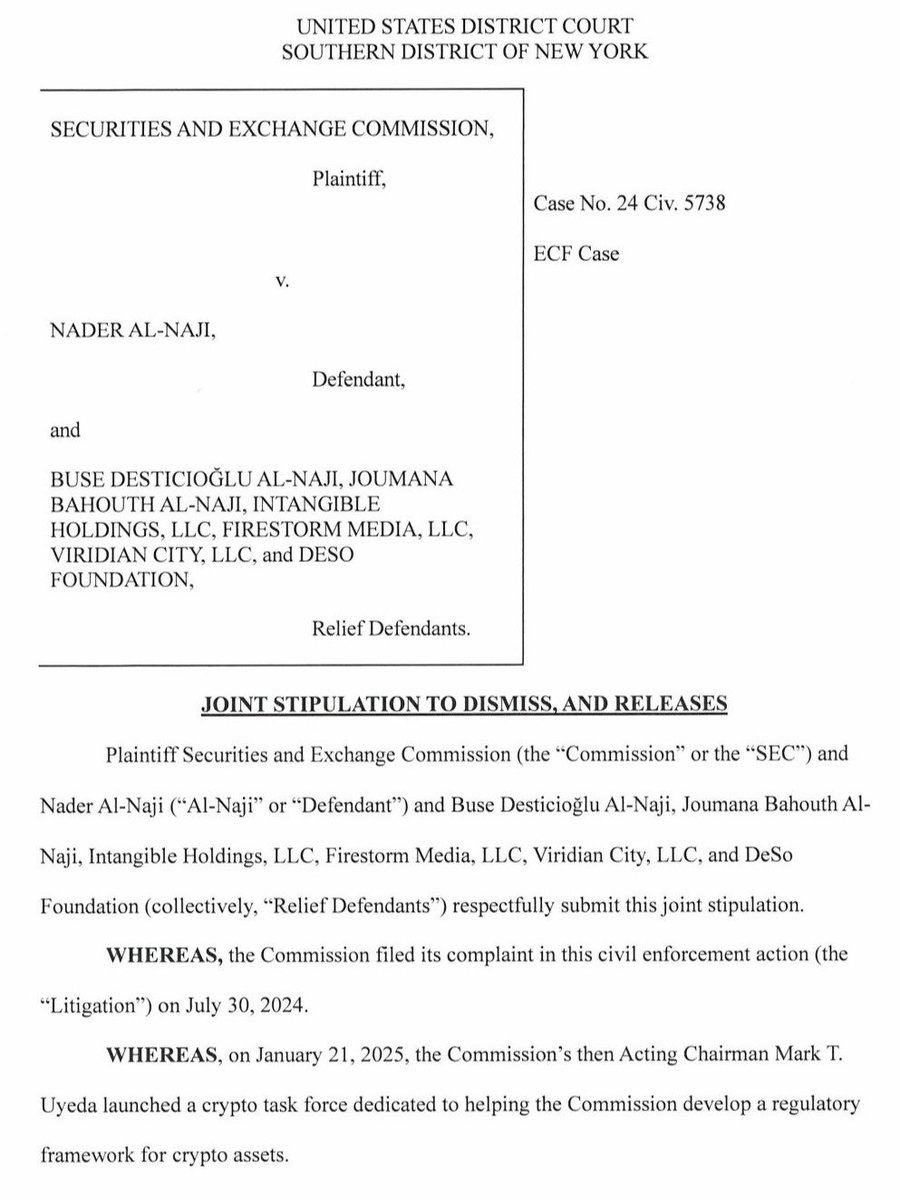
Big news! Last Friday the SEC officially dismissed its enforcement action against me and against DeSo.
This was the last legal issue I had to deal with and I am now completely and totally free to innovate and build again, unhobbled for the first time in years.
Three important points:
1) This dismissal was NOT a settlement. It was "without costs or fees" to me or anyone involved (extremely rare) because there was no wrongdoing and no actual aggrieved parties.
2) This dismissal was "with prejudice" (also rare). This means they can't bring any related action back against me or DeSo in the future.
3) In the SEC's own words, it was based on "a reassessment of the evidentiary record," meaning the actual facts regarding my innocence were heavily scrutinized and drove the decision.
Simply put: The government made a mistake in bringing this case in the first place.
The government accused me of misleading an investor who I knew I had a great relationship with, as in they backed me two separate times and I literally had breakfast with them at their house not long prior to the charge. As a result, soon after the charge I found out that not only were they not upset with me, but they wanted the government to go away as badly as I did. As I understand it, the government compelled the investor to do an interview and then took their neutral testimony and represented it as adversarial. It was an alleged fraud with no actual misrepresentation nor any actual aggrieved parties. My lawyers said they'd never seen anything like this, and I think it speaks to how dogmatically anti-crypto the prior administration's SEC was.
In the coming days and weeks, I will be hopping on some podcasts to tell the whole story, and boy is there a story to tell. Stay tuned, and if you know anyone who'd like to have me on as a guest please reach out.
I'm also excited to start sharing more about what my team has been working on soon. We haven't been twiddling our thumbs.
For now, though, I just want to explain why DeSo is so important to me. DeSo is still the only platform on the internet where you can post content directly to a blockchain without fear of censorship, and where you can monetize your content directly with crypto (including stablecoins). It's really quite shocking how in 2026 we not only have virtually no viable alternative for this clearly-important category, but also other important efforts are actually shutting down. The world needs more people working on decentralizing social media, not less. I'm excited to finally be able to share our vision directly again, and to start bringing more people who care about freedom and censorship into our community. What we have built with DeSo is something people take for granted until they really need it, but hopefully we can convince them sooner than that.
Lastly I want to say how grateful I am to everyone around me. My family, my friends, my backers, and everyone in the DeSo community. For me, this experience showed me just how trusting, loyal and caring everyone around me really is, and reaffirmed my belief that always trying to do the right thing really does pay off.
We're just getting started.
60
48
220
53,267
Feb 25
The US should have to report its audited financial statements during the State of the Union.
84
BKAT - 🐂 💸 🐻 retweeted

Feb 16
Markets closed. Bitcoin open. Happy Hodlday.
960
922
15,068
508,400
Feb 7
Google could drop an all in one dashboard and destroy notion overnight.
30
BKAT - 🐂 💸 🐻 retweeted
Jan 22
DeSo is not going anywhere. DeSo is the world's only blockchain for content, it is actually decentralized, and I couldn't shut it down or censor a piece of content even if I wanted to.
Today, DeSo is the only place on the entire internet that I'm aware of where your content and your social account cannot be censored by anyone. This is because content is stored natively on a fully-decentralized blockchain, not on a centralized company's servers. It is not possible for a private company to "acquire" DeSo, and in fact no corporate entity owns or controls it. DeSo is for content what Bitcoin is for money, and it is currently the only check we have on the centralized content systems that are dominant today.
My team and I have also built the Focus app on DeSo's infrastructure, and today Focus is the only platform I'm aware of where you can sell content for crypto. Focus supports tips, paid content, paid end-to-end encrypted messages, and even subscriptions, all via anonymous crypto payments that can't be censored. It has also been growing over the past few months as creators have begun to find value in monetizing their content via crypto.
We built DeSo from the ground up to support absolute free speech. Not "kinda sorta free speech." Not "post whatever you want unless some people don't like it" speech. Free speech means nobody can censor you, not even the people who built the platform. And it includes being able to pay for and monetize your content without censorship as well. You can think of DeSo and Focus as the world's complete anti-censorship stack. DeSo is the infrastructure (the blockchain) and Focus is the app built on top.
In addition, I want to be clear that I and my team plan on supporting DeSo and Focus indefinitely. As mentioned, it is not possible for any one individual to shut DeSo down, as many at the highest levels have now realized the hard way. However, continued investment in the underlying infrastructure and on the flagship app ensures that everything will continue to scale as more users adopt DeSo, and ensures that your content will continue to be safe even as post-quantum threats emerge. A reminder that every line of code that powers the DeSo blockchain is fully open-source and public under the deso-protocol/core repo on GitHub. This means anyone can contribute and, furthermore, that any contributions my team makes are immediately a part of the public good that is DeSo. This model of open-source iteration directly mirrors that of Bitcoin and the Linux operating system.
In 1991, Linus Torvalds created the Linux operating system because he was passionate about an open and free alternative to existing closed-source operating systems. Today, more machines run Linux than any other operating system, albeit in a different form than he originally envisioned (on servers vs on consumer pcs). Nevertheless, for me, the creation of DeSo came from the same kind of passion. It is the Linux of content, and it is currently the only true economically-sustainable alternative we have to a world dominated by centralized, extractive walled-gardens. DeSo is and will remain an open-source public good that I believe will only continue to grow as more and more people realize its value.
43
27
96
12,739
Jan 21
Double everything then tax the gains

This is not surprising and will not end with OpenAI.
All the capital being being spent and lent by the richest companies on earth will not buy enough time-by the very definition of mania.
The government will pull out all the stops to save the AI bubble to save the market to save the economy.
The problem is too big to save, again by that very same definition.
90
Jan 16
Protection
Jan 15

JUST IN: 🇹🇼🇺🇸 Taiwan commits $500,000,000,000 to support US semiconductor operations.
53