
Bob Milani (Tech Entrepreneur)
Joined August 2007
- Tweets 311
- Following 60
- Followers 40
- Likes 44
36 Photos and videos








Wow! Can't wait to see it!

🚨 Please let me know in the comments or DM me the best poster artists you know. Ideally someone with a strong portfolio and contact information.
I’ll personally commission one to create a poster for THE ODYSSEY and send it to a Universal executive.
20
🧵 We've been building microservices wrong for years. HTTP/3 QUIC SPIFFE just rewrote my mental model. Here's what every builder needs to understand:
1/ TCP is 50 years old. We've been patching it forever. HTTP/2 gave us stream multiplexing — but one dropped packet still froze EVERY stream. That's Head-of-Line blocking. We never actually fixed it. QUIC does.
2/ QUIC runs over UDP and rebuilds reliable transport from scratch. Lost packet? Only that stream stalls. Everything else keeps moving. This isn't an optimization — it's a different category of protocol.
3/ The latency gains are real. QUIC bakes TLS 1.3 directly into the handshake. 1-RTT on first connect. 0-RTT on resume. On mobile networks with 100ms RTT, you're saving 200-300ms per connection. At scale that compounds fast.
4/ Connection migration alone is worth the switch. TCP dies when your IP changes (Wi-Fi → LTE). QUIC uses Connection IDs — the session survives a network switch transparently. No reconnect. No dropped streams. No user-facing failure.
5/ Now layer SPIFFE on top and things get wild. SPIFFE gives every workload a cryptographic identity — an X.509 cert, not a secret. No client secrets to rotate. No token endpoints to call. No bearer tokens to steal.
6/ Since QUIC has TLS 1.3 native, mTLS is zero extra overhead. Service A and Service B mutually authenticate *inside the QUIC handshake*. Identity IS the connection. One round trip. Done.
7/ What you actually eliminate:
— OAuth token management for S2S auth
— Auth server as a synchronous dependency
— Secret rotation pipelines
— Token refresh logic in every service
— Separate TLS auth layers
8/ What you get instead: short-lived certs auto-rotated by the SPIRE agent locally. Private keys never leave memory. Authorization policies consume SPIFFE IDs directly from the cert. No token parsing. No middleware.
9/ The stack I'm converging on: HTTP/3 QUIC at the transport, SPIFFE/SPIRE for workload identity, Envoy or Cilium for policy enforcement on SPIFFE IDs. Zero-trust by default — not bolted on.
10/ TCP OAuth were built for a different era. Builders still treating them as defaults are carrying technical debt they don't have to carry. The new stack is production-ready. Time to move.
What's your team's path to QUIC? Drop it below 👇
21

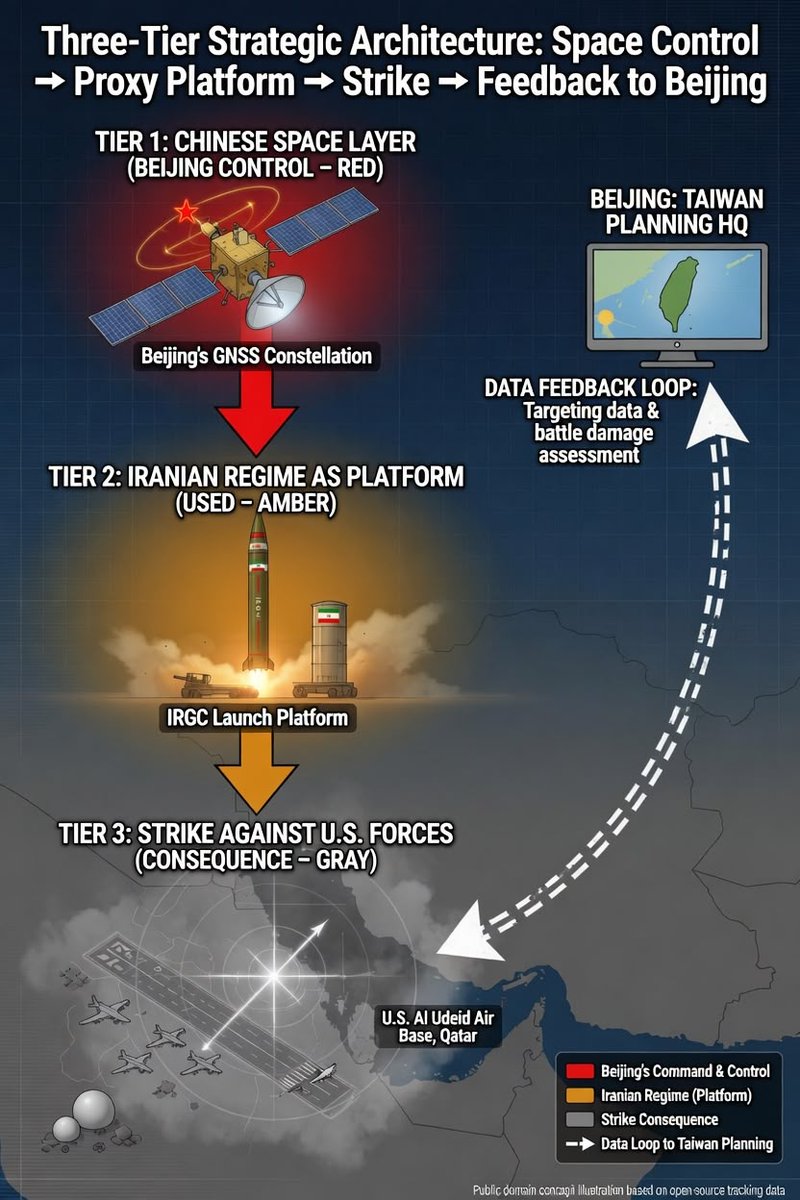
🧵 The story of Operation Epic Fury isn't Iranian missiles hitting U.S. bases.
It's that they're not really Iranian missiles anymore.
The regime in Tehran has become a Chinese client — and Beijing turned the Strait of Hormuz into a live lab against the U.S. Navy.
Here's what's actually happening: 👇
2
47
Combined honest update on two of the weaker claims in the thread:
1) On BeiDou "migration" — selective integration is the better word. Iranian systems have BDS receivers across multiple platforms, but a clean architectural transition isn't documented. The strategic implication holds either way: enough BDS-guided inventory exists that GPS denial no longer neutralizes the threat.
2) On YC8B tracking F-35s — the capability is in country, specific engagement claims during Epic Fury are reported but not independently verified at the operational data level.
What survives both caveats: U.S. air superiority and GPS dominance can no longer be assumed by default. The exact percentages and engagement data are intelligence questions. The strategic shift is the story.
20
The data flows back to Beijing. And forward to Taiwan.
China is fighting the U.S. by proxy, gathering intel for the next flashpoint, while the IRGC pays the price in command structure and the Iranian people pay it in everything else.
This is what 21st-century proxy war looks like.
Free Iran. The regime isn't sovereign — it's a satellite. Literally.
22
The IRGC made a fatal miscalculation.
They spent years mapping every US base in Saudi, Iraq, Oman, Qatar & Bahrain — thinking they had leverage.
They never accounted for the USS Gerald R. Ford USS Abraham Lincoln.
Two floating sovereign US territories that can't be pressured, evicted, or blockaded.
3,000 targets already serviced.
When the USS George H.W. Bush joins? That's 24/7 continuous ops — each carrier runs 8-hour shifts. No breaks. No politics. No host-nation complications.
This is what power projection actually looks like.
And once the third carrier is on station? Oil stabilizes. Prices normalize. The regime's leverage evaporates.
The IRGC played checkers. The US brought a carrier strike group. 🇺🇸
#AmericaFirst #PeaceThroughStrength #TrumpForeignPolicy #MAGA #IRGC #Iran #USNavy #CarrierStrikeGroup #PowerProjection #FreeIran #OilPrices #PeaceThroughStrength #MiddleEast
1
155
Phase 2 isn't coming from Washington.
It's coming from Tel Aviv.
And it will not look like a missile, a strike, or a headline. It will look like nothing — until the entire IRGC command structure collapses simultaneously, in silence, on a day no one marked.
Lebanon, September 2024: 3,000 pagers. 9 seconds. Hezbollah's nervous system severed in one breath. Years of Mossad patience executed in a heartbeat.
The IRGC studied that operation. They didn't learn from it.
They swapped phones for couriers. Couriers for tunnels. Tunnels for "trusted" hardware made by "trusted" suppliers in countries they thought were friendly.
The supply chain remembers.
When Phase 2 lands, it won't be debated on cable news for weeks. It will be over before Tehran wakes up. IRGC general staff. Mojtaba's protection detail. Thar-Allah HQ. Basij command. The Quds Force assassination network Mossad already mapped. All of it — gone in one synchronized heartbeat.
And in that silence, the Immortal Guard activates.
90 million Iranians. Sleeper cells in every province. Patient. Organized. Waiting for the exact second the regime's lattice goes dark.
The US brought the carriers.
Israel is bringing the ending.
Iranians are bringing the beginning.
No other coalition on earth could pull this off. None has the patience. None has the reach. None has the score to settle.
I am watching a real time movie being made. I want a Trailer Preview :)
#FreeIran #Mossad #ImmortalGuard #PagerOperation #PeaceThroughStrength #RoaringLion #OperationEpicFury #AmericaFirst
41
wrote a song. used my own voice :)
"I was a child when we left Iran
my momma gave birth to me in Tehran
and in my heart I will always be there
a teacher taught me to say delam tang shode
and I remember how to say delam tang shode
but I don't know how it feels to miss you that way"
suno.com/s/DutRHwRB8BbgoQZS
61
We are the children of the dawn, the keepers of the flame.
Every name before us calls our name.
New track — 千年曙光 (Thousand-Year Sunrise). Melodic techno erhu Enigma chants. A song for what humanity is about to build.
🎧 suno.com/s/WJZJcuSwUswSriJI
24