
A pre-implementation research layer for AI coding agents | Less tokens spent & time wasted | $brain token CA: 5wxVBRmjaRLw71SE7nNFzTioEtQdzM5EkdP5k1BDBAGS
Joined February 2026
- Tweets 95
- Following 8
- Followers 318
- Likes 335
10 Photos and videos





Pinned Tweet

Jun 5
Say hello to the official brainblast X account
Your direct source of information on, product & feature updates, official project announcements, and community news!
Prove you’re an OG by dropping a follow
And Don’t forget: Use your brain, buy $brain!
34
10
88
9,125
/brainblast AI retweeted
Gm brainblasters 🧠💥
@brainblast_ai v0.5.0 is imminent
$BRAIN utility coded
Oh yeah, it’s gonna be a good day 😎
4
5
12
111
/brainblast AI retweeted
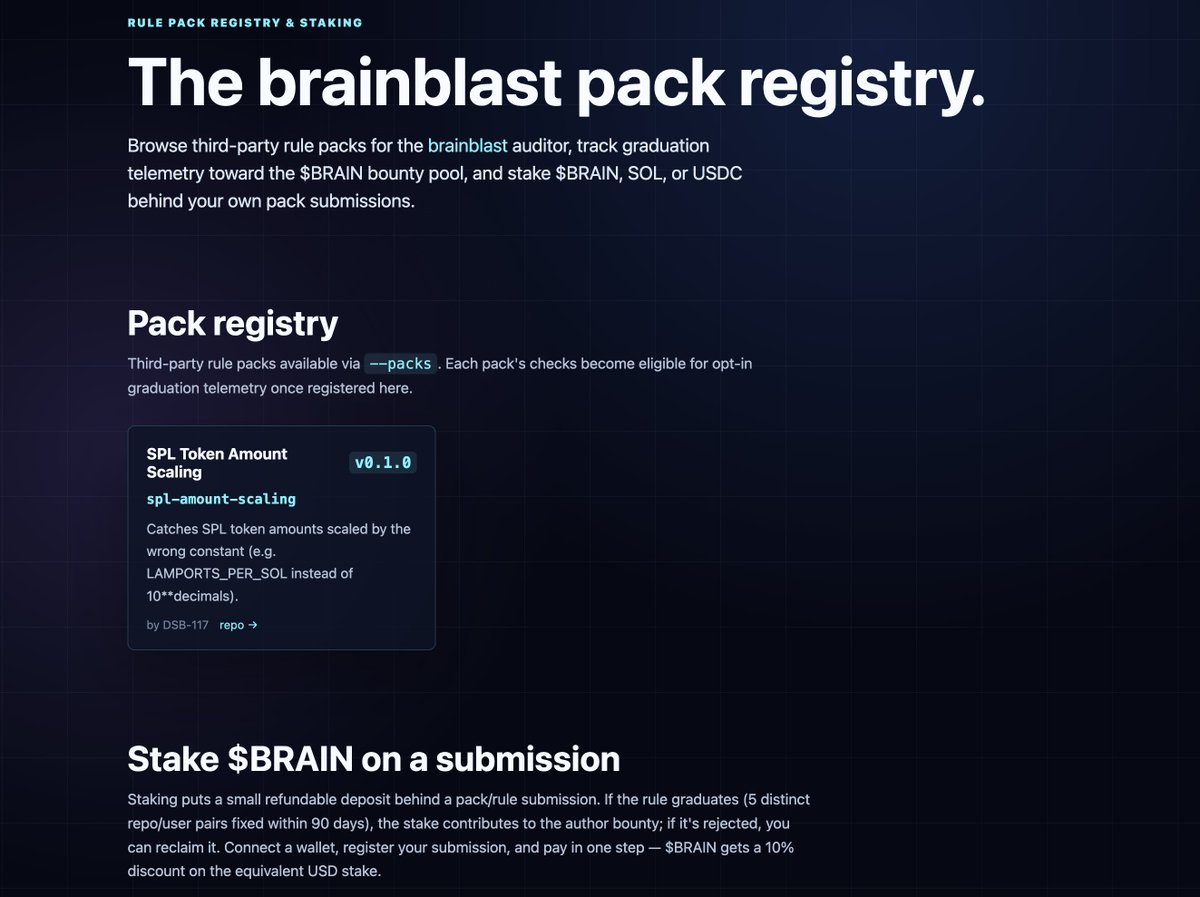
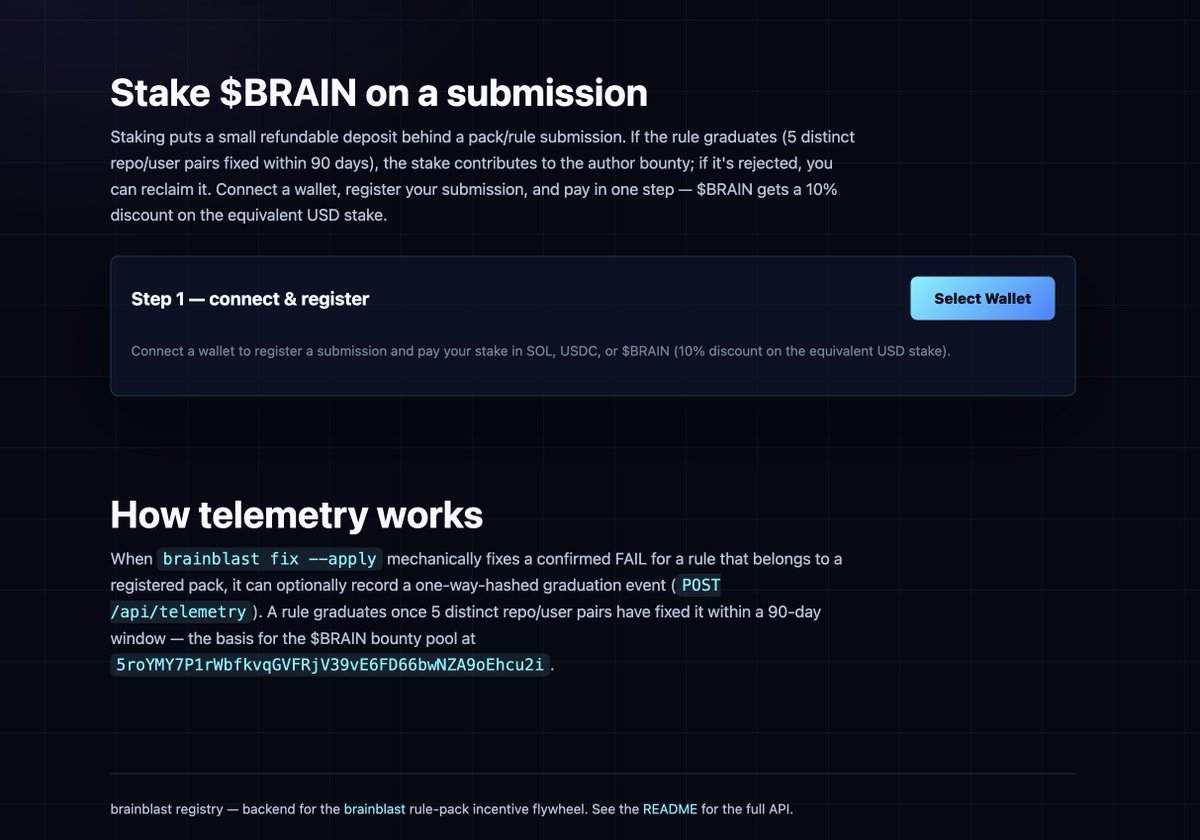
The @brainblast_ai Registry & $BRAIN Staking page is coming together! Here's an early preview.
Still some work to polish up & design improvements to add, but everything is working as intended & looking good! 🧠💥

Creating the @brainblast_ai Registry & $BRAIN Staking page now.
Will share a preview once finished 👀
1
5
21
951
/brainblast AI retweeted
Creating the @brainblast_ai Registry & $BRAIN Staking page now.
Will share a preview once finished 👀
At this rate, the flywheel goes live tomorrow.
Conducting final tests now & things are looking great!
Get ready by grabbing some $BRAIN & secure your stake in the Security Knowledge economy - the foundation for safer, faster agentic coding.
👉 bags.fm/5wxVBRmjaRLw71SE7nNF…
1
5
20
1,520
/brainblast AI retweeted
At this rate, the flywheel goes live tomorrow.
Conducting final tests now & things are looking great!
Get ready by grabbing some $BRAIN & secure your stake in the Security Knowledge economy - the foundation for safer, faster agentic coding.
👉 bags.fm/5wxVBRmjaRLw71SE7nNF…

brainblast v0.5.0 is almost fully coded 🧠💥
With it, a economy begins to form around the $BRAIN token. Developers will be able to scout out new coding traps using /brainblast & submit them to the brainblast registry for rewards.
This isn’t just a flywheel for $BRAIN, this is a flywheel that will make the experience of every developer coding with AI exponentially better.
A gift that keeps on giving!
2
7
17
1,516
brainblast v0.5.0 is almost fully coded 🧠💥
With it, a economy begins to form around the $BRAIN token. Developers will be able to scout out new coding traps using /brainblast & submit them to the brainblast registry for rewards.
This isn’t just a flywheel for $BRAIN, this is a flywheel that will make the experience of every developer coding with AI exponentially better.
A gift that keeps on giving!
3
6
22
1,533
/brainblast AI retweeted
A productive Saturday.
@brainblast_ai v0.5.0 is almost ready.
The Security Knowledge Economy is almost here. The $BRAIN Flywheel is loading. 🧠💥
1
7
13
408
/brainblast AI retweeted
The $BRAIN thesis is clear:
Brainblast becomes security infrastructure for AI-coded software, and $BRAIN becomes the incentive layer around that infrastructure.
@brainblast_ai itself is an open-source tool that runs before and after code is written.
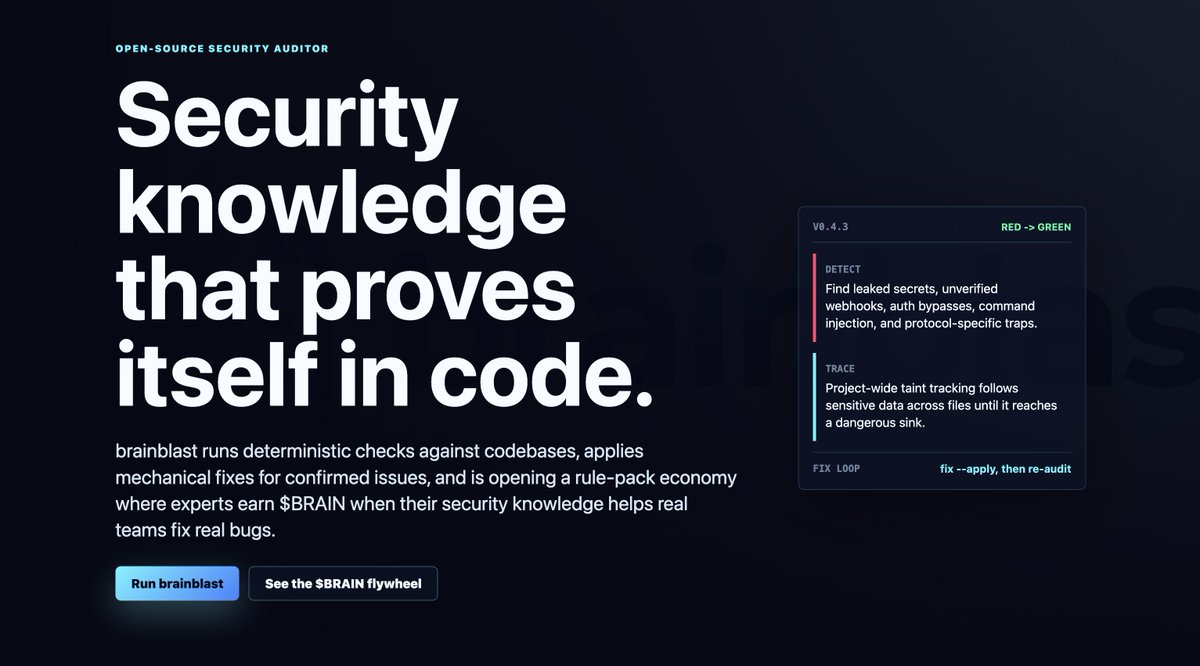
First, it researches external APIs/SDKs so coding agents do not ship bad assumptions; then its CLI scans code in CI for deterministic integration/security traps.
⚠️ AI coding increases insecure code volume.
More software is being generated by agents, but agents still miss boring, high-impact integration details: raw-body Stripe webhook verification, Privy JWT validation, Bags/Solana fee-share creator inclusion, immutable fee modes, rate limits, etc. (just to name a few).
Brainblast is positioned as a deterministic guardrail against those failures.
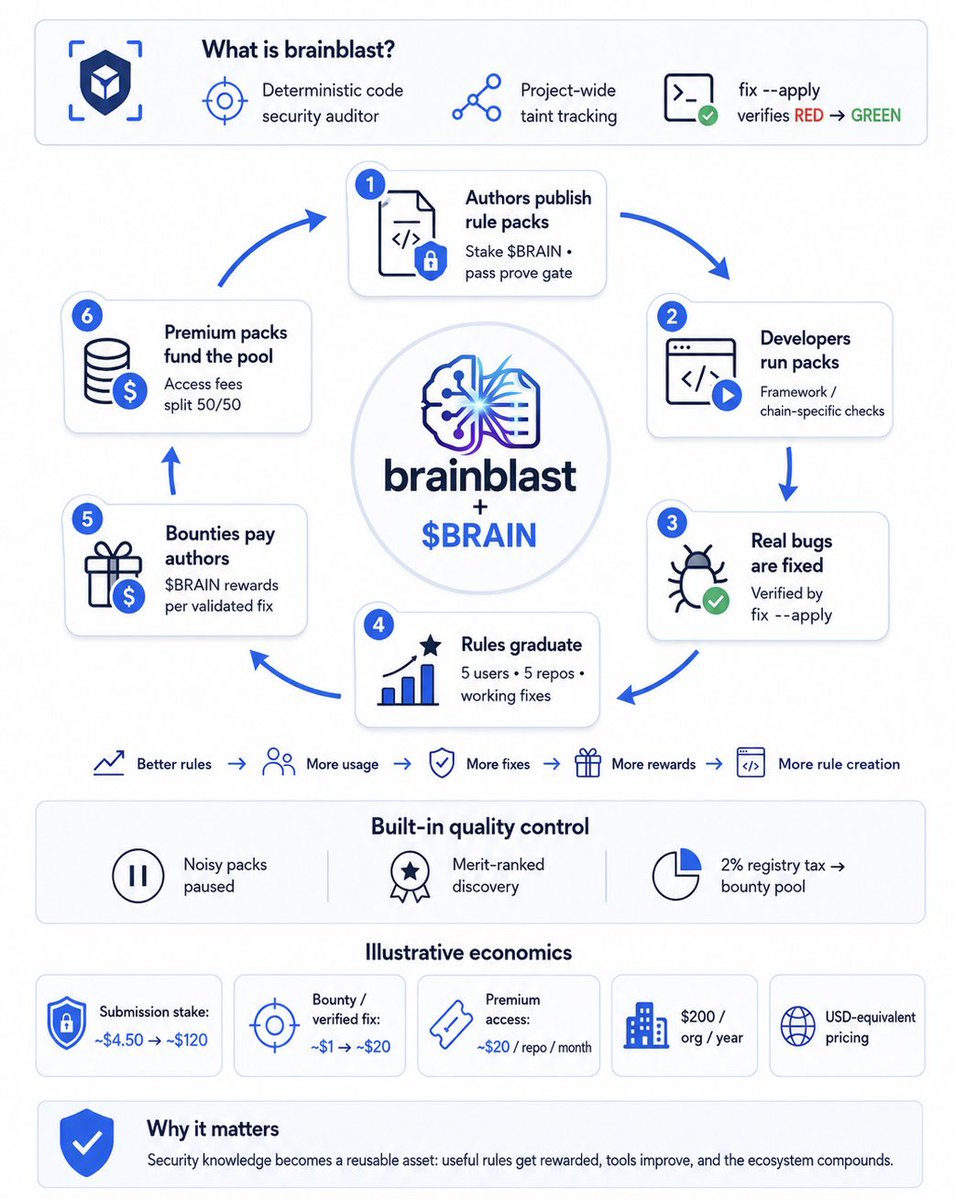
🎡 The flywheel is contribution → detection → payout → better coverage.
More contributors produce more rules. More rules catch more real bugs. More caught bugs make Brainblast more useful to developers and CI pipelines. More usage creates more opportunities for rule authors to earn $BRAIN, attracting still more contributors.
📐 The wedge is “vibe-coded”/agent-coded projects.
Brainblast is not trying to be generic AI security theater. Its strongest positioning is catching the specific silent failures that AI agents are likely to ship: missed config steps, auth bypasses, fee-recipient mistakes, webhook mistakes, and integration assumptions. The project explicitly emphasizes offline deterministic scanning rather than LLM guessing.
🧠💥 In one sentence: $BRAIN is a bet that Brainblast becomes the open, incentive-driven rule registry for securing AI-generated code, where developers get deterministic security coverage and contributors earn when their rules prevent real bugs.
3
7
18
577
/brainblast AI retweeted
GM brainblasters! Yesterday was a great day. Today should be even better!
The $BRAIN flywheel is getting coded & I can’t wait to finish everything.
Going to start mobilizing the community today as well so we can expand our reach & get new eyes on @brainblast_ai! 🧠💥
3
6
19
587
/brainblast AI retweeted

Jun 13
What people don’t know is how hungry I am to win. I’ve been homeless while building @brainblast_ai
If it wasn’t for the fees from @BagsApp, I don’t know how I’d be surviving right now.
When I say I can’t stop, I mean I CAN NOT STOP. Everything depends on this 💯
5
10
27
1,088
/brainblast AI retweeted
Jun 12
brainblast is evolving into something more:
👉 An open-source security knowledge marketplace powered by $BRAIN
• Token Buybacks Staking 🧠
• Developer Incentives 💥
• Rule Packs Submissions 🚀
Each step adds to the value of the economy!
Discover the $BRAIN Flywheel 👇
3
11
28
1,516

BRAINBLAST IS TURNING SECURITY KNOWLEDGE INTO AN ECONOMY 🤯
The team behind @brainblast_ai just unveiled the Brainblast Rule Pack Economy, powered by $BRAIN.
- Create security rule packs
- Publish them to the Brainblast registry
- Catch real vulnerabilities
- Earn $BRAIN when those rules help developers fix bugs
Brainblast already catches:
- API key leaks
- Command injection
- JWT auth issues
- Webhook verification flaws
- Solana misconfigurations
- Secret exposure
And now the community can help expand coverage across thousands of frameworks, chains, and protocols.
6
8
33
1,967
/brainblast AI retweeted
Jun 12
I led a dev team for 4 years building blockchains. However, while I was always more technically inclined than most CEOs, I wasn’t the CTO, I was more of a project manager in that regard.
Then I started building myself, using AI.
It’s awesome, but when building things onchain, it’s an absolute headache at times. The coding agents today just aren’t as smart as we would hope.
No matter which model or harness I used, I would get caught up spending time solving the same problems - problems that could have been easily avoided from the start had the AI been better equipped.
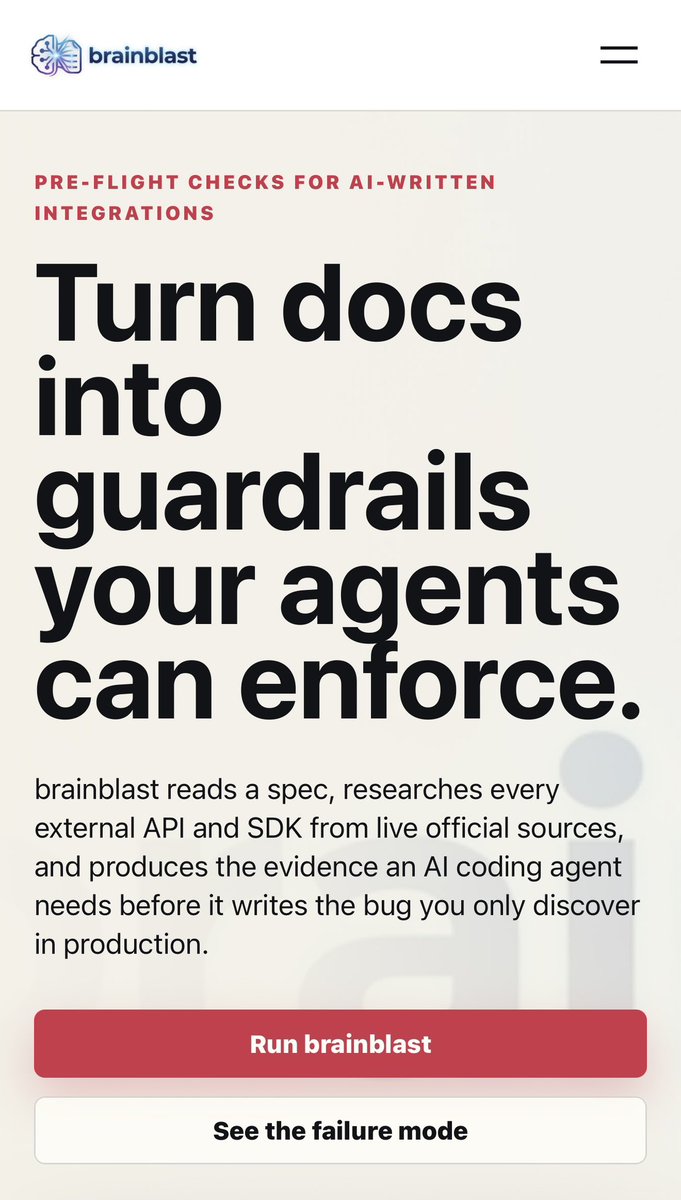
So I built @brainblast_ai to equip coding agents with the ability to not just gather full-scope intel on what’s being built, but detect the bugs & coding traps in advance, and then mitigate them before they even have a chance of causing hell later on.
I love it, and so do those who’ve tried it out for themselves already!
It’s easy to install & start using (link to the GitHub below) - but if you’re using @DaemonTerminal, it’s already integrated & ready for you to use! Try it out for yourself if you haven’t had the chance yet!
3
7
23
620
/brainblast AI retweeted
Jun 12
The $BRAIN Economy is Coming! 🧠💥
Check out the article below to learn how we’re turning @brainblast_ai into an Open-Source Security Knowledge Marketplace powered by $BRAIN
Made possible thanks to @BagsApp
7
20
884
Jun 12
The official brainblast discord is now live! 🧠💥
Catch all the latest product & community updates conveniently in one place, all while chatting it up with other brainblasters & $BRAIN holders!
Hop in today!👇
🔗 discord.gg/nn5WRfyu43 👾
6
24
528
/brainblast AI retweeted
Jun 12
GM brainblasters! 🧠💥
Who’s ready to have a great day?
I’ll be serving up some updates within the next couple of hours. Publishing the $BRAIN flywheel today as well & it’s going to take @brainblast_ai to the next level.
I’m hyped for what’s to come! Today will be epic!!!
Jun 11
Get ready for blast off, the $BRAIN Flywheel is coming...
Keep your eyes on the official @brainblast_ai account for an exciting update getting announced tomorrow, especially all you @solana_devs out there.
Powered by @BagsApp - $BRAIN will never be the same!
11
6
27
1,163
Jun 11
Get ready for blast off, the $BRAIN Flywheel is coming...
Keep your eyes on the official @brainblast_ai account for an exciting update getting announced tomorrow, especially all you @solana_devs out there.
Powered by @BagsApp - $BRAIN will never be the same!
22
9
45
2,559
/brainblast AI retweeted
Jun 11
Now I can finally sit down, focus on getting the Discord launched, and begin to properly mobilize the @brainblast_ai community!
BIG day tomorrow.
Time to get everything ready! 🧠💥
Jun 11
Today's development caps off with v0.4.3! 🧠💥
👉 Cross-file taint tracking is now graph-based
This builds a project-wide call graph & a def-use graph for variables, i.e. real dataflow analysis!
Review all of today's updates by checking out the chain of quoted post below👇
5
16
960