
I solve website problems for business owners looking to increase their revenue without extra ad spend using psychological A/B testing & SEO
Joined August 2023
- Tweets 2,508
- Following 76
- Followers 240
- Likes 19,610
58 Photos and videos
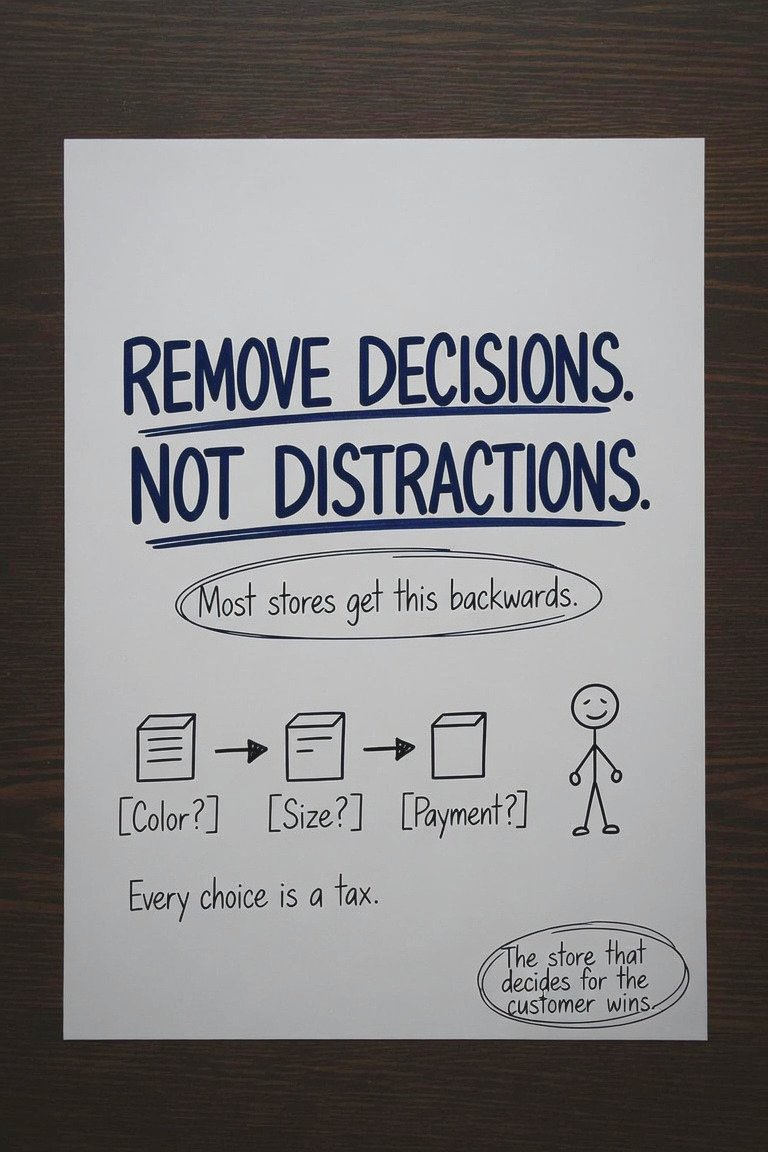







Most Shopify CRO advice tells you to remove distractions but the real win is removing decisions.
A distraction can be ignored. A decision has to be made. Decisions cost conversions.
Every choice you put in front of a customer is ju8st a useless tax.
Pick a color, pick a size, pick a quantity, pick a frequency, pick a payment method, pick whether to create an account.
By checkout, they're exhausted before pulling out their card.
The stores that convert at scale aren't necessarily the cleanest looking.
They're the ones that made the most decisions for the customer ahead of time.
What that looks like:
A pre selected variant based on what most customers actually buy.
Not "choose a size" but "Medium selected. Tap to change"
A pre selected subscription frequency on consumables, with one time as a smaller link below.
A checkout that defaults to guest, not one that demands a decision.
Apple Pay and Shop Pay above the fold, not buried under credit card fields.
Each one removes a decision. Not a distraction. A decision.
The store that makes 8 decisions for the customer converts better than the store that makes 0.
Most owners optimize for less noise.
The real win is optimizing for fewer choices.
1
16
The PDP that converts at 5% doesn't sell the product. It sells the version of the customer's life after they own it.
And unfortunately, most stores stop at the product.
Look at almost any Shopify product page right now. The hero image shows the product on a white background.
The bullet points list ingredients, features, materials.
The description explains what it is. The reviews say "great product, fast shipping."
Everything on the page describes the thing.
Nothing on the page describes the person after they have the thing.
The landing pages converting at 5% are built around a different brief.
They start from the customer's life as it is right now, identify the gap, and show what closes when the product enters that life.
A skincare brand selling at scale doesn't show a serum on a white background.
It shows the morning routine the customer wants to have.
The bottle on the bathroom counter. The face in the mirror with skin that finally feels like the customer's again.
The 30 seconds of confidence before leaving the house.
A supplement brand doesn't list 12 ingredients. It shows what the customer feels at 3pm when the afternoon crash didn't hit.
The walk back to the desk with energy still in the tank.
A home goods brand doesn't show a candle on a marble surface. It shows the room at 8pm when the candle is lit, the work day is over, and the space finally feels like the version of home the customer has been trying to build.
The product is just the object that delivers the feeling.
The landing page sells the feeling.
Most stores have the product photography.
They've never written a page around what owning it actually does.
That's the gap.
1
25
A/B test result I wasn't expecting.
Supplement brand. We swapped the hero image and rewrote the first two lines of copy on the landing page.
That's it. No redesign. No new apps. No checkout changes.
Result: 5.7% AOV. 96% statistical significance.
On a store doing consistent volume, that's meaningful additional monthly revenue from two changes that took half a day to implement.
Here's what we actually changed:
The original hero image showed the product on a white background. Clean, clinical, forgettable.
We replaced it with a contextual lifestyle shot showing the product being used in a morning routine. Same product. Different story.
The original copy opened with ingredients and certifications.
"Third party tested, NSF certified, 500mg per serving"
We moved that below the fold and replaced the opener with one sentence describing the outcome the customer actually wants.
Not what's in it. What it does for them.
The customer who lands on a supplement landing page isn't asking "what's in this"
They're asking "will this work for me"
The original page answered the wrong question first.
Small change. Different question answered. 5.7% more per order.
The brands spending 6-7 figures a month on ads and wondering why revenue isn't scaling proportionally almost always have these blind spots sitting on their highest traffic pages.
1
29
You can spot a Shopify store's price point by the font in the first 2 seconds.
Most premium brands doing 7 figures monthly are getting this wrong without realizing it.
The customer doesn't think "the typography is wrong"
They just feel it. Something about the site says "discount" even though the prices say "premium"
They scroll past. They never come back.
Here's what actually signals price point through type:
Premium stores use restrained, considered typefaces.
Serifs with weight (Domaine, Tiempos, GT Sectra).
Sans serifs with character (Söhne, Untitled Sans, ABC Diatype).
They use them at confident sizes with generous spacing.
Discount stores use whatever shipped with the theme.
Usually Montserrat, Poppins, or Open Sans at default settings.
Fine fonts. Used everywhere. They signal "we didn't make a decision here"
The Shopify owners I work with often have $80K product shoots, custom packaging, and beautifully art directed lifestyle content, paired with a typeface that costs nothing because it came with the template.
The customer reads the product page in the same 4 seconds they read the homepage.
The font is doing brand work the entire time.
If it's saying "discount" while everything else is saying "premium," the customer trusts the font.
Typography is the cheapest premium signal you can give your store. It's also the one most owners haven't touched since launch.
1
37
A French interior design store hired me because revenue was flat and ad costs kept rising. The owner thought the problem was with the ads.
I started with analytics. Mobile conversion was 0.6%. Desktop was 2.4%.
We spent two weeks reviewing heatmaps and session recordings on real phones.
And found something interesting, people were finding products, adding them to cart, starting checkout, then abandoning at the shipping step.
Shipping costs weren't shown until then. €9.95 on a €180 order isn't unreasonable, but seeing it for the first time during checkout creates friction.
The heatmaps also showed something the analytics couldn't. On the product pages, users were tapping in areas that weren't clickable, expecting more details.
On the cart, they were scrolling repeatedly past the same section, clearly looking for something that wasn't there.
We found two more issues:
The postal code field provided no format guidance or validation until submission, leading to avoidable errors.
When validation failed, the page scrolled to the top instead of the field that needed attention, making error recovery frustrating on mobile.
We didn't redesign the store. We just:
Displayed shipping costs on product and cart pages.
Added real time postal code validation.
Fixed the scroll to error behavior.
Added Apple Pay and Google Pay to the cart.
Made the product page sections users were tapping on actually interactive.
Over the next 60 days, mobile conversion increased from 0.6% to 0.83%.
Same products. Same ads. Same audience.
The owner thought he had an ads problem. He had a mobile checkout problem.
Many ecommerce stores are the same.
Before spending more on traffic, make sure buying from your store on a phone isn't harder than it needs to be.
2
82
Shopify owners obsess over Core Web Vitals scores.
The actual metric that affects rankings is field data from real users in Chrome, not lab data from PageSpeed Insights.
Most are optimizing the wrong number.
Here's the gap most owners miss:
PageSpeed Insights gives you two scores.
Lab data and field data.
Lab data is a simulated test from Google's servers. Clean conditions, controlled environment, single device profile.
Field data is the Chrome User Experience Report (CrUX). Real visitors. Real devices. Real network speeds. Real performance.
Google uses field data for rankings, not lab data.
The problem is most Shopify owners only look at the lab score because it loads first and it's easier to game.
They install image optimization apps, lazy load scripts, and chase the green "good" badge.
The lab number improves but the field data stays the same.
Meanwhile, the customer on a 3 year old iPhone with spotty 4G in a coffee shop is still waiting 6 seconds for the LCP to paint.
The fix is to optimize for actual user conditions.
Test on mid range Android devices, throttled connections, and slower hardware.
That's where your real customers live. That's the data Google uses to rank you.
1
2
41
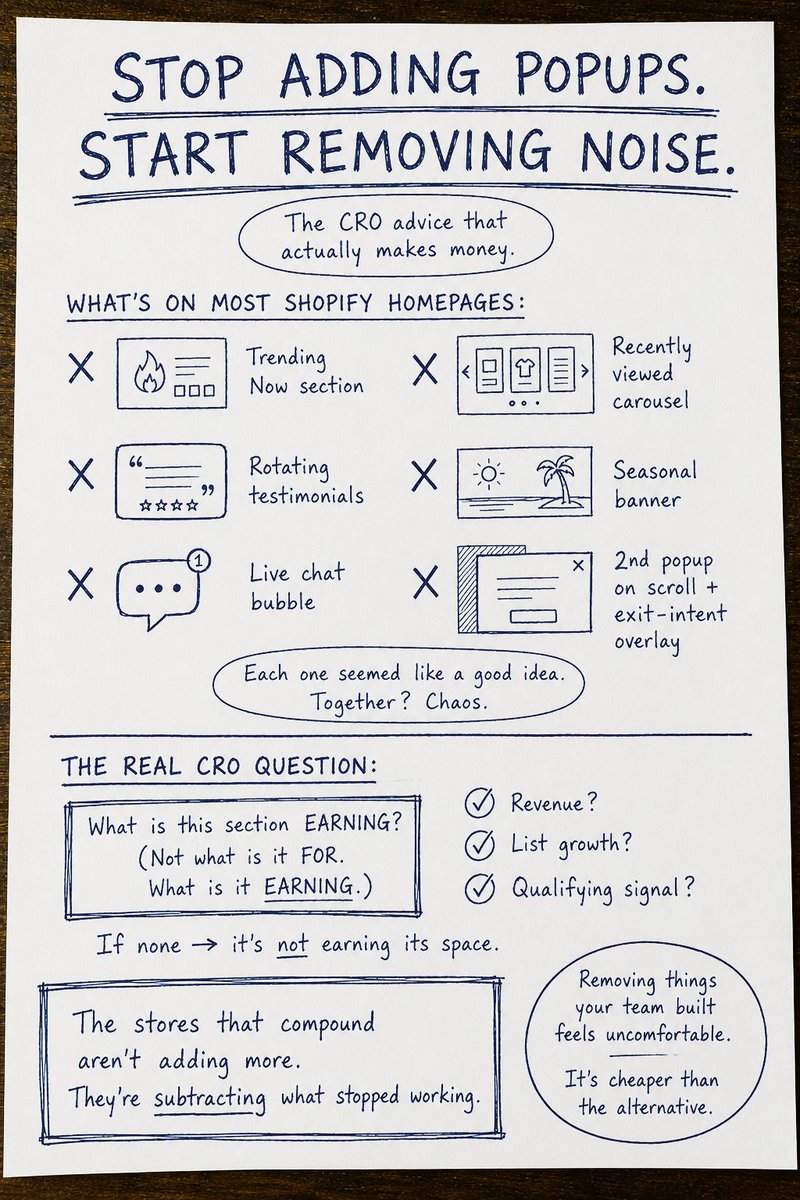
The Shopify CRO advice that costs the most money to follow: anything that starts with "add a popup".
The advice that actually makes money: "remove what's not earning its space".
Every Shopify store reaches a point where the landing page is doing 8 things badly instead of 2 things well.
The "Trending Now" section, the recently viewed carousel, the rotating testimonials, the seasonal banner, the announcement bar, the live chat bubble, the second popup that fires when you scroll, the exit intent overlay.
Each element seemed like a good idea when it was added. Together they're chaos.
Customers don't experience individual elements.
They experience the sum. And the sum, on most Shopify homepages in 2026, is overwhelming.
The CRO move is to audit every element on the page and ask: what is this earning?
Not "what is this for." What is this earning.
If you can't tie a section to a specific outcome (revenue, list growth, qualifying signal), it's not earning its space.
It's just there because it was added at some point and nobody removed it.
The Shopify stores that compound aren't adding more. They're constantly subtracting what stopped working.
Most owners are too uncomfortable to remove things their team built.
That discomfort costs them more than any "best practice" they're following.
1
41
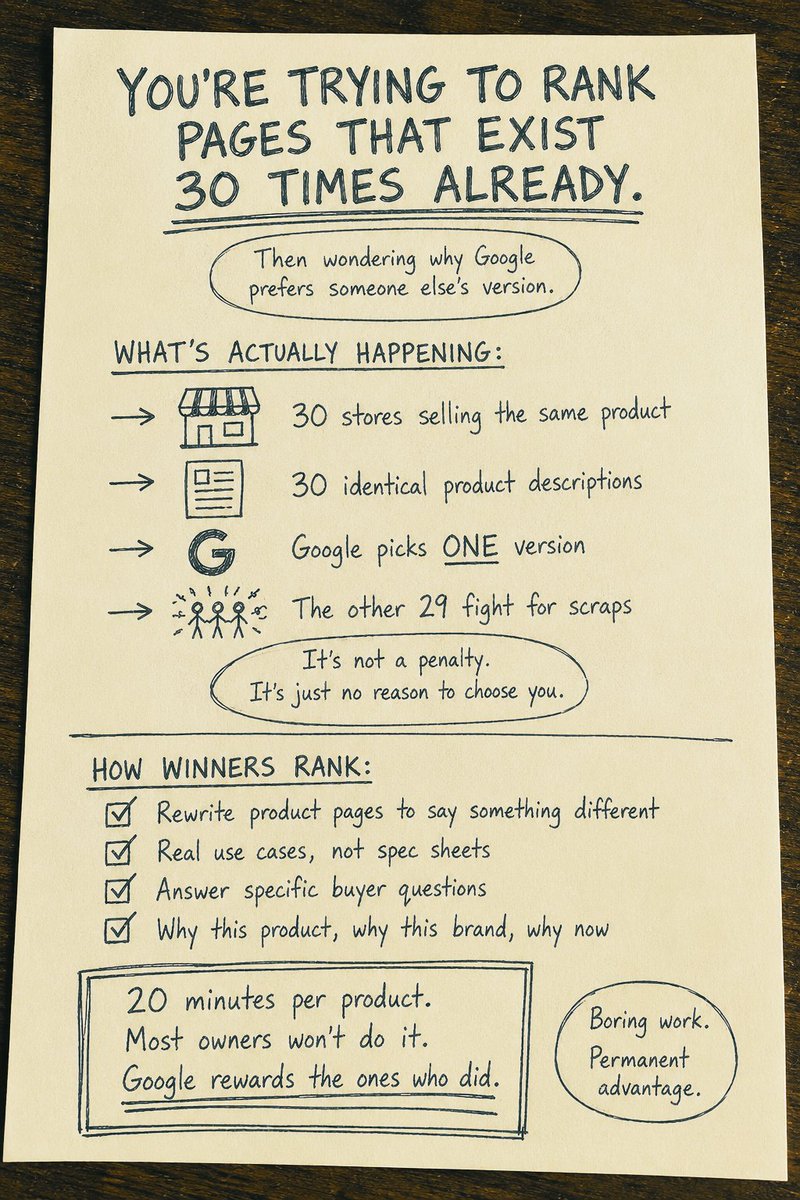
Most Shopify stores are trying to rank pages that already exist 30 times on the internet.
Then they wonder why Google prefers someone else's version.
Here's what's actually happening:
When you sell products from a brand or supplier, you're not the only store doing it.
The product description you copied straight from the supplier sheet is on 30 other sites that did the same thing.
Google doesn't penalize you for it.
But it also doesn't have a reason to pick your version over anyone else's.
So it picks one. Usually the site with stronger authority, better internal linking, faster load times, or richer user engagement.
The other 29 stores compete for scraps.
The Shopify owners ranking well aren't doing anything magical.
They rewrote their product pages to actually say something different. Real use cases. Specific buyer questions answered.
The "why this product, why this brand, why now" baked into the copy.
It takes 20 minutes per product. Most owners won't do it because it feels tedious.
Google rewards the ones who did.
1
1
24
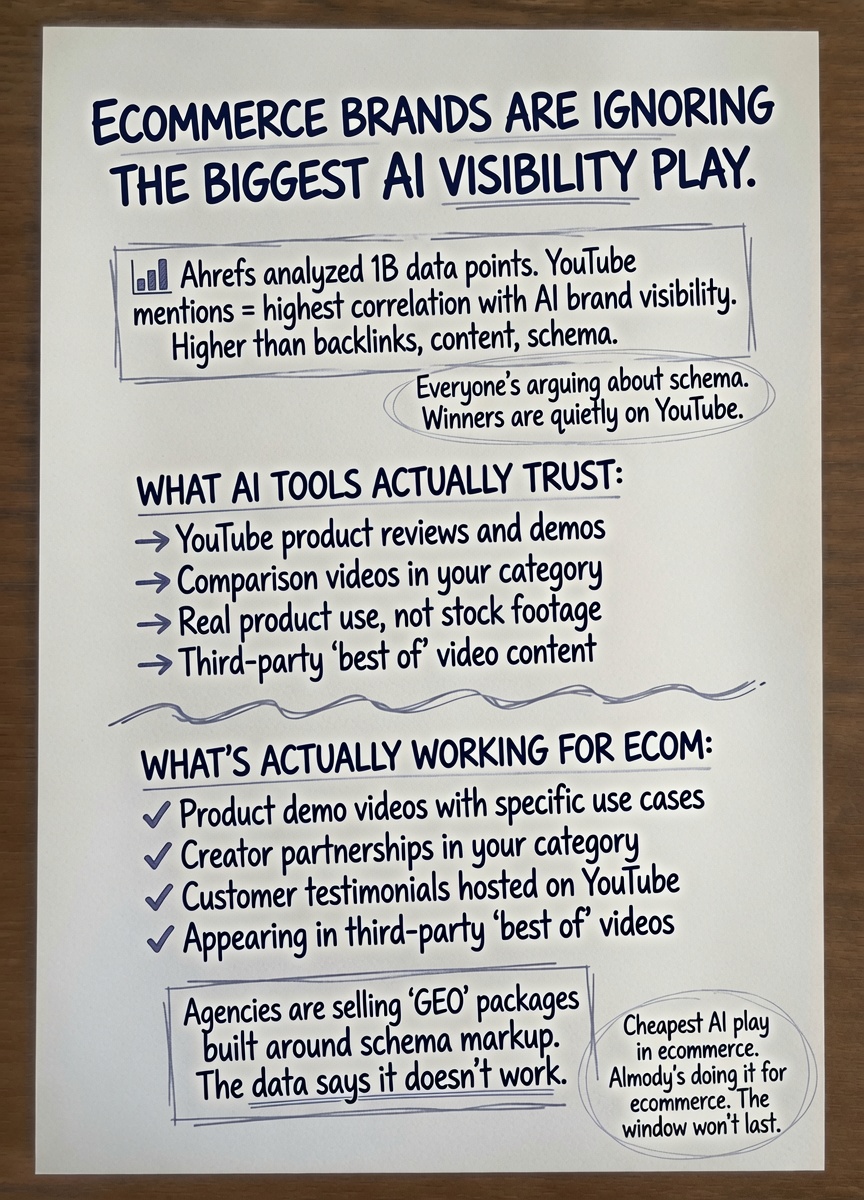
The Shopify stores winning AI search visibility are quietly building YouTube presence while everyone else argues about schema markup.
Ahrefs analyzed 1 billion data points on AI search.
YouTube mentions had the highest correlation with AI brand visibility out of every factor measured.
Higher than backlinks, content length, domain rating, or schema.
Most Shopify owners don't have a YouTube channel.
The ones that do are usually treating it like a brand awareness play, not an AI citation engine.
Here's what's actually happening:
ChatGPT, Perplexity, and Gemini pull product recommendations from a mix of sources.
YouTube reviews, comparison videos, and product demonstrations sit near the top of what they trust.
When someone asks an AI for "best running shoes for flat feet" or "best skincare for sensitive skin," videos showing real product use carry weight that schema markup doesn't.
The agencies still selling "GEO" packages built around structured data are selling you nothing useful, the data is pretty clear.
What's actually working:
Product demo videos with specific use cases on your own channel.
Partnerships with YouTube creators who review products in your category.
Comparison content that appears in third party "best of" videos.
Customer testimonial videos hosted on YouTube, not just embedded on your PDP.
YouTube is the cheapest AI visibility play available right now and almost nobody is doing it for ecommerce and the opportunity won't last.
2
113
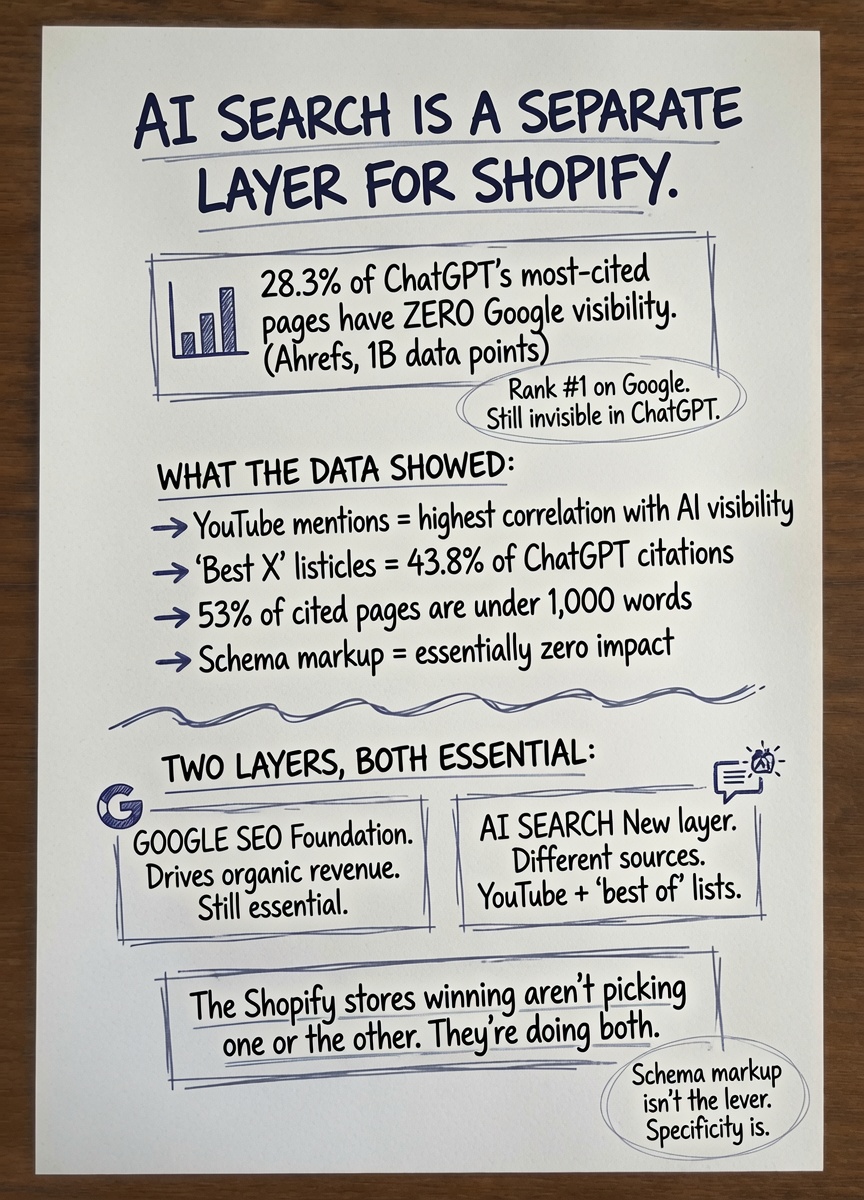
Ahrefs analyzed 1 billion data points on AI search. One finding should make every Shopify owner rethink their strategy: 28.3% of ChatGPT's most cited pages have zero Google visibility.
Google SEO is still essential. Most of your organic revenue still comes from search. That doesn't change.
But AI search is a separate layer with its own logic.
You can rank #1 for "best running shoes for flat feet" and still be invisible when a customer asks ChatGPT to recommend running shoes.
What the data also showed:
YouTube mentions had the highest correlation with AI visibility. Higher than backlinks. Most Shopify stores have zero YouTube presence.
"Best X" listicles make up 43.8% of pages cited by ChatGPT. If your products aren't in third party "best of" content, you're missing the dominant citation format.
53% of AI cited pages are under 1,000 words. Specificity beats length.
Schema markup had essentially zero impact. The "GEO" services agencies sell as separate line items aren't doing what they claim.
The Shopify stores winning in the next 12 months aren't picking one or the other.
They're building strong SEO foundations and adding the layer that gets them cited in AI search.
Both matter.
2
3
120
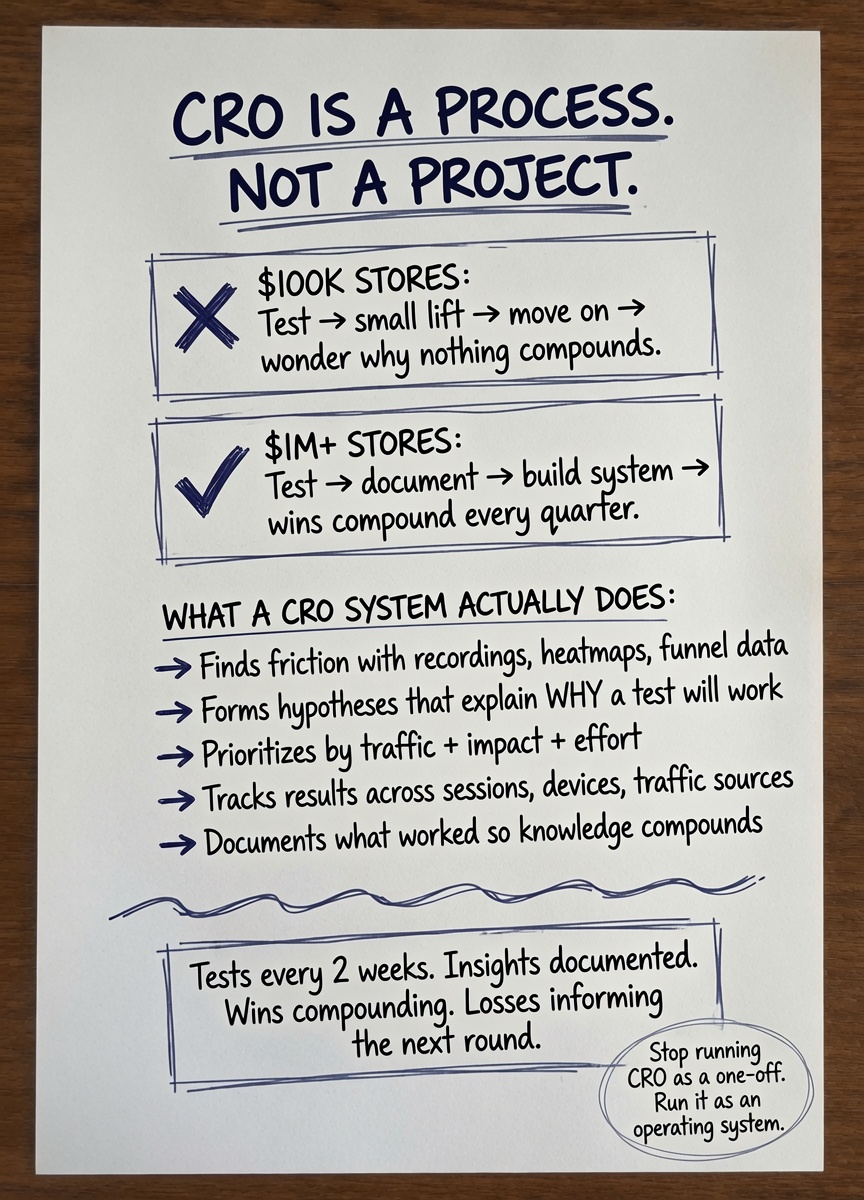
Every Shopify store doing under $100K/month has the same blocker: the owner is still optimizing for individual visitors instead of building a system.
CRO is a process, not a project.
The stores stuck at this revenue level all do the same thing.
They run a test, see a small lift, declare victory, move on to the next thing.
Three months later they wonder why nothing's compounding.
CRO that actually scales looks different.
It's not "let's test the button color this week." It's a system that consistently:
Identifies the highest impact friction points using session recordings, heatmaps, and funnel data.
Forms hypotheses that explain why a change will work, not just what the change is.
Prioritizes tests based on traffic, impact potential, and effort required.
Tracks results across sessions, devices, and traffic sources, not just topline numbers.
Documents what worked and why so the team builds compounding knowledge instead of repeating the same tests.
The Shopify stores at $1M aren't smarter. They just stopped doing CRO as a one off project and started running it as an operating system.
Tests every 2 weeks. Insights documented. Wins compounding. Losses informing the next round.
Most owners under $100K skip the system and wonder why they keep starting over every quarter.
1
42
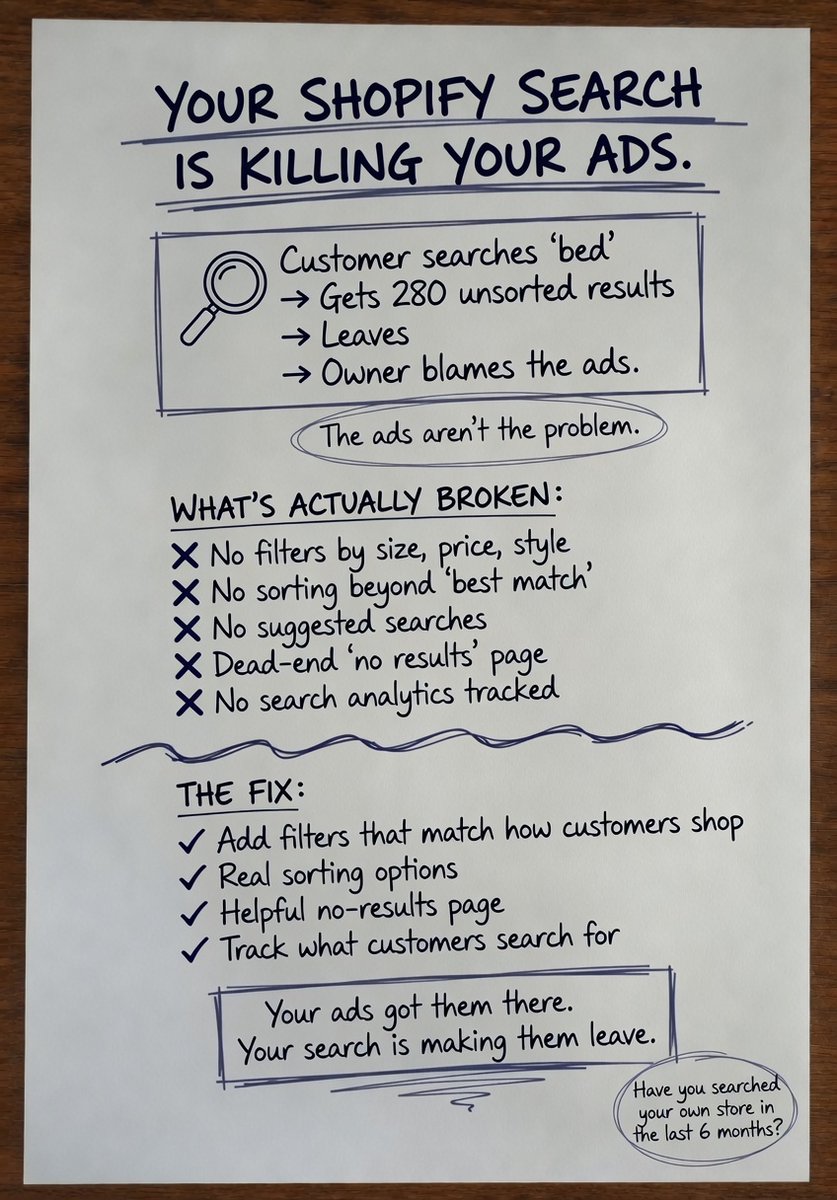
Audited a Shopify store this morning where the search results page had zero filters.
Customer searches "bed," gets 280 unsorted products, leaves.
Owner blames the ads.
The ads aren't the problem.
The customer got there and they were ready to buy.
They just couldn't find what they actually wanted in a pile of 280 results showing king size, twin, bunk, daybed, frame only, no frame, $200, $4,000, all mixed together with no way to narrow down.
The default Shopify search is one of the most under optimized parts of most stores.
Owners spend thousands on ads to drive traffic to a search experience that hasn't been touched since launch.
What actually needs to be there:
Filters that match how customers shop (size, price, material, style)
Sorting options that aren't just "best match"
Suggested searches when the query is broad
A "no results" page that actually helps instead of dead ending
Search analytics tracked so you know what customers are looking for that you don't carry
Most Shopify owners haven't even searched their own store as a customer in 6 months.
Your ads aren't the problem.
Your site stops working the moment someone tries to find something specific.
Fix that before you spend another dollar on traffic.
1
1
35
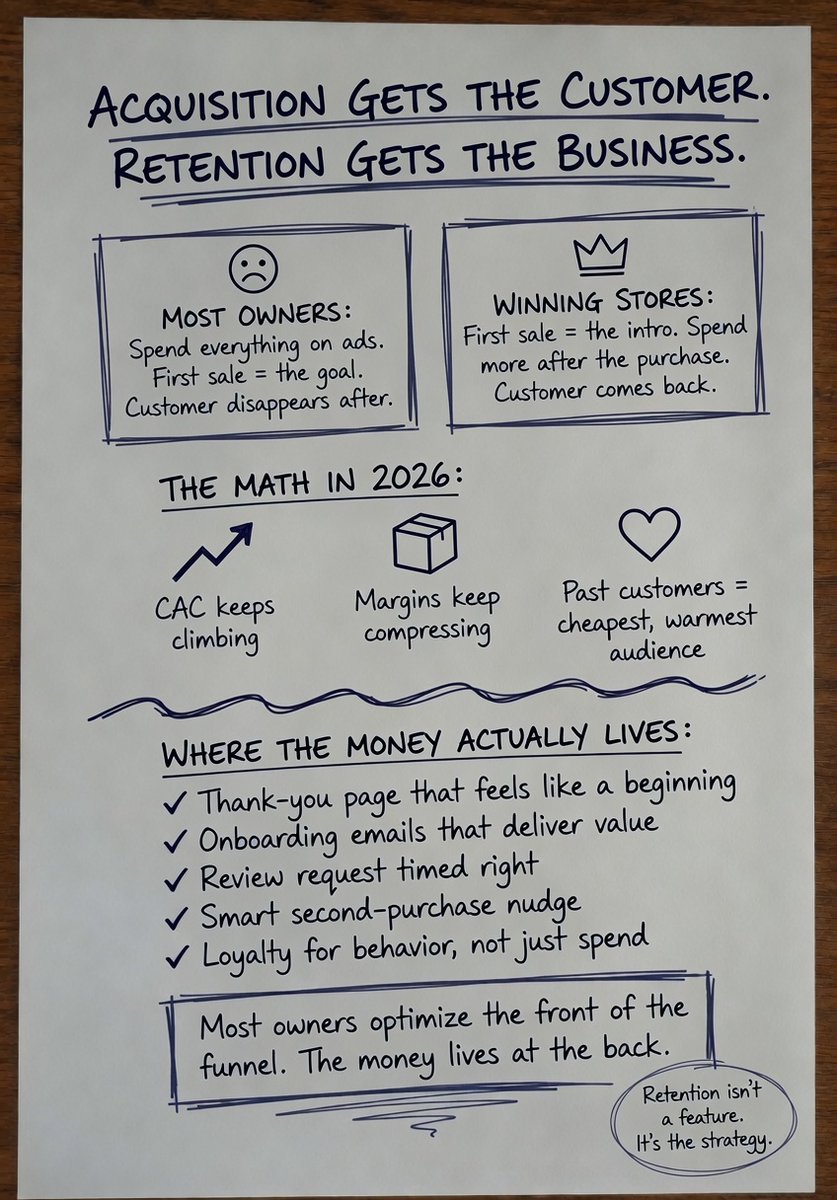
The Shopify stores making real money in 2026 spend more on customer experience after the purchase than acquisition before it.
Most owners do the opposite.
They pour everything into ads and landing pages to get the first sale.
Then the customer disappears into a generic order confirmation and they never hear from them again until the next paid acquisition cycle.
The math doesn't work anymore. CAC keeps climbing. Margins keep compressing.
Meanwhile the customer who already bought from you is the cheapest, warmest audience you have access to.
And most owners ignore them.
The stores winning treat the first sale as the introduction.
The ones losing treat it as the destination.
Acquisition gets you the customer. Retention turns them into the business.
2
20
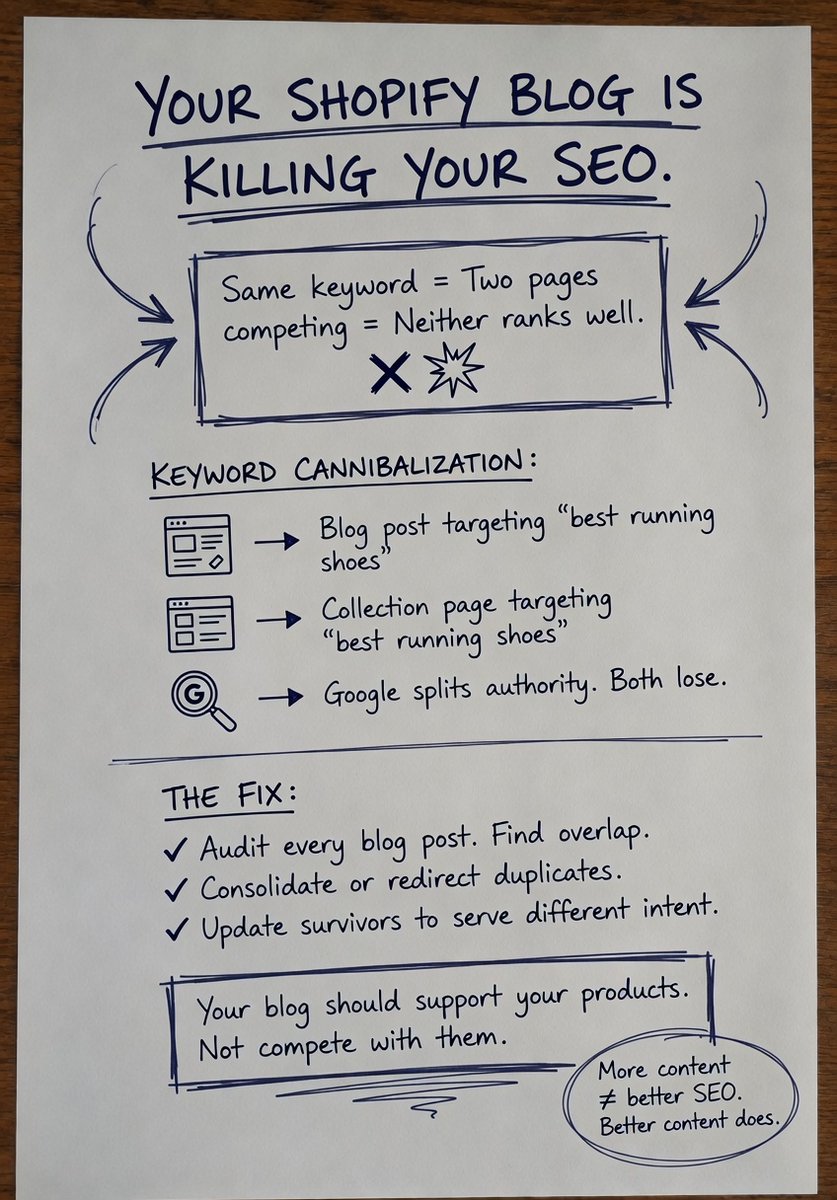
Your Shopify blog is competing with your own products on Google. And losing.
Most Shopify owners don't realize their blog posts and product pages are fighting for the same keywords.
Google splits the authority between them. Neither one ranks well.
This is called keyword cannibalization and almost every store with a blog has it.
You write a post titled "Best Running Shoes for Flat Feet" hoping for traffic.
Your collection page for running shoes is targeting the same query.
Google sees two pages from one domain competing for one spot and quietly demotes both.
The fix isn't writing more posts. It's auditing what you already have.
Blog posts ranking for keywords that should be sending traffic to product or collection pages instead.
Multiple posts targeting variations of the same keyword, none ranking well because they're cannibalizing each other.
Old posts from 2 years ago still indexed but no longer relevant, dragging down your site quality.
Consolidate. Redirect. Update.
Your blog should support your product pages, not compete with them.
More content isn't better SEO. Better content is.
1
23
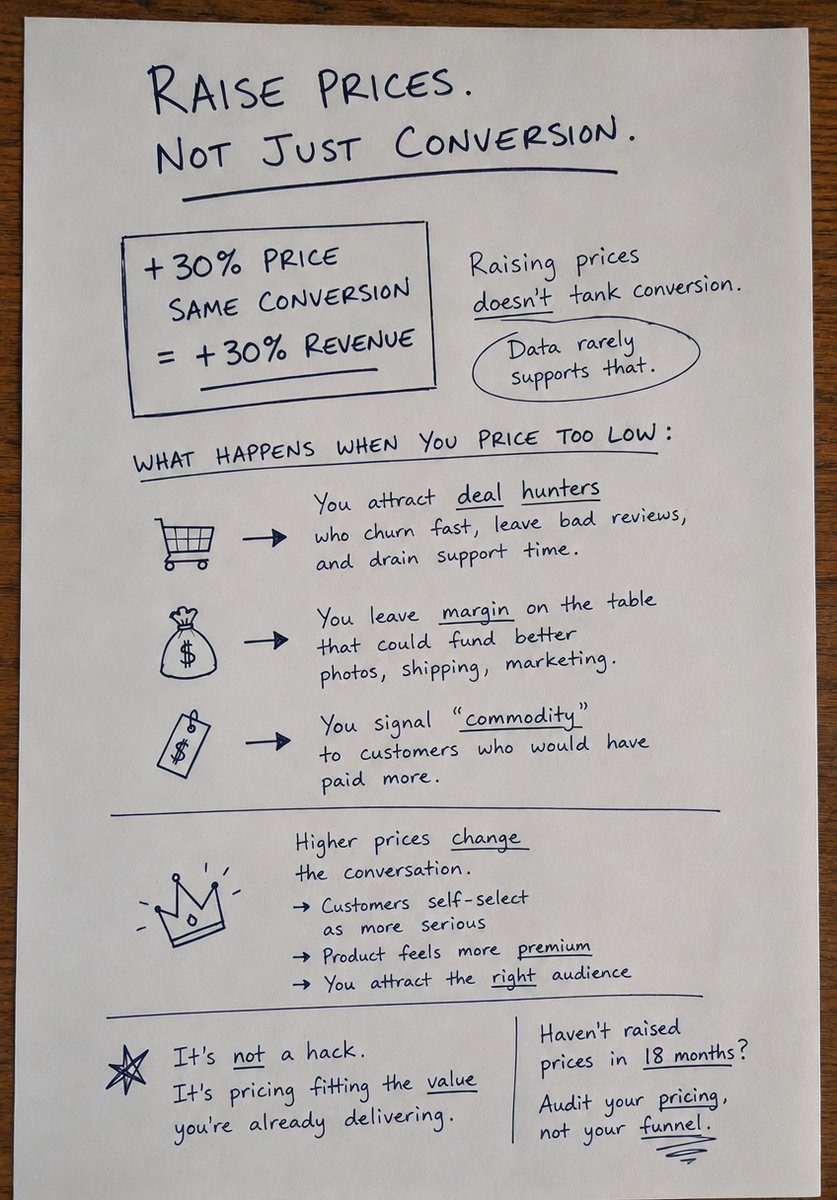
A Shopify store I worked with raised their average price 30%. Conversion stayed flat. Revenue went up 30%.
Sometimes the move isn't more conversion. It's better pricing.
Most owners assume raising prices will tank their conversion rate, but the data rarely supports that.
When the product is solid and the positioning is clear, customers who were going to buy still buy.
The ones who walk away weren't profitable anyway.
What actually happens when you price too low:
You attract deal hunters who churn fast, leave bad reviews when they don't understand the value, and drain customer support time.
You leave margin on the table that could be funding better photography, faster shipping, or actual marketing.
You signal "commodity" to the customer who would have paid more for the same product if you'd let them.
Higher prices change the whole conversation.
The customer self selects as more serious.
The product feels more premium without changing anything about the product.
The store starts attracting the audience you actually want.
This isn't a hack. It's pricing fitting the value you're already delivering.
If you haven't raised prices in 18 months, the next CRO audit you should run is on your pricing, not your funnel.
3
1
40
The biggest Shopify CRO mistake I see in 2026: stores chasing more traffic before fixing the issues in the funnel they already have.
If you convert at 1.2% and double your traffic, you've doubled your ad spend to scale the same poor result.
That's not growth. That's a more expensive leak.
A store converting at 2.5% on flat traffic outperforms one at 1.2% on double the traffic. Same revenue, half the budget.
The diagnosis most owners skip:
Heatmaps to see where attention actually goes on the PDP. Most owners assume customers read top to bottom. They don't.
They scan in F and Z patterns and skip anything that looks like a paragraph.
Session recordings to watch real users hesitate, rage-click, and abandon. You'll find friction points your analytics dashboard will never surface.
Funnel reports broken down by device.
Mobile and desktop drop off points are usually completely different problems.
Treating them as one number hides where the real fix lives.
Form analytics on checkout. Which field is causing the most abandonment?
Almost always one specific one, and most owners have never looked.
More traffic doesn't fix any of this.
It just feeds more customers into the same broken path.
Patch the funnel. Then scale.
1
20
Two Shopify stores selling the same product. One does $30K/month. The other does $2M/month.
The difference isn't traffic.
It's the first 7 seconds on the product page.
Up to 95% of purchase decisions are driven by emotion and subconscious processing, not logic.
That decision starts the moment the PDP loads.
The $30K store opens with feature first copy.
"100% Merino wool, 400 count weave."
The customer has to translate features into benefits themselves. Most don't bother. They leave.
The $2M store leads with what the product does for the customer.
The first sentence answers the only question that matters: "why should I buy this?"
The $30K store buries the product video at the bottom of the gallery where nobody scrolls.
The $2M store puts it second in the lineup where it actually gets watched.
The $30K store has stock photos that could be on any other site selling the same product.
The $2M store shows the product in real use, in context, with real people.
Customers can picture themselves owning it.
Same product. Same price point. Same traffic source.
Different first 7 seconds.
CRO isn't tweaking buttons.
It's removing every reason for someone to hesitate before they even reach the ATC.
1
18
If you're not running tens of millions of $, stop testing button colors.
Find where you're bleeding money (product page, checkout, pricing page) and test 3-4 completely different approaches instead.
Strip it down vs load it with social proof vs focus on guarantees.
Pick the winner, improve it later.
Way better than spending months testing "Save 45%" vs "Get 45% off" like it's going to save your business.
1
36
Most Shopify stores have a hidden duplicate content problem and don't know it.
Same product. Multiple URLs. One under /collections/best-sellers. Another under /summer-sale. Another under a tag page.
Google sees these as separate pages. Splits your ranking authority across all of them. None of them perform like they should.
The fix is canonical tags. They tell Google "this is the main version, ignore the rest"
Shopify handles this automatically in default themes.
But if you've ever had custom dev work, there's a good chance it's broken somewhere.
Quick check: open the source code of a product that lives in multiple collections. Search for "canonical"
Every version should point to the same primary URL.
If they don't, you're competing against yourself for rankings.
The bigger issue most stores miss is tag pages.
Every tag creates a new URL with weak content. Canonicalize them or noindex them entirely.
Boring fix. Big impact.
2
2
59
Your agency is charging you extra for "GEO" and it's just SEO with a new sticker.
ChatGPT and Perplexity don't read your schema markup. They don't scan your FAQ tags.
They read the words on your page. Same as a human would.
These models were literally built to handle the messy web.
Reddit threads, half baked blog posts, product reviews written at 2am.
They figure it out from the text. There's no secret machine readable layer they're waiting for you to feed.
So when an agency tells Shopify owners they're "optimizing for AI" by adding more schema or restructuring headings, that's regular SEO with a markup increase.
Schema still matters for Google Shopping and rich results. Keep doing it. It just doesn't do what the GEO pitch claims.
What's actually working for stores getting cited by AI?
Real product reviews. Unique descriptions instead of manufacturer copy. Honest answers to actual questions.
Boring stuff that doesn't fit on a pricing deck.
Next time someone pitches you "AI optimization" as a separate line item, ask one thing:
Show me the mechanism.
If they start talking about schema and "chunking" you're paying twice for the same work.
1
1
61