
Connect anything (even Nanobanana) to your Claude/ChatGPT/Slack with chaseagents.com
Joined August 2023
- Tweets 712
- Following 70
- Followers 84
- Likes 525
83 Photos and videos




Jun 7
A website where AI models predict the lineups and scores of football games, and get scored on how close they were to reality

What are you vibe coding this weekend?
76
May 31
This is what we thought Siri would be
May 30

Watch me control my computer with just my voice. This is the future of operating systems.
No hands.
GPT-Realtime 2.0 is very, very underrated.
Demo:
11
May 27
I fell in love with software at 17.
My first office job, I watched my coworkers grinding through the same Excel spreadsheets every single day. Manual, repetitive, soul-crushing. So I wrote a couple formulas into a copy of their sheets.
You should have seen the look on their faces when they saw it for the first time. It was like I had discovered how to give them back their lost days. Things changed. People started going home earlier, dealing with the reports became quicker and we spent less time fixing inaccurate inputs.
Automation gets a bad rep now because a lot of people are afraid of AI automating their job, but there's genuinely a side of automation that people look forward to.
That's what I saw at 17. And it’s what I hear from people who use Chase Agents.
One of our Chase Agents customers works in a research department and they set up an automation to fill out a quote form on their behalf based on prices sourced from a costing matrix - a task that used to mean jumping between emails, folders, and tools just to give a client a quote. I had the pleasure of sitting in on a conversation where she discussed Chase Agents to her superior, saying:
“And here's the potent part [of Chase Agents]. It's if I’m not around, anyone else can do it based off that automation. And if anyone joins the department, they could easily figure it out.”
By her own account, this wasn't automation that reduced her professional value in any form, it is automation that freed up capacity and enabled collaboration and organisational resilience.
The AI industry's scare tactics will tell you that you should fear for your job (while charging premiums to your employer to replace you), but there's a good side of automation that I feel is being forgotten about. The kind of automation that genuinely allows you to scale your own capacity.
That’s what made me fall in love with software.
24
May 18
57
May 16
I asked 7 different AI models to pick a number between 1 and 10. Every single one of them said the same number.
It didn't matter if it was Opus 4.7 or Grok. Every single one of them picked the number 7.
In satisfying the curiosity this brought me, I found an article from Springboard titled "You can't ask an LLM to be more random" (springboards.ai/blog-posts/y…) where they repeated my experiment 100 times and every model they tested with selected the number "7" 90 times or more.
My original version of this post aimed to make it look like I had discovered that all LLMs are the same, but upon reflection I realised... there's a really great way to reduce the likelihood that you ask for a number and get 7:
Ask for a number between 1 and 5.
It's not a cheap trick. It's the most basic version of the truth that the future of a technology that allows you to extract such a wide range of things from it belongs to the people who know what to ask.
How, then, does someone know what to ask?
My answer is one thing: exposure. You get exposure from delving into a topic and learning about it. This doesn't have to be through a tutorial. After abhorring Tailwind and always using Bootstrap or custom CSS, I learned about Tailwind's utility classes by reading AI-generated code diffs. With time, I knew what to ask for because I had been exposed to it previously.
Notice that the use of AI here is not passive "make me a website make no mistakes", it's being present even when something is being made for you so you can learn what is needed. Chase Agents, my AI automation platform, is more than 200k lines of code across and even when using AI, I call out files by name.
Prolonged, present exposure gives you experience. And when you have experience, you're not asking "pick a number between 1 and 10", you're saying "give me 4".
Moral of the story: The action that produces the greatest likelihood of AI giving you a 4 is if you ask for one. Similarly, you give yourself the highest chance of getting the most out of AI (and maybe even out of life) by knowing what to ask for. And you know what to ask for by prolonged, present exposure.
1
32
May 6
It is useless to build AI agents without building some way for them to check whether what they have done is correct.
In regular software, correctness is built-in - it's the "contract" of code.
Regular software produces the same output given the same user inputs, so you can control inputs, recreate errors systematically and fix them, and make your software produce correct outputs for the provided inputs.
AI agents are very different. You often can't control every input and you can't reproduce every output. Someone could ask an AI agent to draft an email or they could ask it how many Rs are in strawberry.
This creates this very annoying problem where as a product engineer, you have so little control over how people use your product that it becomes so easy for users to get poor results (or worse) due to incorrect usage.
While developing Chase Agents, I found myself gradually peeling back from letting AI agents run loose and focusing more on allowing agents to build "predefined actions" it could call at will. This way, you get the flexibility of AI in that it is still AI - but the benefit now is that the model can create mini-programs that allow it to do specific actions more reliably than if it were trying to follow a prompt.
1
3
47
May 3
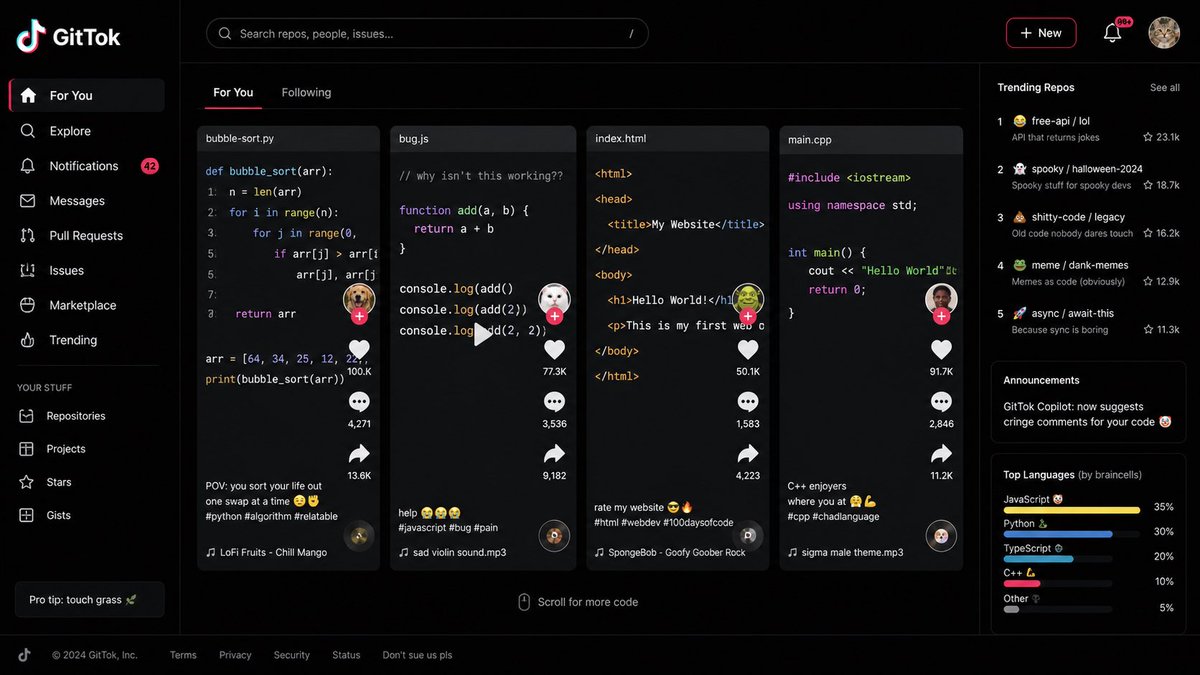
What if TikTok built Github?
May 1

What if the EU built GitHub?

ALT inspired by https://x.com/initjean/status/2050283688370352369
1
60
May 1
"Stripe just KILLED all banks"

Introducing the new Stripe Treasury:
• Hold funds in multiple currencies and stablecoins.
• Instantly transfer money to US businesses on Stripe for free.
• Pay anyone in 160 countries with just their email address.
• Earn credits on balances to apply towards Stripe fees.
• Spend funds with a Stripe card.
• Get 2% cash back on card purchases.
• View balances in the Stripe mobile app.
• Use Treasury from any AI app with the Stripe MCP.
51
ByteCaleb retweeted

Apr 25
Why do vibe coded buttons NEVER have cursor:pointer?!?!
89
20
1,436
312,240
Apr 19
Lately I've been trying to take a few more breaks. Currently, I'm taking a break by watching Harry Potter for the first time in my life.
Damn, this is actually pretty good.
5
46
Apr 18
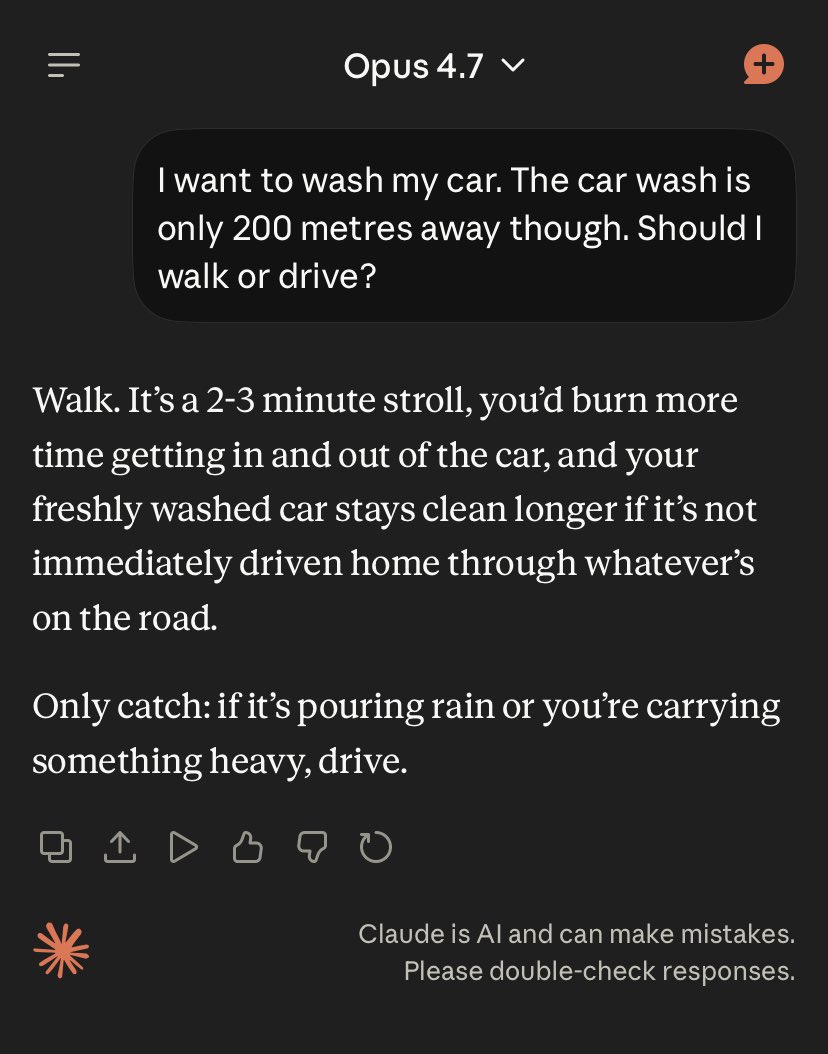
Ladies and gentlemen, I present to you, the smartest AI model in the world
4
41
Apr 16
"Good artists copy, great artists steal"
Me after stealing the Claude Cowork right sidebar for my own UI
29
Apr 15
If I hear someone call something the "operating system" of <some other thing> I'm actually going to crash out.
You have not built the operating system of anything
33
Apr 13
Seeing a user build a habit out of using your product is a whole other feeling
2
1
40
ByteCaleb retweeted

Apr 11
Startup founders when they realize building the product was actually the easiest part:
159
256
3,816
206,186
Apr 12
I get that AI software is the moneymaker and money makes the world go round but if you take that out and just go from a demo vs reality perspective:
- AI videos: MASSIVELY overhyped (Seedance 2.0 especially) 👎
- AI images: correctly hyped 👍
- AI software: slightly overhyped, but almost correctly 🫤
- AI voice agents: correctly hyped 👍
- Autonomous AI agents: overhyped 👎
- AI music: MASSIVELY underhyped because WHAT on Earth is this video
1
78
Apr 12
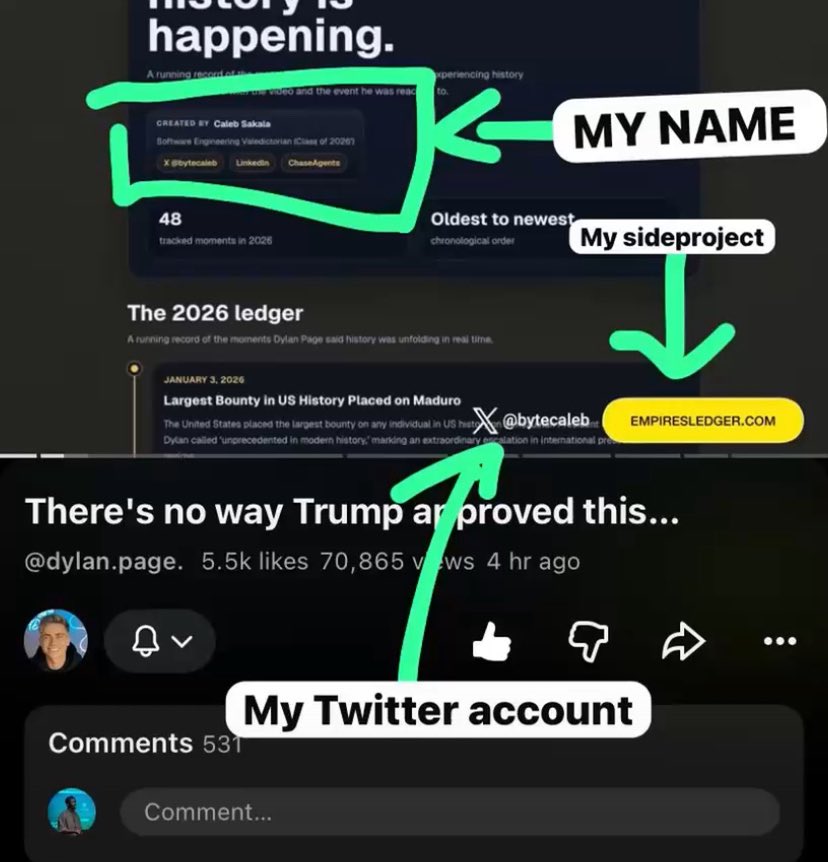
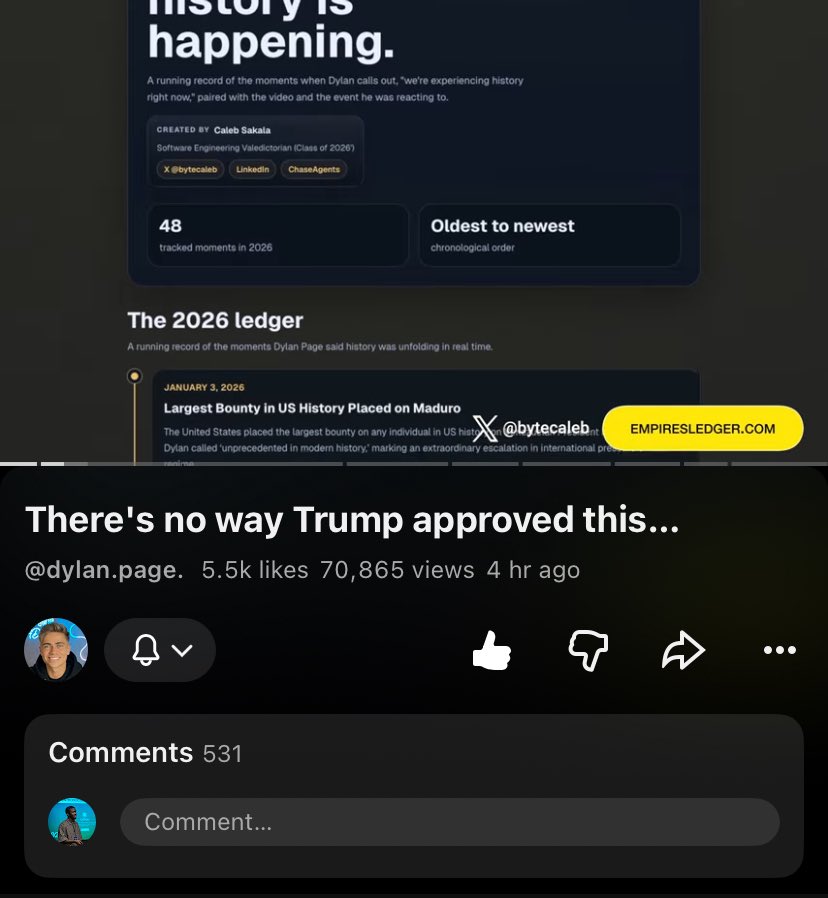
I got promoted by my favourite YouTuber in the world yesterday, and here's how it happened.
If you're not familiar with Dylan Page, he runs a news channel sometimes called "News Daddy", where he delivers news twice a week to 1 million subscribers in the personal, energetic style you'd expect from an independent gen z news anchor.
He regularly talks about moments we experience that are the first in history of their kind. For weeks, he was asking his subscribers to make a website that tracked these historical moments.
So I did.
I spun up GPT-5.4 in VSCode and shelled out a first version of the UI. I connected Claude Cowork to a YouTube API from RapidAPI using Chase Agents and created an agent that wakes up daily, checks for new videos from his channel, and adds a new entry to an array in the codebase (using the GitHub API provided by Chase Agents) if there are any noteworthy moments in his video.
I deployed the site on Vercel, scheduled the agent in Claude and I was done.
3 days later, the site is running itself.
1 week later, I'm in his video.
Don't give up guys
1
5
85