
Founder of @FundiProtocol | Building apps onchain for public good starting with Funds for Humanity 🌱🌎 Views are my own
Joined May 2022
- Tweets 1,165
- Following 513
- Followers 1,769
- Likes 6,899
381 Photos and videos










RJ retweeted

Jun 8
And here is the number that should make every impact organisation stop scrolling.
$736.
That is how much disappears from a $10,000 campaign before a single beneficiary receives anything.
Platform fees, wire transfer costs, & admin overhead.
All of it quietly extracted by a system that was never designed to protect the mission.
Not in one dramatic moment. In small, invisible cuts that nobody talks about because everybody assumed this was how fundraising works.
This isn't how it needs to work.
The family in Uganda waiting for flood relief is not concerned with correspondent banks or quarterly reconciliation cycles.
They care whether the money arrived when it arrived. And whether anyone can prove it did.
That is the only metric that matters.
Everything we are building at Fundi Labs starts and ends there.
Jun 2

The infrastructure that moves charitable money around the world was not built for the people receiving it.
It was built for banks, platforms, & intermediaries who sit between a donor's generosity and a beneficiary's need, and collect their fee at every step of the journey.
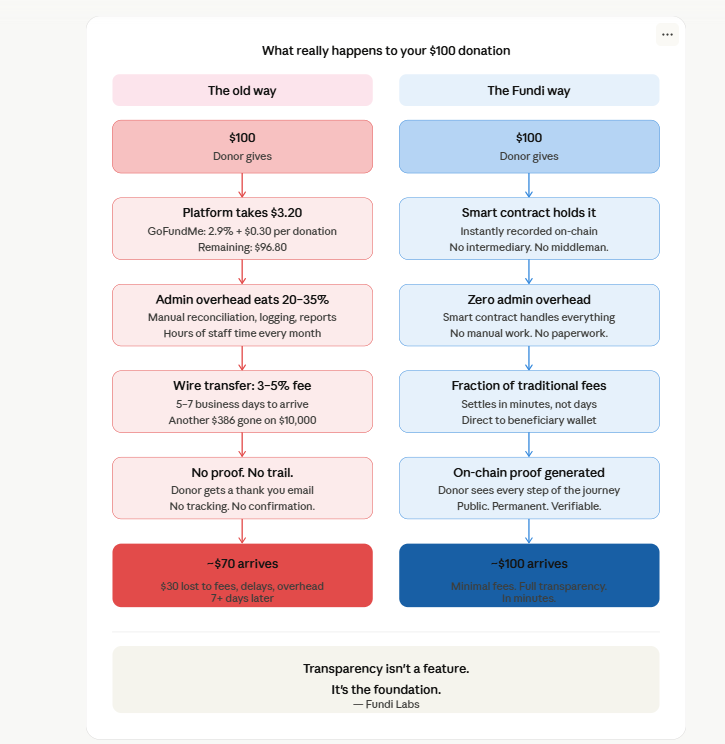
Here is what that looks like in practice.
A donor gives $100 to an NGO running a campaign for flood victims in a rural village in Uganda.
Before the organisation sees a single cent, GoFundMe has already taken 2.9% plus $0.30 on the transaction.
The finance team manually reconciles the donation, logs it, updates the donor database, and flags it for the quarterly report - a process that, across hundreds of donations, consumes 20 to 35% of the organisation's operating budget according to sector research.
Then the money needs to move internationally. The wire transfer costs another 3 to 5% in cross-border fees and takes up to 7 business days - assuming there's no compliance flags, public holidays, & delays at the correspondent bank.
By the time the money arrives, the family that needed it has been waiting over a week.
And somewhere between $25 and $35 of their $100 has quietly disappeared into a system that was designed long before the technology existed to do better.
This is not a story about fraud or negligence.
It is an infrastructure story, and what happens when the tools an entire sector depends on were never built with the end recipient in mind.
That technology now exists.
At Fundi Labs, every donation made through Funds for Humanity is recorded onchain the moment it is given.
Smart contracts route funds automatically. Fees are a fraction of what traditional platforms charge.
Beneficiaries receive funds directly, with no manual reconciliation, no wire transfer queues, no 7-day wait.
And every step of that journey is publicly verifiable in real time by anyone who wants to look.
Not because we built something complicated.
Because we built something that finally puts the cause and the people it serves at the centre of how the money moves.
The cause deserves 100 cents of every dollar donated to it.
Follow @FundiProtocol to see how we're making that the standard, not the exception.
4
5
12
499
RJ retweeted
May 20
EPISODE 2
Nine years ago, a group of nonprofit leaders, fraud experts, and government officials had to gather in a room just to convince the sector that charity fraud was real.
The idea was met with disbelief.
Nine years later, 42% of charities were victims of fraud in 2024. And half of every fraud detected was committed by people already inside the organization - Staff, volunteers, & trustees.
The people donors trusted most with their money.
I want you to sit with that for a moment because this is not a story about scammers in basements posing as charities.
This is a story about the finance manager who has been with the organization for eight years, the volunteer coordinator everyone loves, and the trustee who sat on three boards and stole from all of them.
One fraud expert put it plainly: "People don't stop committing fraud in just one instance. If the charity does not report the behavior out of fear of attention, the fraud will be repeated at the next nonprofit that hires the person."
A sad, recurring theme. His words, not ours.
And then there is the case that stopped me cold when I first read it.
Women's Cancer Fund collected over $18 million from donors who believed they were helping women undergoing cancer treatment. Only about one cent out of every dollar donated actually reached those women.
The rest went to the charity's operator, to fundraisers, to people who had nothing to do with cancer and everything to do with the money.
One cent out of every dollar. And for years, nobody knew.
This is the part that keeps us up at night.
Not that the fraud happened. Fraud happens everywhere there is money and insufficient oversight.
What keeps me up is the donors.
The person who skipped lunch to donate $20. The diaspora family that sent $100 to help someone going through what their mother went through.
They had no way to know; the system was never built to show them.
But we are not in that era anymore.
The technology exists today to make trust unnecessary, not because people are bad, but because proof is better than faith when someone's survival depends on it.
That is what Fundi Labs is built on.
Every donation is recorded onchain the moment it is made. Smart contracts that hold funds and release them automatically based on conditions set before the first dollar arrives.
A trail that is public, permanent, and impossible to alter at 11 pm on a Tuesday quietly. Not an audit that arrives six months later. Or a report that includes a summary of what has already happened.
Real-time, verifiable proof for every dollar, every step, every time.
We are not building Fundi because we think impact organizations are dishonest.
We are building it because the honest deserve a system that proves it - automatically, continuously, without anyone having to take their word for it.
And the donors who give deserve to know their one cent became one dollar.
Every single time.
Follow us to stay in the know.
fundilabs.io
May 14
EPISODE 1
In 2024, international humanitarian assistance fell by nearly $5 billion, the largest single drop ever recorded. X
By mid-2025, less than 17% of the $46 billion needed to meet global humanitarian needs had been received. Facebook
The UN's own Emergency Relief Coordinator said it plainly - "We have been forced into a triage of human survival."
That sentence stopped us cold when we first read it.
Not because it was shocking, but because it wasn't.
We already knew the system was breaking; we just didn't say it out loud.
Governments are pulling back, major donors are cutting budgets...
The platforms that were supposed to fill the gap charge 2.9% plus $0.30 on every transaction, fees that quietly drain the little that does get through.
And the organizations on the ground - the ones doing the actual work, are left holding the shortfall.
Running campaigns on platforms that can't tell them where their money is, sending wire transfers that take a week to arrive, writing reports that nobody can verify.
The infrastructure of giving is broken.
And the people who pay for that are never the donors, the platforms, or the governments writing the press releases.
It's always the 311 million people waiting on the other side.
That's why we chose Funds for Humanity.
Not because it's a clever product, or the technology is impressive, though it is.
But because the system is designed to help the world's most vulnerable, it is failing them visibly; the response cannot be another spreadsheet.
Another slow transfer, another platform taking its cut before the mission gets its money.
The response has to be infrastructure that actually works.
Funds for Humanity puts every donation on-chain the moment it's made. The smart contract holds it.
The release conditions are set in code before the first dollar arrives, the beneficiary receives funds directly...
And every single step is publicly verifiable, not in a quarterly report, not in an email update, but in real time, by anyone, anywhere.
We are not naive about how big the problem is.
$24 billion funding gap, 311 million people in need, Governments retreating, donors fatigued.
But here is what we know: when money does move, it should arrive whole.
It should arrive fast. And the people who gave it should be able to see that it got there.
That is not a radical idea. It is the minimum standard that the people who need this money deserve.
Funds for Humanity is how we build toward that standard, one transparent campaign at a time.
Follow @FundiProtocol. There is a lot more to show you.
fundilabs.io

7
6
18
3,633
RJ retweeted
May 14
There's a reason donor retention rates in the nonprofit sector average just 43%.
People give once, wait for proof their money did something, and when that proof never comes, they move on.
It's not that donors are stingy. It's that most fundraising platforms were never designed to close the loop between giving and impact.
@FundiProtocol was built around one simple idea: every donor deserves to see the full journey of their gift.
From the moment it leaves their hands to the moment it changes someone's life.
When donors can see that, they don't just give again.
They give more. They tell their friends. They become advocates for your cause.
Transparent fundraising isn't just an ethical choice.
It's the smartest growth strategy an impact organization can have right now.
7
5
17
2,567
RJ retweeted
May 13
Most nonprofits ask their donors to simply trust that the money arrived.
No real proof, just a thank you email and maybe an annual report months later.
But donor trust is getting harder to earn, and easier to lose.
The organizations winning right now are the ones who can show their donors exactly where every dollar went, who received it, and when.
Not as a promise, but a verifiable proof.
That's what tokenized fundraising makes possible.
Every donation recorded onchain, visible in real time, impossible to dispute.
@FundiProtocol was built for impact organizations who are ready to stop asking for trust, and start earning it.
5
7
20
2,304
RJ retweeted
May 12
A lot of people hear “smart contracts” and immediately think about automation.
But automation by itself doesn’t solve much if the incentives inside the system are still misaligned.
You can automate a broken workflow and still end up with delays, uncertainty, and coordination problems.
That’s why we think the bigger opportunity isn’t just smart contracts individually.
It’s what happens when contracts operate as part of a connected system.
Where:
~ execution doesn’t depend on constant follow-ups
~ incentives are aligned across participants
~ outcomes can be verified without extra coordination
~ and every action strengthens the reliability of the network itself
That changes the role of infrastructure completely.
Instead of systems being held together by trust and manual oversight, they start operating more like environments with built-in logic and accountability.
That’s the direction we’re moving toward at Fundi Labs.
Not just programmable contracts, but programmable coordination.
7
7
19
2,198
RJ retweeted
May 4
The goal isn’t just to move capital.
It’s to know where it is at any moment, what it’s been used for, and what’s actually been completed, without having to ask anyone.
Because moving money is easy.
What’s hard is everything that comes after.
Following up, waiting for updates, trying to match what was supposed to happen with what actually did.
That’s where most of the friction lives.
And it usually doesn’t show up at the start.
It shows up as things grow.
~ More transactions.
~ More people involved.
~ More expectations around reporting and accountability.
Now every answer takes a bit longer to get.
Not because the team isn’t working, but because the system doesn’t give you that visibility directly.
So everything becomes a process of checking and confirming.
And over time, that becomes the real work.
Not moving capital, just keeping track of it.
That’s the gap.
The difference between a system that can send funds, and one that lets you see, clearly and immediately, what’s happening with them.
Because at scale, you don’t just need movement.
You need clarity that doesn’t depend on coordination.
6
5
16
2,884
RJ retweeted
Apr 29
Trust is not a system, but a risk decision.
We talk about trust like it’s a foundation.
But most of the time, it’s just what we fall back on when there’s no clean way to verify what’s happening. And early on, that’s fine.
When things are small, you don’t need much structure.
You can ask questions, get answers quickly, and move on.
So trust feels natural.
It starts to break when the system grows.
More money moving, people get involved, & more steps between where something starts and where it ends.
That’s when you notice something subtle.
You’re no longer seeing things directly; you’re hearing about them.
Through updates, reports, or someone confirming that “it’s been handled.”
And most of the time, it has.
But the gap remains because the system doesn’t give you visibility by default.
It’s asking you to accept a level of uncertainty and move forward anyway.
Not certainty, just a willingness to proceed without it.
The problem is that it works right up until you need a clear answer.
When something doesn’t line up, timing matters, & someone asks a question that shouldn’t take long to answer, but does.
That’s when the cost shows up.
Because the system was never built to make things obvious in the first place, everything has to be checked after the fact.
That’s the shift happening now.
Less focus on whom you trust and more focus on whether the system itself makes things visible and verifiable as they happen.
Not as a feature, but the default way it works.
Because over time, that gap between “we trust it” and “we can see it” gets harder to justify.
Curious, do you think trust still holds up at scale, or does it eventually need to be replaced by something more concrete?
Follow Fundi Labs for more
8
7
20
2,057
RJ retweeted
Apr 24
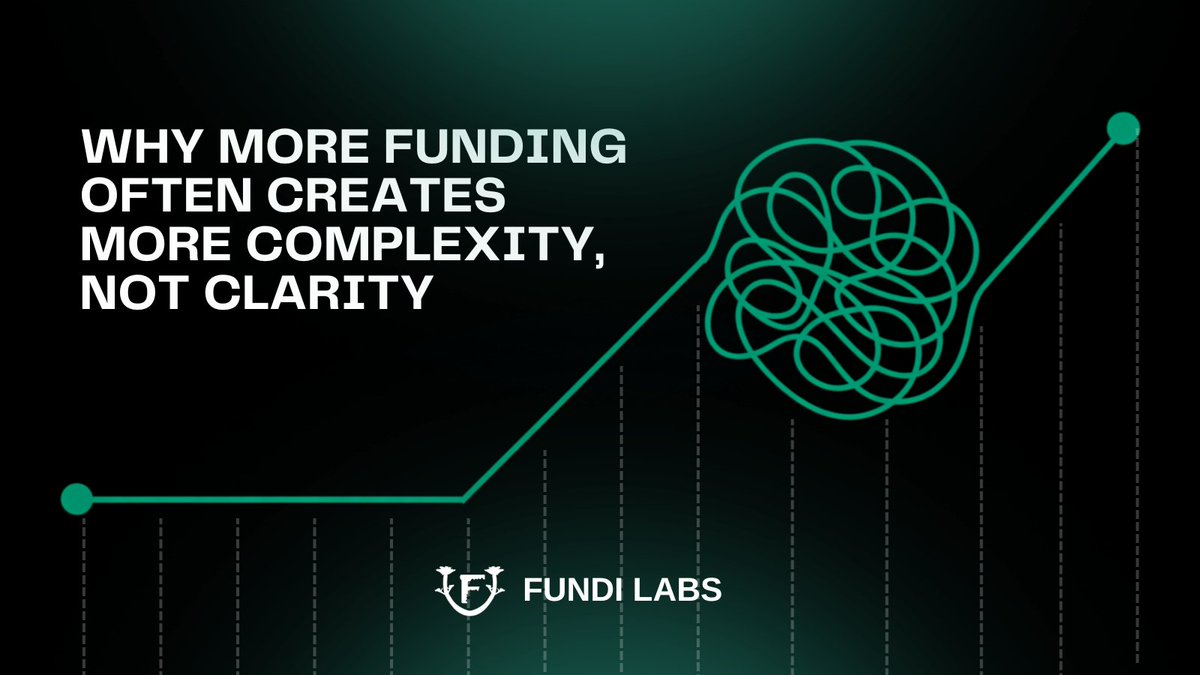
Why More Funding Often Creates More Complexity, Not Clarity
There’s a common assumption in impact funding and capital allocation: more funding should lead to more clarity, better execution, and stronger outcomes.
In practice, that’s not always what happens.
What we often see instead is that complexity outpaces the systems designed to manage it.
At an early stage, operations are relatively straightforward.
Funding sources are limited, programs are easier to track, and reporting can be handled with a combination of internal coordination and basic tools.
As funding grows, the environment changes.
Organizations are managing:
* multiple funding sources with different requirements
* a wider range of programs and allocations
* increased expectations from donors, partners, and stakeholders
* more frequent and detailed reporting cycles
Without corresponding improvements in infrastructure, this creates pressure on existing systems.
A few patterns tend to emerge:
1. Infrastructure lag:
Processes that worked at a smaller scale begin to break down as volume increases. Reporting becomes slower, and visibility into financial flows becomes less immediate.
2. Fragmented data:
Information starts to live across multiple systems, teams, and formats. Different stakeholders may be working with different versions of the same data, making alignment more difficult.
3. Compliance burden:
Additional funding often brings additional requirements. New grants introduce reporting standards and operational constraints that can conflict with existing workflows.
4. Visibility illusion:
Activity increases, and from the outside, things appear to be progressing. Internally, however, teams may be spending more time coordinating, verifying, and reconciling than actually advancing initiatives.
The result is a system that becomes more reactive over time.
Not because the organization lacks capability, but because the structure supporting it hasn’t evolved at the same pace as the capital flowing through it.
This is why more funding doesn’t automatically create clarity.
Without the right systems in place, it can introduce layers of operational friction, making it harder to understand what is happening in real time.
The shift that’s starting to happen is subtle but important.
Organizations are moving from:
managing funding and reconciling activity after the fact
to:
designing systems where flows, allocations, and outcomes are structured in a way that remains clear and verifiable as complexity increases
Because at scale, clarity isn’t a byproduct of growth.
It’s a function of how well the system was designed to handle it.
If you’re working in impact funding or managing growing capital flows, it’s worth asking:
As funding increases, does your system make decision-making easier or more difficult?
Follow @FundiProtocol for more
8
6
21
1,611
RJ retweeted
Apr 20
Most systems don’t fail suddenly, they fail through small inefficiencies that compound over time.
In impact funding and capital flows, the difference between “working” and “scaling” is often whether your processes can hold up without constant manual coordination.
That’s where the real work is.
Let’s build for systems that don’t depend on constant supervision to stay reliable.
GM!
4
4
10
298
RJ retweeted
Apr 18
In many impact organizations, reconciliation is still a manual process.
Donations come in from multiple sources, and funds are allocated across different programs. Updates are tracked in spreadsheets, emails, and internal systems.
At a small scale, this works.
But as funding grows and more stakeholders get involved, manual reconciliation becomes a bottleneck.
~ Data needs to be cross-checked across systems
~ Transactions are matched after the fact
~ Reporting depends on internal coordination
~ Errors and delays become more frequent
Over time, this creates a gap between what happened and what can be confidently proven.
And in impact funding, that gap matters.
Donors want clarity,
partners expect accountability,
organizations need reliable systems to operate efficiently...
Manual reconciliation introduces friction into all three.
The challenge isn’t a lack of effort. It’s that the system itself depends on human coordination to confirm what has already occurred.
This is where the shift begins.
Instead of reconciling transactions after they happen, the next generation of systems ensures that transactions, allocations, and outcomes are structured to be verifiable from the start.
That’s the difference between managing records and building infrastructure.
Tokenization, when applied correctly, isn’t just about digitizing assets.
It’s about designing systems where ownership, flows, and impact can be tracked and verified in real time, without relying on manual reconciliation.
For impact organizations, this changes everything:
i. Less time spent validating data
ii. More confidence in reporting
iii. Clear visibility across all stakeholders
The question is no longer whether reconciliation is necessary.
It’s whether it should still be manual.
If you’re operating or supporting impact funding systems, it’s worth considering how your current processes scale, and whether they’re built for verification or just coordination.
Follow @FundiProtocol to see how we’re building infrastructure that makes impact measurable, transparent, and verifiable by default.
8
8
22
478
RJ retweeted
Apr 14
In our last discussion last month, we highlighted the costs of poor contract design, delays, disputes, operational fragility, and reputational risk.
But here’s the reality: most capital structures don’t fail because of the assets, they fail because agreements weren’t built for scale.
Consider this:
~ A revenue-share agreement works smoothly with 10 participants, but at 100, manual reconciliations, approval bottlenecks, and reporting inconsistencies explode.
~ A token representing ownership functions in a small pilot, but enforcement still relies on offchain approvals.
~ A fund with multiple stakeholders can operate efficiently, until an unexpected event hits and no system enforces the rules automatically.
The common thread is that execution doesn’t match intention. Legal agreements exist, but operational reality isn’t aligned.
This is where programmable enforceability changes the game:
~ Rights and obligations are encoded into the system
~ Payouts, distributions, and approvals happen automatically
~ Audit trails are transparent and verifiable
~ Operational processes reflect the legal contract in real-time
When your capital structure is built this way, risk drops, trust increases, and growth scales naturally.
The next wave in capital infrastructure won’t come from more spreadsheets, dashboards, or tokenized assets, it will come from systems that execute agreements reliably under all conditions.
If you’re designing funds, tokenized assets, or revenue-sharing models, ask yourself:
i. Will this system work when participation grows tenfold?
ii. Will enforcement fail if humans make errors or delay approvals?
iii. Is operational reality aligned with legal intent?
The organizations that answer yes consistently are the ones investors, partners, and communities trust, and they are the ones building lasting capital infrastructure.
Follow us for more insights on structuring capital that scales, and join our community on Telegram (t.me/ zz9hAIl4TwhhOWE0) to explore how enforceable infrastructure transforms real-world capital flows.
Feb 27
The Cost of Poor Contract Design in Real Capital Flows
In capital markets, risk is often discussed in terms of volatility, liquidity, or counterparty exposure.
But one of the most underestimated risks sits elsewhere:
Contract design.
Not whether a contract exists, but how it is structured, enforced, and operationalized.
When real capital is involved - private investments, structured products, revenue-share agreements, tokenized assets, pooled funds, impact financing, contract design directly affects capital efficiency, dispute frequency, and long-term scalability.
Below are the measurable costs of weak contract architecture.
1. Capital Delays and Cash Flow Disruptions
Poorly defined payout logic, ambiguous trigger conditions, or manual reconciliation requirements create bottlenecks.
Examples:
- Revenue distributions dependent on manual calculations
- Waterfall structures interpreted differently by stakeholders
- Reporting lags that delay investor payouts
- Compliance reviews triggered by inconsistent documentation
When execution depends on human coordination instead of system logic, delays become routine.
In capital flows, time is not neutral. Delayed capital reduces reinvestment capacity and increases friction across the entire structure.
2. Escalating Legal and Administrative Costs
Ambiguity is expensive.
When agreements lack clarity around:
i. Rights enforcement
ii. Default conditions
iii. Asset control
iv. Exit mechanisms
Disputes become interpretive rather than procedural.
This leads to:
i. Legal reviews
ii. Amendments
iii. Arbitration
iv. Operational restructuring
What could have been prevented through structured logic becomes a recurring legal expense.
3. Operational Fragility at Scale
Many contract structures function adequately at small volume. They fail under scale.
As participation increases:
i. Manual oversight becomes unsustainable
ii. Approval chains slow down
iii. Reporting inconsistencies compound
iv. Audit complexity increases
What worked for 10 stakeholders often collapses at 100.
The problem is not growth. The problem is agreements that were never built for automated enforcement.
4. Misalignment Between Legal Terms and Operational Reality
In many structures, the legal contract and operational system are disconnected.
The contract states one thing.
The workflow implements another.
For example:
- A token represents ownership, but enforcement remains offchain
- A fund is digitized, but capital calls rely on manual confirmations
- A revenue-share agreement is automated, but data inputs are unverifiable
When systems do not reflect the contract’s logic, risk is not reduced, it is displaced.
5. Reputational and Capital Access Risk
Sophisticated investors evaluate infrastructure quality.
If enforcement depends on trust, spreadsheets, and post-hoc reconciliation, the structure is considered higher risk, regardless of the asset quality.
Weak contract architecture:
i. Reduces investor confidence
ii. Increases due diligence scrutiny
iii. Limits institutional participation
iv. Slows fundraising cycles
Capital flows toward structures that demonstrate predictability and enforceability.
The Structural Shift
The next evolution in capital infrastructure is not just digitization.
It is programmable enforceability.
Well-designed contract infrastructure should:
- Encode rights and obligations into execution logic
- Reduce reliance on manual confirmation
- Automate payout and distribution conditions
- Preserve transparent audit trails
- Align legal intent with operational reality
This is where tokenization and onchain systems become meaningful, not as branding, but as enforcement mechanisms.
The goal is not to replace legal agreements.
The goal is to ensure that execution does not depend on interpretation after capital has moved.
Final Consideration
If your capital structure depends on:
i. Manual reconciliation
ii. Email confirmations
iii. Off-platform enforcement
iv. Trust-based approvals
Then your risk profile is higher than your documents suggest.
The cost of poor contract design is rarely visible at inception.
It becomes visible when: value changes, incentives shift, markets tighten, or scale increases
By then, restructuring is significantly more expensive than proper design at the start.
If you are structuring funds, tokenized assets, revenue-sharing models, or real-world asset flows, evaluate whether your agreements are built for enforceability at scale.
Capital efficiency today depends as much on infrastructure design as it does on asset quality.
If you're building serious capital systems, let’s connect and discuss how enforceable infrastructure reduces long-term operational risk.
7
6
18
2,279
RJ retweeted
Apr 6
Tokenization isn’t just about putting assets onchain.
It’s about rethinking trust in every step of a transaction.
Today, most ownership transfers rely on emails, approvals, reconciliations, and manual processes.
These systems function, until they don’t. A delayed approval, a missing document, or a miscommunication can stall capital, trigger disputes, or undermine confidence in your operations.
At Fundi, we design systems where ownership, rights, and impact are verifiable, auditable, and enforceable, even when human error occurs.
By embedding operational proof into every process, we make sure that:
- Every transfer is traceable
- Every right is enforceable
- Every outcome is measurable
This isn’t just about automation. It’s about reducing reliance on memory, trust, and chance, and creating infrastructure that works reliably, no matter what.
Ask yourself, how much of your current system depends on someone remembering to send a PDF, approve a transaction, or reconcile data manually?
The organizations that get this right don’t just reduce risk, they unlock confidence, transparency, and scale in the way capital and impact are managed.
Follow us to see how operational proof is transforming the way organizations manage capital and impact.
7
4
19
3,356
RJ retweeted
Apr 1
Building real infrastructure doesn’t move at the speed of hype cycles.
It moves at the speed of clarity, iteration, and consistency.
In fast markets, almost everything looks like it’s working.
Ideas get attention, products get traction, and momentum hides a lot of underlying gaps.
But over time, you start to see where the real work is.
The hardest part isn’t launching something new.
It’s building systems that continue to function when activity slows down, when markets shift, and when attention moves elsewhere.
That’s where most projects struggle.
Processes that depend on manual coordination start to break.
Reporting becomes inconsistent.
Ownership and agreements become harder to verify.
And suddenly, what looked like progress turns into friction.
This is why we focus on building systems that are designed to hold up under pressure, not just perform when things are easy.
Systems where ownership, transactions, and outcomes remain clear, verifiable, and enforceable regardless of market conditions.
Because in the long run, reliability always outlasts hype.
Follow us to learn how we’re building infrastructure that supports real ownership, real capital, and real impact.
👇 check the comment to join our Telegram community to stay close to what we’re building.
8
6
23
636
RJ retweeted
Mar 23
Over 3 years ago, we started with a very clear vision of what we wanted to build.
We believed that ownership, agreements, and financial contributions should not depend on emails, screenshots, or manual confirmation between parties.
They should be verifiable by default, enforced by systems, and transparent to everyone involved.
At the time, most of the conversation in the space was focused on speculation and short-term trends, but we were more interested in the infrastructure that would still matter years later.
Since then, the vision itself has not changed, but the amount of work behind it has grown significantly.
Over the past few years we have focused on building the foundation step by step.
We have grown a strong community of supporters who understand why verifiable systems matter.
We have worked with different projects and brands, helped structure campaigns through Funds for Humanity,
and continued developing Fundi as a framework for handling ownership, contributions, and agreements in a way that remains transparent and enforceable even when multiple parties are involved.
This kind of progress is not always visible from the outside. Real infrastructure does not move at the same speed as hype cycles.
It takes time to design contracts properly, to test workflows, to coordinate with partners, and to make sure the systems we build can actually handle real use cases, not just demos.
There have been periods where growth felt slow, but every step added more stability to what we are building.
One thing that has stayed constant through all of this is the direction.
The goal has always been to create a future where ownership can be verified without debate, where agreements do not break under pressure, and where impact can be measured without relying on trust alone. That is what continues to guide the work today.
Looking back, it is clear that the community has grown stronger, the technology has matured, and the vision has become more practical with every iteration.
What started as an idea is now a system that continues to expand, with more people building on it and more use cases being explored.
We are still moving forward the same way we started, one contract at a time, one workflow at a time, one collaboration at a time.
Slow progress is still progress, and we are still building.
7
4
18
1,810
RJ retweeted
Mar 21
One thing we’ve learned while working with real assets and real capital is this: Disputes rarely happen because there was no agreement.
They happen because the agreement can’t be verified fast enough when it matters.
When value increases, everyone wants clarity.
When value drops, everyone wants protection.
When participants change, everyone wants proof.
In traditional systems, that proof is often scattered across documents, emails, internal records, and different versions of the same file.
Finding the truth becomes a process instead of a fact.
And the more parties involved, the harder it gets to maintain a single, trusted source of record.
This is why onchain infrastructure is becoming important for real-world assets, funds, and shared ownership structures.
Not because blockchain is new.
Not because tokenization sounds better.
But because a system where ownership, rights, and transactions can be independently verified removes a huge amount of friction when decisions need to be made.
It reduces the time spent arguing about what happened and increases the time spent moving forward.
As more capital moves into tokenized structures, the projects that last will be the ones where agreements don’t depend on memory, reputation, or manual coordination.
They depend on records that stay consistent, even when people don’t.
That shift, from trust-based workflows to verifiable systems, is where the real value of tokenization starts to show.
9
5
20
2,768
RJ retweeted
Mar 16
Tokenization is growing fast.
Every week, new assets are being brought onchain, new platforms are launching, and more organizations are exploring how digital ownership can improve the way capital, agreements, and assets are managed.
With that growth, we often hear the same question:
“If the asset already exists in the real world, why do we need onchain records?”
On the surface, it sounds reasonable.
If a property exists, a fund exists, or an agreement is already signed, why add another layer?
Because problems rarely appear when everything is going well.
They appear when value changes, when pressure increases, or when participants no longer agree.
As long as everyone is aligned, emails work.
PDFs work.
Spreadsheets work.
Internal records work.
But the moment money is involved, memory becomes unreliable.
Different versions of the same document appear.
Approvals get questioned.
Ownership needs to be proven.
Past decisions need to be verified.
This is where traditional systems start to slow down, and trust alone is no longer enough.
Onchain records are not about replacing the real-world asset.
They are about creating a shared, verifiable source of truth that does not depend on any single party to maintain it.
When ownership, transactions, and obligations are recorded in a system that cannot be altered after the fact, disputes become easier to resolve, audits become simpler, and participants can operate with more confidence.
For organizations managing funds, real-world assets, donations, or shared ownership structures, this becomes critical as scale increases.
More participants means more coordination.
More coordination means more risk if the system relies on manual processes.
The real value of tokenization is not visibility.
It is provability.
When value changes, proof becomes everything.
That is the layer we are focused on building at Fundi - infrastructure where ownership, rights, and history remain verifiable, enforceable, and transparent, even when conditions change and stakes are high.
Because the systems that survive long term are not the ones that look good when things are easy.
They are the ones that keep working when trust alone is no longer enough.
6
7
22
612
RJ retweeted
Mar 10
Scaling RWAs isn’t primarily a “which chain” problem. It’s a contract design problem.
A lot of energy in the tokenization space goes into debating infrastructure.
@ethereum or @solana?
@base or another L2?
Which chain is cheaper, faster, or has better liquidity?
Those questions matter. The underlying chain affects transaction costs, accessibility, and ecosystem reach.
Ignoring that would be a mistake.
But once real assets and real capital are involved, the conversation shifts quickly.
The real challenge becomes how the asset itself is structured.
Tokenization can record ownership and automate transfers.
What it doesn’t automatically solve are the deeper questions investors and institutions care about:
• What legal rights does the token actually represent?
• Who controls the underlying asset?
• How are payouts calculated and distributed?
• What happens if obligations aren’t met?
• How are disputes resolved or terms updated?
These are contract architecture questions, not blockchain questions.
You can move a token across chains instantly.
But if the agreement behind that token relies on manual processes, unclear enforcement, or poorly defined rights, the structure will struggle to scale.
This is why sophisticated participants don’t evaluate tokenized assets based solely on the chain they’re built on.
They examine whether the contracts, governance rules, and operational workflows are designed to handle real-world conditions.
In practice, the most resilient RWA platforms treat tokenization as part of a broader system, one where legal structure, contract logic, and operational processes are designed to work together.
Infrastructure matters. But infrastructure alone doesn’t create reliability.
The projects that will scale real-world assets successfully are the ones that design contracts that hold up when capital moves, incentives change, and markets tighten.
Because blockchains move tokens.
Contracts move capital.
9
5
21
660
RJ retweeted
Mar 9
Tokenization isn’t just slapping an asset onchain.
The real question: Can you prove it works at scale?
Legal, technical, operational, economic… diligence in tokenized assets covers it all.
Read how pros do it ⬇️
Mar 5
What Diligence Really Looks Like in Tokenized Assets Today
Tokenization promises efficiency, transparency, and liquidity. But anyone who’s raised capital or invested in tokenized assets knows this: not all tokens are created equal.
Diligence in tokenized assets goes far beyond a simple legal review.
It’s about understanding whether the asset, its contracts, and its ecosystem can reliably deliver what they promise, today and at scale.
Here’s what professional due diligence looks like:
1. Legal & Compliance Verification
- Is the token backed by a verifiable real-world asset?
- Are ownership rights enforceable across jurisdictions?
- Are contracts structured to protect all stakeholders, not just the issuer?
2. Technical & Smart Contract Audit
- Are contracts secure, audited, and free from exploitable vulnerabilities?
- Does the contract logic correctly handle payouts, governance, and ownership transfers?
- Are there fail-safes or upgrade mechanisms if issues arise?
3. Transparency & Traceability
- Can all token holders independently verify ownership and transaction history?
- Is the asset’s lifecycle fully auditable and tamper-proof?
4. Economic & Risk Assessment
- How is the token’s value derived and maintained?
- Are liquidity and incentive structures robust under market stress?
- Is the model resilient to downturns or rapid scaling?
5. Operational Due Diligence
- Are reporting, distributions, and governance processes automated and reliable?
- Are outcomes measurable, auditable, and aligned with stakeholders’ expectations?
6. Ecosystem & Stakeholder Alignment
- Who are the participants, and are incentives aligned for long-term collaboration?
- Is there a clear path for growth, adoption, and liquidity management?
The takeaway from this is: tokenization alone doesn’t guarantee confidence or risk reduction. Proper diligence evaluates legal, technical, operational, and economic dimensions.
Organizations that bake verifiability, enforceability, and transparency into their assets gain trust, reduce risk, and attract serious participation.
At @FundiProtocol, we help organizations structure tokenized assets in ways that are auditable, enforceable, and investor-ready, so that value isn’t just promised, it’s provable.
Follow for more
7
4
18
411
RJ retweeted
Mar 5
What Diligence Really Looks Like in Tokenized Assets Today
Tokenization promises efficiency, transparency, and liquidity. But anyone who’s raised capital or invested in tokenized assets knows this: not all tokens are created equal.
Diligence in tokenized assets goes far beyond a simple legal review.
It’s about understanding whether the asset, its contracts, and its ecosystem can reliably deliver what they promise, today and at scale.
Here’s what professional due diligence looks like:
1. Legal & Compliance Verification
- Is the token backed by a verifiable real-world asset?
- Are ownership rights enforceable across jurisdictions?
- Are contracts structured to protect all stakeholders, not just the issuer?
2. Technical & Smart Contract Audit
- Are contracts secure, audited, and free from exploitable vulnerabilities?
- Does the contract logic correctly handle payouts, governance, and ownership transfers?
- Are there fail-safes or upgrade mechanisms if issues arise?
3. Transparency & Traceability
- Can all token holders independently verify ownership and transaction history?
- Is the asset’s lifecycle fully auditable and tamper-proof?
4. Economic & Risk Assessment
- How is the token’s value derived and maintained?
- Are liquidity and incentive structures robust under market stress?
- Is the model resilient to downturns or rapid scaling?
5. Operational Due Diligence
- Are reporting, distributions, and governance processes automated and reliable?
- Are outcomes measurable, auditable, and aligned with stakeholders’ expectations?
6. Ecosystem & Stakeholder Alignment
- Who are the participants, and are incentives aligned for long-term collaboration?
- Is there a clear path for growth, adoption, and liquidity management?
The takeaway from this is: tokenization alone doesn’t guarantee confidence or risk reduction. Proper diligence evaluates legal, technical, operational, and economic dimensions.
Organizations that bake verifiability, enforceability, and transparency into their assets gain trust, reduce risk, and attract serious participation.
At @FundiProtocol, we help organizations structure tokenized assets in ways that are auditable, enforceable, and investor-ready, so that value isn’t just promised, it’s provable.
Follow for more
5
4
15
811
RJ retweeted
Feb 25
A question we hear often:
“If the asset exists in the real world, why do we need onchain records?”
Here’s the truth: disputes don’t happen when everything goes smoothly. They happen when value changes.
The moment money moves, ownership is transferred, or outcomes are measured, relying on memory, emails, PDFs, or trust alone becomes risky.
Misunderstandings, lost documents, or human error can derail even the most well-intentioned agreements.
That’s where onchain records matter. They provide:
Immutable proof: Transactions and ownership can’t be altered or forgotten.
Verifiable history: Every step is auditable by anyone with the right permissions.
Confidence at scale: Stakeholders can trust that agreements are enforced automatically, even as complexity grows.
In short, proof becomes more important than trust.
And that’s exactly the layer we’re building at Fundi Labs - infrastructure that makes ownership, agreements, and impact verifiable, transparent, and enforceable.
The real question isn’t whether the asset exists, it’s whether your proof does.
If you’re ready to stop relying on memory and start relying on verification, let’s explore how onchain infrastructure can secure your organization’s operations.
join our telegram channel - t.me/ zz9hAIl4TwhhOWE0
9
8
22
1,899