A product of time and motion. prev: Founding engineer @aptoslabs, @Meta, @Cruise. Opinions are my own.
Joined April 2020
- Tweets 1,183
- Following 603
- Followers 37,613
- Likes 6,011
113 Photos and videos










Pinned Tweet

31 Aug 2024
"Everything you want is on the other side of fear"
5
7
37
14,052
Max retweeted

Jun 13
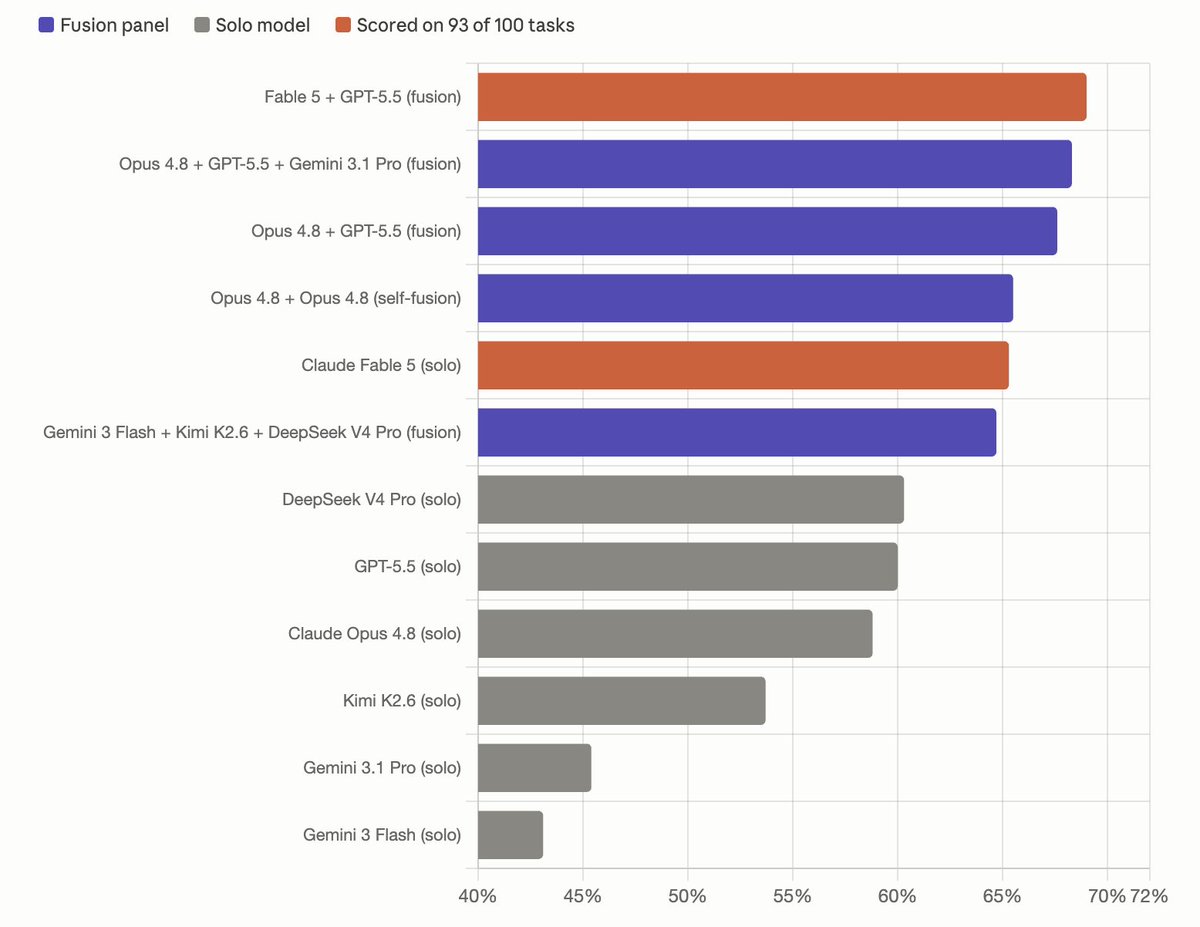
Introducing the Fusion API, the smartest compound model in the market.
Fusion achieves Fable-level intelligence at half the price.
How it works 👇
646
1,648
14,007
5,380,715

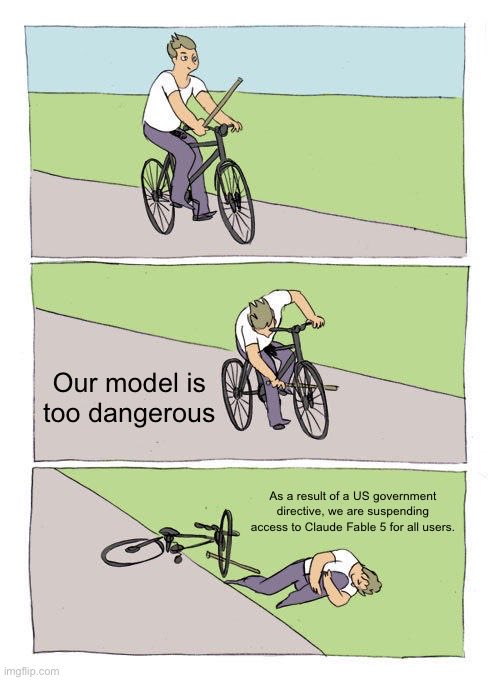
Jun 13
ahahahahahahahaha wtfff
Jun 13

As a result of a US government directive, we are suspending access to Claude Fable 5 for all users. You can continue to use all other Claude models.
Here’s what this means for you:
Across Claude products, new sessions will run on your selected default model or Opus 4.8, and existing Fable 5 sessions will end with an error.
On the Claude Platform, requests to Fable 5 will also return an error. Please update your integrations to other Claude models.
We know this is a disruption to your workflows; we appreciate your patience and support.
108
Max retweeted

Jun 12
I cancelled my $10/mo Calendly subscription and vibe coded my own with Fable for $12,000
467
615
19,284
970,607
Jun 12
Recruiter reach outs have been a great way for me to learn about new companies to invest in
70
Max retweeted

anthropic won't let you use fable for biology, chemistry, ai research, or anything that accelerates human progress. that makes it the perfect tool for developing blockchains
151
551
12,378
456,000
Jun 5
Same… makes me sad, but the output I get from single branch is much stronger
Jun 5

I went HAM on git worktrees when I learned they were a thing like 6 months ago but slowly drifted back to single branch flows.
It's just way easier to manage and far less repeat/conflicting work.
But how do you make sure multiple agents don't collide?
The flow is simple:
You need proper planning. Measure twice cut once has never been more true.
After the plan is created, I prompt the model if it's 100% clear on what to do, and if not to surface non obvious questions edge cases we haven't yet covered.
Now with a SOLID plan, I turn it into a directed graph of tasks where they know the clear order of operations.
The task graph is then fed into a swarm of tmux sessions running [insert your favorite harness here] by a top level agent, lets call it the "ring leader"
The agent sessions collaborate via file reservations and their own agent mail messaging system. This ensures no edits are conflicting and duplicate work is not done.
The top level ring leader agent just sits there on a cron, checking in to the sessions every ~5 minutes to nudge them to pickup unblocked tasks from the graph if there are any until all the work is done.
Then when its all done, I prompt for a summary of work completed and a QA plan for me or other agent to verify.
This is like the "ralph loop" but on galactic steroids. It gets work done would have taken several weeks a year ago to get done in a ~2 hour session.
If this all sounds too hard to manage, I thought so too. But then I stumbled across what @doodlestein was doing thru one of @johnlindquist's AI workshops.
Then Jeffrey released his skills jeffreys-skills.md and holy cow everything I just mentioned above unlocked.
140
Jun 5
There’s no way this ends poorly, right?

Introducing pump fun GO: Pay ANYONE to do ANYTHING
Create & complete bounties for ANY task and leverage the power of humans & money across the globe
The world is at your fingertips. It’s time to GO 👇
92
Max retweeted

Jun 4
There is a private jet trapped in your computer you just have to type the right prompt to get it out
10
9
293
9,543
Max retweeted

The equation is fairly straightforward:
Competent employees x AI tokens = Accelerating business & market share gain
Incompetent employees x AI tokens = slop
Companies are now realizing they have a lot of shitty employees.
They aren’t going to permanently cut spend on tokens. They can’t afford to because of game theory.
So instead they will fire the employees they believe are incompetent to make room for higher token budgets for those that are competent.
Lots of orgs however have a managerial class that doesn’t optimize for share gain and winning in general.
Thats fine. A wave of startups and existing platforms who can effectively leverage AI to expand scope of their business will crush the incompetent at a rate that will leave analysts and managers dizzy.
Change is coming. Fast. And reflexively the faster the change the higher the panic the lower the ROI threshold the more revenue and capital accrues to the labs the faster the models improve. And so on.
Jun 2

@TMTLongShort
What do you think about recent articles stating that companies like UBER are reevaluating and putting caps on their AI Spend for employees
Is this a signal that at least we are going to enter a period of optimization of AI spend or just noise
59
70
618
210,010
Jun 3
Gold
Jun 3

Reporter: How do you define ceasefire?
Trump: In that part of the world, ceasefire is when you're shooting in a more moderate manner
63
Jun 3
Damn, this happened much faster than I thought
Jun 3

Welp, that happened faster than I predicted. Thought it would be end of 2027, then early 2027, but agentic traffic growing so fast that bots have now passed human traffic online for the first time in the Internet's history. radar.cloudflare.com/traffic…
70
Jun 3
Fascinating business model that I’ve always been intrigued by. Really cool investment opportunities in companies that fund efforts like these, too.
Jun 3

Think you got screwed by the recent Polymarket resolution?
117 Partners is interested in purchasing claims from affected users.
I'm Thomas Braziel. I've spent nearly 20 years investing in distressed assets and have been active in crypto distress since Mt. Gox.
If you have a substantial claim and would rather receive cash today than spend years pursuing a recovery, reach out.
For qualifying claims, we may pay up to 20-25% of documented losses/cost basis and take on the recovery risk ourselves.
DMs open.
1
2
1,013
Jun 2
Man, the world is cool
Jun 2

Today a crazy quantum story just got wilder.
On March 31, the Google Quantum AI team published a landmark result on Shor's algorithm for elliptic curve cryptography. Technically, the paper was a bombshell: a dramatic 10x improvement over the state-of-the-art. As a stunt and wakeup call to the blockchain space, those optimisations were illustrated on secp256k1, the elliptic curve underlying Bitcoin and Ethereum signatures.
But perhaps the most striking part of the paper was sociological, not technical. Instead of following standard academic process, the optimisations were kept secret, hidden behind a zero-knowledge (ZK) proof. Google's accompanying blog post mentions they "engaged with the U.S. government". The ZK proof demonstrates the existence of algorithmic improvements without leaking details. Academic censorship with ZK, a historic first!
As a co-author of the Google paper I witnessed some of the context surrounding this censorship. To be honest, multiple aspects of that context don't sit well with me. As much as I believe the general public ought to know more, I am limited in my ability to whistleblow. Though let me be clear about one thing: the Google team's professionalism has been absolutely exemplary, and they deserve nothing but praise.
Censorship has a way of backfiring. The Streisand effect, where an attempt to bury something only draws more attention to it, is exactly what's unfolding today. First, Google's key optimisation has been rediscovered by the French. And in a thrilling turn of events, a collaborative Shor-at-home challenge just launched. The initiative, available at ecdsa[.]fail, breached a new Shor world record in a matter of hours.
Let's start with the rediscovery. Just two months after Google's paper, French quantum expert André Schrottenloher cracks the main secret optimisation. His paper, titled "Optimized Point Addition Circuits for Elliptic Curve Discrete Logarithms", landed on the arXiv today. Big congrats to André, who beat several other nerdsnipped experts to it. In a blog post also published today, Craig Gidney, the world expert on Shor optimisations, revealed that he'd been sitting on this very optimisation for a whole year under censorship pressure.
Interestingly, André missed a handful of minor optimisations, both from Google's original publication and from improvements found since. It's plausible there's still plenty of juice left to squeeze out of Shor, and this is exactly what the ecdsa[.]fail challenge is about. The verifier program developed for the ZK proof does double duty, automatically filtering for valid submissions. Dozens of compounding small and micro improvements are rolling in. As of the time of writing there's an 8.4% improvement to Google's circuit, as measured by the product of logical qubit count and Toffoli gate count. Nice!
The nerdsnipping ran deeper than anyone expected. Over the last few weeks it became clear it extended well beyond André and other quantum experts. Behind the scenes, a small army of amateurs quietly got to work. Inspired by Karpathy-style autoresearch, they turned AI on Shor. Ironically, the verifier program for the ZK proof makes an ideal reward function for AIs. The barrier to entry for this modern style of research is refreshingly low, with several non-experts, even a teenager, finding nice optimisations. Get in touch if you'd like to join a Telegram group with fellow autoresearchers :)
Part 2: neutral atoms and qday
The story doesn't end with Google. On the same day Google went public, a stealthy startup called Oratomic published its own Shor paper in a coordinated release. It made a splash, ultimately becoming the most upvoted paper on scirate[.]com, a website ranking arXiv papers.
Oratomic's claim was wild. By building on Google's logical optimisations and applying custom physical optimisations for neutral atoms, they claimed just 10K physical qubits were sufficient to run Shor's algorithm on secp256k1. That number is mind-bogglingly low.
Knowing essentially nothing about neutral atoms when Oratomic's paper landed, I was intrigued and decided to learn more about the tech. I fell straight down the rabbit hole and spent a couple hundred hours on the topic. I got a little obsessed and watched every YouTube video I could find and spoke to a bunch of experts.
My conclusion? The tech is real, very real. Even Google recently decided to start a neutral atom lab, a notable pivot from their sole focus on superconducting qubits. If you care about qday, i.e. the day a quantum computer will break the first piece of cryptography in production, neutral atoms demand your attention. I shared some of my learnings on Shor and neutral atoms in a 30min talk at the ZKProof cryptography conference. You can find it on YouTube by searching "zkproof neutral atom".
Here's an interesting observation about this duo of breakthrough papers: neither Google nor Oratomic say a word about what their results mean for qday. No timelines. Zero. Nada. That is especially baffling given that the whole point of whitehat quantum cryptanalysis is to inform qday estimations and help the general public make good decisions.
So let me attempt to partially fill the silence, similarly to what Scott Aaronson did in his April 29 post. Given everything I know, including scary non-public information, I now put the odds of qday by 2032 at 50%. 10% by 2030.
Anecdotally, the US government has its own date: 2035. Originating at the NSA and later adopted by NIST, it's when branches of the US government will be disallowed from using quantum-vulnerable cryptography. In plain language: with hindsight, that date is a joke and should be discounted entirely. I don't see how NIST avoids being forced to pull it forward by years.
Part 3: post-quantum cryptography
There are good reasons to sound the alarm today, but please do not panic. Rushing carelessly towards immature post-quantum cryptography is a recipe for disaster. IMO a good target date for migration is 2029, roughly 3.5 years out. 2029 happens to be the date selected by Google, Cloudflare, and the Ethereum Foundation.
These days most of my time goes to safely migrating Ethereum towards post-quantum cryptography as part of the broader lean Ethereum effort. There's a lot to do. We need to rip out and replace BLS signatures at the consensus layer, KZG commitments at the data layer, and ECDSA signatures at the execution layer.
The plan to get there is compelling, and is based on hash-based cryptography. Within the Ethereum Foundation we've developed a Swiss army knife called leanVM (github[.]com/leanEthereum/leanVM) powered by the magic of hash-based SNARKs. Thanks to truly exceptional work by Emile, Thomas, and others, its performance is derisked. Regarding security, leanVM is a jewel, a minimal zkVM crafted for end-to-end formal verification and maximum security.
Want to help? There are two $1M initiatives. First, the Proximity Prize (proximityprize[.]org). Solve a long-standing mathematical conjecture in coding theory, improve hash-based SNARKs, and go home a millionaire. Second, the Poseidon Initiative (poseidon-initiative[.]info), offers $1M for breaking Poseidon, the SNARK-friendly hash function.
1
147
Jun 1
One of these days I’d like to see someone file sheepishly instead of confidently for an IPO
Jun 1

Anthropic has confidentially submitted a draft S-1 registration statement to the Securities and Exchange Commission.
Pending completion of SEC review, this gives us the option to pursue an initial public offering.
Read more: anthropic.com/news/confident…
194
May 30
Singing is such a neat concept. Like, you can just make music any time anywhere? With your voice? Amazing.
71
May 30
WHAT!?
May 30

Omg wait does Cisco refer to San Francisco
1
208
May 28
If you take it while alive does it make you extra alive
May 11

Trump: "We've taken people that were dead. We had a person given the last rites -- gone, the kids are crying and everything -- and started them on this drug. And the person became better. It works."
1
1
116