
Got rich in crypto, spent some, gave away some, lost the rest on non-existent tax planning. Now on a revenge arc. DLMM dino from @MetropolisDEX
Joined June 2021
- Tweets 4,576
- Following 3,289
- Followers 766
- Likes 23,906
431 Photos and videos









capt retweeted

Did frxUSD just win the Aave V4 wars?
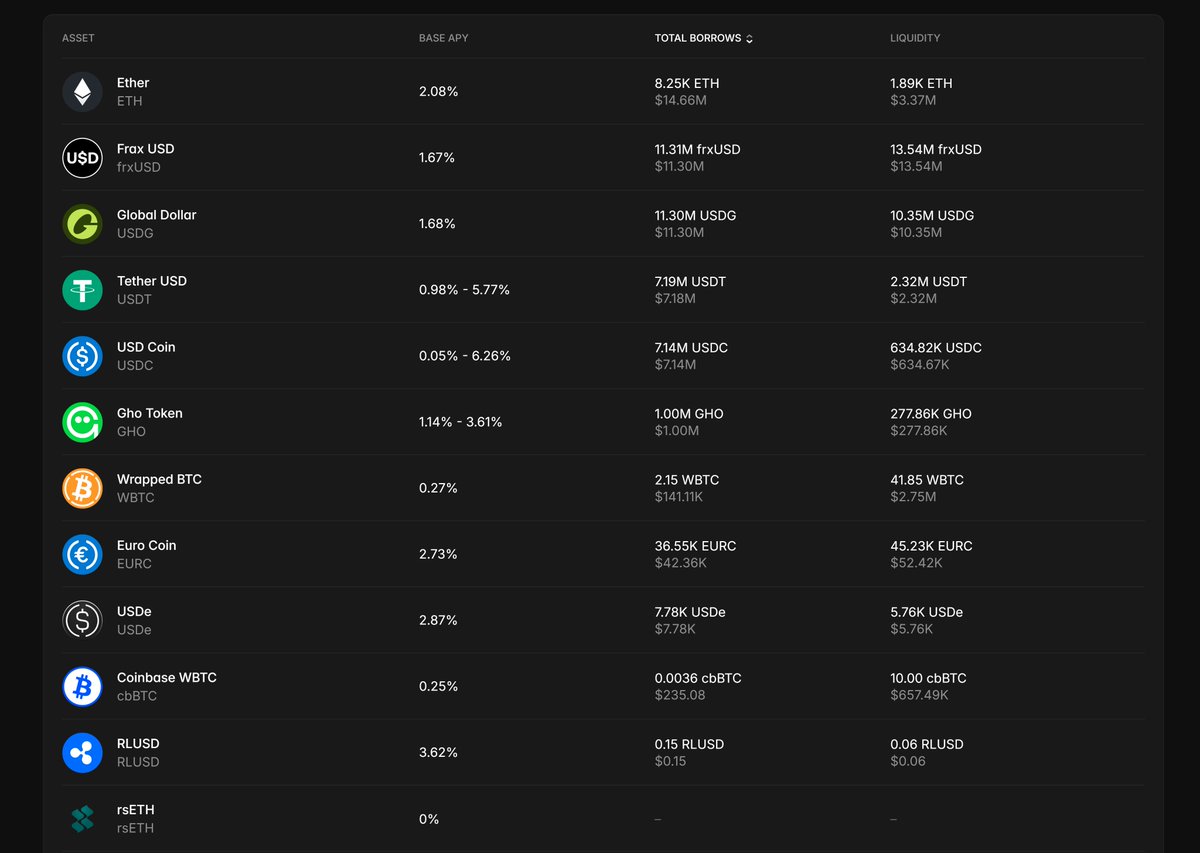
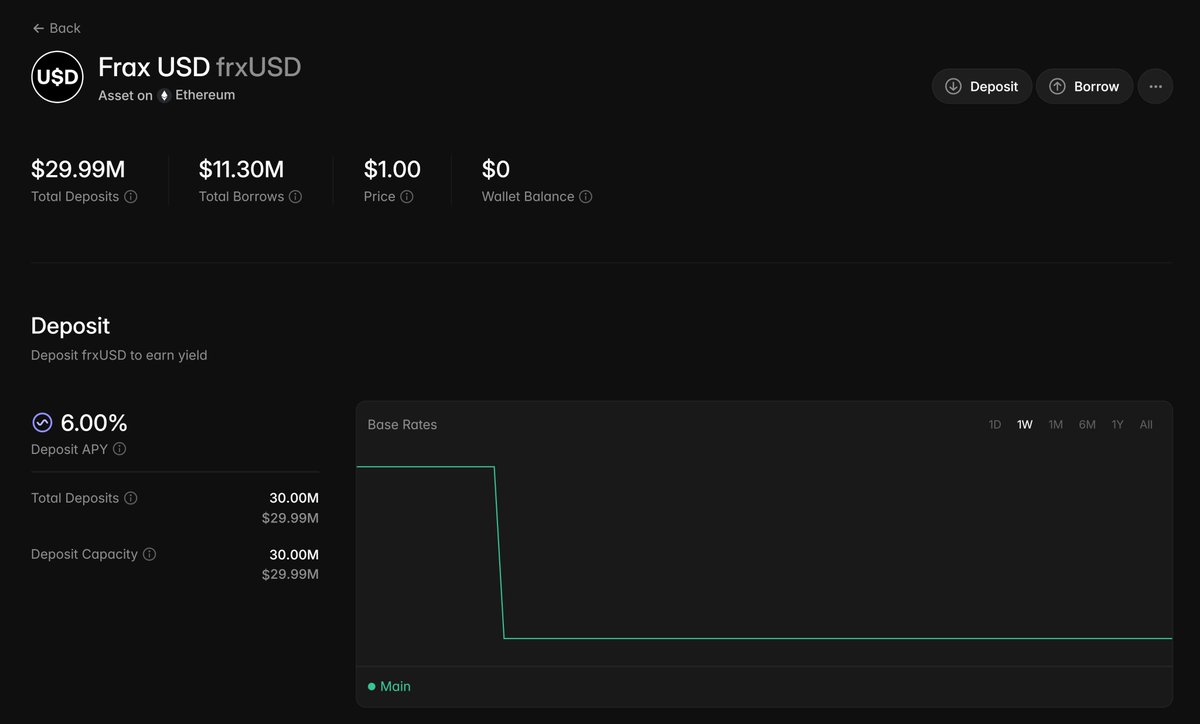
$11.30M in active borrows. Largest stablecoin on Aave V4. Only ETH is ahead at $14.73M in total borrows. frxUSD is pulling away from every other stablecoin on the protocol and dominating on this.
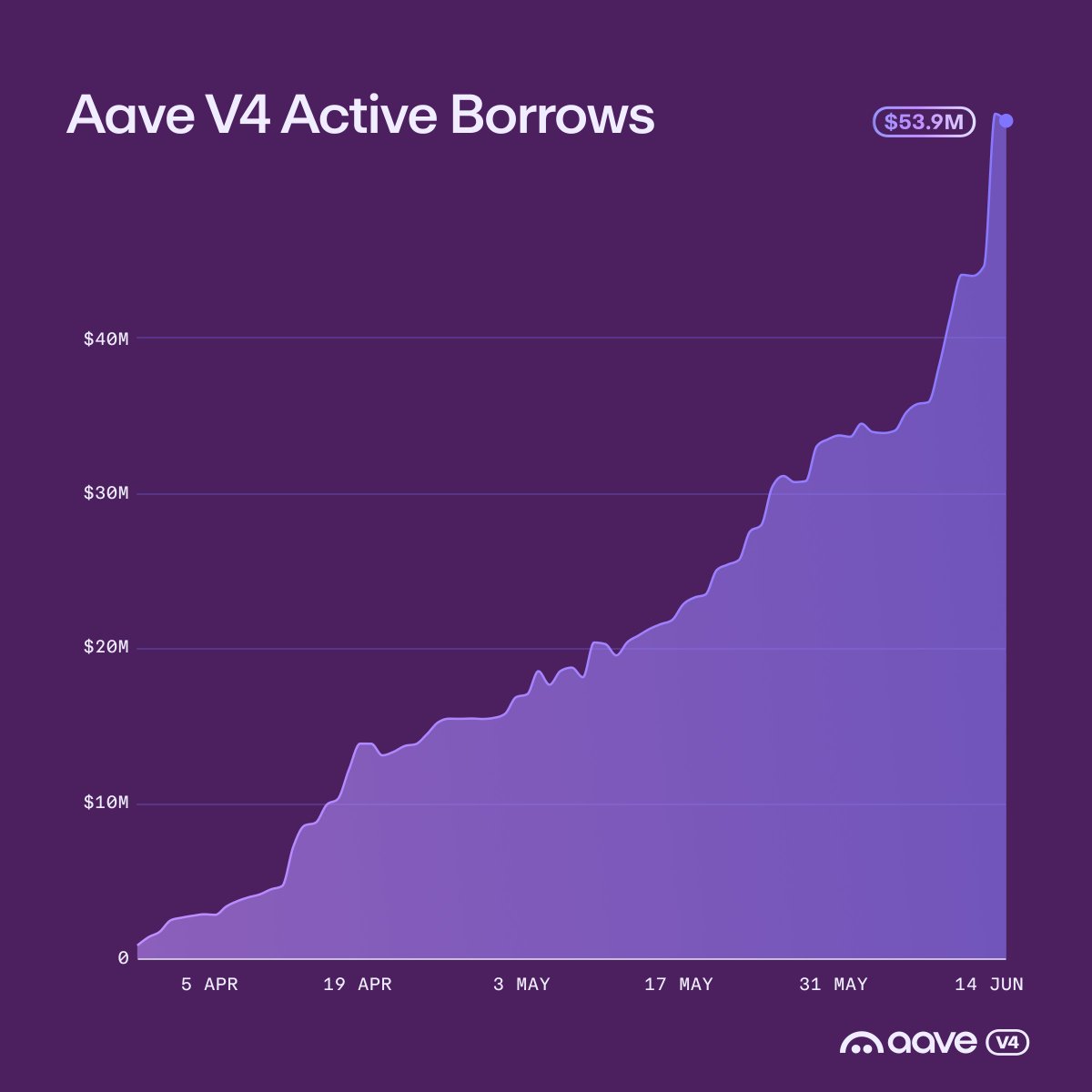
@aave V4 just crossed $50M in total active borrows and frxUSD accounts for roughly 22% of that.
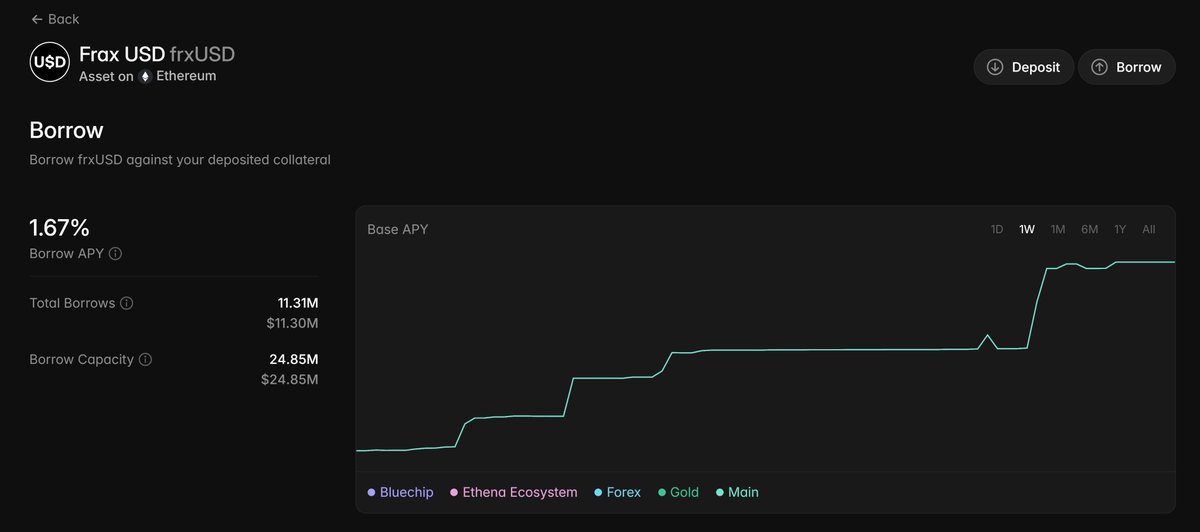
The borrow rate is sitting at 1.67% APY. I wanted to understand why it is this low so I had a conversation with some friends at @FraxForce and the explanation is straightforward once you see it.
Utilization is at 36.67%. $11M borrowed against $30M deposited. A lot of idle capital sitting on the supply side and low utilization means low borrow rates.
@fraxfinance is also actively incentivizing the supply side right now, pulling in capital faster than borrowing demand is growing.
For now the opportunity is clear. 1.67% to borrow the largest stablecoin on Aave V4 with $13.55M in capacity still available.

5
11
40
3,394
capt retweeted

Jun 13
Crypto industry seeing AI getting rugged by the government

56
187
1,939
81,870
capt retweeted

Jun 11
A difference between Tom Lee and Saylor is that Tom has low debt.
Another is that Tom is getting involved and invested in Ethereum's app layer and core dev. Whereas if you own BTC, you can't do much to help your own investment, besides cheerlead.
Alchemy of 5%, 8%, LFG BMNR
32
51
556
64,509

capt retweeted

Jun 10
I still hold BTC, but Ethereum ppl have been shouting this eventuality into the void for years.
It's becoming clearer to me that the best Bitcoin is Ethereum.
Jun 10

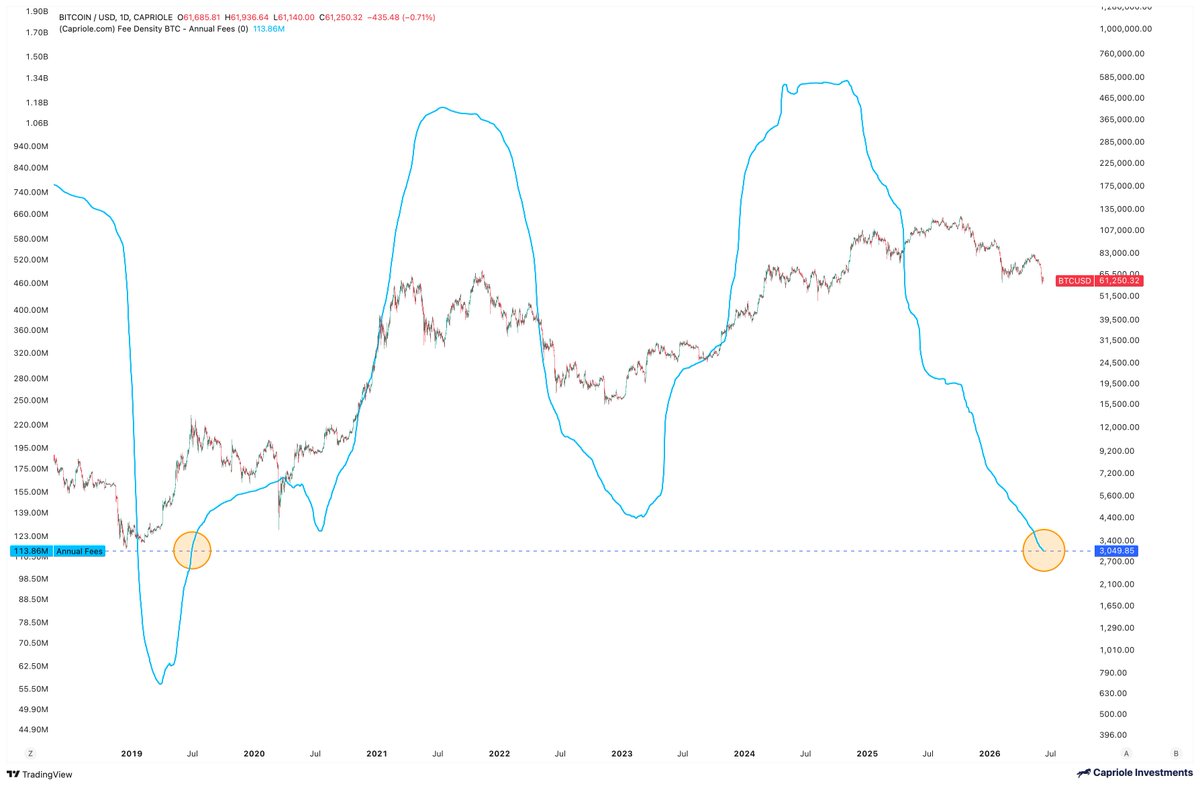
One of the more concerning long-term Bitcoin metrics. The Annual Fees miners earn (ex. block reward) over trailing 12 month period has just dropped to its lowest point since 2019! Bitcoin's transaction throughput fee revenue is in free fall, block rewards keep halving and AI compute demand is through the roof. It's no wonder every single public Bitcoin miner is pivoting away from Bitcoin and into AI. At some point in the future, this line needs to go up if Bitcoin is to be sustainable in years to come. On the positive side, this metric does normally hit a major low at the bottom of bear markets when interest in Bitcoin is lowest.
11
4
54
3,681
capt retweeted

Jun 11
There will be a period when large stablecoins and RWAs will flip Ethereum market cap and it will be net good for eth
61
62
428
26,599
capt retweeted

Jun 10
Almost. docs.flyingtulip.com/risks/c…
Jun 9

it’s crazy how almost no crypto app has rate limits lmfao
4
15
103
8,142
capt retweeted

Jun 9
Justin Drake: Quantum is an opportunity for Ethereum
Ethereum Researcher Justin Drake, who co-authored Google's recent quantum paper explains:
"I've stopped thinking about post-quantum as a hurdle that we have to overcome, and I think of it more as an opportunity. It's an opportunity for Ethereum to stand out as the very first global financial system that is post-quantum secure — not just relative to its competitors, but also relative to fiat and tradfi."
Justin also believes quantum presents an opportunity for Ethereum to become the best version of itself: “The move to post-quantum is essentially a rewrite, and that’s a massive opportunity to start with a clean slate and wipe our technical debt.”
The rewrite bundles post-quantum security with a new ZK virtual machine (LeanVM) that can snarkify the entire consensus layer in real time. The result is that the Ethereum L1 can scale to 10,000 TPS at 1 gigagas/second — while simultaneously becoming quantum-secure.
Source: @Bankless (Mar 2026)
Jun 2

Today a crazy quantum story just got wilder.
On March 31, the Google Quantum AI team published a landmark result on Shor's algorithm for elliptic curve cryptography. Technically, the paper was a bombshell: a dramatic 10x improvement over the state-of-the-art. As a stunt and wakeup call to the blockchain space, those optimisations were illustrated on secp256k1, the elliptic curve underlying Bitcoin and Ethereum signatures.
But perhaps the most striking part of the paper was sociological, not technical. Instead of following standard academic process, the optimisations were kept secret, hidden behind a zero-knowledge (ZK) proof. Google's accompanying blog post mentions they "engaged with the U.S. government". The ZK proof demonstrates the existence of algorithmic improvements without leaking details. Academic censorship with ZK, a historic first!
As a co-author of the Google paper I witnessed some of the context surrounding this censorship. To be honest, multiple aspects of that context don't sit well with me. As much as I believe the general public ought to know more, I am limited in my ability to whistleblow. Though let me be clear about one thing: the Google team's professionalism has been absolutely exemplary, and they deserve nothing but praise.
Censorship has a way of backfiring. The Streisand effect, where an attempt to bury something only draws more attention to it, is exactly what's unfolding today. First, Google's key optimisation has been rediscovered by the French. And in a thrilling turn of events, a collaborative Shor-at-home challenge just launched. The initiative, available at ecdsa[.]fail, breached a new Shor world record in a matter of hours.
Let's start with the rediscovery. Just two months after Google's paper, French quantum expert André Schrottenloher cracks the main secret optimisation. His paper, titled "Optimized Point Addition Circuits for Elliptic Curve Discrete Logarithms", landed on the arXiv today. Big congrats to André, who beat several other nerdsnipped experts to it. In a blog post also published today, Craig Gidney, the world expert on Shor optimisations, revealed that he'd been sitting on this very optimisation for a whole year under censorship pressure.
Interestingly, André missed a handful of minor optimisations, both from Google's original publication and from improvements found since. It's plausible there's still plenty of juice left to squeeze out of Shor, and this is exactly what the ecdsa[.]fail challenge is about. The verifier program developed for the ZK proof does double duty, automatically filtering for valid submissions. Dozens of compounding small and micro improvements are rolling in. As of the time of writing there's an 8.4% improvement to Google's circuit, as measured by the product of logical qubit count and Toffoli gate count. Nice!
The nerdsnipping ran deeper than anyone expected. Over the last few weeks it became clear it extended well beyond André and other quantum experts. Behind the scenes, a small army of amateurs quietly got to work. Inspired by Karpathy-style autoresearch, they turned AI on Shor. Ironically, the verifier program for the ZK proof makes an ideal reward function for AIs. The barrier to entry for this modern style of research is refreshingly low, with several non-experts, even a teenager, finding nice optimisations. Get in touch if you'd like to join a Telegram group with fellow autoresearchers :)
Part 2: neutral atoms and qday
The story doesn't end with Google. On the same day Google went public, a stealthy startup called Oratomic published its own Shor paper in a coordinated release. It made a splash, ultimately becoming the most upvoted paper on scirate[.]com, a website ranking arXiv papers.
Oratomic's claim was wild. By building on Google's logical optimisations and applying custom physical optimisations for neutral atoms, they claimed just 10K physical qubits were sufficient to run Shor's algorithm on secp256k1. That number is mind-bogglingly low.
Knowing essentially nothing about neutral atoms when Oratomic's paper landed, I was intrigued and decided to learn more about the tech. I fell straight down the rabbit hole and spent a couple hundred hours on the topic. I got a little obsessed and watched every YouTube video I could find and spoke to a bunch of experts.
My conclusion? The tech is real, very real. Even Google recently decided to start a neutral atom lab, a notable pivot from their sole focus on superconducting qubits. If you care about qday, i.e. the day a quantum computer will break the first piece of cryptography in production, neutral atoms demand your attention. I shared some of my learnings on Shor and neutral atoms in a 30min talk at the ZKProof cryptography conference. You can find it on YouTube by searching "zkproof neutral atom".
Here's an interesting observation about this duo of breakthrough papers: neither Google nor Oratomic say a word about what their results mean for qday. No timelines. Zero. Nada. That is especially baffling given that the whole point of whitehat quantum cryptanalysis is to inform qday estimations and help the general public make good decisions.
So let me attempt to partially fill the silence, similarly to what Scott Aaronson did in his April 29 post. Given everything I know, including scary non-public information, I now put the odds of qday by 2032 at 50%. 10% by 2030.
Anecdotally, the US government has its own date: 2035. Originating at the NSA and later adopted by NIST, it's when branches of the US government will be disallowed from using quantum-vulnerable cryptography. In plain language: with hindsight, that date is a joke and should be discounted entirely. I don't see how NIST avoids being forced to pull it forward by years.
Part 3: post-quantum cryptography
There are good reasons to sound the alarm today, but please do not panic. Rushing carelessly towards immature post-quantum cryptography is a recipe for disaster. IMO a good target date for migration is 2029, roughly 3.5 years out. 2029 happens to be the date selected by Google, Cloudflare, and the Ethereum Foundation.
These days most of my time goes to safely migrating Ethereum towards post-quantum cryptography as part of the broader lean Ethereum effort. There's a lot to do. We need to rip out and replace BLS signatures at the consensus layer, KZG commitments at the data layer, and ECDSA signatures at the execution layer.
The plan to get there is compelling, and is based on hash-based cryptography. Within the Ethereum Foundation we've developed a Swiss army knife called leanVM (github[.]com/leanEthereum/leanVM) powered by the magic of hash-based SNARKs. Thanks to truly exceptional work by Emile, Thomas, and others, its performance is derisked. Regarding security, leanVM is a jewel, a minimal zkVM crafted for end-to-end formal verification and maximum security.
Want to help? There are two $1M initiatives. First, the Proximity Prize (proximityprize[.]org). Solve a long-standing mathematical conjecture in coding theory, improve hash-based SNARKs, and go home a millionaire. Second, the Poseidon Initiative (poseidon-initiative[.]info), offers $1M for breaking Poseidon, the SNARK-friendly hash function.
17
66
448
42,137
😄

Sweet, I'm working on cryptography and biology 🥲
10
capt retweeted

Jun 9
Stablecoin reserve yield has historically been captive at the issuer layer. With $frxUSD ReserveLink, that value becomes shared infrastructure for @Aave and the users who ACTIVELY provide the ecosystem.
That’s exactly where stablecoin regulation is headed: away from passive yield on idle balances and toward activity-based rewards tied to real participation.
“DeFi stronger together” isn’t a slogan here, it’s a concrete design choice: the stablecoin’s balance sheet and Aave’s markets reinforce each other instead of extracting from each other.
That’s positive‑sum DeFi in practice.

1
6
26
762

capt retweeted
Apr 24
.@drakefjustin: "I don't see how ETH could not flip BTC"
Justin is asked: What's Ethereum? Is it a settlement layer? A world computer? Monetary network?
He responds:
"For me, this hasn't changed for many years. Ethereum is the Internet of Value."
"In order to be successful as the Internet of Value you need very good money at the center of it because that will be the substrate -- the economic bandwidth -- that will allow you to build a lot of services (e.g. loans, stablecoins)."
"In some sense, the success of the platform and the success of the money are tied at the hip. This is why I think those who are pushing for ETH as money are really helping the platform and vice versa -- those who are helping the platform are helping with ETH the money."
"One of my theses is that we'll have winner-takes-most platforms. There's only one Internet. There's only going to be one Internet of Value that captures 90-99% of all economic activity. And just for weird, path-dependent reasons, we have Bitcoin that is the largest money right now. But I think this is a highly-unstable equilibrium for multiple reasons. And I think the best candidate to win the Internet of Value is by far Ethereum."
@fede_intern adds to this point, "I was never convinced there was a chance of [Ethereum flipping Bitcoin] to be honest. But I'm getting convinced there's a high probability -- you [Justin] have played a part in convincing me because of the issuance (declining block subsidy) and now the post-quantum. I do think there's a high chance that ETH becomes the dominant economic substrate in the long-term. I don't see how proof-of-work could work long-term."
Justin echoes this:
"Unless there's some catastrophic failure of Ethereum, I don't see how Ethereum could not flip Bitcoin."
Source: @blockspaceforum
Read our thesis on why ETH is better money than BTC below 👇

33
98
651
170,327
capt retweeted
Jun 7
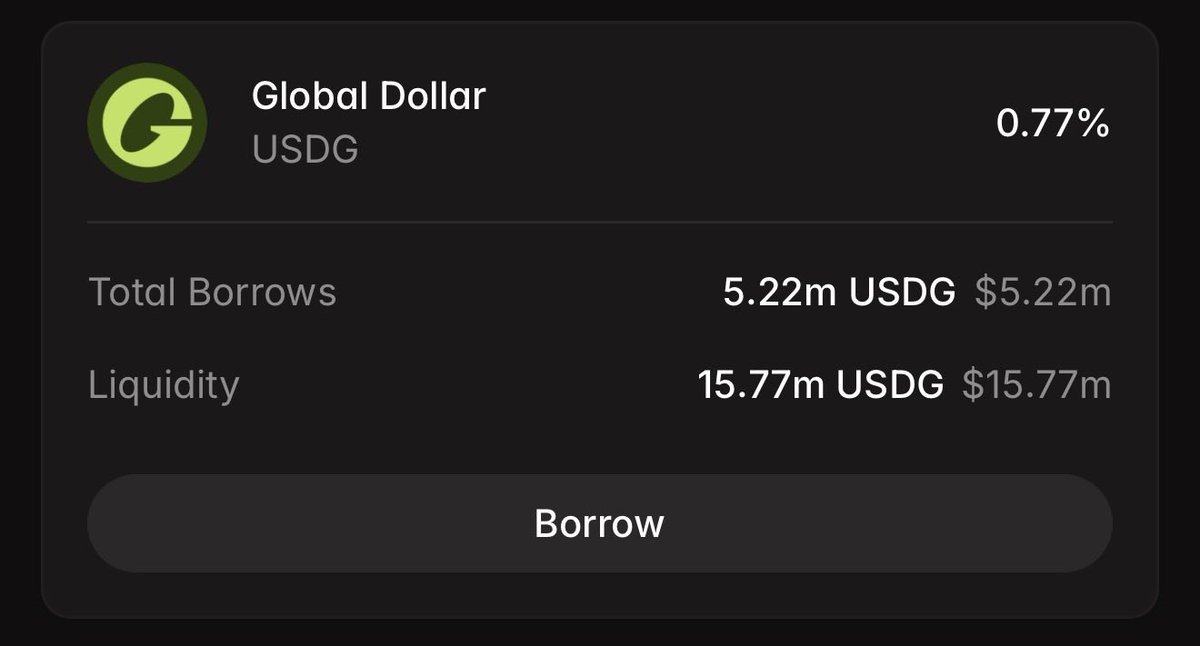
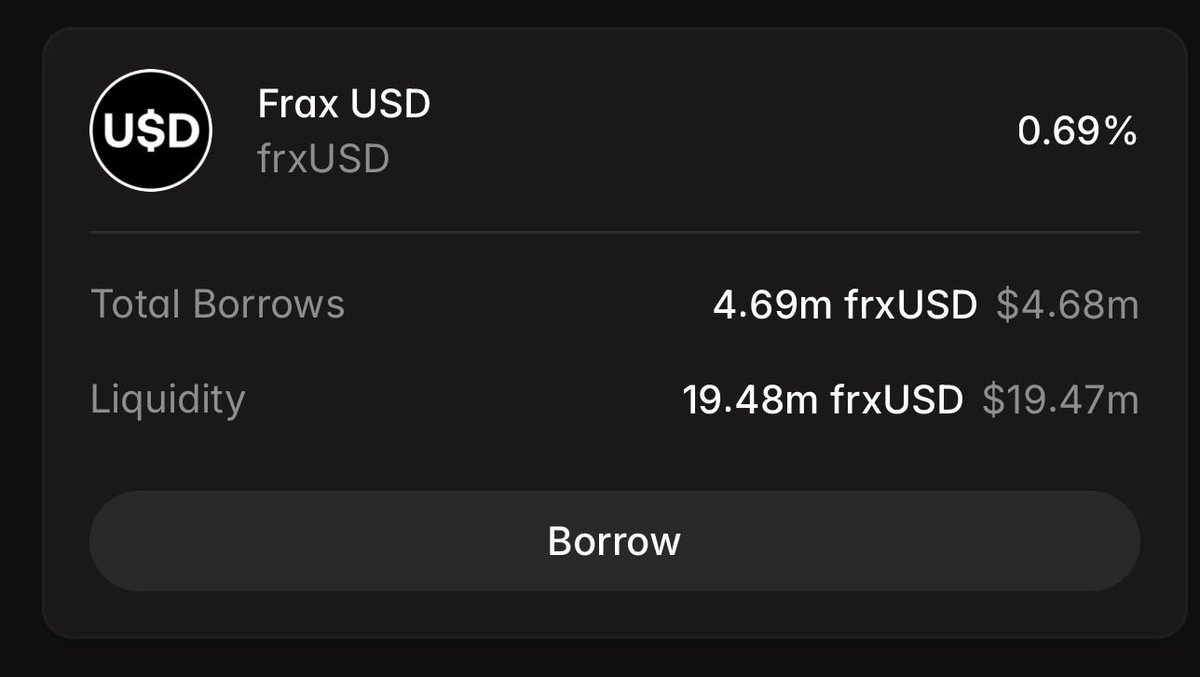
Borrower rate holidays on Aave V4.
USDG and FraxUSD represents the new gen stablecoins that value sharing more rewards with the users. This is net positive for users and all stablecoins should move to this direction to share the pie.
32
36
278
27,202
capt retweeted

Jun 6
parents: "move out"
girlfriend: “quit being such a loser”
boss: "work harder"
claude: "uber for dogs (the dogs are the drivers) is a great idea, you should absolutely pursue it"
198
3,310
81,006
1,261,405

🫡
Jun 5

For @gnosispay users:
You will be able to continue using your physical and virtual card(s), but they will be linked to a new onchain Gnosis Pay Safe. Make sure to NOT send funds to old one anymore as they will be likely lost!
All old Pay Safes were vulnerable and have therefore been replaced. Depending on the owner structure, only some were actually compromised and drained (by either white or black hat).
If your old Safe was drained, your new Safe will be funded by Gnosis. If it was not compromised, you will need to migrate your funds to the new Safe.
27
capt retweeted

Jun 5
Most people still holding $eth are likely ready to go down with the ship; at least I am.
Ethereum is a bastion of freedom and self-sovereignty in an increasingly controlled world.
No amount of number go down could get me to sell. Even with most of my net worth in eth, I would hold it to literal zero.
I would rather take a chance on eth and be wrong than give up hope on the most inspiring invention of my generation.
Come zero or valhalla, I'll be here.
Believe in somΞthing.
114
118
1,385
63,212
capt retweeted

Jun 5
Does it suddenly feel like cryptotwitter zapped back into existence, or is it just me?
36
5
189
10,629
And eth will flip bitcoin, finally
Jun 5
Ok, Ethereum will become the world’s settlement layer.
Price discovery for assets like fiat currencies (FOREX), gold, and equities will take place here.
New powerful entities (aka DAOs) will exist, where people organize with each other beyond the main entities that exist today: nation-states and companies.
And then a whole lot of things we don’t even know about yet.
34
capt retweeted

Jun 5
Woke up extremely bullish on DeFi and Ethereum today
Uniswap launched in the 2018 bear, when Ethereum sentiment was at all time lows
Uniswap and other defi projects relentlessly built through that bear market and proved how powerful Ethereum can be, catalyzing defi summer and everything since
Now vibes are down bad again and Uniswap intends to build our way out of it. Last time it was by proving defi is possible. This time it will be by proving defi is inevitable.
The internet brought two disruptive changes: existing businesses moving onto the internet, and the formation of new internet-native businesses
The same duality will exist for defi: the tokenization of all existing assets, and a growing vibrant economy of crypto native assets. And it’s all happening right now, with more and more assets being brought onchain, increasing the value and productivity of crypto native assets.
As this digital economy grows, Defi is being integrated everywhere - payment processors, brokerage accounts, asset issuers. It won't stop until we eat the entire global economy
Uniswap the liquidity layer Ethereum the settlement layer. The perfect combination of low counterparty risk, permissionless, programmable infrastructure
And all this will result in huge growth in protocol volumes and fee generation. Which reminds me:
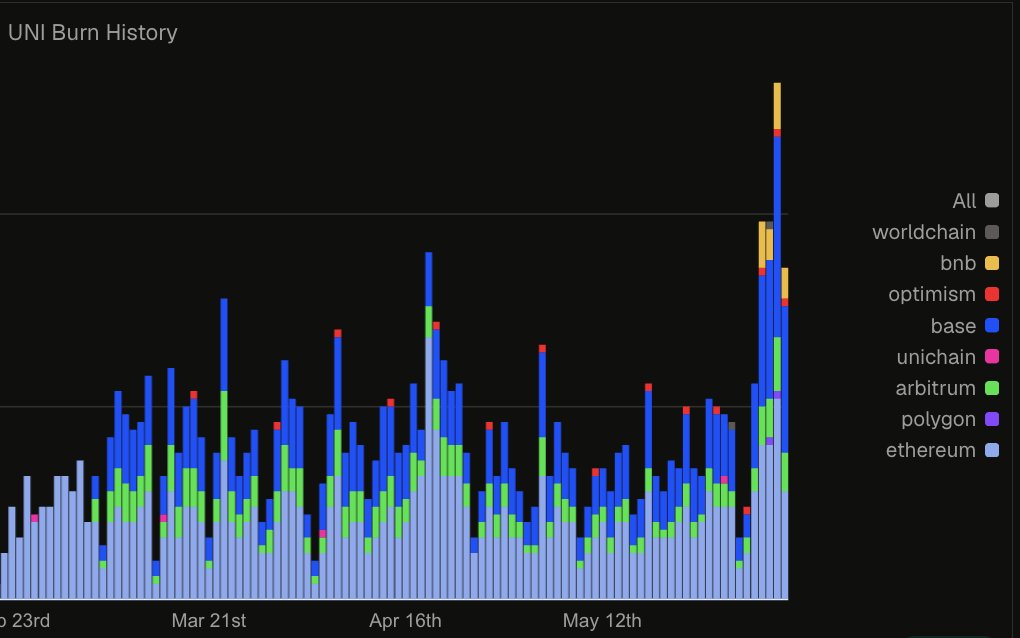
UNI burn hit all time highs today, after several new sources of protocol fees came online.
And there are many more to come: v4, uniswap x, aggregator hooks, more chains, etc
Now add in all the new assets coming onchain
We're still at the beginning 🦄
Jun 5

A new daily all-time high for UNI burned was hit yesterday
134,000 UNI burned in 24H 🔥
173
170
1,191
105,149