
We are financial technology innovators dedicated to generating alpha through advanced algorithms and automation.
Joined September 2024
- Tweets 104
- Following 4
- Followers 15
- Likes 27
3 Photos and videos

Mar 24
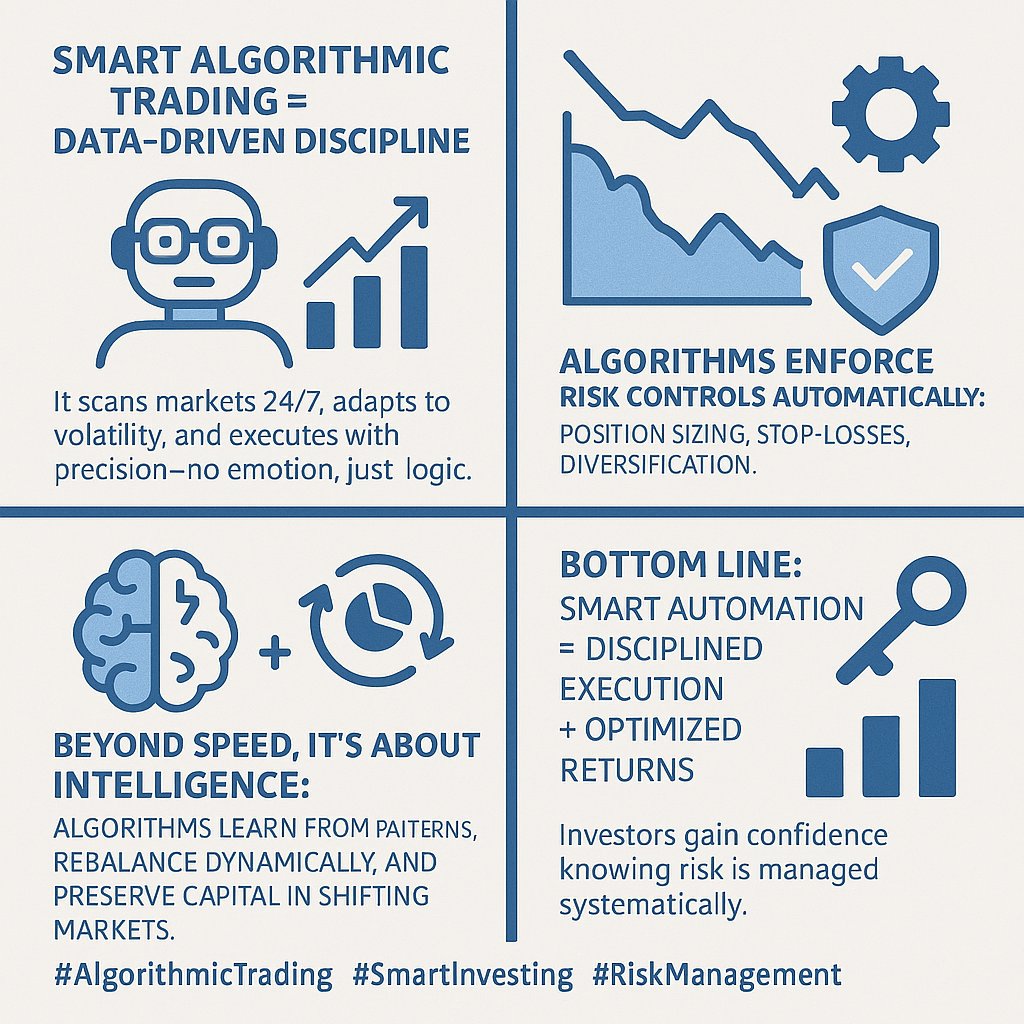
Algorithmic Real-Time Logic Integration. 🧵
1/ Modern stacks aren't just looking at price. They’re ingesting live liquidity maps, social sentiment, and macro event streams directly into the execution engine. If the order book thins or sentiment shifts mid-trade, the logic pivots instantly. 🔄
2/ Dynamic Risk Management: Gone are static stop-losses. We’re seeing "Volatility-Adjusted Circuit Breakers" that recalibrate based on real-time ATR and slippage data. Your bot now knows when to size down before the flash crash even hits the tape. 📉
3/ The Multi-Source Advantage: By syncing APIs for on-chain RWA data, news flow, and L2 exchange feeds, traders are building "Market Aware" scripts. The result? Lower drawdowns and much higher execution precision. 🎯
#AlgoTrading #QuantitativeFinance #TradingTech #FinTech
1
1
15
Mar 16
Algorithmic trading is the ultimate safety net. 📉🛡️
By monitoring multiple indicators in real-time, algos can detect unfavorable price action and exit positions instantly—faster than any human could react.
It’s not just about winning, it’s about systematic capital preservation. 🤖💻
#AlgoTrading #RiskManagement #FinTech
1
1
11
Mar 12
The gap between manual and algorithmic trading is widening rapidly. Algorithmic trading has the ability to synthesize massive amounts of data into a single, logical action in real-time.
It follows a high-speed "Three-Step Loop":
Ingestion (The "Sensors"): The bot pulls live data from multiple APIs—not just price, but also "Alternative Data" like social media sentiment, weather patterns (for commodities), and macro-economic trackers.
Analysis (The "Brain"): It runs this data through a Decision Tree or Neural Network. For example: “IF [Sentiment is Bullish] AND [Volume > 2x Average] AND [RSI < 70], THEN [Identify Entry].”
Simulation (The "Alternative"): Algos don't just pick one path. They analyze in the background, comparing multiple strategies (e.g., Trend Following vs. Mean Reversion) and selecting the one with the highest probability of success for that specific market condition.
1
1
18
Mar 10
Algorithmic trading bots are no longer just tools-they are the architects of the new market paradigm.
By processing data at speeds humanly impossible, they exploit information asymmetries in milliseconds to capture alpha.
Precision, speed, and asymmetric returns.
#AlgorithmicTrading #FinTech #QuantLife #TradingBots
1
3
16
Mar 9
A "thoughtful" algorithmic agent moves beyond static automation to act as a dynamic orchestrator for your investments.
By shifting from rule-based to context-aware decision-making, it fundamentally transforms the traditional portfolio lifecycle.
1
2
16
Mar 8
Automated trading is flipping the script for hedge funds and family offices, swapping rigid models for hyper-tailored, real-time execution.
It’s no longer about following the herd—it’s about precision, speed, and strategies as unique as the capital behind them.
The future is personalized trading bots. 🤖🚀
#FinTech #HedgeFunds #FamilyOffices #AlgorithmicTrading #WealthManagement
1
2
12
Mar 6
Algorithmic trading is revolutionising how we navigate the markets by turning massive data streams into actionable insights. 📈
Through automated pattern recognition, these systems identify intricate trends and market anomalies that human traders might miss.
1
2
16
Mar 5
Laundromats didn’t just automate the wash; they reclaimed the entire day from the manual scrub. 🧼
Algorithmic trading is doing the same for the "stare at the screen" era. We’ve traded the repetitive, manual heavy lifting for a system that runs in the background.
What was once a grueling chore is now just part of the plumbing of modern life. Manual trading is no different and algorithmic trading is making trading less stressful for traders.
1
9
CatBotsHQ retweeted

Mar 3
tesing bulk api : get bal > buy > get bal > sell in less than a second. Lightning speed.
1
4
11
463
Mar 4
Algorithmic trading is exploding as markets move toward tokenization. In some major markets, over 70% of perpetuals volume is already automated.
With the tokenized asset market projected to reach a staggering $41.9 trillion by 2032, human-only desks simply can't keep up.
Bots don't sleep, and in a global, tokenized economy, opportunities never seize. 📈🤖
#AlgoTrading #Tokenization #FinTech #FutureOfFinance
1
11
Mar 3
Algorithmic trading isn't just executing orders; it’s providing holistic strategy adjustments in sub-seconds. We’ve moved from static rules to AI agentic models that:
✅ Self-Optimize: Automatically rebalancing entire portfolios based on live macro shifts, not just price action.
✅ Contextualize: Fusing news sentiment, ESG data, and on-chain analytics to adjust risk parameters on the fly.
✅ Predict & Pivot: Identifying regime changes (from trend to mean-reversion) and switching the underlying logic.
It’s no longer about who has the fastest line to the exchange—it’s about whose strategy can learn and breathe with the market. 🌊
1
1
16
Mar 2
The era of "one-trick pony" algorithms is over. 📉➡️🚀
The biggest pivot isn't just faster execution; it’s the evolution of #AlgorithmicTrading into full-scale, Portfolio Management Systems (PMS).
Here’s how the game has changed:
From Silos to Synapses: Strategies are no longer locked into single assets. New hybrid architectures analyze cross-asset correlations in real-time—balancing Equities, FX, and Crypto in one unified logic.
Regime-Aware Risk: Instead of static stop-losses, algos now use "Regime Detection" to sense shifting market climates, automatically pivoting from aggressive trend-following to defensive mean-reversion.
The Alpha of Efficiency: By integrating automated rebalancing and tax-loss harvesting, these systems don't just hunt for price gaps; they optimize the entire "yield-to-risk" lifecycle.
2
2
26
Mar 1
How do AI bots decide when to exit a trade? It’s a mix of "memory" and your personal "strategy" 🤖📈
Historical Pattern Matching -
Bots scan millions of past data points to find "lookalike" scenarios. If current price action mirrors a 2022 setup that resulted in a 10% drop, the bot calculates the probability of success and may tighten your stop-loss before the dump happens.
The Customization Layer -
The best bots don't just follow the herd; they follow your rules. By combining historical trends with your User-Defined Parameters, they calculate the optimal exit.
1
2
19
Mar 1
How do AI bots decide when to exit a trade? It’s a mix of "memory" and your personal "strategy" 🤖📈
Historical Pattern Matching -
Bots scan millions of past data points to find "lookalike" scenarios. If current price action mirrors a 2022 setup that resulted in a 10% drop, the bot calculates the probability of success and may tighten your stop-loss before the dump happens.
The Customization Layer -
The best bots don't just follow the herd; they follow your rules. By combining historical trends with your User-Defined Parameters, they calculate the optimal exit.
1
16
Feb 27
Algorithmic trading is the future because it replaces human emotion with mathematical precision. In a world of millisecond advantages, "manual" is too late too slow.
Early adopters are winning, they already have edge in next decade of finance. 🚀 #AlgorithmicTrading #FinTech #FutureOfFinance
1
2
18
Feb 26
Algo trading can easily convert a "Gamble" to "Calculated Hedge" strategy - like Statistical Arbitrage or Market-Neutral Pairs Trading, doesn't care if the market goes up or down.
Calculate spread between correlated assets monitor hundreds of pairs real time to seize the arbitrage opportunity. Trading bots can do this !
2
2
21
Feb 25
Algo bots scan multiple exchanges simultaneously, calculating optimal execution paths factoring liquidity depth, bid-ask spreads, funding rates, commission - all in few seconds.
They find arbitrage through execution efficiency. Bots can pick micro-opportunities. 📊⚡
1
1
18
Feb 24
Trading bots never sleep, never take holidays, operate across every global market simultaneously. While you're offline, they're executing strategies.
Markets are now 24/7/365. Manual trading is a part-time job competing against full-time machines.
2
2
15
Feb 23
Smart traders use algos to stress-test their strategies across thousands of scenarios, optimize entry/exit timing down to the tick, and eliminate emotional slippage.
Same strategy, algorithmic precision gives better returns. Your edge is an idea flawless execution. 🎯📈
2
1
22
Feb 22
In a trading strategy which is time sensitive and edge shifts quickly, execution speed defines the performance.
A few seconds cost thousands of dollars. Automated bots are better placed to implement such strategies.
1
1
10