
CEO @sovereignxyz. previously: ethereum core dev @Teku_ConsenSys. simplicity maxi
Joined May 2017
- Tweets 4,072
- Following 1,253
- Followers 6,438
- Likes 23,735
95 Photos and videos













Jun 3
the biggest (and likely the only) value prop of crypto is global access to financial products
3
3
172
May 20
can we get tradingview to add hyperliquid pricing for off-market hours?
2
1
8
492
May 19
this would expand the TAM for crypto by so fucking much
May 18

*SEC SAID TO LEAN TOWARD ALLOWING THIRD-PARTY TOKENIZED STOCKS WITHOUT ISSUER CONSENT - BLOOMBERG LAW
2
3
525
Cem | Sovereign retweeted

May 13
ive spent the last year building the best architecture for trading
we chose solana because we’re aligned with the same end state: internet capital markets with global access, high-performance execution, and on-chain settlement. we just have different opinions on how to get there
blink is built to provide the same execution guarantees as traditional exchanges without making compromises on transparency, verifiability or fair-access
colocated users get deterministic, ultra-low latency order entry and market data: users win because they are better traders not because they have an unfair edge
blink is fully verifiable, auditable and transparent: users can audit every property of blink in real-time
to make this all possible we're evolving sequencer design. orders are sequenced at line-rate, in real-time and distributed over @doublezero multicast
blink is built for price discovery: real-time sequencing and market data, fair-access, no speed-bumps
until now traders have been forced to choose between best-execution on black-box models or lower-quality transparent open-models
if you are a trader, market maker, or liquidity provider who wants to compete on an equal playing field where the best traders win, reach out, id love to talk
May 13

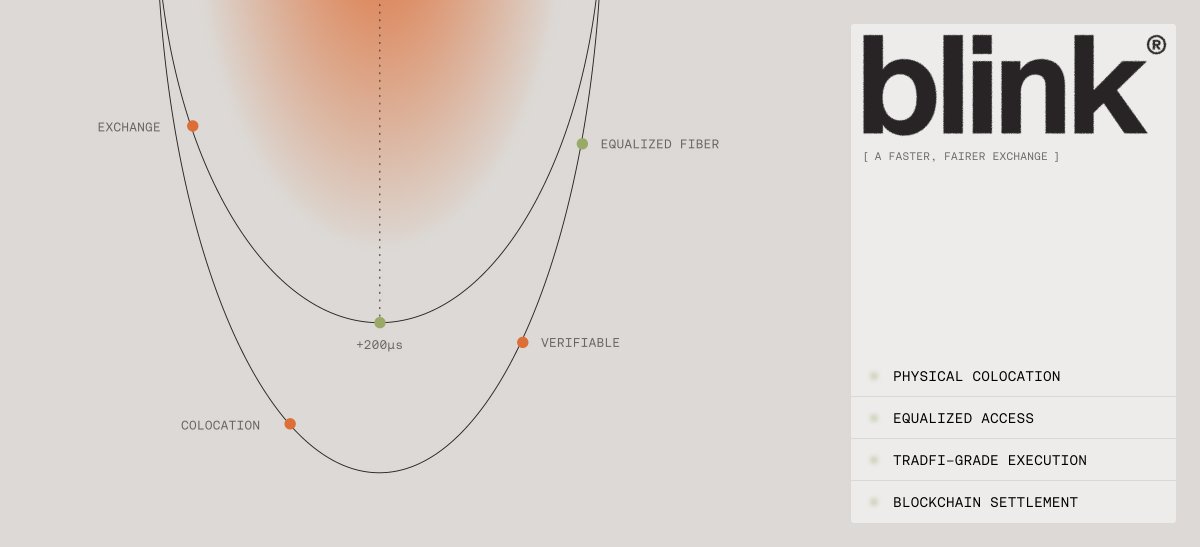
Crypto built global settlement before it built exchange-grade execution.
blink is built to close that gap.
Physical infrastructure.
Equalized access.
Tradfi-grade execution.
Blockchain settlement.
Today, blink comes out of stealth.
19
15
157
47,305
Cem | Sovereign retweeted

Apr 21
Very exciting to see @SynchronicityHQ finally come out of stealth.
This team has been quietly building for a long time, and this first look already hints at something much bigger: institutional grade trading tools made dramatically more accessible to everyone.
This is just the tip of the iceberg. Wait until they bring AI into the builder.
Reply for early access.
Apr 21

Modern markets are fundamentally extractive
We've spent three years rewiring them from scratch
One core feature is everyone deploying their own bots without code or infra
Here's a first look @SynchronicityHQ We're looking for strategists to test drive. Reply for early access
4
6
29
4,306
Apr 21
because buy and burn is growth spend.
and the best way to grow a network is to create a hardcore base of believers who are economically aligned with its success.
Apr 20

it's insane to me that buy and burn has become the default for profitable crypto protocols
why would a high growth startup would ever take its profits and distribute them to shareholders instead of re-investing for future growth, or at least holding it for runway
4
2
4
578
Apr 7
is the ethereum foundation in touch with anthropic? asking for a friend.
Apr 7

Introducing Project Glasswing: an urgent initiative to help secure the world’s most critical software.
It’s powered by our newest frontier model, Claude Mythos Preview, which can find software vulnerabilities better than all but the most skilled humans.
anthropic.com/glasswing
12
8
215
28,045
Cem | Sovereign retweeted

Mar 31
Ok I just want to add one thing.
Folks, for state actors, the value of having a quantum computer is massively higher if you DON’T tell people you have a quantum computer.
Exploiting Bitcoin is a parlor trick. Exploiting the world’s communications is where the value is at.
40
109
948
74,534
Mar 31
the speed with which we worked through ZK proof optimizations makes it clear how quickly we can now move through quantum optimizations.
and there is much, much more money at stake.
1
6
513
Mar 31
and now add autoresearch, i.e. automatable research with clear objective function (in this case reducing the number of logical bits) to the mix.
Bitcoin Core needs to move fast, or we could be looking at a major breakdown within the next few years.
2
188
Cem | Sovereign retweeted

Mar 5
Three years ago I suddenly developed blurry vision in one of my eyes.
Went to the GP.
Eye drops. No effect.
Went to a specialized eye hospital.
No solution there either.
A few weeks ago I tried something new: I asked an LLM.
It analyzed my diet and suggested I might be omega-3 deficient. It also pointed me to studies showing that this can impair the meibomian glands (which produce the oily layer that smooths the surface of the cornea.)
I started taking algae oil supplements.
Two weeks later… my vision is perfectly restored!
Honestly, I got a bit emotional.
Banning AI from being used for medical questions is a terrible idea.

A New York bill would ban AI from answering questions related to several licensed professions like medicine, law, dentistry, nursing, psychology, social work, engineering, and more.
The companies would be liable if the chatbots give “substantive responses” in these areas.
402
1,217
16,919
962,007
Cem | Sovereign retweeted

Feb 12
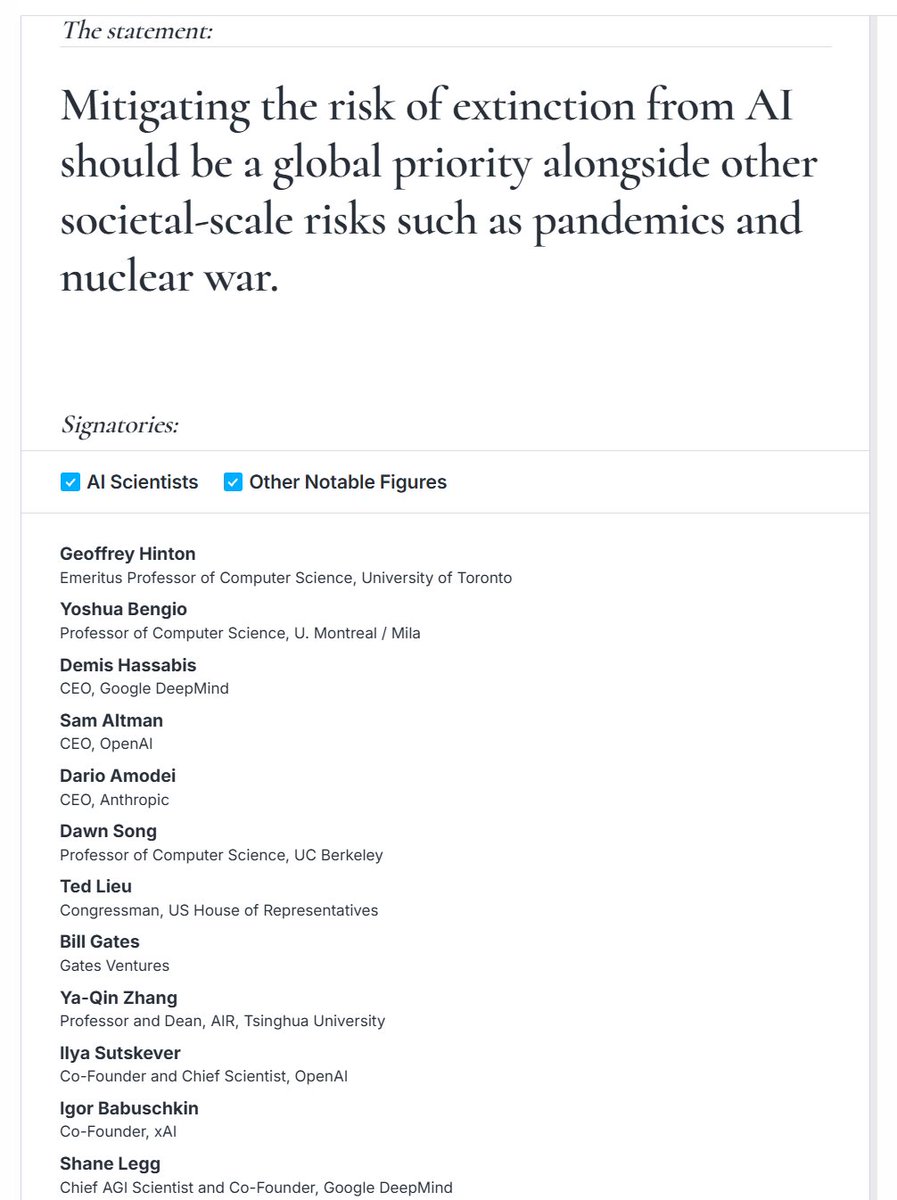
Hundreds of scientists, including 3/4 of the most cited living AI scientists, have said that AI poses a very real chance of killing us all.
We're in uncharted waters, which makes the risk level hard to assess; but a pretty normal estimate is Jan Leike's "10-90%" of extinction-level outcomes. Leike heads Anthropic's alignment research team, and previously headed OpenAI's.
This actually seems pretty straightforward. There's literally no reason for us to sleepwalk into disaster here. No normal engineering discipline, building a bridge or designing a house, would accept a 25% chance of killing a person; yet somehow AI's engineering culture has corroded enough that no one bats an eye when Anthropic's CEO talks about a 25% chance of research efforts killing every person.
A minority of leading labs are dismissive of the risk (mainly Meta), but even the fact that “will we kill everyone if we keep moving forward?” is hotly debated among researchers seems very obviously like more than enough grounds for governments to internationally halt the race to build superintelligent AI. Like, this would be beyond straightforward in any field other than AI.
Obvious question: How would that even work? Like, I get the argument in principle: “smarter-than-human AI is more dangerous than nukes, so we need to treat it similarly.” But with nukes, we have a detailed understanding of what’s required to build them, and it involves huge easily-detected infrastructure projects and rare materials.
Response: The same is true for AI, as it’s built today. The most powerful AIs today rely on extremely specialized and costly hardware, cost hundreds of millions of dollars to build,¹ and rely on massive data centers² that are relatively easy to detect using satellite and drone imagery, including infrared imaging.³
Q: But wouldn’t people just respond by building data centers in secret locations, like deep underground?
Response: Only a few firms can fabricate AI chips — primarily the Taiwanese company TSMC — and one of the key machines used in high-end chips is only produced by the Dutch company ASML. This is the extreme ultraviolet lithography machine, which is the size of a school bus, weighs 200 tons, and costs hundreds of millions of dollars.⁴ Many key components are similarly bottlenecked.⁵
This supply chain is the result of decades of innovation and investment, and replicating it is expected to be very difficult — likely taking over a decade, even for technologically advanced countries.⁶
This essential supply chain, largely located in countries allied to the US, provides a really clear point of leverage. If the international community wanted to, it could easily monitor where all the chips are going, build in kill switches, and put in place a monitoring regime to ensure chips aren’t being used to build toward superintelligence.
(Focusing more efforts on the chip supply chain is also a more robust long-term solution than focusing purely on data centers, since it can solve the problem of developers using distributed training to attempt to evade international regulations.⁷)
Q: But won’t AI become cheaper to build in the future?
Response: Yes, but —
(a) It isn’t likely to suddenly become dramatically cheaper overnight. If it becomes cheaper gradually, regulations can build in safety margin and adjust thresholds over time to match the technology. Efforts to bring preexisting chips under monitoring will progress over time, and chips have a limited lifespan, so the total quantity of unmonitored chips will decrease as well.
(b) If we actually treated superintelligent AI like nuclear weapons, we wouldn’t be publishing random advances to arXiv, so the development of more efficient algorithms and more optimized compute would happen more slowly. Some amount of expected algorithmic progress would also be hampered by reduced access to chips.
(c) You don’t need to ban superintelligence forever; you just need to ban it until it’s clear that we can build it without destroying ourselves or doing something similarly terrible. A ban could buy the world many decades of time.
Q: But wouldn’t this treaty devastate the economy?
A: It would mean forgoing some future economic gains, because the race to superintelligence comes with greater and greater profits until it kills you. But it’s not as though those profits are worth anything if we’re dead; this seems obvious enough.
There’s the separate issue that lots of investments are currently flowing into building bigger and bigger data centers, in anticipation that the race to smarter-than-human AI will continue. A ban could cause a shock to the economy as that investment dries up. However, this is relatively easy to avoid via the Fed lowering its rates, so that a high volume of money continues to flow through the larger economy.⁸
Q: But wouldn’t regulating chips have lots of spillover effects on other parts of the economy that use those chips?
A: NVIDIA’s H100 chip costs around $30,000 per chip and, due to its cooling and power requirements, is designed to be run in a data center.⁹ Regulating AI-specialized chips like this would have very few spillover effects, particularly if regulations only apply to chips used for AI training and not for inference.¹⁰
But also, again, an economy isn’t worth much if you’re dead.
This whole discussion seems to be severely missing the forest for the trees, if it’s not just in outright denial about the situation we find ourselves in.
Some of the infrastructure used to produce AI chips is also used in making other advanced computer chips, such as cell phone chips; but there are notable differences between these chips. If advanced AI chip production is shut down, it wouldn’t actually be difficult to monitor production and ensure that chip production is only creating non-AI-specialized chips. At the same time, existing AI chips could be monitored to ensure that they’re used to run existing AIs, and aren’t being used to train ever-more-capable models.¹¹
This wouldn't be trivial to do, but it's pretty easy relative to many of the tasks the world's superpowers have achieved when they faced a national security threat. The question is whether the US, China, and other key actors wake up in time, not whether they have good options for addressing the threat.
Q: Isn't this totalitarian?
A: Governments regulate thousands of technologies. Adding one more to the list won’t suddenly tip the world over into a totalitarian dystopia, any more than banning chemical or biological weapons did.
The typical consumer wouldn’t even necessarily see any difference, since the typical consumer doesn’t run a data center. They just wouldn’t see dramatic improvements to the chatbots they use.
Q: But isn’t this politically infeasible?
A: It will require science communicators to alert policymakers to the current situation, and it will require policymakers to come together to craft a solution. But it doesn’t seem at all infeasible.
Building superintelligence is unpopular with the voting public,¹² and hundreds of elected officials have already named this issue as a serious priority. The UN Secretary-General and major heads of state are routinely talking about AI loss-of-control scenarios and human extinction. At that point, the cat has already firmly left the bag. (And it's not as though there's anything unusual about governments heavily regulating powerful new technologies.)
What's left is to dial up the volume on that talk, translate that talk into planning and fast action, and recognize that "there's uncertainty how much time we have left" makes this a more urgent problem, not less.
Q: But if the US halts, isn’t that just ceding the race to authoritarian regimes?
A: The US shouldn’t halt unilaterally; that would just drive AI research to other countries. Rather, the US should broker an international agreement where everyone agrees to halt simultaneously. (Some templates of agreements that would do the job have already been drafted.¹³)
Governments can create a deterrence regime by articulating clear limits and enforcement actions. It’s in no country’s interest to race to its own destruction, and a deterrence regime like this provides an alternative path.
Q: But surely there will be countries that end up defecting from such an agreement. Even if you’re right that it’s in no one’s interest to race once they understand the situation, plenty of people won’t understand the situation, and will just see superintelligent AI as a way to get rich quick.
A: It’s very rare for countries (or companies!) to deliberately violate international law. It’s rare for countries to take actions that are widely seen as serious threats to other nations’ security. (If it weren't rare, it wouldn't be a big news story when it does happen!)
If the whole world is racing to build superintelligence as fast as possible, then we’re very likely dead. Even if you think there's a chance that cautious devs could stay in control as AI starts to vastly exceed the intelligence of the human race (and no, I don't think this is realistic in the current landscape), that chance increasingly goes out the window as the race heats up, because prioritizing safety will mean sacrificing your competitive edge.
If instead a tiny fraction of the world is trying to find sneaky ways to build a small researcher-starved frontier AI project here and there, while dealing with enormous international pressure and censure, then that seems like a much more survivable situation.
By analogy, nuclear nonproliferation efforts haven’t been perfectly successful. Over the past 75 years, the number of nuclear powers has grown from 2 to 9. But this is a much more survivable state of affairs than if we hadn’t tried to limit proliferation at all, and were instead facing a world where dozens or hundreds of nations possess nuclear weapons.
When it comes to superintelligence, anyone building "god-like AI" is likely to get us all killed — whether the developer is a military or a company, and whether their intentions are good or ill. Going from "zero superintelligences" to "one superintelligence" is already lethally dangerous. The challenge is to block the construction of ASI while there's still time, not to limit proliferation after it already exists, when it's far too late to take the steering wheel.
So the nuclear analogy is pretty limited in what it can tell us. But it can tell us that international law and norms have enormous power.
Q: But what about China? Surely they’d never agree to an arrangement like this.
A: The CCP has already expressed interest in international coordination and regulation on AI. E.g., Reuters reported that Chinese Premier Li Qiang said, "We should strengthen coordination to form a global AI governance framework that has broad consensus as soon as possible."¹⁴ And, quoting The Economist:¹⁵
"But the accelerationists are getting pushback from a clique of elite scientists with the Communist Party’s ear. Most prominent among them is Andrew Chi-Chih Yao, the only Chinese person to have won the Turing award for advances in computer science. In July Mr Yao said AI poses a greater existential risk to humans than nuclear or biological weapons. Zhang Ya-Qin, the former president of Baidu, a Chinese tech giant, and Xue Lan, the chair of the state’s expert committee on AI governance, also reckon that AI may threaten the human race. Yi Zeng of the Chinese Academy of Sciences believes that AGI models will eventually see humans as humans see ants.
"The influence of such arguments is increasingly on display. In March an international panel of experts meeting in Beijing called on researchers to kill models that appear to seek power or show signs of self-replication or deceit. A short time later the risks posed by AI, and how to control them, became a subject of study sessions for party leaders. A state body that funds scientific research has begun offering grants to researchers who study how to align AI with human values. [...]
"In July, at a meeting of the party’s central committee called the 'third plenum', Mr Xi sent his clearest signal yet that he takes the doomers’ concerns seriously. The official report from the plenum listed AI risks alongside other big concerns, such as biohazards and natural disasters. For the first time it called for monitoring AI safety, a reference to the technology’s potential to endanger humans. The report may lead to new restrictions on AI-research activities.
"More clues to Mr Xi’s thinking come from the study guide prepared for party cadres, which he is said to have personally edited. China should 'abandon uninhibited growth that comes at the cost of sacrificing safety', says the guide. Since AI will determine 'the fate of all mankind', it must always be controllable, it goes on. The document calls for regulation to be pre-emptive rather than reactive."
The CCP is a US adversary. That doesn't mean they're idiots who will destroy their own country in order to thumb their nose at the US. If a policy is Good, that doesn't mean that everyone Bad will automatically oppose it. Policies that prevent human extinction are good for liberal democracies and for authoritarian regimes, so clueful people on all sides will endorse those policies.
The question, again, is just whether people will clue in to what's happening soon enough to matter.
My hope, in writing this, is to wake people up a bit faster. If you share that hope, maybe share this post, or join the conversation about it; or write your own, better version of a "wake-up" warning. Don't give up on the world so easily.
81
196
705
107,005
Cem | Sovereign retweeted
Feb 13
Yes, you read that right.
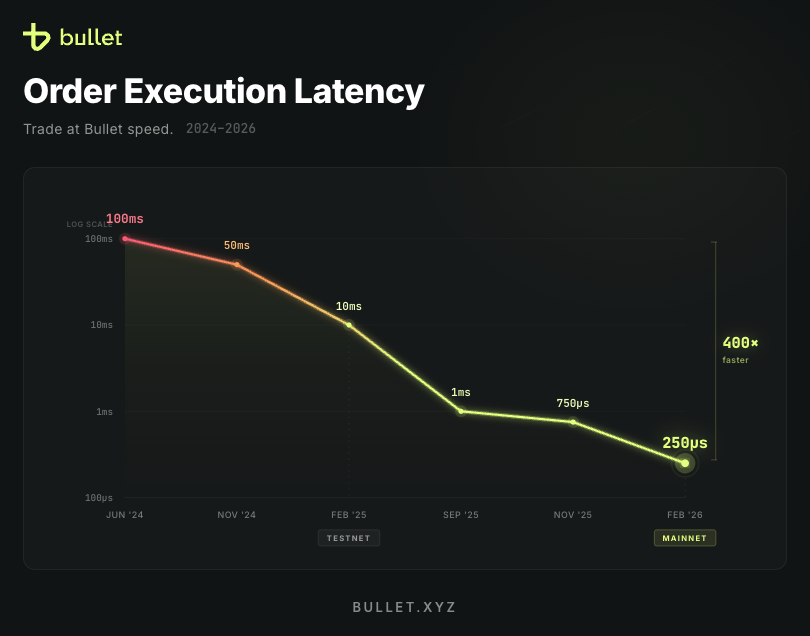
250 microsecond execution latency @ 30k orders/sec.
Unheard of performance for a DEX.
Only possible on Sovereign SDK.
Feb 12

After two years of blood, sweat and pull requests @Bulletxyz mainnet is finally here.
Absolutely stoked with what our team achieved. Getting down to an unmatched 250us order execution latency @ 30k orders/sec, unheard of for a perps DEX. Bullet's law seems to be playing out (order of magnitude speed increase every year), and the tech will only continues to get better.
Admittedly mainnet took longer than I expected, but good things take time and there are no shortcuts for building on the cutting-edge. We'll be slowly rolling out in private beta to a select group of whitelisted traders, and continue making our way through the waitlist (DM me if you are interested in getting in early, high quality feedback appreciated and welcome).
Job's not done, now we go hard on liquidity, expanding the product suite and user growth. If you see what we've achieved in just two years, imagine what we can achieve in the next two.
Bullet Time.
4
3
18
2,102
Cem | Sovereign retweeted

Feb 12
After two years of blood, sweat and pull requests @Bulletxyz mainnet is finally here.
Absolutely stoked with what our team achieved. Getting down to an unmatched 250us order execution latency @ 30k orders/sec, unheard of for a perps DEX. Bullet's law seems to be playing out (order of magnitude speed increase every year), and the tech will only continues to get better.
Admittedly mainnet took longer than I expected, but good things take time and there are no shortcuts for building on the cutting-edge. We'll be slowly rolling out in private beta to a select group of whitelisted traders, and continue making our way through the waitlist (DM me if you are interested in getting in early, high quality feedback appreciated and welcome).
Job's not done, now we go hard on liquidity, expanding the product suite and user growth. If you see what we've achieved in just two years, imagine what we can achieve in the next two.
Bullet Time.
Feb 12

Perps Trading on Solana is about to change for the better.
Mainnet is live.
Here's how you can get in early 👇
43
19
201
22,386
Feb 12
we seem so close to automated AI researchers that would soon take us to superintelligence.
no words.
5
1,332
Cem | Sovereign retweeted

Feb 12
Perps Trading on Solana is about to change for the better.
Mainnet is live.
Here's how you can get in early 👇
60
67
334
103,166
Feb 9
Reading code is about to be like reading assembly.
You might still need to in very particular cases, but it's no longer a generally useful skill.
1
9
613
Cem | Sovereign retweeted

Feb 5
.@collision and I interviewed @elonmusk.
0:00:00 - Orbital data centers
0:36:46 - Grok and alignment
0:59:56 - xAI’s business plan
1:17:21 - Optimus and humanoid manufacturing
1:30:22 - Does China win by default?
1:44:16 - Lessons from running SpaceX
2:20:08 - DOGE
2:38:28 - TeraFab
1,012
2,802
16,836
3,531,403
Feb 8
a rollup is simply a verifiable server
Feb 8

a rollup is simply a verifiable server
4
32
3,643
Cem | Sovereign retweeted

Feb 8
a rollup is simply a verifiable server
Feb 4

rollup research flourished because Ethereum hoped it would fix scaling after sharded execution was deemed too complex to ship.
but after 4 years building in this space, it’s clear to me: rollups aren’t primarily useful for "scaling" an ecosystem, unless scaling means running identical chains competing for the same use cases.
they’re a new primitive for building new blockchains easily and cheaply.
spinning up and maintaining a validator set is hard and expensive. if you’re building anything high-performance, each replica has high operational costs. and since it’s likely new software, you’ll need operators willing to deal with ongoing bugs. they’ll demand a premium.
all of this costs money and attention. resources startups should be extremely careful with.
rollups let you skip the validator set entirely. pay for data as you go.
if any party wants full security or transparency on your chain’s operations, they just run a full node pointed at the same DA layer namespace.
that’s it.
if you’re building a new chain, let’s talk.
10
9
87
17,514