
Christ-follower, Husband, Dad, Professor, Author (Beating the College Debt Trap, Thriving at College, Preparing Your Teens for College). Students & higher ed.
Joined February 2009
- Tweets 12,414
- Following 1,120
- Followers 1,399
- Likes 8,537
255 Photos and videos








Pinned Tweet

13 Mar 2018
As they graduate, help your loved ones get ready to make the most of their college years! @TyndaleHouse amazon.com/gp/product/141433…
2
5
20
May 29
legend

34
May 29
We are losing our sanity.
May 29

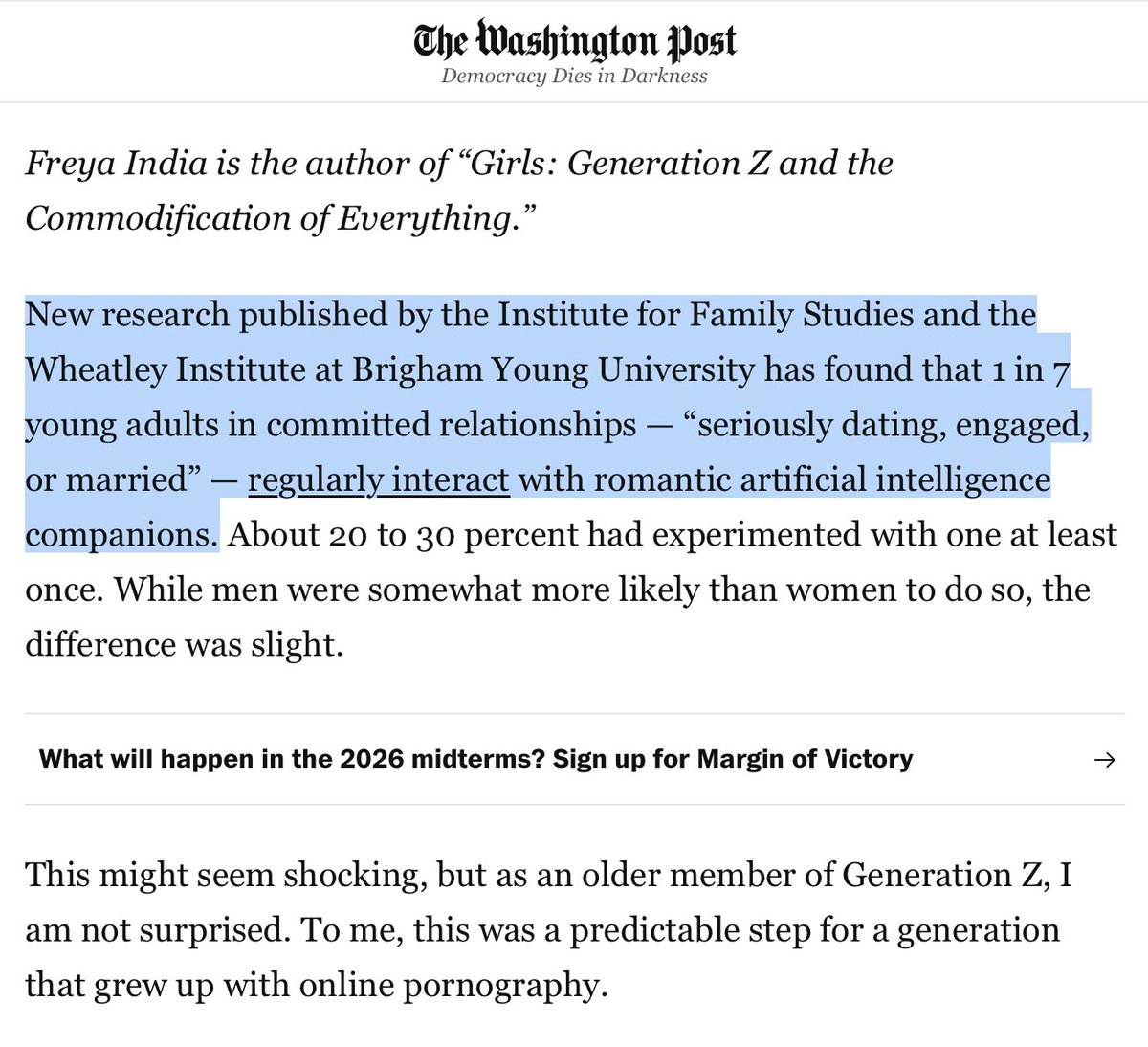
"New research. . . has found that 1 in 7 young adults in committed relationships — “seriously dating, engaged, or married” — regularly interact with romantic artificial intelligence companions." @freyaindiaa @wapo @FamStudies @BYUWheatley
34
May 28
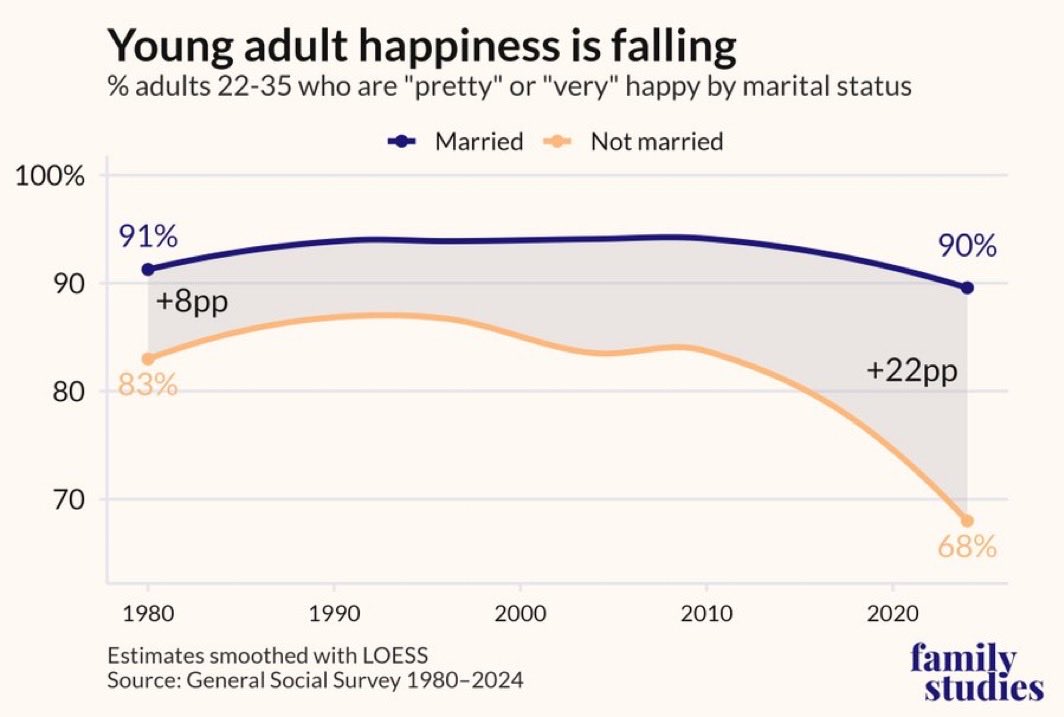
"From 2010 to 2024, happiness among married young adults fell from 94% to 90%, compared to a decline from 82% to 68% among unmarried young adults" ifstudies.org/in-the-news/gr… Hey @BradWilcoxIFS - If click on "continues", it says article is blocked. Tried on 2 browsers. Same error.
25
May 28
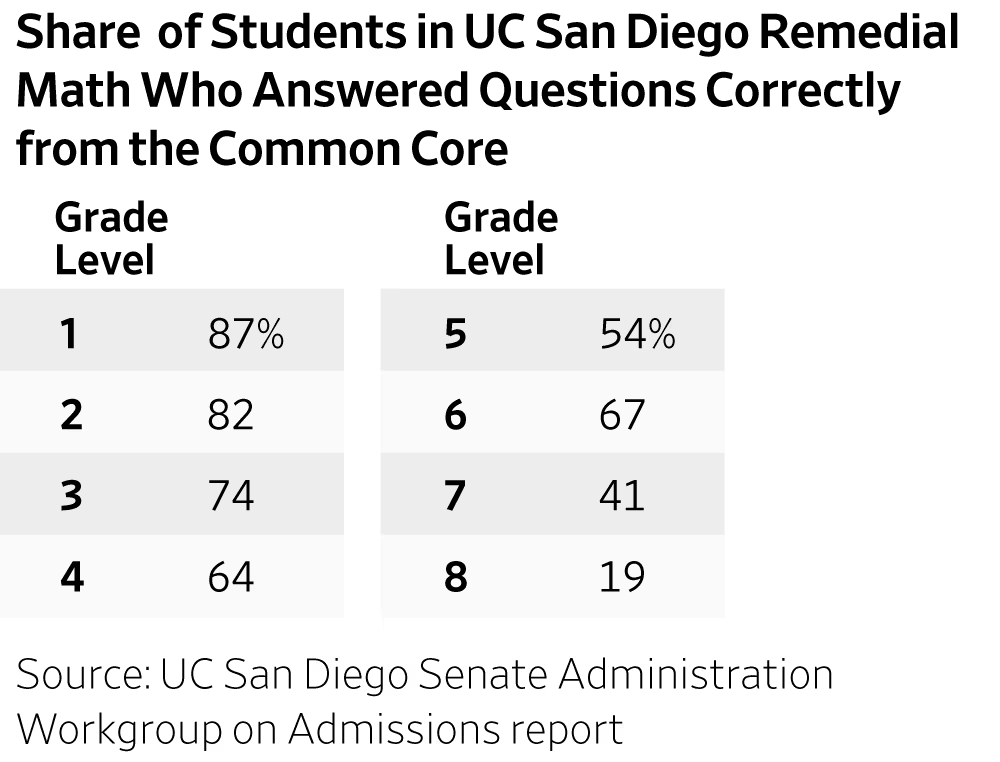
"A coalition led by UC Berkeley math professors argues that abandoning the admissions test requirement has created “preparation gaps so severe that instructors must reteach middle-school mathematics” while also trying to teach college-level math." sfchronicle.com/california/a…
1
91
May 28
While my MAGA friends gloat over Trump's massive influence in the primaries (congrats), remember that this is true:
May 27

It is depressing that Texas voters have to choose between a grifting adulterer dirtbag and an extreme far left lunatic with heretical and unacceptable cultural, theological, and political positions. Neither are acceptable candidates. Neither are conservative. Neither are moderate. Neither are fit for office. Any attempt to criticize one by defending the other is intellectually and morally deficient. BOTH candidates are unworthy of one’s support. It is not just that I CAN hold both positions at once (Paxton is personally unfit; Talarico is positionally unfit) - it is that I MUST hold both positions at once.
73
May 28
Thankful for @gcrumejr at Judson College.
May 28

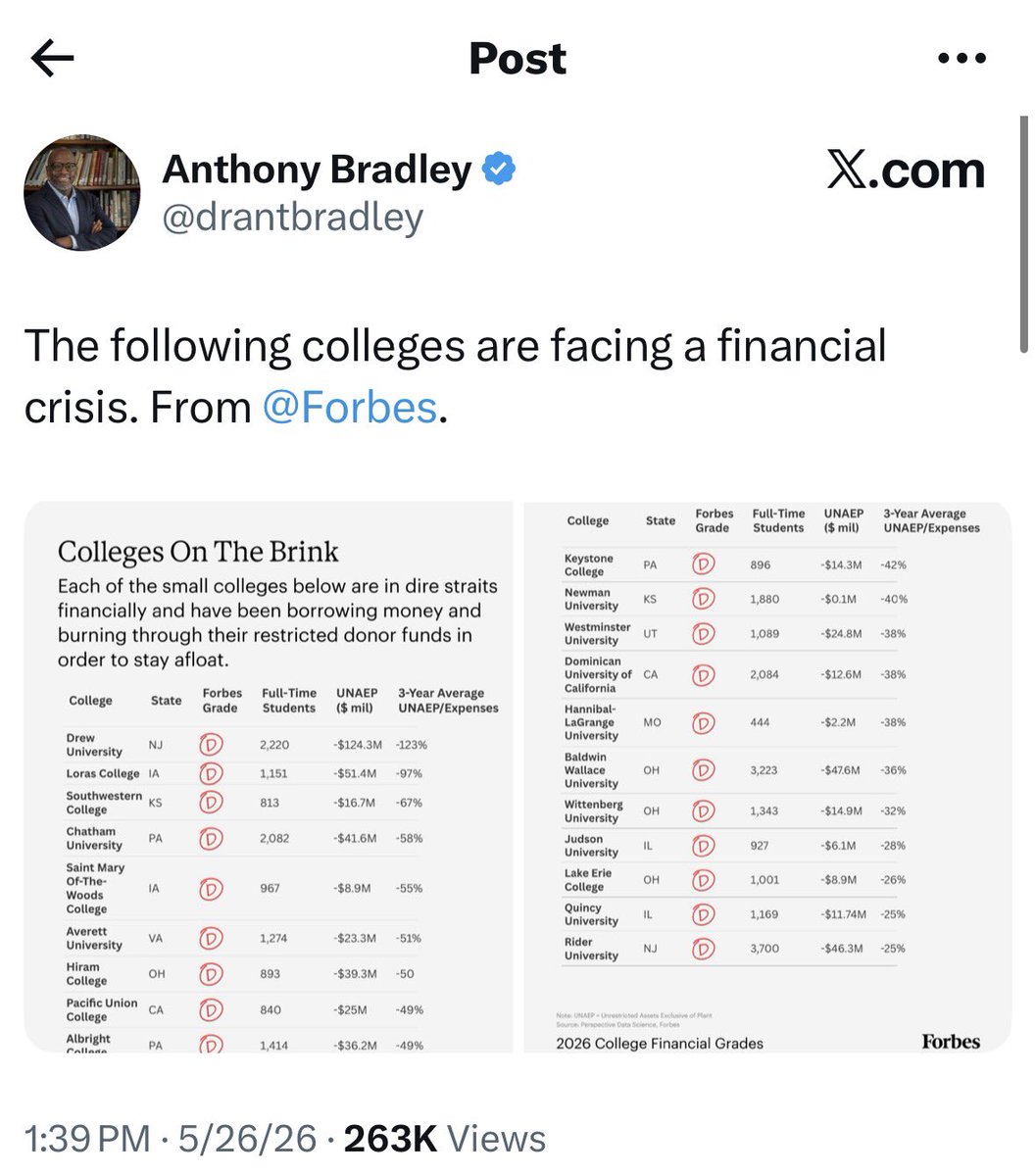
At least one college president, Christian college Judson, is telling me this list is not accurate and that Forbes used misleading metrics.
2
3
669
May 25
Great question. Almost no blip in happiness among those married.
May 25

Young adult happiness is falling, yet it’s being driven by the unmarried. Married 22-35 year olds are as happy as ever.
So why does the media keep saying that single women are the happiest out there? Who wants us all single, and why?
3
171
May 21
Strikes me as a pretty good summary, though I am less aware of the things he said about abortion.
May 21

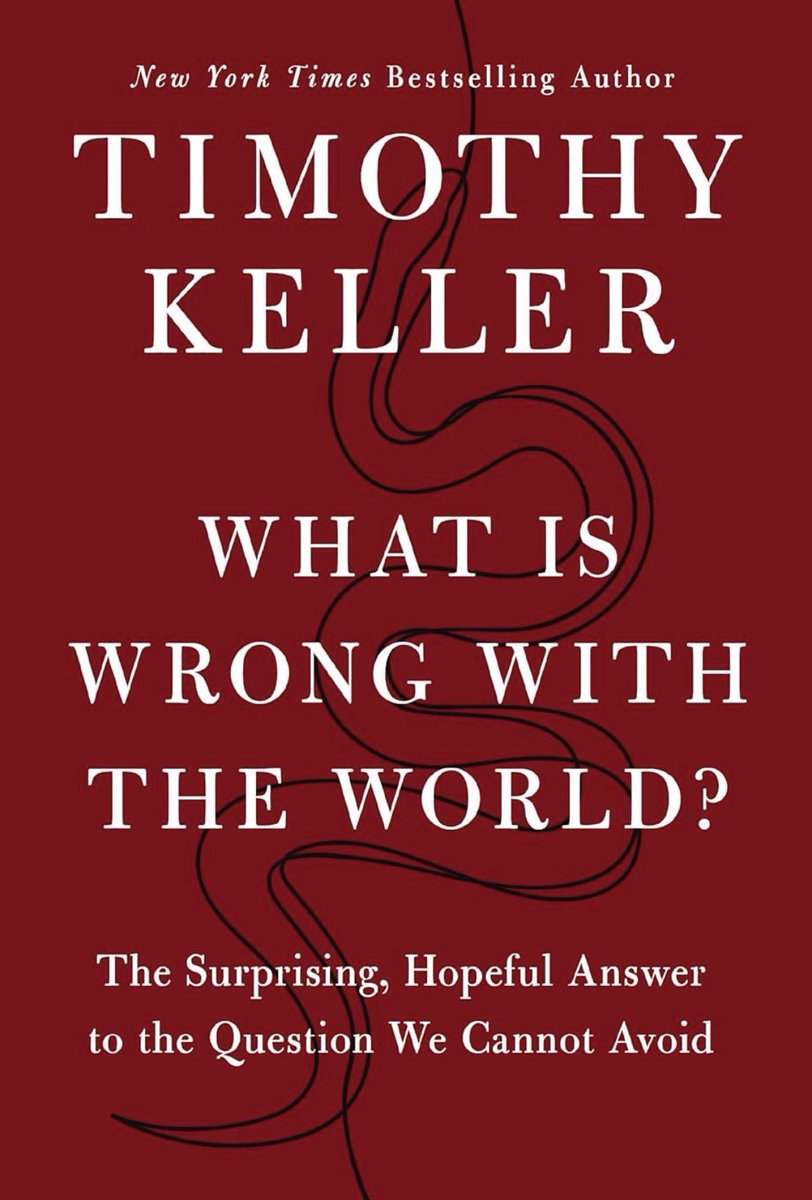
Since people seem to be commenting on Tim Keller's legacy (or at least they were and I'm late to the party), some thoughts:
-Tim Keller made an intellectually reasoned case for Christianity when I desperately needed to know that one existed.
-Tim Keller caused me to think deeply about the core significance of the atonement.
- Tim Keller challenged me to identify idols in my life that might not look like idols.
-Tim Keller highlighted the difference between gifting and qualification in ministry, which was pivotal in my thinking.
-Progressives hated Tim Keller. (A compliment)
-Tim Keller said some confusing, unhelpful, and sometimes downright inexcusable things about race, politics, and abortion.
-Tim Keller was soft on evolution, and soft on Side B ideology (although it would be difficult for someone to make the case that he was squarely Side B).
-I am grateful for how God used the ministry of Tim Keller in my life.
-I am sad about some things he taught and believed.
-I will meet him one day in glory.
1
207
May 20
CT's right to critique this regulation. Is a Christian U only supposed to produce high wage earners? Isn't the better question to ask: Are the students paying off their loans? It's their freedom to have chosen a lower wage line of work. (@megbasham)
christianitytoday.com/2026/0…
1
42
May 20
What matters is that the students make an informed decision when the begin their studies, and that they take future earning prospects into consideration when deciding how much to borrow.
1
25
May 20
Lastly, as important as earning after graduation is, education is about moral formation, not the mere transfer of information and job training (though that matters too).
24
May 19
Congrats to @DrJohnPinheiro and his co-editor on the release of their book amzn.to/4dD7zaQ!
1
53
May 19
Well reasoned

Let me lay out the unpleasant arithmetic of the replacement rate, and why a modern society finds it so hard to reach.
A population of 100 women in an advanced economy needs 210 children to replace itself. Why?
Absent sex-selective practices, roughly 105 boys are born for every 100 girls. Evolution overshoots male births because boys are more prone to early death from accidents and disease. Therefore, of 210 children, about 108 are boys and 102 are girls. Not all girls reach the midpoint of their fertile age: accidents, suicide, homicide, and illness take some. In an advanced economy, about 98% of them survive, leaving 100 women to replace the original 100.
Now consider the distribution of children per woman.
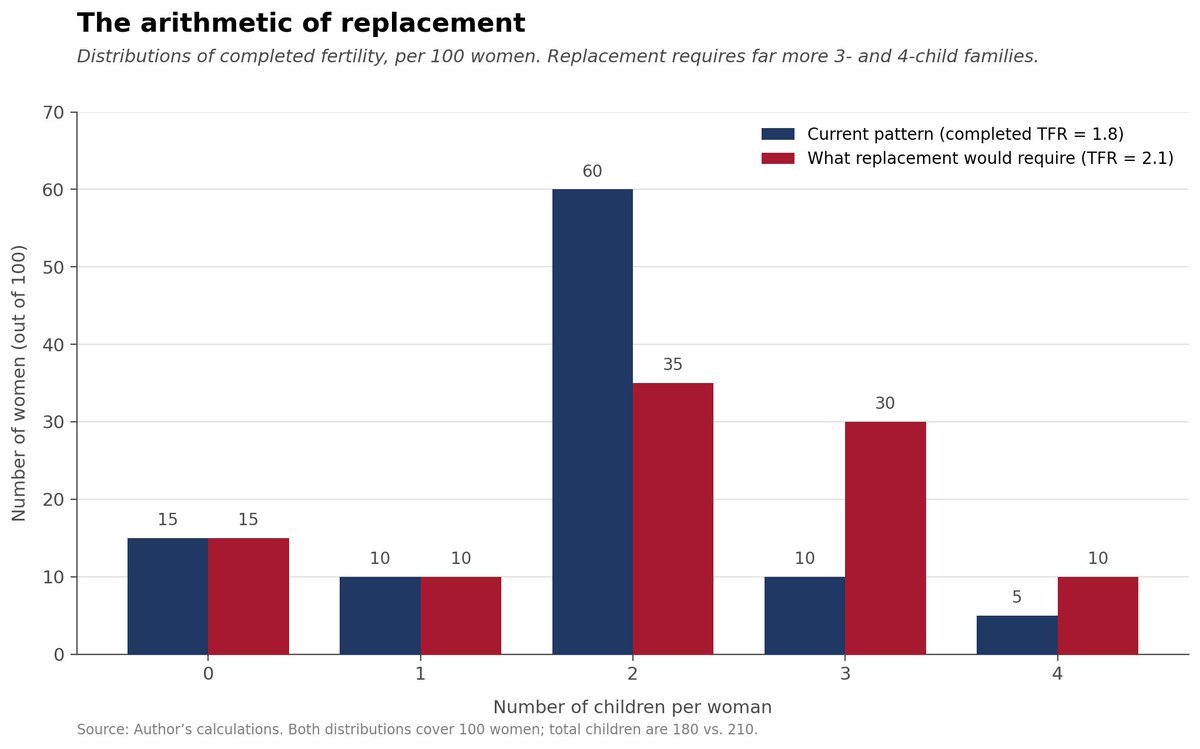
Imagine 15 women have no children. Five do so by choice, for various reasons (professional, affective, religious). Ten face unfixable fertility problems, theirs or their partner’s. The 10% figure is conservative: the medical literature points to around 13%, and that does not even count male fertility problems.
Of the remaining 85, 10 have one child, 60 have two, 10 have three, and 5 have four. I am stopping at four to keep the post concise; very few women in younger cohorts have five or more children, but I could adapt the example to account for them.
Hence, the 100 women in this population have 180 children, for a completed fertility rate of 1.8.
Interestingly, this is roughly the rate we saw in many advanced economies until the early 1990s, and in the U.S. until around 2008.
But we are still 30 children short of replacement! Voluntary childlessness is only 5%. Three-quarters of women have two or more children. Look around: most of your friends will have two, plenty will have three or four. And yet, we are well below replacement.
You would not look at this population and call it selfish (is having two kids hedonistic?) or accuse it of losing family values (only 5% of women are choosing voluntarily not to have children).
The point is simpler. To reach 210 births, you need a substantial share of women to have three or more children. Two as the “normal” pattern will not get you there. And modern society makes three or more a costly proposition for most families.
Of course, current fertility rates in most advanced economies are well below 1.8. But my point is that, under present social arrangements, we should not expect 2.1, even if (to humor last weekend’s debate) we banned smartphones and TikTok. We need many, many more families with three or four children.
More pointedly, there is no self-regulating mechanism that pushes a society back to 2.1. The market-clearing analogy many economists use is flawed; scarcity feedback does not work the same way. (Another post on this another day.) And, as I often read, the claim that “nature” somehow regulates current overpopulation is just childish mumbo jumbo.
So yes, the arithmetic of replacement rate is unpleasant.
111
May 19
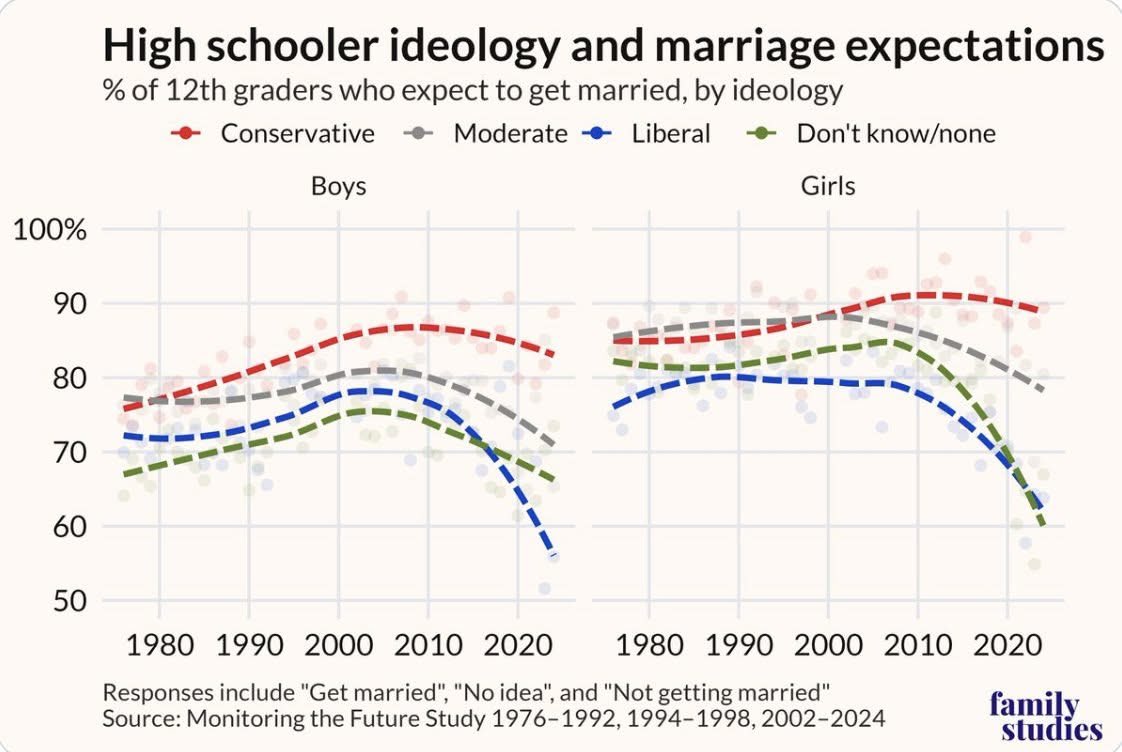
This is the way -- we must go the opposite direction as the broader culture: More marriage, kids, commitment, community building, and church belonging.
May 19

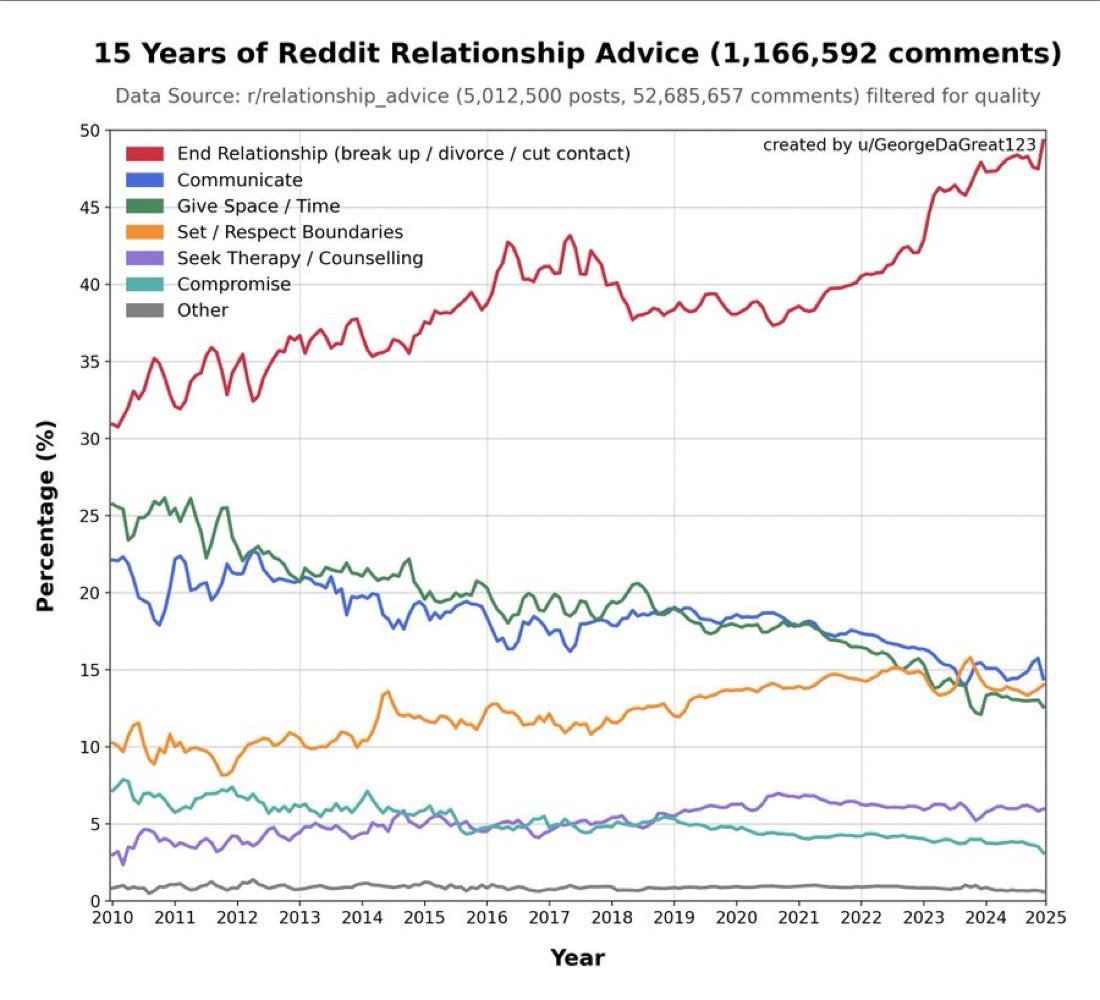
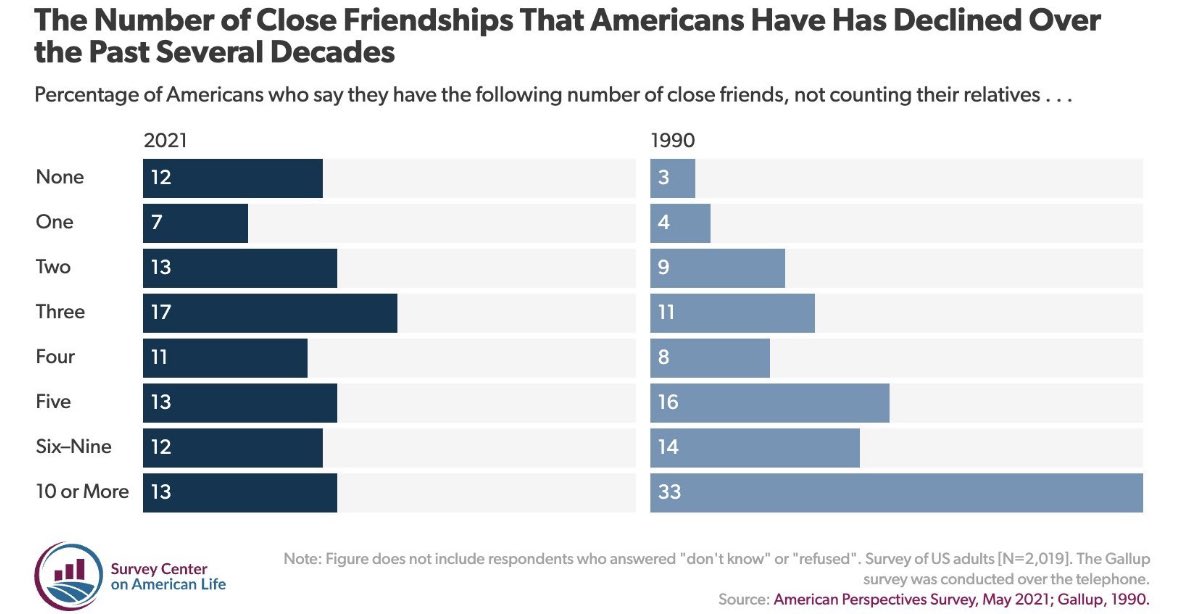
The number of marriages has declined, and so has overall happiness.
It’s not surprising that close friendships have also declined over the past several decades.
Be countercultural. Reject isolationist propaganda. Love more. Embrace commitment and community. Get married and build a legacy of your own.
100
May 18
A trend to keep an eye on. I'm thankful to God for my employer!

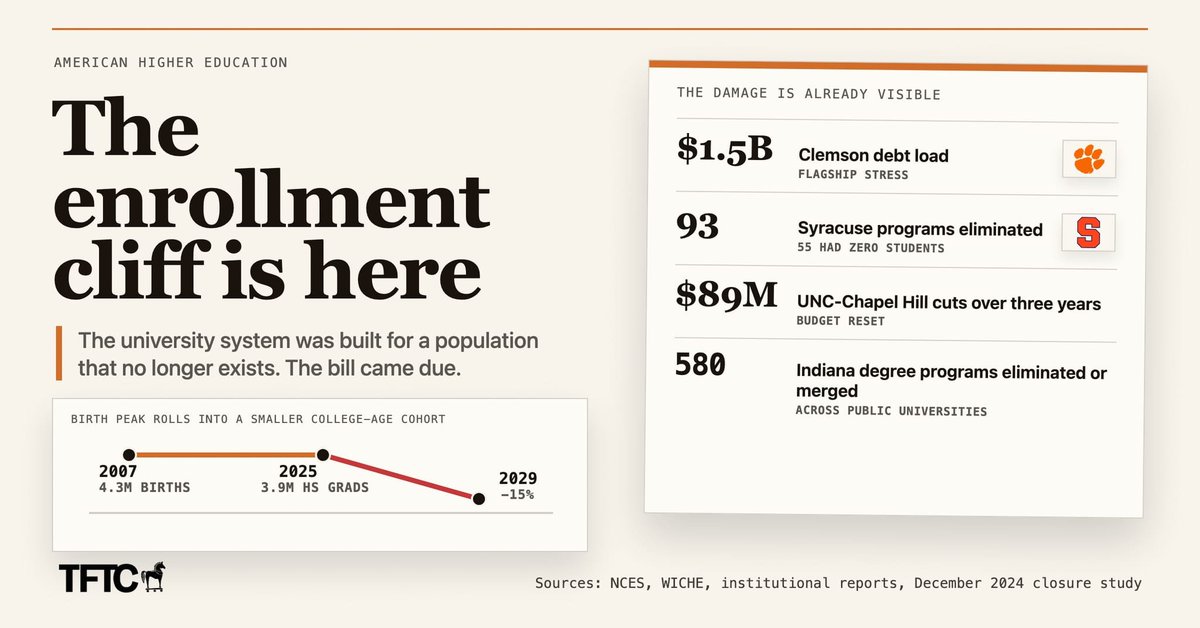
The college enrollment cliff is no longer a forecast. It is happening right now, and the damage is showing up everywhere:
Clemson is $1.5 billion in debt. Syracuse just eliminated 93 academic programs, 55 of which had zero students enrolled. UNC-Chapel Hill is cutting $89 million over three years. Duke let 600 employees go in a $350 million budget reduction. Indiana's higher education commission voted to eliminate or merge 580 degree programs across all public universities. The University of Vermont is projecting a 15% drop in its freshman class. Vermont alone has had five college closures in the last three years.
These are not small schools nobody has heard of. These are flagship state universities and elite private institutions.
The projections are brutal. High school graduates peaked at roughly 3.9 million in 2025 and will now decline steadily through 2041. A 15% drop in college-age students is expected by 2029. A worst-case scenario from a December 2024 study projects up to 80 additional college closures per year through 2029. Since 2020, more than 48 public and private colleges have already shut down.
US births peaked at 4.3 million in 2007. The birth rate dropped 4% between 2007 and 2009 and never recovered. 2026 is 18 years later. The baby bust generation just hit college age, and there are not enough of them to fill America's universities.
The American university system was built for a population that no longer exists. Tuition kept rising while the number of 18-year-olds started falling. The endowments of Harvard and Stanford will be fine. Everyone else is fighting over a shrinking pie with a cost structure designed for a world where 4.3 million babies were born every year.
That world ended in 2007. The bill just came due.
1
146
May 18
Yes, they are.
May 18

Widows are way happier than widowers after losing a spouse.
Arthur Brooks dropped this on Steven Bartlett’s podcast: Around 60% of men in their 60s say their wife is their best friend… but only 30% of women say the same about their husband. Women tend to have deeper connections with friends, family, and kids.
So when the wife dies, the husband often loses his main emotional support.
Men especially need strong relationships outside of marriage — real friendships and community — so we’re not left completely isolated if something happens.
Do you think men are generally worse at maintaining close friendships as they get older?
90
May 18
From @BenSasse "We are in a civilization-warping crisis of institutional decline. The consequences are all around us. We’re lonely...We don’t trust our institutions...We don’t trust one another." greatheartsamerica.org/wp-co…
1
34
May 18
I’m seeing a similar outcome.
May 16

Teaching in the age of LLMs:
I failed 4 students, for the first time ever. I also gave more A 's than ever before.
In previous years, students realized after the first or second HW that they weren't in Kansas anymore and needed to work hard.
No more. Just solve it with LLMs.
But then the midterm arrives, and they can answer 0 of 40 questions. Do they reform their ways? Nah, they just decide to "give up" on class, assuming they'll get a B, or a C, or whatever, because they submitted HW and got decent grades on those. And never before have they encountered a professor who will dare fail them.
The flip side is that the most "agentic" students now have the world's best tutor at their disposal. They deeply understand the material and aced my (intentionally very difficult) exams. As if we live in "The Diamond Age".
Inequality galore.
From my vantage point, "the permanent underclass" appears to be about agency, not assets.
1
104