
A (formerly) crossfitting, beer-drinking (former and future) runner with a (short-term) computer consulting problem.
Joined July 2009
- Tweets 855
- Following 103
- Followers 121
- Likes 187
94 Photos and videos







A new series: A Pause for Perspective
Lately I’ve found myself more disturbed than usual by the tone of our politics. Too often, what I see online isn’t thoughtful discussion but anger, insults, and posts that dehumanize people on “the other side.” Conservatives get called
1
25
Abraham Lincoln (Second Inaugural Address, 1865)
“With malice toward none, with charity for all…”
Lincoln was confronting a nation more divided than ours is now. If anyone had a reason to be consumed by hatred , it was him. Yet he chose language of reconciliation and humility.
12
I've been appalled each time anyone labels republicans as fascists or nazis. It is dehumanizing and dangerous and contributed to the death of Charlie Kirk.
Disagree with me on that? Okay. You also disagree with Gov. Spencer Cox (R-UT), Gov. Gavin Newsom (D-CA), Bill Maher,
2
75
Special K retweeted

30 Apr 2025
Perspective.
1,169
7,271
35,559
2,391,954
Special K retweeted

29 Mar 2025
Marc Andreessen on what makes Elon impossible to compete with
“I’m not aware of another CEO who operates the way he does.”
Marc believes you have to go back in history to the industrialists of the late 1800s and early 1900s to find founders comparable to Elon Musk (e.g. Henry Ford, Andrew Carnegie, Thomas Watson, Andrew Mellon, Cornelius Vanderbilt).
“Those guys ran very similar to the way Elon runs things… The top line thing is just this incredible devotion from the leader of the company to fully, deeply understand what the company does, to be completely knowledgeable about every aspect of it, and to be in the trenches and talking directly to the people who do the work to deeply understand the issues. And then be the lead problem solver in the organization. Basically what Elon does is he shows up every week at each of his companies, identifies the biggest problem the company’s having that week and he fixes it. He does that every week for 52 weeks in a row and then each of his companies has solved the 52 biggest problems that year.”
Marc juxtaposes this process with more conventional CEOs who respond to problems with planning, meetings, and reports.
The other crucial factor in Elon’s success that Marc points to is his ability to attract incredible talent:
“Many of the best people in the world want to work with him because if you work with Elon the expectations are through the roof in terms of your level of performance. And he is going to know who you are and what you’ve done. He’s going to know what you’ve done this week and if you’re underperforming. And he may fire you in the meeting if you’re not carrying your weight. But if you are as committed to the company as he is, and hard working and capable, many people who have worked for him say that they had the best experience of their lives.”
Marc recalls a famous line from somebody who joined SpaceX from another aerospace company and said, “It’s like being dropped into a shocking zone of competence. Everybody around me is so absolutely competent.”
And lastly, as Marc argues, Elon’s technical ability is another competitive advantage versus non-technical CEOs:
“When he identifies the bottleneck, he goes and talks to the line engineers who understand the technical nature of the bottleneck… He’s not asking the VP of Engineering to ask the Director of Engineering to ask the manager to ask the individual contributor to write a report that’s to be reviewed in three weeks. He doesn’t do that. What he does is he goes and personally finds the engineer who actually has the knowledge about the thing, and then he sits in the room with that engineer and fixes the problem with them. And again, this is why he inspires such incredible loyalty from especially the technical people who he works with. They’re just like, ‘Wow, if I’m up against a problem I don’t know how to solve, freaking Elon Musk is going to show up in his Gulfstream and he’s going to sit with me overnight in front of the keyboard or in front of the manufacturing line and help me figure this out.’”
Video source: @ChrisWillx (2024)
385
1,491
7,916
1,571,824
Special K retweeted

25 Jan 2025
Why AI Won't Cause Unemployment
Marc Andreessen
Reposted Jan 24, 2025
"In retrospect, I wish I had known more about the hazards and difficulties of [running] a business." -- George McGovern
Fears about new technology replacing human labor and causing overall unemployment have raged across industrialized societies for hundreds of years, despite a nearly continual rise in both jobs and wages in capitalist economies. The jobs apocalypse is always right around the corner; just ask the Luddites.
We had two such anti-technology jobs moral panics in the last 20 years — “outsourcing” enabled by the Internet in the 2000’s, and “robots” in the 2010’s. The result was the best national and global economy in human history in pre-COVID 2019, with the most jobs at the highest wages ever.
Now we’re heading into the third such panic of the new century with AI, coupled with a continuous drumbeat of demand for Communist-inspired Universal Basic Income. “This time is different; AI is different,” they say, but is it?
Normally I would make the standard arguments against technologically-driven unemployment — see good summaries by Henry Hazlitt (chapter 7) and Frédéric Bastiat (his metaphor directly relevant to AI). And I will come back and make those arguments soon. But I don’t even think the standand arguments are needed, since another problem will block the progress of AI across most of the economy first.
Which is: AI is already illegal for most of the economy, and will be for virtually all of the economy.
How do I know that? Because technology is already illegal in most of the economy, and that is becoming steadily more true over time.
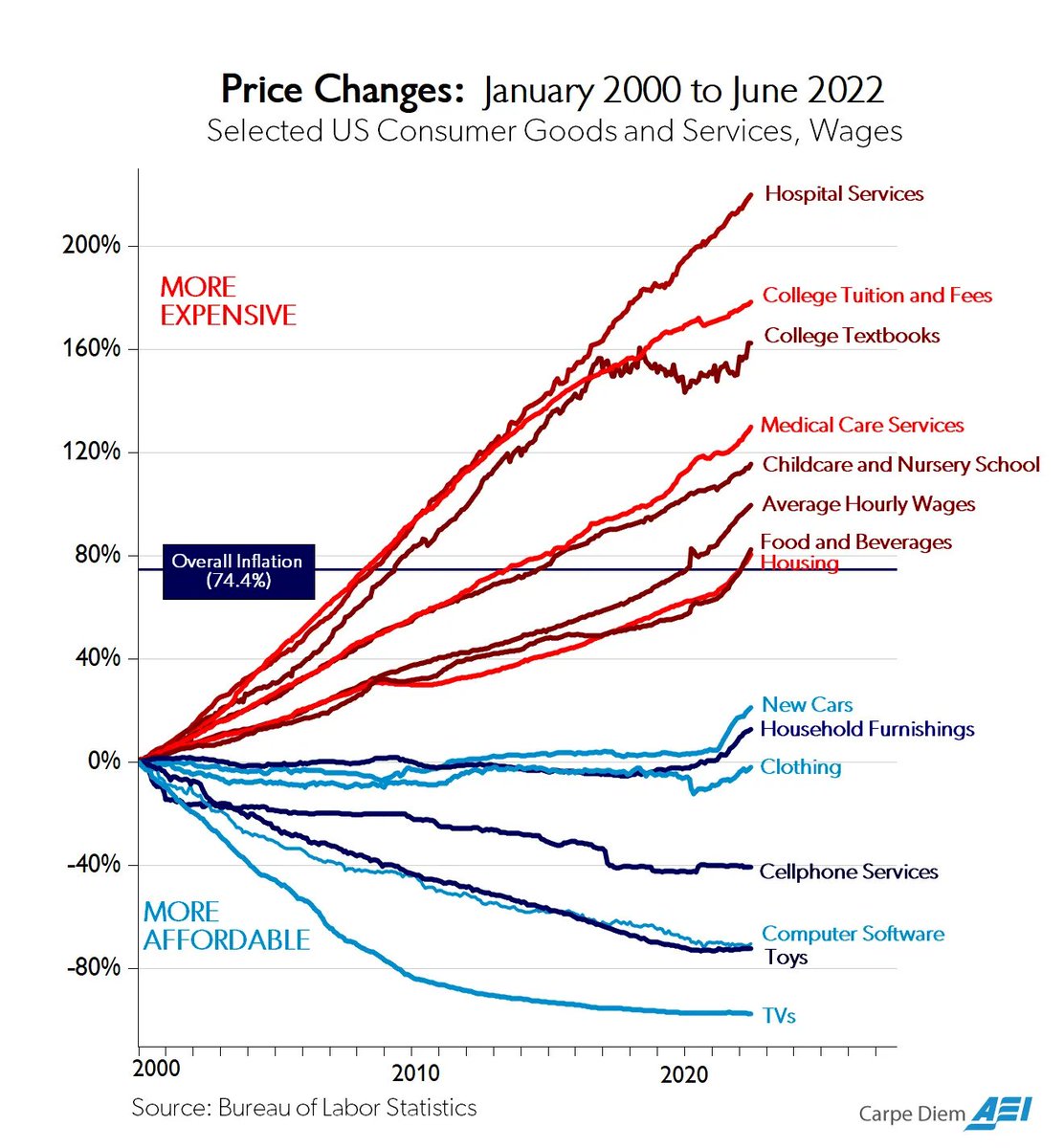
How do I know that? Because, [see chart].
This chart shows price changes, adjusted for inflation, across a dozen major sectors of the economy.
As you can see, we actually live in two different economies.
The lines in blue are the sectors where technological innovation is allowed to push down prices while increasing quality. The lines in red are the sectors where technological innovation is not permitted to push down prices; in fact, the prices of education, health care, and housing as well as anything provided or controlled by the government are going to the moon, even as those sectors are technologically stagnant.
We are heading into a world where a flat screen TV that covers your entire wall costs $100, and a four year college degree costs $1 million, and nobody has anything even resembling a proposal on how to systemically fix this.
Why? The sectors in red are heavily regulated and controlled and bottlenecked by the government and by those industries themselves. Those industries are monopolies, oligopolies, and cartels, with extensive formal government regulation as well as regulatory capture, price fixing, Soviet style price setting, occupational licensing, and every other barrier to improvement and change you can possibly imagine. Technological innovation in those sectors is virtually forbidden now.
Whereas the sectors in blue are less regulated, technology whips through them, pushing down prices and raising quality every year.
Note the emotional loading of the interplay of production and consumption here. What do we get mad about? With our consumer hat on, we get mad about price increases — the red sectors. With our producer hat on, we get mad about technological disruption — the blue sectors. Well, pick one; as this chart shows, you can’t have your cake and eat it too.
Now think about what happens over time. The prices of regulated, non-technological products rise; the prices of less regulated, technologically-powered products fall. Which eats the economy? The regulated sectors continuously grow as a percentage of GDP; the less regulated sectors shrink. At the limit, 99% of the economy will be the regulated, non-technological sectors, which is precisely where we are headed.
Therefore AI cannot cause overall unemployment to rise, even if the Luddite arguments are right this time. AI is simply already illegal across most of the economy, soon to be virtually all of the economy.
765
1,534
9,131
1,774,903