
Assessing government action against the Paris Agreement's 1.5˚C warming limit. Climate Analytics (@CA_Latest); NewClimate Institute (@newclimateinst)
Joined November 2009
- Tweets 2,148
- Following 656
- Followers 21,731
- Likes 349
916 Photos and videos
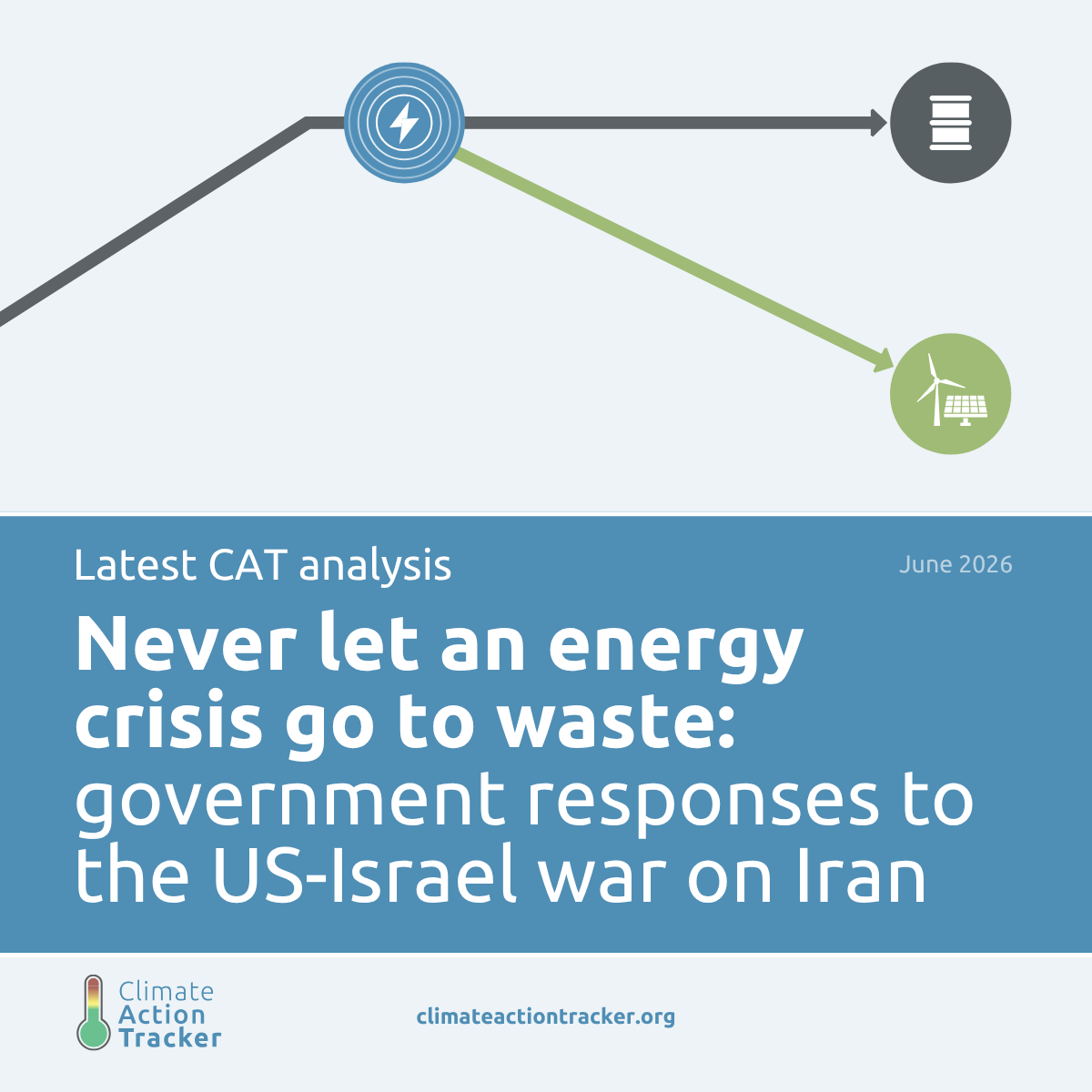

1/ Three major energy shocks in a decade, yet many governments still treat #FossilFuel volatility as a temporary disruption rather than a structural risk. Our latest briefing on government responses to the US-Israel war on Iran highlights a recurring lesson:
1
1
1
576
2/ dependence on fossil fuels leaves countries exposed to geopolitical turmoil and price shocks. As @BillHareClimate notes, the climate crisis remains the larger existential risk.
📚 Read more: climateactiontracker.org/pub…
1
537
1/ Yesterday at #SB64 in Bonn, we presented our new briefing, “Never let an energy crisis go to waste.” @niklashoehne from @newclimateinst explains:
“But this crisis is significantly different. Energy technologies are now cost-competitive, and scaling at exponential speed [...]
1
1
1
651
2/ [...] Meanwhile, #FossilFuels are expensive and insecure, and their expansion is constrained. So the hypothesis is that this time is different - and that it could flip the dynamic.” ▶️ Can this energy crisis become a catalyst for the clean #EnergyTransition?
1
610
1/ The US–Israel war on Iran has once again put #EnergySecurity at the centre of geopolitical tensions. It is the third major shock to the global energy system this decade, exposing the vulnerabilities of fossil fuel-dependent economies.
1
3
4
491
2/ But this crisis is different. Clean energy technologies have matured, deployment is accelerating, and electrification is gaining momentum. Governments now face a choice: deepen #FossilFuel dependence or accelerate the transition to a more resilient energy system.
1
2
379
3/ Our latest briefing examines responses across 40 countries following the Iran energy shock. The picture is mixed, with many governments still falling short of measures that would support future decarbonisation.
Read the full briefing here: climateactiontracker.org/pub…
2
320
📢 The #SB64 climate talks started in Bonn this week, and we are releasing a new briefing that examines how countries have responded to the energy crisis. Join our press conference - or watch it online.
📅 11 June 2026
🕒 15:00–15:30 CEST
More info: climateactiontracker.org/blo…
1
145
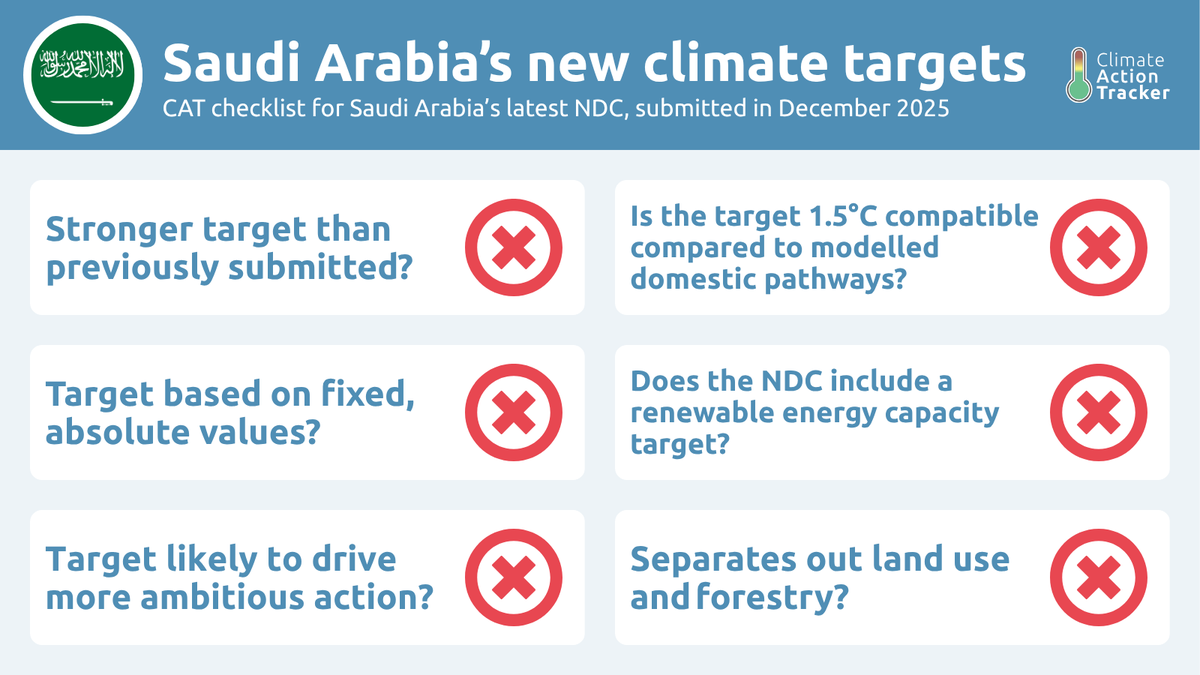
Saudi Arabia’s latest climate pledge is once again undermined by a lack of transparency. It provides no 2035 emissions reduction target, and the 2040 target is tied to an unspecified baseline projection, making ambition and progress impossible to measure.
1
2
2
515
Its new climate pledge does not raise ambition, it lowers it. Its new emissions reduction target is set at a higher emissions level than the 2030 target, widening the gap with a 1.5°C-compatible pathway. ➡️ Updated 2035 #NDC analysis: climateactiontracker.org/cou…
1
4
656
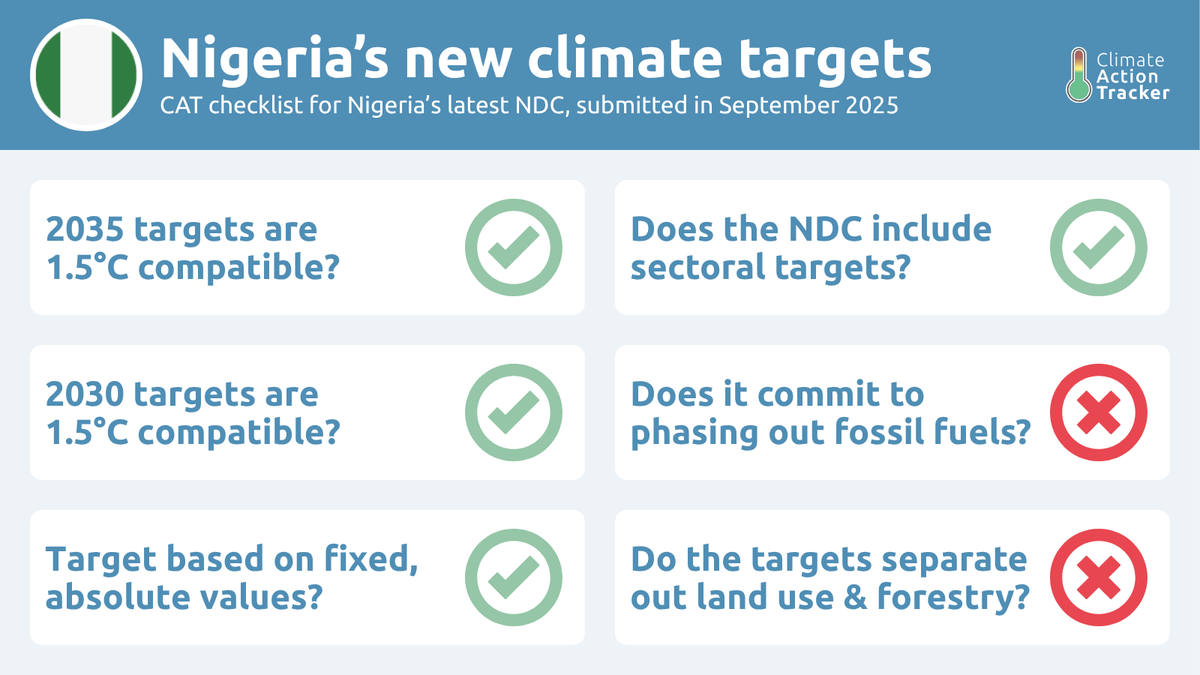
Nigeria submitted its 2035 NDC in September 2025: it is 1.5°C aligned, representing a high level of ambition. However, Nigeria's current policies are projected to significantly increase emissions, which conflicts with the new targets.
1
1
3
297
There is no commitment in the #NDC to phase out #FossilFuels, and the Nigerian economy is still heavily reliant on oil and fossil gas exports. Click here to read more about Nigeria’s 2035 NDC target: climateactiontracker.org/cou…
1
2
355
Again, India chooses a more polluting, expensive solution to its heat-related electricity crisis: more fossil fuels. It'd be better off putting this cash into renewables & grid stabilisation instead of fuelling the #climate crisis bringing the heatwaves.
bloomberg.com/news/articles/…
1
2
366
Our India country lead Nandini Das discusses India's renewable opportunities in this recent blog
climateactiontracker.org/blo…
1
271
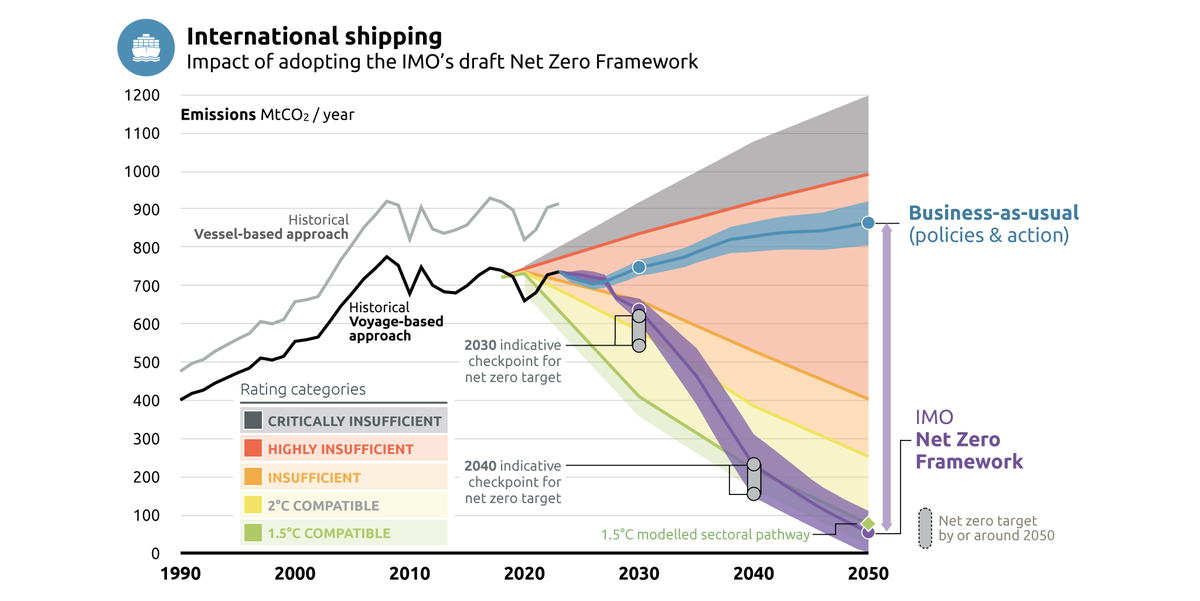
Last month, the International Maritime Organization (@IMOHQ) held its Environment Committee meeting, where member states agreed to preserve the Net-Zero Framework (NZF) as the central basis for negotiations on decarbonizing #InternationalShipping.
1
1
1
221
Reducing emissions from shipping will not be easy, but continued cooperation represents progress. As @michael_petroni, CAT Analyst, explains: “While not perfect, in its current form the Net-Zero Framework is the IMO’s most ambitious emissions reductions mechanism to date.”
1
1
2
190
➡️Our work featured in @AJOT: ajot.com/insights/full/ai-si…
1
1
1
135
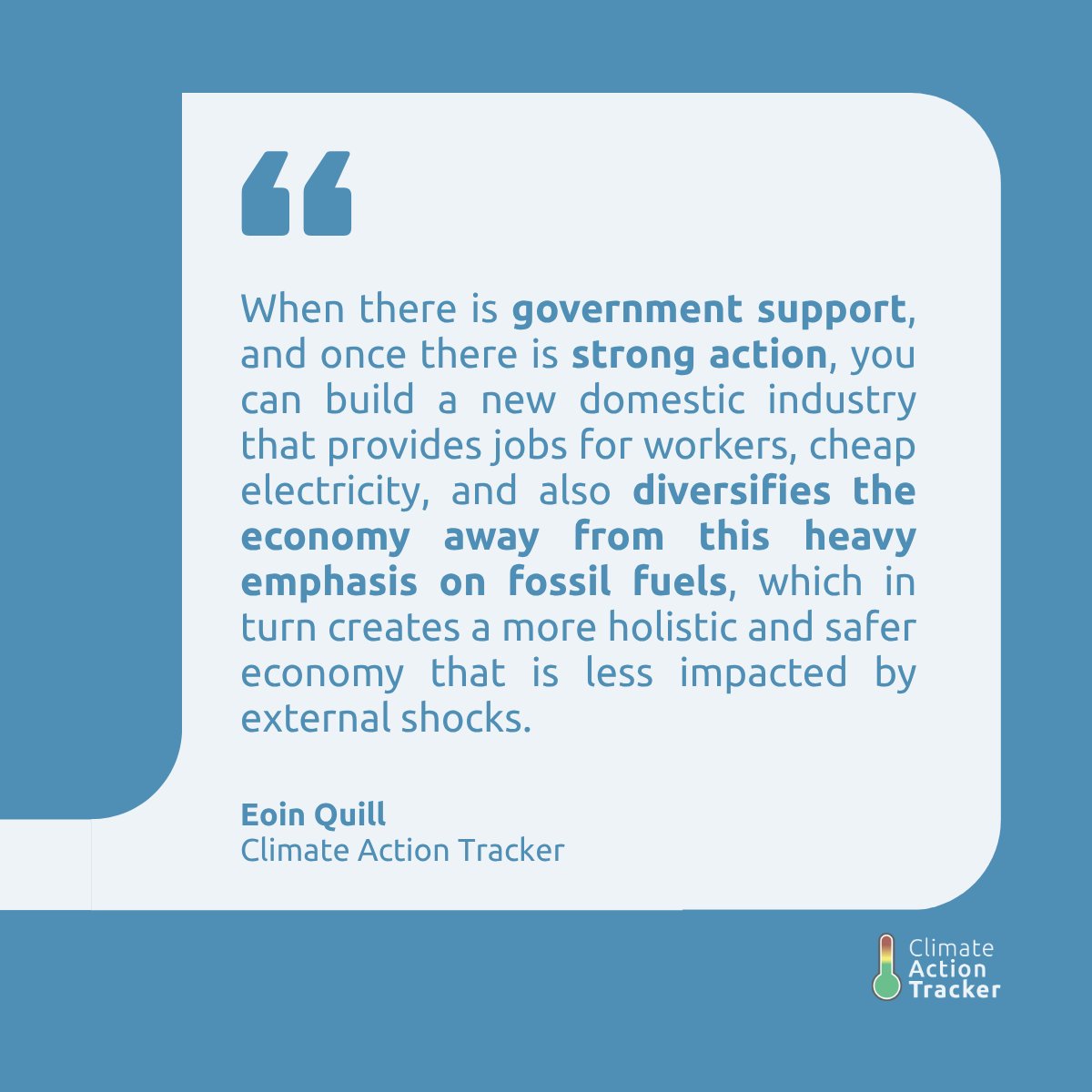
How are war and #climatechange reshaping Russia’s energy landscape? In the podcast “Energy Evolution” by S&P Global, CAT researcher Eoin Quill puts Russia’s greenhouse gas emissions into a global context.
🎧 Listen to the full episode here: spglobal.com/energy/en/news-…
2
2
228
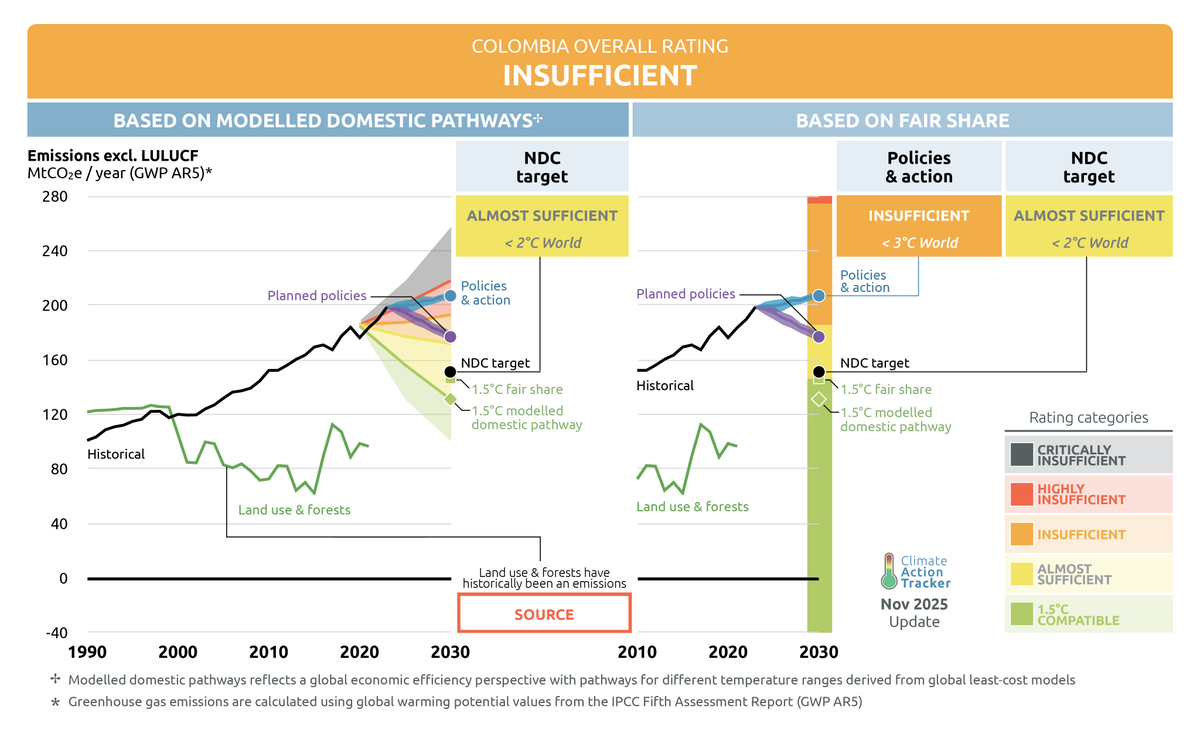
Colombia’s 2035 #ClimateTarget sends mixed signals on ambition. While the country has reaffirmed its 2030 commitment & introduced a slightly lower emissions target for 2035, the bigger picture is concerning: progress is not keeping pace with what’s needed for a 1.5°C pathway.
1
2
3
264
Colombia would need to reduce its emissions to 111 MtCO₂e, or by at least 44% below 2023 levels by 2035 (excl. LULUCF). The gap between Colombia’s NDC target and its 1.5°C compatible modelled domestic pathways has actually grown, from 12% for 2030 to 28% for 2035.
1
1
1
204
The revised NDC also acknowledges that the central challenge for Colombia is not the level of ambition but implementation. Our assessment confirms: current and planned policies are insufficient to meet either its 2030 or 2035 targets. 2035 NDC tab: climateactiontracker.org/cou…
1
1
163