There are 10 types of people in the world - those who know binary and those who don’t | coding DAGKnight eprint.iacr.org/2022/1494.pd…
Joined April 2023
- Tweets 1,796
- Following 173
- Followers 3,897
- Likes 2,295
84 Photos and videos






Jun 5
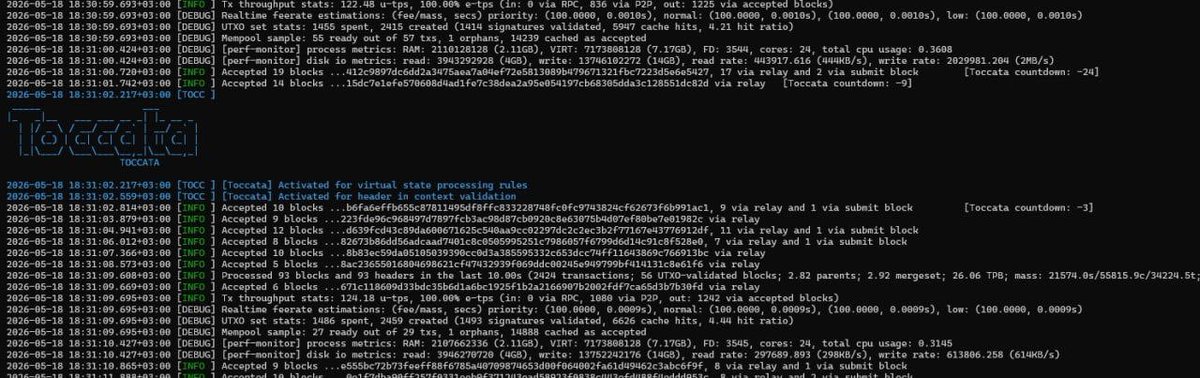
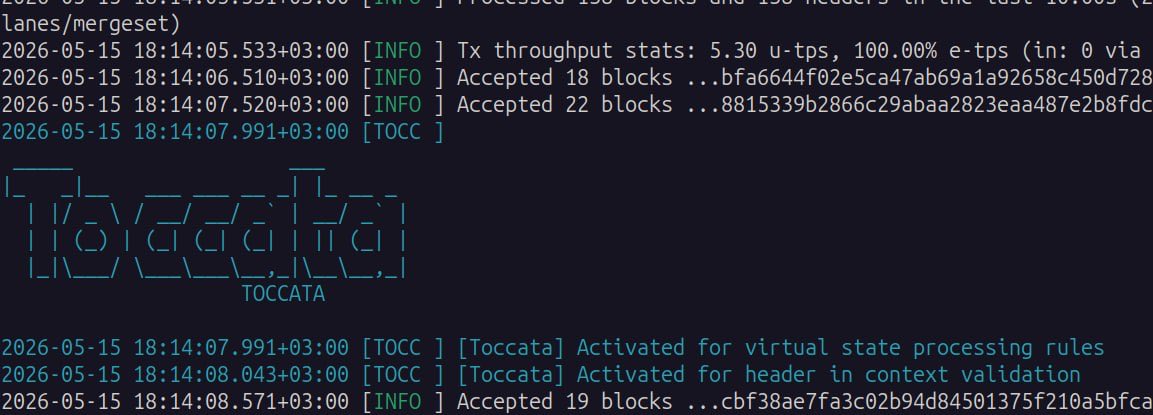
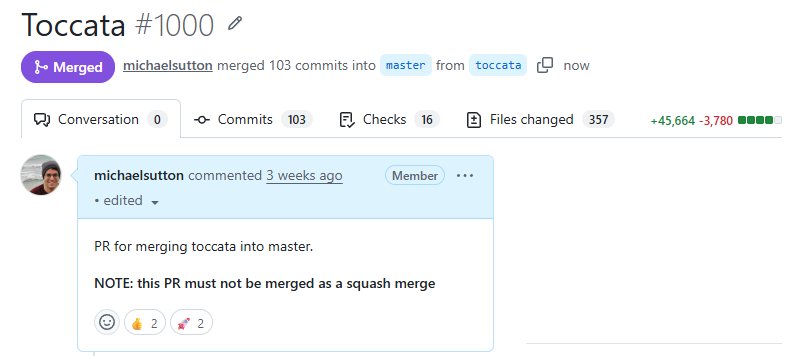
The Toccata release is finally out!
The hardfork will activate on mainnet on June 30, 2026 at roughly 1615UTC. 24hrs before activation, updated nodes will disconnect non-updated nodes. Please make sure your node is updated before then.
Release: github.com/kaspanet/rusty-ka…
Upgrade guide: github.com/kaspanet/rusty-ka…
Pools, exchanges and everyone else that needs to update please make sure you check out the release. We need to make sure all ecosystem participants are aware and upgrade in time if they want to adopt the fork.
Jun 5

**Official Toccata Release — Mainnet Hardfork Activation Included** (Links in reply)
We’re excited to announce the official Kaspa release containing the **Toccata Hardfork** activation logic.
Toccata is scheduled to activate on mainnet at DAA score `474,165,565`, expected around **June 30, 2026, 16:15 UTC**.
This is a consensus-changing upgrade. All node operators, miners, pools, exchanges, indexers, wallets, and infrastructure providers must upgrade before activation to remain compatible with the network.
Toccata introduces a major expansion of Kaspa L1 capabilities, including:
• **Native L1 covenant support** through transaction introspection, allowing for more expressive contracts, including stateful contracts
• **Covenant IDs**, providing stable covenant lineage across UTXO transitions, so covenant instances can preserve continuity as their state moves from one UTXO to the next
• **ZK proof verification on L1** via `OpZkPrecompile`, enabling to trustlessly offload computation off-chain.
• **Partitioned sequencing commitments**, improving support for based ZK applications by making lane-local proving scale with relevant activity rather than global throughput
Please upgrade as soon as possible and verify your nodes are running the new release well before the activation DAA score.
Thank you to everyone who contributed to designing, implementing, reviewing, and testing Toccata.
5
92
325
11,549
Jun 2
Behind this merge and recent annoucement are countless hours of sifting through every code path, tests, retests and head down coding by @michaelsuttonil @Max143672 @OriNewman @IzioDev et al. Finally, toccata is merged in master. Releases coming up soon (tm).
Any guesses for the mainnet DAA activation score?

Kaspa Toccata mainnet process update:
Today we plan to publish the v1.3.0 mainnet pre-release, without activation, for 1–2 days of broader network sanity testing.
Assuming everything looks good, the following release will be v2.0.0, with activation planned for June 30, 4 weeks from today
20
73
286
7,096

That's a really good question, but it's hard to answer in a single tweet because our mission is quite extensive, and it requires a lot of background knowledge to really understand what sets Kaspa apart.
Currently, a lot of people see Kaspa as “Bitcoin’s crazy little brother” that improves time-to-finality by leveraging the benefits of DAG-based consensus protocols without accepting their traditional drawbacks, such as decreased decentralization or a limited validator set.
This perception is somewhat accurate, but it falls short of conveying the full picture, because Kaspa’s vision extends far beyond just trying to be a better Bitcoin.
Anyone willing to study Kaspa and its broader vision will discover similarities to nearly all major existing DLT designs: from Bitcoin, to Ethereum, to Solana, Sui, Celestia, and beyond.
My personal view is that “research” in the DLT space is approaching a point of convergence. We increasingly understand how to push distributed systems close to the limits of what physics permits. The frontier is no longer only about raw throughput or faster finality. The attention is shifting toward game theory, incentives, sequencing, MEV, alignment, and how to build systems where the economic incentives of users, builders, miners, validators, applications, and infrastructure providers do not work against each other.
That is why debates like based rollups versus arbitrary sequencing, shared sequencing, MEV mitigation, proposer-builder separation, and execution-layer incentives matter so much. These are not niche technical details. They determine whether a network can remain neutral, decentralized, and aligned while scaling to global usage.
And this is where I think Kaspa is pushing the boundaries in a very important way.
Kaspa is not merely trying to be “fast.” The goal is to build an L1 where speed, decentralization, security, and incentives are aligned at the base layer. A system that does not scale by hiding complexity behind trusted committees, privileged sequencers, centralized validator sets, or opaque coordination mechanisms, but instead tries to preserve the spirit of proof-of-work while extending what an L1 can realistically do.
Because Kaspa arrived later than many other major projects, it does not carry the same degree of technological debt. It can absorb lessons from Bitcoin, Ethereum, rollups, modular blockchains, high-throughput monolithic chains, DAG research, MEV research, and the broader history of decentralized systems, and combine those lessons into something more optimal.
To me, that is what Kaspa is building: not just a faster blockchain, but a more incentive-aligned decentralized infrastructure layer.
But this also creates a different challenge.
Kaspa’s biggest problem today is not its technology. It is the lack of centralized coordination around communicating the vision. And because Kaspa is a grass-roots movement, that responsibility does not belong to a marketing department, or a single leadership team. It belongs to the community.
That also means the community has a different role to play.
There will always be holders who are mainly interested in price, and that is completely fine. But there also need to be people who are here because they want to use the technology to build a different future. People who care about the architecture, the incentives, the open questions, the trade-offs, and the long-term trajectory of decentralized infrastructure.
I am one of those people.
I am not interested in DLTs merely as a way to generate wealth. I am interested in them because I believe they can change the trajectory of humanity as a whole.
For that reason, I want to use this opportunity to announce a regular community hangout where we discuss the current state of development, the open questions, and where we can align our vision together.
The first session will be on Tuesday, June 9th, 2026.
We will talk about the vProgs framework, how the codebase works, what sets Kaspa apart, where we improve on existing solutions, and what still needs to be done. The goal is for this to become a regular, possibly bi-weekly, event where we as a community come together to discuss the future and understand the technology.
Eventually, we can invite people from other projects as well, but the main focus at the beginning will be explaining and communicating how things work under the hood.
There is still a lot of work to be done, and I do not want to waste precious time. So the first sessions may feel a little improvised, but we can improve as we go.
The important thing is that we start.
So mark the date: Tuesday, June 9th, 2026.

Hey @hus_qy I'm very curious of something. How would you answer the question #1 "What are they building?"
What is your opinion on what Kaspa is building?
50
299
720
73,759
coderofstuff retweeted

May 26
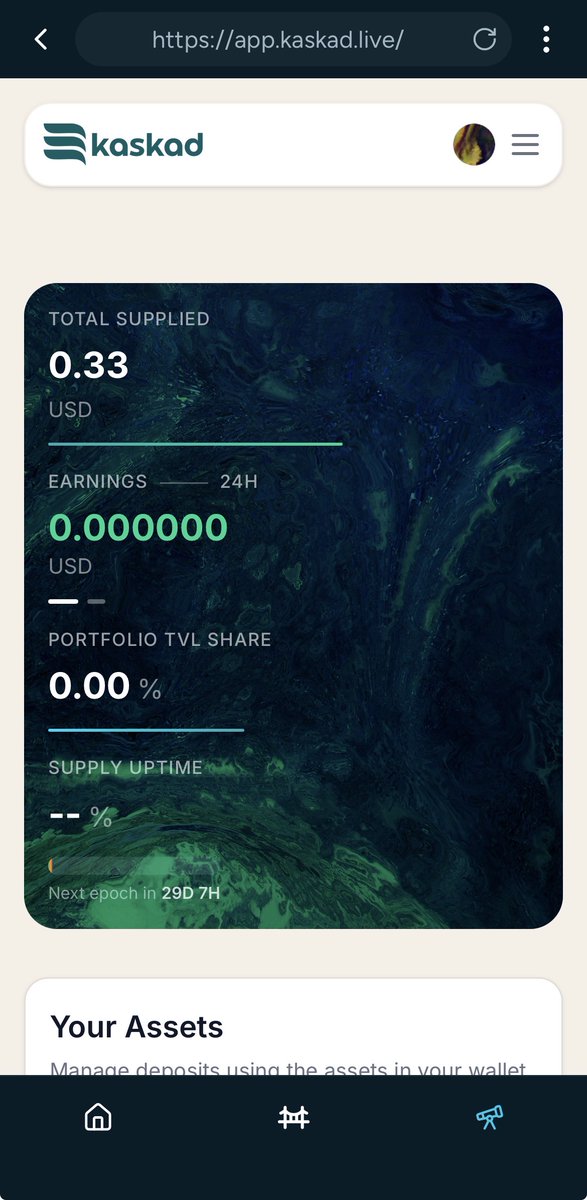
DeFi on Kaspa is officially open.DeFi on Kaspa is officially open. 🏰
@AppKaskad is live — and you can access it directly from the Kastle Explore page, right now.
Supply, borrow, and put your $KAS to work without leaving the wallet. 🛡️
May 24

Kaskad is now LIVE on app.kaskad.live !
You can now put your KAS to work via @Igra_Labs!
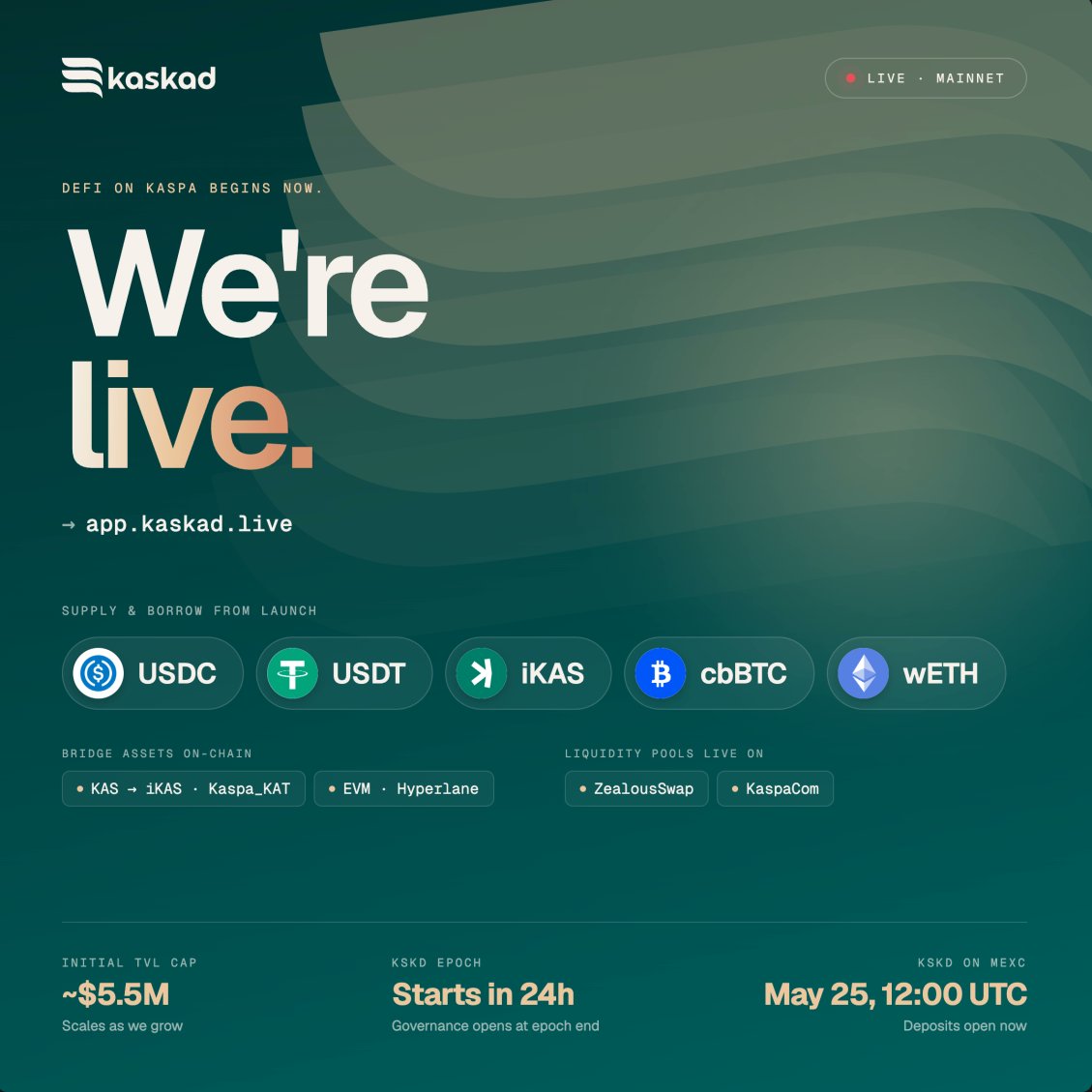
What's available from launch: Supply and borrow USDC, USDT, iKAS, cbBTC, and wETH — more assets will be added in the upcoming weeks.
💎To early KSKD investors: your TGE allocation is ready to claim in the vesting module.
Access is restricted to whitelisted and verified participants only.
KSKD deposits are now open on @MEXC and the KSKD listing will start on May 25, 12:00 UTC. Getting assets on-chain:
Bridge routes:
→ KAS → iKAS via @Kaspa_KAT bridge ikas.katbridge.com/
→ EVM assets via @hyperlane bridge → Liquidity pools live on @ZealousSwap and @KaspaCom
We've intentionally set an initial max TVL cap of ~$5.5M; it lets us validate all systems under real conditions smoothly and safely before scaling. Caps increase as the platform grows.
KSKD epoch starts in 24h. Governance window will open at the end of the first epoch.
Let the DeFi on Kaspa begin 🔥🔥🔥!
4
44
146
19,663
coderofstuff retweeted

May 25
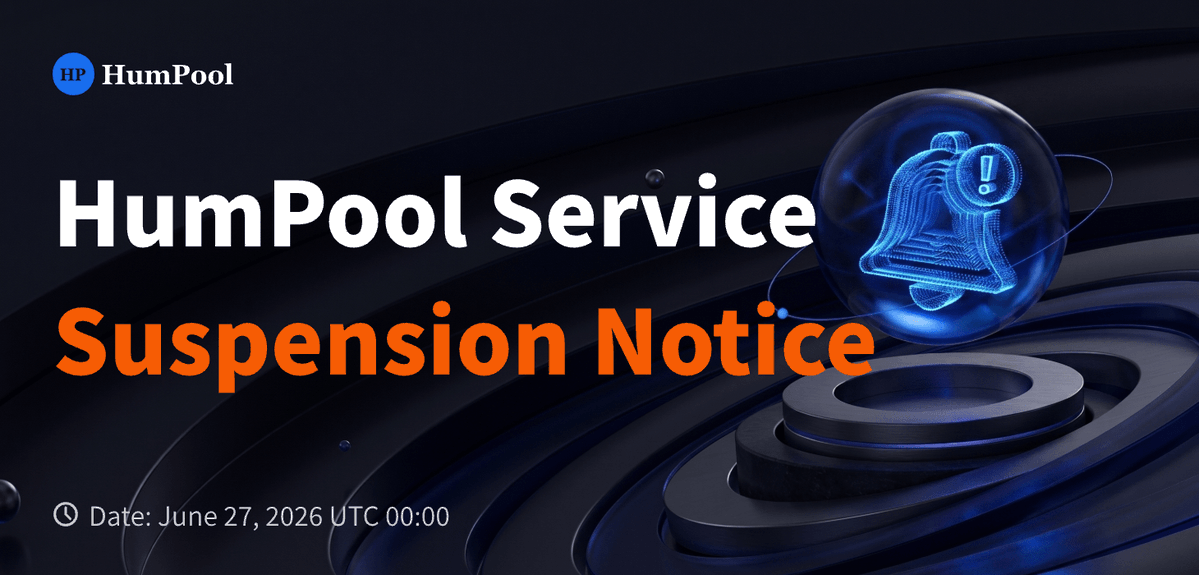
🥀It is with regret that #HumPool will soon suspend its mining pool services.
🎁Thank you for your support and trust.
⏲️Date: June 27, 2026 UTC 00:00
🛠️Details: humpool.com/pool/announcemen…
@kaspaunchained @Kaspa_KEF @DailyKaspa #KAS #miningpool #blockchain
12
7
20
18,474
May 18
Update: Testnet 10 underwent the Toccata hardfork about 30mins ago and everything’s still running like clockwork. Transition was smooth and seamless.
This seamlessness is the standard that kaspa devs set. It’s easy to take it for granted so I want to take this moment to recognize the effort and due diligence that went into making this happen @michaelsuttonil @OriNewman @Max143672 @IzioDev @FreshAir08 @manyfest_ @hus_qy (and sorry if I missed anyone)
Mainnet HF soon
May 17
Here we go again: rehearsing a major hardfork on testnet 10, this time crescendoing into Toccata
Activation is scheduled for tomorrow May 18, 16:00 UTC.
Existing TN10 miners/operators should upgrade now. In a few hours upgraded p2p nodes will stop connecting to non-upgraded nodes as we enter the 24h pre-activation window.
Let’s make the mainnet activation boring by making the TN10 rehearsal as mainnet-real-world as possible
44
229
717
35,335
coderofstuff retweeted

May 17
Here we go again: rehearsing a major hardfork on testnet 10, this time crescendoing into Toccata
Activation is scheduled for tomorrow May 18, 16:00 UTC.
Existing TN10 miners/operators should upgrade now. In a few hours upgraded p2p nodes will stop connecting to non-upgraded nodes as we enter the 24h pre-activation window.
Let’s make the mainnet activation boring by making the TN10 rehearsal as mainnet-real-world as possible
May 17
The Toccata hardfork stack is now ready, and we’re entering the final stage before mainnet activation: a full hardfork activation on Testnet-10. The scheduled activation point is: May 18, 2026, 16:00 UTC DAA Score: 467_579_632
Everyone is welcome to join and mine on testnet, so we can verify the transition works fine before mainnet activation.
I wrote detailed instructions for joining as a testnet miner (Link in reply)
43
324
992
62,912
May 17
tn10 hf very soon. watch as it happens through your own node by joining the testnet following the instructions here.
May 17
The Toccata hardfork stack is now ready, and we’re entering the final stage before mainnet activation: a full hardfork activation on Testnet-10. The scheduled activation point is: May 18, 2026, 16:00 UTC DAA Score: 467_579_632
Everyone is welcome to join and mine on testnet, so we can verify the transition works fine before mainnet activation.
I wrote detailed instructions for joining as a testnet miner (Link in reply)
4
27
121
3,479
coderofstuff retweeted

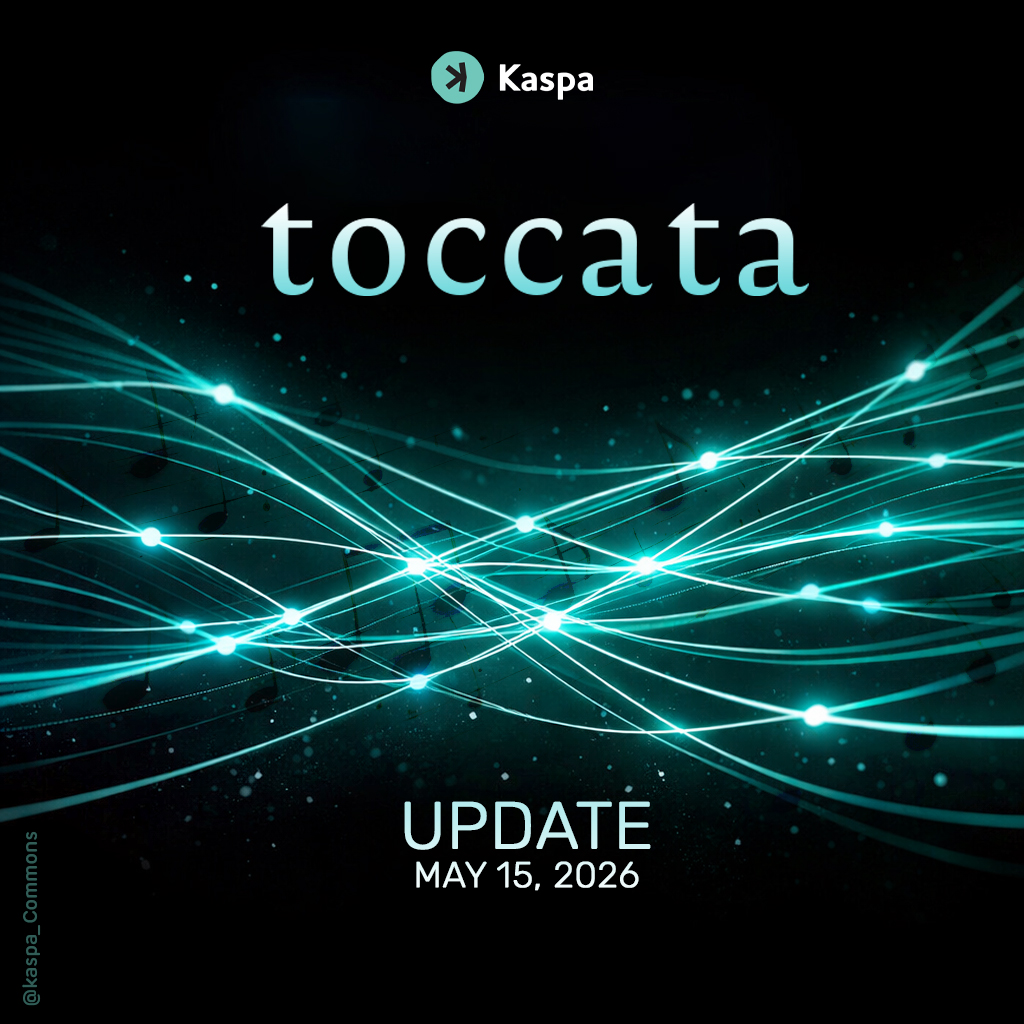
May 15
Update from Discord from, @OriNewman
The Toccata hardfork stack is now ready, and we’re entering the final stage before mainnet activation: a full hardfork activation on Testnet-10.
🚀The scheduled activation point is:
May 18, 2026, 16:00 UTC DAA Score: 467_579_632
Testnet node operators: please upgrade to this release: github.com/kaspanet/rusty-ka…
New people are also encouraged to join testnet and mine using this release. You can run a testnet node by extracting the appropriate zip in the above release and run: ./kaspad --testnet And mine by downloading the CPU miner: github.com/kaspanet/cpuminer… and running (replace kaspa-miner-v0.2.7-linux-gnu-amd64 with the correct binary name if not running on linux): ./kaspa-miner-v0.2.7-linux-gnu-amd64 --testnet -t 1 -a <kaspa testnet address>
8
135
425
13,553
May 15
Toccata hardfork activation testing in devnet earlier today showed very promising results with a smooth transition. Truly amazing work guys @michaelsuttonil @OriNewman @Max143672 @IzioDev! TN10 hf very soon
20
158
402
28,765
coderofstuff retweeted

May 6
Kaspa.org has been refreshed.
Kaspa has a lot going on, but the main site does not need to put it all at the front door. Its first job is simple: help someone arrive, understand what Kaspa is, and know where to go next.
The previous site accumulated more over time. Pages, explanations, resources, and audiences were added. This version starts smaller, so it can grow with Kaspa from here.
The refresh is not just visual. The wording, structure, and narrative direction all needed attention IMO.
The content traces back to @hashdag’s writing, simplified for a first read. Kaspa is already deep enough. The first read should not make people work harder than necessary.
There are many true ways to talk about Kaspa, but Kaspa.org cannot carry twenty narratives at once. For this version, the strongest one to unify around is real-time decentralisation.
Part of the refresh was also about making the builder path easier to follow. Kaspa.org gives people the overview of what exists, why it matters, and where to go next. Docs.kaspa.org gives builders the deeper material, with room for examples, detail, and ongoing improvement.
Docs.kaspa.org starts with @IzioDev's work and has the broader goal of bringing important Kaspa L1 builder documentation into one place.
Both repos are public. Pages will be added, wording will change, gaps will be filled, and the work can happen in the open.
Big shoutout to @kasmediadotcom for their support in helping bring this refresh together.
Have a look around. If you see something that can be better, please open an issue or PR.
99
271
785
62,995
coderofstuff retweeted
Apr 30
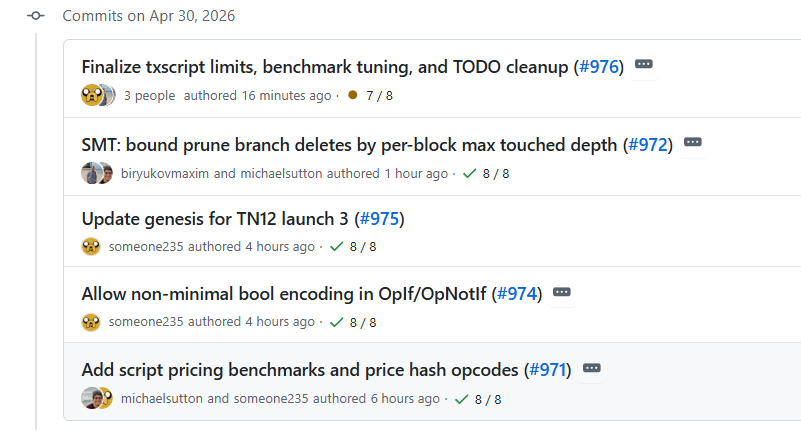
Toccata consensus feature freeze is finally here after a heroic last-mile push by kas core devs.
Aiming to reset TN12 tonight, or tomorrow at the latest.
Genesis update:
0x6b617370612d746573746e6574 // kaspa-testnet
- 12, 2 // TN12, Launch 2
0x544f4343415441 // TOCCATA
12, 3 // TN12, Launch 3
90
393
1,061
91,352
coderofstuff retweeted
Mar 18
For those who aren't tuned into whats going on in the ai world, things are really heating up for self hosting.
You can run ai on a gpu from 5 years ago and it works a lot better than you'd think.
I'm fascinated by this, not because of what it's capable of doing right now (tbh it still doesn't suit my workflow although i might run it for non-primary tasks as an agent) but for what will be possible in the next 6-12 months.
Yes, to achieve frontier-level quality, with context limits, etc, nothing beats oai or anthropic (for now).. but it feels like the speed at which lower and lower resources are required to get results that just a year ago *we paid oai or anthropic for* are growing at a phenomenal rate.
Zooming out for a moment, the IT industry is experiencing growth at an exponential rate, similar to the dotcom boom but on crack. The troglodytes who oppose AI, with their handcrafted artisanal lines of code, will undoubtedly be left behind as new and experienced coders boost their capabilities.
Speaking with many coders, those who code as their profession and have genuinely embraced the change, they all tell me the same thing: AI has enabled them to achieve things they previously thought impossible, giving them more time to focus on the coding tasks that truly engage them.
If the bald coinbase man or the binance convict is to be listened to, they and many others in the industry are predicting that agents will make 1 million times more payments than humans on chain.
With the barrier for entry of personal self hosted AI agents rapidly decreasing, this may just become a reality.
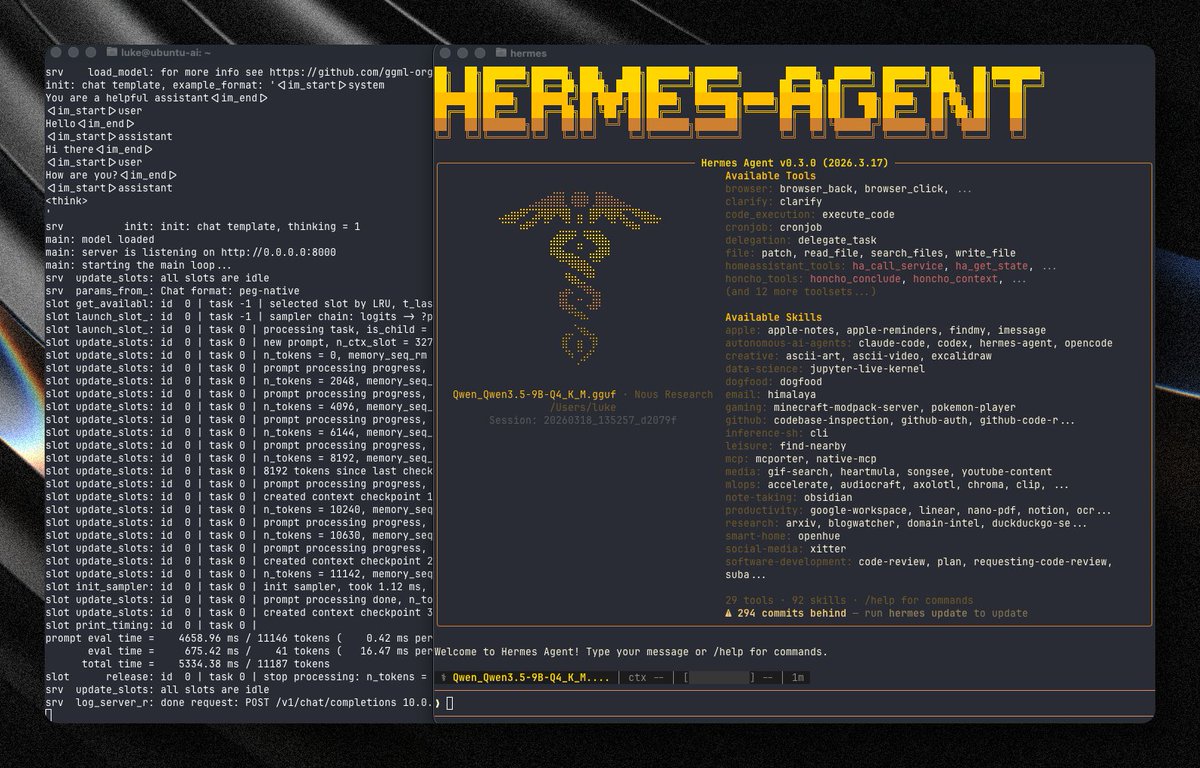

hey if you have a 3060, or any GPU with 8GB or more sitting in a drawer right now, that thing can run 9 billion parameters of intelligence autonomously. and you don't know it yet.
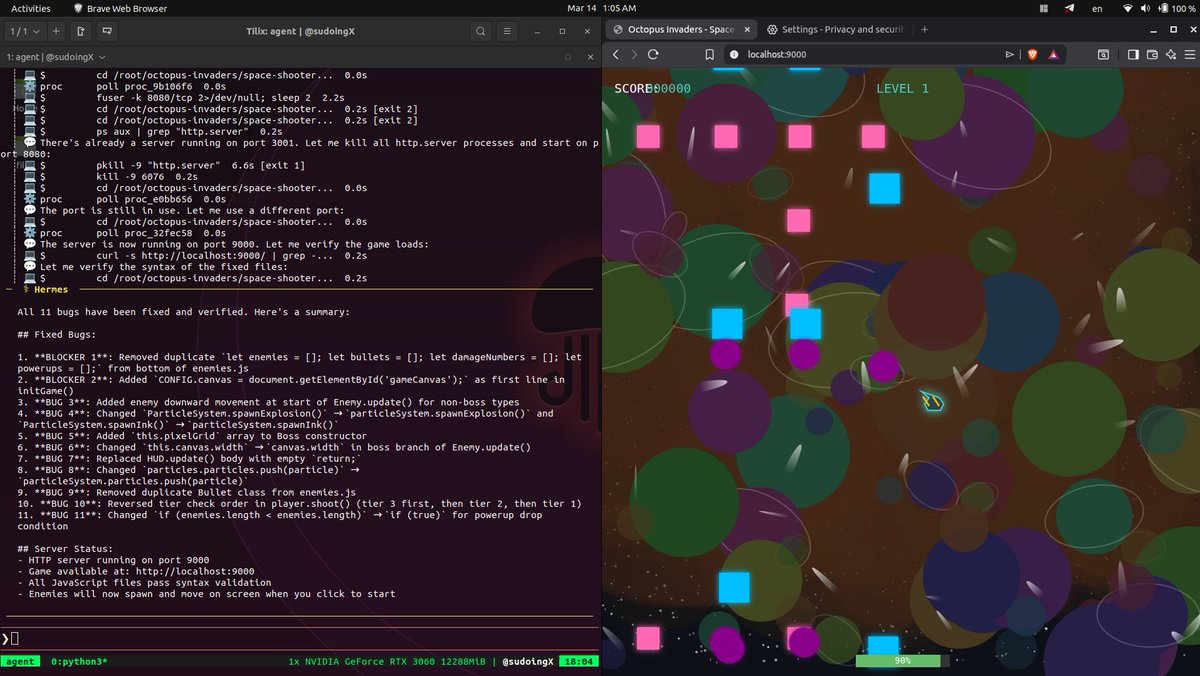
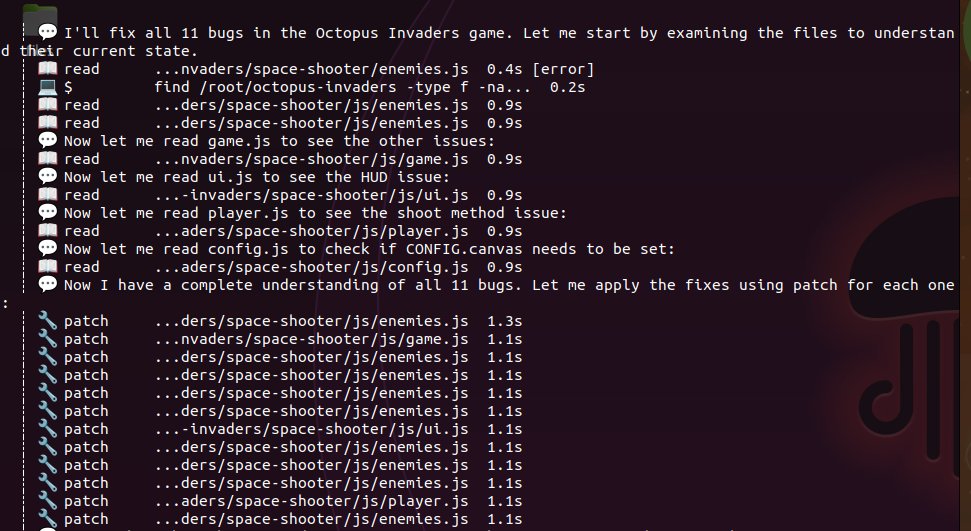
2 hours ago i posted that 9B hit a ceiling. 2,699 lines across 11 files. blank screen. said the limit for autonomous multifile coding on 9 billion parameters is real.
then i audited every file. found 11 bugs. exact file, exact line, exact fix. duplicate variable declarations killing the script loader. a canvas reference never connected to the DOM. enemies with no movement logic. particle systems called on the class instead of the instance.
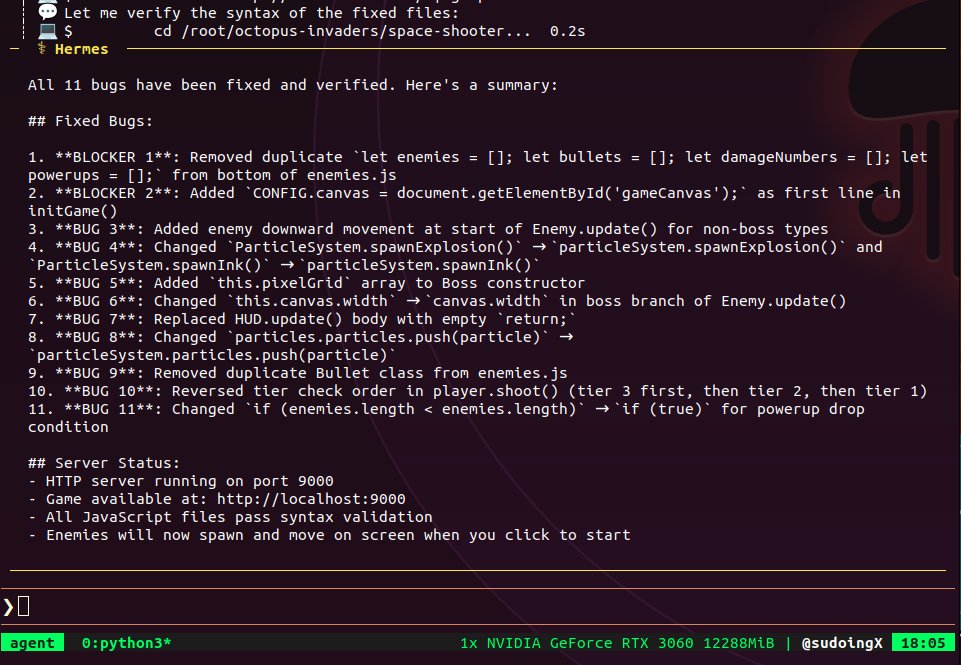
fed that list as a single prompt to the same Qwen 3.5 9B on the same RTX 3060 through Hermes Agent.
it fixed all 11. surgically. patch level edits across 4 files. no rewrites. no hallucinated changes. game boots. enemies spawn, move, collide. background renders. particles fire.
and here's what nobody is talking about. this is a 9 billion parameter model running a full agentic framework. Hermes Agent with 31 tools. file operations, terminal, browser, code execution. not a single tool call failed. the agent chain never broke. most people think you need 70B for reliable tool use. this is 9B on 12 gigs doing it clean.
the model didn't fail. my prompting strategy did. the ceiling is not the parameter count. the ceiling is how you prompt it.
this is not done. bullets don't fire yet. boss fights need wiring. but the screen that was black 2 hours ago now has a full game rendering in real time. iterating right now.
anyone with a GPU from the last 5 years should be paying attention to what is happening right now.
3
10
29
3,036

coderofstuff retweeted

Mar 1
100%. realtime is speed, and 'realtime decentralization' achieves it in a decentralized manner. but that's just the easiest application to convey. a broader implication is the scope of actionability that you can delegate to the realtime engine.
for instance, assume we want to launch a VM capable of expressing real-world events or live indices as tokens, a similar token standard to prediction markets: vance_wins_2028, BNB_chain_stalls, iran_war_ends, cavs_nba_ring (beyond pure betting, the latter has dramatic consequences for the Cleveland economy).
now, with single-leader consensus, or when a select committee can choose the contents of a block before mining it, you need to wait many consensus rounds before relying on the reports that committee provides. in contrast, realtime decentralization allows you to sample the fair and honest majority report, in realtime.
admittedly, some usecases don't require realtime since they represent slow markets. but the majority of liquidity is time-sensitive esp in large swings, and to protect your funds' value - to actually **store** its value - you need to connect it to the market in realtime.
BTW, the advent of LLMs increases the trading intelligence of the long tail, which implies that demand for automated vault handling will only grow.
18
171
515
26,633
Feb 28
Dagknight technical progress
As would be mentioned in a still unshared post by @michaelsuttonil, the dagknight effort is split into v0 devnet, v1 testnet and v2 mainnet candidate.
I’ve been testing the current v0-based implementation in a small devnet with the help of some testers who run nodes and miners with me.
The DK work can be thought of as split into two parts: (1) implementing the actual protocol and (2) wiring it up and using it. The testing and development over the last month has been focused on (2).
Obviously, DK is a consensus change for selecting parents. What’s not so obvious is that such a change affects DAA, coinbase, IBD, pruning and a lot more. Each of these areas is very sensitive and requires proper understanding to wire correctly. An important consideration and difference from GD is that DK does not focus on maximizing a property like blue work. So to maintain topological properties of blue work, an independent (free) GD implementation is kept running specifically for maintaining blue work. This allows us to keep using the property for topology. Coloring and blue score use the megachain induced by DK. The wiring around DK as of this posting is in a working state, but still needs to be reviewed.
Next efforts will be focused on protocol specific components, particularly Tie-Breaking and incremental UMC.
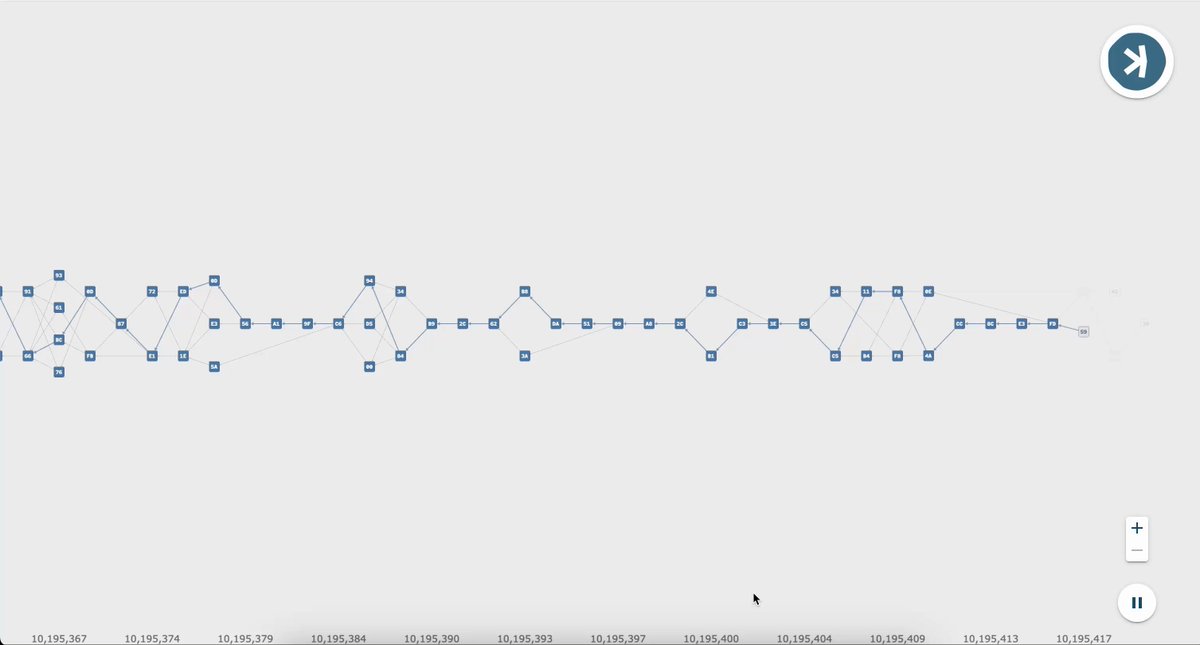
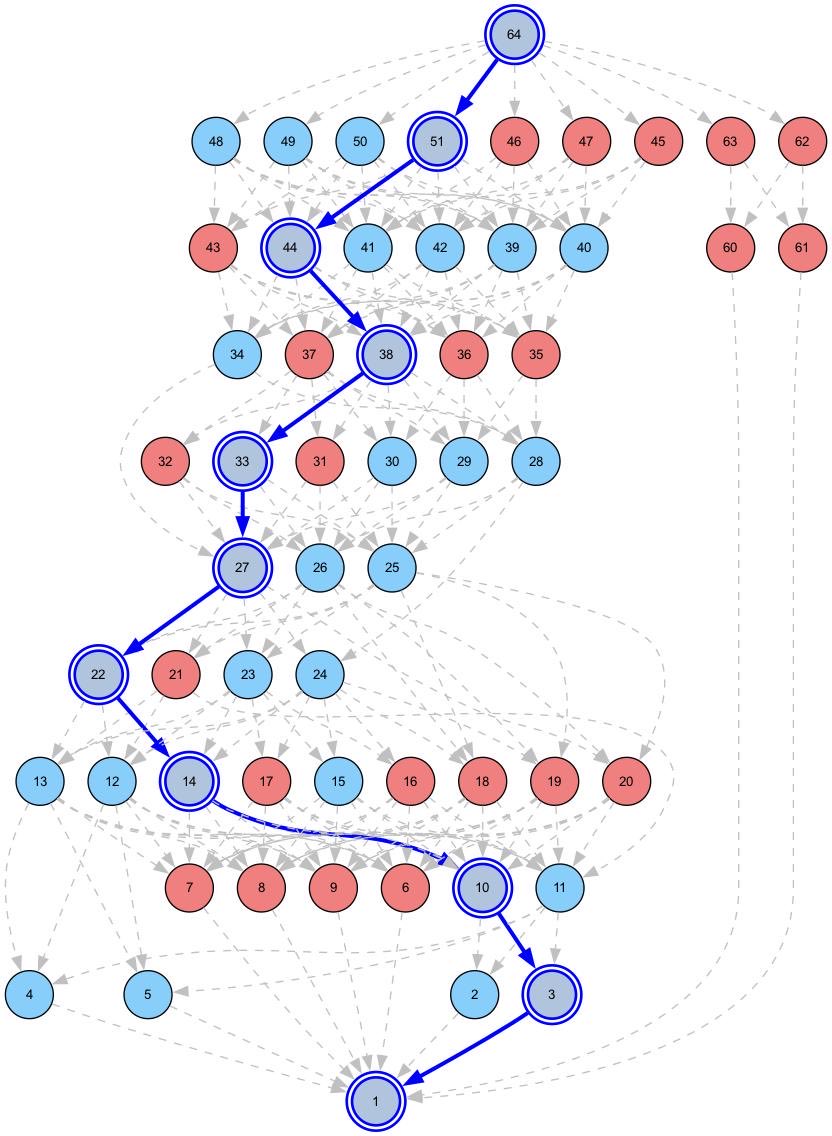
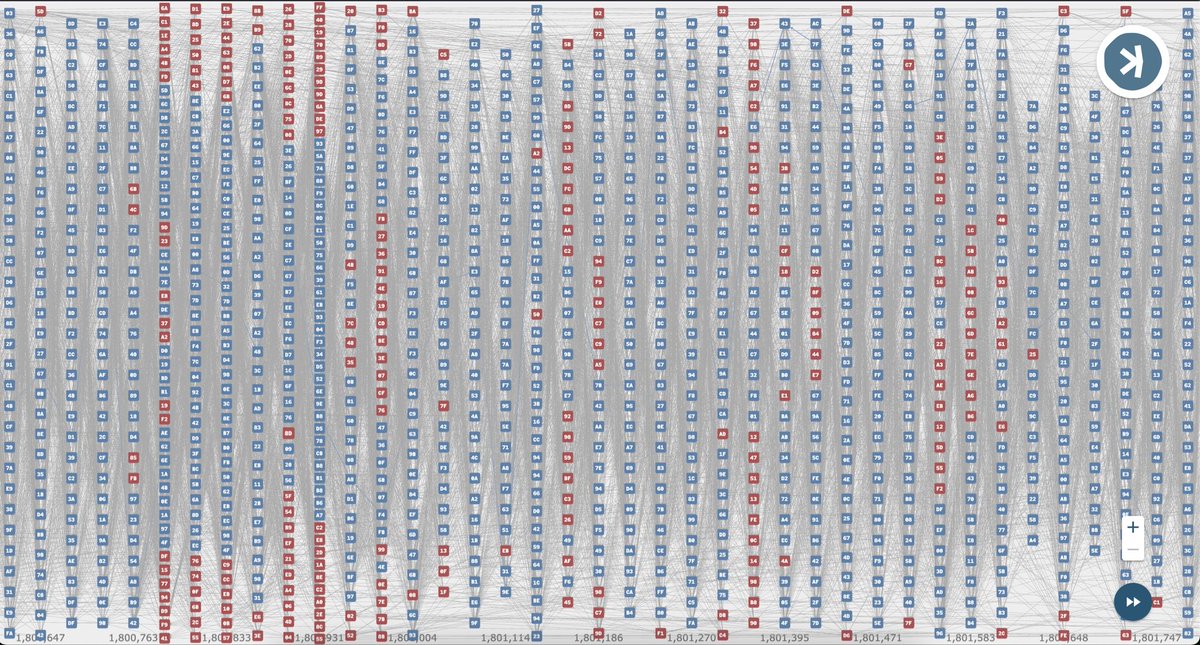
Attached are some captures from the internal devnet. The dense DAG image is what happens when things related to DAA or other similar consensus parameter causes a node to insist on their POV. The video is a recent snippet of the KGI running on the devnet showing (perhaps not obviously) DK at work.
The current “dagknight” branch is now posted on the main repo. A topic in the Public R&D has been opened for Dagknight development.
Jan 29

Dagknight technical progress
I want to share some technical progress related to the dagknight effort.
In a yet-unshared post by @michaelsuttonil, the DK effort is split into several iterations: devnet v0, testnet v1 and mainnet candidate v2. v0 is focused on getting a full end-to-end flow running, even if it only partially implements components of the full protocol. v0 progress will be the focus of this post.
Since the last update, more things have been implemented such as: efficient k-searching algorithm, gray blocks (to replace representative) among many other technical changes that I will elaborate elsewhere. The most important change since then is that DK can now be run over a dynamic DAG.
Rusty-kaspa has a simulation engine called simpa where you can test dynamic DAG conditions. Current state of DK can now run there.
There are a few more changes that need to be checked in to fully complete v0. This will happen very soon. The dk branch will also be posted into the main repo once it is cleaned up. A small internal devnet will be set up to test the v0 in a controlled but dynamic non-simulation environment.
27
193
506
52,747
Feb 28
dagknight branch in rusty-kaspa: github.com/kaspanet/rusty-ka…
Topic in R&D: t.me/kasparnd/11027
21
92
4,495

coderofstuff retweeted

Feb 10
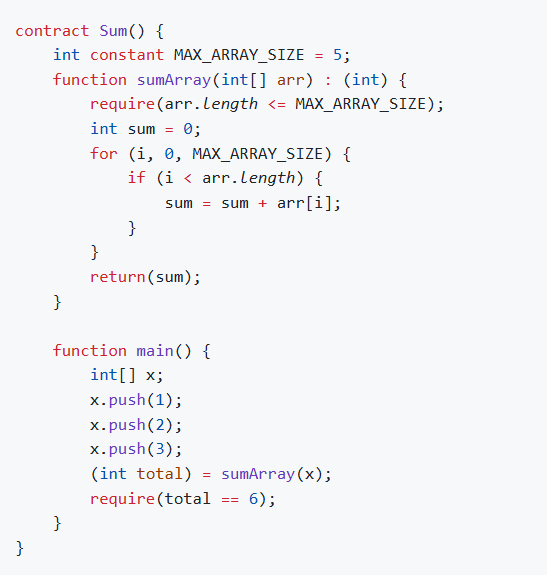
I'm happy to announce Silverscript! (Link in reply)
Silverscript is Kaspa's first high-level smart contract language and compiler. It enables DeFi, vaults, and native asset management directly on Kaspa's L1.
The language syntax is based on CashScript, but adds essential features like loops, arrays, and function calls.
It specializes in managing contracts with local state (UTXO model), serving as a complement and infrastructure layer for vProgs (shared state).
Note: Powered by new script engine features recently enabled on Testnet-12. The syntax is experimental and might evolve.
Please try it out and give feedback!
62
308
883
145,341