
The state machine replication engine for the interchain. CometBFT is a fork and successor of Tendermint Core.
Joined January 2023
- Tweets 460
- Following 7
- Followers 2,649
- Likes 243
17 Photos and videos





CometBFT retweeted

9 Apr 2025
One Network.
Infinite Chains.
Tomorrow.
165
287
1,215
238,722

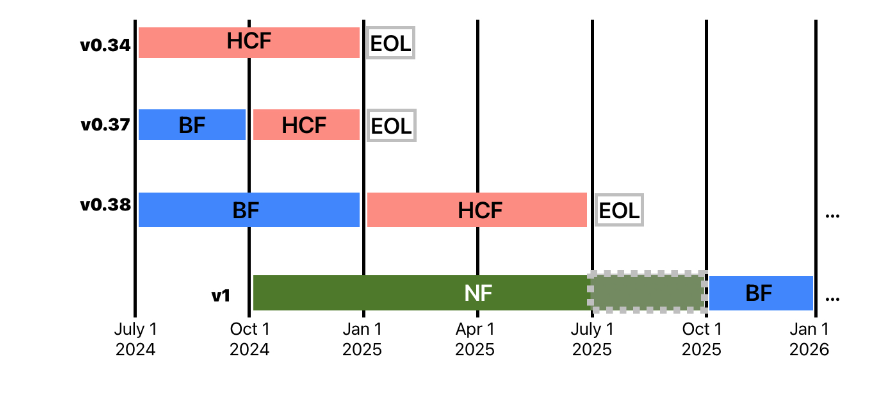
CometBFT v1.0.0 is out 🚀!
This release marks a major milestone in the lifecycle of CometBFT. Building on the solid foundation of the previous version, it introduces additional features and improved performance. Below are only some of the highlights, more details coming up in a blog post! You can also check out the Changelog github.com/cometbft/cometbft… and upgrading guide github.com/cometbft/cometbft… for migrating to v1 from v0.38!
Thank you all for your valuable feedback, support and especially @osmosiszone for their contributions to this release! Also kudos to the core team at @informalinc ♥️ Fantastic work everyone!
4
17
70
12,909
☑️mempool - experimental feature to limit the number of peers to gossip transactions to
☑️nop mempool
☑️p2p performance optimisations ( together with Osmosis)
☑️Improvements to the performance of blocksync (together with Osmosis! )
☑️BLS12-381 curve
☑️PBTS
☑️Support for pebbledb
☑️Remove persistence of genesis file in the DB
☑️Forcing compaction on pruning to reduce the storage footprint
☑️Background pruning to not block consensus
☑️DataCompanion API (gRPC endpoints to manage what is stored on Comet nodes)
☑️Support for a different key format in the DB
1
14
1,292
The CometBFT team @informalinc has finished merging the DOG 🐾 protocol feature and it is now available in `main` branch.
Read more below 👇
16 Dec 2024

Announcing DOG protocol, an improvement to the @cometBFT mempool gossip sub-system.
The Dynamic Optimal Graph (DOG) protocol slashes bandwidth use, improves performance, and speeds up transaction confirmations. 🧵
2
15
1,927
🧐
22 Oct 2024

Lots of interesting things going on in the @cometbft codebase.
DOG Mempool Gossip: github.com/cometbft/cometbft…
QUIC: github.com/cometbft/cometbft…
Shoutout to the team working on comet for all the hard work!! 🚀🚀🚢🚢
1
3
1,768
Join the Interchain stack experts at Cosmoverse this year.
17 Oct 2024

1/ On day 3 of #Cosmoverse2024, Oct 23, get hands-on experience building with the Interchain Stack.
Join workshops with ICF devs and steward teams in the Al Maasa Room.
Only 40 slots per workshop - Check this thread for more details how you can register now ⬇️
5
645
CometBFT retweeted

14 Oct 2024
good reminder
if you're building on @cometbft or operating Hermes IBC relayer, please read ⤵️
11 Oct 2024
1/ Liveness is an important concept in the Interchain Stack, affecting operational reliability, scalability, and performance.
Yet, the inherent challenges of decentralized blockchain development make it challenging to provide liveness guarantees at the protocol level today.
1
7
643
9/10 In summary, Tendermint is classified as optimistically responsive, meaning it performs well under favorable conditions, but its speed is limited when faced with faulty leaders or network asynchrony (a standard assumption).
Full article ⬇️ informal.systems/blog/tender…
1
2
284
10/10 We hope you've found this thread helpful. Make sure you follow @cometbft for future announcements.
Like & Repost the quote below, thanks for your support!

1/10 🧵 In the past we wrote about responsiveness in consensus algorithms and why it's a critical property.
Despite its popularity, questions persist about the responsiveness of the Tendermint consensus algorithm.
For everyone in doubt 👇
2
250
CometBFT retweeted

24 Sep 2024
1/ Why Build with CometBFT?
@cometbft has a modular design and language flexibility, allowing the system to be pulled apart if and where necessary, making it a flexible and easy-to-use solution for various distributed applications.

5
9
50
7,194
chop chop 🔪 product development picking up speed 🔪
feedback welcome!
19 Sep 2024
1/ Here are some updates on @cometbft product development.
This serves both as a log of what the team has been up to, plus a peek at our Q4 priorities.
Long thread & very dense in information coming up, with a lot of stuff I am very excited to report on. Buckle up! 🪢

4
436
In addition to the security fix, here are all the changes in the new versions.
v0.34.34 → github.com/cometbft/cometbft…
v0.37.11 → github.com/cometbft/cometbft…
v0.38.12 → github.com/cometbft/cometbft…
1
1
304
Got a talent for tracking down bugs?
Put your skills to work! Join the Interchain Bug Bounty Program and report vulnerabilities here 👉 hackerone.com/cosmos?type=te….
🪲 Help us strengthen the #Interchain ecosystem and unlock amazing rewards 🪲
1
219