
Thoughtful antitrust, not make-believe antitrust. Prof @EUI_EU & co-founder DCI @fordynamism. Opinions mine only. Multi-homer @competitionprof.bsky.social
Joined June 2010
- Tweets 14,106
- Following 451
- Followers 9,975
- Likes 21,085
1,359 Photos and videos







Pinned Tweet

10 Nov 2025
Decline is a choice, not a fate.
Today, with @LuisGaricano (@LSEnews) and Bengt Holmström (@MIT), we launch The Constitution of Innovation - a manifesto for a new European renaissance.
We make 6 concrete proposals.
Read them at constitutionofinnovation.eu/
#Europe #Innovation 1/6
12
89
406
50,669
De growth is a regressive agenda.

This plan is incompatible with freedom- a global class of planners telling us how long to work, how much we can grow, what we can eat. It is also completely wrong. All advances for climate (including the huge drop in battery and solar and wind costs) have come (and will come) from more innovation, more competition, firms that grow and invent and innovate and produce energy solutions that replace fossil fuels. If you enforce degrowth in the West you will kill for ever the climate agenda.
4
498
I agree with @lugaricano: there’s a commodification risk here, with low value capture opportunities for proprietary model developers.
But will this cut profits down to 0?
Not so sure. In industries w/ critical risk or heavy regulation, clients will not go to open source /1
May 30
Four months lag!!! If EpochAI is right, I am sorry, but for all their revenue growth, OpenAI and Anthropic are going to be making exactly 0 profits. See my and Jesús Saa-Requejo analysis of the market here: siliconcontinent.com/p/three…
1
1
1,965
And I don’t see the DoD or western defence industries using models developed in China even if only weights /4
1
115
So GenAI may not be your blue ocean 🌊 market, but it will not be a completely red ocean either END.
114
Interesting given that God’s human form is not required by dogma
May 25

In the era of #ArtificialIntelligence, when human dignity is threatened by new forms of dehumanization, ours is the pressing duty to remain profoundly human. We must lovingly safeguard the grandeur of humanity bestowed upon us and revealed in its fullness in Christ, the splendor of which no machine can ever replace. #MagnificaHumanitas
vatican.va/content/leo-xiv/e…
1
569
Nicolas Petit retweeted

Il découvre le réel, c’est à dire la France du laisser-passer A38
2
3
950
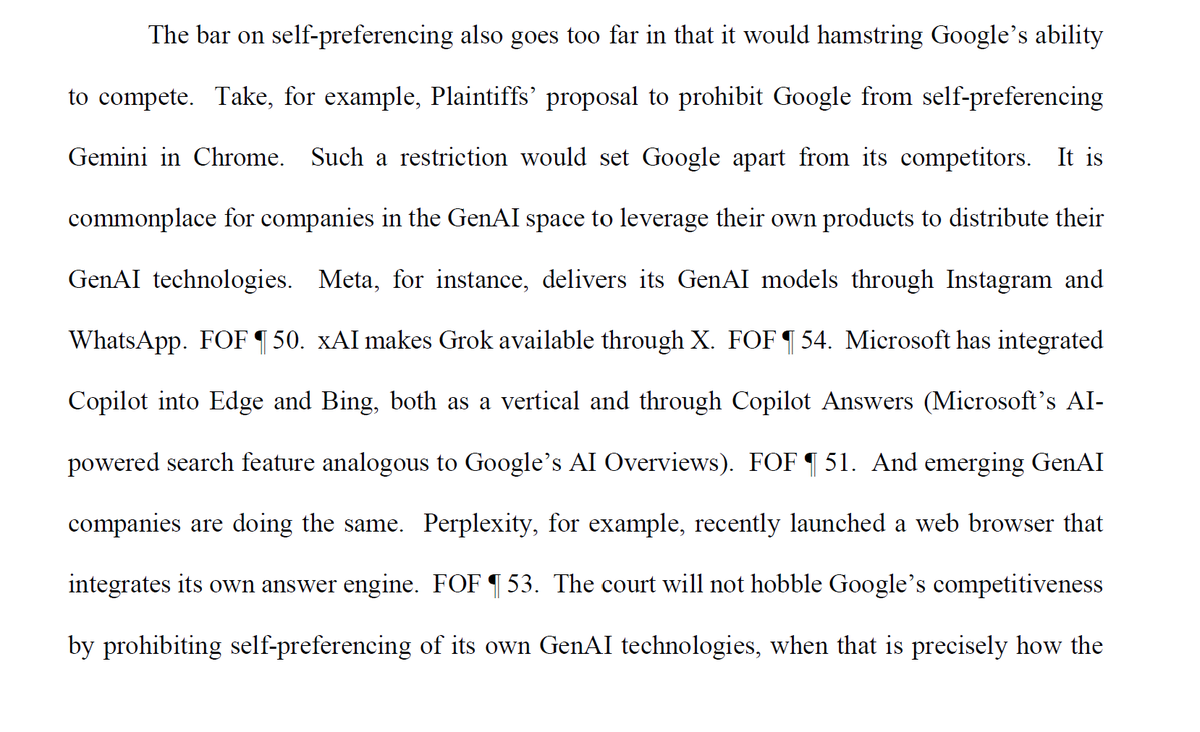
When the Italian 🇮🇹 competition agency will be done toying with the issue of AI distribution on digital platforms, it can fix robocall harassment 👇, cab cartels 🚕, or the summer Bagno ripoff 🏖️
3
218
Les politiques boivent du champagne sur le pont du Titanic
May 22

Le scandale politique de ces derniers jours. Le jeune PDG français de Mistral AI, Arthur Mensch, s’est déplacé pr une audition devant la commission d’enquête sur les vulnérabilités numériques
Quasiment aucun député présent.
Une salle vide, une intervention pourtant magistrale

1
2
517
Betting on implementation is what 🇨🇳 does. Just follow the patents.
May 22
I write today in Silicon Continent with Jesús Saa-Requejo "Three Theses on AI Value Capture".
We argue that the leading AI labs are betting hundreds of billions on the idea that holds the best model captures the value. We think that's the wrong bet. The model layer is squeezed between customers who can switch with a simple change in configuration and suppliers who are each monopolists. Our hypothesis is that the surplus flows past the labs, to chips above and implementation below.
Hence the country that wins AI is not the one with the tokens on the frontier model. It's the one that is best able to implement the technology.
siliconcontinent.com/p/three…
1
4
775
Nicolas Petit retweeted

May 18
Congrats to Aime!! He said his left forearm is basically broken 😂
Final scores:
→ F.03: 12,732 packages (2.83 seconds/package)
→ Aime: 12,924 packages (2.79 seconds/package)
This is the last time a human will ever win
815
927
18,963
4,470,578
Nicolas Petit retweeted

May 16
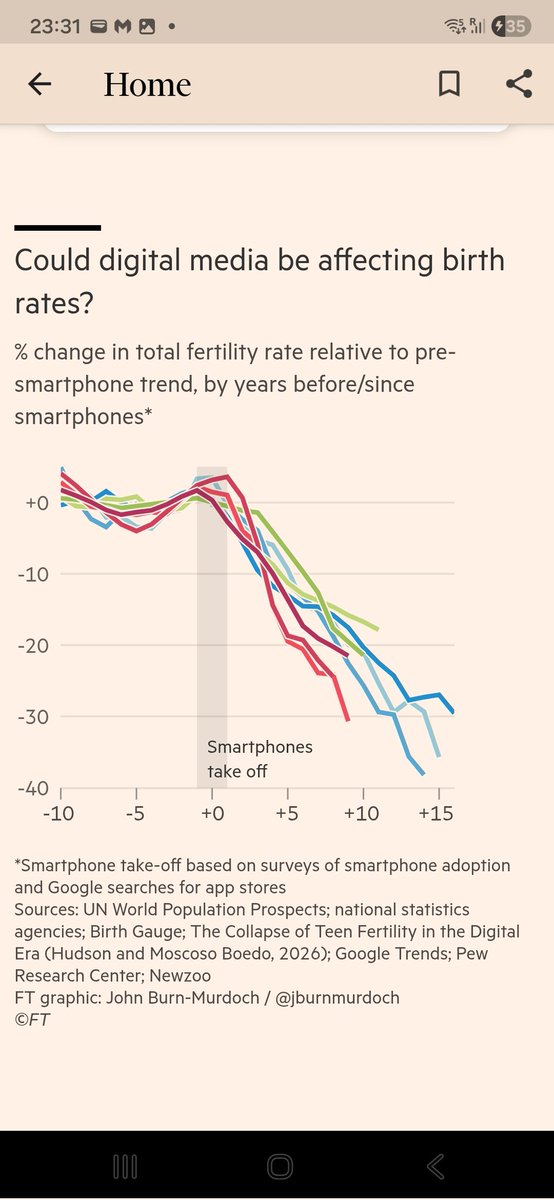
No smoking gun, but the preponderance of evidence points to smartphones, not economics, as the culprit for the global drop in fertility:
• In the US and UK, births fell first and fastest in areas that got 4G earliest
• Birth rates were stable in the US, UK and Australia until 2007; in France and Poland until 2009; in Mexico and Indonesia until 2012; in Ghana, Nigeria and Senegal until 2013-15
Each of these inflection points matches local smartphone adoption (see picture).
• The younger the age group, the sharper the drop.
• in-person socialising among young adults is dropping. In SK, by 50% in 20 years
• Sexual dysfunction is higher among heavy social media user
• Effect is largest in culturally traditional societies — Middle East, Latin America, sub-Saharan Africa
• Decline holds across countries hit hard by GFC 2008 and those not hit, fast-growing and not growing.
Excellent again @jburnmurdoch.
ft.com/content/fba35eca-df3a…
314
1,044
4,544
1,424,817
Europe is getting poorer, America richer.
Inequality is decreasing more there 🇺🇸 , less here 🇪🇺.
May 12
We stopped everything to write an answer (link below) to Paul Krugman's two posts of today (one informal, one with a simple model) arguing that Europe is broadly not falling behind the United States.
The change measured by the Draghi report, he argues, is mostly due to growth in the technology industry, which has distorted GDP numbers without actually leading to higher standards of living. We should believe our eyes when we walk around France and walk around Mississippi.
Krugman is wrong. The measures he uses understate European stagnation. This matters enormously. Divergence with the United States is the strongest evidence for reform in Europe.
1. The growth numbers
Krugman compares the United States, France, and Germany at purchasing power parity in current prices. On that measure, France's and Germany's position relative to America has been roughly constant since 2000.
But current price comparisons miss productivity gains in sectors where prices fall. If America produces twice as much software while the price of each unit halves, the value of American software output looks unchanged even though the volume has doubled.
Most economists therefore use constant prices, which fix the base-year PPP level and apply each country's real output growth on top of it. American output growth has concentrated in tech, where prices have fallen tremendously as productivity rises. In terms of the volume of things produced, America has pulled away from Europe.
2. Is it all the tech industry?
Krugman concedes this tech divergence but says it is not welfare-relevant. The American growth lead is an accounting artefact of measuring more iPhones at base-year prices, not a sign that Americans are actually richer, because Europeans buy the same iPhones at the same world prices.
This is not the right way to think about the world today, as an earlier Paul Krugman would have argued.
His model assumes tradable goods, interchangeable workers, marginal-cost pricing, and no profits. Each assumption fails.
Most of what households buy is non-tradable: housing, healthcare, childcare, education. When American tech firms bid workers from haircutting to coding, American haircut wages rise. Germany has no growing tech sector to do the bidding, so German wages stay flat.
Technology is not priced at marginal cost. Apple's margins are around 40 percent. Anthropic's inference margins are at 70 percent. The major platforms enjoy network effects, switching costs, and lock-in that hold prices well above what a competitive market would deliver. A large share of the productivity gains in technology stays as profit.
A lot of the value of American technology dominance shows up in equity, not in wages. Apple, Microsoft, Nvidia, Alphabet, Meta, and Amazon together are worth $21 trillion, more than the entire combined stock market value of all European stock markets. Around 60 percent of US equity is held by American households. The median French or Spanish household holds almost no equity.
The median employee at Meta, a company with almost 80,000 employees, earned $388,000 in 2025.
This advantage is not going to go away. Krugman's own 1991 paper, cited in his Nobel prize, showed that comparative advantage in modern industries is produced by increasing returns to scale, specialized labor markets, supplier networks and the agglomeration of suppliers, workers, and ideas in particular places. Once an industry concentrates somewhere, the concentration is self-reinforcing. Europe is being pushed away from the next round of technology industries (AI!).
3. What about inequality?
Another retort is that GDP per capita hides substantial inequality, and so even if America is rich on average, this is mostly due to the super wealthy.
But despite the US's high pre-tax income inequality, it also achieves higher median incomes than Europe, in part because of such a high base, and in part because it actually redistributes more than many European countries.
The cleanest comparison is median equivalised disposable household income: income after cash taxes and transfers, adjusted for household size and purchasing power. According to the OECD's 2021 numbers, the median American earns 30 percent more than the median Dutchman, about 31 percent more than the median German, and about 52 percent more than the median Frenchman.
4. What about hours worked?
Krugman points out that while American GDP per person is higher, most of this is because Americans work more. For this divergence to be an hours worked story, Americans must work more relative to Europeans now than they did in 2000.
The opposite has happened. Birinci, Karabarbounis, and See in a 2026 NBER paper show that about half of the American-European hours gap that existed in the 1990s has reversed by the end of the 2010s. Americans work fewer hours per person than they did in 2000, while most Europeans work more.
5. Is America not a bad place to live?
Walk around Alabama and France: surely the former cannot be substantially richer than the latter?
American cities often have poorer centres and richer suburbs or exurbs. European cities preserve richer and more attractive historic cores. A visit to a city as a tourist in America compared with a city in France will leave one having seen different spots on the income distribution. Americans in Europe go to the nicest and richest European cities.
Rather than a walking around test, do a driving around test. Go to the periphery of any modern American city and see a level of new-built material wealth that is extremely uncommon in Europe, with thousands of enormous four- or five-bedroom homes. In the South, in places like Nashville and Austin, drive around the downtowns to see hundreds of luxury apartment buildings springing from the ground. This construction boom is replicated virtually nowhere in Europe today.
The other question is generational. Housing often costs more in Europe than in the United States, despite the quality of the housing stock generally being much better. Europe has nice city cores but these are inaccessible to young Europeans.
Consider the salaries available to entry-level workers. The starting pay for a London police officer is $57,000. In Washington, DC, $75,000. The entry-level Deloitte consultant job in Madrid pays around €28,000, roughly $33,000 per year. In Charlotte, the entry-level Deloitte job pays $63,000.
There are many things to dislike about life in America. But relative to 25 years ago, the gap in material wealth has shifted dramatically in America's favor.
siliconcontinent.com/p/europ…
6
1,157
Nicolas Petit retweeted
May 12
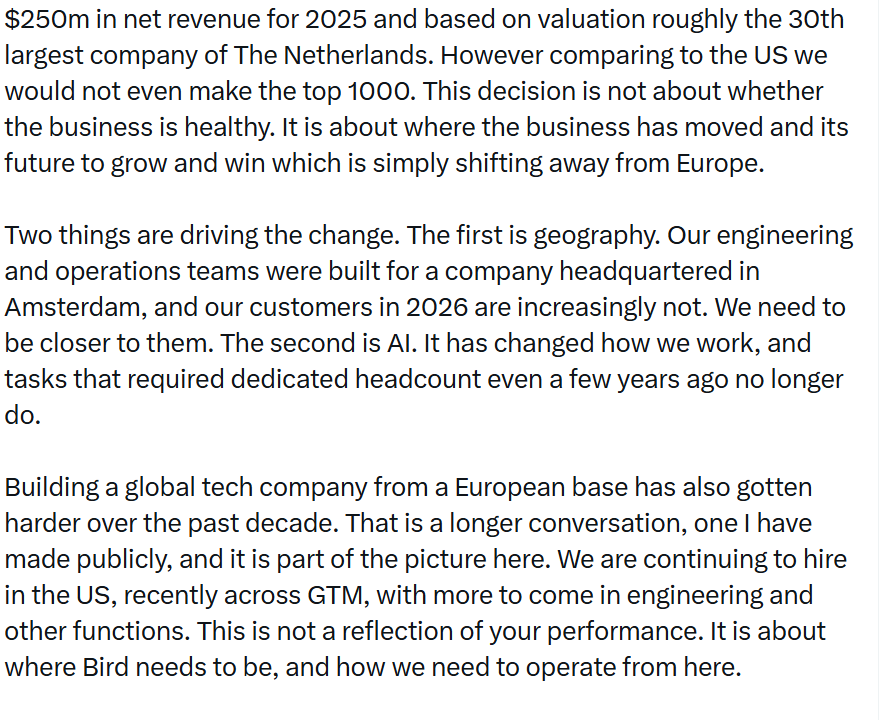
"Building a global tech company from a European base has also gotten harder over the last decade." if we do not act, we are going to be in very serious trouble
May 11

This is a note I sent earlier today to all employees at Bird on why we are decreasing our European headcount by 20% as we shift our employee base closer to our customers in the US.
Hi Team,
Today I've made the difficult decision to reduce Bird's headcount by approximately 20%. The majority of the reduction is in Europe, with smaller adjustments across the rest of the business.
I want to be direct with you about why.
When I founded Bird 15 years ago in Amsterdam, we had no choice but to go global from Day 1. The Netherlands and Europe were simply too small a market for the company I wanted to build. Fifteen years later, the centre of gravity of the business has shifted: 75% of our revenue now comes from US-headquartered companies, including most of the Fortune 500, all of big tech, and many AI-native companies. As per my recent shareholders note, Bird is profitable and growing, with roughly $250m in net revenue for 2025 and based on valuation roughly the 30th largest company of The Netherlands. However comparing to the US we would not even make the top 1000. This decision is not about whether the business is healthy. It is about where the business has moved and its future to grow and win which is simply shifting away from Europe.
Two things are driving the change. The first is geography. Our engineering and operations teams were built for a company headquartered in Amsterdam, and our customers in 2026 are increasingly not. We need to be closer to them. The second is AI. It has changed how we work, and tasks that required dedicated headcount even a few years ago no longer do.
Building a global tech company from a European base has also gotten harder over the past decade. That is a longer conversation, one I have made publicly, and it is part of the picture here. We are continuing to hire in the US, recently across GTM, with more to come in engineering and other functions. This is not a reflection of your performance. It is about where Bird needs to be, and how we need to operate from here.
To those of you leaving: thank you. You poured yourselves into Bird and helped build something extraordinary. I'm grateful for everything you've contributed, and I'm sorry.
Within the next 15 minutes you'll receive an email to your personal inbox with details on next steps and the support we're providing. In line with our security policy, your system access will be removed at the same time.
To the team staying: I know today is hard. We're saying goodbye to colleagues and friends. What we've built together is rare, and protecting it - and growing from here - is what this decision is about. We'll hold an All Hands later today; you'll receive an invite shortly, and I'll answer your questions there directly.
Thank you to everyone affected for what you built here.
Robert
3
27
139
12,869
Nicolas Petit retweeted

May 10
La légende du jazz Miles Davis reprend un journaliste qui lui parle de l'esclavage et des souffrances que ça a engendré chez les noirs et dans leur musique :
"Mon père est riche, ma mère est belle et je sais jouer le blues. Je n'ai jamais souffert et je n'ai pas l'intention de souffrir." ⬇️
40
528
1,873
89,165

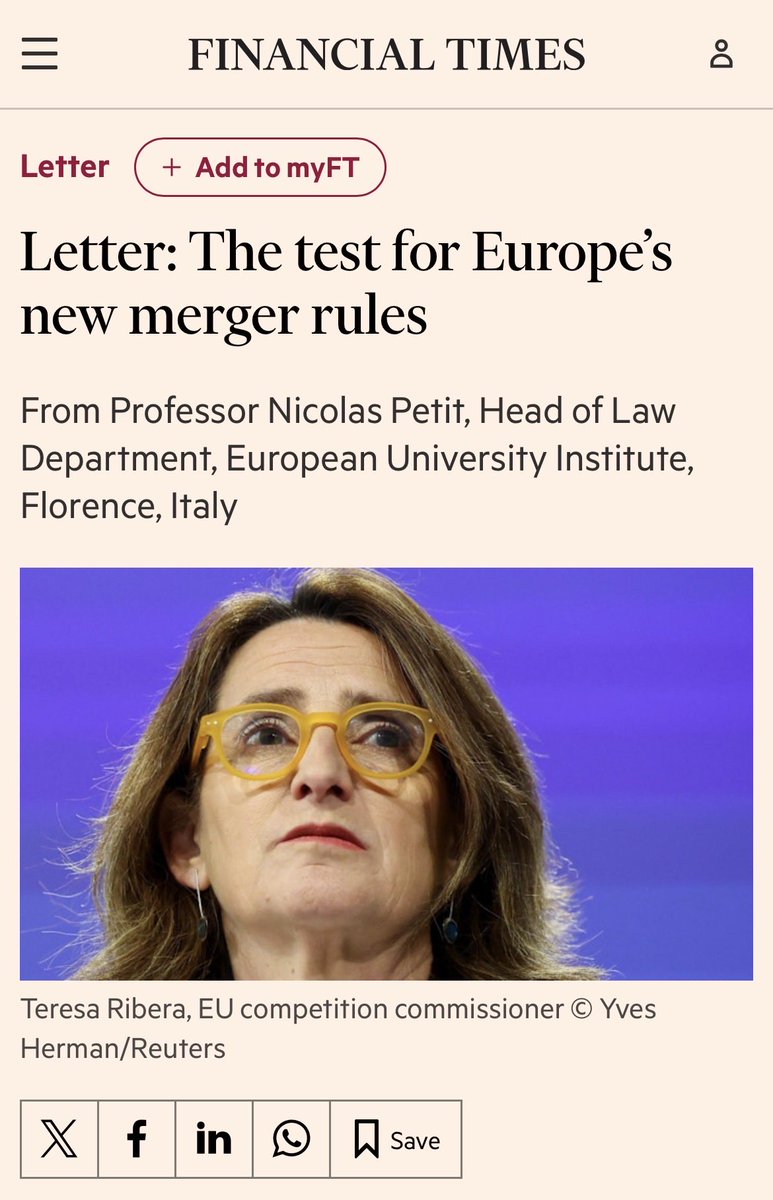
My @FinancialTimes letter: Europe just issued a good blueprint of merger rules oriented towards innovation and competitiveness. Here’s how to approach the next steps 1/n
1
6
495
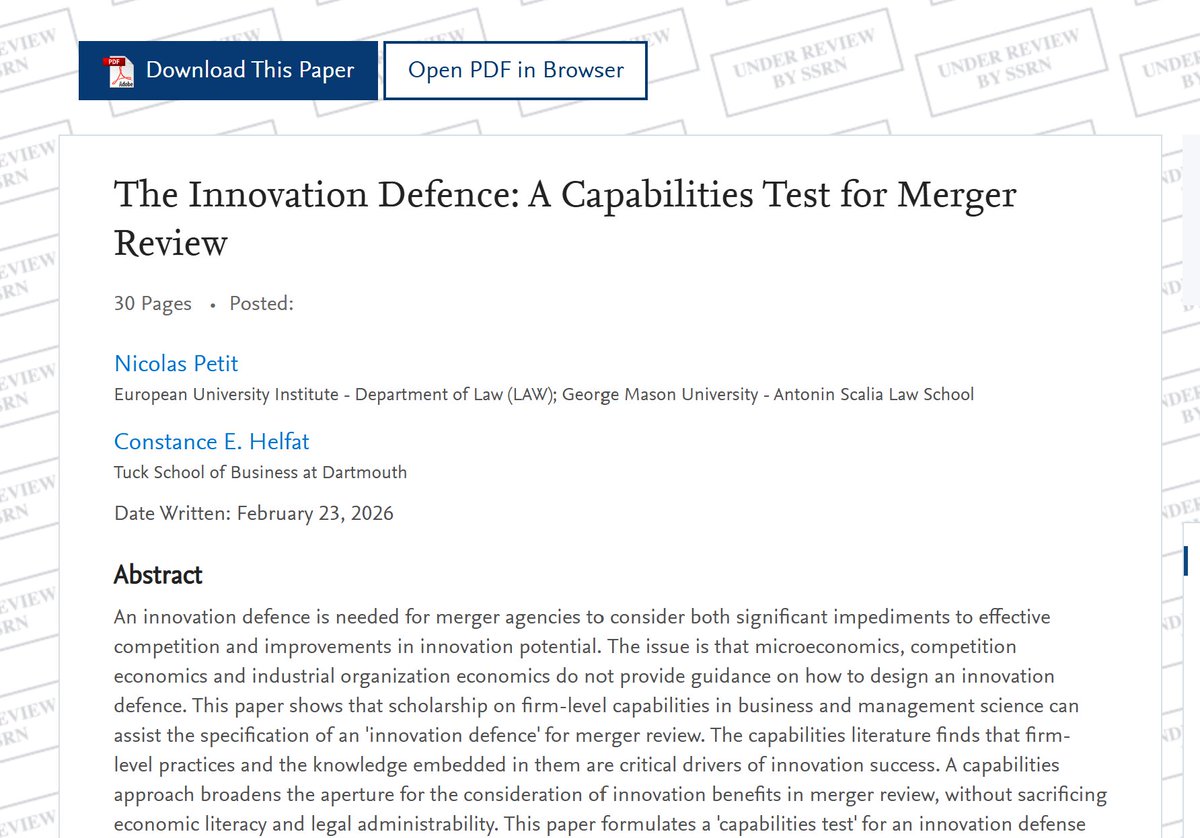
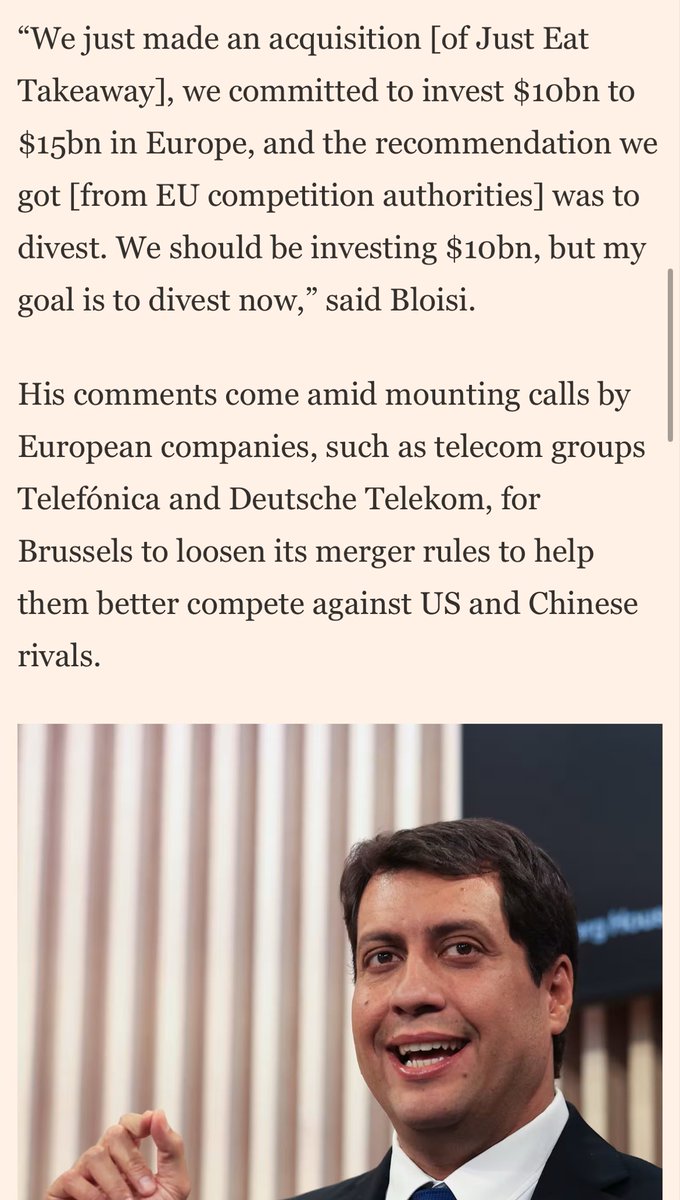
Second, put an end to "divestment culture”. Regulators should accept behavioral commitments (R&D investments) over forced divestments. Innovation gains benefit all - even if uncertain, the potential is too large to ignore. 4/n
1
1
145
Last, be less strict on out of market efficiencies. By definition drastic or radical innovation benefits are necessarily out of market. The current approach in the draft prefers process or incremental innovation. They should do the contrary /end
1
138