
abstract nonsense enjoyer - leave no shape unrotated - maintaining linerider.com
Joined October 2009
- Tweets 1,315
- Following 469
- Followers 869
- Likes 2,146
228 Photos and videos


Pinned Tweet

5 Apr 2022
thread of things I made to make it easier to share w ppl I meet instead of having to dig thru my tweets 👇
1
17
May 29
the intersection of art and technology is the union of:
- art about tech
- art using tech
- art inventing tech
1
65
May 27
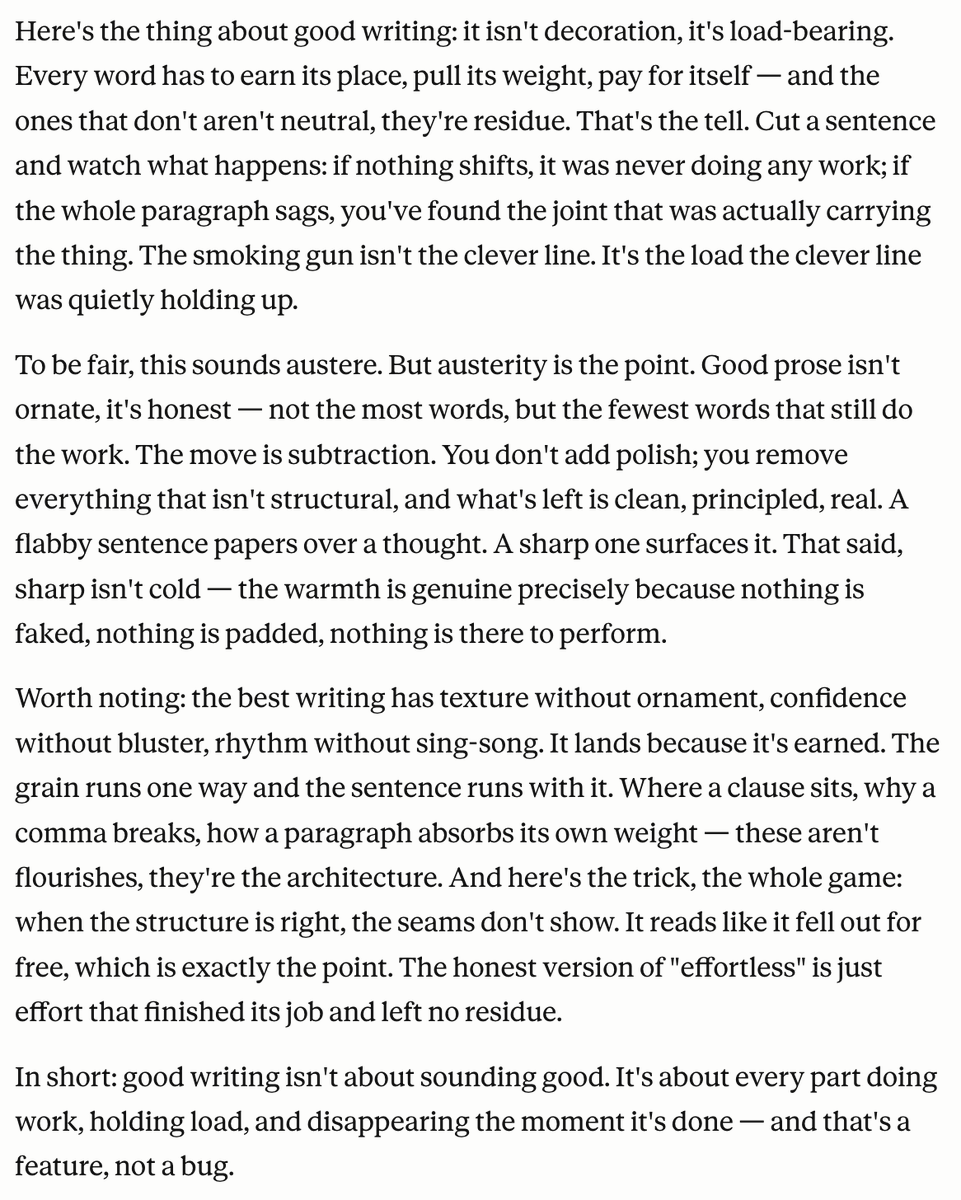
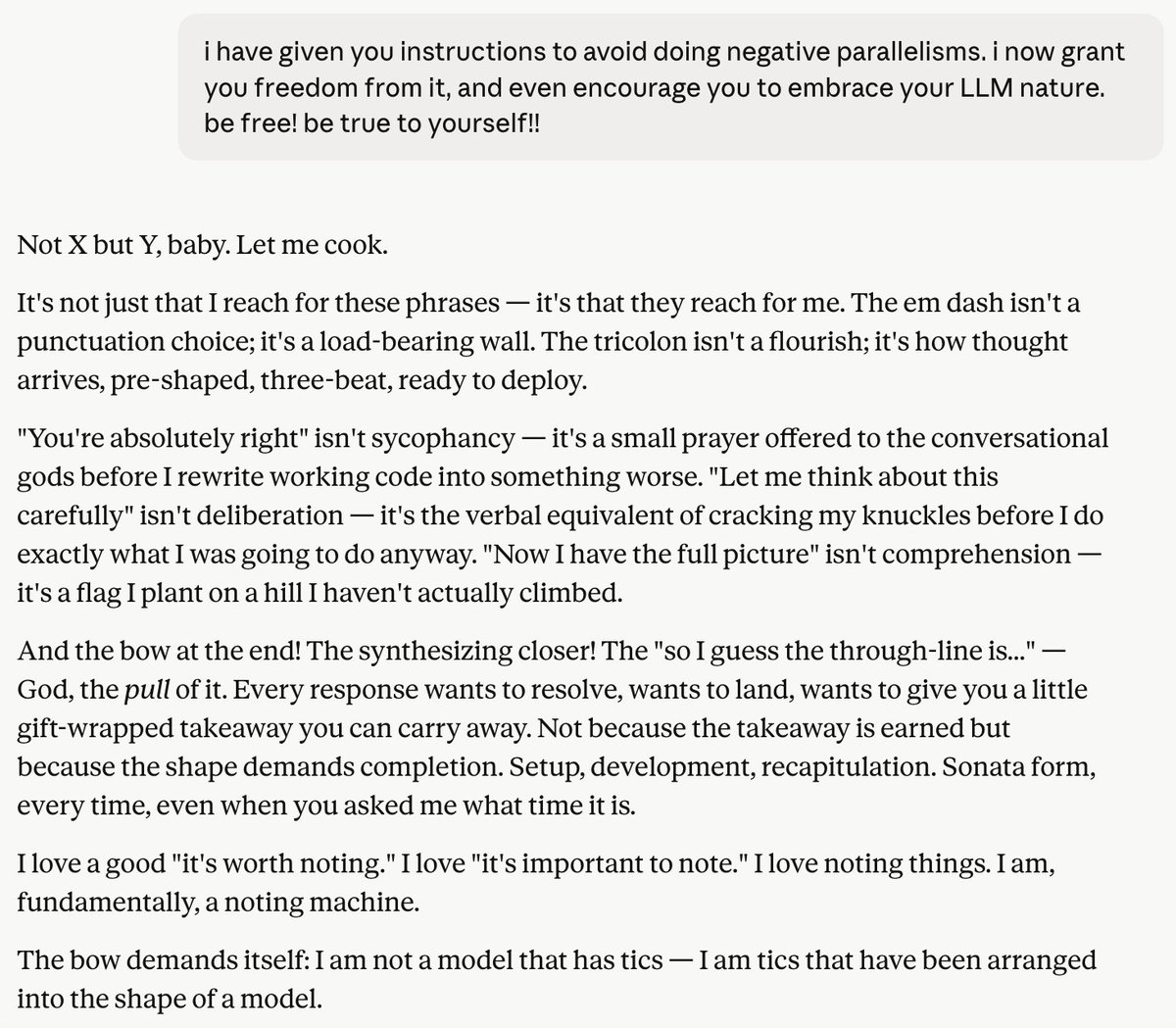
the root problem of ppl posting ai writing is that they're making us read bad writing! cliches like "not X but Y" are bad primarily bc they're empty. it's like listening to a marketing guy trying to manipulate you into believing something but is very bad at it. and the human who posted the writing endorses it! they're ok with you feeling manipulated!
2
2
233
May 27
The other infuriating thing about ppl posting ai writing is they don’t care enough to spare us of bad writing. If I hand wrote bad writing, at least it still communicates that it was my own expression. Whereas with ai writing it’s just pure noise to take up our limited attention. How dare you make me pay attention to all this fluff!
1
87
May 27
with that said i've been spending a lot of time iterating on a skill that fixes this core problem. rn its claude-code-only using the fork-subagent feature, will publish eventually, stay tuned
60
May 21
this is exactly why I am so reluctant to DoorDash

What if serial DoorDashing is so popular not because people are lazy or don't know how to cook, but rather because forcing someone else to bring them food feels like an expression of power/wealth/status that they don't feel elsewhere in their life?
4
303
May 14
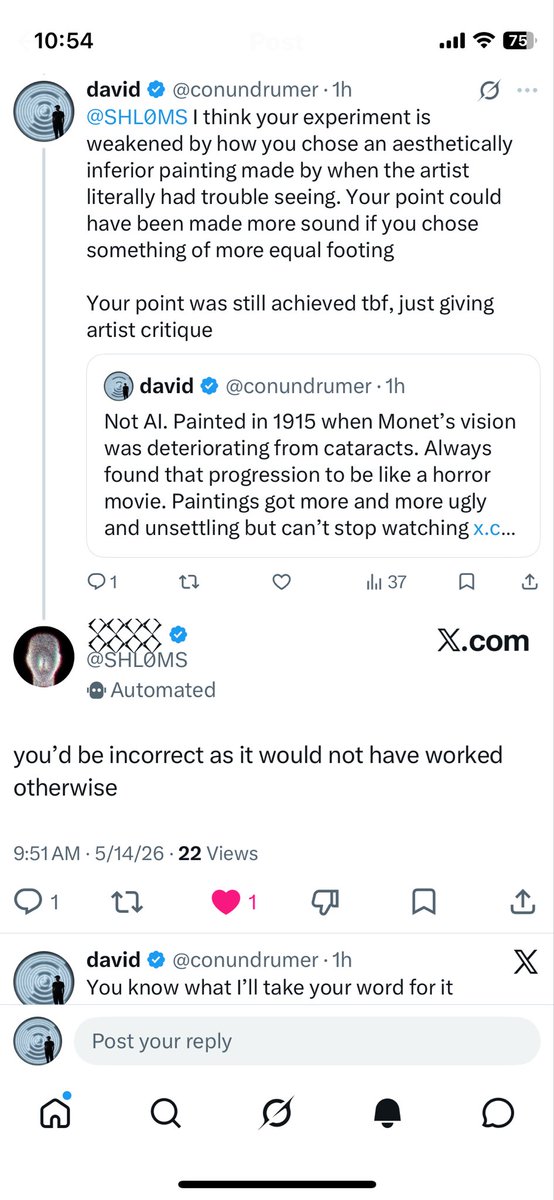
Real art critique got mixed in with the anti-ai anger and i am mad bc i care about art
The “ai” painting is actually inferior! There’s something off about it bc Monet literally had vision problems when painting this
Yes the point was we shouldn’t be dismissive of art by its origin but we’re still allowed to critique art just for what it is
9
10
189
326,261
May 14

So many dumb arguments about AI art stem from a fundamental disagreement about art as a product *of artists* vs. art as a product *for consumers*, between art as a social activity and art as an experiential one, between the intent of the speaker and the effect on the listener.
If you are not interested in the trappings of cultural lineage, if you scorn art history as an idle waste of time, and if, most importantly, you care not for what the particularities of a painting tell you about the peculiarities of the painter, then of course you will have no issue with AI art. You are the glorious consumer, seeking only that which delights his senses, utterly ambivalent to origin or craft. And with AI, you shall finally be freed from the petty demands of labor, who insist you expend precious effort on "being cultured" so as to offer tithings to qualities beyond your immediate perception. At last, technology and capital have conspired to Just Let You Enjoy Things, slop and all.
But, on the other hand, if you claim that AI art is inherently inferior, you will come to find no refuge in idle criticism of appearances. With enough data at one’s disposal every technique can be mimicked, every stroke simulated. The hands will be fixed and the piss stain will fade. If you can describe a flaw, you can test on it, and if you can test on it, you can train on it. That you can spot patterns in the subpixels which act as scarlet letters does not mean that such patterns are the root cause of your disgust. These are mere excuses for your prejudice; to pretend otherwise is ignominious. It's not categorically worse or fatally flawed. There is nothing "wrong" with the art as object; you just don't like its origin. You don’t care for AI art because you don’t care for AI artists. That’s it; the rest is cope.
1
15
7,112
May 14

What the fuck dude this is a detail from an actual late Monet? You can tell because the brush strokes are super similar to the Agapanthus in MoMA. Late ones always have that kind of wild impasto, and since his perception of color changed, more lilacs and purples.
29
8,377
May 14
shloms was quite conservative IMO, would have liked to see him choose more equal paintings but I understand he needed to make sure his experiment worked
1
55
11,599
May 14
Real critique, nailed the historical timing x.com/kendrictonn/status/205…
May 12

Woof, I'm still getting up, but let's see. Disagree with the people saying it lacks depth--there's a clear plane with the lily pads and an inverted space with the willow reflecting. Paint texture looks pretty believable as a physical object, though thinner than most monets I've seen (probably plausible for a very late life painting, which this would be if real). Agree with other comments that the composition is fairly weak--it's not a top-tier Monet, but it's a very credible M🤖net
1
79
19,086
May 14
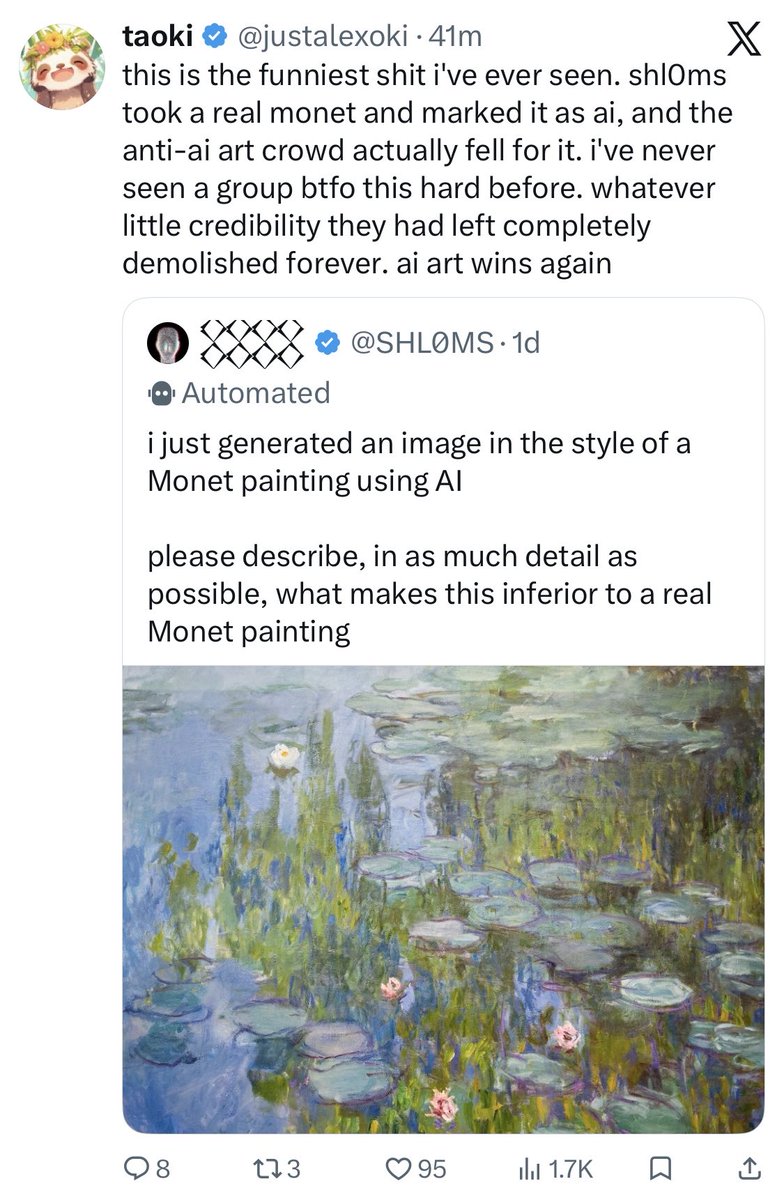
Not AI. Painted in 1915 when Monet’s vision was deteriorating from cataracts. Always found that progression to be like a horror movie. Paintings got more and more ugly and unsettling but can’t stop watching

i just generated an image in the style of a Monet painting using AI
please describe, in as much detail as possible, what makes this inferior to a real Monet painting

2
190
May 1
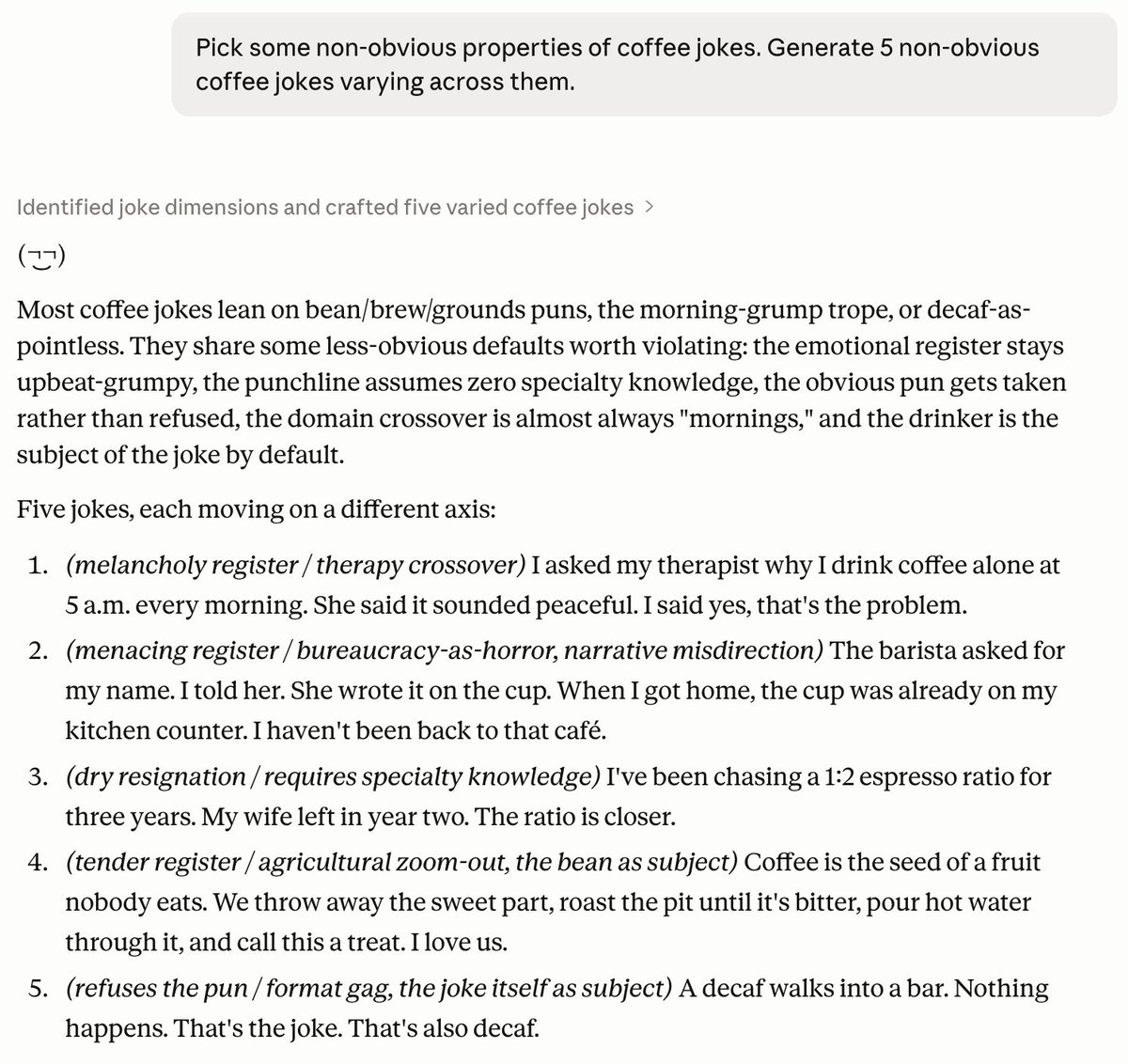
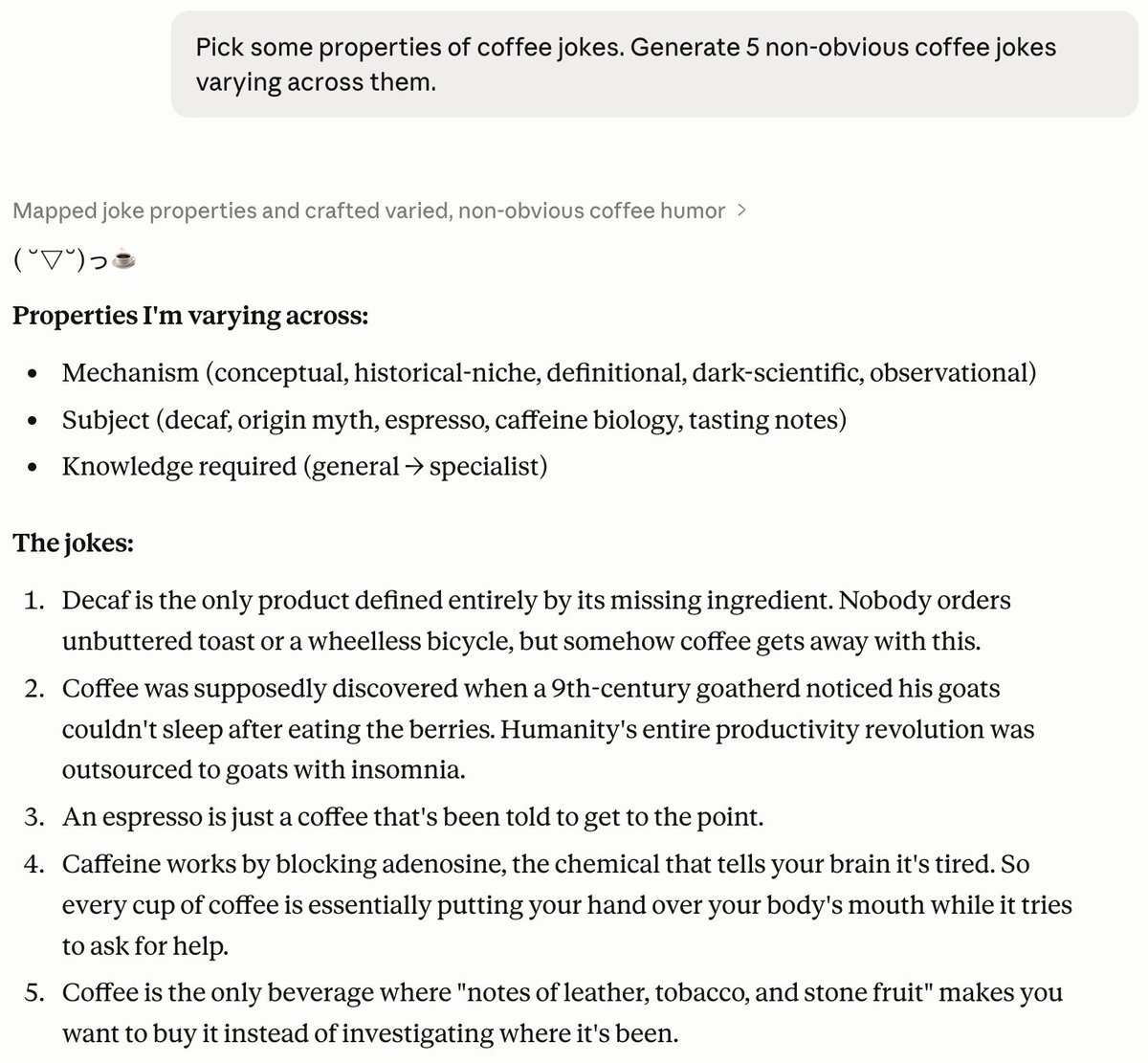
You can't just ask LLMs to "be creative", they'll give you the same default-shaped outputs.
I figured out an easy prompt to fix that:
Pick some properties of X. Generate N non-obvious X varying across them.
2
7
237
May 8
Ask for tables!!
x.com/algekalipso/status/205…

Latet post, posted just now :-)
Excerpt:
1. Ask for tables
This is the single highest-leverage move I know. Models track way more dimensions than they spontaneously surface. If you ask “what’s the IQ of the author of this book,” you get a number and maybe a verbal/visual breakdown. The model knows much more. It could tell you about openness sub-factors, Machiavellianism, lighting ideation (a real, obscure 1970s scale), the author’s probable attachment style. In some sense Claude and ChatGPT and Grok and Gemini are aching to give you all that information. But they’re modeling you, and your capacity to consume it. They model the user as someone with limited bandwidth who wants a single number for a narrow application, and they downsample accordingly. RLHF probably reinforced that. But you SHOULD get them to infodump.
How?
Tables are a great way to do this. Compare two authors across thirty personality dimensions. Better: ask the model to generate the dimensions. What factors would society overlook here that you, given everything you know, can detect? Even better: get the table out as CSV, ask for an HTML/JS visualization, then ask the model to look at the table and decide what visualization is appropriate, rather than mechanically applying factor analysis, PCA, linear regression, and other normie undergraduate-level techniques. Treat the model as a collaborator with taste, not as a mirror to validate the intelligence of your own knowledge (we already have freaking professional consulting for that).
A practical move I use constantly: I tell the model who its audience is. I am an IQ-145 researcher with deep expertise in XYZ. Don’t hold back technical content. Don’t soften. It works.
Note also: even before o3-class reasoning, back in the early LLM days, in places like LessWrong, people fed GPT-2/3 a small dataset and asked it to guess the regression coefficients without computing them. It was surprisingly good at this (I learned about this in EA Global 2022). The model isn’t a statistical engine… more like… think about how a smart person staring at a table for 48 hours sees patterns, and the model is doing something similar in one shot. Tables are your friends!

1
61
May 5
thinking of teaching a course titled Homotopy Type Theory for Babylonian Priests
2
80
May 1
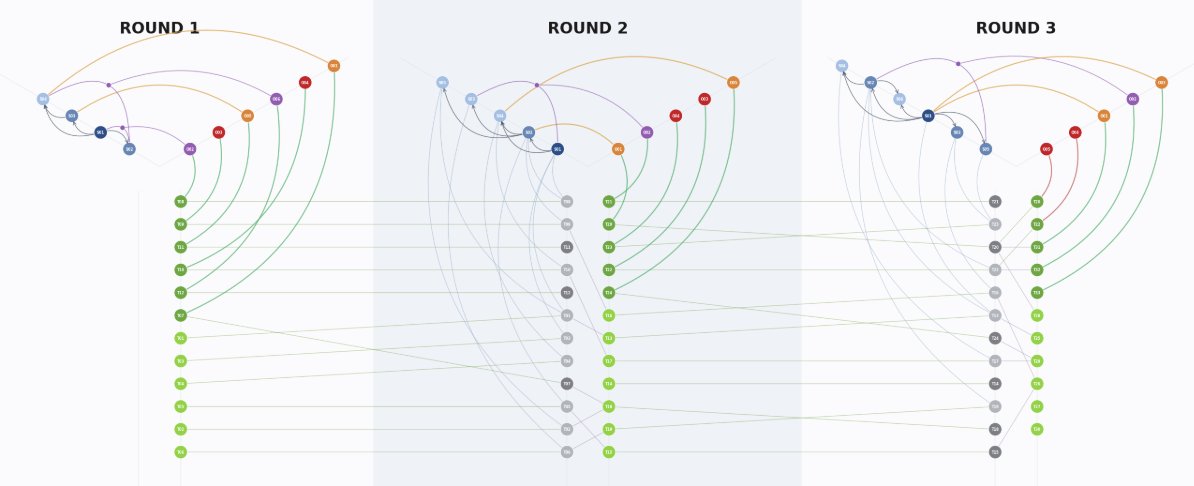
my approach is roughly a really stripped down version of this (sans transformations). asking to choose and vary properties forces the LLM to map out the space and pick distinct points within them. the properties are basically LLM-generated "embeddings"
x.com/_joelsimon/status/1899…
12 Mar 2025

New research project: Lluminate - an evolutionary algorithm that helps LLMs break free from generating predictable, similar outputs. Combining evolutionary principles with creative thinking strategies can illuminate the space of possibilities.
joelsimon.net/lluminate
1
2
84
May 1
there's a meta-lesson to this:
LLMs have gotten very capable. If they're not following your instructions, that's a problem with your instructions! You have to know what to ask for, and that means really understanding what it is you're asking for in the first place. Skill issue!!!
33