
I solve marketing problems for a living. Here, I write about marketing & copywriting, pulling wisdom from philosophy, psychology, and history. ENG & SRB
Joined September 2009
- Tweets 20,027
- Following 711
- Followers 2,130
- Likes 7,144
1,128 Photos and videos





Pinned Tweet

18 Sep 2025
If You’re In The Info-Publishing / Coaching Space, This Is The Best Sales Copy Framework You Can Use
After 10 years of writing copy… 15 years in marketing… and over $50,000,000 in sales generated for clients…
… I believe I’ve earned some reason to trust me when I say this - the copywriting framework I’m about to share with you is the best one you can use for an info-product.
Now, a part of me wanted to go deep and share every psychological and philosophical reason why each step is in the place it is, and why this whole thing works…
But a wiser part of me said: “They don’t care - just give them the framework.”
So here it is - my SLA Framework (Story → Logic → Action).
It combines the knowledge from psychology, philosophy, storytelling, and best-selling non-fiction writing. And when implemented, it also includes elements from rhetoric and behavioral science.
#1: Let’s start with the headline.
Although there are many ways to write your headline, the elements you should always aim to have in it are (in no particular order):
A sense of new-ness and freshness
Curiosity / unexpected connection
Benefit
Authority / credibility tease
Here’s an example:
❌ How To Build Muscles Without Going To The Gym…
✅ For The First Time In His 30-Year-Long Bodybuilding Career, Dr. Biceps Gluteus Talks Openly About His “0-lbs Protocol” That Lets You Build Muscles Without Lifting Any Weights…
Not ideal. But still better than the first one, right?
#2: Now let’s move to starting your copy.
Again, there are dozens of ways to start your copy.
But neuroscience is clear here - the best way to start is with a story.
But not with just any story.
You need a story in which your reader can see himself / herself. Not necessarily externally. But internally.
(How many people can relate to a chemistry teacher becoming dr*g lord to pay for his cancer treatments? Not that much.
And how many people can relate to a guy facing his own mortality and the fact that he needs to do everything in his power to keep his family protected when he’s gone? A TON!)
You also need to pick a story that will ultimately help you make the full circle and show how your core principle, idea, or guidance helped make the journey from Ordinary to the New world.
This can be a client story. It can be your story.
But it can also be a story/anecdote from history or pop culture. Or even a parable, as long as you keep it compliant.
The key with this story opener is to show a person with a problem. And give a glimpse of hope that there is a solution, and that it’s just right there behind a corner (or, in this case, after a few mouse scrolls).
Now, this is not a post about storytelling, so I’ll have to stop myself here. Otherwise, this will turn into a book, lol.
#3: With the story opener, you’ll use it to make a puzzling question that (hopefully) keeps people glued to your copy.
Let’s keep that “no weight protocol” example from above.
And let’s say you told a story about a guy who had both of his hands broken, was forbidden from lifting weights, but was still more jacked than 99% of gym bros.
The puzzling question writes itself. It’s a verbalization of the thought every single person reading up to that point has:
“How is it possible that some people spend years at the gym lifting weights without noticeable biceps or a 6-pack, yet this guy, who can’t lift a grocery bag, managed to look like an Apollon?”
“That’s the biggest question we’ll try to answer today in this letter.”
BAM! Hooked!
This ends the Story portion of the SLA framework.
We got them by their emotions… now let’s satisfy the rational part of the brain with some Logic.
#4: Establish authority / credibility.
After the puzzling question, the most natural thought is: “well, why should I listen to you - who d*ed and made you the lord of the topic?”
Well… address it.
#5: It’s safe to assume you’re not the first one trying to help them solve their problem, nor the first solution they’ve heard of.
So… put some strong light on them. Show the alternatives they’ve tried or heard of.
And then…
#6: Use that strong, bright light to show CRACKS in those common-wisdom solutions.
A stat. A chart. A study. A piece of a logical argument…
Whatever it takes to place the seeds of doubt into their mind about the common knowledge.
For example:
“But, if lifting more weights more often is the key to bigger muscles… then why does XYZ, who can lift 700 pounds, look like a wine barrel?”
After the seeds of doubt are planted, it’s time for…
#7: Your New / Unique / Different Mechanism!
This is the key!
This is why your approach works, and others did not. This is your counter-intuitive idea that everyone else missed.
Give it a catchy name.
Show visually how it works in 3 steps (no less than 3 and no more than 5) - our brains process visual information about 60,000x faster than words.
And then support the heck out of it.
Studies. Quotes. Charts. Historical anecdotes. Origin story.
Prove your Mechanism works!
(Note: in case of a biz-op, you can think of the Mechanism as your Unique / New Opportunity. Or, if it’s an existing and well-known opportunity, as a novel way of leveraging it.)
#8: Now it’s time to put some meat on that skeleton.
Your Mechanism is the Big A-HA moment.
But that Big A-HA moment sits on 3-5 (ideally 3, but no more than 5) Pillars, or Principles, or Secrets, or Steps.
Those are smaller a-has that help people see how/why it works… possible use-cases… make sense of everything you said above… address some of the biggest objections… or some mix of these.
(They can even be some quick wins.)
As Alen Sultanic would put it, this gives them the feeling of being educated.
For each Pillar (let’s call them that), you’ll use pretty much the similar structure:
- Claim
- Proof of the claim being true - usually starting with some story (different from the one you used, but you can go back to the intro story if it makes sense)
- Tips on how to do it
- (optionally) Testimonial-style proof
- Foreshadow what’s to come
#9: At this point, you’ve made a lot of claims.
People want to believe you. They want all that to be true. But they’re not yet sure. They have questions.
Answer the biggest ones of them (if you haven’t done it through your Pillars).
“Yes, I can see the elephant in the room… ‘If this is all so amazing, why am hearing for it just now for the first time?’”
By doing all this (and doing it right), you’ve satisfied the logical side of their mind.
They have charts, numbers, social proof…
You gave them enough ammo to justify believing in what they wanted to be true from the moment they read your headline.
Now it’s time for the last part of the SLA Framework - Action!
#10: Switch to pitch.
A.k.a. make a transition.
After everything you’ve discovered, you knew you had to systematize all this and make it accessible to people all over the world.
You did.
And here are…
#11: Results.
You can come back with your intro story and explain how Johnny used your Mechanism to achieve those amazing results.
You also want to show diversity or results and backgrounds, giving people more chances of seeing themselves in someone else.
#12: Put them in the crossroads.
They can do nothing. They can try on their own. Or they can join all these people whose stories they’ve just heard.
Paint a vivid picture of every choice.
Once you do that, then it’s time for the grand finale…
#13: The Offer!
Again, this is not a post about offers. You have a great book about it. And a few dozen copycat videos.
And there you go - a full circle.
If you pay close attention, you’ll notice that this structure takes the reader on a Hero’s Journey!
They are in their Ordinary world with the problem. They’ve been Called to Adventure with your headline. The Puzzling Question was their Break into the Second World. The objections were their Dark Night of the Soul.
And staying for your offer is the Elixir they can get back with.
So, the Hero’s Journey is not some storytelling and writing formula you try to squeeze your story into. It’s, as the name suggests, a journey you’re taking the reader on.
And if you pay even closer attention, you’ll also see that this Framework closely follows Aristotle’s 3 core pillars of persuasion: Pathos (emotion, starting with the story), Ethos (establishing credibility of the spokesperson), Logos (logic, giving them all the proof they need).
This is a powerful, layered framework.
But it’s not that powerful if it stays saved in some notepad or bookmark.
Use it. That’s why I shared it with you. 🙂
1
1
7
1,216
Now, this excites me. Private, secured AI.
Jun 14

🚨 SHOCKING: LISA SU’S $1,499 LUNCHBOX ANNIHILATES NVIDIA’S $4K AI BEAST!
AMD CEO Lisa Su walked on stage, held a lunchbox sized PC in one hand, and ran a 235 billion parameter model live.
No data center. No cloud. No rented GPU.
The chip inside is the AMD Ryzen AI Max 395. It is the first x86 chip where the CPU and GPU share the same pool of memory. Up to 128GB of unified memory. That one design choice is what changes everything.
An RTX 5090 gives you 32GB of video memory. A 4090 gives you 24. This box gives you more than three times either of them in a chassis you can carry in a backpack.
On DeepSeek R1 inference, AMD's chip beat an Nvidia RTX 5080 by more than 3x. A desktop the size of a thick paperback outrunning a dedicated graphics card that costs over a thousand dollars on a real AI workload.
Now do the math on your subscriptions.
Claude Code Max is $200 a month. ChatGPT Pro is another $200. Cursor is $20. Gemini is $20. That is $5,280 leaving your account every year before you build a single thing.
The 128GB version of this machine starts at around $2,399. At that run rate it pays for itself in under a year and then runs free.
Install Ollama. Pull Qwen3 235B. Point Claude Code at localhost. Same interface you already use. Nothing leaves your machine. Nothing costs per request. No throttling at 3am when you finally have time to build.
Lawyers stop worrying about what OpenAI does with their files. Developers stop watching the token counter. Founders stop killing prototypes because the cloud bill scared them off.
Private AI just became something a normal person can own.
Community note
The device demoed by AMD CEO Lisa Su, the Ryzen AI Halo mini PC capable of running 235B parameter models, costs $3,999, not $1,499. amd.com/en/products/pr…
1
20
Jun 15
Gene Schwartz was wrong! You CAN create desire in humans...
... you just need to tie it to some deep-rooted, unnamed, unexpressed, unmet psychological need or feel.
And then to execute it properly, of course. (Damn it, there's always some catch.)
I know of only three people who taught this:
1. Ernest Dichter, in his book The Strategy of Desire (and other books)
2. @IAmAlenSultanic , in his NHB
3. Edward Bernayes (kinda) in his book Propaganda
Bottom line is: no one is right about everything, and no one is wrong about everything.
Question everything. Expand your knowledge. Upgrade your thinking.
2
23
Jun 14
AI may replace writers, but only because humans will willingly outsource writing to AI.
But the progress of human knowledge will depend on those few who refuse to do it.
32
Jun 13
The US banning Anthropic's Fable 5 model for users outside of the US is an amazing thing.
I hope y'all finally realized NOT to allow yourself and your business to be dependent on someone else's tool.
It can be taken away the same way it was given to you.
Use all those tools. Fine.
But never let yourself depend on them to do your job.
🧠🧠🧠
34
Jun 12
The fact that most people who call themselves "creative strategists" in fact do the most tactical work with almost no strategy behind it is so funny.
21
Jun 12
"If you don't know where you're going, speed will only get you lost faster."
-- Josh Spanier, VP of AI & Marketing Strategy @ Google (talking about the importance of strategic thinking and strategy before tactics, especially when using AI)
21
Jun 11
Work is so much more boring when all you care about is the end result, and not enjoy the process that got you there.
16
Jun 11
Soooo... she's a direct mail copywriting expert 🤔

Angela White says she applied to enter the a6ult indu$try in 2003 by mailing a CD-ROM of nu6e videos of herself and a letter explaining why she wanted to become a c6rnstar revealing she had dreamed of doing c6rn from a young age and, after turning 18, was excited to finally pursue what she was born to do. 👀👀🔥
“In 2003 was a CD-ROM full of nak3d photos and a cover letter explaining why I wanted to be in the indu$try. So it’s been something I wanted to get into from a young age and obviously I waited till I was 18yrs to apply and get in and yes it was really exciting time in my life because I was finally doing what I feel like I was born to do.” 👀🔥
1
161
Jun 10
To get people to buy from your sales copy, you first need to capture and hold their attention.
In its simplest form:
- To capture people's attention, show them something unexpected that's relevant to them.
- To hold people's attention, show them stakes they can feel, and tease answers they don't yet have.
48
Jun 10
Man... how true is this:
"Most people do not have a stable identity. They have accumulated reactions... condition behaviors... defense mechanisms."
4
25
3,154
Jun 9
Sales copy that makes people feel like they're discovering something on their own is far more persuasive than sales copy that teaches, preaches, and lectures people on the topic.
24
Jun 8
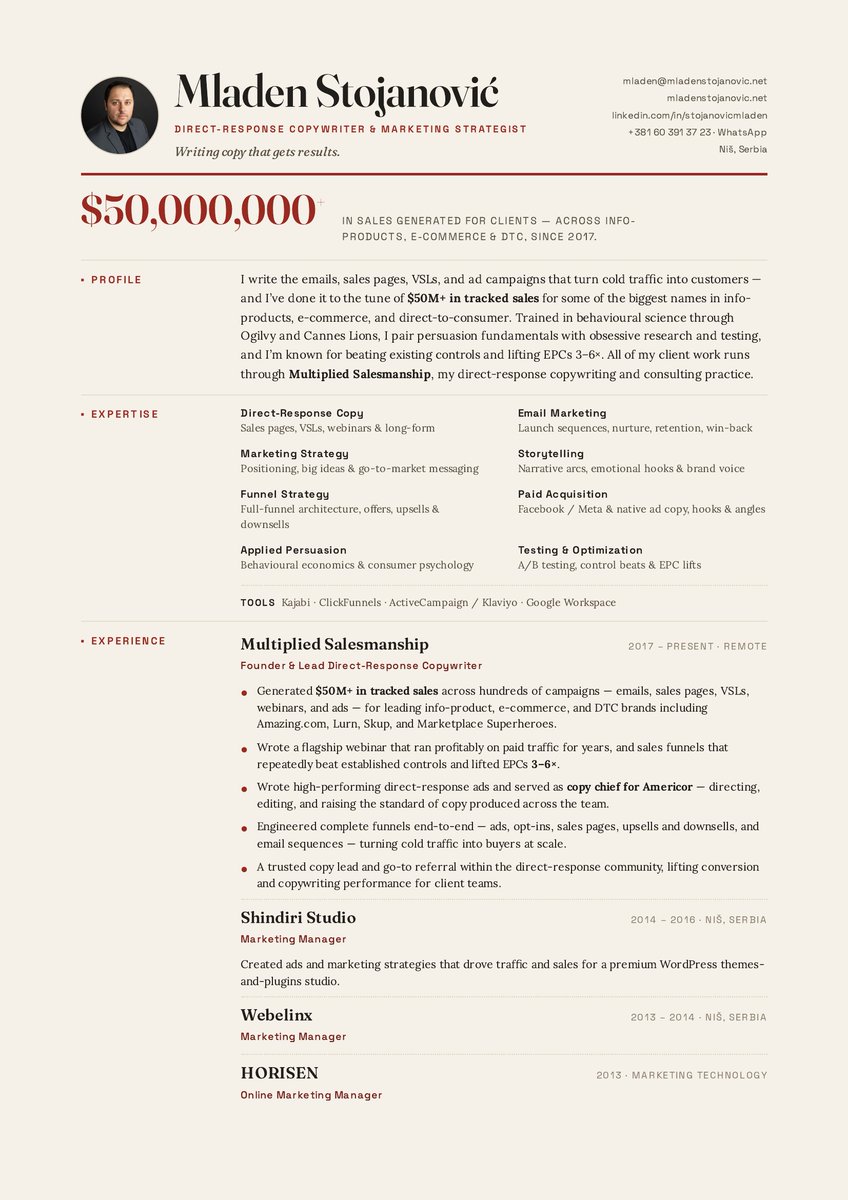
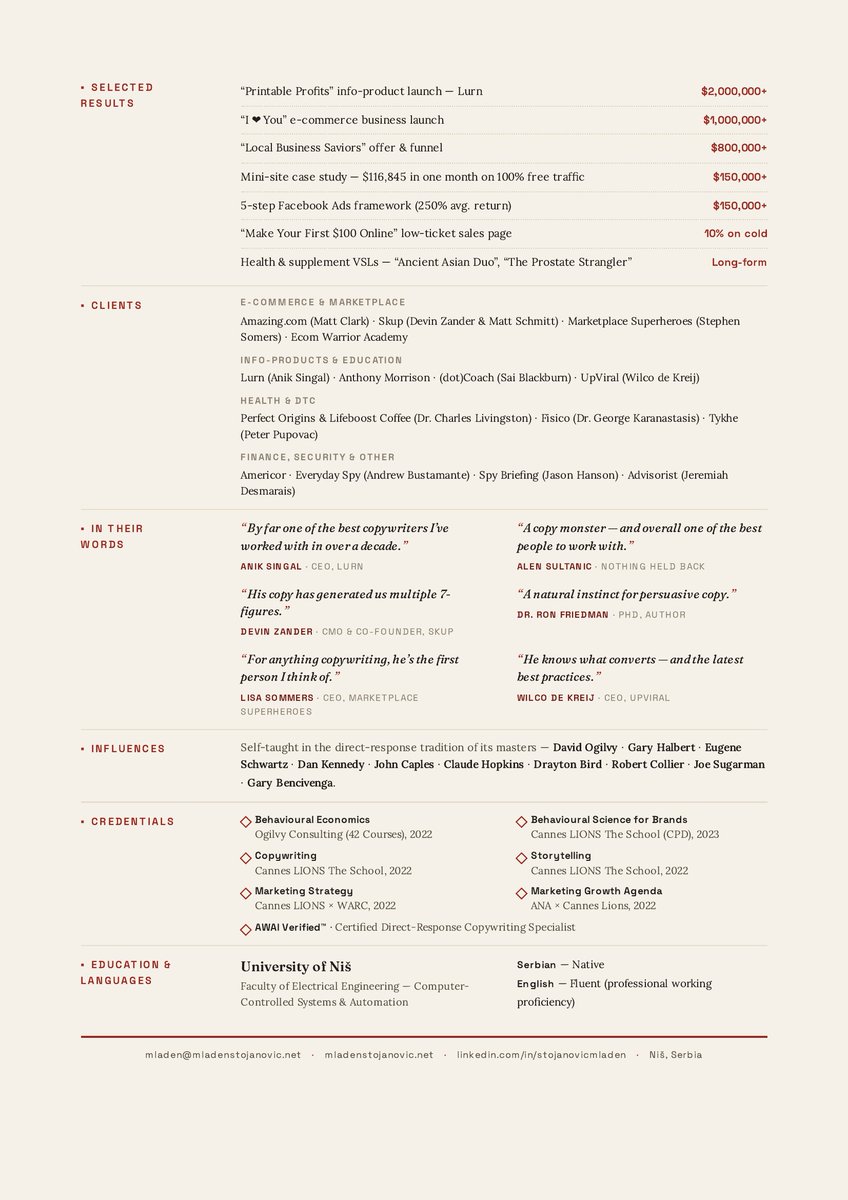
I gave Claude my portfolio and social media links, and asked it to create a CV for me. It did not disappoint.
156
Jun 6
If copywriters promoted themselves as Anthropic does:
"I wrote sales copy that would outsell everyone out there and create a monopoly in the industry... and I'm terrified of its power... so I decided not to send it to a client, and not let others see it. Trust me."
1
37
Jun 6
One of the keys of crafting great sales copy is, counterintuitivly, to take it less seriously, don't aspire for perfection, have fun with it, and let the process take you somewhere new.
33
Jun 5
To što nemaš ništa zajedničko sa naprednjacima i ćacijima je možda trenutno i najveći flex koji možeš da imaš.
38
Jun 4
This
Jun 4

If you look at a few “hiring a copywriter” posts you'll understand the people doing the hiring have no idea how to sell their opportunity to good copywriters. Your incentives are mid.
Here are 5 things you don't understand about good copywriters:
1. Good copywriters are mercenaries. They aren't willing to give up their freedom unless you make an irresistible offer. And an offer they can't say no to is beyond most of y'alls ability and willingness to pay.
2. Good copywriters look like they're doing nothing most of the time. Creativity happens in spurts. Between these spurts of creativity is a lot of mulling, doodling, scrolling, exploring, and consumption.
3. Good copywriters have about 4 hours a day of honest creative work in them. If you expect them to work 996 you are a fool.
4. Good copywriters have trouble with authority. That's why they became copywriters in the first place. They don't like bosses. They are willing to tolerate you for short durations because that's how they earn their living.
5. You will never be able to do what good copywriters can do. With or without AI. Just because you have written words and people have read them doesn't mean you can write good copy. Just because you got Hermes to create a /david-ogilvy skill doesn't mean it can write good copy either. Your favourite AI shill/grifter is full of it. Sorry to break it to you.
“They can't do what we do. And they hate us for it.” – Don Draper
Source: I run a community of over 5,000 copywriters. I've been a working copywriter for nearly 10 years.
2
2
1,259
Jun 2
"AI can tell you everything about the rain...
... except for how it smells... how it feels running in the rain when you're happy... or how it feels walking in the rain when you're sad."
Probably the best description I read on why human writing will never be replaced with AI.
1
39
Jun 1
I always liked @thesamparr because of this love and appreciation for good sales copy.
But after this podcast interview > youtube.com/watch?v=uf4fR3qc… ... I like him even more.
1
16
7,569
May 31
You May Be Writing Amazing Copy... But For The Wrong Client...
Ever had a piece of copy you loved and were proud of, but it completely bombed?
Really makes you question your skill and competence, eh?
It's a normal reaction. But not necessarily a true one.
There's a realistic chance that your copy is objectively great... but it's your client's reputation (or the lack of it) that's causing the problem.
Let me illustrate that with an example.
The year is 1985.
Toyota and GM wanted to exchange some experiences, tech, and know-how, so they formed a new factory in the US - NUMMI (New United Motor Manufacturing, Inc.).
And in this factory, they started making cars. (Shocking, I know. But keep reading.)
And every car from that factory was exactly the same: designed by Toyota... with the same Toyota engines and transmissions... made by the same workers on the same assembly line with the same tools.
The cars had only one major difference...
One group had a Toyota logo on them.
The other had a Chevrolet logo on them.
Exact same cars. Just different logos.
They sold equally well, right?
At this point, you must know that's not what happened. :)
What really happened is that all the car journalists, consumer surveys, public reviews... consistently rated Toyota (Corolla) as a much better, more reliable, and higher-quality car than Chevy (Nova/Prizm).
Buyers were ready to pay a premium price for the Toyota version.
And on the used car market, a secondhand Toyota Corolla was worth MORE than the IDENTICAL Chevy Nova.
SAME F-ING CARS!
Eventually, Corolla became a symbol for reliability and one of the best-selling cars in history.
Any Chevy Nova... well.. you know already.
All because of the perception.
So, sometimes, you can have an amazing product. You can have an amazing sales copy.
But if your client has a bad reputation on the marketplace, it's all worthless.
Be careful who you're taking on as clients.
Good ones will turn you into Corolla. Bad ones will turn you into Nova.
58
May 29
Marketing activities should NEVER be about helping cr***y and mediocre products be seen as premium and pushed to people who don't want them nor need them.
Marketing activities should ALWAYS be about helping great products and services (and causes) be seen with the right positioning, by the right people, at the right price... and presented in a way that makes people excited and happy to take the next step.
Stop helping sh***y products sell.
1
33