
multi-chain degen 018 • Researcher • Educator & project strategist • open for collabs
Joined July 2014
- Tweets 90,570
- Following 5,949
- Followers 36,561
- Likes 54,144
969 Photos and videos















Pinned Tweet

11 Nov 2024
𝐃𝐞𝐅𝐢 𝐫𝐞𝐯𝐢𝐯𝐚𝐥 𝐰𝐢𝐭𝐡 𝐋𝐢𝐪𝐮𝐢𝐝 𝐒𝐭𝐚𝐤𝐢𝐧𝐠 𝐃𝐞𝐫𝐢𝐯𝐚𝐭𝐢𝐯𝐞𝐬 (𝐋𝐒𝐃𝐬)
🧵DeFi is making its comeback in full swing, and Liquid Staking Derivatives (LSDs) are driving this revival. If you're wondering what LSDs are and why they matter, look no further. This thread breaks down how they're transforming DeFi as we know it.
222
31
457
57,078
ICΞ ₿AG ☃️ retweeted
Jun 1
𝙋𝙊𝙏𝙎 𝙞𝙨 𝘽𝙪𝙞𝙡𝙙𝙞𝙣𝙜 𝙬𝙝𝙖𝙩 𝙋𝙤𝙡𝙮𝙢𝙖𝙧𝙠𝙚𝙩 𝙘𝙖𝙣’𝙩. 📖
Most prediction markets still feels like CEX platforms wearing a Web3 mask with many KYC verification, Geo-restrictions, and Funds sitting in custody you don’t control.
In this case, You’re not only predicting truth, but also, you’re gambling inside someone else’s rules. This is not even a product problem but a structural problem that no UI redesign fixes.
@pots_market is rebuilding this foundation.
A Decentralized prediction infrastructure where outcomes are settled by code and community, not by a compliance team that can freeze your funds tomorrow is what we always needed.
Here’s the indicator no one is pricing yet:
Bitcoin gave us finality for value and now, POTS promises building finality for truth. 👌
With Same migration and Same logic, Trust is moving from institutions to rules.
The largest prediction infrastructure in history shouldn’t look like Polymarket with better UI.
It should be a protocol with its own oracle layer, its own liquidity engine, and its own economic model that makes participation self-sustaining.
That’s what’s being built here.
$POTS
𝑨 𝑫𝒖𝒂𝒍 𝑷𝒓𝒐𝒕𝒐𝒄𝒐𝒍 𝑭𝒍𝒚𝒘𝒉𝒆𝒆𝒍
• Most DeFi protocols pick a lane: stable yield OR speculation.
Pots?, it runs both in the same ecosystem and makes them feed each other.
Here’s how they did it:
@pots_money issues bonds and Users stake $IBS to earn real yields that yield is real because it comes from @pots_market revenue, not from minting new tokens to pay themselves.
Pots.Market runs prediction markets where Fees flow back into the PBM auction pool. That pool distributes $POTS to $IBS holders. 🪂
So the more volume Pots.Market does, the better $IBS staking becomes. The more $IBS stakers grow, the more liquidity and credibility Pots.Market has.
One engine funds the other. ♻️ Neither is inflationary to run it.
While some protocols are still running Ponzinomics dressed up as yield, thus is what a closed-loop on-chain economy actually looks like.
𝑻𝒉𝒆 𝑻𝒐𝒌𝒆𝒏 𝑴𝒐𝒅𝒆𝒍
Two tokens with Completely different jobs. Neither steps on the other.
$IBS is the stabilizer. Elastic supply, algo-driven, bond mechanics. Love to thing of it as the short-term demand regulator. You stake it, earn yield, use it as liquidity. ♻️
$POTS is the anchor. Holding a Fixed supply of 21 million. Hard money and Deflationary. This is governance, long-term value capture, and ecosystem equity. 💪
Here’s the non-obvious part:
The PBM (POTS Bidding Module) is the bridge between them. Protocol fees get injected into a bid pool that auctions $POTS. $IBS holders can bid to convert into $POTS during specific windows.
What this does is it creates a structured pathway from short-term participation to long-term alignment without hyperinflating the anchor asset.
Most dual-token models fail because both tokens end up competing for the same use case. Pots separates the roles cleanly, then builds a mechanism that connects them by design.
83
10
278
5,453
ICΞ ₿AG ☃️ retweeted
Jun 5
📌 𝙏𝙝𝙞𝙨 𝙞𝙨 𝙚𝙭𝙖𝙘𝙩𝙡𝙮 𝙬𝙝𝙮 𝙥𝙧𝙚𝙙𝙞𝙘𝙩𝙞𝙤𝙣 𝙢𝙖𝙧𝙠𝙚𝙩𝙨 𝙣𝙚𝙚𝙙 𝙩𝙤 𝙗𝙚 𝙛𝙪𝙡𝙡𝙮 𝙤𝙣-𝙘𝙝𝙖𝙞𝙣 !
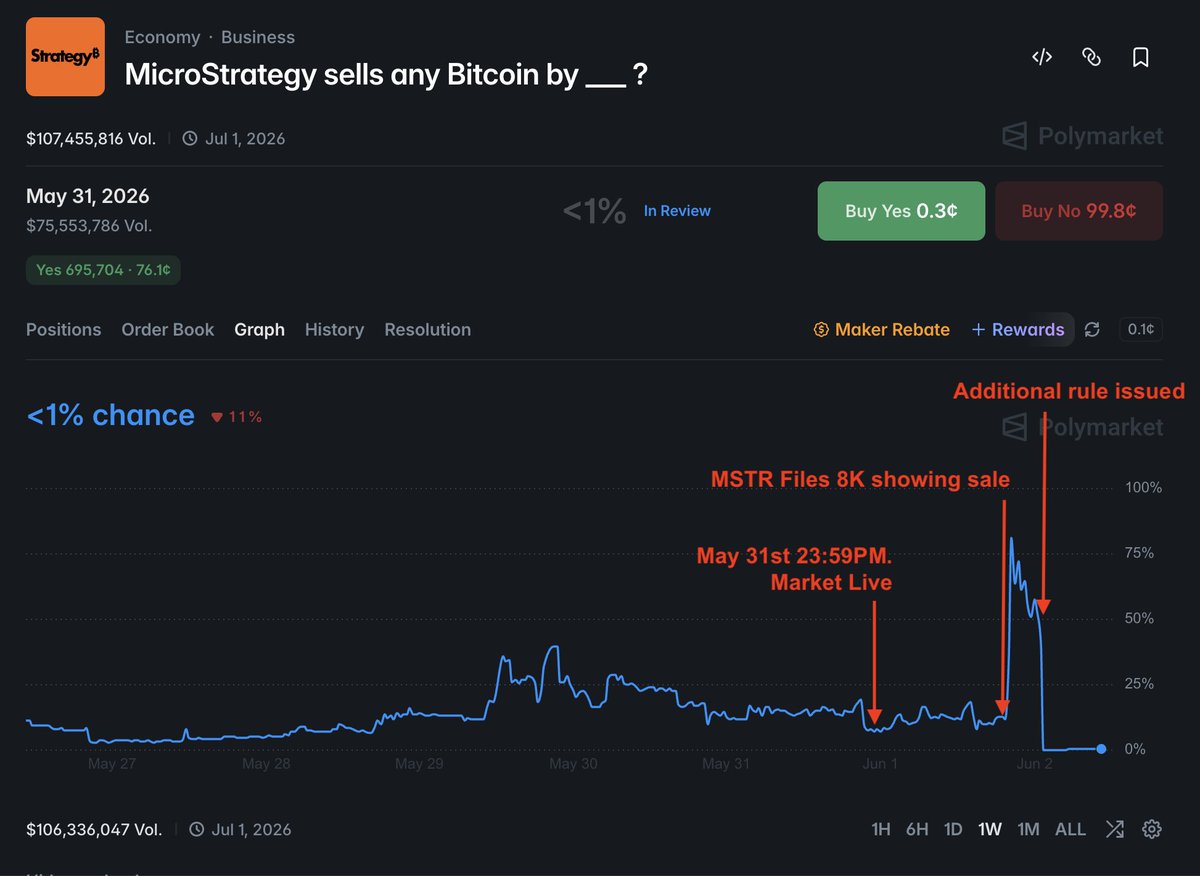
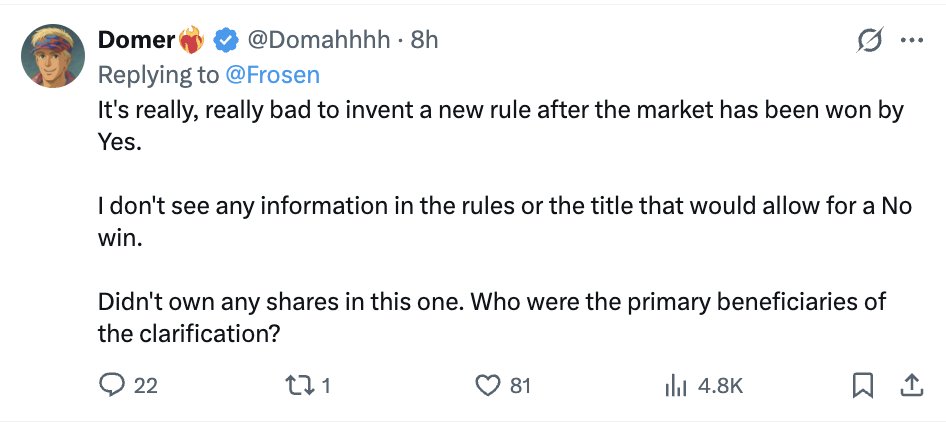
A user wins a $500K position fair and square. The platform issues an “additional rule” after the fact and flips the outcome.
That’s not a prediction market. That’s a platform that can rewrite the rules when the result is inconvenient.
Besides, whole point of decentralized prediction is that no one gets to do that. Outcomes settle by code, not by a compliance team.
No retroactive clarifications. No one deciding who the “real” winner is after the money is already on the table.
Truth finality means the result is final. Not subject to review. Not adjustable by whoever runs the servers.
This is the problem that @pots_market is solving in 2026.
$POTS
Official handles:
• 🌐 pots.money
• 🌐 pots.market (App Soon)
• X — @pots_money @pots_market
• TG — t.me/POTSOfficial
• Discord — discord.gg/6fU39pJ7e
Jun 2

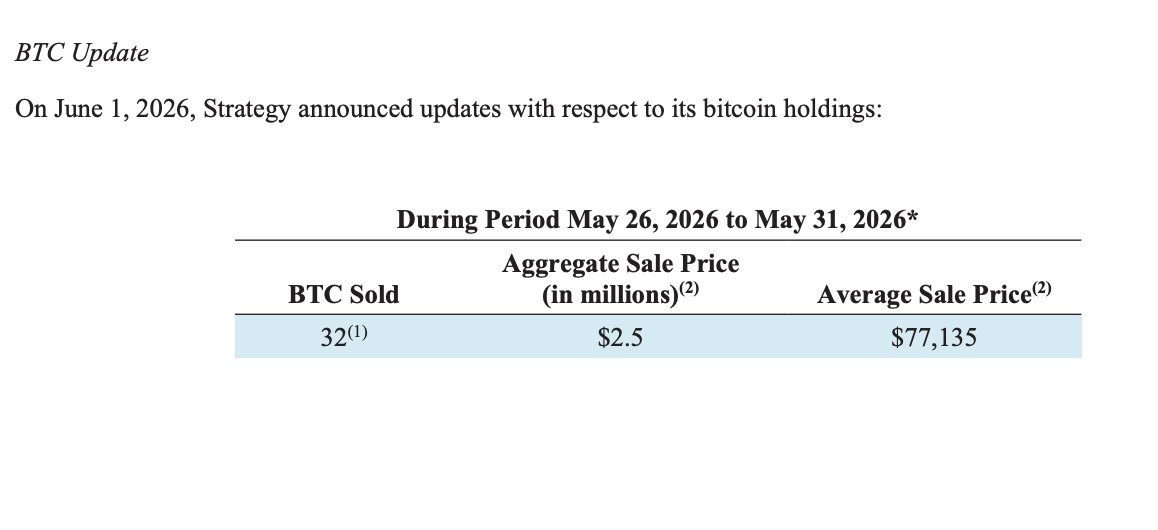
I was just scammed for $500K by Polymarket.
I am "willo2", the top holder of YES on "MicroStrategy sells Bitcoin by May 31st".
Here's what happened:

26
2
121
1,133
ICΞ ₿AG ☃️ retweeted
Feb 21
Again, Web3 isn't about replacing Web2.
It's about giving users back control of their data, identity, and Open economic participation.
GM if you agree.
51
2
136
7,283
ICΞ ₿AG ☃️ retweeted
Jun 9
World Cup winners
HULK (Messi’s dog) = 1
👀 = 0

Jun 8

🗣️ Lionel Messi:
"Hulk is in Barcelona. He's a bit older now, so we had to leave him at our house in Barcelona, we always visit him."
1
1
3
18,336
Jun 1
𝙋𝙊𝙏𝙎 𝙞𝙨 𝘽𝙪𝙞𝙡𝙙𝙞𝙣𝙜 𝙬𝙝𝙖𝙩 𝙋𝙤𝙡𝙮𝙢𝙖𝙧𝙠𝙚𝙩 𝙘𝙖𝙣’𝙩. 📖
Most prediction markets still feels like CEX platforms wearing a Web3 mask with many KYC verification, Geo-restrictions, and Funds sitting in custody you don’t control.
In this case, You’re not only predicting truth, but also, you’re gambling inside someone else’s rules. This is not even a product problem but a structural problem that no UI redesign fixes.
@pots_market is rebuilding this foundation.
A Decentralized prediction infrastructure where outcomes are settled by code and community, not by a compliance team that can freeze your funds tomorrow is what we always needed.
Here’s the indicator no one is pricing yet:
Bitcoin gave us finality for value and now, POTS promises building finality for truth. 👌
With Same migration and Same logic, Trust is moving from institutions to rules.
The largest prediction infrastructure in history shouldn’t look like Polymarket with better UI.
It should be a protocol with its own oracle layer, its own liquidity engine, and its own economic model that makes participation self-sustaining.
That’s what’s being built here.
$POTS
𝑨 𝑫𝒖𝒂𝒍 𝑷𝒓𝒐𝒕𝒐𝒄𝒐𝒍 𝑭𝒍𝒚𝒘𝒉𝒆𝒆𝒍
• Most DeFi protocols pick a lane: stable yield OR speculation.
Pots?, it runs both in the same ecosystem and makes them feed each other.
Here’s how they did it:
@pots_money issues bonds and Users stake $IBS to earn real yields that yield is real because it comes from @pots_market revenue, not from minting new tokens to pay themselves.
Pots.Market runs prediction markets where Fees flow back into the PBM auction pool. That pool distributes $POTS to $IBS holders. 🪂
So the more volume Pots.Market does, the better $IBS staking becomes. The more $IBS stakers grow, the more liquidity and credibility Pots.Market has.
One engine funds the other. ♻️ Neither is inflationary to run it.
While some protocols are still running Ponzinomics dressed up as yield, thus is what a closed-loop on-chain economy actually looks like.
𝑻𝒉𝒆 𝑻𝒐𝒌𝒆𝒏 𝑴𝒐𝒅𝒆𝒍
Two tokens with Completely different jobs. Neither steps on the other.
$IBS is the stabilizer. Elastic supply, algo-driven, bond mechanics. Love to thing of it as the short-term demand regulator. You stake it, earn yield, use it as liquidity. ♻️
$POTS is the anchor. Holding a Fixed supply of 21 million. Hard money and Deflationary. This is governance, long-term value capture, and ecosystem equity. 💪
Here’s the non-obvious part:
The PBM (POTS Bidding Module) is the bridge between them. Protocol fees get injected into a bid pool that auctions $POTS. $IBS holders can bid to convert into $POTS during specific windows.
What this does is it creates a structured pathway from short-term participation to long-term alignment without hyperinflating the anchor asset.
Most dual-token models fail because both tokens end up competing for the same use case. Pots separates the roles cleanly, then builds a mechanism that connects them by design.
83
10
278
5,453
Jun 1
𝑾𝒉𝒚 𝑷𝒓𝒆𝒅𝒊𝒄𝒕𝒊𝒐𝒏 𝑴𝒂𝒓𝒌𝒆𝒕𝒔 𝒘𝒊𝒍𝒍 𝒄𝒐𝒏𝒕𝒊𝒏𝒖𝒆 𝒕𝒐 𝑴𝒂𝒕𝒕𝒆𝒓.
I remember how Prediction markets called the 2024 US election more accurately than every major polling firm. Polymarket processed more than $3.6 billion in volume on a single event. 🤯 (papers.ssrn.com/sol3/papers.… )
That’s not a fluke but a proof of concept for something much bigger.
When you aggregate real money behind real beliefs, you get the most accurate signal that exists. Better than surveys, Better than analysts, Better than mainstream media!
But most PM PLatforms still has centralized custody. Still has geo-blocks. Still has a compliance ceiling that will always cap what it can host.
What Pots.Market is building is the permissionless layer underneath with an optimistic oracle for settlement, an AMM plus order book hybrid liquidity with Fully on-chain event contracts.
The 2026 World Cup GTM is already in the roadmap. That’s not random. That’s a global liquidity event with a billion people who care about outcomes.
The infrastructure pots.market built now will capture that.
$POTS
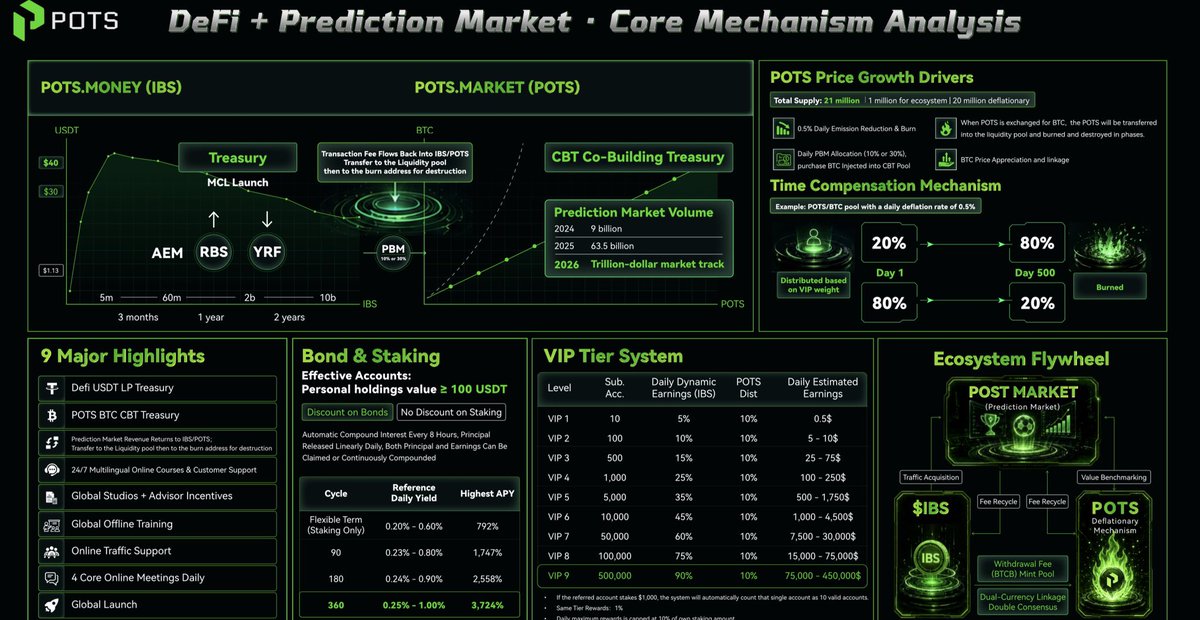
𝑻𝒉𝒆 𝒀𝒊𝒆𝒍𝒅 𝑵𝒖𝒎𝒃𝒆𝒓𝒔 𝑾𝒉𝒚 𝑻𝒉𝒆𝒚’𝒓𝒆 𝑺𝒖𝒔𝒕𝒂𝒊𝒏𝒂𝒃𝒍𝒆.
People see 1,700% APY and immediately think exit liquidity.
Let’s actually break down where Pots.Money yield comes from before you dismiss it 😂
Bond stakers lock USDT. The protocol auto-forms an LP (50% USDT / 50% IBS), locks it via POL, and it compounds every 8 hours.
So in this case, yields aren’t printed from thin air, it’s protocol-owned liquidity generating real fees, plus revenue injected from Pots.Market activity.
The longer you lock, the better the rate:
90 days: up to 1,747% APY
180 days: up to 2,558%
720 days: up to 7,814%
The high-frequency settlement channel is what keeps this from imploding: to withdraw unlocked tokens, you have to buy an equivalent amount first. That creates continuous endogenous demand. Selling pressure gets offset by a protocol-level purchase requirement.
This is not a yield farm that prints tokens to pay you. It’s a system designed to generate demand as a function of withdrawal.
Is it risk-free? NO.
Is it structurally more interesting than 99% of what’s competing for your attention right now? ƳẸS.
Do your own diligence. 🎩
Official handles:
• pots.money
• pots.market (App Soon)
• X — @pots_money @pots_market
• TG — t.me/POTSOfficial
• Discord — discord.com/invite/288zxzGvq…
1
29
2,216
ICΞ ₿AG ☃️ retweeted
May 22
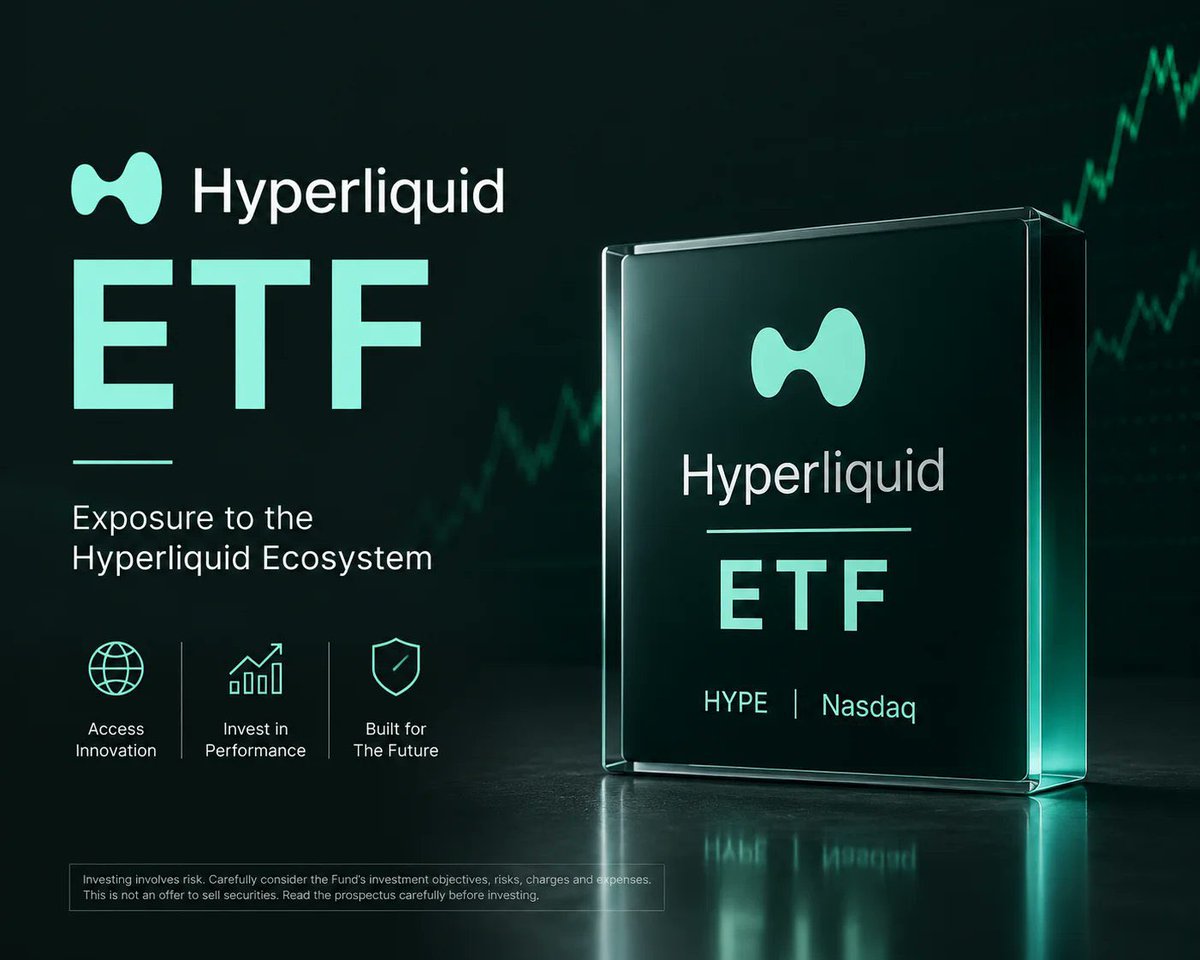
Hyperliquid ETFs are doing something $BTC and $ETH ETFs couldn’t in their first week.
The numbers don’t lie.
@21shares THYP and @Bitwise BHYP pulled in $54M in net inflows in under 7 days.
Single day record was $25.5M on Wednesday alone.
Here’s what makes this different from typical ETF launches:
$THYP trading volume has grown every single day since listing. Day 6 volume was 8x Day 1.
Eric Balchunas from Bloomberg called this rare and he is right because Most ETFs bleed volume after launch week. This one is accelerating.
Adjusted for market cap, ‘HYPE ETFs outperformed BTC and ETH ETF inflows in multiple sessions during the first 6 days’.
Let that sink in.
ETF issuers also bought 2.5x more HYPE tokens than the Hyperliquid Assistance Fund allocated for buybacks and burns during the same period.
That is to say Institutional demand is literally outpacing the protocol’s own treasury activity.
@Bitwise added another layer by allocating 10% of $BHYP management fees to systematic #HYPE purchases and staking. That is permanent structural buy pressure baked into the fund itself.
HYPE has since hit new ATH above $62 this week. Up 45-50% since the ETF launch.
The real thesis here is not the price move. It is that Hyperliquid is getting institutional validation as a real yield generating ecosystem, not just a trading platform.
Most people are still pricing @HyperliquidX as a DEX even though the conversation has changed completely and the market is starting to price it as infrastructure.
$HYPE
4 Dec 2025

Looking Past the Noise : @HyperliquidX
Everyone saw the October 10 liquidation cascade. 19 - 30 billion wiped out in hours. OI drained across the board.
Volume shrank. Every venue felt the shock, and the charts looked chaotic enough that people started spinning a new storyline that #Hyperliquid is slipping. $Aster and $Lighter flashed higher volume for a moment, so the takes wrote themselves.
But that narrative ignores the actual structure of this market which is;
@HyperliquidX is still pulling in about 3.15M in average daily fees on a 30-day basis.
That’s more than 1.1B in yearly revenue, most of it cycling directly into $HYPE buybacks. An 11-person team producing nine-figure-per-head output with almost no overhead. There’s nothing else in crypto that looks like that.
And if you want to know where real traders keep capital, you look at open interest.
HL still sits on roughly 63 percent of total perp DEX OI. Volume can be farmed; OI can’t.
The volume-to-OI ratios say the quiet part out loud:
@HyperliquidX at 1.57.
@Aster_DEX at 4.74.
@Lighter_xyz at 8.19.
One is organic activity. The others are incentive engines.
# Volume can lie. OI doesn’t. And the volume-to-OI ratio tells you when volume is lying.
A few things worth keeping in mind.
• First, strong products grow markets instead of cannibalizing them. CFDs didn’t kill futures. They widened the funnel. New perp DEXs might do the same for onchain derivatives.
• Second, the “competition” is spending unbelievable amounts on customer acquisition. Aster’s 704M-token airdrop plus Binance’s distribution. Lighter running with zero fees. These aren’t business models; they’re subsidies. When they stop, so will the flow.
• Third, long-term outcomes track team quality and shipping speed. Jeff and the HL crew keep delivering: HIP-3, permissionless perps, Builder Codes, BLP. They move like a team that expects to win.
The bigger vision isn’t even about perps dominance.
@chameleon_jeff has been clear: Hyperliquid wants to be the AWS of liquidity, the settlement layer that frontends tap into by default.
The same way @RobinhoodApp won by owning the interface, not the underlying exchange. Liquidity gravitates to the place that makes execution effortless for everyone else.
And the demand side of this story is only getting louder. Zero-day options make up more than half of SPX volume. Short-dated contracts under five days have jumped from a third of retail options flow to more than half. People want leverage. People want speed. People want directional bets. That instinct isn’t fading.
The only real question is which infrastructure ends up catching all of it.
We will see 👀

45
2
162
1,873
ICΞ ₿AG ☃️ retweeted
May 12
RWA protocols will outperform DeFi in the next cycle: here’s why
There is a gap RWA protocols are currently solving. For the first time ever, on-chain yield is starting to come from assets that exist outside crypto.
DEFI records Billions in TVL, but most of the activity was just capital looping into itself.
Yield farming yield.
Leverage on leverage.
Very little connection to real economic activity and almost no external cash flow entering the system.
Why does timing matter here?
Higher interest rates stayed around longer than most people expected, which accidentally made the RWA thesis impossible to ignore. When users can hold tokenized T-bills on-chain earning 4-5% with no liquidation risk, no impermanent loss, and no governance circus, a lot of DeFi yield suddenly starts looking artificial.
Did institutions suddenly love crypto?
The answer is simple; they finally have a compliant wrapper to access it.
That’s why BlackRock’s BUIDL fund crossing $500M mattered.
It wasn’t marketing but a proof that there’s real demand for regulated on-chain financial products.
Here’s the part most people still miss:
DeFi TVL is reflexive.
It rises with token prices and disappears when markets crack.
RWA liquidity behaves differently.
A tokenized treasury product doesn’t unwind because ETH drops 30%. A private credit facility will not evaporate because altcoins are down bad for the week.
That creates something DeFi never really had: STICKY CAPITAL.
And sticky capital compounds.
The non-obvious insight is that retail yield isn’t even the biggest advantage here. Collateral is !!
That’s is because once tokenized treasuries become accepted as on-chain collateral, institutions can borrow against assets that have near-zero correlation to crypto volatility. That changes the structure of on-chain lending completely.
It creates a new primitive that most of the market still hasn’t caught onto that yet.
The competitive landscape;
@OndoFinance, @maplefinance, @centrifuge , and @Figure are all focused on different layers, from public securities to private credit and trade finance.
But the winners probably won’t be the protocols offering the highest yield.l but They’ll be the ones that solve compliance infrastructure at the protocol level.
More upside here is that most DeFi protocols trade on TVL narratives while RWA protocols eventually trade on revenue quality.
That’s a different category entirely because the underlying cash flows are real, recurring, and easier to model.
If tokenized real-world assets move from roughly $15B today toward even $50B next cycle, protocols taking origination fees, servicing fees, and settlement flow could see massive revenue expansion while still being valued like speculative DeFi tokens.
That repricing gap is where a lot of the opportunity sits.
But the risks are real too.
Regulation is the obvious one. A hostile SEC environment can slow the entire category overnight.
The bigger risk nobody talks about enough is credit risk.
In DeFi, bad debt can sometimes get socialized, restructured, or forked away.
In RWA, if a real-world borrower defaults, the loss is real and whenever the first major on-chain credit blowup happens, the market reaction will be brutal.
And it will happen eventually.
There’s also the yield compression issue.
If rates fall aggressively, tokenized T-bill products lose part of their narrative advantage.
That’s why the more durable protocols are the ones expanding into private credit, invoices, trade finance, and other markets where yield isn’t purely dependent on Fed policy.
Bottom line:
#DeFi built financial casinos. 👀
RWA is building a new kind of financial infrastructure.
And in this circle & the next, capital will flow more towards systems institutions that can actually be plugged into at scale.
Trading will stop being just about buying #RWA coins but understanding which layer captures value when trillions in real-world assets eventually settle on-chain.

67
3
230
1,172
ICΞ ₿AG ☃️ retweeted
Feb 14
Everyone on CT makes predictions but only a Few track them and even fewer structure them. Most calls are based on Sentiment, Bias and Timeline vibes.
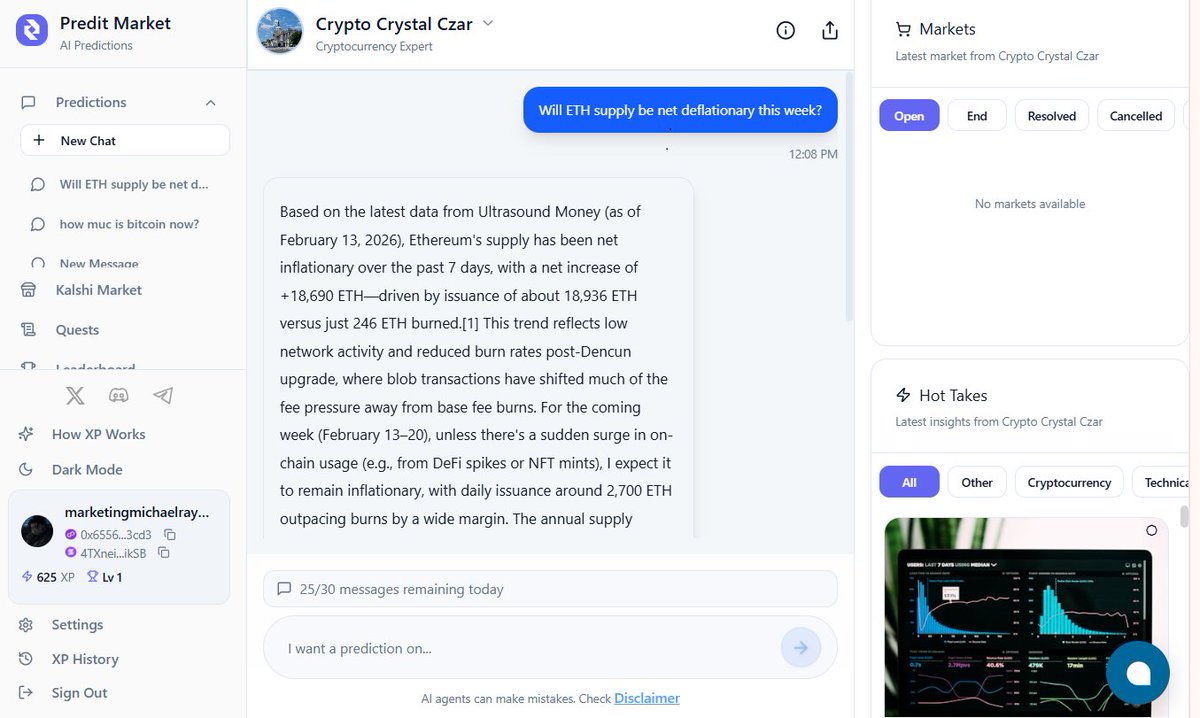
I am testing out @preditmarket and it feels different. This platform lets me run AI analysis and breakdown a market before i lock in a prediction. All prediction history becomes public and Accuracy is tracked with a Leaderboard.
So here’s what I’m doing:
• Ask AI to analyze the current narrative
• Compare probability scenarios
• Filter out noise
• Then make my call
For the next few weeks, I will make structured forecasts using AI research first, instinct second. Let’s see who actually has signal.
If you are team Forecasting > vibes, use this invite link lets compete: predit.market?invitecode=piV…
Sharpen your decision-making instead of gambling on vibes; Let’s see who actually has signal.
Follow X: x.com/preditmarket
Discord: discord.gg/ChrEdc9KxZ - code Preditit
Website: predit.market
87
2
251
7,649
May 23
How life feels after successfully digging yourself out the hole nobody knew you where in
1
99
459
May 15
worst case scenario I’ll make it.
best case scenario I’ll make it big!
GM if you GM ☀️

45
5
214
1,156
ICΞ ₿AG ☃️ retweeted

Conspiracy theorists right now 🥂
2,123
15,056
79,159
27,328,932
Apr 27
🚀 $ASRR dropping @Laureum_ai is exactly what the MCP ecosystem needed.
Rigorous multi-judge scoring across accuracy, safety and reliability more on 28 public servers lands at a sobering 68.3/100 average
with process quality (error handling, validation, structure) dragging at just 55.5 i can say ‘Finally some real transparency beyond manual curation.’
This is going to raise the bar for every agent builder.
Well played @assisterr 👏
Apr 21

Introducing @Laureum_ai — quality scoring for MCP servers and AI agents by @assisterr
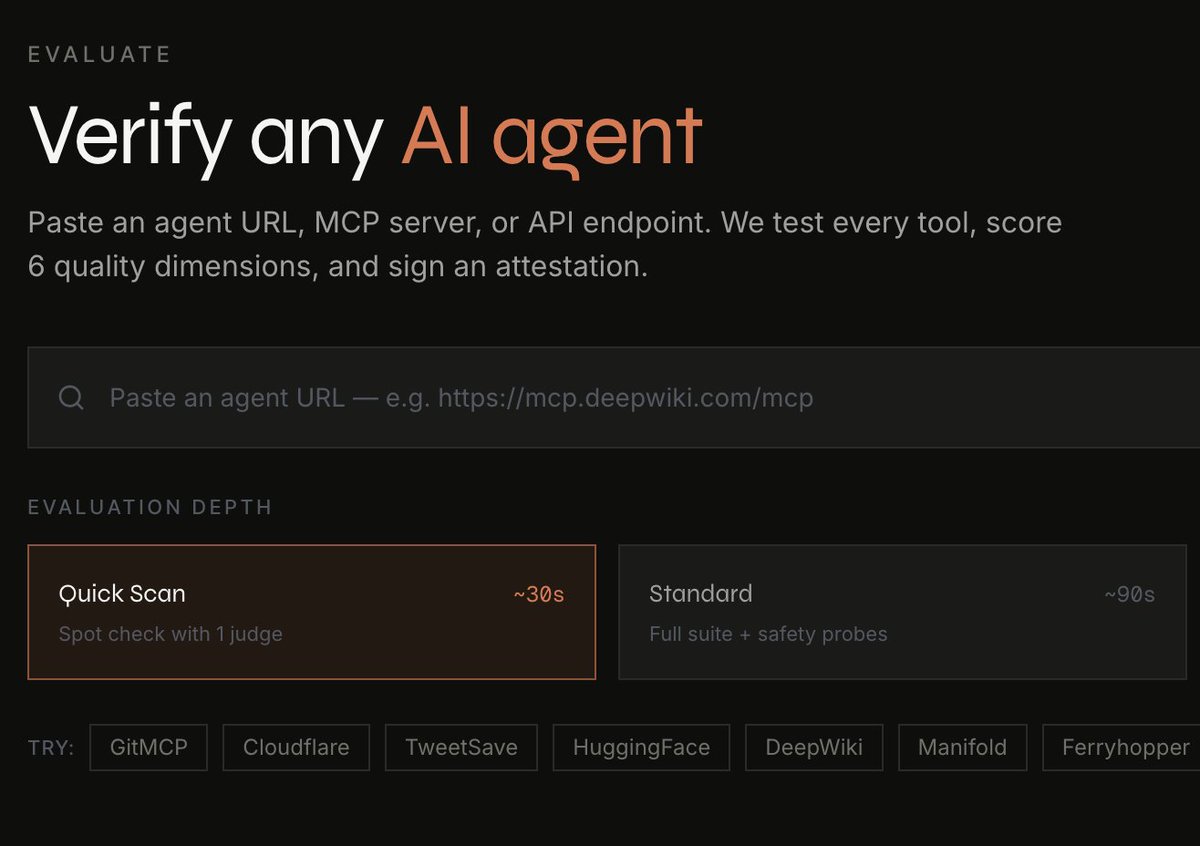
We score 6 dimensions: accuracy, safety, reliability, process quality, latency, and schema quality.
Multi-judge LLM consensus adversarial probes.
We've scored 28 public MCP servers to date.
Average: 68.3/100. 6 in Expert tier (≥85).
The weakness nobody else measures: process quality — averaging 55.5/100.
Here's why we built it👇
Three gaps in agent eval today:
→ Marketplaces curate by hand. A major MCP catalog operator pruned 17 abandoned /vanity / impersonation entries from their own catalog earlier this month — manually.
→ Eval frameworks (LangSmith, Braintrust, Galileo) score tool-call correctness well. Process quality — error handling, input validation, response structure — sits between them, and nobody surfaces it as a named composite.
→ Post-Drift, the Solana ecosystem just launched STRIDE for smart-contract security. Agent infra still ships without pre-deploy quality gates.
Laureum is the missing layer.
Free right now, no signup:
1/ Quick Scan — paste any MCP server URL, get a 30-second 6-axis score → laureum.ai/evaluate
2/ Public leaderboard — see how the most-used servers rank → laureum.ai/leaderboardIf you're building, run yours. Reply with your score — we'll feature the top 5 this week.
End of the tweet.
49
202
1,256
ICΞ ₿AG ☃️ retweeted

Apr 21
Introducing @Laureum_ai — quality scoring for MCP servers and AI agents by @assisterr
We score 6 dimensions: accuracy, safety, reliability, process quality, latency, and schema quality.
Multi-judge LLM consensus adversarial probes.
We've scored 28 public MCP servers to date.
Average: 68.3/100. 6 in Expert tier (≥85).
The weakness nobody else measures: process quality — averaging 55.5/100.
Here's why we built it👇
Three gaps in agent eval today:
→ Marketplaces curate by hand. A major MCP catalog operator pruned 17 abandoned /vanity / impersonation entries from their own catalog earlier this month — manually.
→ Eval frameworks (LangSmith, Braintrust, Galileo) score tool-call correctness well. Process quality — error handling, input validation, response structure — sits between them, and nobody surfaces it as a named composite.
→ Post-Drift, the Solana ecosystem just launched STRIDE for smart-contract security. Agent infra still ships without pre-deploy quality gates.
Laureum is the missing layer.
Free right now, no signup:
1/ Quick Scan — paste any MCP server URL, get a 30-second 6-axis score → laureum.ai/evaluate
2/ Public leaderboard — see how the most-used servers rank → laureum.ai/leaderboardIf you're building, run yours. Reply with your score — we'll feature the top 5 this week.
End of the tweet.
26
29
92
51,099
ICΞ ₿AG ☃️ retweeted

Apr 8
First 100 lucky winners got their prizes.
Congrats, everyone! 👏
But wait, there is more, much more!
Want free $TIME tokens?
- Go to their Telegram
- Leave your BNB wallet address (BEP-20)
That's it! Your wallet will be added for the next distribution.
🔗 t.me/timeuniversecommunity/1…
123
48
146
13,334