
tokenization @avalabs 🔺 || former @troweprice || @williamandmary || Opinions are my own & not the views of my employer || 🇺🇸
Joined January 2021
- Tweets 3,622
- Following 2,488
- Followers 2,609
- Likes 4,970
336 Photos and videos

Pinned Tweet

31 Jan 2025
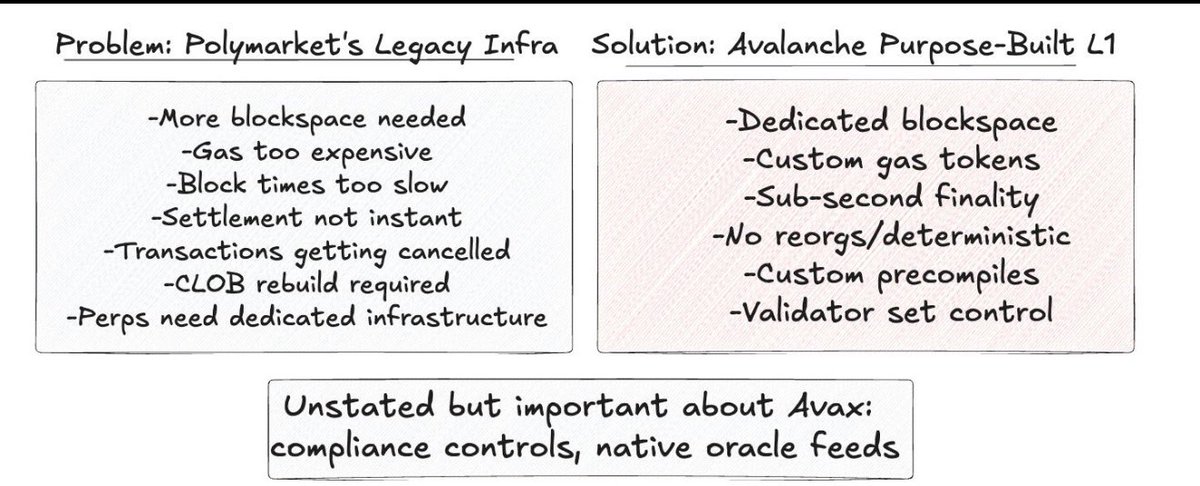
1/ As the crypto bull market accelerates, builders, investors, and enjoyoors face a crucial question: what blockchain architecture will fuel the next wave of innovation?
The answer is clear—purpose-built blockchains on @avax will lead the way. Here’s why. 👇
🔗 Full deep dive: medium.com/@ovwoude/swiss-ar…
11
15
77
32,652
5 tokenized primitives for a user on @avax:
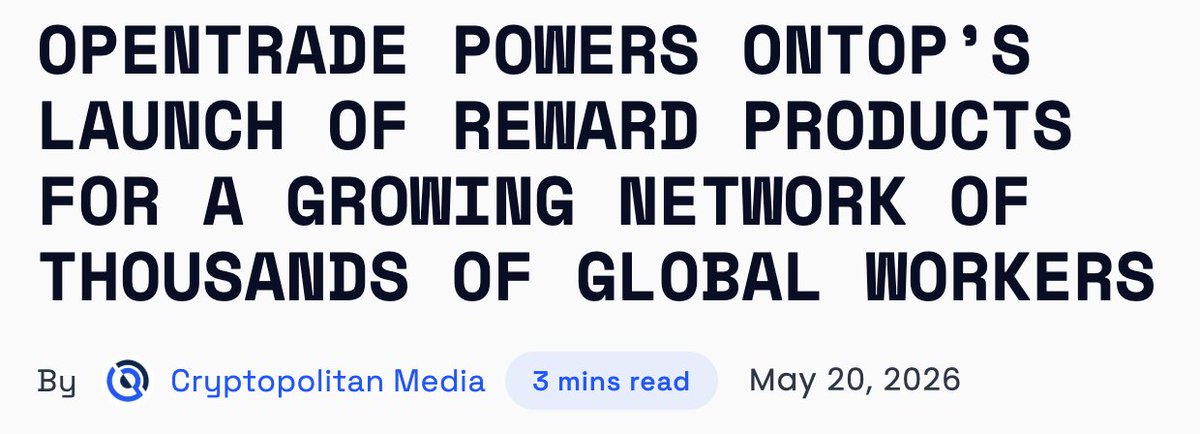
-Stablecoin banking yield (@opentrade_io)
-Tokenized US equities (@DinariGlobal)
-Capital-efficient payments (@AxiymFinance)
-Embedded consumer credit
-Stablecoin-native cards (@raincards)
what used to demand a license and a balance sheet is now an API integration.
8
4
50
3,743
who's going to the @Bitso Stablecoin Conference this week? let's grab coffee!
6
369
tokenization settles & distributes beautifully. what it does NOT do is manufacture access to a syndicate book
we keep relearning that the legal/market access layer is the hard part, & the chain is the easy part
Jun 12

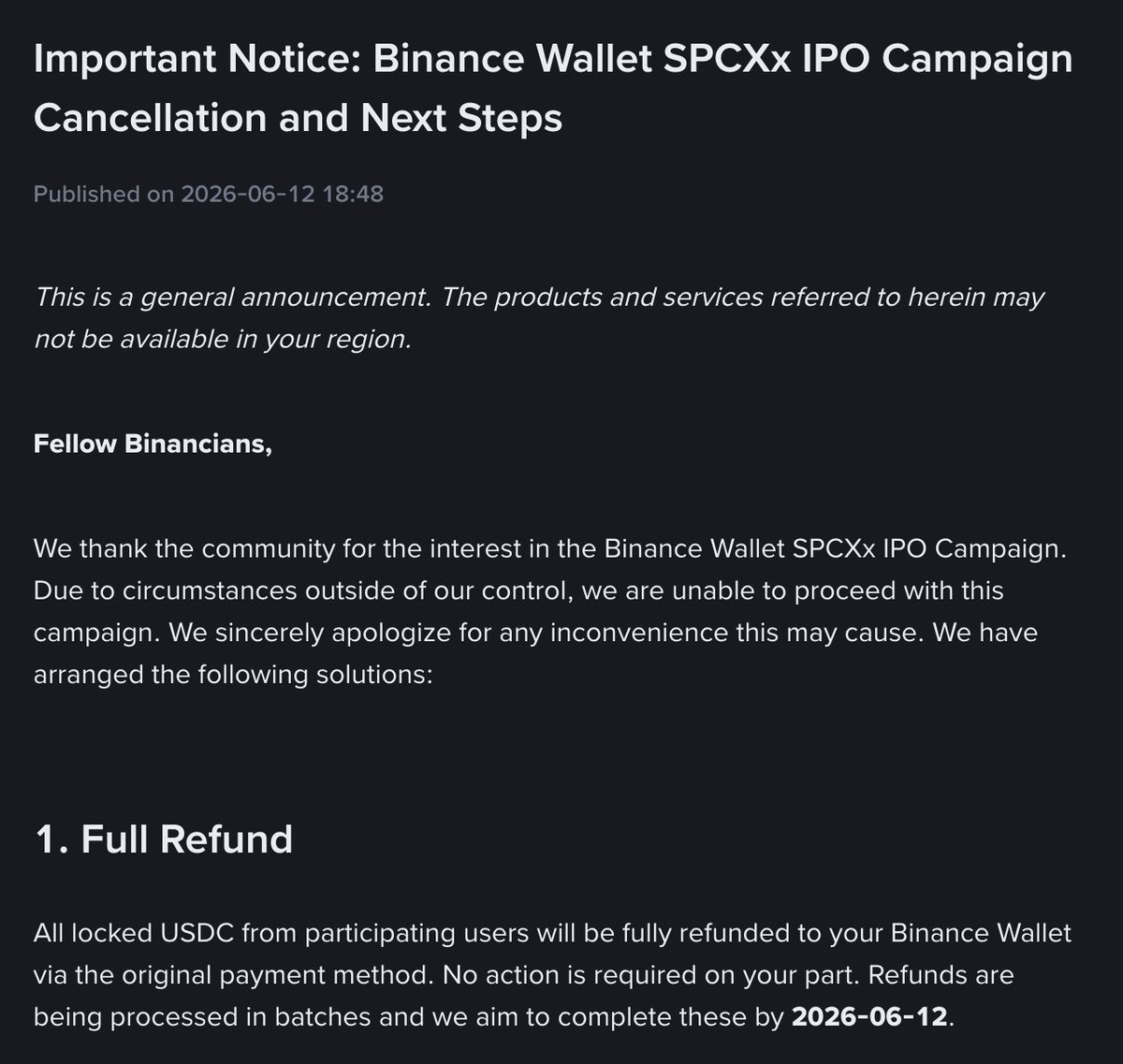
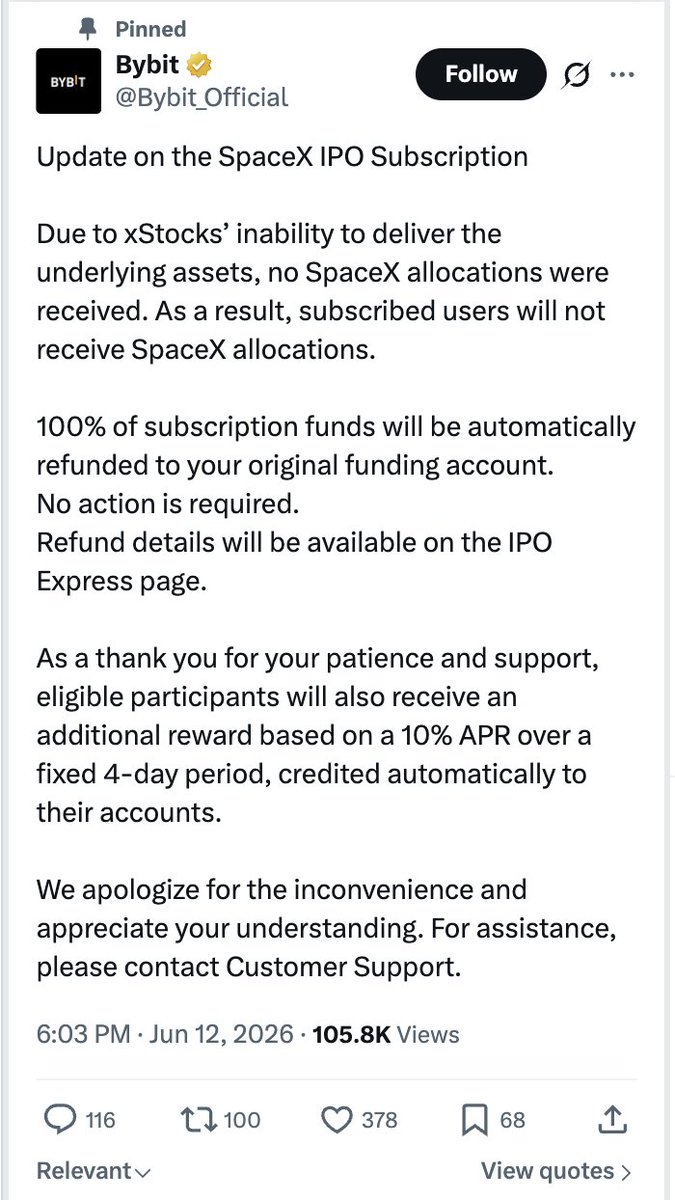
Bybit and Binance announce the cancellation of their SPCX IPO campaigns due to Xstocks' inability to deliver the underlying asset. 👀
10
798
the failure here was specific: the centralized allocation model, where an intermediary has to procure real IPO shares & hand them to an exchange, broke @ exactly that procurement

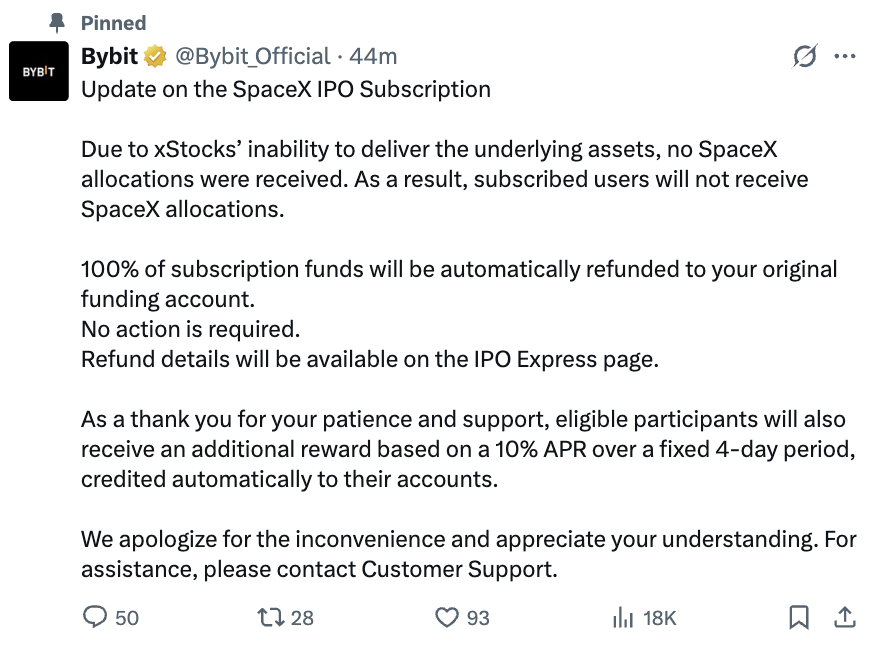
NEW: Crypto exchange Bybit says users will not receive SpaceX ($SPCX) IPO allocations after xStocks was unable to deliver the underlying shares.
1
455
thste 1 wave of embedded finance won on UX and price. But the product shelf stayed thin bc the products that build real wealth sat behind broker-dealer licenses, BIN sponsors, & correspondent banking
tokenization removes that barrier
128
Olivia Vande Woude retweeted

Me too!!

VP of Onchain Finance at @AvaLabs @MorganKrupetsky is excited for when “Apple stock is just Apple stock.”
4
4
38
3,896



Olivia Vande Woude retweeted

“From an @avax standpoint, we've been fortunate given the architecture of the network, where if someone wants to go full degen and deploy on C-chain… they can do that.”
@MorganKrupetsky, VP of Onchain Finance at @AvaLabs explains how hybrid tech can make institutions more comfortable.
4
7
44
5,227
Jun 12
Tokenized SpaceX did not fail on Friday, but a particular distribution model did.
> When SpaceX rang the Nasdaq bell at a $1.75t valuation, a wave of crypto platforms moved quickly to put tokenized exposure in front of users. By day's end, Binance, Bybit, Bitget had withdrawn their campaigns & refunded subscribers in full, w/ Binance alone unwinding roughly $557m.
> @ first glance, that reads like a verdict on tokenization but it is nothing of the sort. blockchain rails performed as designed; what broke was something older & more mundane: the work of actually sourcing the shares.
> the exchanges were selling a claim on a real IPO share while relying on a single intermediary to procure / deliver it. The moment that intermediary came up short on the float, the structure gave way, b/c nothing sat beneath the claim. That is counterparty risk vs a flaw in the chain.
> evidence is clear in what held the same morning. The instruments that owned the share outright or routed via a registered broker-dealer cleared.
> So the variable that separated winners from losers came down to who sources the asset. this is the synthetic claim vs real ownership debate playing out in the open, @ full scale. Real ownership rails hold their footing when markets turn volatile; sourcing promises appear sound when conditions are calm.
The takeaway is not to approach tokenized equities w/ caution so much as to know who holds the share.
3
1
22
1,501
Jun 12
The variable that decided winners from losers came down to a simpler question than the tech debate: who actually sources the asset. everything else is downstream of that answer
Jun 12

TOKENIZED SPACEX STOCKS RUN INTO TROUBLE AT LAUNCH
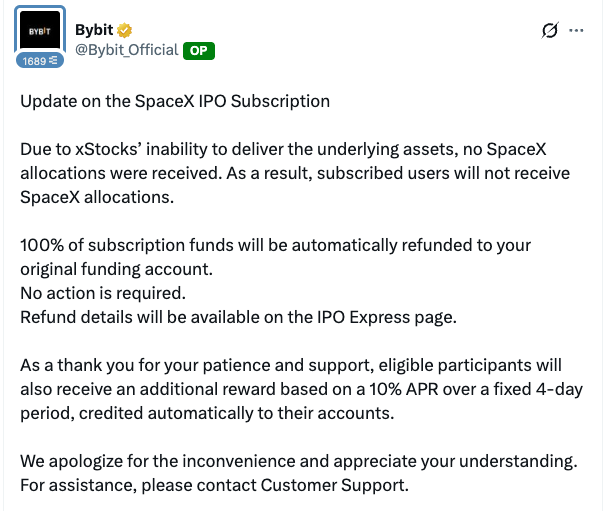
Binance, Bybit and Bitget scrapped tokenized SpaceX allocations Friday after @xStocksFi couldn't source shares, the CEXs said. Rival protocols from Ondo and Backpack launched the same day.
Is this a failure of the tokenized equity model?
Read more here:
thedefiant.io/news/cefi/bybi…
1
8
882
Jun 12
tokenized equities didn't fail Friday, to be clear... 1 distribution model did. don't conflate the two.
Jun 12

Tokenized stocks, perps, etc. worked perfectly. The issue wasn’t the crypto rails — it was the IPO allocation process. TradFi bottlenecks still exist.
thedefiant.io/news/cefi/bybi…
1
1
439
Jun 12
tokenized SpaceX trading went live in minutes but sourcing the actual shares took down a few campaigns
the blocker in 2026 is access to the float
Jun 12

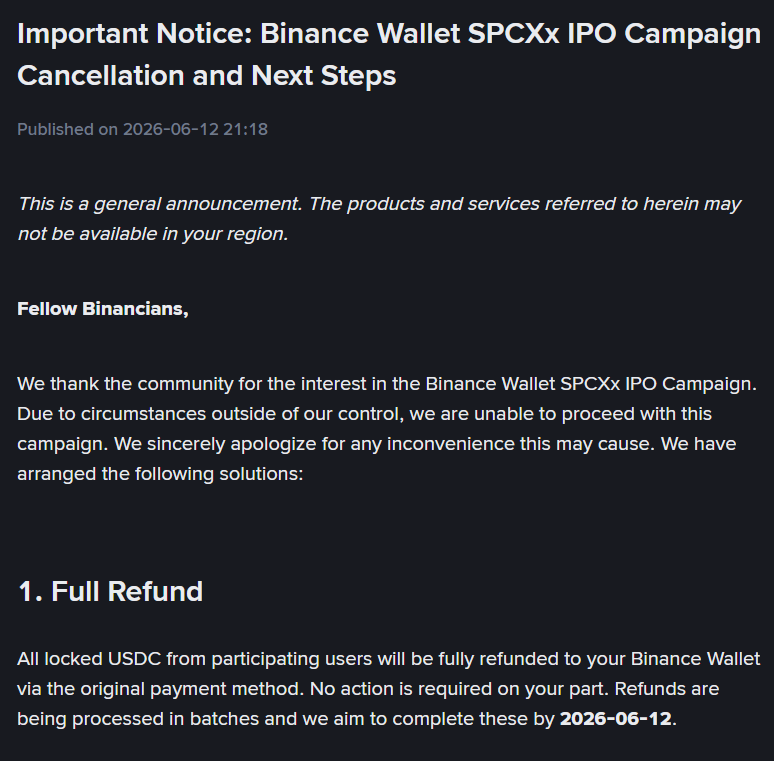
BREAKING: Binance, Bybit and Bitget cancel SpaceX IPO allocations and issue full refunds after failing to secure the underlying shares.
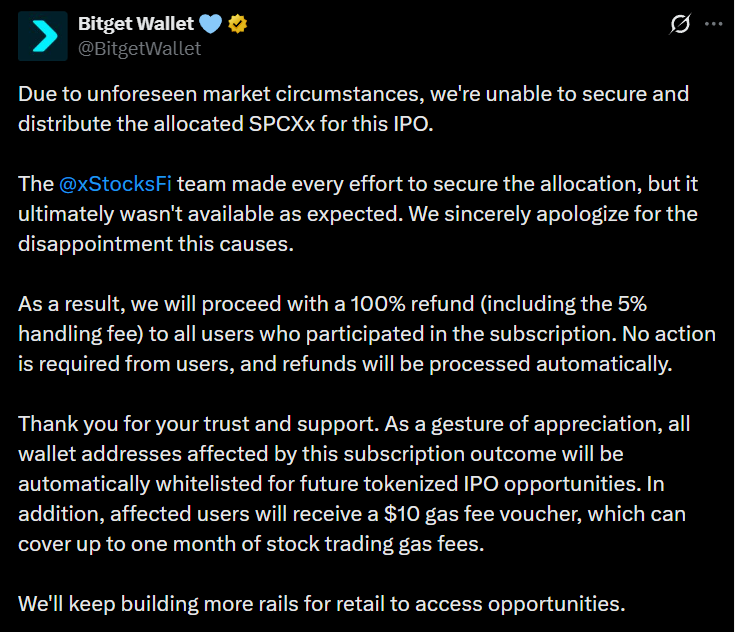
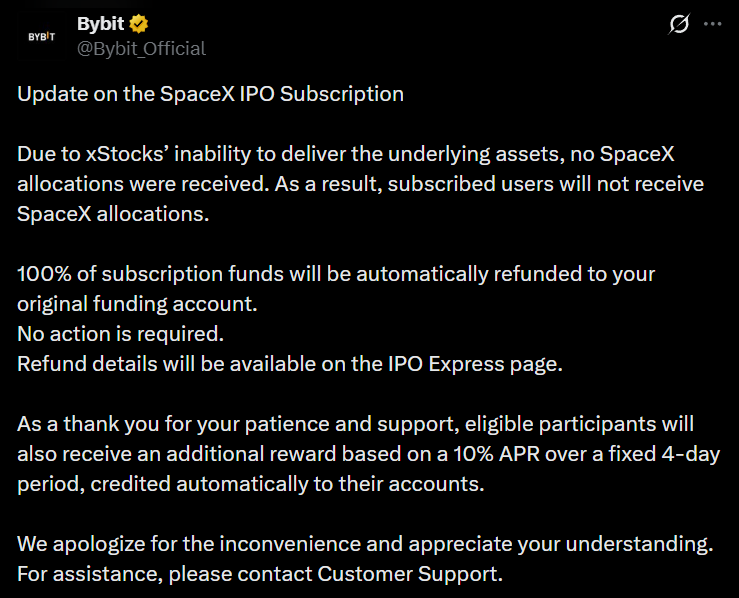
1
4
396
Jun 12
real ownership rails clear under stress; sourcing promises clear in calm
today showed the difference @ the worst possible moment ($1.75t IPO), making the case building on the frmr

Crypto promised retail the SpaceX IPO. Wall Street said no.
@binance, @Bybit_Official and @bitget all canceled their tokenized @SpaceX IPO programs today. Because the share allocation never arrived. Underwriters handed the crypto channel a fraction of expectations, and xStocks couldn't deliver the underlying stock.
Subscribers get full refunds plus compensation: bonus interest at Bybit, fee refunds at Bitget, a $1M airdrop at Binance. Per @cz_binance: protect users when things don't go as planned.
SPCX is up 26% from its IPO price, a pop retail subscribed for and never got. Crypto's "equal footing with institutions" pitch just met the allocation desk.
158
Jun 12
if your tokenized equity product depends on a 3rd party promising to go get shares, that is counterparty exposure donning a token
Jun 12

Binance and Bybit lost a lot of trust today.
Hyperliquid gained a lot of trust today.
Choose wisely.
1
11
2,551
Jun 12
credit where due: when the sourcing failed, refunds settled onchain, in full, same day
the rails handled the cleanup that the legacy allocation pipeline couldn't deliver on

BINANCE, BYBIT E BITGET CANCELAM OFERTAS DE AÇÕES TOKENIZADAS DA SPACEX
📰 Participantes foram reembolsados e não receberam ações no IPO recorde da SpaceX, empresa de foguetes de Elon Musk
portaldobitcoin.uol.com.br/b…
3
285
Jun 12
an IPO is the hardest possible test for an intermediary-sourcing model
a heavily oversubscribed debut near $1.75t is when instis absorb the float & the crypto channel gets squeezed out
Jun 12

Bybit, Binance, Bitget cancel tokenized SpaceX IPO allocations after share shortage theblock.co/post/404644/bybi…
1
8
1,249
Jun 12
the question that decided the winners & losers in tokenized SpaceX on Friday: who sources the share
Own it or route a broker-dealer, you delivered... depend on a middleman's promise to procure it, you refunded
Jun 12
Bybit and Binance announce the cancellation of their SPCX IPO campaigns due to Xstocks' inability to deliver the underlying asset. 👀
1
1
258
Jun 12
Binance, Bybit, and Bitget canceled their tokenized SpaceX campaigns & refunded in full... blockchain rails worked but the share sourcing handoff to xStocks didn't...
break was in procurement vs. the rails
Jun 12

SpaceX IPO access became the first big stress test for tokenized stocks.
Binance, Kraken, Bybit, and others saw huge demand for $SPCX exposure, but allocations came in far below expectations. Bybit got zero allocation and refunded users.
Meanwhile, Solana CPO Vibhu says this is exactly why open markets matter: multiple issuers can compete, users get choices, and no single platform owns the outcome.
Crypto rails moved fast.
Wall Street still controlled the shares.
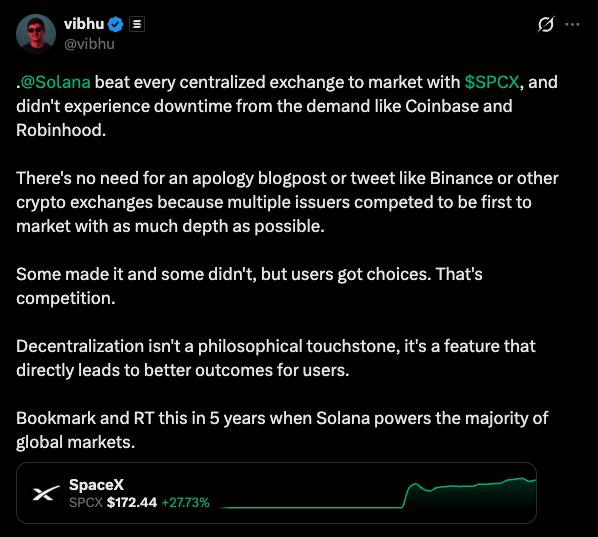
1
8
828
Olivia Vande Woude retweeted

Jun 12
Land records are among the most critical datasets a government maintains, yet much of the infrastructure supporting them hasn’t kept pace with the digital age. It’s time to invest in modern technology that improves security, resilience, transparency, and efficiency across the entire property ecosystem.
Jun 10

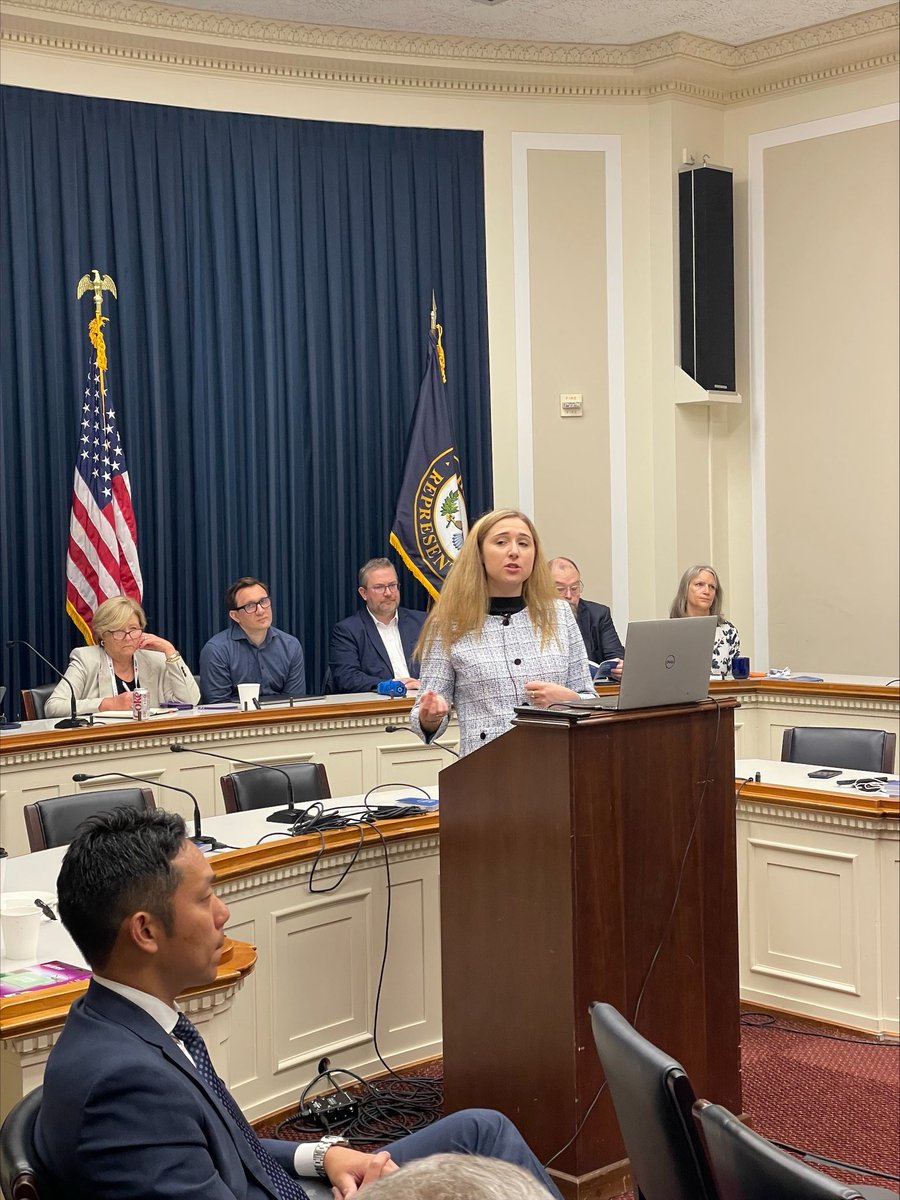
Joined @GBBC_io on the Hill today to share how tokenization is an upgrade to record-keeping…. a security stays a security, and a deed stays a deed, as shown through @avax partners Broadridge, @balconytech.
1
2
156
Jun 12
Tokenization, week in review:
> Visa advanced stablecoins & tokenized deposits from pilot -> roadmap @ its Payments Forum, citing a ~$7b annualized stablecoin settlement run rate 160 linked card programs.
-Why I care: Tokenized deposits are the version instis can underwrite @ scale.. credit committees already model bank liabilities w/ existing rules. Pure stablecoins require DD on nonbank reserves // cross jurisdictional risk, which is a heavier lift for conservative capital. Visa prioritizes the bank native path bc it clears approvals & thus drives vol.
> Janus Henderson ($480b AUM) took a strategic ENA stake, committed treasury cash to USDe, & routed its AAA-rated JAAA CLOs into reserves, w/ a joint ETP target for latter half of 2026.
-Why I care: token stake is minor imo; the more interesting piece is reserve integration as high quality CLO collateral may reduce reliance on procyclical funding carry... & the even bigger win is distribution thru a $480b network. I see the ETP as optionality
> Securitize cleared SEC effectiveness for its Cantor SPAC merger & will list publicly as SECZ (pending the 6/29 vote).
-Why I care: As its own SEC-registered transfer agent, Securitize is tokenizing its equity on its own infra… the listing proves it works.
1
8
475