
Software Engineer. Fullstack on Solana || co-founder of @sol_recovery
Joined October 2021
- Tweets 390
- Following 328
- Followers 908
- Likes 144
28 Photos and videos






rrivem retweeted

23 Oct 2025
finished the claiming and distribution for all wallets we managed to recover from the @MeteoraAG airdrop. We still have funds awaiting for those that haven't give the safe address, please check your DMs
3
2
18
2,607
rrivem retweeted
14 Feb 2025
if your wallet was compromised and you have JUP in staking, reach out to us, we can help you.
This wallet has been stealing from many wallets, don't let em take more.
solscan.io/account/ACXdEaaCw…
5
8
35
3,682
rrivem retweeted
14 Feb 2025
hey, following up on the #jupiter #asr, we'll be doing the claim of JUP. Tokens claim will go to staking, but we won't start the unstaking of them til Monday.
Please ONLY reach out then to start the unstaking with our tool.
Thank you
13 Feb 2025

#jupiter #asr we just run the claim on 144 wallets for the DBR tokens that were immediate claim. Check if your wallet got a transaction including this wallet:
31if31frVS3YvV7GZHyUA1ZpCRFJwbkRwv2qK83DYaPE
Please reach out over DM for us to process the delivery of DBR to your safe wallets
JUP would go to staking so we'll await for you to reach out to do it
2
3
9
7,109
rrivem retweeted
13 Feb 2025
#jupiter #asr we just run the claim on 144 wallets for the DBR tokens that were immediate claim. Check if your wallet got a transaction including this wallet:
31if31frVS3YvV7GZHyUA1ZpCRFJwbkRwv2qK83DYaPE
Please reach out over DM for us to process the delivery of DBR to your safe wallets
JUP would go to staking so we'll await for you to reach out to do it
1
2
17
5,312
rrivem retweeted
21 Jan 2025
Here's the info we managed to collect related to #jupuary.
All these cases below apply ONLY for COMPROMISED wallets.
8
10
28
6,871

17 Dec 2024
Can someone explain me what's the trend with the new airdrops doing linking of wallets?
7
4
24
2,322
17 Dec 2024
I get it, it's good to simplify the process of combining multiple chains and burners, but the result is a very complex claim procedure that's ends with a major bottleneck: a centralized db not handling the load
1
8
1,327
17 Dec 2024
Not to mention the impact this has on compromised wallets.
Call me old school, but having a mechanism as merkle trees that can help a lot on concurrency and not doing it...
I just don't understand the benefits of not using them
2
8
1,202
rrivem retweeted
13 Dec 2024
ok fam, it's almost 1 AM, I processed and set 92/140 wallets. Need to rest and get the rest done tomorrow, I apologize to those who wrote and couldn't answer yet, will get you sorted soon. gn
5
1
29
3,281
rrivem retweeted
12 Dec 2024
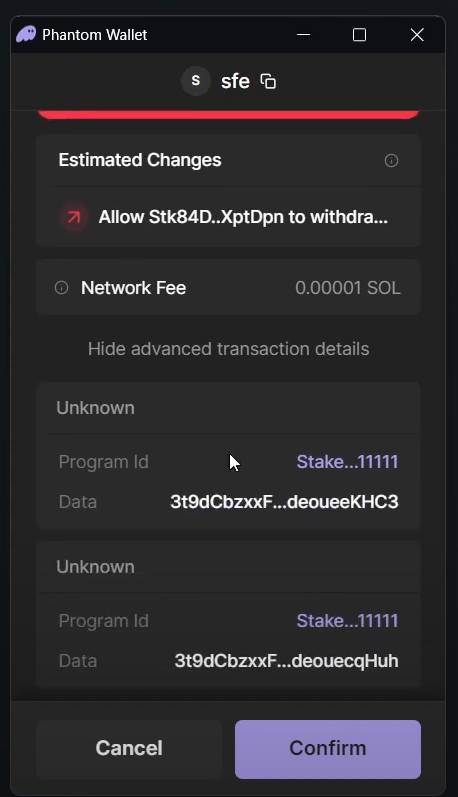
gm, the CLAIM PROCEDURE will work like this, please follow the steps STRICTLY:
7
2
38
6,140
rrivem retweeted
11 Dec 2024
ga, stepping out for a few hs (family duties). Collected the amounts for each wallet we managed to recover, and will be sharing the procedure to present all the required information.
9
1
29
2,518
rrivem retweeted
10 Dec 2024
guys, I'm stepping out for tonight, appreciate your trust, and if you still have tokens to claim, reach out, politely please, we're human beings trying to do what we can
thanks
@cryptorrivem
30
4
72
4,630
rrivem retweeted
24 Nov 2024
For all those that got affected on the drain from a known hacked Twitter/X account, please don't rush!
If you haven't entered or shared the seed phrase or private key, your remaining assets are safe for the moment.
4
8
35
5,268



16 Apr 2024
@solflare_wallet having some issues with the wallet and would like to know if it's just me or general:
- Cannot use it for devnet. When a signTransaction is sent to it, it's saying the wallet is on the wrong network (guess is the standard adapter assuming it's mainnet)
6
1
4
1,340
16 Apr 2024
- When trying to connect or trigger a transaction sign, it gets stuck and sometimes a browser restart is needed to get it to work (others just opening the extension popup and triggering again)
2
1
1,135
rrivem retweeted

10 Apr 2024
Developers from Anza, Firedancer, Jito, and other core contributors are working diligently (and not sleeping much) to shore up Solana's networking stack to meet the unprecedented demand the network is seeing today.
There's been a lot of threads on what exactly is causing the extreme congestion – and many of those threads disagree with one another – but at a high level the issue is conceptually simple: the implementation of a software system is today not robust enough to handle the amount of traffic being thrown at it. That's now being fixed – but an obvious question is "How did we get here?"
This was, to some extent, a known bottleneck in the implementation of QUIC used on the Agave validator client, and was on the roadmap to be addressed. What was not expected was the rate at which demand for Solana would increase, flipping the implantation from 'adequate but needing improvement' to 'inadequate' in a matter of days. A charitable reading is a 'failure of success' which is otherwise known a 'failure of planing'
This is, put simply, tech debt. The tradeoff between new and important new work (like readying Solana to support its first independent validator client implementation, Firedancer, which includes near total rewrite of the networking stack, later this year) and important maintenance/improvement work. Every decision is a series of tradeoffs, sometimes you get it right, sometimes you get it wrong. This is not dissimilar from what the Solana network went through in early 2022 – when demand outstripped the capacity of several systems.
Core protocol developers from across the ecosystem are working as swiftly as they can to implement and test improvements in the networking stack to address the current network congestion. It will take some time, but we'll get there. This open source software project is nothing without the thousands of developers and millions of users who believe in the vision of Solana. We'll get there, together 🤝
102
279
1,140
224,675