
Joined January 2023
- Tweets 33,621
- Following 603
- Followers 1,315
- Likes 54,580
6,819 Photos and videos













cryptotweek retweeted

Jun 12
When it is easy for someone to print money, everything else becomes hard for the others who can't.
Read about $BSV
2
10
64
3,078

Jun 12
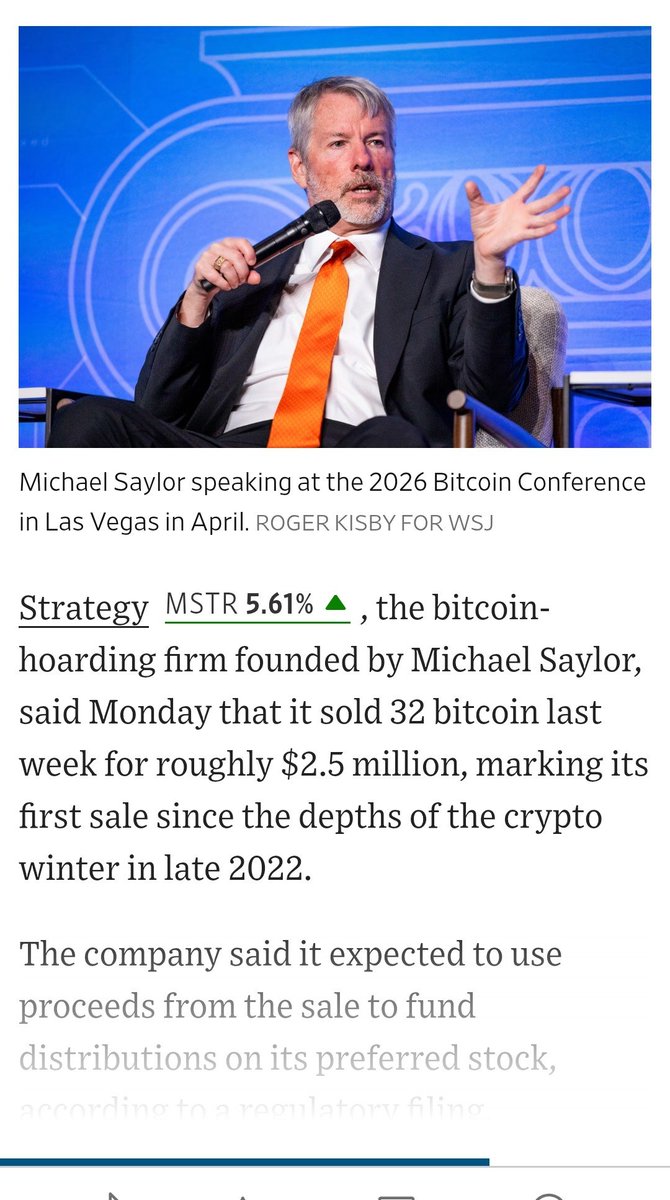
Yep, not 1 sat,
Technically, selling 32 BTC is selling 3,200,000,000 sats.
🤣🤣🤣

Jun 12

I haven’t sold a sat. Strategy is still stacking.
2
94
Jun 12
2. Transactions
We define an electronic coin as a chain of digital signatures.
This is where many Bitcoiners confuse a ledger with a magic vault.
A ledger does not erase history.
A ledger records history.
When ownership changes, you don't delete the previous entries.
You append a new one.
That's how land titles work.
That's how share registries work.
That's how accounting systems work.
The historical record remains intact.
The current ownership state is updated.
A court-determined ownership change doesn't rewrite history.
It becomes part of the history.
That's what ledgers do.
Jun 12

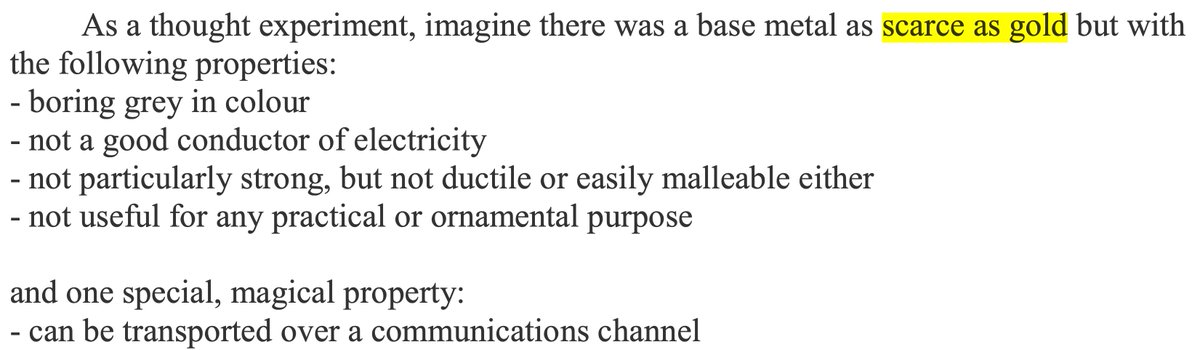
> What I don't see him discussing is:
• Permanent loss as a feature
• Ownership disputes
• Bitcoin as digital gold
I literally gave you evidence for all three. You just don't read (or didn't feed it to your AI).
Eg:

1
1
3
161
Jun 11
DAR doesn't mediate transactions.
It addresses legal disputes after they arise.
Bitcoin was designed to remove the need for trusted intermediaries in transaction processing, not to abolish courts, contracts, and property rights.
If a court order affecting ownership is a protocol violation, then how do you handle theft, fraud, inheritance, bankruptcy, or corporate insolvency?
Jun 11
> If minimizing protocol change is the standard
How is this objectively measured?
I’d argue that BSV made a fundamental change by accepting a trusted third party to mediate disputes (DAR), exactly what Bitcoin was designed to avoid.
3
1
8
440
Jun 10
Bitcoin didn't turn monetary verification into open-source software.
Bitcoin turned monetary verification into cryptographic evidence.
Running a node is one way to verify that evidence, not the only way.
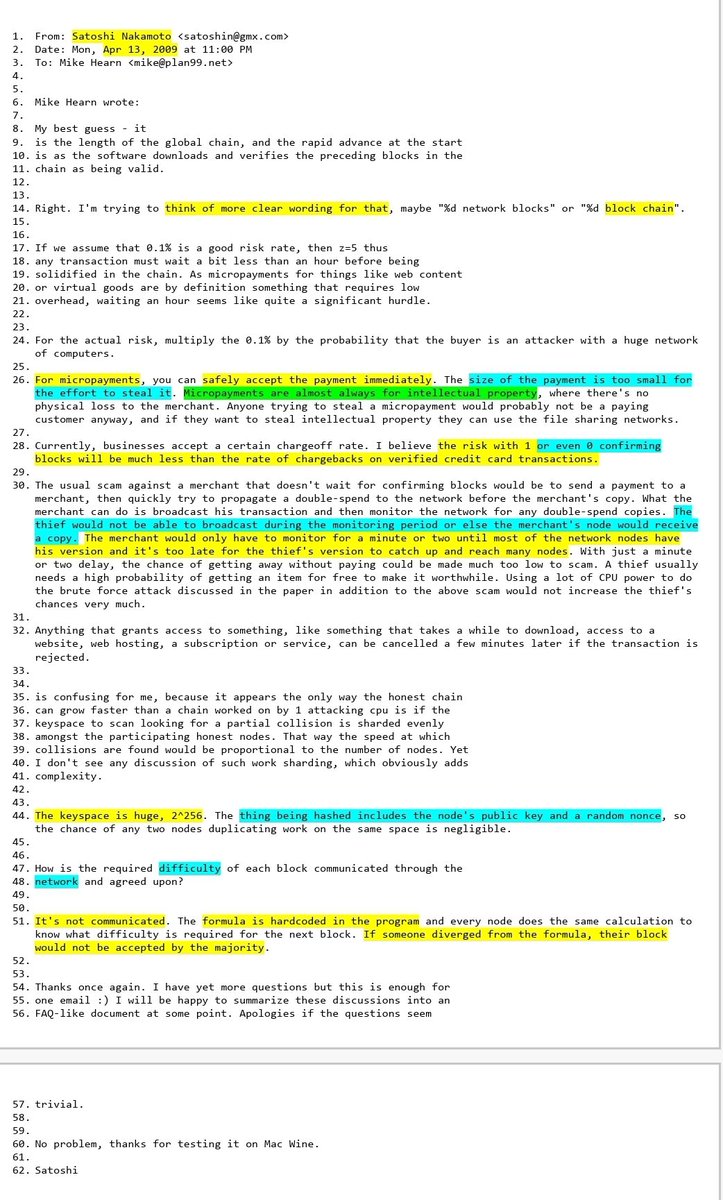
In fact, Satoshi explicitly described a system where most users would not run full nodes at all.
Jeff keeps describing BTC node culture as though it were Bitcoin's original design.
Satoshi invented SPV because he expected most users to verify payments without running full nodes.
If everyone must run a node to use Bitcoin, then Bitcoin has failed to scale.
Jun 10

To verify gold, you need acids, scales, and experts.
To verify Bitcoin, you run a node.
No certificates to trust.
No experts to consult.
No "is this real?" debate.
No trusted middlemen.
Bitcoin turned monetary verification from an expert service into open-source software.
2
5
171
Jun 7
Bitcoin does not become valuable because people run nodes.
Bitcoin becomes valuable because people use it.
Businesses create transactions.
Transactions create fees.
Fees create miner revenue.
Miner revenue secures the network.
Economic activity, not ideology, sustains the system.
That's really the fundamental disagreement between the BTC and BSV worldviews.
BTC tends to start with:
Decentralization → Security → Value
Whereas the genuine Bitcoin SV argument tends to start with:
Utility → Transactions → Revenue → Security

MICHAEL SAYLOR: "BITCOIN REACHES ITS FULL POTENTIAL BY REMAINING TRUE TO ITS CORE PRINCIPLES: SELF-CUSTODY, PERSONAL NODES, DECENTRALIZATION, IMMUTABILITY, AND USE AS MONEY."
1
2
15
1,458
Jun 4
Energy secures Bitcoin.
Energy does not back Bitcoin.
If I burn twice as much electricity tomorrow, Bitcoin doesn't become worth twice as much.
Security and value are different things.
A hole in the ground can consume energy.
That doesn't make the hole valuable.
Energy is a cost of production, not proof of demand.
Jun 4
"Bitcoin isn't backed by anything."
Let me stop you right there.
Bitcoin is backed by energy. Real energy. Kilowatts. Heat. Physics.
The kind of backing you can't print, fake, or vote into existence at an emergency Fed meeting.
Every block mined is a thermodynamic proof of work. Not a promise. Not a policy. Proof.
The issuance schedule has never been amended by a committee. Not once. Not ever. Because there is no committee.
There's just math. Cold, indifferent, and immune to political theater.
The network is secured by more raw computing power than anything humanity has ever built. Hundreds of exahashes per second standing guard. Every single day.
Now let's talk about what is backed by nothing.
The dollar.
It's is backed by confidence. Specifically, confidence in the institution that printed $6 trillion in two years while telling you 3% inflation was healthy and you should be grateful for the soft landing.
In the same people who can't pass an audit.
Who fund wars with a credit card.
Who promise solvency while sitting on $39 trillion in debt and accelerating.
"Backed by nothing" isn't an attack on Bitcoin.
It's a confession about the dollar.
Follow if you're serious about building wealth they can't print away.
2
2
11
428
cryptotweek retweeted

Summer money moves hit different.
Instant deposits. No waiting. No stress
☀️ orangegateway.com

2
11
23
705
cryptotweek retweeted

By forking PostgreSQL and embedding triple-entry accounting BSV tokenisation directly into the database engine, the system can:
Ingest real invoices and shipping documents automatically
Record them as cryptographically verifiable triple-entry entries
Tokenise them on BSV
Provide proofs that everything balances and is auditable
Integrate with the rest of the ecosystem (payments, access control, NFTs)
github.com/prof-faustus/trip…
14
70
253
6,149
Jun 3
🤣 The irony is that this argument often undermines Bitcoin's original design more than it supports Lightning.
The post is basically saying:
"The blockchain is a privacy problem, so move activity away from the blockchain."
But Bitcoin's whitepaper wasn't trying to hide transactions from the public ledger. It was trying to replace trusted third parties with a public chain of evidence.
The real question becomes:
If everyone is expected to transact off-chain, what exactly is the blockchain for?
The privacy claim itself is also not as absolute as they make it sound.
If someone knows:
your Lightning node,
your channels,
your counterparties,
your KYC exchange activity,
or your channel open/close transactions,
they can still learn quite a lot.
What they're really saying is:
"Lightning obscures information better than publishing every payment directly on-chain."
That's a much narrower claim than "massively increases privacy."

This is why Lightning is a massive improvement for Bitcoin.
Not only does it help bitcoin scale, it massively increases privacy from future prying eyes.
1
6
419
Jun 3
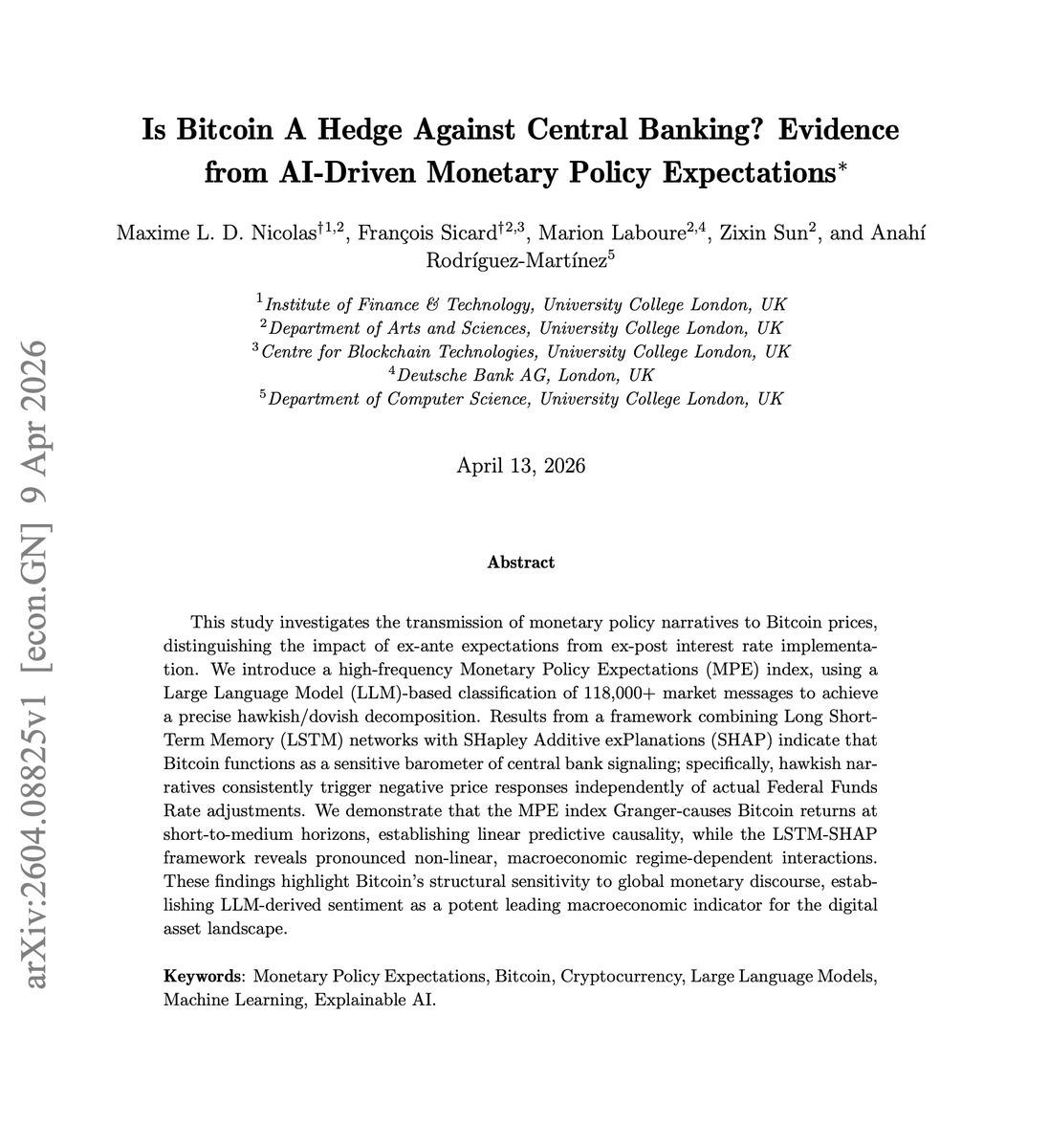
Pierre is presenting this paper as evidence for:
"Bitcoin monetary maximalism empirically vindicated."
But the actual abstract, as shown in his screenshot, is saying something much narrower:
Bitcoin prices are sensitive to central bank narratives and monetary policy expectations.
Those are not the same claim. 🤦
May 29

"Bitcoin functions as a sensitive barometer of central bank signaling; specifically, hawkish narratives consistently trigger negative price responses independently of actual Federal Funds Rate adjustments."
Bitcoin monetary maximalism empirically vindicated
1
227
Jun 3
🤣🤣🤣🤣


3
21
254
Jun 3
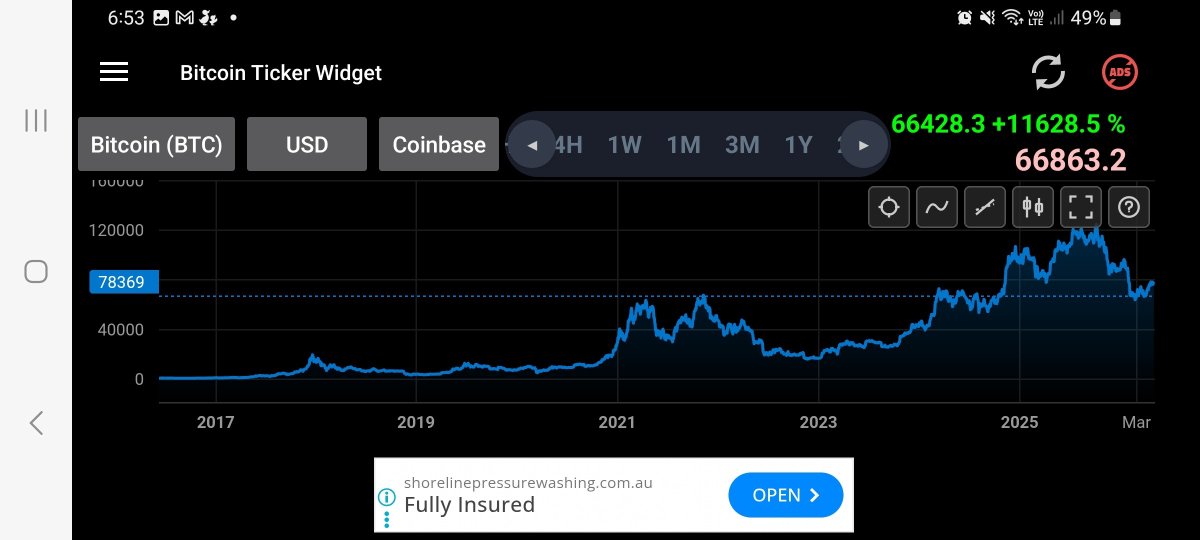
Not sure what chart his looking at.
🤣🤣🤣
Jun 2

BITCOIN JUST BROKE THE MOST IMPORTANT LEVEL IN ITS ENTIRE HISTORY.
And if we don't reclaim it fast…
We are in serious trouble.
14 years of support. Gone.
That line defined every single bull market.
Never broke without catastrophic consequences.
Never.
Volatility exploding.
Liquidity hunting lower.
Weak hands getting destroyed.
This is not a dip.
This is not a shakeout.
This is structural failure.
Ignoring this isn't conviction.
It's denial.
1
135
Jun 3
The interesting historical angle is that Satoshi actually mentioned poker and micropayments very early on.
Bitcoin wasn't originally presented as merely "digital gold." The early discussions often revolved around:
micropayments,
machine payments,
online services,
gaming,
contracts,
commerce.
So when Craig says:
"When combined with micro-payments (bonded-subsat-channel)..."
he's describing a broader architecture rather than just a poker game.
The poker game may simply be the first demonstration because it's easy to understand:
Can strangers:
- hold money,
- hide information,
- reveal information when required,
- settle fairly,
- prove nobody cheated,
- do it without a house?
If yes,
many other applications become possible.
That extends beyond gaming into auctions, marketplaces, machine-to-machine commerce, supply-chain negotiations, autonomous agents, and other systems where participants need both private information and financial settlement.
Mental Poker appears to be the proving ground. If it works, it demonstrates that Bitcoin can coordinate value transfer, private information, and cryptographic fairness without a trusted intermediary. The poker game is the demo; the underlying infrastructure is the real objective.

Why Mental Poker Matters Today
It is the cryptographic foundation for true trustless multiplayer games on public blockchains.
When combined with micro-payments (bonded-subsat-channel), verifiable accounting, and secure key management (overlay-broadcast), it enables games where real money can be at stake with no house, no trusted operator, and full cryptographic fairness.
1
15
616
cryptotweek retweeted

With #BSV and the new internet.
28 Dec 2021

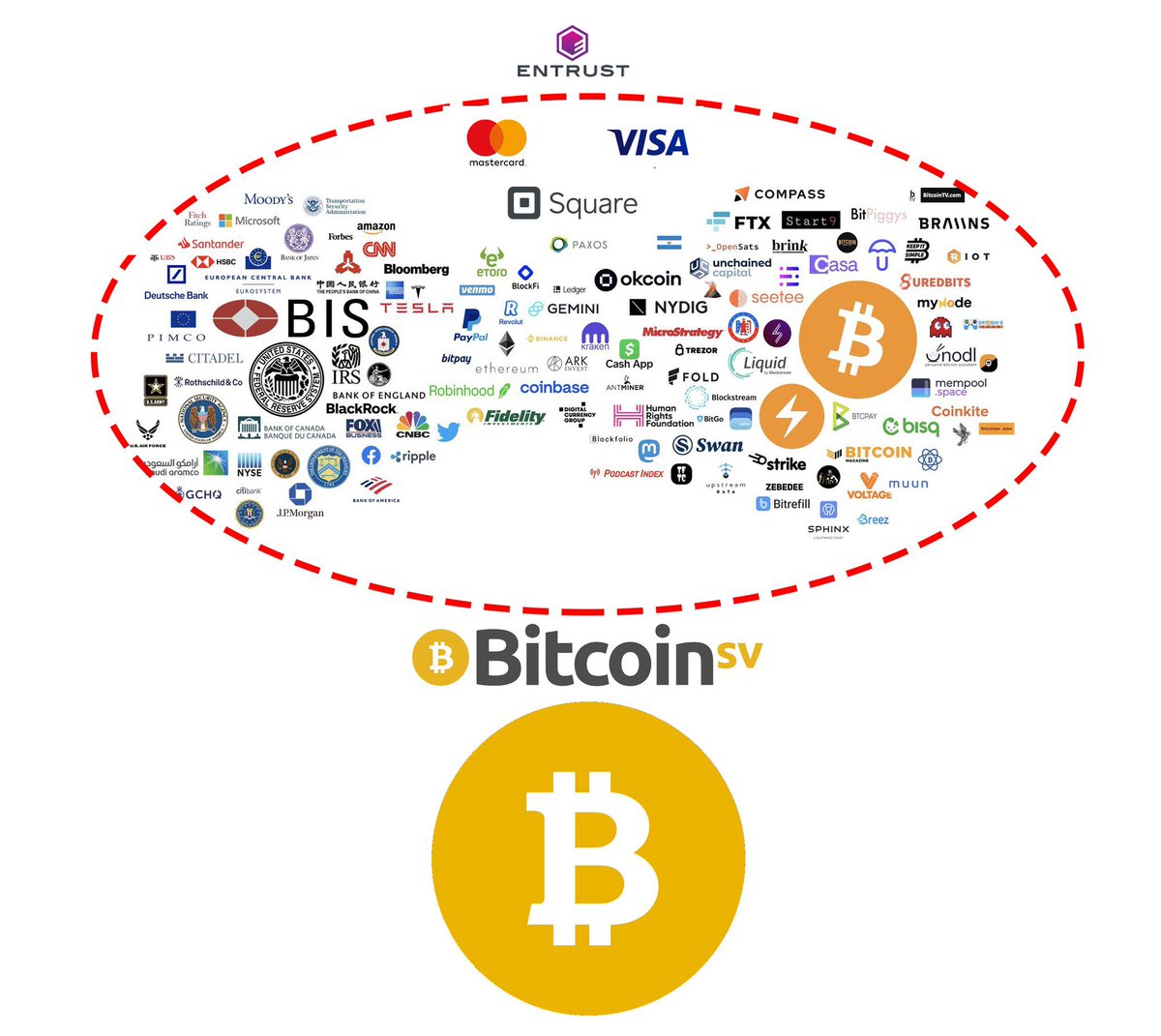
You’re either with the global ruling class of controlled opposition or you’re with #BSV.
That’s it. We’re the resistance; the last stand for hard money and data sovereignty. Everyone else is already bought and paid for. #bitcoin
1
4
168
Jun 3
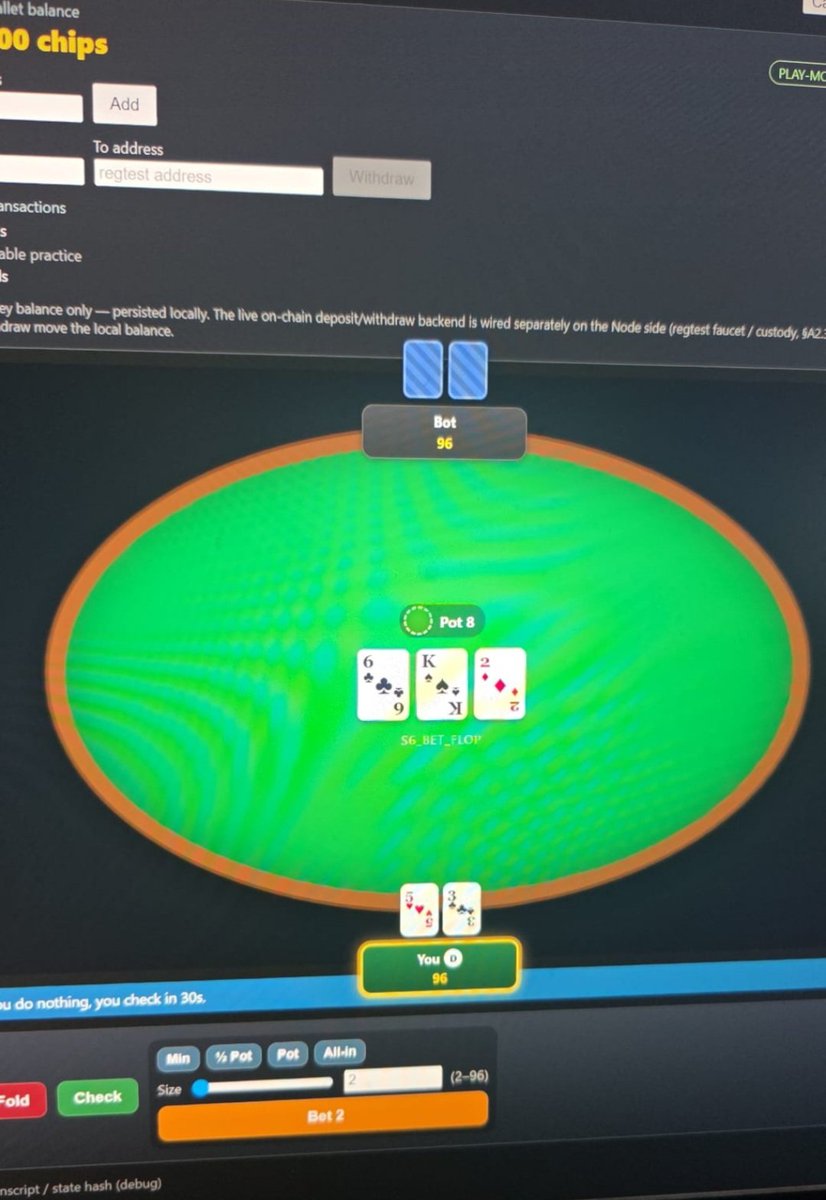
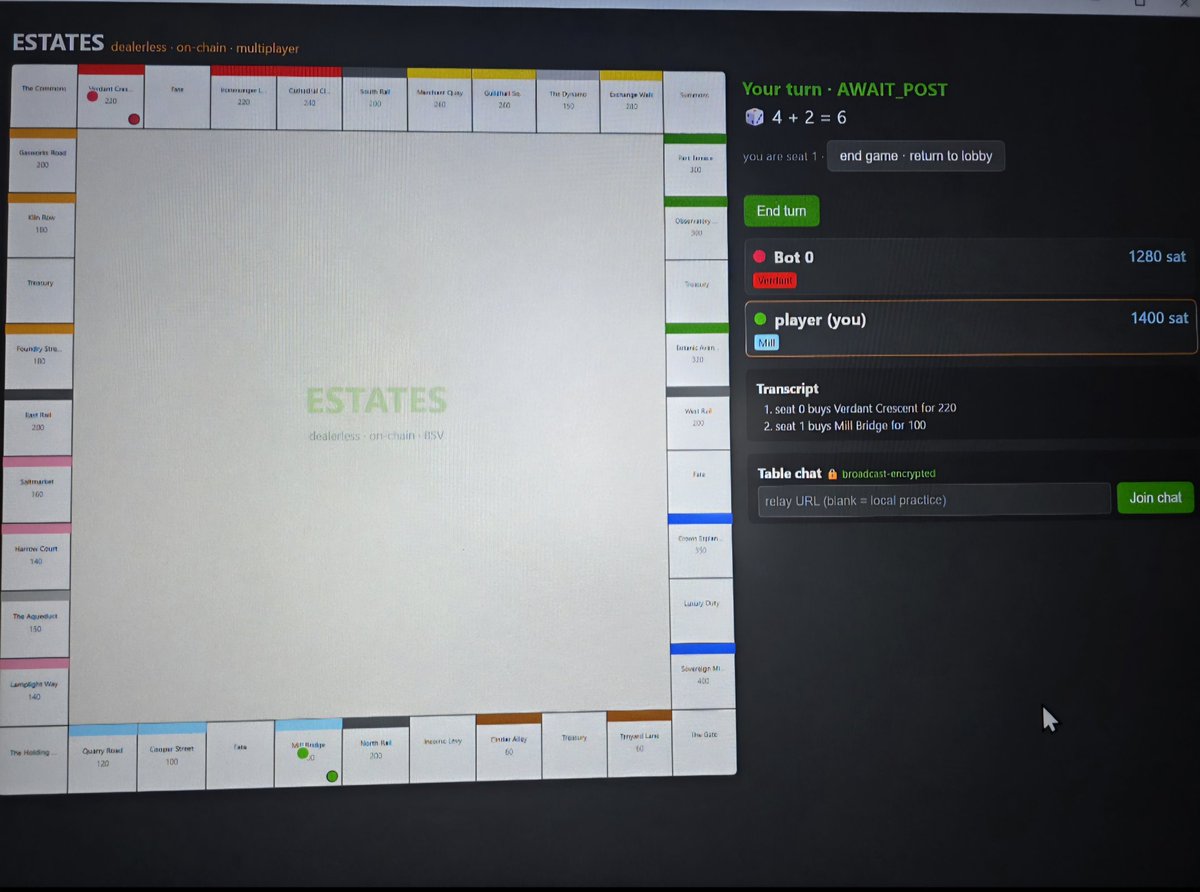
Looking at my own work with complete honesty, I can readily admit that my design skills are dreadful. The interfaces are ugly as hell. If aesthetics were the measure of engineering, I would already be convicted.
Fortunately, software is judged by whether it works.
By tomorrow, I expect to have the system loaded and integrated so that the wallet, the game layer, and the supporting infrastructure operate together as a coherent whole. There are still multiple configuration options and some areas where the integration can be refined, but that is largely a matter of presentation and convenience rather than functionality.
The essential point is one that critics seem determined to overlook. The difficult part already works. The mental poker system works. The underlying protocols work. The trustless interactions work. The cryptography works.
One can always hire a designer to improve appearances. It is rather harder to hire someone to invent a functioning trustless mental poker system.
As one as Satoshi might have observed, there are only two kinds of software: software that is beautiful and does not work, and software that works and is eventually made beautiful. I know which category I would rather inhabit.
4
218
cryptotweek retweeted

Jun 1
Craig Wright (aka Satoshi Nakomoto) just announced the release of his new systems - A Bitcoin-integrated banking framework, and a system for true digital scarcity.
And nobody is reporting on this.
The game is rigged.
Pay attention before it's too late.
#BSV
This month I will release the code.
Not a white paper.
Not a roadmap.
Not a promise about what might exist someday.
Code.
Working systems.
A Bitcoin-integrated banking framework. A Bitcoin-enabled SQL architecture. Deterministic cryptographic payment systems built around single-use keys, ECDH-derived addressing, and complete transaction traceability without public identity leakage.
But those are merely components.
The more important release is something I believe has never previously existed.
A system for true digital scarcity.
A system where possession matters.
A system where transfer means transfer.
A system where ownership is not represented by a token while the underlying asset remains infinitely reproducible.
For decades we have accepted a false assumption about computing. We have assumed that digital information must always be copyable. We have assumed that duplication is an unavoidable property of digital systems.
What if that assumption is wrong?
What if possession can be transferred rather than duplicated?
What if a digital object can move from Alice to Bob in a manner where Alice no longer possesses it?
Not as a legal fiction.
Not as a contractual obligation.
As a cryptographic reality.
If that can be achieved, then much of what we think we know about information security, digital ownership, intellectual property, confidential information, and electronic commerce must be reconsidered.
The implications extend far beyond cryptocurrency.
Far beyond NFTs.
Far beyond digital collectables.
The ability to create truly scarce digital goods changes the economics of information itself.
This month people will not need to speculate about whether such a system can exist.
They will be able to read the code themselves.
5
36
168
5,881
Jun 2
This one has more utility than BTC.

2
145