
Joined May 2009
- Tweets 127,877
- Following 8,001
- Followers 12,161
- Likes 30,952
4,997 Photos and videos




Pinned Tweet

15h
Does this upset you? Are you seething inside while you watch people have a good time on the White House lawn?
If it does, I recommend you go to church tomorrow. There's a problem in your soul.
115
42
531
14,427
1h
Getting ready for church. I made a list after reading the comments below. It will be a long prayer session.
So many haters, so little time.
Think you can take up some of the burden?
15h

Does this upset you? Are you seething inside while you watch people have a good time on the White House lawn?
If it does, I recommend you go to church tomorrow. There's a problem in your soul.
3
4
90
58m
Meanwhile, for those of you why can't tear yourself away, enjoy a better view of yesterday's activities.
2
2
25
2h
Some are going to have a really sad Flag Day. Bad enough it is Trump's 80th Birthday, plus a judge allowed the UFC fight this afternoon.
All we need now is for Iran to sign the MOE today, and it will be a trifecta.
Think Lincoln would have approved?
2
14
967
9h
Good thing the Knicks won 94-90.
I hate to think of the carnage if they had lost.
Congrats to the new NBA champs. What Trump curse?
5
5
38
7,262
Tom Finnell retweeted
Jun 13
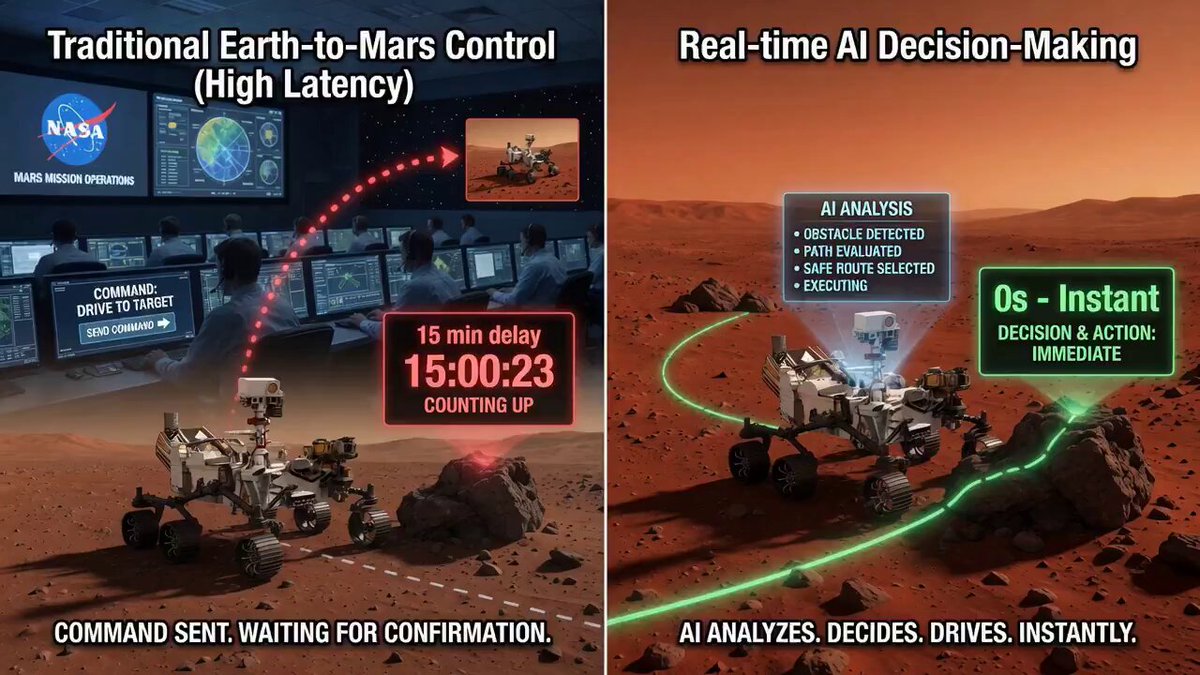
As we pivot from ground-controlled space missions to autonomous, AI-driven orbital infrastructure, the question is not just how we get to Mars, but who governs the logic that guides us there.
Light-speed delay makes it unavoidable. One-way communications to Mars range from 3 to 24 minutes, with round-trip times up to 44 minutes. No real-time commands from Earth are possible when issues arise on the surface or in orbit.
This video illustrates the difference perfectly. Traditional control means long waits and limited actions. Real-time AI lets the rover detect obstacles, evaluate paths, select safe routes, and execute instantly.
NASA has therefore increased autonomy on Perseverance. The rover now determines its precise position in minutes by matching onboard camera images to orbital maps. It performs over 90 percent of its driving independently, plans routes, avoids hazards, and selects science targets in real time.
This shift is accelerating across the board. Onboard AI handles navigation, fault recovery, science operations, and critical decisions. Starship-class missions and future crewed flights will require even higher levels of independence. Humans cannot micromanage systems millions of miles away.
The core challenge remains: who develops, certifies, and oversees the decision-making logic when an autonomous system must choose between safety, mission goals, or new science opportunities? NASA, SpaceX, international bodies, or the AI models themselves?
We are delegating real authority to code that operates beyond immediate human control. This governance discussion needs to happen now, ahead of the first crewed Mars missions.
What are your thoughts? How much autonomy is safe for deep space, and who should set the rules for AI decision-making?
#AutonomousSpacecraft
3
2
10
285
18h
Stealth X app feature just introduced!
I was composing a post with a video of an old WW2 bomber engine cranking up in a cart and I noticed I could edit the video now, directly in in composer. This is with Android.
Did you know about this ability?
4
2
13
684
18h
I'm a member of the X News chat group and I had heard nothing about this being released. I know they've talked about it.
I'm sure iPhone has had it for a while. Any input?
2
3
88
21h
Speaking of vacation culture, if you want to get away with the kids, you have just a few weeks left to take advantage of a fantastic offer from Disney.
Pay no attention to the fact that my son and his wife are Disney travel agents.
Tell 'em I sent ya. makingmagicalmemoriessfrf@gmail.com

Most people understood this, but a few took it as me being antitravel.
That’s not it.
Travel is great when you actually want to go.
What feels exhausting is acting like a normal life at home is something you constantly need to escape from.
Some of the best replies were people saying they’d rather be on their porch, with their dogs, drinking coffee, looking at their own trees.
That is not boring to me.
That sounds like winning.
2
10
352
21h
We did a Disney Marvel Cruise for Sean's 40th Birthday. You make a lot of memories on a trip like that.
5
66
Jun 13
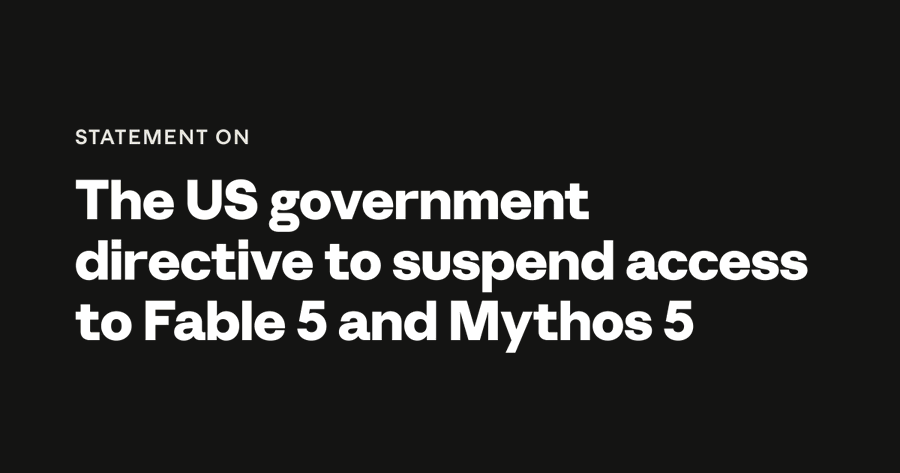
Brian Krassenstein is calling this the moment the "AI bubble popped," but that feels like a massive misread of the situation. After all, Sam Altman marketed this is a "bomb" shortly after telling the Pentagon to go pound sand.
What we’re actually seeing isn't a collapse of the AI industry - it’s the reality of frontier AI being treated as a critical national security asset. Restricting access to models like Fable 5 and Mythos 5 due to export control directives isn't a "bubble pop"; it’s the start of a highly regulated, "US-first" era for frontier model development.
The underlying engine of AI - compute, capital, and talent - is still running at full throttle. This is just the first major geopolitical friction point. We’re moving from the "move fast and break things" phase into a new, heavily guarded era of global strategic competition.
Jun 13

And just like that,Trump popped the AI bubble.
1
2
1,146
Jun 13
Here is the best analysis of this. Reasoned, not reactionary.
x.com/gothburz/status/206560…
Jun 13

A short history of how we got here, because the chronology is the whole story.
January: the Pentagon demands unrestricted use of Claude for autonomous weapons and domestic surveillance. Anthropic says no.
February: the President orders every federal agency to drop Anthropic. The Defense Secretary bans Pentagon contractors from doing business with them. A rival announces its classified-network deal within hours.
March: the Pentagon designates an American company a "supply chain risk" under a statute written for foreign adversaries. A federal judge blocks it.
May: the Pentagon signs AI deals with seven companies. Anthropic is not one of them.
June 9: Anthropic releases Fable 5.
June 12: Commerce issues an export control directive over a jailbreak that, by the government's own account, was demonstrated verbally, came with no written explanation, and involves a capability you can get from other publicly available models today.
Two things are true at once.
First: Anthropic spent months marketing Mythos as too dangerous to release. Sam Altman said it was "incredible marketing to say we have built a bomb." The Commerce Department has now formally agreed it is a bomb. If you describe your product as a munition in every press release, eventually a government takes you at your word. They wrote the legal predicate themselves and called it a brand.
Second: we have run this experiment before. In the 90s the government classified encryption as a munition under ITAR. Activists defeated it by printing PGP's source code as a book, because books are protected speech and floppy disks were arms exports. A t-shirt with three lines of RSA Perl was legally a munition. The controls collapsed because math does not stop at customs.
The new wrinkle is the "deemed export" rule: showing controlled technology to a foreign national inside the US counts as exporting it abroad. Which is why Anthropic's own foreign-national employees are now locked out of the model they built. The munition is in the building and the people who made it are not allowed to look at it.
The jailbreak is the paperwork. The refusal was in January.
1
150
Jun 13
As we pivot from ground-controlled space missions to autonomous, AI-driven orbital infrastructure, the question is not just how we get to Mars, but who governs the logic that guides us there.
Light-speed delay makes it unavoidable. One-way communications to Mars range from 3 to 24 minutes, with round-trip times up to 44 minutes. No real-time commands from Earth are possible when issues arise on the surface or in orbit.
This video illustrates the difference perfectly. Traditional control means long waits and limited actions. Real-time AI lets the rover detect obstacles, evaluate paths, select safe routes, and execute instantly.
NASA has therefore increased autonomy on Perseverance. The rover now determines its precise position in minutes by matching onboard camera images to orbital maps. It performs over 90 percent of its driving independently, plans routes, avoids hazards, and selects science targets in real time.
This shift is accelerating across the board. Onboard AI handles navigation, fault recovery, science operations, and critical decisions. Starship-class missions and future crewed flights will require even higher levels of independence. Humans cannot micromanage systems millions of miles away.
The core challenge remains: who develops, certifies, and oversees the decision-making logic when an autonomous system must choose between safety, mission goals, or new science opportunities? NASA, SpaceX, international bodies, or the AI models themselves?
We are delegating real authority to code that operates beyond immediate human control. This governance discussion needs to happen now, ahead of the first crewed Mars missions.
What are your thoughts? How much autonomy is safe for deep space, and who should set the rules for AI decision-making?
#AutonomousSpacecraft
3
2
10
285
Jun 13
FIMP discussed autonomous semis in his Space Wednesday, which got me thinking about this.
On Earth they get low-latency remote human backup for sudden hazards. On Mars the AI must handle everything alone with no backup possible.
That’s why the governance question matters now.
1
61
Jun 13
When I'm feeling tight and need to loosen up a bit, I pop on my MetaQuest VR and do a flow workout.
This is not a boring workout video- it's about Coach Casey Sims and the pep talk she gives before hand.
She's one of a dozen coaches on the platform. Having someone walking you through the routine makes it more useful. And fun.
Do you do VR?
1
1
8
182
Jun 13
I've used FitXR for 77 straight weeks, at least 5 times a week.
104 is my goal.
3
71