
Occasional publisher, writer, and podcaster.
Joined August 2010
- Tweets 20,872
- Following 5,797
- Followers 10,224
- Likes 17,486
736 Photos and videos



My PhD thesis is available as a free PDF. It's an attempt to renovate and democratise Hobbes's account of sovereignty, by putting it into dialogue with contemporary work in social ontology. Something to annoy almost everyone. etheses.whiterose.ac.uk/3551…
5
19
67
21,474
1979: Just do what we tell you and it will be gravy all the way. We'll all be millionaires! Just vote for markets and freedom!
2026: You can have children going to school hungry. Or you can have well-fed children. But if children have enough to eat the Russians will shoot them.

Lord Alan West: "Its all very well having nice spending for breakfast for children at school.. but if that means.. you have Russians stomping down your streets shooting the children who would have been having breakfast.."
Russians killing your kids. IS THAT WHAT YOU WANT?
12
18
703
Maybe we should coordinate and campaign to put pressure on the BBC to proclaim loudly what is happening in the rest of the media. It is farcical that BBC Verify obsesses about no-marks online and ignores the antics of outlets with vast reach and even a veneer of respectability.

We really need to do something much more decisive than watching this wash over us day in day out on Twitter dot com
1
6
19
854
It would mean having a whole campaigning infrastructure, membership, fund-raising, the lot. Frankly it's exhausting to think about. But if any wealthy liberals actually want to stop the race war the far right are angling for, then this is something that might make a difference.
1
2
319
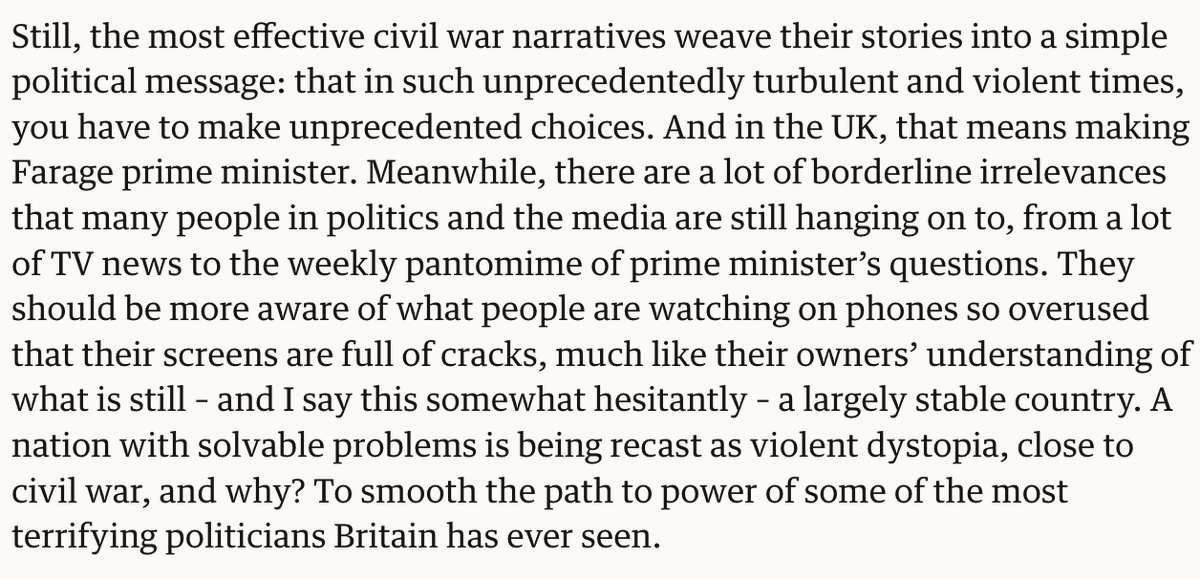
If, as John Harris "somewhat hesitantly" claims, we are "a largely stable country" then why are "some of the most terrifying politicians Britain has ever seen" leading in the polls? Some very important people must have been wrong at some point, presumably?
theguardian.com/commentisfre…
2
9
39
1,949
Until we have a honest discussion about who has been right, and who has been wrong, about the direction of the UK since, say, 1979, the millionaire functionaries of the trillionaire right are going to go from strength to strength. To start the ball rolling, Reform have been ...
1
2
17
477
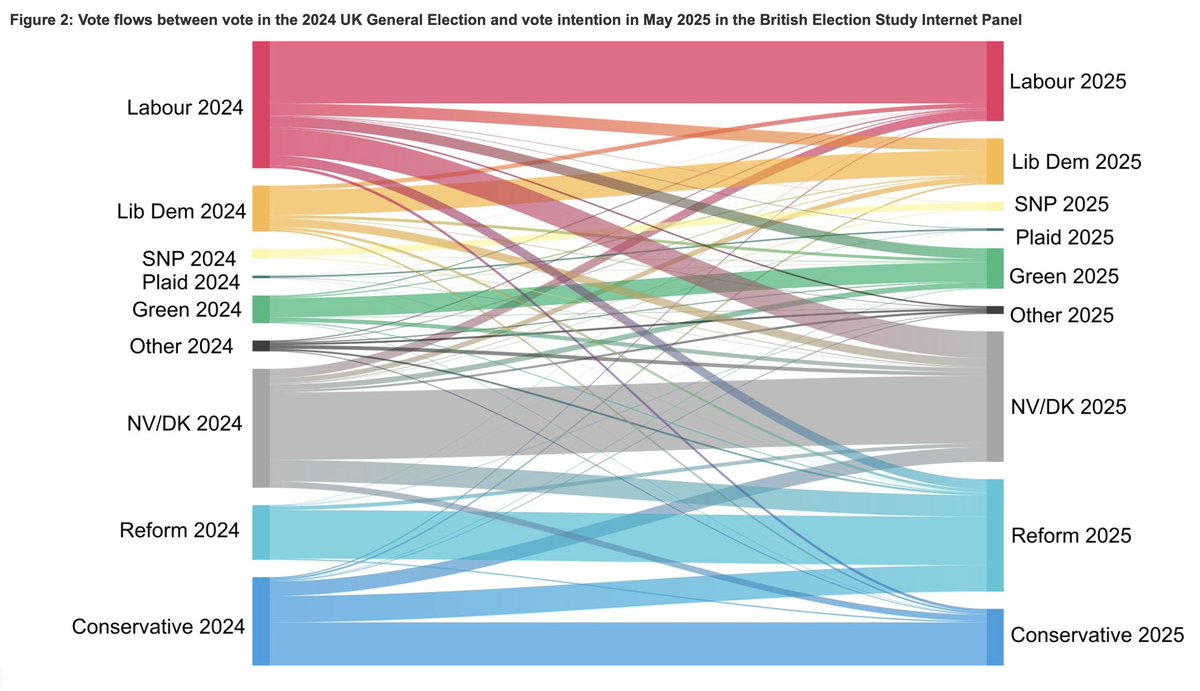
... quite successful in mobilising previous non-voters. So, who decided to shut down the Labour Party's Community Organising Unit in 2021? Who exactly? And what other bright idea have they had? This is the sort of question well-meaning Guardian columnists should be asking.
1
3
19
472
RT @rachelmillward: We're just never going to mention Nigel Farage and his role in this?
I don't know, maybe you could even write him a le…
604
Why is the idea of a trillion dollar cooperative so hard for some people to grasp?
Jun 11

Never thought I'd see this guy coming out in favour of selling ARM
1
7
932
Dan Hind retweeted

Jun 11
A profoundly important investigation that the mainstream press has ignored. People should go to jail for this—a massive heist of British democracy in broad daylight, the consequences of which are the narrow remaking of Parliament by a tiny corrupt faction.
Jun 11

CALL FOR EVIDENCE: THE LABOUR TOGETHER PARLIAMENT
Please share widely and help us expose the hyper-factional remaking of the Parliamentary Labour Party by the Labour Together/Morgan McSweeney project.
Submissions to be made to research@shadowworldinvestigations.org
Shadow World Investigations (SWI) and Paul Holden - author of The Fraud: Keir Starmer, Morgan McSweeney and the Crisis of British Democracy – are today announcing a new investigative project about the transformation of the Parliamentary Labour Party (PLP) under the Labour Together Project.
This long-germinating project is soliciting evidence about how Labour Party processes were used (and abused) to manipulate the selection of Labour MP candidates who now make up the majority of the PLP.
Sir Keir Starmer was the frontman for a scandalous political project that spent the best part of a decade remaking the Labour Party along rigidly factional and exclusionary lines.
The most consequential transformation was of the Parliamentary Labour Party.
Two thirds of the Labour MPs currently sitting in the House of Commons were selected through a process tightly controlled by Morgan McSweeney and his allies, allegedly with direct (albeit informal) input from Peter Mandelson. Labour Together, and its key donors, then spent over £2 million on getting this intake of MPs elected.
The selection process that McSweeney oversaw was beset by allegations of misconduct and irregularities so widespread that veteran journalist Michael Crick warned of potential ‘corruption’. One MP selection has resulted in criminal charges being filed against Labour officials.
These are the MPs that not just determine the future of the country but will play a key role in either making or breaking the political fortunes of whoever next succeeds Starmer.
In a follow up to The Fraud, SWI, Paul Holden and Jessica Murray will be embarking upon ‘The Labour Together Parliament’ project to examine the legitimacy of the process that resulted in the current Parliament, upon which any Labour government will rest.
What we need as a first step is information.
We would like evidence of any wrongdoing or stitch-ups during the selection process. We would like to build a collection of evidence about the ways in which bureaucrats forced through or manipulated the selection process, including in the finalisation of longlists and shortlists, and, where it happened, the decision being removed from local democratic decision making altogether.
We are particularly interested in the vote tallies from every Labour candidate selection between 2022 and 2024. These have not been routinely published.
We are particularly interested in tallies that distinguish between postal/online/and in-person votes. These different vote tallies would have been provided to losing candidates. Sometimes they were only read out in selection meetings. We are not only looking for results that seem ‘dodgy’ – but all vote tallies, including those that are not in the least suspicious. This will allow us to build a holistic database and rigorously test different hypotheses.
We would also like tallies from candidate selections in seats that weren’t Labour targets and didn’t result in any MP. Ideally, it would be great if we could be provided with contemporaneous evidence of these vote tallies – such as a screenshot of a message or email relaying the result.
We would also be interested in narrowing down which CLPs used Anonyvoter for MP selection, even if the vote tallies are not available.
Please send any information you think is relevant to the selection of the current PLP toresearch@shadowworldinvestigations.org.
And please share this call for evidence widely!
1
49
89
2,658
2017: Labour promise to revive social democracy, increase vote share.
2019: Rightwingers frantic to hand money to corporates in exchange for goodies tank Labour.
2024: Labour promise change, win, hand money to corporates, get goodies.
2026: UK media: Why are the Greens popular?
12
37
791
Polanski speaking in favour of a cooperative model of public ownership. It's hard to square the idea that the 2015-19 Labour Party was an intellectual wasteland with the fact that the 2026 Green Party is adopting and adapting the work done then.
Jun 10

Zack Polanski on renationalising the water companies,
“I talk a lot about nationalising the water companies.”
“We also need to be clear that, in and of itself, is not a socialist policy.”
“It’s a policy that I think is strongly important.”
“I think it moves us towards socialism.”
“But actually, that should be the first step.”
“Ultimately, we need much greater worker control.”
“So I’d go further than the question actually.”
“I’d say I’m more than just interested.”
“I would say this is crucial if we’re going to change society in the ways that I’ve been talking about today.”
“We know these changes cannot come from the top down.”
“And again, it might sound odd as a political leader to say this, but they’re not going to come from political leadership.”
“They’re probably not solely going to come from political parties.”
“They’re going to come from workers.”
“They’re going to come from workers on boards making their decisions about how things go.”
“Now, the reason why I talked about water companies is I want to talk about an odd thing that’s just happened in London, or happened last year.”
“So I’ve been talking to Sadiq Khan, the London Mayor, for a while now about nationalising Thames Water, the water company.”
“And I am not coming here to slate Sadiq.”
“He’s one of the better Labour politicians.”
“But we do have disagreements in times and this is one of the more telling.”
“He said, “I don’t have the power to do that.””
“He didn’t seem really interested in the conversation.”
“At one point he said he wasn’t the leader of a political party and he didn’t have the platform I do.”
“I had to remind him that the Mayor of London does have quite a big platform.”
“And talking about water nationalisation would not go unignored and might mean Keir Starmer had to talk about it a little bit more.”
“Anyway, he wasn’t willing to do that.”
“So then I went at a lower stage and I said, “In many water companies across Europe, they have political representatives on the water boards.””
“So even if it’s privately held, there are still people who are democratically elected who are there to make decisions.””
“And he still wasn’t willing to go that far.”
“And so we have a huge gap right now between where our political system is, which is they don’t even think there should be democratic governance on privately held water companies, and what are public goods and vital goods for so many people, whether we’re talking about water or indeed food.””
“But that still wouldn’t be enough.”
“It’s not just about democratic governance.”
“We should have workers and the people who understand those industries in those rooms helping to make those decisions.”
“So absolutely, a cooperative model, a worker-led model, I don’t think should be an if.”
“It needs to be a when.”
“Because we know right now, with all the problems in our society, they are only going to get worse unless we have a much stronger grassroots, community-led approach to everything in society, but particularly the workplace, particularly businesses, to make sure that the people who are producing and the people who are making the work happen are also there, making sure that they’re vitally involved in the decisions, and also they’re being paid properly and treated with dignity and care.”
3
22
63
5,962
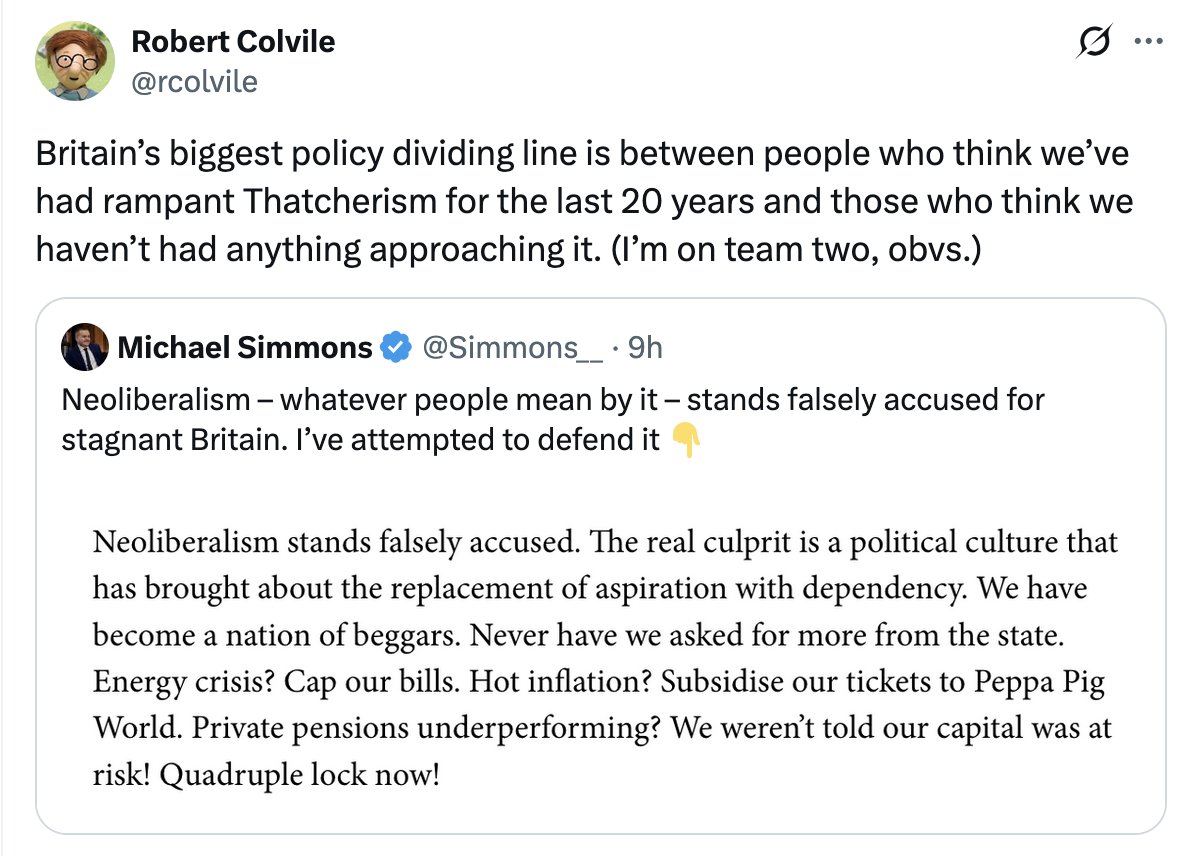
Unrelatedly here's a 2018 paper I wrote on the idea of a "cooperative state", a state form that integrates with the cooperative, rather than the corporate, sector. thenextsystem.org/learn/stor…
1
6
6
811
Meanwhile we are being treated to the spectacle of a Labour minister - a Labour minister! - bemoaning the fact that the UK does have any trillion dollar PLCs. It's no wonder the party is in danger of being replaced by the Greens in much of the country.
bbc.co.uk/news/articles/cd0m…
4
19
50
7,668
Dan Hind retweeted

Jun 10
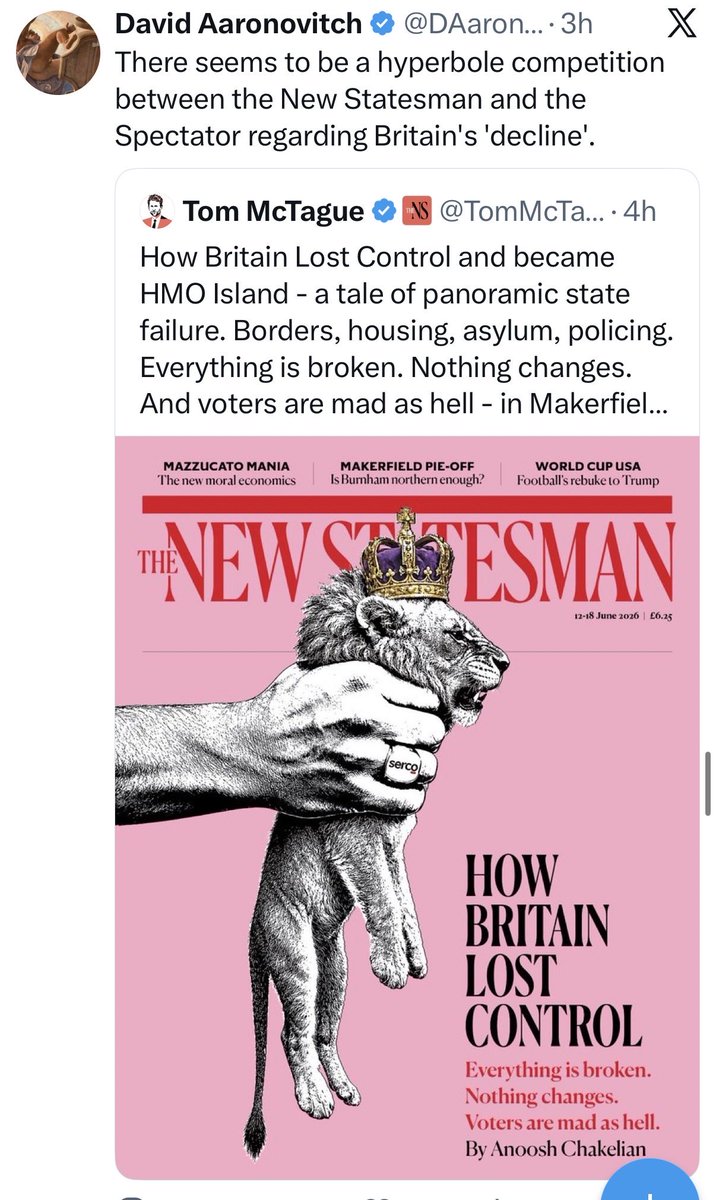
In fairness to ‘em, the NS are correctly asserting - with evidence - that successive governments sold or outsourced most of the state’s capacity to improve society somewhat*. The Spectator is repeating a lot of gargling horseshit about The Suicide Of The West.
4
24
132
3,739
It is the hallmark of capitalist imperialism to capture the fundamentals of life and reformat them as addiction, in pursuit of super profits: opium in the 19th century, gambling today. It is to Labour's lasting disgrace that they have been complicit in this.
Jun 9

The policy of the current LABOUR government is to grow the gambling industry. That means logically it wants more people to lose more money gambling, with addictive online casino the dominant mode. For once Labour succeeds — profits in 2025 were £17.35bn, up from £16.8bn in 2024
2
18
39
2,794
Dan Hind retweeted
Jun 9
Reform won 24 out of 25 contested seats in Wigan in the recent local elections, annihilating Labour, so Nandy is in fact one of the last people anyone should be listening to about ordinary voters and the toxic Labour brand. wigantoday.net/news/people/i…
Jun 8

“Have you been [to Makerfield], Clive?”
“I’m going up tomorrow”
“Come up, I’ll happily take you for a pint”
Culture Secretary @lisanandy calls out Clive Lewis’ ‘breathtaking arrogance’ for assuming what voters in Makerfield think
#Peston
4
39
91
2,650
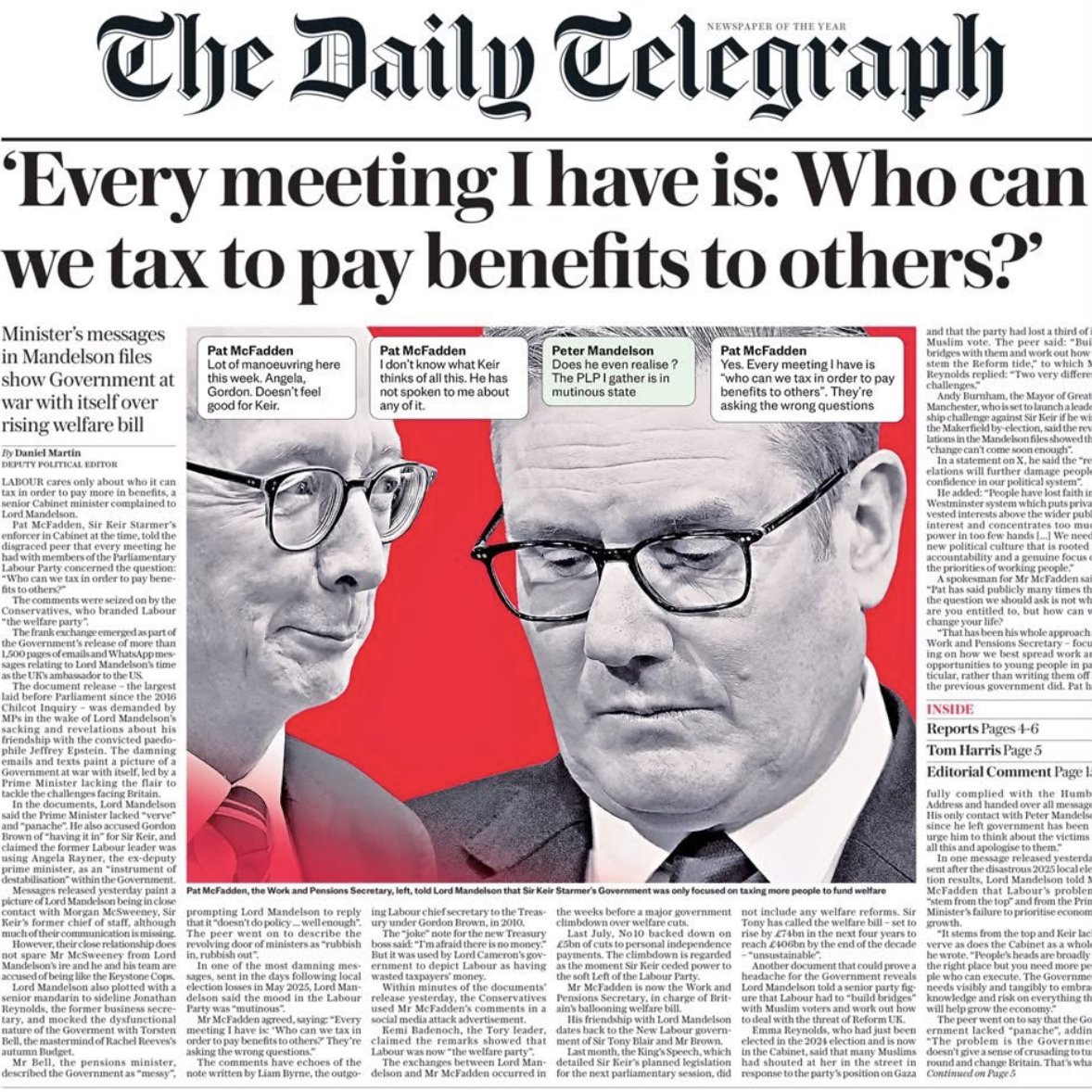
Meanwhile the Labour right - the very people who have driven the party into a ditch with their pathetic West Wing fantasies - are lobbying for Reeves to remain in post as Chancellor. If Burnham doesn't clear out the Labour Together team, the soft left should join the Greens.
Jun 5

Strategic ineptitude caused the Labour soft left—@mainstreamlbr etc—to row in behind @AndyBurnhamGM without extracting any commitments. This has at least had the salutary effect of allowing him to triangulate right from the outset, showing what we’d get. Don’t buy it, it’ll fail.
8
31
2,598
Dan Hind retweeted

One of the worst legacies of Brexit is the determination of liberal columnists to blame everything since the EU referendum on Brexit. "It’s a tragic tale – a once-confident nation making such a fearful, self-harming decision".
theguardian.com/commentisfre…
2
9
27
2,109
Streeting is a brilliant communicator, so long as the communicative apparatus likes what he is saying, and wants to amplify it.

It appears that nobody wants to hear this and indeed, maybe nobody *can* hear this, even when it’s coming from golden boy.
1
11
31
10,489