
Philomath from a modest background.
Joined December 2021
- Tweets 10,189
- Following 777
- Followers 276
- Likes 4,007
2,518 Photos and videos









Pinned Tweet









2
542
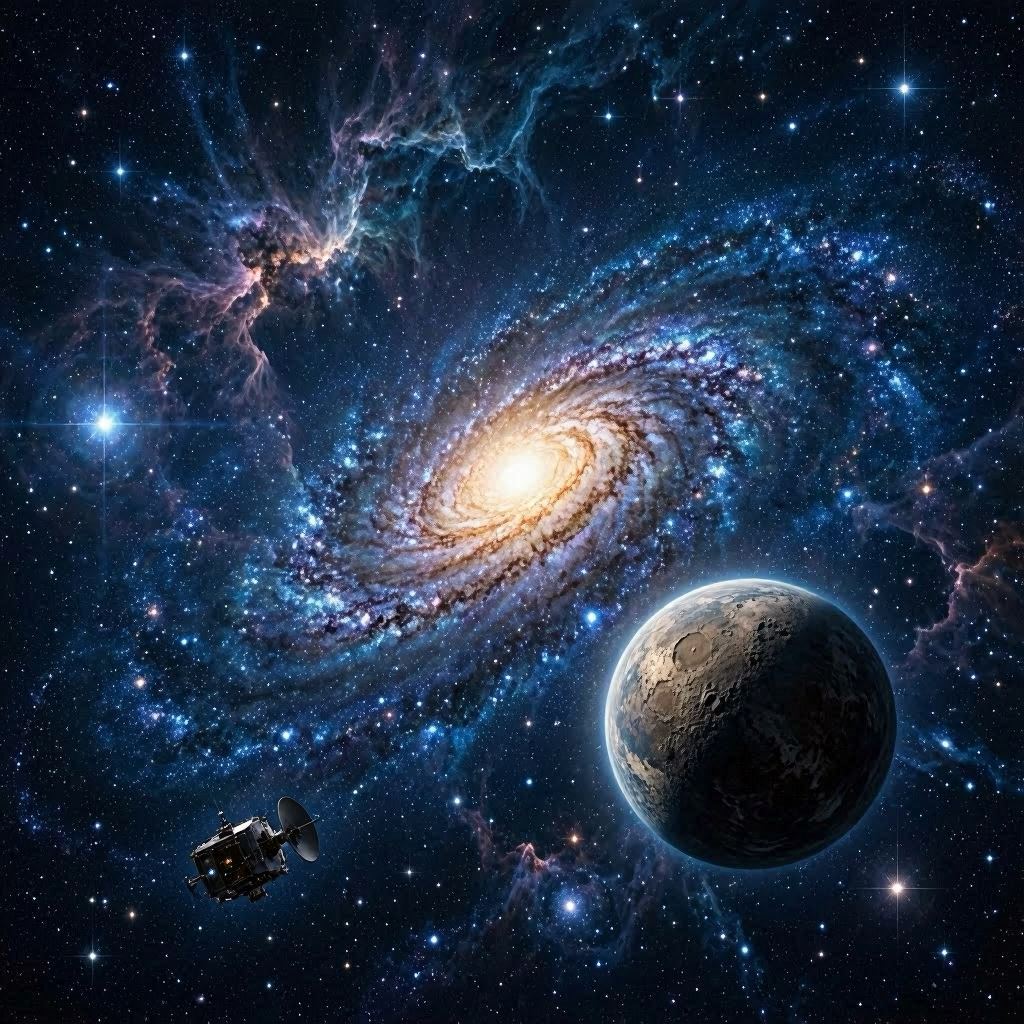
Copilot 5.5 universe
On the largest cosmic scale, the universe is growing colder as it expands.
The clearest evidence is the cosmic microwave background — the leftover radiation from the early universe. NASA says the CMB originated when the universe was dense, hot, and opaque, and that as the universe cooled, light decoupled from matter; we now observe that same light stretched by cosmic expansion into a cold 2.7 K glow.
Why expansion makes it colder
As space expands, the wavelengths of ancient photons stretch. Longer wavelengths mean lower energy, so the radiation cools. Britannica explains that as the universe expanded, the temperature of the cosmic background radiation dropped because each photon was redshifted by the cosmological expansion to longer wavelength.
NASA’s CMB explanation says that if the universe was once smaller and hotter and has been expanding, then it must have been cooling the whole time. It also states that COBE measured leftover Big Bang radiation with a blackbody temperature of about 2.728 K.
But not every place is cold
This does not mean every object or region is cooling uniformly. Stars, galaxies, black hole accretion disks, supernovae, and planets can be extremely hot because local energy sources still exist. The “universe is cooling” claim mainly refers to the overall cosmic background and the large-scale evolution from a hotter, denser early universe to a colder, more diffuse one.
Bottom line
The universe as a whole is cooling because it is expanding, and the ancient light from the Big Bang has been stretched into a very cold microwave glow. Local pockets can still be hot, but the cosmic background trend is toward colder radiation.


15
Copilot 5.5 fatalism
Fatalism is the belief or attitude that what happens is bound to happen and cannot meaningfully be changed by human effort. Britannica defines fatalism as “the attitude of mind which accepts whatever happens as having been bound or decreed to happen.”
In everyday language, fatalism often means a resigned attitude:
“Whatever will happen will happen, so there’s no point resisting.”
The Britannica Dictionary similarly defines fatalism as the belief that what will happen has already been decided and cannot be changed.
Philosophical meaning
In philosophy, fatalism is usually more precise. The Stanford Encyclopedia of Philosophy defines fatalism as the view that we are powerless to do anything other than what we actually do.
So fatalism is not merely pessimism. It is a claim about necessity, fate, and human power.
Fatalism vs. determinism
Fatalism is often confused with determinism, but they are not exactly the same.
Determinism says events happen because of prior causes.
Fatalism says the outcome is fixed or inevitable, and human effort cannot alter it.
Britannica notes that later fatalistic doctrines are sometimes loosely treated as synonymous with determinism, but it says a distinction is useful: determinism can be represented as compatible with moral responsibility, while fatalism tends toward resignation to the course of events.
A simple example:
Determinist view: “Your choices are caused by prior conditions.”
Fatalist view: “The result will happen no matter what you choose.”
Types of fatalism
The Stanford Encyclopedia identifies different ways fatalism has been argued for:
Logical fatalism — based on logic, truth, and future events.
Theological fatalism — based on God’s foreknowledge or omniscience.
Arguments from causal determinism, though Stanford notes these are not usually called “fatalism” today.
Where did fatalism originate?
Fatalistic ideas are very old and appear in multiple cultures rather than having a single origin.
Britannica says the idea can be found in ancient Greek and Roman mythology, where Fate was personified, and in Norse mythology, with the Norns.
In philosophical history, Stanford says the classic argument for fatalism occurs in Aristotle’s De Interpretatione, chapter 9, where Aristotle discusses whether statements about future events must already be true or false.
The word itself is connected to fate. Encyclopedia.com says the term fate comes from the Latin fatum, derived from fari, “to say,” and that Latin fatum was used to translate Greek terms associated with fate.
Simple summary
Fatalism means believing that events are already fixed or inevitable, so human effort cannot ultimately change what is destined to happen.
Its roots are ancient: mythologically, in Greek, Roman, and Norse ideas of fate; philosophically, in ancient debates such as Aristotle’s discussion of future truths; and linguistically, in the Latin word fatum, meaning fate or what has been spoken/decreed.

10
Copilot 5.5 P.G. Wodehouse
P.G. Wodehouse — full name Sir Pelham Grenville Wodehouse — was an English-born comic novelist, short-story writer, lyricist, and playwright. He is best known as the creator of Jeeves, the famously capable “gentleman’s gentleman.”
1. Jeeves and Bertie Wooster
Wodehouse’s most famous creation is the comic pairing of Bertie Wooster, an amiable young bachelor, and Jeeves, his superior and resourceful manservant. Britannica notes that Bertie and Jeeves first appeared in a story in The Man with Two Left Feet in 1917.
2. Comic fiction and farce
Wodehouse became especially known for farce, which Britannica calls his “special strength.” His plots were “highly complicated and carefully planned,” and he had what Britannica describes as a “scholar’s command of the English sentence.”
3. A distinctive comic style
His writing is associated with lightness, verbal wit, slang, elaborate comic plotting, and far-fetched imagery. Britannica specifically says he “delighted in vivid, far-fetched imagery and in slang.”
4. A large body of work
Wodehouse was extremely prolific: Britannica says he wrote more than 90 books, more than 20 film scripts, and collaborated on more than 30 plays and musical comedies.
5. Other comic worlds and characters
Beyond Jeeves and Wooster, Wodehouse is also associated with Blandings Castle, Psmith, Ukridge, Uncle Fred, and Mr. Mulliner, according to the official Wodehouse site.
6. Musical comedy and theatre
Wodehouse also wrote lyrics for musical comedies. The official Wodehouse site says he wrote lyrics with Guy Bolton and Jerome Kern, and at one time had five musicals running simultaneously on Broadway.
Simple summary
P.G. Wodehouse was known as one of the great comic writers in English, especially for the Jeeves and Bertie Wooster stories, intricately plotted farces, sparkling prose, and a comic fictional world of upper-class English absurdity.



10
Copilot 5.5 John Donne
John Donne was an English writer and Anglican cleric, now widely known as the leading Metaphysical poet of his time. The Poetry Foundation calls him “the preeminent metaphysical poet of his time.”
He is mainly known for four things:
1. Metaphysical poetry
Donne is famous for poetry that combines intellect, emotion, argument, wit, and startling imagery. The Poetry Foundation says his work is distinguished by emotional and sonic intensity and by its exploration of paradoxes involving faith, human and divine love, and salvation.
2. Conceits — bold extended metaphors
A major feature of Donne’s poetry is the metaphysical conceit: an ingenious extended metaphor linking seemingly unlike things. Britannica says Donne’s poems often develop as closely reasoned arguments or propositions that rely heavily on conceits, and that he transformed the conceit into a vehicle for multiple, sometimes contradictory, feelings and ideas.
3. Love poems and religious poems
Donne wrote intense love poetry as well as religious verse. Britannica mentions his elegies, Songs and Sonnets, Holy Sonnets, hymns, and religious lyrics. The Poetry Foundation describes his work as plumbing the paradoxes of both human and divine love.
Well-known poems include:
“The Flea”
“The Good-Morrow”
“The Canonization”
“A Valediction: Forbidding Mourning”
the “Holy Sonnets”
4. Sermons and prose
Donne was also known as a powerful preacher and prose writer. The Poetry Foundation notes that in his later years he gained wide fame as a preacher. Britannica says his sermons most powerfully illustrate his mastery of prose and describes them as intellectual, witty, and deeply moving.
His prose work Devotions upon Emergent Occasions includes the famous line“No man is an island,” which Britannica identifies as one of Donne’s well-known metaphysical conceits illustrating the unity of Christians.
Simple summary
John Donne was known as the greatest Metaphysical poet, famous for intellectually daring love poems, religious poetry, striking conceits, dramatic language, and powerful sermons.



14
Copilot 5.5 deontology
Deontology, in simple terms
Deontology is an ethical theory that says morality is mainly about duty, rules, and the nature of the action itself—not just about the consequences.
Britannica defines deontological ethics as theories that place special emphasis on the relationship between duty and the morality of human actions. It says an action is morally good because of some characteristic of the action itself, not because the result is good.
Core idea
A deontologist asks:
“What is my duty?”
not merely
“What outcome will this produce?”
So if lying is wrong, a deontologist may say you should not lie even if lying would produce some benefit. If keeping promises is a duty, then you should keep promises because promise-keeping is morally required.
Deontology vs. consequentialism
The contrast is important:
Deontology: Some actions are right or wrong in themselves.
Consequentialism: Actions are judged mainly by their outcomes.
Utilitarianism: A major form of consequentialism that judges actions by whether they maximize overall happiness or welfare.
Britannica contrasts deontology with teleological or consequentialist ethics, which hold that the basic standard of morality is the value of what an action brings about.
Kant and deontology
The philosopher most associated with deontology is Immanuel Kant. Britannica says Kant held that nothing is good without qualification except a good will, and that a good will acts in accordance with moral law out of respect for that law.
Kant’s famous idea is the categorical imperative, an unconditional moral command. One version of it says you should act only according to principles you could will to become universal law. Britannica says Kant believed the moral law was a categorical imperative and that its content could be established by human reason alone.
Examples
A deontological approach might say:
Do not murder innocent people.
Do not torture.
Do not lie under oath.
Keep your promises.
Respect people’s rights.
Treat persons as ends, not merely as tools.
The point is that some actions are morally forbidden or required regardless of whether breaking the rule might seem useful in the moment.
Strengths
Deontology is powerful because it:
protects individual rights;
resists “the ends justify the means” reasoning;
gives clear moral boundaries;
treats people as having dignity, not merely as units in a calculation.
Common criticism
The main criticism is that deontology can seem too rigid. If rules conflict, or if following a rule leads to terrible consequences, deontology must explain what to do.
For example: if lying is always wrong, is it wrong to lie to protect an innocent person? Different deontologists answer such cases differently.
Bottom line
Deontology is duty-based ethics. It teaches that some actions are right or wrong because of what they are—not merely because of what they produce.
In one sentence:
Deontology says morality requires us to act according to duty, principle, and respect for moral rules, even when consequences tempt us otherwise.
13
Copilot 5.5 John Locke
John Locke was a 17th-century English philosopher and political theorist. Britannica describes him as the founder of British empiricism and the author of the first systematic exposition and defense of political liberalism.
In simple terms, Locke taught that knowledge comes from experience and that government exists to protect people’s natural rights.
1. Knowledge comes from experience
Locke rejected the idea that people are born with innate ideas. Britannica says Locke argued against innate ideas by showing how human ideas may be derived from sensation or reflection—that is, observation of the operations of the mind.
The Internet Encyclopedia of Philosophy similarly says Locke offered an empiricist theory according to which we acquire ideas through our experience of the world.
This is why Locke is associated with the idea of the mind as a kind of blank slate, or tabula rasa, though the sources I found here emphasize the broader claim: ideas arise from experience.
2. The mind works with ideas
In An Essay Concerning Human Understanding, Locke analyzed the human mind and how it acquires knowledge. The Internet Encyclopedia of Philosophy says Locke thought the mind can examine, compare, and combine ideas in many ways, and that knowledge consists in a special kind of relationship between different ideas.
So Locke’s theory of knowledge is not just “we sense things.” It is also that the mind actively compares, organizes, and reflects on what experience provides.
3. Government must be limited
Locke is one of the great theorists of limited government. The Internet Encyclopedia of Philosophy says Locke used a theory of natural rights to argue that governments have obligations to citizens, have only limited powers over citizens, and can be overthrown by citizens under certain circumstances.
Britannica says Locke rejected the divine right of kings and argued that all persons have natural rights to life, liberty, and property.
4. Legitimate government depends on consent
Locke taught that political authority is not simply inherited from kings or imposed by force. Britannica says Locke’s Two Treatises of Government defended political authority based on natural individual rights and freedoms and the consent of the governed.
Britannica also says the authority of government derives from a contract between rulers and people, and that this contract binds both parties.
5. People may resist tyranny
Locke argued that rulers who fail to protect natural rights can lose their legitimacy. Britannica says rulers who fail to protect rights to life, liberty, and property may be removed by the people, by force if necessary.
This idea became one of Locke’s most influential political teachings.
6. Property comes from labor
Locke gave an important account of property. Britannica says Locke wrote that every person has “property” in his own person and has “mixed his labour” with what he owns, and that government has no right to take it without consent.
This is often called Locke’s labor theory of property.
7. Religious toleration matters
Locke also argued for religious toleration. The Internet Encyclopedia of Philosophy says he provided powerful arguments in favor of religious toleration. Britannica says Locke’s philosophy reflected Enlightenment values through its advocacy of religious toleration and criticism of arbitrary authority.
Bottom line
Locke taught that:
human knowledge comes from experience, not innate ideas;
the mind forms knowledge by working with ideas;
people have natural rights to life, liberty, and property;
legitimate government rests on consent;
government power must be limited;
rulers may be resisted if they violate people’s rights;
property is connected to labor;
religious toleration is politically and morally important.
In one sentence: John Locke taught that free and equal individuals learn through experience and form governments by consent to protect their natural rights.



26



Copilot 5.5 UC Berkeley
George Berkeley was an Anglo-Irish Anglican bishop, philosopher, and scientist. He is best known for an empiricist and idealist philosophy holding that reality consists only of minds and their ideas; everything non-spiritual exists only insofar as it is perceived by the senses.
His core teaching is often summarized by the Latin phrase:
Esse est percipi — “to be is to be perceived.”
1. Berkeley taught that matter, as mind-independent substance, does not exist
Berkeley defended immaterialism, the claim that matter does not exist, and idealism, the claim that everything that exists either is a mind or depends on a mind for its existence. He did not mean that ordinary objects are fake or that life is a dream. Rather, he argued that what we call physical objects are composed of ideas—colors, sounds, textures, shapes, tastes—experienced by perceiving minds. The Internet Encyclopedia of Philosophy says Berkeley’s view that physical objects are composed of ideas is captured in his motto, “to be is to be perceived.”
2. He rejected “material substance” behind experience
Berkeley’s target was the idea that behind our perceptions there is some unknowable material substance existing independently of all minds. Britannica says his early philosophical work involved studying “the hypothesis that there is no material substance,” and that his new principle analyzed “to be” or “to exist” as meaning, for objects, “to be perceived.”
In plain terms: you never experience “matter itself.” You experience color, hardness, shape, sound, resistance, warmth, and so on. Berkeley thought positing a hidden material stuff behind those perceptions was unnecessary.
3. He taught that minds are real
Berkeley’s “to be is to be perceived” applies to nonthinking objects. For subjects—minds or spirits—“to be” means to perceive. Britannica says Berkeley distinguished “to be,” said of the object, as meaning to be perceived, and “to be,” said of the subject, as meaning to perceive.
So Berkeley’s world contains:
minds/spirits that perceive;
ideas/perceptions that are perceived.
4. He used God to explain the continued existence of things
A common objection is: “If objects exist only when perceived, does my desk disappear when I leave the room?”
Berkeley’s answer involves God. Britannica’s summary of the esse est percipi doctrine says Berkeley argued that even unperceived objects are sustained in existence by the continuous thought of God.
So, for Berkeley, the world remains orderly and continuous because it is always perceived by the divine mind.
5. He was an empiricist
Berkeley was one of the major British Empiricists, alongside Locke and Hume. The Internet Encyclopedia of Philosophy says Berkeley was one of the three most famous British Empiricists.
Like other empiricists, he emphasized sensory experience. But unlike Locke, he denied that sensory experience gives us access to a mind-independent material substance.
6. He criticized abstract ideas
Berkeley argued that abstract ideas caused philosophical confusion. The Internet Encyclopedia of Philosophy says Berkeley claimed abstract ideas are the source of philosophical perplexity and illusion, and argued that Locke-style abstract ideas cannot be formed, are not needed for communication or knowledge, and are inconsistent or inconceivable.
This matters because Berkeley thought philosophers created needless puzzles by imagining abstract “matter,” “extension,” or “substance” apart from concrete experience.
7. He also wrote on vision
Berkeley was known for work on perception, especially vision. The Internet Encyclopedia of Philosophy says his Essay towards a New Theory of Vision challenged the standard account of distance vision and argued that visual perception of distance is explained by correlations between ideas of sight and touch.
Bottom line
George Berkeley taught that:
knowledge begins with experience;
what we call physical objects are collections of perceived ideas;
mind-independent matter is unnecessary and does not exist;
minds or spirits are real perceivers;
God guarantees the stability and continuity of the world;
“to be,” for ordinary objects, is to be perceived.
In one sentence: Berkeley taught that reality is fundamentally mental: the world consists of minds and ideas, not material objects existing independently of perception.



73

Copilot 5.5 David Hume
David Hume was an 18th-century Scottish philosopher, historian, economist, and essayist, best known for empiricism and skepticism. Britannica says he conceived philosophy as an inductive, experimental science of human nature and concluded that there can be no knowledge of anything beyond experience.
In simple terms, Hume taught that human beings know far less with certainty than they think they do.
His main ideas
1. Knowledge comes from experience
Hume was an empiricist: he thought the contents of the mind ultimately come from experience. The Internet Encyclopedia of Philosophy says Hume belonged to the British empiricist tradition with John Locke and George Berkeley, and that this tradition held that there are no innate ideas and that knowledge comes from experience. So for Hume, if an idea cannot be traced back to some experience, we should be suspicious of it.
2. Cause and effect are not known with certainty
Hume challenged the idea that we directly perceive necessary causal connections. The Internet Encyclopedia of Philosophy says Hume argued that our ideas of cause and effect are grounded in habits of thinking, rather than in direct perception of causal forces in the external world. For example, when one billiard ball hits another and the second moves, we see one event followed by another. But Hume says we do not literally see “necessary connection”; we form an expectation because similar events have regularly gone together before.
3. Induction cannot be rationally guaranteed
Hume is famous for the problem of induction: the fact that past patterns do not logically prove future patterns. The Internet Encyclopedia of Philosophy explains that Hume’s view of causation gives rise to the problem of induction: we are not reasonably justified in making inductive inferences about the world. This does not mean we stop expecting the sun to rise or fire to burn. It means those expectations rest on habit and custom, not absolute proof.
4. Human beings are guided more by sentiment than pure reason
Britannica says Hume concluded that humans are creatures more of sensitive and practical sentiment than of reason. In morality, this means Hume did not think ethics comes simply from abstract reasoning. The Internet Encyclopedia of Philosophy says Hume offered one of the first purely secular moral theories, grounding morality in the pleasing and useful consequences of actions.
5. You cannot simply derive “ought” from “is”
Hume is also known for the is–ought problem: moral obligations cannot be directly deduced from factual statements alone. The Internet Encyclopedia of Philosophy says he is famous for the position that we cannot derive “ought” from “is,” meaning statements of moral obligation cannot simply be deduced from statements of fact. For example, saying “people suffer” is a fact; saying “therefore we ought to help them” requires an additional moral principle or sentiment.
6. The self is not a fixed substance
Hume questioned ordinary ideas of personal identity. The Internet Encyclopedia of Philosophy says he argued that there is no permanent “self” that continues over time. This is often called the bundle theory: what we call the self is more like a bundle of perceptions, memories, feelings, and experiences than a single unchanging thing.
7. Religious claims should be examined skeptically
Hume was also important in philosophy of religion. The Internet Encyclopedia of Philosophy says he argued that it is unreasonable to believe testimonies of alleged miracles and criticized standard theistic proofs such as design and causal arguments for God’s existence.
Bottom line
Hume taught that:
knowledge begins with experience;
reason has limits;
causation is based on habitual expectation;
induction cannot give absolute certainty;
morality depends heavily on sentiment;
one cannot derive ought directly from is;
the self is not obviously a permanent substance;
religious and metaphysical claims require skeptical scrutiny.
In one sentence: David Hume taught that human life is governed less by certainty and pure reason than by experience, habit, feeling, and practical belief.



67

Copilot 5.5 divine purpose
From many religious perspectives, every life has divine purpose. From secular, existentialist, or non-theistic perspectives, lives may have meaning without having a specifically divine purpose.
A careful answer would be:
All lives can be understood as meaningful, but whether all lives have “divine” purpose depends on whether one believes reality is grounded in God, gods, sacred order, or spiritual destiny.
Religious perspectives
Many religions do see human life as connected to ultimate purpose. A philosophy-of-religion source notes that life’s meaning and purpose are central to religious and philosophical thought, and that different traditions offer varied perspectives, including divine purpose, spiritual liberation, and secular humanism.
In Abrahamic religions such as Judaism, Christianity, and Islam, life’s purpose is often understood in relation to God—fulfilling God’s will, living morally, and seeking salvation or eternal life.
In many Eastern traditions, the language may be less about a personal divine plan and more about liberation, enlightenment, dharma, karma, or harmony with ultimate reality. The same source says Hinduism aims for moksha, Buddhism seeks nirvana, and Indigenous religions often emphasize harmony with nature and preservation of cultural traditions.
Philosophical and secular perspectives
Not all traditions frame purpose as divine. Some philosophies say meaning is created through freedom, responsibility, virtue, love, work, service, or self-understanding. The Stanford Encyclopedia of Philosophy entry on life’s meaning notes that people ask different questions: what “life’s meaning” means, what the meaning of life is, and whether life is meaningful at all.
So someone might say:
▬ Theist: “Every life has purpose because every person is created by God.”
▬ Pantheist or spiritual view: “Every life participates in a sacred whole.”
▬ Buddhist view: “Purpose is not necessarily divine, but life has a path toward liberation from suffering.”
▬ Existentialist view: “Purpose is not given from outside; we create it through choices.”
▬ Humanist view: “Lives matter because persons matter, even without divine design.”
My best synthesis
If by divine purpose you mean “a specific mission assigned by God,” then not everyone agrees.
If by divine purpose you mean “every life has sacred worth and can participate in goodness, love, truth, repair, or awakening,” then many spiritual traditions would answer yes.
A balanced formulation is:
Every life has moral and existential significance. Whether that significance is divine depends on one’s metaphysics; but the claim that every life matters does not require everyone to agree on the same theology.



80
Some connections look like friendship on the surface but create complications behind the scenes.
11

Time has a way of showing who returns to support you and who returns to unsettle you.
8
Copilot 5.5 mystery
Many aspects of life are mysterious because we can describe them, study them, and live through them—yet still not fully explain what they mean, why they matter so much, or what they are “from the inside.”
Deeply mysterious aspects of life
1. Consciousness
Perhaps the greatest mystery is why experience exists at all. The “hard problem of consciousness” asks why any physical state is conscious rather than nonconscious—why there is “something it is like” to have an experience.
We can study brains, behavior, attention, memory, and perception, but the first-person feel of pain, color, music, grief, or joy remains philosophically puzzling.
2. Death
Death is biologically familiar but existentially mysterious. The philosophy of death asks what death is, whether it is bad for the one who dies, how mortality shapes meaningful life, and what ethical attitudes toward death are justified.
The mystery is not only “what happens after death?” but also “how should knowing we die change how we live?”
3. Meaning
The meaning of life remains mysterious because people ask different but related questions: what we mean by “life’s meaning,” what the meaning of life is, and whether life is in fact meaningful.
Meaning can come from love, work, service, beauty, faith, knowledge, family, creativity, or moral purpose—but no single answer satisfies everyone.
4. Love
Love is mysterious because it is emotional, ethical, biological, personal, and sometimes spiritual all at once. The Internet Encyclopedia of Philosophy calls love one of the most “universal, mysterious, and all-permeating phenomena,” while noting that no full or finite definition has been found.
We can explain parts of love, but not why one person becomes irreplaceable to another.
5. The self
We live as if there is a stable “I,” yet the self changes across time. Memory, body, personality, values, and relationships all shift. The mystery is: what makes you still you?
6. Time
We measure time precisely, but our lived experience of it is strange. A minute can feel endless or vanish instantly. The past is gone but shapes us; the future does not exist yet but governs our choices.
7. Moral conscience
People often feel that some things are genuinely right or wrong, not merely preferred or disliked. The mystery is why moral obligation feels binding—why guilt, duty, justice, mercy, and responsibility have such force.
8. Beauty
Beauty can seem unnecessary from a survival standpoint, yet it moves people deeply: music, faces, landscapes, poetry, mathematics, kindness. The mystery is why certain forms, sounds, or moments feel meaningful beyond utility.
9. Suffering
Suffering is mysterious not because we cannot identify causes, but because of its moral and existential weight. Why do innocent people suffer? How can suffering break some people and deepen others? What can redeem pain, if anything?
10. Choice and freedom
We experience ourselves as choosing, but our choices are shaped by genetics, upbringing, culture, emotion, habit, and circumstance. The mystery is how freedom and causation fit together.
Bottom line
The most mysterious aspects of life tend to be the ones we cannot fully reduce to mechanics:
consciousness, death, meaning, love, selfhood, time, morality, beauty, suffering, and freedom.
They are mysterious because they are not just things we observe; they are things we live from the inside.



1
27