
#Cardano // DRep drep1yfsgx4dqfcxxs0ms533twzs7w0cvw8vq8qwzmjyrp280jfsl8gusv
Joined May 2009
- Tweets 7,038
- Following 1,074
- Followers 3,186
- Likes 13,073
88 Photos and videos
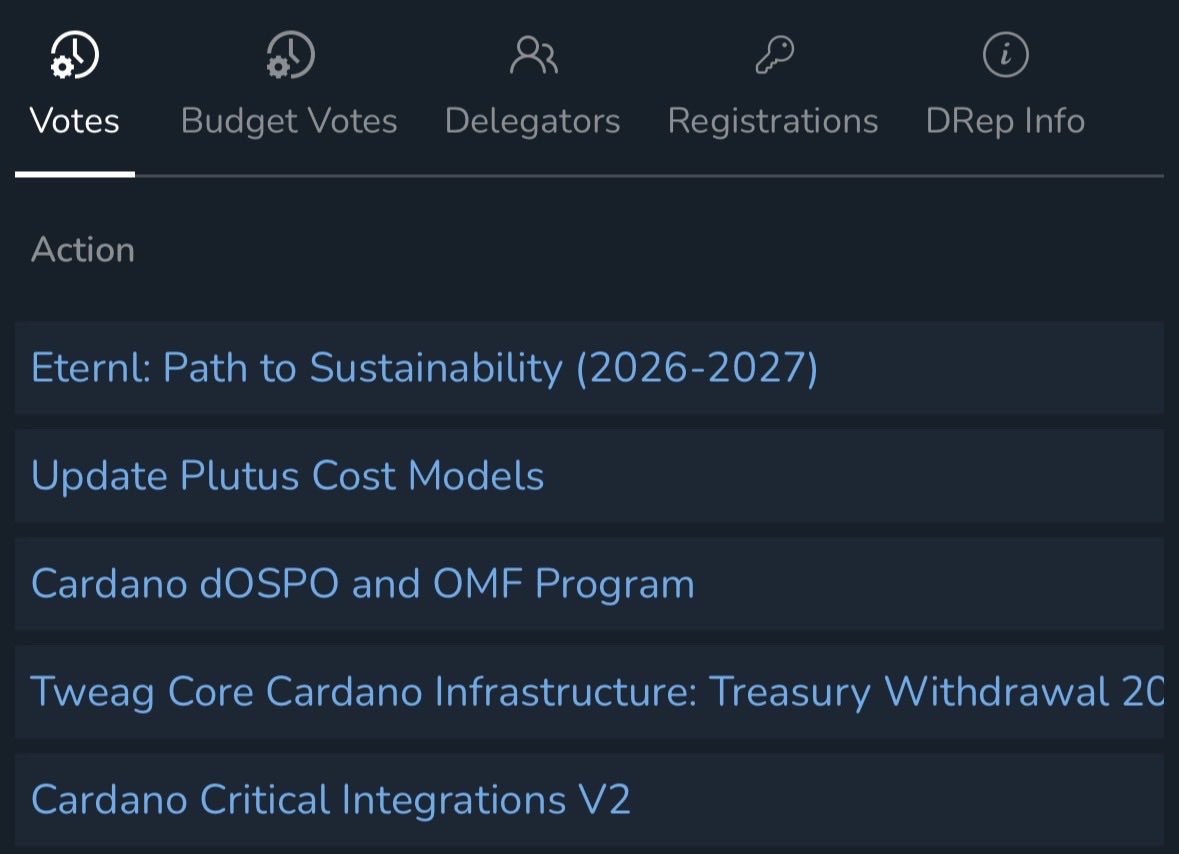









IO’s research proposal now looks like it will pass, having crossed the 67% threshold (thanks to some large DReps who previously abstained changing their vote to yes).
This is great to see. Cardano has always been the science chain, the one where ideas are rigorously explored and tested before being implemented.
The slow and steady approach is not without its critics, particularly given ADA’s relative decline against chains that decided to skip a few steps. But we’ve seen how this worked out – frequent outages, hacks, and centralisation.
The product market fit for crypto so far has been memecoins, gambling, and perps. These use cases don’t typically reward highly resilient, decentralised architecture. Users will go wherever they get the cheapest fees and the fastest transactions.
But this won’t be the case forever. Use cases of the future may favour different features. For those that need security, reliability, and decentralisation – there is Cardano.
Research is a big part of Cardano’s story. Without it, we lose our edge in the market.

There’s less than 2 days until the vote closes for IO’s Cardano Vision 2026 proposal.
Post-quantum security is critical. Q-Day could occur before 2030 – we must be prepared.
If the top 6 DReps who haven’t voted yet vote yes, it will pass.
adastat.net/governances/5ad1…
6
8
67
2,476
Midnight
Strike
Minswap
Liqwid
Empowa
RealFi
Veridian
Wayup
Snek
VESPR
Masumi
SundaeSwap
Lace
USDM
Bodega
Midgard
Djed
USDA
Finest
World Mobile
Pogun
DeltaDeFi
Surf
Wanchain
Dano
Indigo
Fluid Tokens
Bifrost
Surge
Bending
Aiken
Pebble
Gravity
Hosky
Iagon
Clarity
Typhon
Tango
Gero
Nucast
Sokosumi
Palmyra
Syngenta
Pondora
Marlowe
Pool pm
Ascend
Maestro
Tempo
Govtool
Mithril
Charms
Revuto
Urble
Koios
Ekklesia
Splash
Frigid
Helios
Amaru
Eternl
Atrium
Titans
Tokeo
BloxBean
Genius Yield
PoolTool
Txnerd
Stuff io
Cardanoscan
Metera
Clay Nation
Minute Markets
OpShin
MAYZ
Sundial
Orcfax
DripDropz
Lucid Evolution
Quantum Hosky
Daedalus
TosiDrop
Pyth
Tx3
Snek .fun
MuesliSwap
NuNet
Dingo
Keystone
Gummiworm
Ada Handle
Saturn Swap
Charli3
Book io
CSWAP
Yoroi
Cexplorer
NMKR
Reeve
Cardanzo Tools
Butane
Optim
Dune
Astarter
Nuvola
VyFinance
PBG
SpaceBudz
Atlas
WingRiders
Fetch
BTC Karma
ASI
NUFI
Xerberus
CNFT Tools
Materios
Comet
Pulse
AdaStat
Vendano
Infinity Rising
Charms
Sync AI
Begin
LayerZero
Titan
Mesh
DexHunter
Trivole FMS
BikeID
Orion Fund
SecondFi
SteelSwap
Blockfrost
USDCx
Starstream
Hydra
DeFi Kernel
Leios
Cardano.
28
48
301
7,292
There’s less than 2 days until the vote closes for IO’s Cardano Vision 2026 proposal.
Post-quantum security is critical. Q-Day could occur before 2030 – we must be prepared.
If the top 6 DReps who haven’t voted yet vote yes, it will pass.
adastat.net/governances/5ad1…
12
37
3,494
This needs to happen. The redesign looks great.

Cardano's front door hasn't been redesigned in years. So we redesigned it.
Introducing the new Cardano.org
A concept study - protocol website built for adoption
2
3
38
1,561
Whether this is the low for ADA or we go down further, I still believe Cardano’s future is bright.
The chain is getting better everyday. With Leios, it will match or surpass almost everyone in the industry: on security, decentralisation, and soon performance.
Our DeFi ecosystem is comparatively small, but has a lot of potential.
Aside from Ethereum and Solana, most other chains have a tiny app ecosystem, with top DeFi projects often built by the same entity as the chain itself. TVL looks high, but is artificially inflated by VCs.
Cardano meanwhile has a dedicated community of builders creating apps, tools, and projects that are genuinely best in class. Strike, Minswap, Midnight, Empowa, Liqwid, World Mobile, VESPR, Snek, and many others. There are also promising new projects like RealFi.
The price is down but the tech is not. Major flaws being found in top chains show the importance of the slow and steady approach. Cardano’s track record speaks for itself – no downtime and no hacks.
The industry is brutal. While in hindsight there are things that could have been done differently, we have also been at the mercy of the wider market full of scams, hacks, tech failures, and VCs only looking to extract. Crypto is simply not in a good spot right now.
Cardano has the opportunity to show a different way forward. The original vision can still be realised. Cardano’s best days are ahead, if we want them to be.
19
40
309
6,684
Charles gets too much hate. Cardano isn’t perfect but it’s a hell of a lot better than most other chains.
If you think Cardano is bad, look around. Outside a few niche areas the entire industry is wrecked.
BTC only pumped thanks to a madman leveraging his entire company to buy it. ETH didn’t break its previous ATH (even with multiple DATs buying it). SOL barely did. Could ADA have done better? Yes, but it could also have done worse.
Crypto has not had a great time recently. Scams, hacks, tech failures, security vulnerabilities, AI threats, and the looming quantum problem. Even true believers are beginning to question the future of the industry.
But blockchain’s potential to transform the world’s systems hasn’t gone away. If anything, it’s more needed than ever.
“Build fast and break things”. The Silicon Valley mindset has permeated the industry’s thinking. Blockchain is just a technology, right? But the result has been hacks to the tune of billions of dollars, chains that go down for hours at a time, and the centralisation of power.
What is the point of crypto if we’re just building a faster casino, or a playground for VCs to max extract from retail? Blockchain was supposed to be about changing the economic, social, and political systems of the world. It’s no wonder crypto is down bad. People no longer believe in its potential.
Cardano is one of the few projects that has stayed true to the original mission. It has been a slow process, but the result is a chain that is battled-tested. It is hard to find examples of other chains with comparable levels of security, reliability, and decentralisation.
Most other crypto projects would kill to be in our position. Not only do we have one of the most advanced chains, we also have an extremely passionate and engaged community. People who are dedicated to seeing Cardano succeed.
Charles is one of those people. The reality is Cardano wouldn’t exist without his efforts, and his vision and passion to make something great.
75
127
906
17,101
Mainstream adoption of blockchain will only happen if the North Star is safety.
Above all else, this is the most important concern for users. Most are not willing to trust their money to something that doesn’t guarantee its safety. Unfortunately, crypto today is riddled with hacks – $16.5 billion to date. No wonder there’s a trust issue.
The industry will never be taken seriously if this is allowed to continue. There are risks in traditional finance too, but in countries with stable banking, people generally don’t have to worry about losing their money in savings accounts.
Higher returns can be found in DeFi, which attracts some, but there’s a reason the most successful apps are those further out on the risk curve. Most people don’t want to risk it all to win – they want better financial products, but with the same (or better) level of security as what they’re already used to.
Decentralisation is sometimes pointed to as crypto’s North Star. But most don’t care about this. They just want to know that their assets are safe. They want to borrow, lend, and earn yield without worrying about smart contract vulnerabilities. Decentralised networks provide assurance that your funds can’t be frozen, but this is only one aspect of safety.
Safety also involves the security of the underlying ledger, the reliability of the code that runs on it, and even the interfaces users interact with. At every level, safety needs to be paramount. The ledger must be rock solid. The smart contracts must be bulletproof. The user interfaces must consider the human element; the last line of defence – which is often where things go wrong.
Mass adoption will never happen until we get this right. Some blockchains are further along than others, but no one has completely cracked the code yet.
Cardano stands in a strong position. The overall design of the protocol, features like native assets, the use of functional programming and formal verification, its high degree of decentralisation… all set it apart from most other chains. For nearly 9 years it has been running continuously with no hacks. In terms of security and reliability, Cardano’s track record is second to none.
Other L1s aren’t as fortunate. Solidity hacks are so common there’s been on average three per week this year alone. Newer chains like Solana and Sui have suffered multiple major outages, showing the limits of the “build fast, break things” approach.
But it’s not enough for Cardano to rely on its technical prowess. We must push forward in areas we’re lacking, particularly user experience. Managing seed phrases is a horrible UX. Sending funds is stressful. Unfracking your wallet shouldn’t be a thing. Min ADA adds additional friction.
Thankfully, there are efforts underway to address these challenges, including through some of the proposals recently funded by the treasury. Midnight will help too – as well as adding privacy, it also introduces the Midnight Passport to make user onboarding seamless.
Cardano’s best days are ahead. The foundation is solid. The original vision of being your own bank and owning your identity is in sight. But if we want to win, we must be uncompromising – we must continue to focus relentlessly on safety.
5
4
18
1,648
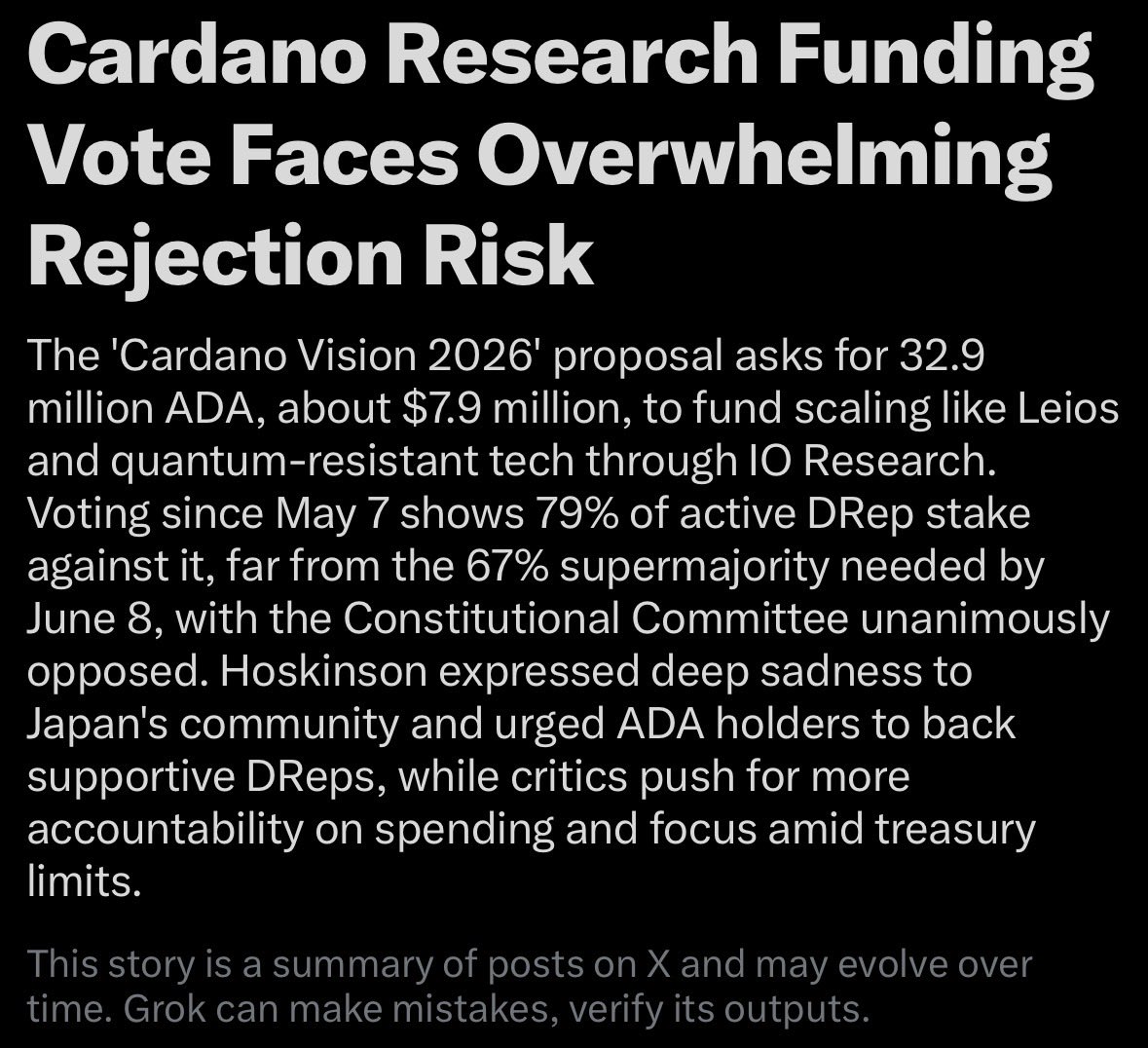
This summary by Grok shows it doesn’t really understand Cardano governance.
The Constitutional Committee aren’t “unanimously opposed”, none of them have voted yet. Likewise, the majority of DReps are only against it by default. There are still 16 days until the vote closes.
4
502
I remember hearing about a blockchain that pioneered formal verification, what was it again? 🤔
May 18

Many people have claimed that with AI-assisted bug finding, secure code (and hence trustless anything) will be impossible.
I have a much more optimistic take, and AI-assisted formal verification is a major part of the reason why:
vitalik.eth.limo/general/202…
1
14
839
Why I believe in Cardano:
- built like a tank
- transactions never fail
- way harder to attack than EVM chains
- doesn’t feel like I’ll get rugged using DeFi
- liquid staking
- actually decentralised
- cult community (in a good way)
- on-chain governance
- innovative builders
18
58
406
10,932
Ethereum and Cardano are the only major L1s focused on making programmable blockspace decentralised, permissionless, and resilient.
If they don’t succeed, the fate of the crypto industry will be tied to Silicon Valley and the VCs behind almost every other blockchain.
Jan 5
“Ethereum was not created to make finance efficient or apps convenient. It was created to set people free”
This was an important - and controversial - line from the Trustless Manifesto ( trustlessness.eth.limo ), and it is worth revisiting it and better understanding what it means.
“efficient” and “convenient” have the connotation of improving the average case, in situations where it’s already pretty good. Efficiency is about telling the world's best engineers to put their souls into reducing latency from 473 ms to 368ms, or increasing yields from 4.5% APY to 5.3% APY. Convenience is about people making one click instead of three, and reducing signup times from 1 min to 20 sec.
These things can be good to do. But we must do them under the understanding that we will never be as good at this game as the Silicon Valley corporate players. And so the primary underlying game that Ethereum plays must be a different game. What is the game? Resilience.
Resilience is the game where it’s not about 4.5% APY vs 5.3% APY - rather, it’s about minimizing the chance that you get -100% APY.
Resilience is the game where if you become politically unpopular and get deplatformed, or if a the developers of your application go bankrupt or disappear, or if Cloudflare goes down, or if an internet cyberwar breaks out, your 2000ms latency continues to be 2000ms.
Resilience is the game where anyone, anywhere in the world will be able to access the network and be a first-class participant.
Resilience is sovereignty. Not sovereignty in the sense of lobbying to become a UN member state and shaking hands at Davos in two weeks, but sovereignty in the sense that people talk about "digital sovereignty" or "food sovereignty" - aggressively reducing your vulnerabilities to external dependencies that can be taken away from you on a whim. This is the sense in which the world computer can be sovereign, and in doing so make its users also sovereign.
This baseline is what enables interdependence as equals, and not as vassals of corporate overlords thousands of kilometers away.
This is the game that Ethereum is suited to win, and it delivers a type of value that, in our increasingly unstable world, a lot of people are going to need.
The fundamental DNA of web2 consumer tech is not suited to resilience. The fundamental DNA of _finance_ often spends considerable effort on resilience, but it is a very partial form of resilience, good at solving for some types of risks but not others.
Blockspace is abundant. Decentralized, permissionless and resilient blockspace is not. Ethereum must first and foremost be decentralized, permissionless and resilient block space - and then make that abundant.
7
1,176
Recently, New Zealand’s largest patient information portal ManageMyHealth was compromised, with files containing the most private medical details for about 125,000 patients now up for ransom on the dark web.
It got me wondering – is this something Midnight could’ve prevented? Hacks of private health data are becoming increasingly common, opening victims up to embarrassment, identity fraud, and social engineering attacks. People want their medical data to be safe and secure, but existing systems don’t provide that.
Because Midnight acts as a control layer for private access, a medical platform built on it would be significantly more robust than current options, which often centralise both the storage of information as well as keys, creating a honeypot risk (lots of valuable data in one place).
A Midnight-based healthcare platform could do away with this by distributing access.
Imagine the following scenario:
- A patient signs up for the system, creating a master key (stored securely on their device).
- The patient’s doctor gets a partial key on their system, as do the local and national health agencies (stored on separate systems).
- Only the patient’s master key provides full access to their encrypted data. But if they lose it for whatever reason, the key shards held by the patient’s doctor and health agencies can be used together to restore their master key.
By distributing access, no one party aside from the patient themselves can unlock their medical record, making the encrypted files useless even if an attacker obtained them. There is no central key database that a hacker can exploit to decrypt files for multiple users.
Midnight would also allow for selective disclosure. A patient could choose to only share relevant parts of their record with certain providers. For example, when donating blood, they may only need to share their blood type, medications, and contraindications. Using Midnight could also provide a tamper-proof access log for audits.
Everyone has to use healthcare at some point. Digital tools can enhance access and put patients in control – but only when done right. When done poorly, they open up new vectors for scams and identity fraud, leading patients to lose confidence. Midnight offers a different approach, providing a way to reduce centralisation while restoring trust.
4
14
1,445
Voted yes to add @cardanocuria to the CC. Let’s get this sorted soon so governance actions aren’t delayed.
9 Dec 2025

🚨 NEW GOVERNANCE ACTION ALERT! 🚨
🏷️ Type: New Committee
🔗 Details: adastat.net/governances/4dab…
#Cardano #Blockchain #Governance
2
6
977