Joined December 2023
- Tweets 2,985
- Following 309
- Followers 220
- Likes 8,146
140 Photos and videos





Jero retweeted

Apr 20
A tip if you have a good hold of technical analysis but still lack execution skills. Something I believe many around here still need to improve on. It's a myth that good technical analysis leads to profitable trading, finding levels and understanding the charts is quite easy - if you put the work in you can fully understand a conceptual strategy within a month depending on who you learn it from. But execution takes years to develop psychologically and that's what generates money.
The main hiccup is the trades you take vs don't take, but most importantly the trades you over manage and their potential outcomes if you did not over-manage, in which you probably did not document.
Create some type of demo/paper money account. For every single trade you take, copy that same exact trade on the demo account. Same entry/SL/final TP.
The only difference is, once you copy those down on your demo account - DO NOT manage the trade. Let the market either run your SL or take final TP. Don't take any profits manually, do not trail your SL, just do absolutely nothing.
Once you finish the real trade, whether stopped breakeven or in profit etc.. later on compare it to the final result of the demo trade. How did the R/R or PnL compare to your real trade ? When you do this, you start to see how your live decisions differ from the original format of your setups & if your emotional reactions hinder or facilitate your trading.
Then you can document the trades and understand your best setups, you'll start to realize money was left on the table due to over-managing textbook entries out of fear/greed & analysis paralysis.
9
27
229
9,838

Jero retweeted

Mar 22
For decades, the American political system has sustained itself on a single operating fiction:
that elections matter.
The left believed that electing the right Democrats would produce social progress, expand protections, and hold corporate power accountable.
The right believed that electing the right Republicans would restore traditional values, secure borders, and rebuild American economic strength.
The MAGA movement believed, with particular intensity, that Donald Trump represented a genuine rupture from the establishment, a wrecking ball sent to destroy the machinery of elite capture and return power to ordinary Americans.
All three groups are starting to converge on the same conclusion, arriving from different directions but landing in the same place.
The left watched Biden continue Trump's immigration enforcement architecture, expand military spending, and deliver nothing resembling the transformative social investment his campaign promised. They watched the Democratic establishment crush its own progressive wing with more energy than it ever directed at Republican obstruction. They are beginning to understand that the party exists to absorb and neutralize progressive energy, not to act on it.
The right watched two decades of Republican governance produce no meaningful reduction in the size of government, no reversal of cultural trends they oppose, and no restoration of the economic conditions they remember.
Every Republican president expanded the deficit. Every Republican Congress funded the wars. Every conservative Supreme Court majority failed to produce the cultural restoration that was promised. The institutions captured the revolutionaries, not the other way around.
And the MAGA base is now watching Trump, their chosen instrument of disruption, fill his administration with the same Goldman Sachs alumni, the same defense contractor lobbyists, the same private equity figures who populated every administration before him. They watched Jared Kushner collect two billion dollars from Saudi Arabia's sovereign wealth fund while generating zero return on investment, because the investment was never commercial.
It was blackmail.
They are watching tariffs that were sold as protection for American workers function instead as leverage for renegotiating the terms under which global capital accesses American markets, terms that benefit the negotiators and their financial networks, not the factory workers in Ohio who were promised their jobs back.
The convergence is not ideological.
These three groups do not agree on policy, on values, or on what America should become. What they are converging on is a structural recognition:
the electoral system is a selection mechanism for which faction of private sector power gets to operate the state apparatus for the next four years.
The policies that affect their lives, the ones that determine whether wages rise or fall, whether housing is affordable or financialized into an asset class, whether healthcare is accessible or remains a debt generation mechanism, those policies do not change with administrations because they are not set by administrations.
They are set by the capital interests that captured the state, and those interests are continuous across every presidency, every Congress, and every judicial appointment of the last forty years.
This is not cynicism. It is a structural observation that can be verified by anyone willing to look at outcomes rather than rhetoric.
Track what actually happens to wages, to household debt, to incarceration rates, to healthcare costs, to infrastructure quality, to wealth concentration, across administrations of both parties.
The trajectory is identical. It does not matter who sits in the Oval Office. The operating system runs the same code regardless of which user interface is installed on top of it.
That is what state capture means. The state has been captured by business, and business has been captured by the financiers, and the financiers are captured by zero-sum game theory; no national loyalty, no ideological commitment, and no obligation to the population of any country.
They optimize for return.
When America provided the best return, they invested in America.
That calculation has changed.
With a categorical decision.
The financial industrial complex has made the decision that most Americans have not yet absorbed, a decision that was not announced, was not debated, and will never be acknowledged publicly, but which is visible in every data point that matters. They have concluded that the United States, as a platform for capital growth, has passed its peak utility.
This is not speculation. It is observable in the movement of capital itself.
Between 2021 and 2024, venture capital investment in India crossed thirty billion dollars. Microsoft committed over two billion dollars to data center expansion in Japan and pledged more than a billion to build AI infrastructure in Kenya and East Africa.
Google established its first cloud computing region in Africa in 2022. Amazon Web Services began building data centers across Nigeria, Kenya, and South Africa. BlackRock's leadership has stated publicly that the firm is transitioning its investment thesis toward emerging markets and the Global South.
These are not experiments.
These are exits.
The logic is not complicated.
The United States has a fertility rate of 1.62, below the replacement level of 2.1, and falling.
Its infrastructure earned a C minus rating from the American Society of Civil Engineers.
Its education system ranks 38th globally in mathematics.
It lost five million manufacturing jobs between 2000 and 2015, and those jobs are not coming back because they were sent away deliberately, not lost accidentally.
Its political system cannot pass basic legislation. Its social cohesion has fractured along every available fault line: racial, generational, geographic, economic, cultural.
Its consumer base is sustained not by income but by credit, which means not by wealth but by debt, which means the consumption that drives the economy is itself a form of extraction from the population.
Compare that to what the Global South offers.
Nigeria's population will double by 2050. India's median age is 28. Sub-Saharan Africa's population will exceed China and Europe combined within thirty years.
Indonesia, Pakistan, Bangladesh, Egypt, and Ethiopia represent billions of consumers who have not yet been fully integrated into the global financial system.
The labor is cheaper, the markets are growing, the regulatory environments are more accommodating, and the demographic trajectory guarantees decades of expansion.
For capital that optimizes on a fifty-year horizon, the calculation is obvious. The future is not in a country whose population is aging, indebted, divided, and shrinking.
The future is where the people are.
The categorical decision is not to destroy the United States. Destruction is unnecessary and counterproductive. The decision is to phase it out as the central hub of capital accumulation and to reposition toward new centers of gravity.
The state apparatus will continue to be useful, its military still projects power, its financial system still clears the majority of global transactions, its technology sector still produces valuable intellectual property. But the investment thesis has shifted. What was once the engine is becoming the legacy asset.
What was once the growth market is becoming the managed decline.
To understand what this means for ordinary Americans, you have to understand how the wealth distribution system actually works, not the way economics textbooks describe it, but the way it functions in practice.
The financialized capital that sits at the top of the American economic hierarchy does not distribute wealth downward through wages and investment in domestic productivity. It distributes wealth downward through the complexes: the Military-Industrial Complex, the Technology-Industrial Complex, the Consumer-Industrial Complex, and the Financial-Industrial Complex itself.
These complexes are the transmission mechanisms through which capital spending reaches the broader population. Defense contracts employ engineers and factory workers. Technology companies employ programmers and support staff. Consumer platforms employ warehouse workers and drivers. Financial institutions employ analysts and administrators. The wealth does not trickle down through generosity. It trickles down through the operational needs of the complexes that serve the capital class.
That's how the wealth distribution ACTUALLY works in America.
When those complexes redirect their operations outward, the trickle dries up.
The Technology-Industrial Complex is already well into this transition. The next generation of data centers, AI research facilities, and cloud infrastructure is being built in India, Kenya, Japan, and Southeast Asia.
The jobs that would have gone to American workers, the construction contracts, the maintenance positions, the technical roles, are going to workers in countries where the growth is happening. Silicon Valley will retain its headquarters functions and its highest-value roles, but the mass employment that technology expansion generates will increasingly occur elsewhere.
The Military-Industrial Complex is pivoting in two directions simultaneously. Internationally, it is converting NATO from a US-subsidized security alliance into a customer base.
Trump's pressure on European members to increase defense spending to three or four percent of GDP is not about burden-sharing.
It is about market creation.
European nations will buy American weapons systems through American-approved procurement channels, generating revenue for Raytheon, Lockheed Martin, and Northrop Grumman without the American taxpayer bearing the cost.
The military-industrial complex gets its returns from European budgets instead of American ones.
The Consumer-Industrial Complex is following the consumers. When the next billion customers are in Lagos and Jakarta and New Delhi, the investment in retail infrastructure, logistics networks, marketing systems, and consumer credit platforms follows them there.
American consumers, already stretched to their limit on credit, are a declining market.
Their spending power is artificial, sustained by debt rather than income, and debt-sustained consumption is inherently self-limiting because each dollar of spending generates a future dollar of repayment that reduces future spending capacity.
The consumer complex will continue to extract from American consumers through subscription models, planned obsolescence, and financialized purchasing (buy-now-pay-later for groceries is the clearest signal of where this trajectory ends), but the growth investment, the new stores, the new platforms, the new logistics networks, will be built where the demographic growth is.
The Financial-Industrial Complex, the apex of the entire structure, is already globally positioned by design. It has never been nationally loyal. Its assets are distributed across jurisdictions, its instruments are denominated in multiple currencies, and its optimization is borderless.
The shift is not that the financial complex is leaving America.
It is that the financial complex is reducing the share of its attention and capital that flows through American channels.
That reduced volume means reduced fees, reduced intermediation revenue, reduced employment in the American financial sector, and reduced tax revenue for American municipalities that depend on financial sector activity.
The combined effect is a progressive hollowing out of the economic foundation that sustains American daily life. Not a dramatic collapse. Not a single catastrophic event. A slow, grinding contraction of opportunity, services, and stability that has already been underway for years and will accelerate.
The jobs that remain will increasingly be concentrated in two categories.
At the top, a shrinking pool of high-value positions in technology, finance, and management that serve the global operations of the complexes. These jobs will pay well and will be concentrated in a handful of metropolitan areas.
At the bottom, a vast and growing pool of service, logistics, enforcement, and gig-economy positions that pay subsistence wages and offer no security, no benefits, and no path to advancement.
The middle, the manufacturing jobs, the stable white-collar careers, the small business ownership that once defined American economic life, will cease to exist.
The factories are in Asia. The growth markets are in the Global South.
The capital has moved on.
Public services will continue to degrade. This is not a prediction. It is already happening. When the tax base contracts because capital and high-income earners optimize across jurisdictions, the revenue that funds schools, roads, water systems, and public safety declines.
The response, visible in every post-industrial American city, is not to raise taxes on the capital that left but to cut services for the population that stayed, and then to financialize the gap.
Public water systems are privatized.
Public education is replaced by charter networks.
Public transportation is replaced by ride-sharing platforms.
Public safety is supplemented by private security.
In each case, what was once a public good funded by collective taxation becomes a private service funded by individual payment, and the people who cannot pay simply go without.
This is structural adjustment.
It is the same program that the IMF imposed on Global South nations throughout the 1980s and 1990s, now arriving in the country that designed it.
Healthcare will remain financialized.
The American healthcare system does not exist to make people healthy. It exists to generate revenue for insurance companies, pharmaceutical manufacturers, hospital networks, and medical device firms.
That revenue model does not require a healthy population. It requires a population that is sick enough to need treatment, insured enough to pay for it (or indebted enough to be billed for it), and politically powerless enough to be unable to change the system.
As the complexes redirect outward and the domestic economy contracts, the population will become sicker (stress, poverty, environmental degradation, reduced access to nutrition) while the healthcare system becomes more expensive. This is not a bug in the system. It is the system operating as designed.
Housing will remain an asset class. The financialization of housing, the process by which homes were converted from places to live into investment vehicles for institutional capital, is irreversible within the current structure.
BlackRock, Vanguard, and institutional investors now own significant portions of the American single-family housing stock. Their business model requires housing prices to rise, which requires housing to remain unaffordable for a growing share of the population, which requires a growing share of the population to rent rather than own, which generates perpetual cash flow for the institutional owners.
The population pays an increasing share of its declining income in rent, enriching the same institutional capital that is simultaneously redirecting its growth investment elsewhere. The citizen becomes a revenue source for capital that no longer invests in the citizen's country.
The convergence of disillusionment described at the beginning of this post will intensify. As the structural reality becomes more visible, the population will increasingly recognize that the electoral system offers no mechanism for changing the trajectory. This recognition produces one of three responses.
The first is paralysis. A significant portion of the population will disengage entirely from political participation, concluding that the system cannot be changed from within and that resistance is futile. This outcome serves the capital class because a disengaged population does not organize, does not protest, and does not interfere with the extraction process.
The second is misdirection. Another significant portion will be channeled into reactive political movements that direct anger at visible but structurally powerless targets: immigrants, racial minorities, cultural opponents, foreign governments. This misdirection is actively cultivated because it prevents the population from identifying the actual source of their declining conditions.
Every dollar of political energy spent fighting the culture war is a dollar not spent examining the balance sheets of the institutions that own the country.
The third is organization. A smaller but potentially consequential portion of the population will recognize that the only response to structural abandonment by the capital class is structural self-sufficiency: community-based economic systems, mutual aid networks, cooperative housing, parallel education, local food production, and the gradual construction of institutions that serve the population rather than extracting from it.
It's possible. But very hard.
Understand that it's nothing personal.
This is the path that colonized populations throughout the Global South have walked for generations. It is now the path available to the American population, or more precisely, to the portions of the American population willing to build rather than to rage.
The capital class is indifferent to which of these three responses predominates. Paralysis, misdirection, and organization all produce acceptable outcomes from their perspective, as long as none of them generates sufficient organized economic pressure to make injustice unprofitable.
That's the only language they understand.
Profit and loss.
53
90
350
23,934

Mar 11
RT @Moneytaur_: You don't exploit the possibility of achieving greatness because you don't believe it can happen for you. Fear of failure p…
32
Jero retweeted

Mar 8
Stop blaming discipline for everything.
You are not undisciplined.
You are perfectly disciplined toward what you actually believe in.
If you still believe the outcome in front of you matters more than the process behind it, you will follow that belief faithfully.
You will override rules, chase exits, and adjust size without hesitation.
That is not a lack of discipline.
It is discipline in service of the wrong game.
The fix is not to argue with that belief in live trading.
It is to test and practice your system through your own hands until that old belief no longer gets the final vote.
8
14
121
3,665
Jero retweeted

Mar 4
Why Now is the best time to Start
You maybe watch all the Trades I or other people share, the Setups, the executed ones and those who still need to be executed. The Scalps, the Swings - but you stay on the sidelines.
Staying on the sidelines won't build skill, you have to do the next Step.
Waiting for confidence will keep you stuck, you have to escape the loop and take the risk - if you want to become a trader.
Those who start - even if small - always gonna outperform those who don't. There won't be a perfect moment, so just do it.
By not beginning you gonna lose the opportunity to build the skill you desire.
You choose your path. Start now.
5
4
122
3,677
Mar 1
RT @Moneytaur_: "When you have done something long enough, your mind begins to recognize patterns automatically, even if you cannot immedia…
30
Jero retweeted
Feb 19
This post is about the managed capital flight of the TPS out of a declining US and into the emerging multipolar order.
If you don't know what the TPS is, read my pinned tweet, otherwise this will go over your head.
This is my best read on one of the most consequential shifts underway.
It's not a panic exit or a collapse narrative. Yes, this is boring. It's not engagement farming.
Capital flight is a deliberate, phased rebalancing by elite forces that have always played finite games with long horizons.
The concept of a "transnational" private sector, particularly in the context of what I refer to as the TPS, a coalition of financial, military, consumer, and tech giants,
goes far beyond mere border-crossing operations.
I believe "transnational" truly means a form of power that operates above and through nations, unbound by loyalty to any single flag or populace.
It's a finite-game machine, prioritizing profit extraction over long-term stability, where corporations like JPMorgan or Goldman in finance or Lockheed in defense leverage global networks to hedge risks and capture value.
Once that value is captured, it's not really about "abandoning" the US; it's about reshaping it. The TPS doesn't "leave" a declining platform; it extracts resources, imposes dependencies, and transforms it into an ideal vassal.
Still useful, but as a subordinate policy driver, rather than a profit generator.
In this capital flight process, the US remains essential as the primary base for housing legal frameworks, intellectual property protections, and assets reframed under "national security" umbrellas.
This "national security" is a key concept to understand before moving on. That's a marketing term the TPS uses every time it needs to use US soil to protect/control assets. This is why the MIC frequently flirts with the term "national security".
It's not about the security of the nation. It's about the security of their IP around weapons/defense.
Same thing with semiconductors, chips etc etc.
The TPS views host nations like the US not as permanent homes but as platforms to be optimized.
It extracts wealth through mechanisms like deregulation or tariffs that erode living standars, squeeze domestic small businesses, while bolstering corporate consolidation.
This calculated drain leaves the host weakened but intact, bound by debt, policy strings, and economic reliance. The US, for instance, accumulates mounting debt and eroding wages, yet the TPS ensures it survives as a vassal because it needs that stability for core functions.
Laws like the US patent system protect trillions in IP for tech giants like Apple or Microsoft, while "national security" classifications shield military-industrial assets from foreign scrutiny. Without this base, the TPS risks fragmentation in a multipolar world where rivals like BRICS enforce their own rules.
A prime example is the billions funneled through recent US-Taiwan trade deals to transfer semiconductor production from Taiwan to the US. TSMC has committed massive sums to build fabs in Arizona, with additional facilities planned, all to "reshore" capacity amid tariff threats.
So there's a clear difference between the TPS fleeing and capital flight. It's investing heavily in fortifying the US as a secure hub; but its pursuit in profit generation lies elsewhere.
The capital flight will be gradual and managed. It won't be a chaotic exodus.
It'll be in phases, where the FIC leads with portfolio diversification; asset managers like BlackRock and Vanguard quietly rotate holdings from US treasuries and equities into emerging market (EM) bonds, stocks, and infrastructure.
This is a single key concept to understand. Because this capital rotation means that the FIC is ready to amputate itself from the larger system it has built if the TPS collectively cannot keep up.
Yes, that means the MIC, TIC, CIC are all on the chopping block if they fail to secure contracts and slow their relentless pursuit of profit.
The FIC does not care.
This is a key reason why you may have seen posts where I advise to only buy stocks in companies that own digital/physical infrastructure in which it imposes a monopoly, either through ironclad policy, or advanced technology. I call these companies TPS-nodes.
Anything short of this, a US company will be kicked out of the index-club and face existential crisis in this capital flight.
We're already seeing this by the way; early this year, EM equity funds drew significant inflows while US funds experienced outflows. This is driven by EM growth forecasts vs the US's slower pace, with earnings growth at double digits in many EM regions compared to the S&P 500.
Trade and FDI flows will subsequently accelerate the shift; yuan-denominated settlements in BRICS will surge, with the yuan facilitating a growing share of intra-BRICS transactions and reaching higher percentages of global forex trades.
This means that the TPS will no longer be able to sanction states with currency wars. Again, the FIC knows this, and it has already hedged with ETF's and other financialized mechanisms.
Gulf partnerships and BRICS bonds will become additional hedges, embedding TPS in multipolar systems. These partnerships appear as positive sum in the media, like bin salman initiating a standing ovation for trump, but the reality is, that most of these deals were coerced via geopolitical leverage (be it syria, palestine, gaza, yemen, iran, ukraine etc etc)
Yes. Syria is on a path of prosperity, because the GCC and the TPS have come to terms to jointly benefit from that very prosperity.
That was the cost of stability. An invitation to dance with the devil.
The techno and consumer industrial complexes will themselves hedge and invest in EM tech hubs (AI in India, renewables in Brazil) while the MIC secures contracts in stable regions for security and unstable regions for weapons.
The federal reserve will manage the transition with rate cuts to cushion volatility, quantitative easing to further inflate, and force policy pivots. Overall, I see net capital flows to EM continuing at robust levels, a steady rebalancing rather than a stampede.
This pattern echoes historical precedents with the Dutch and British East India companies, which I view as early prototypes of TPS-like entities.
The Dutch East India company (VOC), founded in 1602 as the world's first publicly traded corporation, dominated trade but declined in the late 1700s due to corruption, high administrative costs, and smuggling that eroded profits. Capital flight wasn't abrupt; investors shifted to rivals like the British as the VOC's monopoly crumbled, leading to bankruptcy and dissolution in 1799.
The British East India company (EIC) extracted vast wealth from India but faced rebellions, debt from overextension, and corruption where governors amassed personal fortunes while the company borrowed heavily. By the mid-1800s, capital drained to industrial competitors as monopolies broke, culminating in the 1857 Indian rebellion and dissolution in 1873, with assets nationalized under the British Raj.
In both cases, the "company" vassalized hosts (Dutch republic, britain) through extraction but retained them as bases until multipolar rivals (France, emerging powers etc) forced a managed decline.
Today's TPS mirrors this; extracting from the US while hedging into BRICS, ensuring continuity without full collapse.
That said, I believe this modern capital flight differs markedly from those historical investor exoduses, largely due to the role of exchange-Traded Funds (ETFs) aand other financialized methods acting as sophisticated tools for seamless reallocation.
In the Dutch and British eras, capital shifts involved cumbersome, illiquid processes; selling physical shares, redeeming bonds, or withdrawing from company ventures, often triggering fire sales, market panics, or outright bankruptcies as liquidity dried up.
Investors had to navigate opaque markets with high transaction costs, and the flight could take years, amplifying disruptions like the VOC's slow bleed or the EIC's rebellion-fueled collapse.
Today, ETFs change the game entirely. These are baskets of assets traded like individual stocks on exchanges, offering instant liquidity, low fees, and broad diversification. I think they function as the perfect vehicles for TPS-led flight, allowing institutional players like BlackRock or Vanguard to pivot billions in capital with a few clicks, swapping US-centric ETFs (tracking the S&P or Treasuries) for EM-focused ones without directly dumping underlying assets.
This minimizes shocks; no massive sell-offs cratering prices, just algorithmic rebalancing that keeps markets moving steadily.
An institutional investor fleeing US exposure can buy into an ex-China EM ETF, instantly gaining stakes in Indian AI firms or Brazilian renewables, while the TPS hedges across sectors. ETFs also amplify passive investing trends, where index-tracking draws in retail and institutional money alike, making the flight more democratic and systemic. Trillions flow not from panic but from data-driven rotations.
Unlike the VOC/EIC eras' zero-sum scrambles, this enables a smoother, managed decline for the US platform, with the TPS embedding deeper into multipolar hubs without the historical volatility. In essence, ETFs turn capital flight into a precision tool, preserving TPS dominance in ways 18th and 19th century investors could only dream of.
The US Treasury yields is a key indicator of capital flight. Sustained rises above 4.5% (currently hovering in the mid-4% range) signal foreign holders selling. A quarterly drop in foreign Treasury holdings over 5% would confirm capital reallocation.
All this bitcoin, and gold manipulations are NOT random. This is all institutional experimentation for what's coming.
Second is the stock market volatility; S&P dips of 10-15% in shocks, but EM equities outperforming, with inflows to EM funds accelerating.
Look at EEM, IEMG, VWO.
They're all EM ETF's that have outperformed your SPY, IVV in 25' and still are this year.
Third is your bond and FDI flows. EM bond inflows exceeding $10 billion monthly, yuan trade volumes climbing steadily, and dollar weakening over time.
There will be a rise in new EM ETF launches, BRICS summit announcements on yuan bonds, and US fiscal strain (debt service crowding out growth).
When all these align, some which already are, a full gradual decay will take place, continuously facilitated by Fed interventions.
20
22
153
13,208
Feb 15
RT @Moneytaur_: In the wild ride of Bitcoin, timing the peak is everything.
Picture this: if you peg the macro top a tad too high and the…
67
Feb 12
RT @Moneytaur_: The top players in this game can extract $ when everyone else's paying back $. Different leagues. Be with the herd or devel…
8
Jero retweeted

There are many things one can do with their own time, and watching sports shouldn’t be one of them.
169
41
569
25,102

Feb 3
Fear increasing. Bulls getting into analysis paralysis. That's rarely a bad sign, especially when majors are near or in key liquidity. Maybe the market needs a bit more price/time capitulation but this is definitely a 1

Just woke up and it seems it's time for an update..
74k has finally been broken (as much as I thought it would not be) which means for the first time since our 15k lows we have broken a significant level of HTF market structure.
This opens up the doors to a number of scenarios, both bullish and bearish, which I will cover in a new Youtube video (which I will start working on now) that will be released within the next day or two.
The scenario below is one example of a bullish possibility (expanded flat) that simply takes our key HTF swing lows and reverses shortly after, but like we saw in 2021 these structures can also extend pretty deep, and it is hard to anticipate which version we may get.
Holding above 74k meant all these other scenarios were all hypotheticals, so we didn't need to try and evaluate them against each other- until now.
I've been staunchly HTF bullish from the 15k lows until now, insisting at every major inflection point (20k, 25k, 40k, 50-60k, and 72k) that we had higher to go because we had zero breaks in HTF market structure.
With this break of our key HTF swing low at 74k, for the first time- it suggests to me that it is POSSIBLE that our 5 wave move off of 15k is finally complete.
As I said, there are other possibilities as well (which we will evaluate in the coming days) but assuming Bitcoin HAS found its top, I would expect the "post BTC top" alt-coin rotation once Bitcoin finds it's local bottom on the current correction. More on that here: x.com/CredibleCrypto/status/…
With that all said, time to get started on that new video which will go into much more depth on all of the above...
1
238

Wow what a powerful post. Thanks for the authenticity.
Also, nice to see a familiar MT student username that was around when i first entered.
The further i go in this journey, the more i understand what people mean when they say "trading is the hardest journey you'll ever take". I used to think they were talking about it from an IQ perspective. No they don't mean it will be technically difficult, it's not like a super hard maths exam/test or something like that. The hard part they refer to is that you have to address your automatic behaviours and automatic thoughts that you don't even know exist. They're there but they're hidden. It blocks you from the shadows. But you don't know what you don't know. So you either keep bashing your head against the wall and not know why you can't get it going, or you do some deep self-reflective analysis with an open & humble mind to figure it out.
THAT's the hard part. You don't have to be a genius. You have to be self-aware and willing to discover hidden habits that you're not proud of.
THEN you have to be able to overcome them, not just be aware of it. That's the hard part.
Jan 24

This journey nearly broke me.
And I don’t mean “oh it was hard lol”. I mean it forced me to look at myself in ways I’d avoided my entire life.
At the start, I thought I had it handled.
Edge? Check.
Confidence? Check.
Vision of freedom? Crystal f*cking clear.
That illusion didn’t last long, because when the pressure came, the truth came with it:
- My psychology was a mess.
- My rules were flexible when they shouldn’t have been.
- My convictions weren’t even mine half the time.
Being truly honest? I wasn’t trading, I was performing.
I’ve got a family. Responsibility. Real stakes.
So in a way, you could say I did this backwards.
I messed up early.
Then I kept messing up.
Loss after loss after loss.
But instead of quitting…
I stayed long enough to see what was actually wrong with me.
That’s the part very few talk about.
I didn’t just lose money.
I lost illusions.
I lost identities I thought were “me”.
Being completely transparent? There were days I was deep in red after being millimetres from passing challenges, moments where I’d blown it and genuinely didn’t want to exist anymore.
Not metaphorically.
Not dramatically.
I’m talking about that quiet, heavy thought:
“I don’t want to be here.”
If your mental game isn’t locked down, this path will eat you alive.
No edge, no system nor mentor will save you.
So I stopped trying to control myself.
I stepped away.
I dissected every single mistake I’d recorded.
Not to beat myself up, but to understand the pattern underneath the behaviour.
And what I realised changed everything:
You don’t kill old habits.
You outgrow them.
You don’t “fix” psychology.
You build a new identity that doesn’t need the old coping mechanisms.
I got quieter.
I stopped explaining.
I stopped looking sideways.
Silence became my edge.
I came back.
Still imperfect.
Still human.
But the mistakes got smaller.
Less frequent, less emotional.
That’s how you know something real is changing.
I’m nowhere near where I want to be, but this is a turning point.
My family is that bit safer.
My decisions are cleaner.
And I’m no longer a one-trick pony clinging to hope.
For the first time, I’m proud, not because I “won”…
but because I didn’t abandon myself.
I owe a huge part of this to @Moneytaur_ .
Yes, I did the work, but without his willingness to share real knowledge, to stay present, to teach without ego, I don’t know if I’d have made it through the darkest parts.
I’ll probably never meet him.
I’ll probably never be in his circle.
And that’s fine, because what he gave me didn’t just change my trading.
It changed the trajectory of my life.
This isn’t motivation, nor is it advice.
It’s proof that staying long enough to face yourself
is the hardest trade you’ll ever take.

1
3
34
2,806
Jero retweeted
Jan 23
Read this.
Then watch Jared Kushners speech at Davos.
17 Jul 2025

If the region doesn’t normalize,
every square foot will be rigged with bombs and blood.
All stamped with the MIC logo.
The MIC don’t want peace.
They don’t want handshakes or summits.
They want bodies clutching their rifles, proxies like Israel swinging their endless supply of war toys.
You genuinely don’t understand how it works. These people aren’t just Godless. They would modify weapons so it can fit in the hands of children.
Every explosion is a sales pitch for them.
They showcase it in their quarterly pitch decks. Every casualty is a proof of concept to the board of directors.
That’s how it works. That’s the real world.
Syria, Lebanon, Iraq, pick your poison.
They’re all just a testing ground for their latest gadgets.
Just like Gaza was.
A ceasefire means idle factories and the MIC doesn’t do idle.
Idle means diminishing bottom lines.
Diminishing bottom lines means investors panic.
Investors panicking means stock prices drop.
They’d rather see every border a frontline, every city a rubble, with weapons in every hand.
Blown off or not.
When you say “I hope the region never normalizes” what you’re actually saying is,
“I hope the MIC never ceases to generate profits”.
Because Israel might be the current hot buyer. But they’re not the ONLY buyer.
The MIC doesn’t just arm Israel; they arm almost EVERY regional player plus hold a buffet of proxies trained by PMCs ready to enter the game.
They want EVERY country to go to war so EVERY country can become a customer.
Stockpiling doesn’t cut it. Arms race doesn’t cut it. They want inventory to move. They want purchase orders to fill up their backlog.
Their wet dream is a region where no one’s left standing, just hands gripping their guns, firing until the last breath.
And the FIC does not care.
They’re sipping champagne while the fires burn. BlackRock, JPM, Goldman don’t flinch at the body count.
They just see dollar signs in the ashes.
When the shooting finally slows because everyone is just dead,
the FIC swoops in with reconstruction deals. Followed by your CIC.
Across all sectors. Rebuilding while simultaneously rewriting the rules.
That’s how it works.
War is just the setup for the FIC. An opportunity to groom a state. The reconstruction that follows after is the payoff.
You don’t understand that weapon supplies through the MIC doesn’t end.
The manufacturing has NO END.
There’s no such thing as depletion with the MIC.
The ONLY way to stop the MIC, is to make the shareholders of the MIC,
sabotage their own profits,
by interfering with their future holdings in the FIC.
And you do that by offering them time-sensitive returns in an investment that requires conflicts to end.
And then you have to demonstrate with charts, that the investment will outperform the returns in the MIC department.
That’s how you negotiate with the TPS.
It HAS to be time-sensitive. It has to be an OPPORTUNITY LOSS.
Otherwise the FIC will never interfere to prematurely stop the MIC from conducting bloodshed.
It will wait.
The longer it waits, the more profitable it is.
So it’s a God given miracle that the region has been able to push normalization to force the MIC to end it prematurely and set up shop elsewhere.
Or maybe you genuinely want everyone to die in the Middle East.
I’ve made my account public so people can retweet and others can see the real side of private sector geopolitics.
25
23
185
25,386
Jero retweeted

Jan 16
What Actually Happens When You Become A Winning Trader
17
83
567
43,632
Jero retweeted

Here is a test as to whether your problem is Greed or Ignorance.
First question
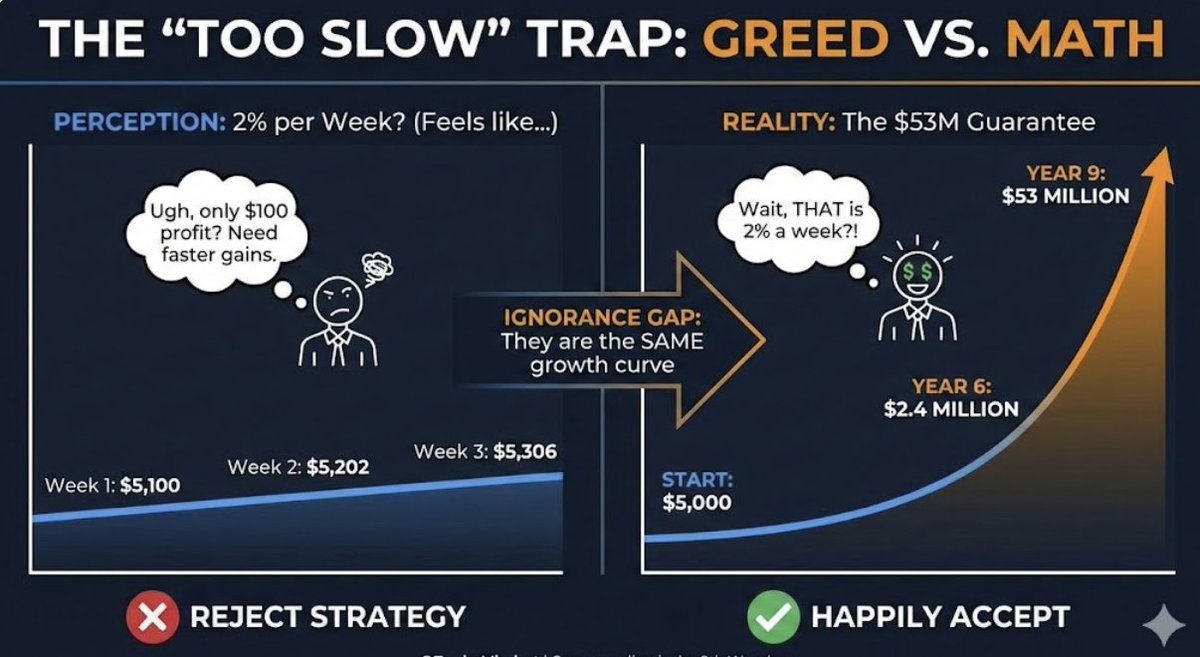
If you had a $5,000 trading account and a guarantee that it would be $2,400,000 in 6 years, and $53,000,000 in 9 years, would you accept the guarantee happily? Or would you think the growth is too slow, and look for something else to do with your money?
Second Question
If you had a $5,000 account and had a trading strategy that generated 2% a week, would you trade that system happily and diligently? Or would you think the growth is too slow, and look for a new trading strategy?
If you happily accepted the terms of the first question but rejected the second, your problem is ignorance. 2% per week with a $5,000 trading account is the same thing as a $53,000,000 return in 9 years.
Most of you would instantly accept the 2% per week strategy when it's framed with the end result of $53,000,000 in 9 years, but would reject a strategy that sustained 2% per week, with a small account if its framed as a weekly result.
Here is the problem: You don’t get to choose what edges exist in the market, and a 2% per week edge puts you in the company of the best traders to ever live, yet many people would reject it as "too slow". If you consider having a trading strategy that puts you among the best traders to ever live as "too slow", that is by definition ignorance.
14
22
337
31,918