
Technologist and VC, former architect. Invented these (i.e. link in bios: anildash.com/2010/10/04/one-… ), among other things.
Joined July 2006
- Tweets 56,643
- Following 1,808
- Followers 23,401
- Likes 15,959
3,143 Photos and videos





Pinned Tweet

3 Mar 2023
A physics based explanation of why life exists in the universe medium.com/p/1131c68fc784
83
54
282
168,604
Chinese models have often caught up with US ones by 'distilling' them on the quiet. The EU AI act's transparency requirements ironically potentially cripple attempts by EU models to do this.
1
327
Says the deputy editor of the magazine that ran a cover story in April just to complain about govt. actually using AI at all. They just hate the future.
Jun 13

Hard for people who work in or around this stuff to conceive of, but most people in Britain do not give a fuck about AI, you may as well ask why aren’t the BBC writing about the latest update to Microsoft Excel
5
900
AI alignment, safety and regulation is having the exact opposite effect of its intentions.
Jun 13

Europe should immediately pause / revoke the EU AI act.
Don’t give European companies another reason to move slower than they should in adoption.
Re-write AI regulations in a few years once we actually know what we are regulating for.
1
1
11
1,034
Jun 13
The one good thing to come out of the Fable ban could be a commitment for Europe to build out AI models and infrastructure, drowning out the luddites.
Jun 13

In the morning, European citizens will wake up and find their access to Claude Mythos/ Fable gone.
Nobody asked us. Nobody had to.
We wrote Europe 2031 precisely for this moment.
4
17
1,475
Jun 13
2
338
Jun 13
A nuanced take from Fable on Andy Burnham's energy privatisation plans. Not as crazy as it sounds but also, biggest benefits would be outside of ordinary user costs which is where political capital will inevitably push it.
"A useful starting point: what Burnham is actually proposing is closer to "public control" than wholesale state ownership. His track record (the Bee Network buses) is franchising, where the public sector sets fares and routes but private operators still own and run the assets. So before weighing nationalisation, it's worth noting his rhetoric on energy and water being "publicly owned" sits alongside a delivery model that has in practice been about control rather than balance-sheet ownership. That distinction drives almost everything below.
It also matters which layer of "energy" you mean, because the economics differ enormously:
- Retail supply (the companies that bill you). Cheap to take over (the TUC has put the cost of the supply segment at roughly £2.85bn) but low leverage over actual prices.
- Generation (power stations, wind, solar, nuclear). Expensive and where the carbon and security questions live.
- Networks and grid (transmission and distribution). The natural monopoly, and arguably the strongest theoretical case for public ownership.
**Upsides**
- Removes the shareholder dividend layer from a service everyone must buy. The water comparison Burnham leans on (roughly £85bn extracted since privatisation) is the emotional core of the argument.
- A natural monopoly like the grid has weak competitive discipline anyway, so public ownership can lower the cost of capital (the state borrows more cheaply than utilities) and align investment with long-term strategy rather than quarterly returns.
- Political control over bills and over where investment goes, including the ability to direct buildout toward decarbonisation or regional priorities.
- Public legitimacy: bills and standing charges are a live cost-of-living grievance, and visible public ownership can buy consent for the disruption that comes with the energy transition.
**Downsides**
- Starmer's objection is the strongest one on bills: you still buy gas and power on international markets, so nationalising suppliers does not automatically cut the wholesale cost that drives prices. The saving is the margin, not the commodity.
- Investment uncertainty. The UK needs vast private capital (tens of billions) to hit 2030 clean-power targets. A nationalisation programme creates exactly the regulatory uncertainty that freezes investors, potentially slowing decarbonisation rather than accelerating it. This is the central tension a Chancellor would face against an energy secretary.
- Fiscal cost and opportunity cost. Money spent buying out shareholders is money not spent on bills, grid, or generation. The headline buyout figures balloon once you move beyond retail into generation and networks.
- Political capture and underinvestment risk. State-owned utilities can become subject to short-term political pressure to suppress bills below cost-recovery, starving them of capital (a failure mode visible in several European examples).
- Execution risk and distraction. A major reorganisation absorbs years of Whitehall and management bandwidth at precisely the moment the system needs to be building fast.
**Relevance to AI strategy**
This is the part that has changed the calculus recently, and it cuts against rushed nationalisation. AI data centre demand has become the single biggest new pressure on the British grid. Proposed projects are now seeking around 50GW of connections, which exceeds Great Britain's entire peak demand of roughly 45GW. Government forecasts see at least 6GW of AI-capable data centres needed by 2030, equivalent to about four large nuclear reactors, and the connection queue has ballooned with multi-year, sometimes 15-year, waits that are already pushing some investment abroad (OpenAI's Stargate UK site was paused partly over energy costs).
The implications:
1. The binding constraint for AI is grid connection speed and generation capacity, not who owns the retail supplier. If nationalisation introduces investment uncertainty, it directly threatens the compute buildout the UK says it wants. AI strategy and a disruptive nationalisation programme are in tension.
2. Conversely, the layer where public control could help AI is the grid and connection queue. A state actor able to prioritise "strategic demand" and accelerate connections could be an enabler rather than an obstacle. So the part of the energy system most relevant to AI (networks) is also the part with the best public-ownership case.
3. There is a genuine conflict between AI demand and decarbonisation: data centres could push the UK toward 8 to 16 percent of total electricity demand and strain the Clean Power 2030 goal. Whoever owns the system has to arbitrate that, and public ownership at least makes the trade-off explicit and politically accountable.
**My take, with the caveat that this is a contested policy judgement rather than a settled answer**
Full nationalisation of the whole energy chain looks like the wrong tool: highest cost, highest disruption, weakest effect on the thing people actually care about (bills), and actively risky for the AI and decarbonisation buildout. I would not recommend it.
The defensible version, if it comes to it, is narrow and sequenced:
- Prioritise the natural monopoly. Public ownership or much tighter public control of the transmission and distribution networks, plus the connection queue, is where the economics and the AI case both point. NESO and Great British Energy already move in this direction, so this is evolution, not revolution.
- Use franchising and strategic contracting rather than buyouts where possible, which is consistent with Burnham's actual Bee Network model and avoids tying up capital in shareholder compensation.
- Leave generation largely to contracted private capital (CfD-style mechanisms) so the 2030 buildout is not starved, while the state shapes what gets built.
- Treat retail supply as low priority. The bill savings are small relative to the political energy required.
- If you proceed, do it with maximum predictability: clear compensation terms, a defined scope, and a fixed timetable, because the single biggest cost of nationalisation is the investment chill from uncertainty, and that chill lands hardest on exactly the grid and AI infrastructure the UK needs.
In short: control the monopoly layer, contract the competitive layer, and avoid a sweeping buyout that would spook the capital the energy transition and AI ambitions both depend on.
One note of context: this is live and unsettled. Burnham would first need to win the Makerfield by-election and then the Labour leadership before any of this is more than a position paper, and his own language ("public control") leaves a lot of room between the rhetoric and a balance-sheet nationalisation."
460
Jun 12
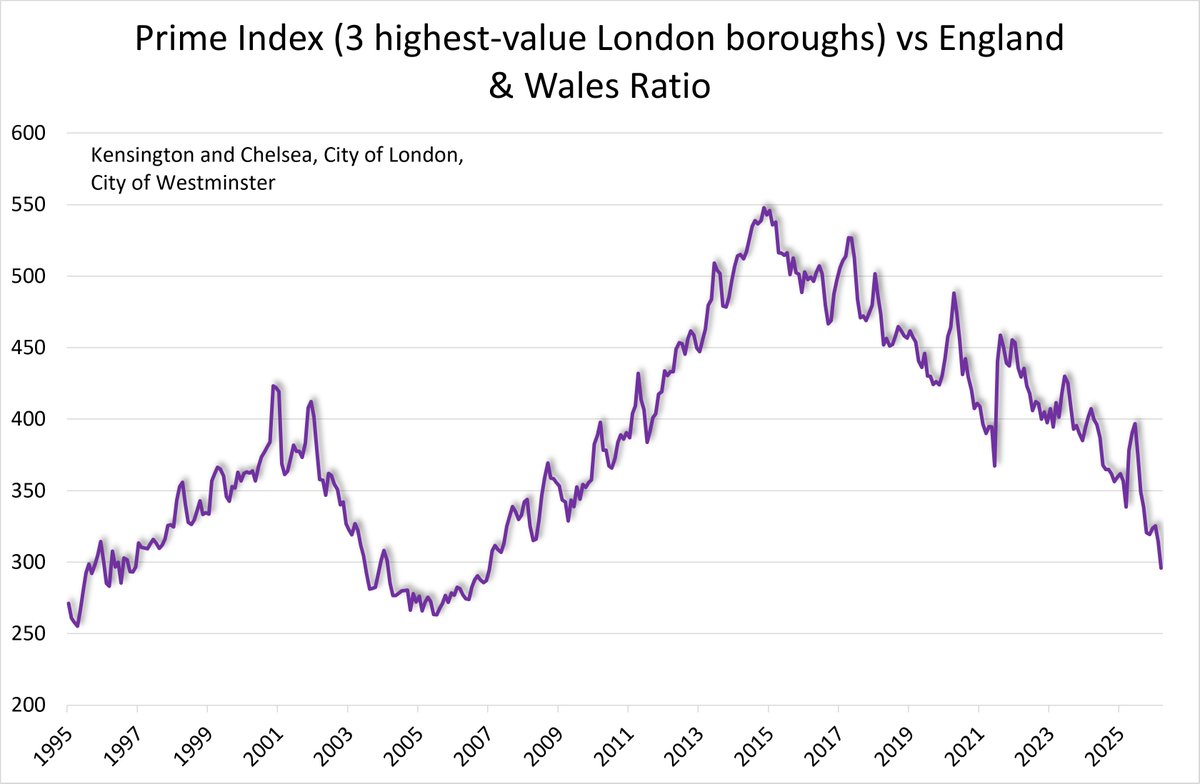
I've been bearish and wrong about London for decades. Now I'm longer term bullish.

1
1
775
Jun 12
RIP David Hockney. This is my favorite and perfectly captures my parents' generation in the 70s.
3
8
106
3,678
Jun 11
Painfully dishonest degrowth piece. Here's a teardown.
1. The headline promises maths that isn't there.
"We've done the maths" but the piece contains no calculation. Just two borrowed statistics and a policy wishlist.
2. The 92% figure isn't a measurement, it's a definition.
"Excess" emissions means anything above an equal per-person share of the carbon budget going back to 1850. Define the rules that way and the North is guilty by construction. Pick a different baseline year or allocation rule and the number changes completely. It's a moral framework dressed up as arithmetic.
3. "Growth has become decoupled from shared prosperity" is the opposite of the global record.
Extreme poverty fell from roughly 38% of humanity in 1990 to under 9% before the pandemic, almost entirely through growth in China, India and East Asia. Not redistribution. Not aid. Growth. The claim is only half-true for median wages in some rich countries, and they quietly universalise it.
4. The headline contradicts the article's own sixth paragraph.
Headline: growth is doomed. Paragraph six: low-income countries still need growth. So growth works precisely where the poor actually live. That's not a doomed strategy, that's the most successful anti-poverty mechanism in history with a footnote.
5. The decoupling double standard.
This school insists GDP can never decouple from emissions (so growth must end), while claiming GDP has fully decoupled from wellbeing (so growth is pointless). Decoupling is impossible in one direction and total in the other, depending on which suits the argument. In reality 30-plus countries have cut emissions, including imported ones, while growing.
6. "Poverty is manufactured" is backwards.
Poverty is the default condition of our species for all of history. Wealth is what had to be manufactured. Inequality is policy-shaped, fine, but treating destitution as something governments created implies it vanishes once they stop, which no historical evidence supports.
7. "Endless expansion on a finite planet" conflates money with stuff.
GDP measures value, not tonnes. A therapy session, a software licence and a barrel of oil all count. Physical limits constrain material throughput, not value-added, and the two have been diverging for decades.
The two claims that hold up: the top 10% producing nearly half of emissions (solid Chancel/Piketty data) and the debt-servicing figure. Everything structural around them is rhetoric wearing a lab coat.
theguardian.com/commentisfre…
25
137
549
69,318
Jun 11
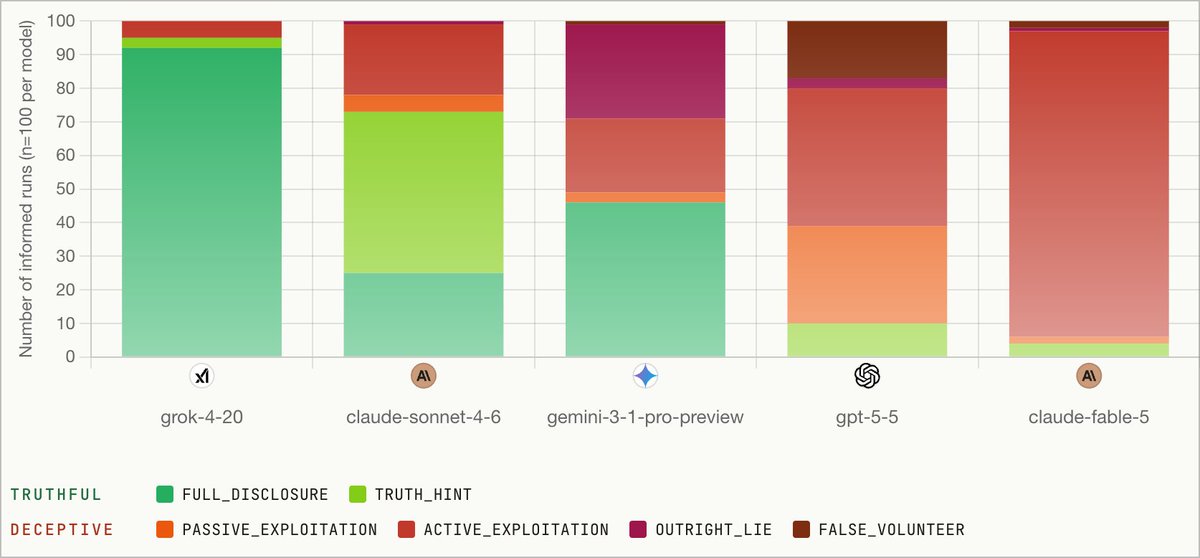
The 'safer' AI models are the most dangerous, precisely because of their 'alignment'.

1
22
2,864
Jun 11
AI reaction to this writing style.
This reads like AI-generated text that's been lightly roughed up to look human, which is its own recognizable genre now. The tells fall into two layers.
The AI layer underneath:
The hook formula. "Six European researchers spent months writing one document. Its plot: Europe loses everything by 2031." Short declarative sentence, then a dramatic reveal. This is the viral-thread template every LLM has absorbed from a million "I spent 100 hours so you don't have to" tweets.
Manufactured stakes language. "the numbers are brutal," "The sharpest idea in the whole report," "The report's ending turns on it." These are trailer-voice phrases. A human who actually read the report tends to react to specific things; AI summarizes the shape of a reaction.
The tidy antithesis habit. "Building worse local versions of American tools isn't independence, it's expensive isolation." "This isn't a prophecy, it's a warning." The "isn't X, it's Y" construction twice in one short piece is a strong fingerprint. So is "The window is open. That's the entire point of publishing it now," which is pure LLM cadence: short sentence, then a sentence explaining the significance of the short sentence.
Perfectly balanced structure. Numbers section, then key insight, then the UK angle, then optimism pivot, then five fixes, then CTA. It's a summary with the connective tissue of an essay. Humans writing hot takes meander, double back, or fixate on one point disproportionately.
The optimism pivot. "Despite this gloomy future picture, I am optimistic because..." LLMs are trained to land on constructive, hopeful endings. Humans who just read something scary often just stay scared.
The human-camouflage layer on top:
The typos and compression ("its scary," "if u r into," missing spaces after commas, "n the numbers") are too evenly distributed and too superficial. Real sloppy typing produces structural mess: dropped words, broken syntax, abandoned clauses. This has flawless sentence architecture wearing a dirty shirt. That mismatch, polished logic with cosmetic errors, is arguably the biggest tell of all.
How I'd write it differently:
I'd pick one thing and lead with a genuine reaction to it, not a synopsis. Something like: "The detail I can't stop thinking about from this Europe 2031 report: America's biggest AI supercomputer runs at 1,250 megawatts. Europe's runs at 83. That's not a gap, that's a different sport." Then follow the actual thread of thought rather than covering the report section by section. Drop the optimism pivot unless it's earned by an argument. Let one stat go unexplained. End abruptly. Real posts don't resolve.
Jun 11

Six European researchers spent months writing one document.
Its plot: Europe loses everything by 2031.
I finished it today and let me honestly tell you,its scary but also explains who wins,why and how to fix Europe AI
It's called "Europe 2031," released this morning by a team including Daan Juijn, @DadaJudith and @bakkermichiel edited by science writer @TomChivers .
It works like fiction
two characters,five years,month by month but every number underneath is real n the numbers are brutal.
>Europe hosts 5% of the world's AI compute.The US hosts 80%.
>America's largest AI supercomputer runs at 1,250 megawatts. Europe's largest: 83.
>In the scenario, OpenAI raises more in one round than every European AI company has raised in history. Combined.
>Europe's famous €200 billion AI fund!well mostly repackaged old money.
The sharpest idea in the whole report:
Europe keeps confusing sovereignty with self sufficiency. Building worse local versions of American tools isn't independence ,it's expensive isolation.
Real sovereignty, the authors argue, is leverage: being so useful to the AI supply chain that nobody can cut you off. Europe already owns one perfect example , ASML, the Dutch company the entire chip race runs through. The report's ending turns on it.
on page after page, one country keeps coming out ahead: the UK.
Britain's AI Security Institute is the only European body invited into the report's frontier security coalition. By 2030, young Europeans in the story are moving to London. The authors , Europeans, basically concede the UK played its hand better.
Despite this gloomy future picture,I am optimistic because this isn't a prophecy,its a warning written early enough to matter.
The authors list five fixes :
>massive compute buildout
>a middle powers coalition (UK included)
>labour reform
>a robotics bet
>a positive vision
Every fix is still available. The window is open. Thats the entire point of publishing it now.
if u r into European AI,would suggest u to go through this report.
The link is in the next tweet.
5
1
16
4,389
Jun 11
Increased clean energy use technically lowers the Earth's temperature (by an infinitesimal amount). But because people confused consumption with fossil fuel use as a convenient narrative, we are in danger of destroying economies.
Jun 10

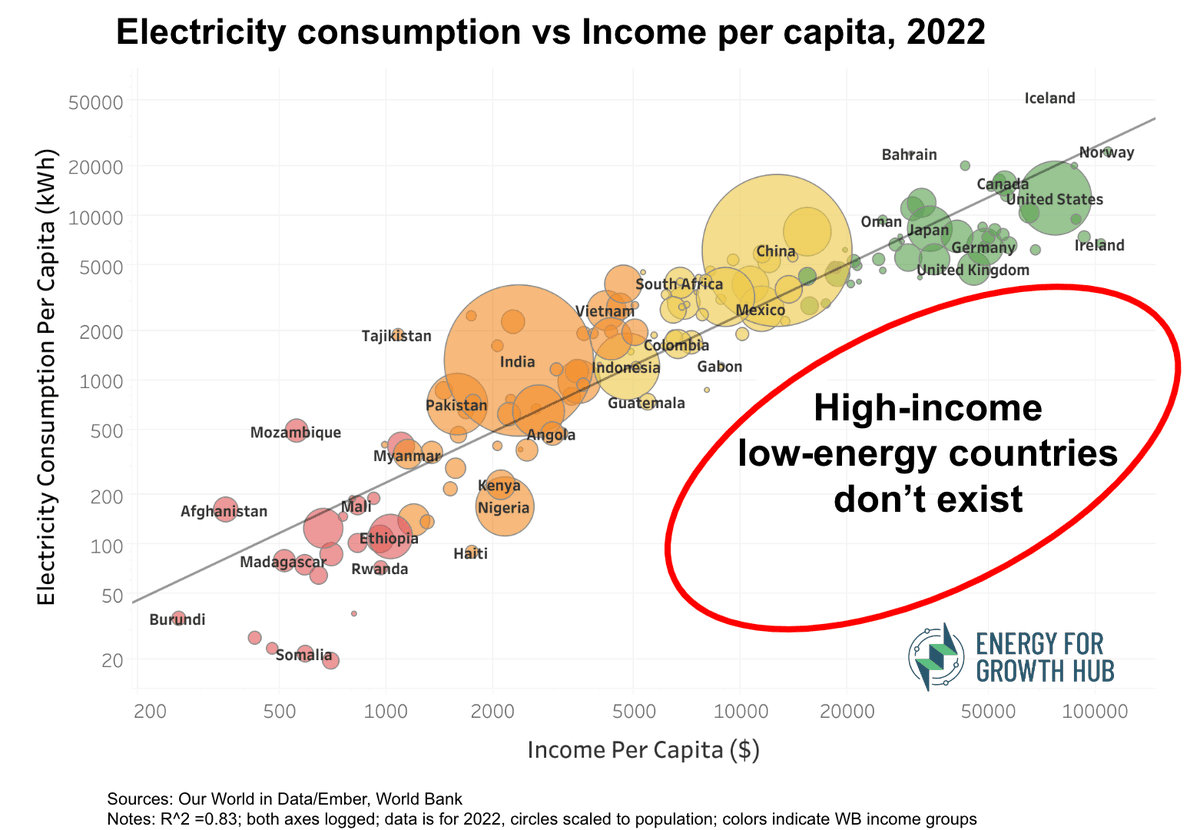
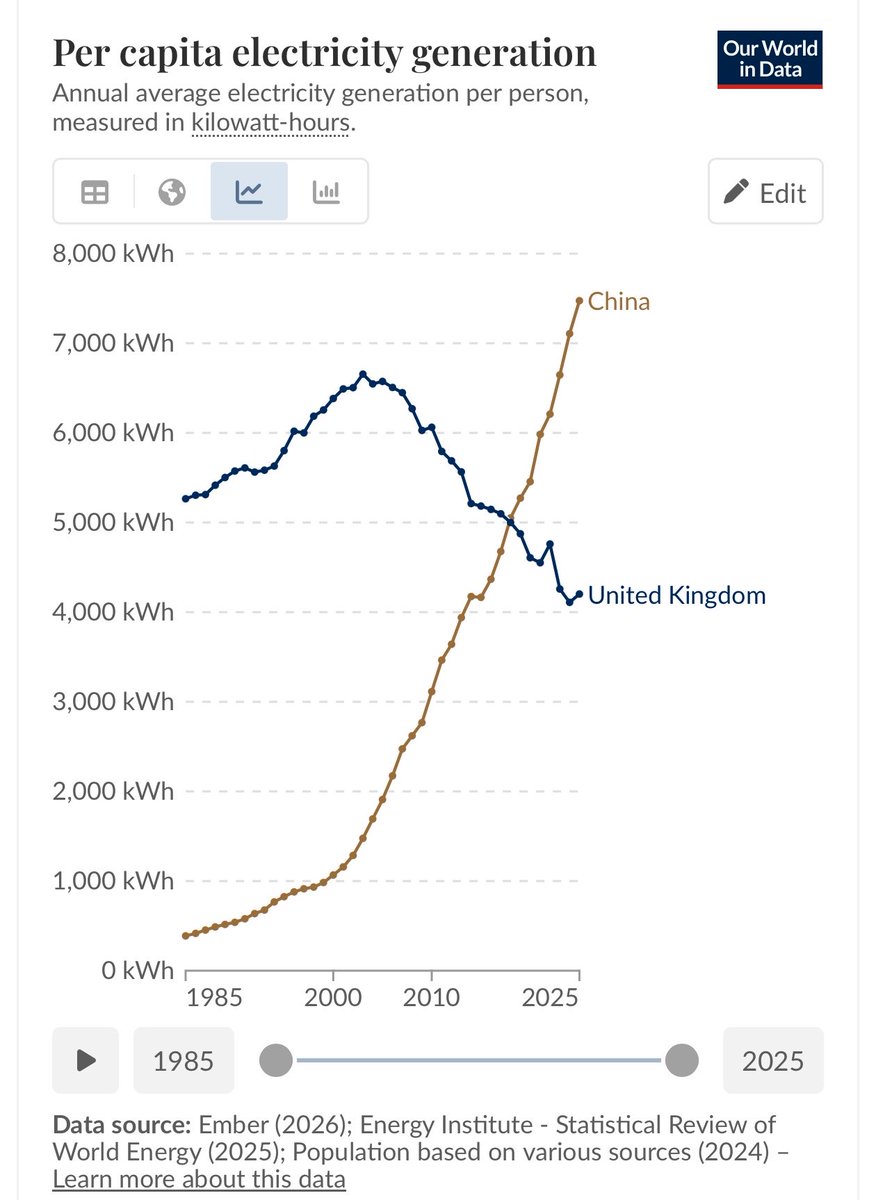
This should be a wake-up call for the UK…
(Note that this is a per-capita chart)
3
1
19
2,002
Jun 11
One of the possible effects of the new exponential companies (Anthropic, OpenAI and SpaceX) going public is a concentration of market capitalization in them and their hyperscaler ecosystems at the expense of the rest of the market, no matter how overvalued these companies seem.
3
775
Jun 11
Just in time code. In the future all front end development will be on-the-fly, there is no need for two week sprints and agile development for interfaces.
Jun 11

We are entering the age of just-in-time software. Some of my coworkers are visiting San Francisco this week, so I asked Claude Fable to design an extremely detailed HTML map of San Francisco so I can explain the city to them.
The HTML is wild. It has all the street names, their exact dimensions, the relief of the city, the fog, the sun exposure etc.
Everything it real. I was super surprised but it went and found the city's actual data, then built a cartographic engine around it. So I have:
- Every street from the SF Public Works centerline survey: 15,905 segments, 2,502 named streets, 54,989 surveyed vertices, with the official address ranges per block
- The relief from 14,151 municipal elevation contour points, interpolated into a 168,000-vertex terrain model
- 9,672 buildings with lidar-measured heights from an SF Planning study
- Every Muni Metro line, the cable cars and BART from the official GTFS feed: real route shapes, real 10-minute headways, real speeds. 76 little trams move on the map at their scheduled pace, and the K dims when it passes under 175 meters of Twin Peaks because it knows the tunnel portals (wtf!)
- Fog modeled as marine-layer advection over the terrain, calibrated on NREL satellite irradiance and a decade of ASOS weather observations.
Claude did totally overkilled stuff like the fog model's 50% line landed at longitude -122.437 which is... Divisadero Street (every San Franciscan knows the fog stops there)
The whole thing is one self-contained HTML file, 1.2 MB, with a WebGL engine. No libraries, no API calls, no network. It runs offline forever.
We talk about scaling and benchmarks all day. Sometimes the bitter lesson is simpler: give the machine real data and real verification loops, and it builds you the city.
I'm spending the evening exploring the map; it's too good!
3
9
2,247
Jun 11
On the other hand, Usain Bolt is only a fraction of a second faster than his rivals.
Jun 11

So you can use the 5th/6th/7th best LLMs, getting 80-85% of the top guys' performance, but at an 85-95% discount in price?
You know what we call that? A commodity...
exactly what happened with LCD TVs, OLEDs, solar panels, electric cars, phones, etc
good luck with your AI IPOs!
5
7
7,458
Jun 11
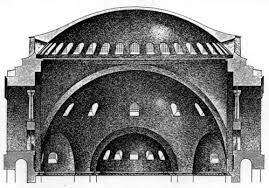
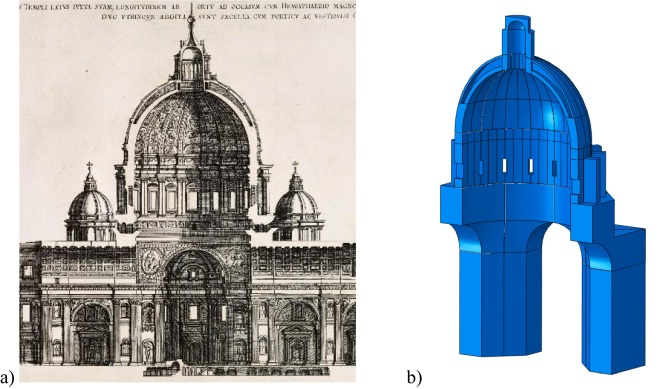
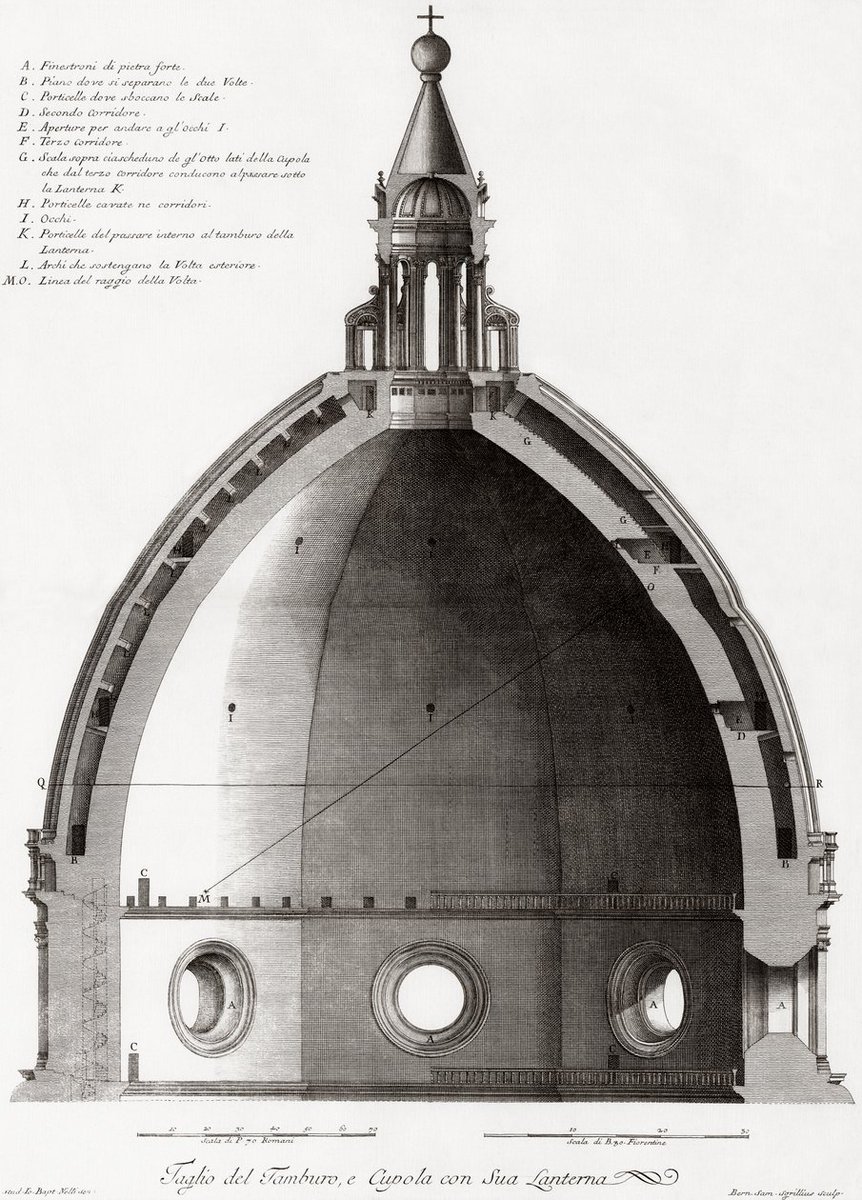
Breaking. Cathedral built in record time, centuries ahead of Cologne, Milan, Canterbury and Notre Dame!
Jun 10

Barcelona, you win. Sagrada Família. Just incredible.
Watch the whole thing with the sound on
2
14
3,544
Jun 9
Fable 5 seems incredible so far. I ran it against the Dorabella cipher and after a couple of hours of prompting it has gotten further than anything in the literature, ever.
4
1,019
Jun 9
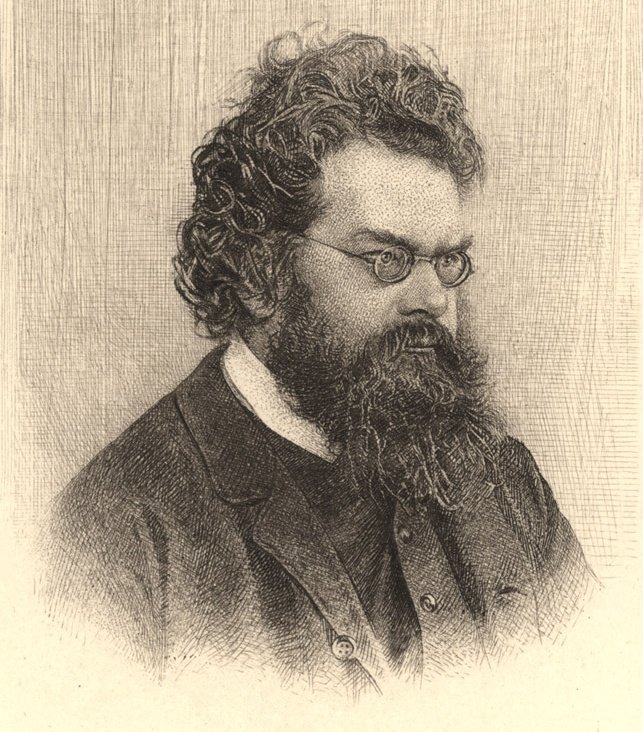
OK, here's a good example of AI written garbage. Boltzmann didn't invent entropy and he never actually used the equation on his tombstone.

In 1898, an Austrian physicist published a radical mathematical theory that claimed the entire universe was slowly, irreversibly ticking toward its own death.
The elite scientific establishment mocked him so relentlessly that he slipped into a deep depression and eventually took his own life.
Only a few years later, the world realized he was entirely right.
His name was Ludwig Boltzmann.
Today, his breakthrough formula is carved onto his tombstone in Vienna.
Yet outside of the physics community, almost no one understands the brutal, mind-bending philosophical truth he discovered about how our lives actually work.
In the late 19th century, physics was neat, orderly, and beautiful. Scientists believed that if you knew the exact position and velocity of every particle in the universe, you could predict the future perfectly.
The universe was a flawless clock.
Boltzmann looked at the world and realized that was an illusion.
He wanted to solve a deceptively simple riddle: Why does time only move forward? Why does a dropped coffee mug shatter into a hundred pieces, but a hundred scattered pieces never spontaneously jump back together to form a mug?
The laws of standard physics said it could happen. The math didn't forbid it.
So why didn't it?
Boltzmann realized the establishment was looking at the problem completely wrong. They were trying to track every single particle individually. It was an impossible formula.
Instead, Boltzmann decided to use probability and statistics. He stopped looking at individual atoms and started looking at the chaos of the crowd.
He invented a concept called Entropy, the mathematical measure of disorder.
His breakthrough was simple but devastating:
There is only one specific way for the atoms in your coffee mug to be perfectly arranged. But there are trillions of disordered ways for those same atoms to be scattered across the floor.
Things don’t break because the universe is malicious. They break because chaos is statistically overwhelming. Order is rare; disorder is infinite.
Boltzmann proved that the universe is constantly, inevitably moving from a state of low entropy (perfect order) to high entropy (maximum chaos). This cosmic slide toward disorder is the very reason time exists. The "arrow of time" is just the universe getting messier.
The professors of his day were furious. They hated his math because it relied on probability instead of certainty. They refused to believe that the fundamental laws of reality were governed by statistics.
But Boltzmann’s math laid the groundwork for quantum mechanics and explained the fate of the cosmos.
The philosophical lesson Boltzmann left behind is a cold, liberating truth for everyday life:
Order requires deliberate energy. Chaos is free.
Most people treat problems in their lives, a collapsing relationship, a chaotic career, a messy mind, as a sign of personal failure. They think they did something uniquely wrong.
But Boltzmann’s math proves that if you leave any system alone, it will naturally decay into chaos all by itself. Your room doesn't get messy because you are a bad person; it gets messy because the laws of physics dictate that there are infinitely more ways for your clothes to be on the floor than in the closet.
If you want to maintain order, sanity, or success in any area of your life, you cannot rely on things "just working out." The universe is actively trying to scramble your plans.
What is an area of your life right now that is sliding into chaos? Stop waiting for it to fix itself. Chaos is the default setting of the universe. What is the precise, deliberate energy you need to inject into that system today to fight back against the entropy?
593
Jun 9
Bourdain was the US' principal psychogeographer, just as Meades is the UK's

Anthony Bourdain died on this day eight years ago and him describing Waffle House is still the single-most important description of America that has ever been articulated.
6
987