
thirty-one. south florida is where u can find me.
Joined February 2012
- Tweets 5,577
- Following 596
- Followers 689
- Likes 844
236 Photos and videos










dan retweeted

Apr 30
When Dave Chappelle did a skit mocking me during BLM, I responded that I was flattered that he even knew my name.
When South Park did an episode mocking Charlie Kirk, he played it on repeat on his show.
Were Charlie alive and the subject of the Druski skit, he would have laughed.
Whether regarding Jimmy Kimmel, South Park, Chappelle or otherwise— any person attempting to criminalize jokes is the enemy of free speech.
Not one inch.
1,624
5,024
58,408
2,080,853
dan retweeted

Apr 29
PETE HEGSETH: “I don’t give a shit about the economic impact the Iran war has on Americans.”
Of course he doesn’t care. Hegseth doesn’t serve America or Americans; he serves the secular genocidal state of Israel.
1,497
13,095
57,458
1,466,488
dan retweeted

Apr 29
🚨 HOT MIC: Sen. Chuck Grassley (R-IA) was caught asking staff during questioning of Trump judicial nominees: “What would be wrong if they said Biden won?”
Multiple people in the room heard it. GOP staffers were reportedly panicking, according to sources familiar.
191
4,087
22,182
2,230,579

The deal that trump ripped up. Almost feels like it was all part of whatever sick plan he has is. I feel like it’s a bucket list item for him. This all also could still be about the damn peace prize. If he can take credit for ending this war, and reinstating the peace deal — just prepare yourself for gaslighting— how he ended it all and came to an agreement like no other — reinstating peace in the Middle East. The narrative that this was a continuation and conclusion of a 47 year old conflict will be the only acceptable one, and claiming trump started this on behalf of Israel will probably get you sued by Trump, maybe killed by the IDF.
Mar 30

Quick question. What stops Iran from developing nuclear weapons now?
1
52
Honestly this whole thing with Iran probably began because Trump always wanted to be president during wartime and get to live out some sick fantasy he had of what it meant to be President. People are dying and he is literally the time of his life, golfing, parties, dragging it out. He only pretends to want to end it to influence the markets when we complain too loudly about gas. youtu.be/AIQyJTEmeWw
40
The fact that the world is literally burning and this is what is trending on this app just shows you this app is useless.

Who is the left gonna hate when Trump is gone?
15
Can we circle back on something that happened and then we haven't heard anything since?
> Kristi Noem, UNDER OATH, testifies that the President WAS AWARE AND OKAY with the 140m no-bid contract details.
> Trump denies knowledge. Noem immediately gone.
The end?
No. If Noem is lying, she committed perjury & implicated Trump. She danced around everything else to avoid perjury, including the affair, but says she got APPROVAL from the President to commit or conspire to commit fraud with our money, essentially implicating him.
LEGALLY only 1 thing can be true: Noem guilty of perjury OR Trump implicated in massive fraud.
So Noem disappears, and we never hear about it again...
There is no way to spin it, don't even attempt to, these are the only options.
Noem getting away with perjury or the President was involved in the very well documented fraud.
12
dan retweeted

24 Jun 2025
With events moving quickly, I want to preview our study on battle damage coming out later today, here are some takeaways.
1) Overall, Israel's and U.S. attacks have effectively destroyed Iran’s centrifuge enrichment program. It will be a long time before Iran comes anywhere near the capability it had before the attack.
2) That being said there are residuals such as stocks of 60 percent, 20 percent, and 3-5 percent enriched uranium and the centrifuges manufactured but not yet installed at Natanz or Fordow. These non-destroyed parts pose a threat as they can be used in the future to produce weapon-grade uranium.
3) Complicating any effort to turn weapon-grade uranium into nuclear explosives have been extensive attacks against Iran’s facilities and personnel that would make the nuclear weapon itself. Iran’s infrastructure to build the nuclear weapon has been severely damaged. The time Iran would need to build even a non-missile deliverable nuclear weapon has increased significantly.
What to do?
1) Israeli intelligence would be expected to continue hunting in Iran, even under the ceasefire, for non-destroyed residuals, such as nuclear materials, centrifuges, and nuclear weapon manufacturing capabilities.
2) Any U.S. agreement with Iran should address these residuals by negotiating an end to Iran’s enrichment program, as President Trump has stated, in a verifiable manner. As part of that deal, Iran must also give up its enriched uranium stocks and destroy its remaining centrifuges. The IAEA can verify this. An agreement should also require Iran to dismantle its capabilities to make nuclear weapons. The IAEA can verify all this as well.
Any agreement should be cast as a ceasefire agreement; violations can lead to prompt Israeli attacks and in rare cases a U.S. response.
50
327
988
259,719



So, advocating for someone to drive into a crowd is okay, but parodical comedy is despicable?
12
dan retweeted

Mar 10
That’s actually very heartwarming. Yglesias tried to dunk on the idea of being heartbroken by this horrible moment…and the internet was like, wtf, ratio, why are you such a sociopathic ghoul? Nice to see empathy win out once in a while.
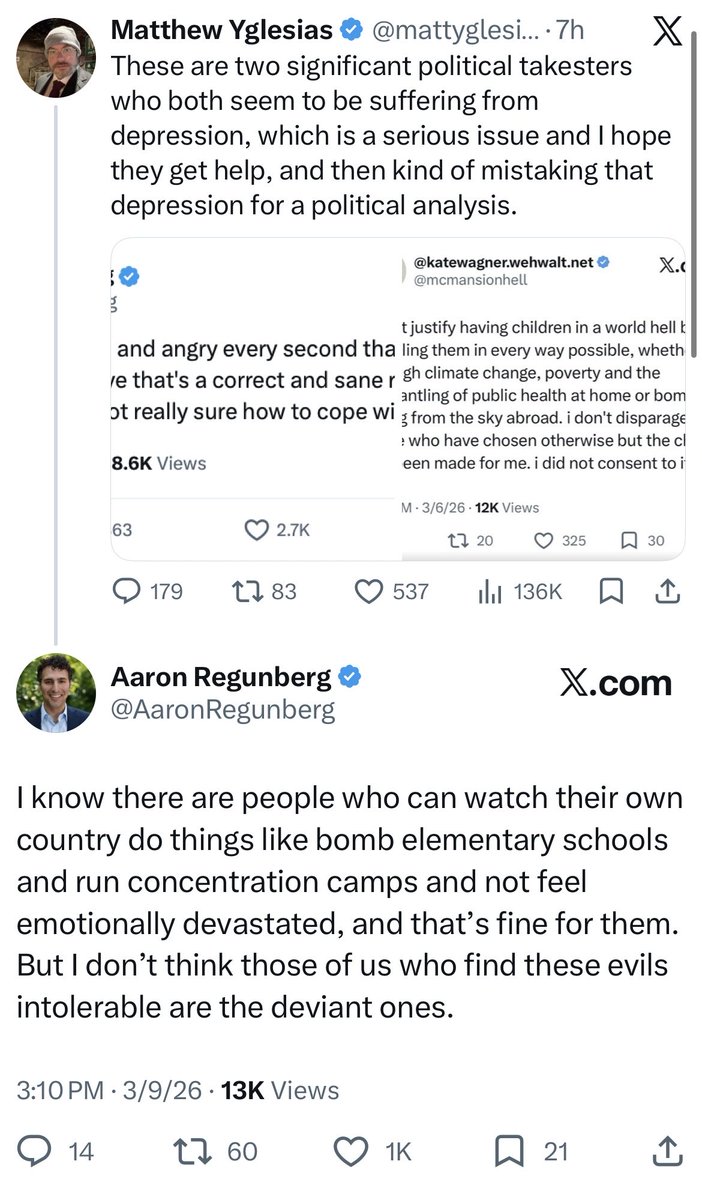
6
26
576
14,062
dan retweeted

Mar 9
Piers Morgan cooked Ben Shapiro.
"One thing he doesn't criticise, however, is Israel, and he routinely gets very upset when other people do. It's such a blind spot for Ben that through the red mist of his rage, he sees an alternate reality.. everyone is demonic."
176
1,182
12,345
623,439
dan retweeted

Q: “How long should Americans be prepared for this war to last?”
Trump: “The big risk on that war has been over for 3 days… The rest is going to be a determination as to my attitude…”
So, we’re killing children based on his MOOD. Such stupidity.
103
966
4,507
77,940
dan retweeted
Mar 9
The Iranians are saying that any Arab or European country that expels the ambassadors of Israel and the United States from its territory will, starting from tomorrow have full authority and freedom to pass through the Strait of Hormuz.
211
2,356
15,608
693,138
dan retweeted

We got a call yesterday from a spouse of a sailor deployed overseas. Her husband told her that once the news broke of the U.S. being responsible for the massacre at the girls school, they shut down all news & social media access on the ship.
340
12,060
55,635
1,364,705