
A research-driven firm dedicated to making crypto happen sooner and better than it would without us.
Joined September 2018
- Tweets 11,671
- Following 999
- Followers 705,177
- Likes 9,373
4,031 Photos and videos










Pinned Tweet
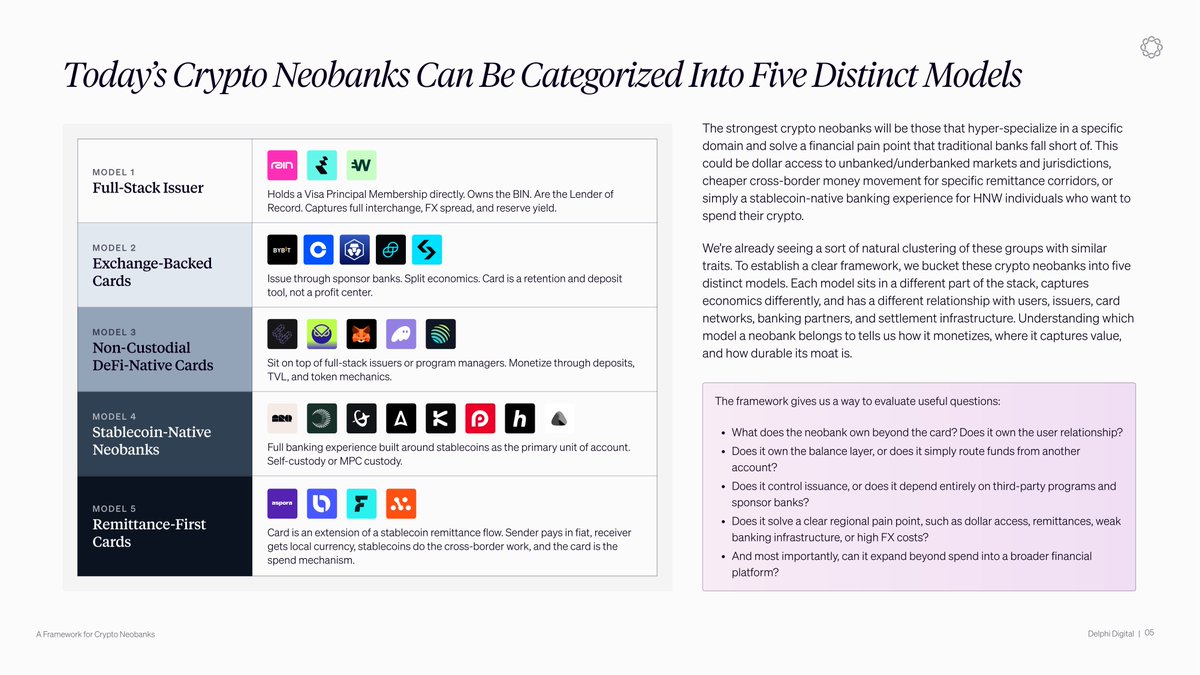
Our report "A Framework For Crypto Neobanks" is now live!
Stablecoin payment infrastructure is inevitable but the crypto companies built for it may not be.
The category has fragmented into five distinct models that each occupy a different layer of the stack. The survivors will either own infrastructure, own distribution, or specialize in markets traditional banks fail to serve.
Rain and RedotPay are early proof of both paths. Rain holds a Visa principal membership and sells issuance infrastructure to other crypto apps. RedotPay focuses on emerging markets where dollar access is the actual product.
Across 190 tracked crypto card programs, Rain and RedotPay account for roughly 90% of observed onchain volume while everyone else is fighting over the remainder.
Then there's the settlement layer. Visa's stablecoin settlement pilot has hit a $7B annualized run rate across nine chains. Mastercard is moving in the same direction with expanded stablecoin settlement capabilities. The incumbents are extending downward into it before a parallel rail can form outside their networks.
The most likely path is not a clean victory for either side. Incumbents will adopt stablecoin rails. A select few crypto companies will still command the volume. The technology can win while most of the companies fall behind.
20
14
89
30,709
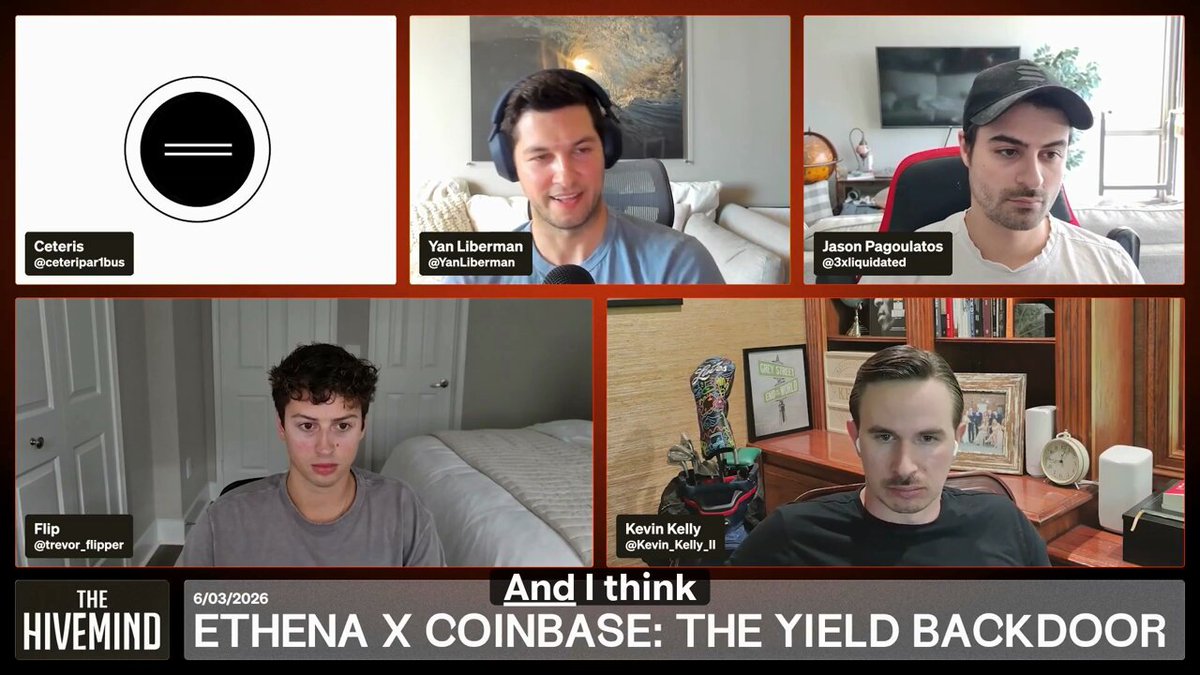
Jason explains why Lighter’s early token performance may be misleading.
"Lighter obviously has a decent business. They have a decent roadmap... they just happened to TGE a month and a half after 10/10."
3
7
2,119
Delphi Digital retweeted
Our report "A Framework For Crypto Neobanks" is now live!
Stablecoin payment infrastructure is inevitable but the crypto companies built for it may not be.
The category has fragmented into five distinct models that each occupy a different layer of the stack. The survivors will either own infrastructure, own distribution, or specialize in markets traditional banks fail to serve.
Rain and RedotPay are early proof of both paths. Rain holds a Visa principal membership and sells issuance infrastructure to other crypto apps. RedotPay focuses on emerging markets where dollar access is the actual product.
Across 190 tracked crypto card programs, Rain and RedotPay account for roughly 90% of observed onchain volume while everyone else is fighting over the remainder.
Then there's the settlement layer. Visa's stablecoin settlement pilot has hit a $7B annualized run rate across nine chains. Mastercard is moving in the same direction with expanded stablecoin settlement capabilities. The incumbents are extending downward into it before a parallel rail can form outside their networks.
The most likely path is not a clean victory for either side. Incumbents will adopt stablecoin rails. A select few crypto companies will still command the volume. The technology can win while most of the companies fall behind.
20
14
89
30,709
Muhammad explains why industry could be the first proving ground for machine payments.
“Where it could get interesting with agentic or machine payments is at the intersection of robots and crypto rails... given that the labs themselves are autonomous, this is where machine payments could be an interesting use case.”
3
2
5
4,210
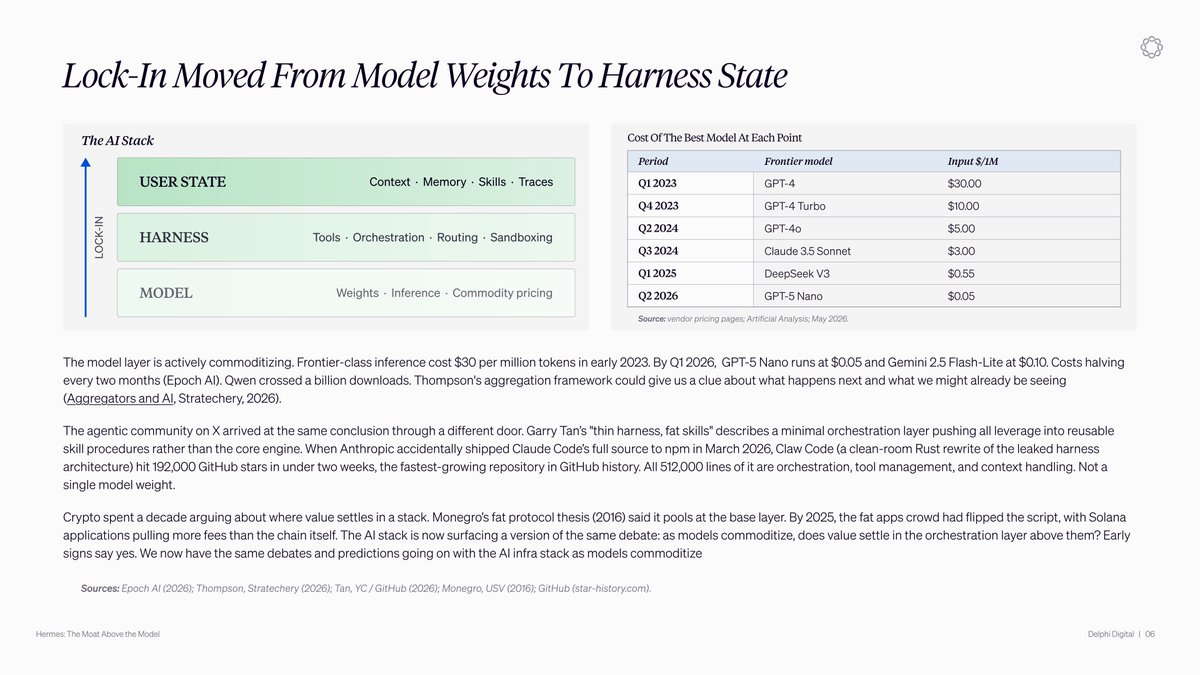
Read the Hermes report for free here.
delphi.link/Hermes
2
2,962
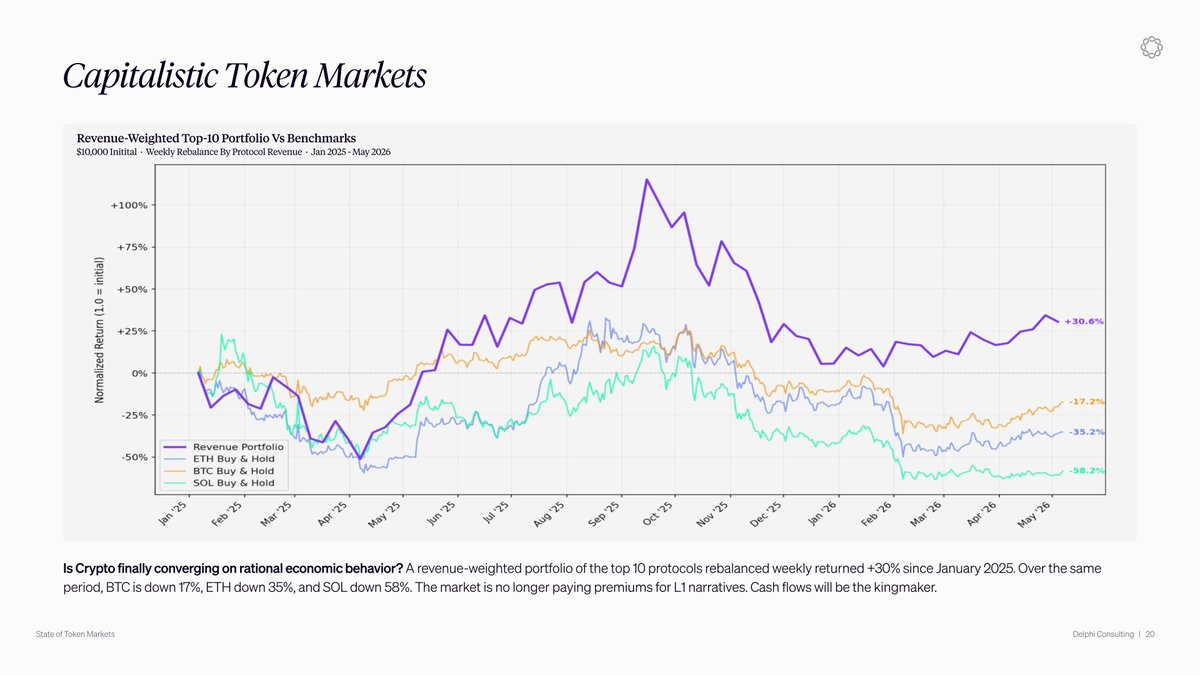
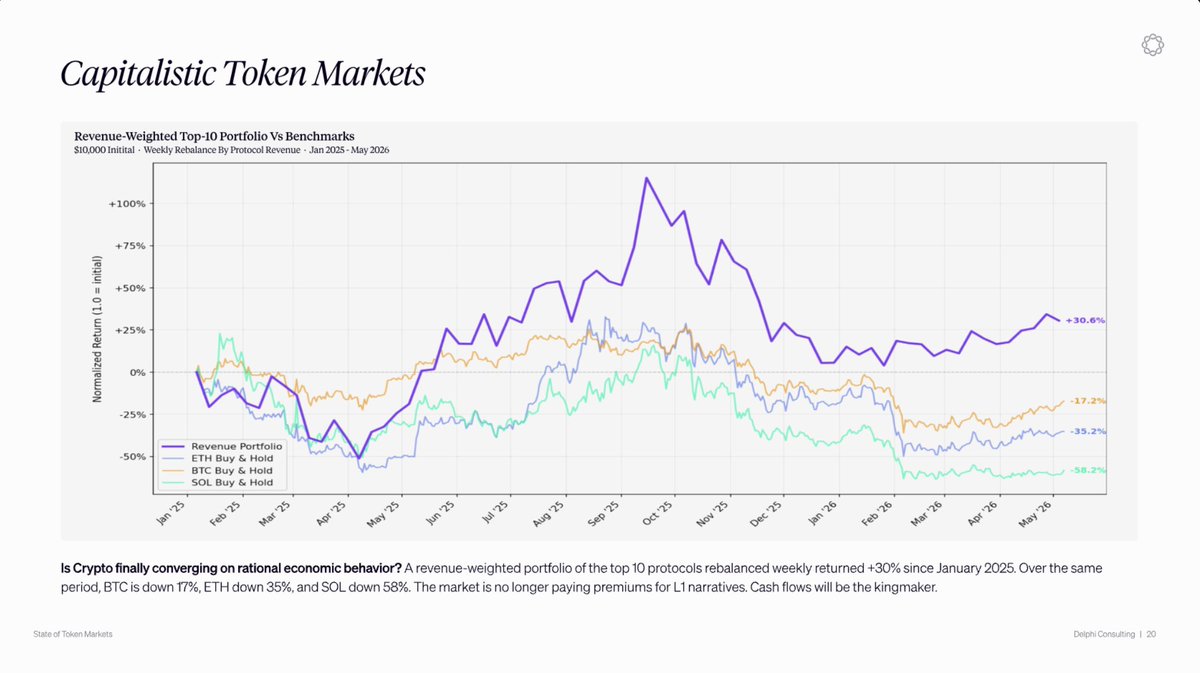
Cash flow is starting to matter more than narratives.
Even in a market that rewarded short-term rotation, the strongest signal among outperformers was still revenue.
However, this shift only matters if projects also fix the supply side. Buybacks are not enough when unlocks and emissions add more supply than demand can absorb. Revenue only translates into value accrual when supply is disciplined.
The business model is starting to matter more than narrative.
11h

A couple of weeks ago, @Delphi_Digital published our state of token markets report. Putting it together took months of digging through data to diagnose what was happening in token markets.
For the first time in a while, we see the path forward for tokens as an asset class and couldn’t be more excited to play a driving role in manifesting this into reality via Delphi Consulting
Here are some of my favorite slides from the report:
(1) 2024-25 saw a raging bull market, but a fickle one. Most Investors who made medium-to-long term conviction bets ended up on the wrong side of the market. The market participant cohort that won the most were traders that rotated from coin to coin with little conviction.
(2) The most positive sign out of this cycle is that the top performers have been tokens with real revenue and cash flow. It’s too early to call for the death of narrative-centric token performance, but the market is very clearly moving into a regime of real capitalism, where revenue speaks the loudest.
Narrative-centric token appreciation is short lived and often ends with a drawdown just as violent as the swing up. It becomes obvious that tokens whose platform consistently generates meaningful revenue will win over the longer term. The short-term narrative pumps aren’t going anywhere. In fact, they’ve permeated equities and commodities too. But it’s obvious that these are trades and not multi year holds.
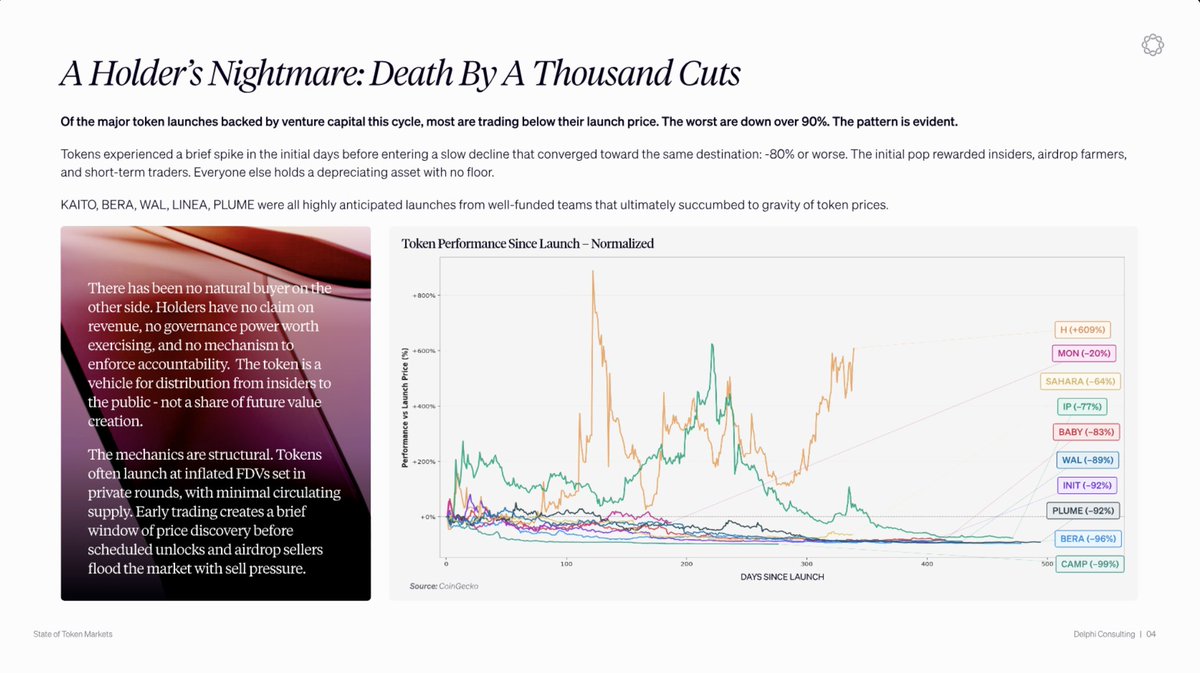
(3) The core issue plaguing token markets are emissions and the way they come online. This should be no surprise to anyone. Tokens with upcoming emissions almost always get punished, especially when there are no real catalysts on the horizon.
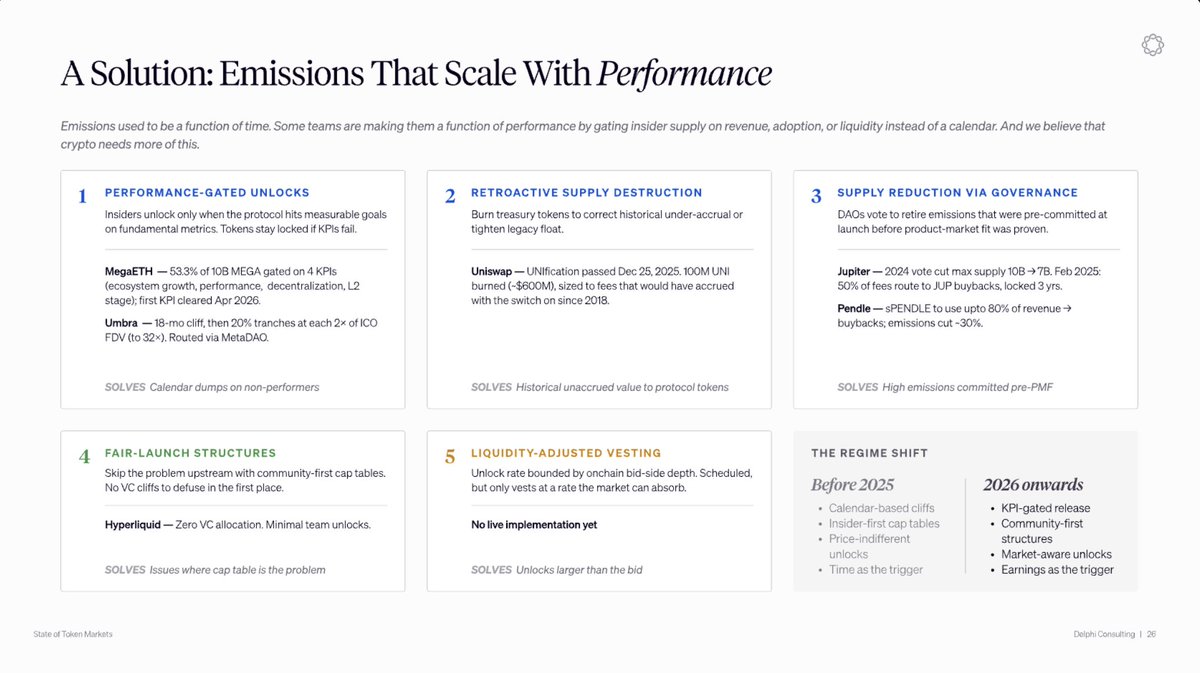
There are a number of creative solutions to mitigate this problem. Performance and liquidity gated vesting are the most powerful, whereas retroactive supply destructions are more posturing than genuine market impact. And tinkering with this is the single most important thing we can do around token markets.
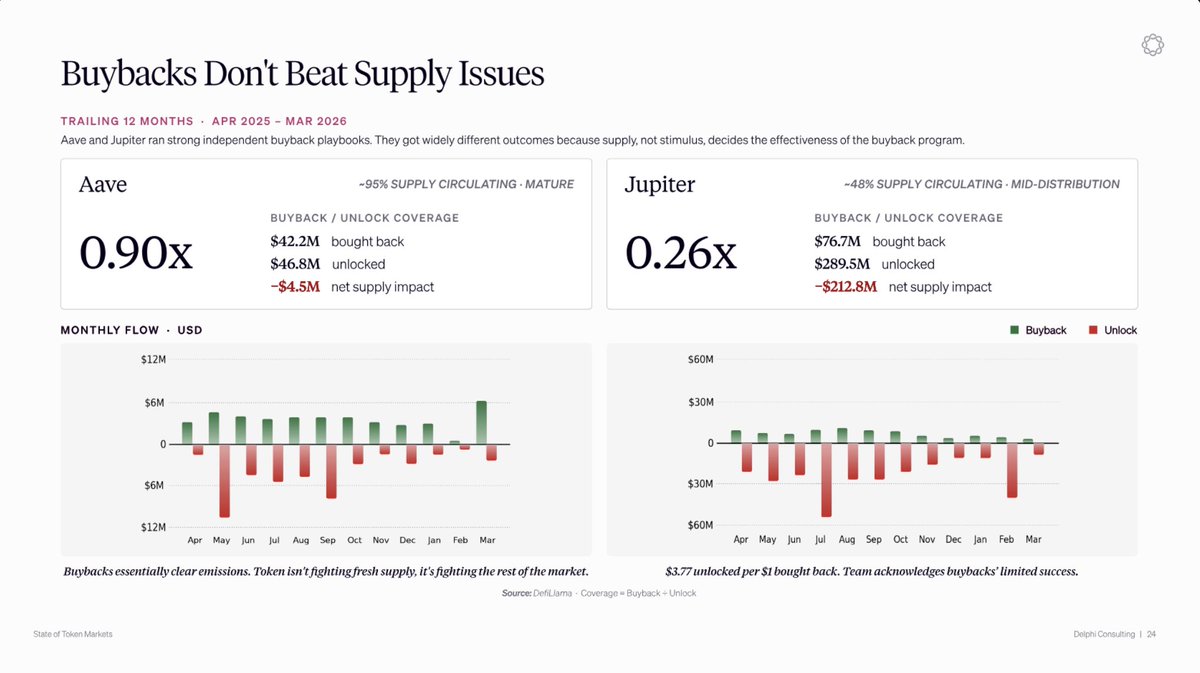
(4) Buybacks are now the gold standard in value accrual, but buybacks alone aren’t enough. If supply gets diluted at a rate higher than buybacks take supply off the market, the token’s price still suffers.
So the real solution is two pronged: as a project, you must both make a meaningful amount of revenue and allow that revenue to really have an impact on the market (by minimizing supply overhangs).
The era of the crypto vibe market is coming to a close. Your business model will be more important than your narrative. And we're already seeing signs that the market will close this loop sooner than most expect.
2
5
16
4,387
Our report "A Framework For Crypto Neobanks" is now live!
Stablecoin payment infrastructure is inevitable but the crypto companies built for it may not be.
The category has fragmented into five distinct models that each occupy a different layer of the stack. The survivors will either own infrastructure, own distribution, or specialize in markets traditional banks fail to serve.
Rain and RedotPay are early proof of both paths. Rain holds a Visa principal membership and sells issuance infrastructure to other crypto apps. RedotPay focuses on emerging markets where dollar access is the actual product.
Across 190 tracked crypto card programs, Rain and RedotPay account for roughly 90% of observed onchain volume while everyone else is fighting over the remainder.
Then there's the settlement layer. Visa's stablecoin settlement pilot has hit a $7B annualized run rate across nine chains. Mastercard is moving in the same direction with expanded stablecoin settlement capabilities. The incumbents are extending downward into it before a parallel rail can form outside their networks.
The most likely path is not a clean victory for either side. Incumbents will adopt stablecoin rails. A select few crypto companies will still command the volume. The technology can win while most of the companies fall behind.
20
14
89
30,709
Read the full report here. First 30 people get it for free.
delphi.link/Neobanks
4
2
11
2,460
Delphi Digital retweeted

Jun 15
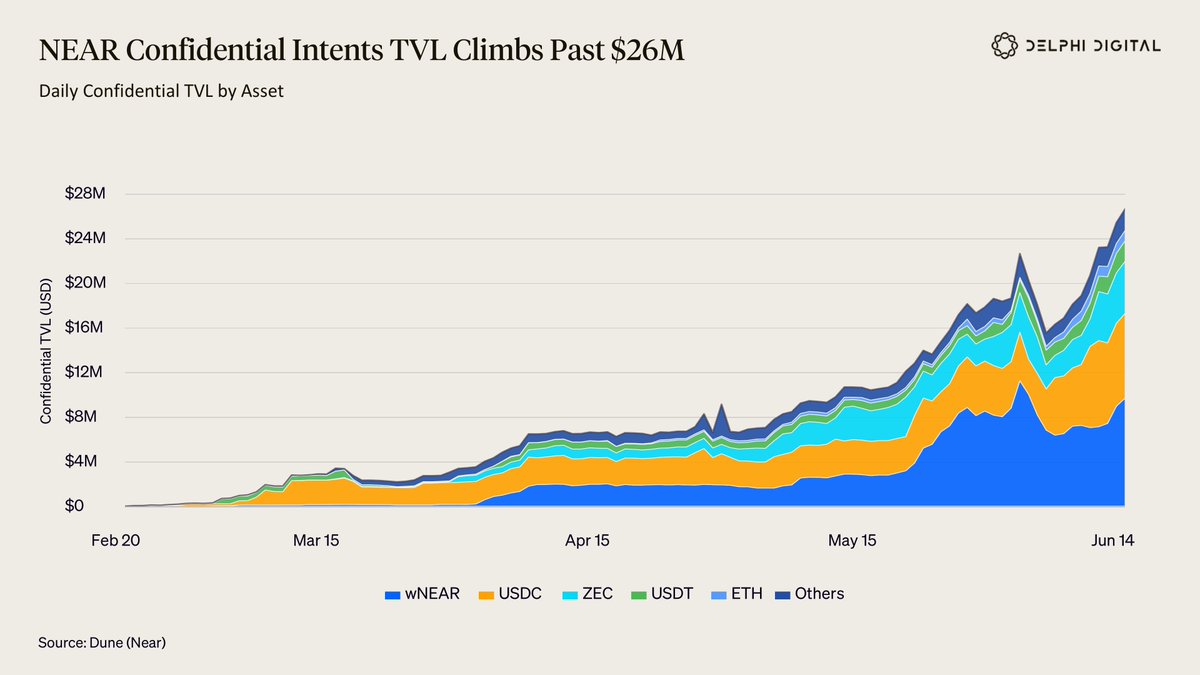
NEAR Confidential Intents TVL climbs past $26M.
Confidential intents is extending the private execution layer to 35 supported chains across swaps, transfers, and more. Almost half of the volume on NEAR's main venue is now routing through private intents.
The Intents stack is becoming one liquidity layer for everything.
37
37
198
27,251
Jun 15
Kevin explains why agentic payment adoption may be closer than people think.
"I’ll just tell my agent what rules I want to give it. To me, that’s so straightforward, that’s inevitable.”
16
3
18
6,481
Jun 15
Jason explains why Bitcoin weakness no longer has to define crypto as a whole.
“I don’t think crypto will be the market where Bitcoin has to dictate if things can be positive or not.”
12
1
13
5,517
Jun 15
NEAR Confidential Intents TVL climbs past $26M.
Confidential intents is extending the private execution layer to 35 supported chains across swaps, transfers, and more. Almost half of the volume on NEAR's main venue is now routing through private intents.
The Intents stack is becoming one liquidity layer for everything.
37
37
198
27,251
Jun 14
Yan explains what to look for in crypto’s next winners.
“There’s value in crypto to continue building... if you’re actually building something that has a lot of room for growth but hasn’t really repriced, that’s one way people are looking for returns right now.”
66
2
27
13,882
Jun 13
Kevin explains why open-source AI is becoming so crucial.
"Prior to this example, we kind of had fears of being priced out or locked out. Now we’re starting to see that becoming real... And that’s where open source comes in.”
60
4
37
11,985
Delphi Digital retweeted
Jun 12
Kevin explains why agent harnesses are becoming the next operating system.
"I could boot up straight into Hermes Desktop and everything I need to do can be done through that harness.”
26
7
33
9,399