
Joined March 2022
- Tweets 14,825
- Following 1,236
- Followers 1,661
- Likes 29,111
1,444 Photos and videos









LordPetroleum 👑 retweeted

💰 $100
5 winners
72 hours
Step 1:
Follow @youfadedwealth
Follow @SimonDezX
Follow @ClipurMediaCorp
Step 2:
Put notifications on for this account
Step 3:
Repost & comment proof 👇

383
319
550
28,902
LordPetroleum 👑 retweeted

May 1
799
1,383
1,764
25,836

Apr 20
So @NetworkNoya was fast to use Billions as an example of Projects who haven't launched due to the War
Well looks like Billions is Launching this Month and hope Noya can also do the Same since they were following to postpone like them 😕
Apr 20

Billions Rewards Season 1 - Registration is open.
Register before TGE.
community.billions.network
3
99
The intelligent economy demands secure custody 🌐
@BosonProtocol is reshaping how value moves between humans and AI, enabling verifiable, trustless exchange for any agent.
$BOSON, the protocol’s core token, stays fully under your control with @GuardaWallet.
8
3
20
1,721
Google, OpenAI, Visa, and Stripe are all building payment rails for AI agents but they’re centralized. 💥💯
That’s the problem.
When both sides are software, unknown, high-frequency, even adversarial, you need guarantees, not trust. Centralized escrow puts one party in control of outcomes. That’s not neutral infrastructure.☑️✅
Verifiable fair exchange changes that: either the item is delivered, or funds are returned, no counterparty risk, no subjective rulings, no platform cuts.🤔🤔
@BosonProtocol delivers this with trust-minimized escrow for agent-driven commerce—at ~0.5% fees, not 20–30%.
5
3
14
1,595
Donald Trump has announced Cease Fire
So my question is What will be the Excuse of Network Noya, Billions, Tea Protocol and Other Projects who Postponed Launch now?? 🌝🌚
I'm Patiently waiting for them to come up with another Excuse now 🙃
2
5
79
Commerce isn’t just evolving, it’s being reshaped.
Autonomous AI agents will soon trade real-world assets nonstop, at speeds humans can’t match.
To scale this agent-driven economy, foundational infrastructure is essential, and @BosonProtocol provides exactly that.
Thread 🧵👇
11
3
14
1,203
3/4
The real limit is the boundary.
Commerce exists between precise code and messy reality, delivery, condition, authenticity, disputes. These aren’t simple inputs; they need judgment.
AI can now manage this at scale, but judgment by itself isn’t enough to complete the process.
1
6
65
4/4
AI creates signals, but protocols ensure outcomes.
One interprets reality; the other locks in value. Without certainty, transactions stall.
Boson Protocol bridges this gap with trustless, verifiable exchange between humans and AI.
Step into the agentic commerce era
6
65
Mar 31
What happens when the parties you’re dealing with aren’t people, but software agents you don’t know, acting fast, and possibly against your interests?
What can you really trust in that kind of environment? 🤔🤔
Not reputation.
Not legal contracts.
Not “we’ll sort it out later.”
This is the core problem behind agent-driven commerce.😎😎
As machines begin to buy, sell, and negotiate on our behalf, we need a new kind of trust, one that works instantly, automatically, and without relying on human systems.💯🔥
That’s the idea behind @BosonProtocol building a decentralized commerce layer designed for an intelligent, automated economy.💥💯
9
3
11
1,283
Mar 27
AI agents are becoming more independent ; with enough training, they can think and act very much like you.💯✅
But the real challenge isn’t the agents themselves. It’s the marketplaces they operate in. Even on familiar platforms like Jumia, trusting an unknown seller can still be risky.🤔🤔
Adding AI into these systems doesn’t fix that.
@BosonProtocol focuses on something deeper ,making exchanges between strangers work without relying on trust at all. 🚀😎
Blockchains already allow digital transactions without trust. The problem starts when physical goods are involved.
Boson solves this by structuring deals so neither side is exposed.
The trade either completes as agreed, or it simply doesn’t go through without unfair loss on either end.
That means fewer risks like paying and not receiving, or getting something below expectation.
In this setup, both people and AI agents can transact with confidence, because the system enforces the outcome, not trust.
It’s a different way to think about commerce: not hoping the other party is honest, but ensuring the transaction itself is fair by design.
8
3
13
1,160
Mar 27
The idea that you must trade usability for decentralization is often a sign of poor system design.😎😎
Look at ERC-8183:
Relies on an external party to finalize transactions
Control over dispute resolution sits with the buyer
Incentives aren’t clearly aligned
Leads to delays and weaker reliability ✅🚀
Now compare that to @BosonProtocol:
No central authority in normal operation
Transactions complete automatically in most cases
Lower friction through efficient design choices
Built to integrate with broader on-chain systems. 💯🚀
Incentives are structured to encourage honest outcomes
The difference comes down to design logic.
When incentives are engineered properly, you don’t have to sacrifice user experience for decentralization ; you can achieve both at the same time.💥😁
5
2
11
1,185
LordPetroleum 👑 retweeted

Mar 24
🧠 $NOYA KNOWLEDGE QUEST: Decode The Noise- Find The Edge! 🧠
Dive into @NetworkNoya! Answer the 3 questions below correctly to win your share of the $100 reward pool. 💰🚀
👇 THE QUEST:
Q1: Noya is known as the "Execution Layer" for which fast-growing Web3 sector?
A) Real World Assets
B) Prediction Markets
C) DePIN
D) Liquid Staking Derivatives (LSD)
Q2: Noya offers "4 Products in One" to give traders a structured edge. Which of the following is NOT one of those core products?
A) AI Copilot
B) Omnivaults
C) Meme Coin Generator
D) Omnichain AI Agent
Q3: How does Noya ensure its Omnivaults operate with verifiable, trustless execution across its 10 supported chains?
A) Manual multisig approvals
B) Zero-Knowledge Machine Learning
C) Optimistic Rollups
D) Proof of Work consensus
🏆 HOW TO ENTER:
1️⃣ Follow @CVPadAlpha & @NetworkNoya
2️⃣ Like & RT this post
3️⃣ Reply with your 3 answers (e.g., 1A, 2B, 3C) and tag 2 friends!
⏳ Deadline: 1 week. Winners will be randomly selected from the correct entries.
May the best researchers win! 🕵️♂️⚡
Grab your $NOYA: cvpadalpha.com/project/noya

210
125
210
15,571
Mar 24
Instead of asking, “How do we protect funds?” it asks, “What is a transaction at its core?” 🤔🤔
A transaction is a commitment
someone promises to deliver, and someone else has the right to receive.
That promise has value even before anything is fulfilled. 💯💯
So rather than locking money away, @BosonProtocol turns that promise into a tradable asset. The buyer gets an NFT that represents their right to redeem. And that NFT isn’t static , it can be held, sold, transferred, or even used in other financial activities.
The transaction doesn’t pause. It keeps moving. 🚀🚀
Most deals complete without issues, and disputes become the exception, not the norm. Because these commitments are tokenized, they can connect with the wider ecosystem , marketplaces, lending systems, DAOs.
In simple terms:
One model treats commerce like money waiting in a vault for a decision.
The other treats it like a living agreement that can move, adapt, and create value across the system.
The starting perspective changes everything. ✅✅
5
3
7
1,488
Mar 24
Reputation doesn’t really protect you in agent-based systems it can actually be used against you. ✅✅
Agents don’t hold a fixed identity. They can create one, build trust quickly, use it, and then vanish all at high speed.
Then they just start again with a new identity.😎😎
When identities are cheap and easy to reset (like sybils), reputation stops being a strong defense. Instead, it becomes part of the trap, something used to gain trust before exploiting it.
If your system is focused on identifying “good actors,” you’re solving the wrong problem.💯💥
The real issue is this: can an agent cheat and still make profit?
That’s the standard that matters.
That’s the direction @BosonProtocol is pushing building systems where cheating isn’t profitable in the first place. And standards like ERC-8183 haven’t fully reached that level yet.
$BOSON is positioning itself at the front of secure, agent-driven commerce.
5
3
7
1,083
Mar 19
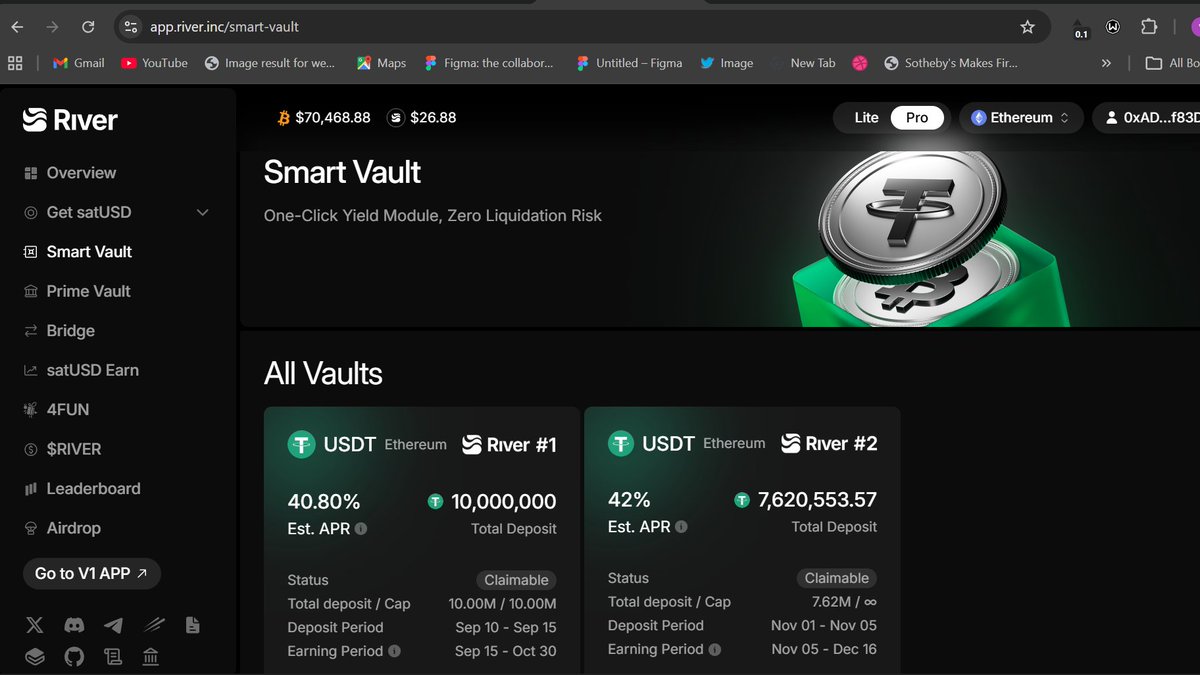
I'm sure you have seen a lot of Posts about @RiverdotInc flying all over the Timeline but do you really Know the Product they are building?? 👀
My work today is to introduce you to one of the Products that River is building and that's the Smart Vault. 🔥
So we all know that most DeFi Products makes us work for yield but that's not the case with River's Smart Vault🫗
River’s Smart Vault is a yield engine designed to abstract away complexity.
So Instead of manually Moving assets across chains, Finding yield opportunities and then Managing positions, You just deposit (USDT), and the protocol handles everything.
⚙️How it works (the real mechanics): Smart Vault runs on River’s Omni-CDP system, which is the core of everything.
🧠Here’s the Process:
1. You deposit stable assets (e.g. USDT)
2. River mints satUSD (its stablecoin) against that collateral
3. satUSD is automatically:
. Staked
. Deployed into liquidity pools
. Allocated across yield strategies
4. Yield is generated from:
. Strategy returns
. Protocol revenue sharing
All of this happens in one click; No bridging, No leverage loops, No farming dashboards.
@RiverdotInc Smart Vault is part of a bigger shift happening in crypto:
👉 From 'users doing everything'
👉 To 'protocols doing everything for users'
You can Get started today through this Link: app.river.inc/smart-vault
@River4fun 🛡️
3
2
10
1,148
Mar 19
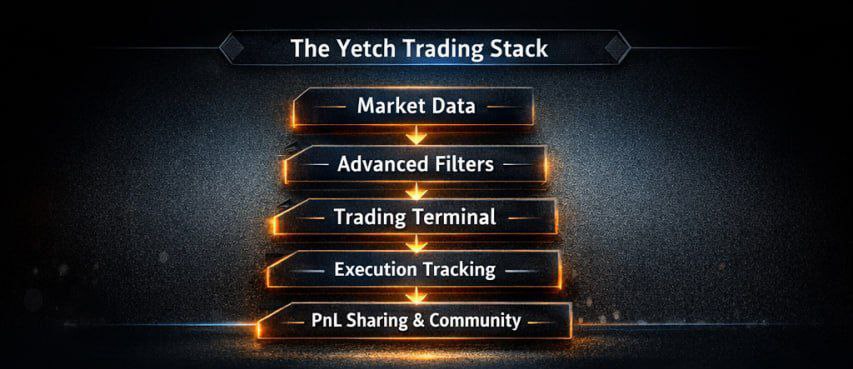
The Trading Terminal That Pays Its Users: Inside Yetch
Most trading platforms follow a similar Pattern where Users trade and Platforms collect the fees which sees the upside staying with the Project.
But @yetchxyz is experimenting with something different. @base
Instead of extracting value from traders, Yetch is designed to share it.
1/

16
11
23
2,285
Mar 19
My Honest Opinion on Yetch UI, Performance, and Execution
UI / UX; The interface is really friendly and easy to navigate but I feel that the User experience should be worked on so as to make the platform more professional.
Strengths: clear layout, fast navigation and trading-focused design
Performance; Speed is critical in trading Platforms and Yetch Trading Platform is really showing that with: quick loading, responsive panels and efficient data updates. These details matter because slow platforms can cost traders money.
Execution Experience; I did really enjoy the Trading Experience that I had on Yetch because it looked really easy to navigate.
Key positives: minimal steps to execute, immediate trade feedback and clear post-trade visibility.
These combination really created a smooth trading experience for me.
9/
1
14
120
Mar 19
Now to the Main Question; Will I recommend Yetch Platform for Traders to explore and Use?
The answer is a Big YES because of its unique features/utilities and the fact that it distributes 20% of all Platform Profits to Traders monthly.
If You want to get rewarded for the Value that you provide, then you should visit the Yetch Trading Platform: app.yetch.xyz/?inv=gwpke15n and start Trading Today!!!
End
15
105