
Joined June 2014
- Tweets 11,088
- Following 3,938
- Followers 7,845
- Likes 61,988
949 Photos and videos


Pinned Tweet

7 Dec 2025
Very thankful to @owocki to be invited as a cohost for the annual "state of public goods" discussion with @VitalikButerin
it was honestly a test of my mental fortitude & stamina to be top of my game for all 1.5 hours 😅
I've scratched out 5 key points from the long episode;
1. what should we ask PGF funders to rally behind?
A norm of 20% to public goods and 80% to commercial is inherently unsustainable. Because competitors will do 90-10, then 100-0, which will eventually beat out the market
Quadratic funding should be seen in this light, of a global tax to the public goods god distributed via matching funds. Instead, a norm of funding your own dependencies is more sustainable and what we should be moving towards
lawful & good - QF
chaotic & evil - dependency funding
2. what should PGF builders work on over the next year?
a. structured & well thought out proposals for how we fund ethereum open source software beyond just block rewards
b. productizing deep funding & making it easy for any ecosystem to generate their dependency graph, ascertain relative value between them & finally stream funding based on it
for example, vitalik said he finally crossed the threshold this year where over half his onchain transactions are private. he similarly hopes we can eventually make it as easy for any project to fund its own dependencies
3. When asked about the 3rd prong of accountabililty, vitalik pulled his classic switcheroo trick - putting the Q back on us
I shared my experience with deep funding where maintainers wanted their repo to participate for not just funding but also the thoughtful feedback which spot checkers provided in their evaluations
So we should think of accountability not as carrots & sticks but more as motivation, even though many of us get paid for our work when we have a compatriot tracking our progress it automatically makes us work harder to showcase our best
in this light, airdropping money to repos is much worse than streaming money to them based on the fact that they are in your dependency graph, along with comments made by any spot checker on the value their repo provides
4. He sees a short window of time to create a software license with a sliding scale where derivative work that becomes proprietary pays a fee (while it doesn't if it remains open)
He even said he would be happy for some of the software he personally writes to be under such a license! But it is important to get the terms right as they are hard to change once it reaches escape velocity
5. Finally, why is public goods important & why should builders spend their time working on it?
At a conceptual level, public goods innovation is key to maintaining the ethos of the crypto space in being open & transparent, since we forego commercialization opportunities that web2 has done by keeping their IP close to the chest
so instead of building the 101st stablecoin, there is much more leverage in figuring out designs that can sustainably govern the ethereum commons. he also advised new builders in the space that their radical ideas would get more traction with new projects that don't have power brokers who would lose by a change to the system compared to trying to reform existing big ones
3 other bonus points from the episode for those that have stayed to the end;
- in a deep funding world where projects support their dependencies, there is a natural evolution function where if a repo stops innovating, lesser projects use it, which means lesser money coming into it.
- if we decide to allocate fees to some institution or mechanism for passing on to projects, a key issue becomes ensuring they don't get corrupted or experience purpose drift, like funding preservation of a 3000 year old language when its actual purpose is open source software
even in the case of funding mechanisms, how to programmatically figure out in code what is a mechanism vs an institution is hard. preventing the free rider problem with solutions such as "if 51% vote then remaining 49% also comply" have the biggest risk of the 51% voting to siphon away money from the 49% towards themselves
- finally, there are some cases where making the wrong decision is catastrophic (concave vs convex). for eg SBF funding lobbyists is very harmful & better if he hadn't done it at all. solving for cases where mechanisms don't produce such negative outcomes is another hard challenge we don't think about.
i have seen this occur with airdrops going to those posting on particular forums or making github contributions to a repo which then poisons the well by making those spaces high noise & low signal
overall meaty end to the year and helpful podcast for general direction our space should move towards in 2026!

NEW POD @vitalikbuterin on the @greenpillnet podcast for a year-end deep dive into public goods funding in the @Ethereum ecosystem.
Thx @devanshmehta for co-hosting. We discuss how the landscape has shifted from “vibes-based” funding to verifiable, dependency-driven mechanisms, and why this is the best moment to reform PGF using new tools like programmable cryptography, AI-assisted evaluation, and deep funding models.
Vitalik shares how he thinks about dependencies, credible neutrality, open-source licensing, pluralism, accountability, ethereum localism, and what builders should prioritize in the coming year.
00:00 – Welcome to the Greenpill Podcast
01:50 – Vitalik joins: why public goods funding matters
02:19 – Why PGF is essential for decentralization
04:18 – The crypto spirit: censorship resistance, institutional design & funding
06:42 – The shift from vibes-era PGF to verifiable mechanisms
08:25 – Why 2026 is the best moment to reform PGF
10:19 – Where does PGF money actually come from?
12:45 – Open-source licensing, taxes & funding dependencies
17:34 – “Fund your dependencies” as a stable mechanism
19:35 – Why general-purpose QF doesn’t work in a chaotic world
21:59 – Bottom-up vs top-down: polycentric PGF
25:29 – How to create accountability loops in public goods
27:22 – Funding open-source as an Ethereum priority
29:31 – Privacy as a public good & why it’s upstream of PGF
31:54 – What OSS developers really think about crypto
33:52 – Mixing social outreach with financial support
35:56 – What should PGF builders focus on in 2026?
38:13 – Work with new projects, not legacy ones
39:44 – Ecosystem cycles & “layers of sediment”
41:39 – Yield-based funding (Octant) & treasury strategies
43:40 – Accountability: from vibes to rigorous mechanisms
47:35 – Motivation, feedback & the psychology of public goods
50:43 – Profit sharing licenses & sustainable PGF pools
53:46 – Security, issuance & public goods
56:12 – Technology, democracy & long-term risks
58:31 – How PGF relates to DIAC (Defensive/Decentralized Acceleration)
01:00:05 – Solving the free-rider problem without coercion
01:02:12 – Mechanisms vs coercion: credible neutrality
01:04:16 – Institutions, power & capture risks
01:06:16 – Individuals vs institutions in PGF
01:08:41 – Why PGF is more error-tolerant than governance
01:11:01 – Pluralism: many funders, many mechanisms
01:13:14 – Why diversity of funders is healthy
01:15:17 – What Vitalik wants built next
01:17:12 – Ethereum localism & real-world experiments
01:19:28 – What success in PGF looks like by end of 2026
01:24:28 – Closing thoughts
18
10
127
20,272
The overall vibe at manifest reminds me a bit of rhesus macaque monkeys 🐒
To build status in this community, you either
1. Fight your way to the top by doing incredible things that advance rationality
2. Be a person that the women in the community love hanging out with
Jun 13

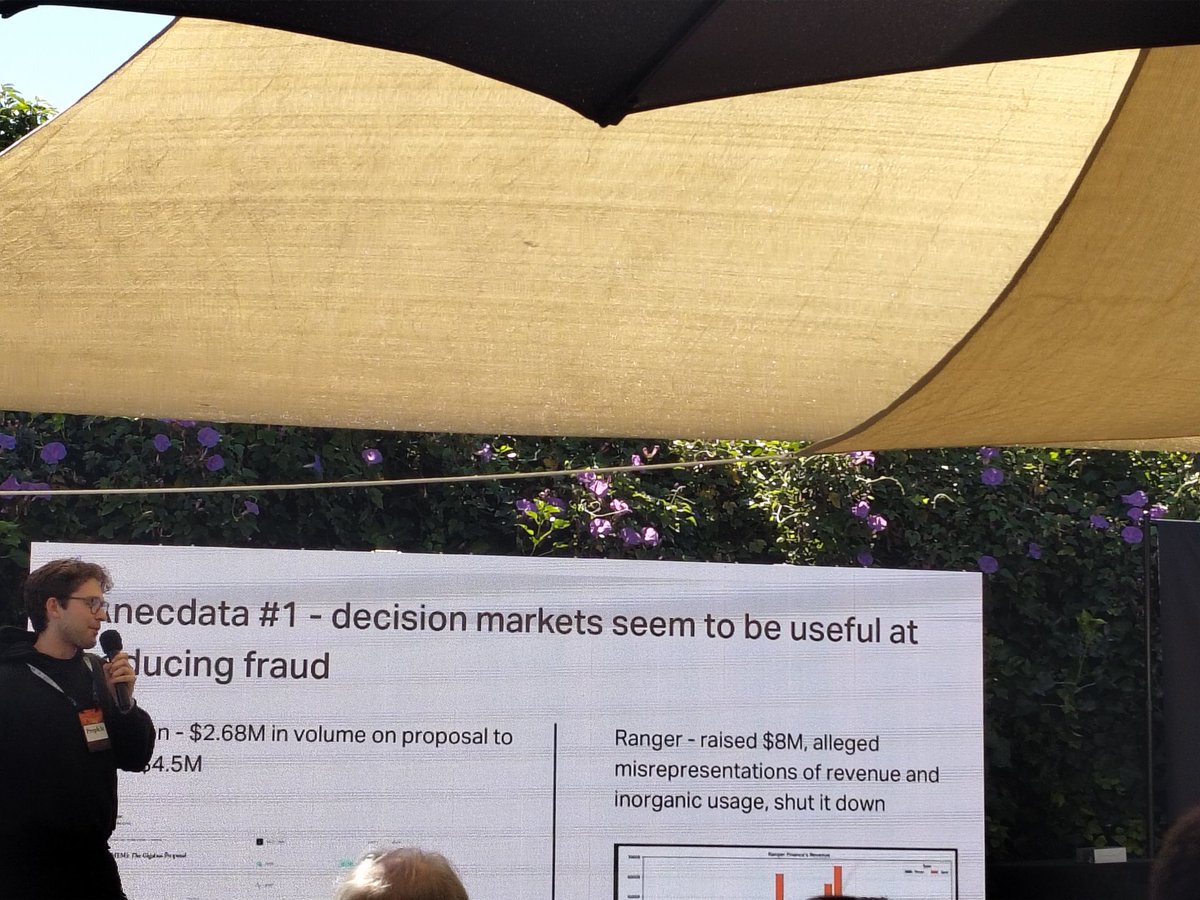
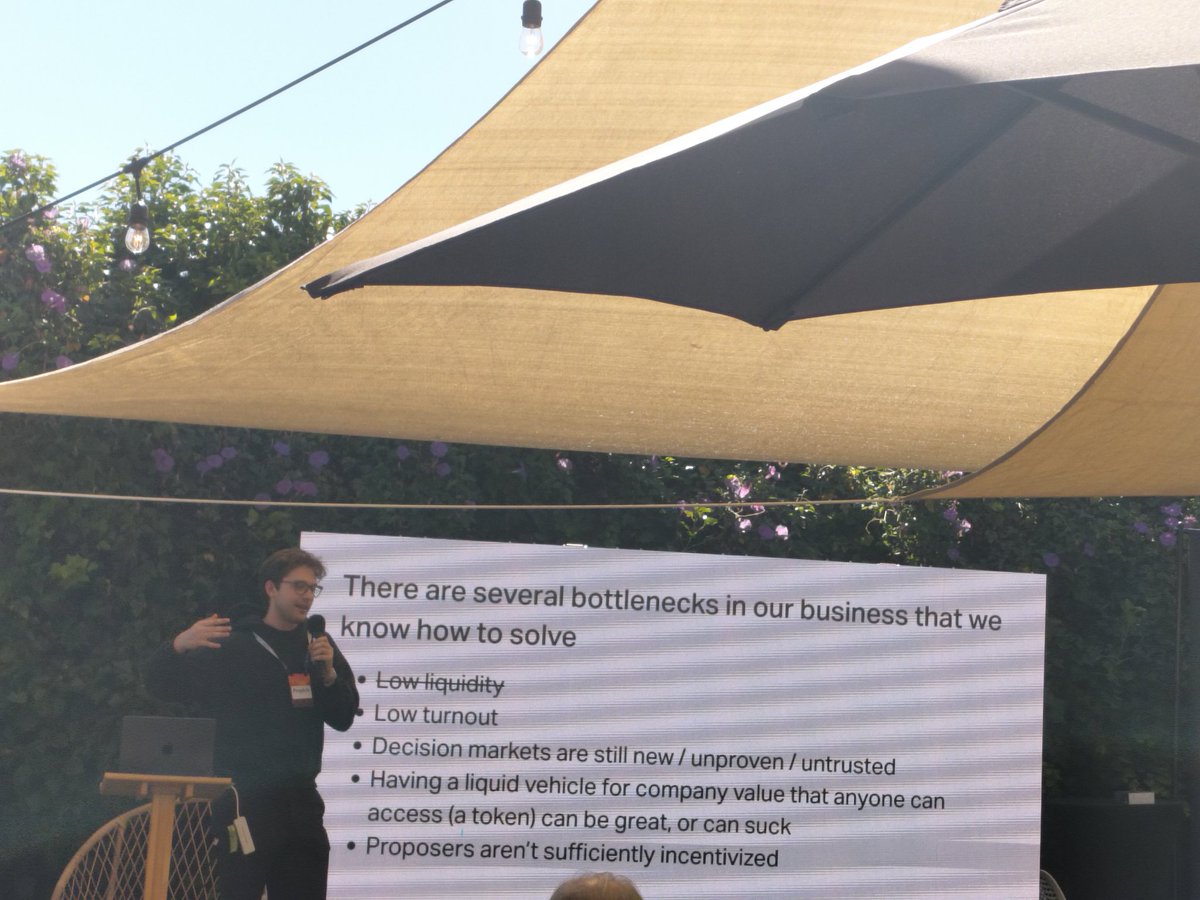
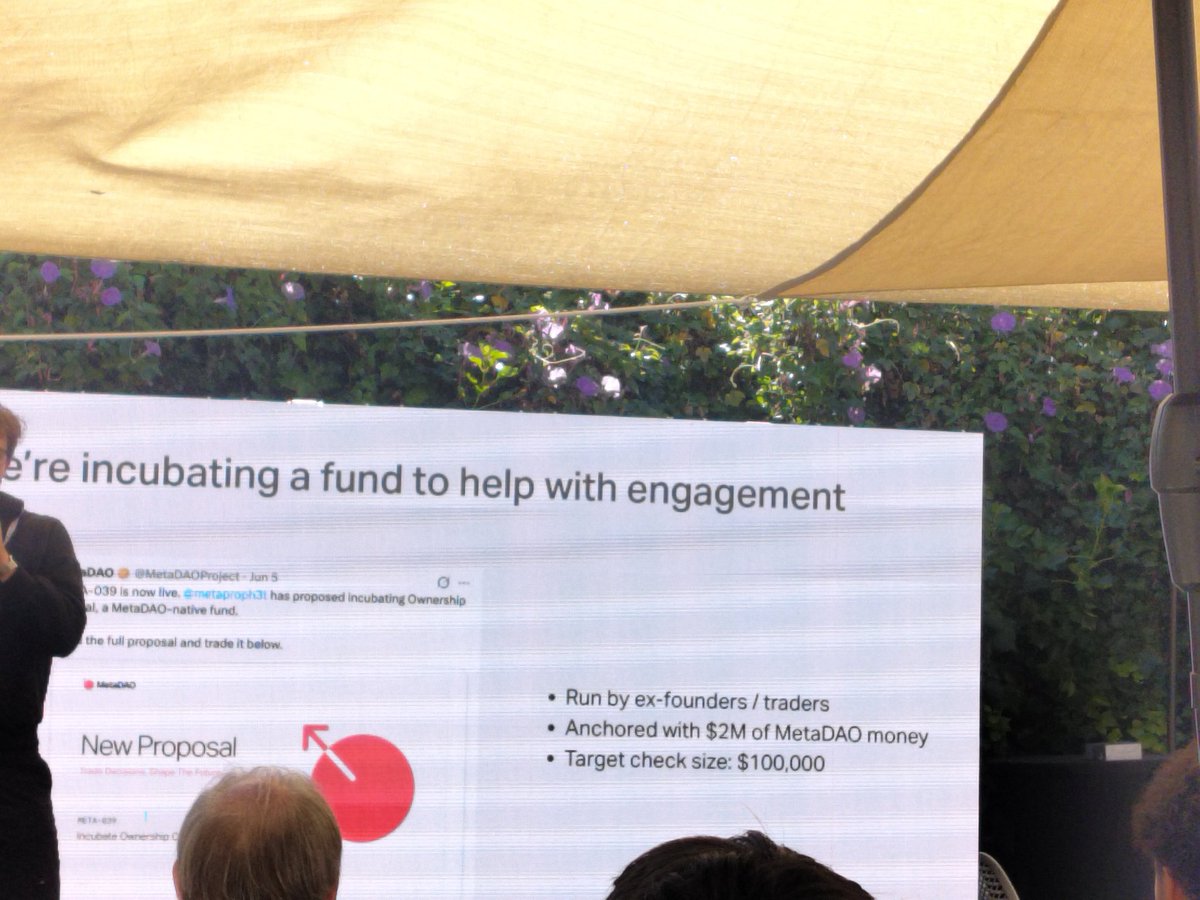
Loved the 4 takeaways by @metaproph3t on decision markets in practice
They started by doing decision markets for logos but realized quickly that founders don't like giving up control
So they then became a launchpad where founders give IP and power to spend investor money over to futarchy
After achieving PMF, they have learnt 4 key lessons that he was generous enough to share
1. Decision markets are good at reducing fraud
Ranger was a fraudulent raise on metadao. Once investors realized, they made a proposal to reclaim all their money and it passed
On the flipside, Solomon raised 8 million. When they asked for 4.5 million to use as liquidity, some investors thought it was fraud and traded against. But other traders saw it was genuine, leading to it passing after $2.68 million in trading volume
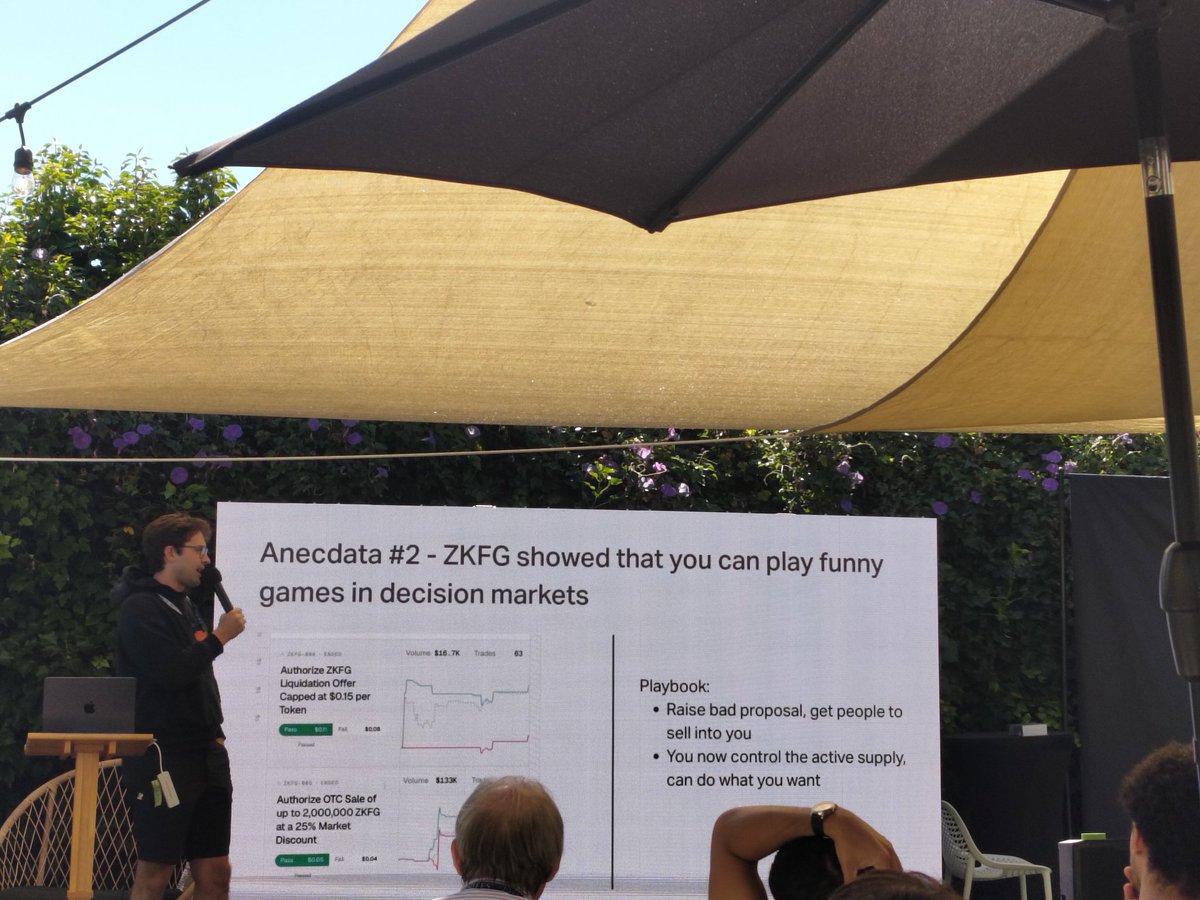
2. You can still play funny games in decision markets
ZFKG founders wanted to rug their investors, but didn't have the token supply to trade for it.
So they created one obviously bad proposal, which traders went against. As their token supply got used up in this proposal, they then created another malicious one that then passed. This happened yesterday and they are figuring out what to do about it
3. Markets don't like issuing new tokens at a discount to its market price
This is quite a contrast to normal web3 projects where tokens are regularly sold below spot to get cash
4. Decision markets don't like when token is trading below NAV
If the value of assets in the treasury is greater than its mcap, futarchy has always approved buybacks till it becomes equal. This is in contrast to tokenvoting wher GNOSIS voted against
Overall, they are now focusing on fundraising for vibe coders as the crypto fundraising scene is down bad. They called themselves 'founder rigor' rather than 'founder friendly', since investors can recall their money and also trade to make major decisions. Their hope is proving higher RoI for such futarchy orgs so investors insist on this structure like how they do with delaware c corp
Going into the future, they have 3 new initiatives in the works;
1. $2 million is approved for activist investor type personas that make proposals. Improving the pipeline of high quality proposals & increasing engagement is something they are looking to address through this structure
2. A whitelist for only good investors to participate, eliminating those who are toxic and dunk on you if token is down
3. A research fund to bring academic rigor into decision markets and whether it makes good decisions
They also have 3 unsolved questions to tackle;
A. Which decisions should go to the market in the first place?
B. An inherent issue in decision markets where traders have a free call option on a proposal succeeding (didn't understand this point fully)
C. Giving up control still sux esp at the early stage, so how do we make it more founder friendly
Early ethereans spent a lot of their wealth effect on tokenvoting via open zeppelins governor contract. I'm glad that solana is now spending it's wealth on properly testing out decision markets so we can learn about the messy details on their dime 😆
1
7
584
Jun 13
Loved the 4 takeaways by @metaproph3t on decision markets in practice
They started by doing decision markets for logos but realized quickly that founders don't like giving up control
So they then became a launchpad where founders give IP and power to spend investor money over to futarchy
After achieving PMF, they have learnt 4 key lessons that he was generous enough to share
1. Decision markets are good at reducing fraud
Ranger was a fraudulent raise on metadao. Once investors realized, they made a proposal to reclaim all their money and it passed
On the flipside, Solomon raised 8 million. When they asked for 4.5 million to use as liquidity, some investors thought it was fraud and traded against. But other traders saw it was genuine, leading to it passing after $2.68 million in trading volume
2. You can still play funny games in decision markets
ZFKG founders wanted to rug their investors, but didn't have the token supply to trade for it.
So they created one obviously bad proposal, which traders went against. As their token supply got used up in this proposal, they then created another malicious one that then passed. This happened yesterday and they are figuring out what to do about it
3. Markets don't like issuing new tokens at a discount to its market price
This is quite a contrast to normal web3 projects where tokens are regularly sold below spot to get cash
4. Decision markets don't like when token is trading below NAV
If the value of assets in the treasury is greater than its mcap, futarchy has always approved buybacks till it becomes equal. This is in contrast to tokenvoting wher GNOSIS voted against
Overall, they are now focusing on fundraising for vibe coders as the crypto fundraising scene is down bad. They called themselves 'founder rigor' rather than 'founder friendly', since investors can recall their money and also trade to make major decisions. Their hope is proving higher RoI for such futarchy orgs so investors insist on this structure like how they do with delaware c corp
Going into the future, they have 3 new initiatives in the works;
1. $2 million is approved for activist investor type personas that make proposals. Improving the pipeline of high quality proposals & increasing engagement is something they are looking to address through this structure
2. A whitelist for only good investors to participate, eliminating those who are toxic and dunk on you if token is down
3. A research fund to bring academic rigor into decision markets and whether it makes good decisions
They also have 3 unsolved questions to tackle;
A. Which decisions should go to the market in the first place?
B. An inherent issue in decision markets where traders have a free call option on a proposal succeeding (didn't understand this point fully)
C. Giving up control still sux esp at the early stage, so how do we make it more founder friendly
Early ethereans spent a lot of their wealth effect on tokenvoting via open zeppelins governor contract. I'm glad that solana is now spending it's wealth on properly testing out decision markets so we can learn about the messy details on their dime 😆
Jun 12
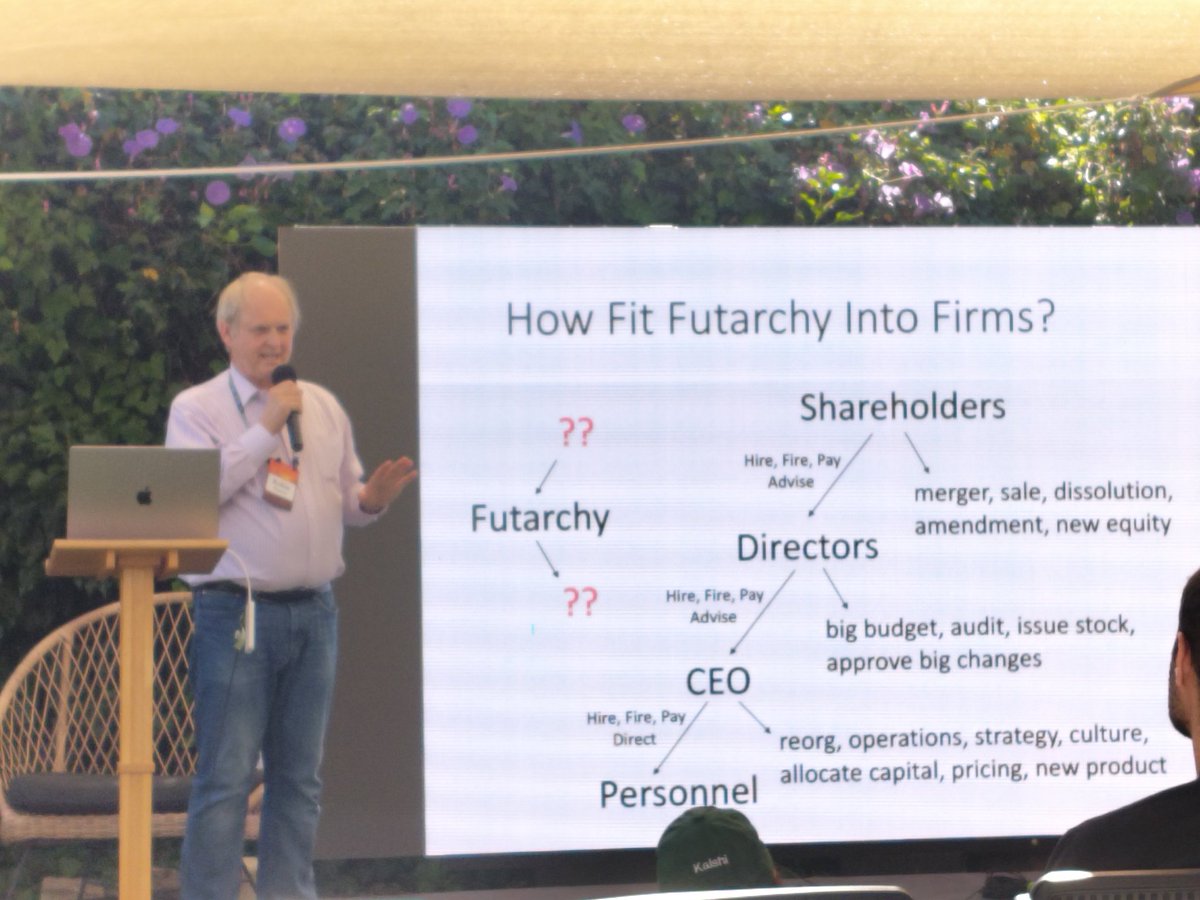
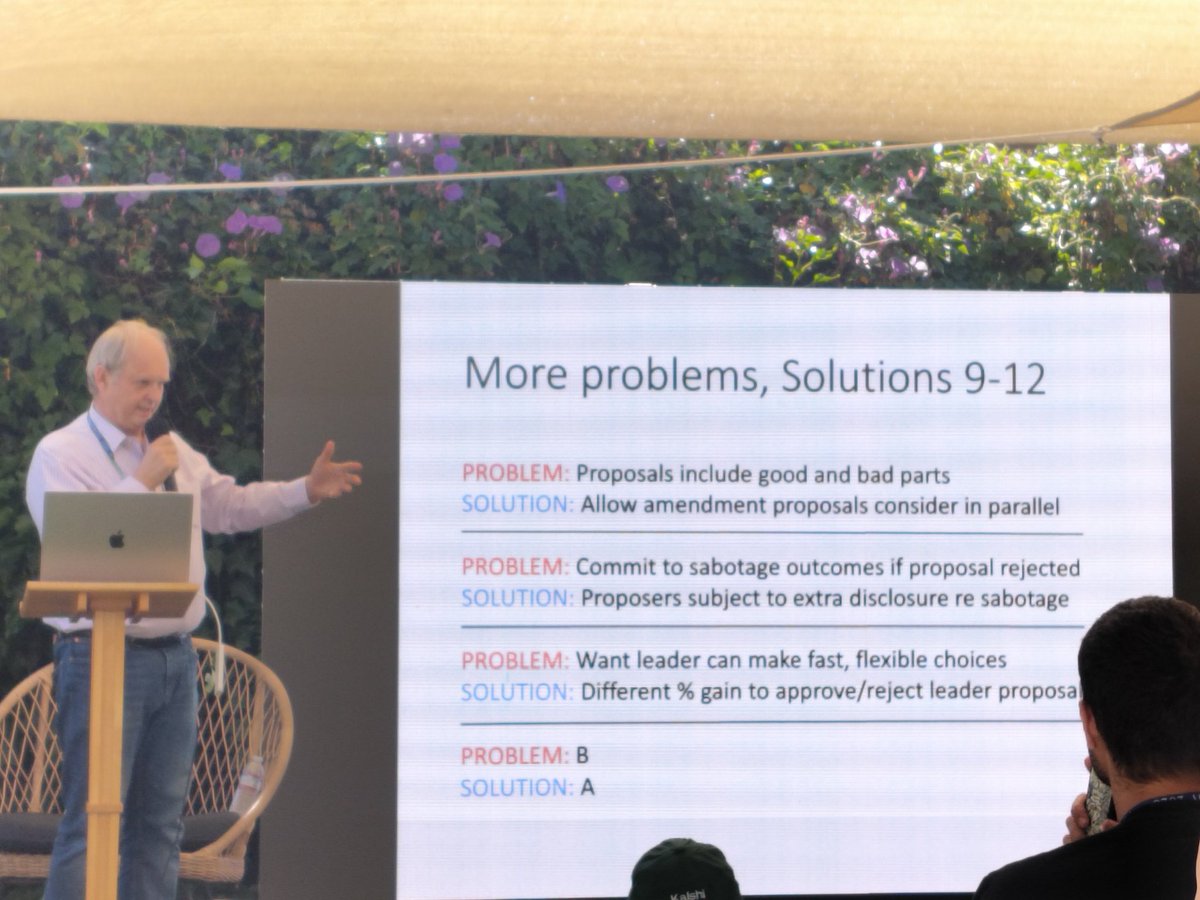
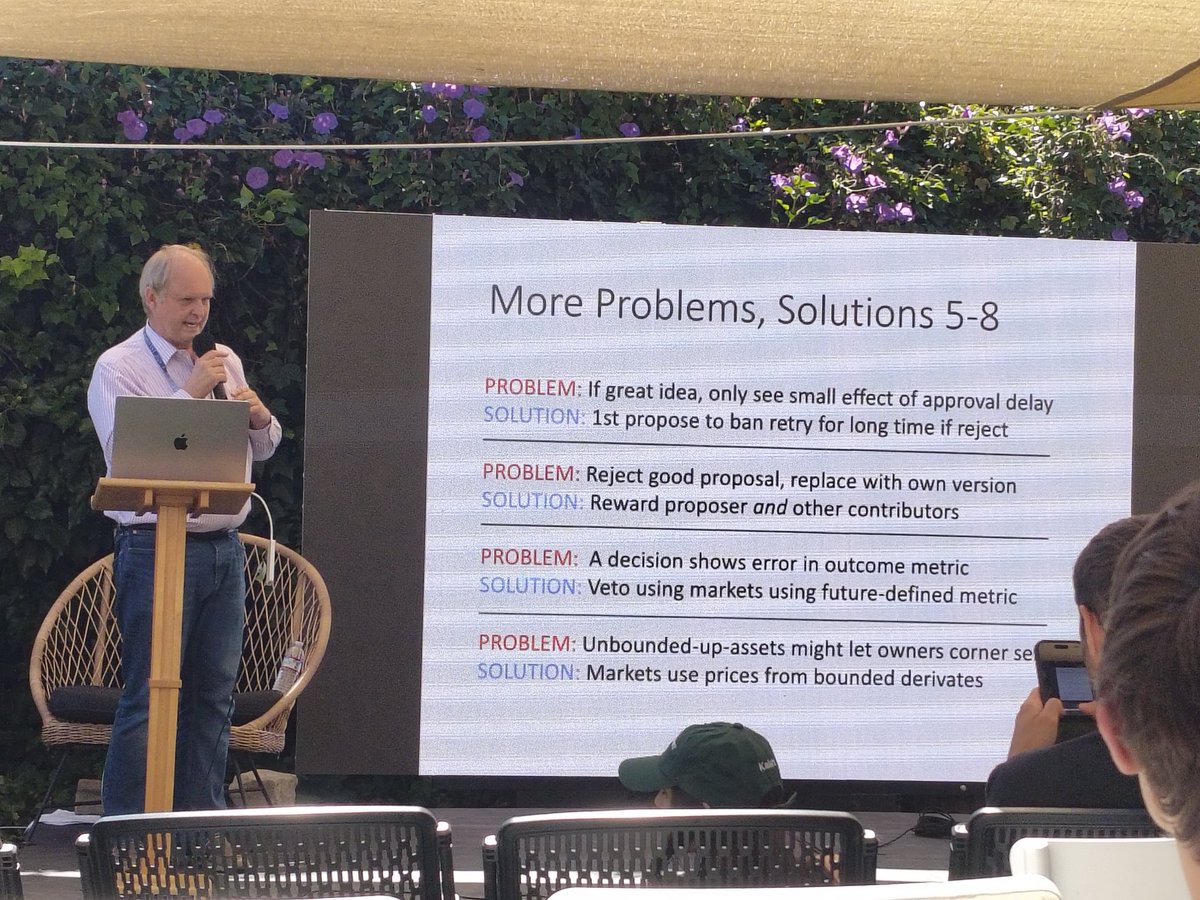
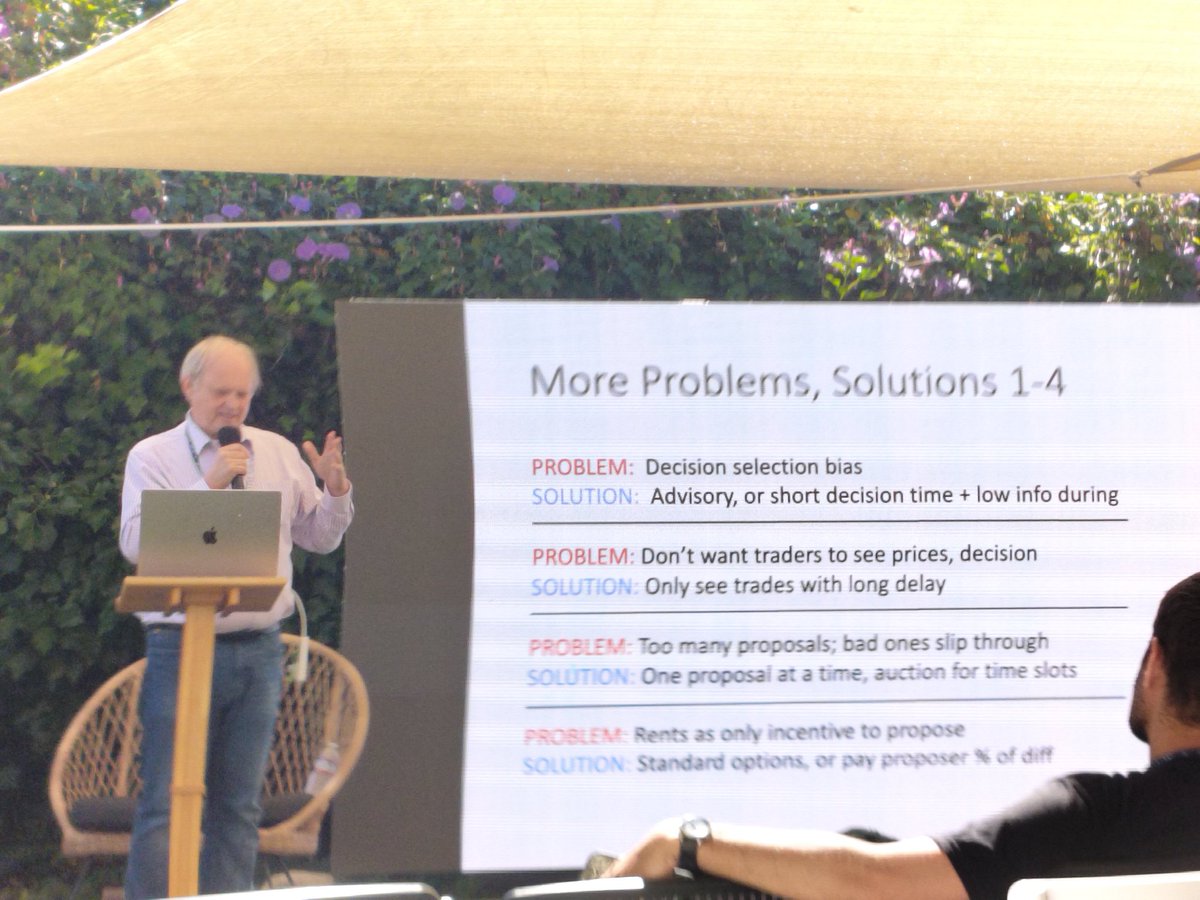
As a conference focused on prediction markets, great start seeing @robinhanson get to the messy details of futarchy in and putting prices against decision
One issue was CEOs not wanting to give up decision making power to markets, so they GTM with multi stakeholder decisions
2
12
1,868
Jun 12
As a conference focused on prediction markets, great start seeing @robinhanson get to the messy details of futarchy in and putting prices against decision
One issue was CEOs not wanting to give up decision making power to markets, so they GTM with multi stakeholder decisions
Jun 12
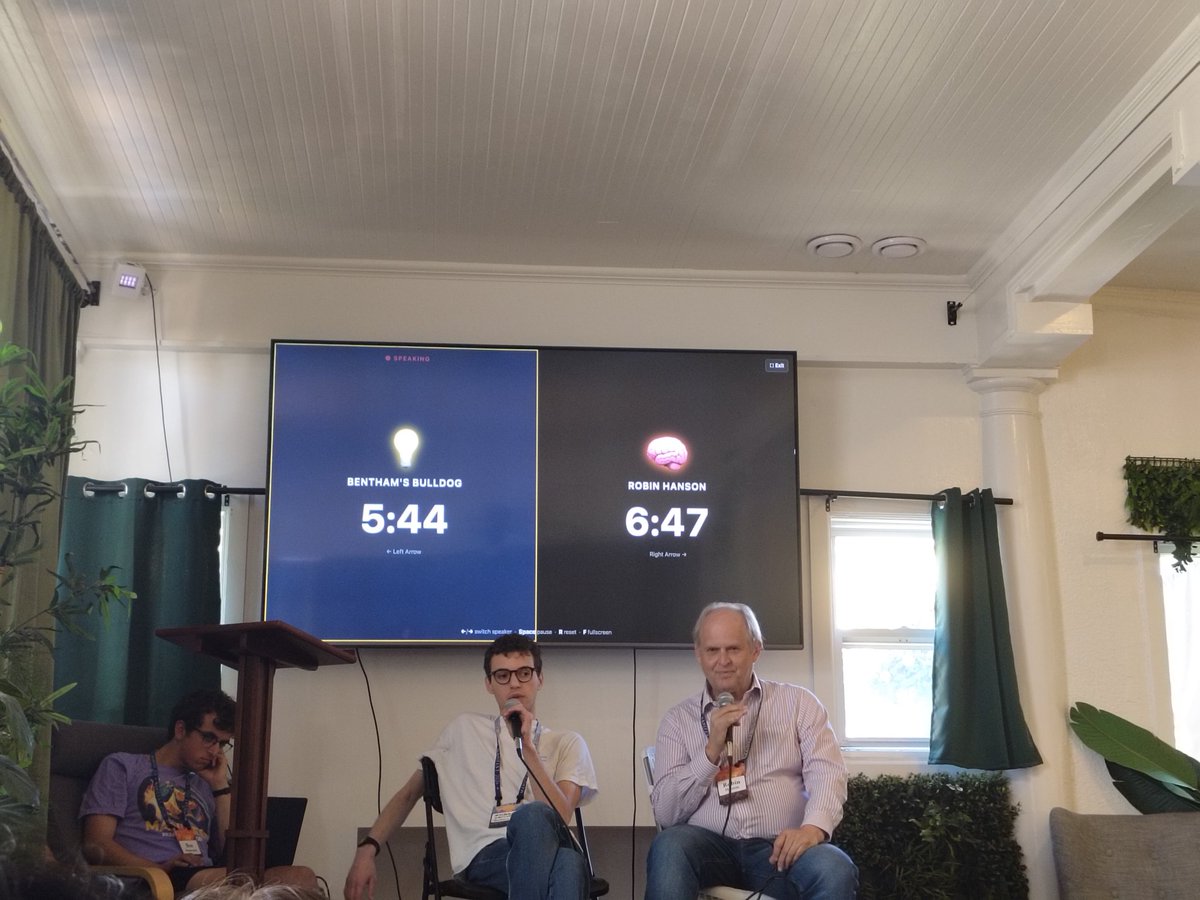
Came back to manifest this year, and it's as well organized as ever!
Their debate format is like chess where each speaker has a clock that ticks when they are speaking 😆
Prevents one person from talking too much & makes it more engaging too
2
10
2,539
Jun 12
Came back to manifest this year, and it's as well organized as ever!
Their debate format is like chess where each speaker has a clock that ticks when they are speaking 😆
Prevents one person from talking too much & makes it more engaging too
10 Jun 2024
manifest is officially the best organized conference i have ever attended, narrowly beating out the @PluralityInst conference from 2022
they brought together a very particular set of people: those who read @slatestarcodex , listen to @dwarkesh_sp podcast, follow @Aella_Girl for romantic advice, were early on AI risk becoming a big deal, make bets on prediction markets for fun, frequent LessWrong , EA and other rationality forums, know about impact certificates & desire funding or recognition from @open_phil
what were some of the things that organizers @akrolsmir , @saulmunn & rachel weinberg did right?
1. talks were strictly on time so that people could follow the schedule. they delay the start by 5 minute but end promptly by moving speakers to a side room for office hours where attendees engage in deeper discussion
2. high price for attendees ($400-$650) , fully complementary to invited speakers
3. insanely good lunch and dinner that prevented us from ever having to leave the venue.
have seen too many hungry people leave crypto conferences becoz there's free alcohol but no food 😅
this one had the full works, from electrolytes, vitamin c powder and nutribars to soft drink cans, popcorn, lindor truffle chocolates, and potato chips
4. understanding that the purpose of events is not to give a lecture but bring together people in the same subject area. most talks were highly interactive as a result and there were even sessions for getting people to dance & wrestle with each other 😲
on the 1st day, @mishaglouberman facilitated conversations by having us randomly speak to each other in groups of 3 & then hold up signboards of topics we like so we move around & self-organize by interests
5. lighthaven campus on berkeley was simply the best venue ever (photo below), with talks nestled into various nooks & crannies throughout the venue
really memorable experience, manifest has taught me what it takes to run a good event with attention to detail. feel lucky i was in california the same time this was taking place, gonna try making it an annual pilgrimage if it continues!

2
19
2,178
Jun 12
Agree with a lot of what lukas says. Despite its impeccable organization, eth conf has me convinced that Devcon NY would be a bad idea. The local community support just isn't there for it
Perhaps most disappointing were how many of my New Yorker crypto friends didn't even buy tickets or show up at the conference
& of those that did have tickets, they came for the 1st day and then returned to office for the remainder, as they didn't have leave to be there for all 3 days
I had a very productive time as the venue was cozy (chess boards were brilliant) , good coffee was available, and a lot of old timers were around
It may take a couple more iterations until it becomes a conference for finance, right now it was majority the community
Jun 11

Having an Eth Conference in NYC was a perfect timing (maybe half a year ago would have been even better).
Did Wall St come, listen and participate?
Not really. High quality attendees but the usual suspects from Ethereum centric conferences.
Why didn’t they show up?
From the meetings we had in the city throughout this week. Two reasons:
- NYC: People don’t have to go to conferences to meet people. Everyone passes by at some point. Nothing you can do here.
- Agenda: One big institution that builds in the space very actively said that they it’s just still too much in the weeds to be worthwhile for us.
I know that the organisers but a lot of effort in curating the agenda to the needs of the financial industry. Unfortunately that didn’t work well enough.
Hopefully it was just the first version of a blue chip conference. Big thanks for the whole org team for bootstraping this in NYC.
Looking forward to next year.

9
54
11,263
Jun 12
i know @fede_intern has been a big proponent of Devcon NY, curious if your opinion is changed now or still think its a good idea
2
3
517
Devansh Mehta retweeted

Jun 12
IMHO, NY is a great destination for meetings, workshops, special events ... but bad for multi-day conferences. It's expensive, hard to navigate unless you know the subway system, and you lose the magic of "bumping into people" because even a big conference draw is still a drop in the ocean for NYC.
As a local, it is very difficult for me to block off 2-3 days to attend a conference in my hometown. Instead I assume that I will be able to just stop by for a half-day, meet people at side events, or register last minute. Then I invariably get busy and fail to show up.
Finally, mid-town Manhattan is NOT a good place if you want local community to show up. It's one of the worst parts of the city for conference-adjacent activities like meeting for breakfast or having a happy hour. Lower Manhattan or Williamsburg are probably better targets
1
1
3
504
Jun 10
It's not easy to find holes in vitaliks thinking, but i think he forgot a 4th important category participating in prediction markets;
> Manipulators who want to bend public perception around likelihood of an outcome
If i want to boost perception that kamala harris will win the election, what better way than to simply buy their shares on the prediction market?
This group becomes esp important in futarchy or decision markets where peoples attempt to game the system becomes profit margin for the sharp traders
This group also doesn't necessarily have nefarious intentions, like my placing a bet on NY knicks winning the game tonight isn't some rational calculation but simply a way for my capital to have a voice & express my desire
Increasing participation by this group is actually key to make these markets profitable for the sharps
Feb 14

Recently I have been starting to worry about the state of prediction markets, in their current form. They have achieved a certain level of success: market volume is high enough to make meaningful bets and have a full-time job as a trader, and they often prove useful as a supplement to other forms of news media. But also, they seem to be over-converging to an unhealthy product market fit: embracing short-term cryptocurrency price bets, sports betting, and other similar things that have dopamine value but not any kind of long-term fulfillment or societal information value. My guess is that teams feel motivated to capitulate to these things because they bring in large revenue during a bear market where people are desperate - an understandable motive, but one that leads to corposlop.
I have been thinking about how we can help get prediction markets out of this rut. My current view is that we should try harder to push them into a totally different use case: hedging, in a very generalized sense (TLDR: we're gonna replace fiat currency)
Prediction markets have two types of actors: (i) "smart traders" who provide information to the market, and earn money, and necessarily (ii) some kind of actor who loses money.
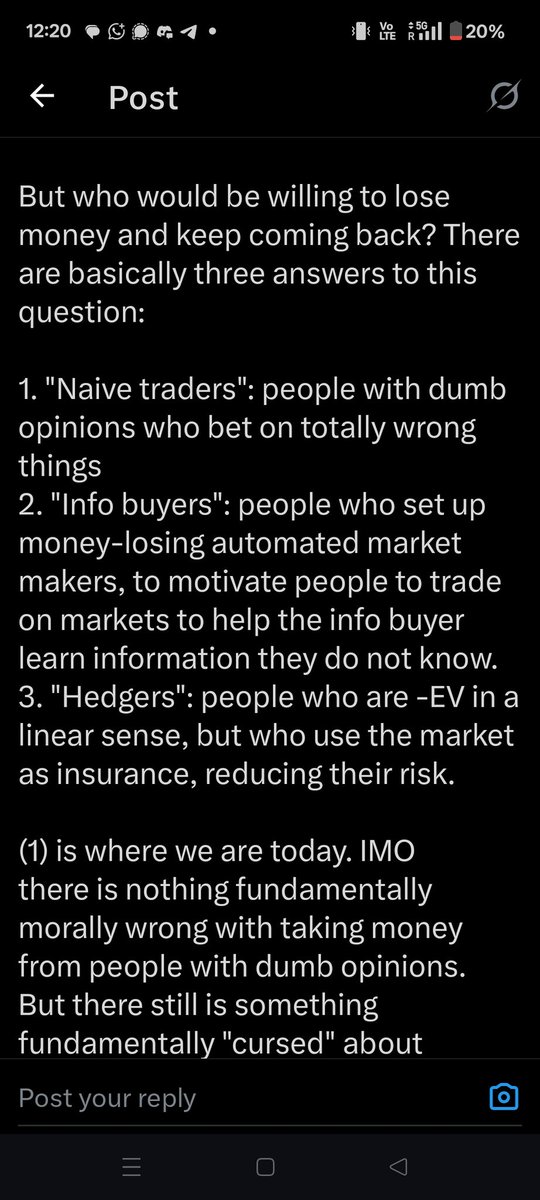
But who would be willing to lose money and keep coming back? There are basically three answers to this question:
1. "Naive traders": people with dumb opinions who bet on totally wrong things
2. "Info buyers": people who set up money-losing automated market makers, to motivate people to trade on markets to help the info buyer learn information they do not know.
3. "Hedgers": people who are -EV in a linear sense, but who use the market as insurance, reducing their risk.
(1) is where we are today. IMO there is nothing fundamentally morally wrong with taking money from people with dumb opinions. But there still is something fundamentally "cursed" about relying on this too much. It gives the platform the incentive to seek out traders with dumb opinions, and create a public brand and community that encourages dumb opinions to get more people to come in. This is the slide to corposlop.
(2) has always been the idealistic hope of people like Robin Hanson. However, info buying has a public goods problem: you pay for the info, but everyone in the world gets it, including those who don't pay. There are limited cases where it makes sense for one org to pay (esp. decision markets), but even there, it seems likely that the market volumes achieved with that strategy will not be too high.
This gets us to (3). Suppose that you have shares in a biotech company. It's public knowledge that the Purple Party is better for biotech than the Yellow Party. So if you buy a prediction market share betting that the Yellow Party will win the next election, on average, you are reducing your risk.
Mathematical example: suppose that if Purple wins, the share price will be a dice roll between [80...120], and if Yellow wins, it's between [60...100]. If you make a size $10 bet that Yellow will win, your earnings become equivalent to a dice roll between [70...110] in both cases. Taking a logarithmic model of utility, this risk reduction is worth $0.58.
Now, let's get to a more fascinating example. What do people who want stablecoins ultimately want? They want price stability. They have some future expenses in mind, and they want a guarantee that will be able to pay those expenses. But if crypto grows on top of USD-backed stablecoins, crypto is ultimately not truly decentralized. Furthermore, different people have different types of expenses. There has been lots of thinking about making an "ideal stablecoin" that is based on some decentralized global price index, but what if the real solution is to go a step further, and get rid of the concept of currency altogether?
Here's the idea. You have price indices on all major categories of goods and services that people buy (treating physical goods/services in different regions as different categories), and prediction markets on each category. Each user (individual or business) has a local LLM that understands that user's expenses, and offers the user a personalized basket of prediction market shares, representing "N days of that user's expected future expenses".
Now, we do not need fiat currency at all! People can hold stocks, ETH, or whatever else to grow wealth, and personalized prediction market shares when they want stability.
Both of these examples require prediction markets denominated in an asset people want to hold, whether interest-bearing fiat, wrapped stocks, or ETH. Non-interest-bearing fiat has too-high opportunity cost, that overwhelms the hedging value. But if we can make it work, it's much more sustainable than the status quo, because both sides of the equation are likely to be long-term happy with the product that they are buying, and very large volumes of sophisticated capital will be willing to participate.
Build the next generation of finance, not corposlop.
3
8
987
Devansh Mehta retweeted

Institutions need an encrypted public mempool
Jun 8
Learnt about the 3 things institutions want to be sure of before coming on Ethereum @ethconf
1. the counterparty they trade with isn't sanctioned
2. they aren't paying a sanctioned entity (such as N korea validating their blocks)
3. they aren't frontrun via mev
There are proposals of separate set of "institutional blocks" that are from attested, US based validators. Apparently adoption of commit boost by validators plays a part in enabling this
I'm still unsure how & whether it affects censorship resistance, if users can start to choose the category of validators they want for their blocks
2
2
10
795
Jun 9
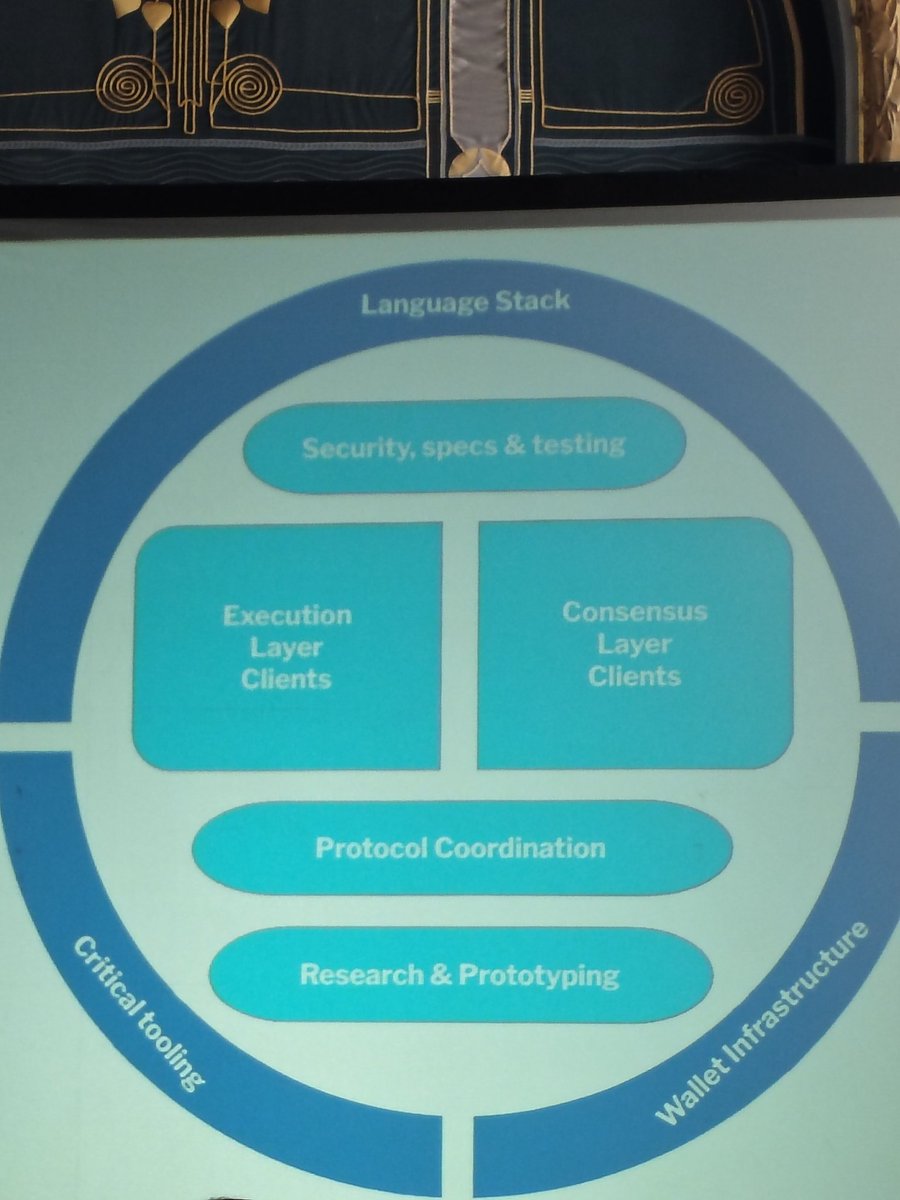
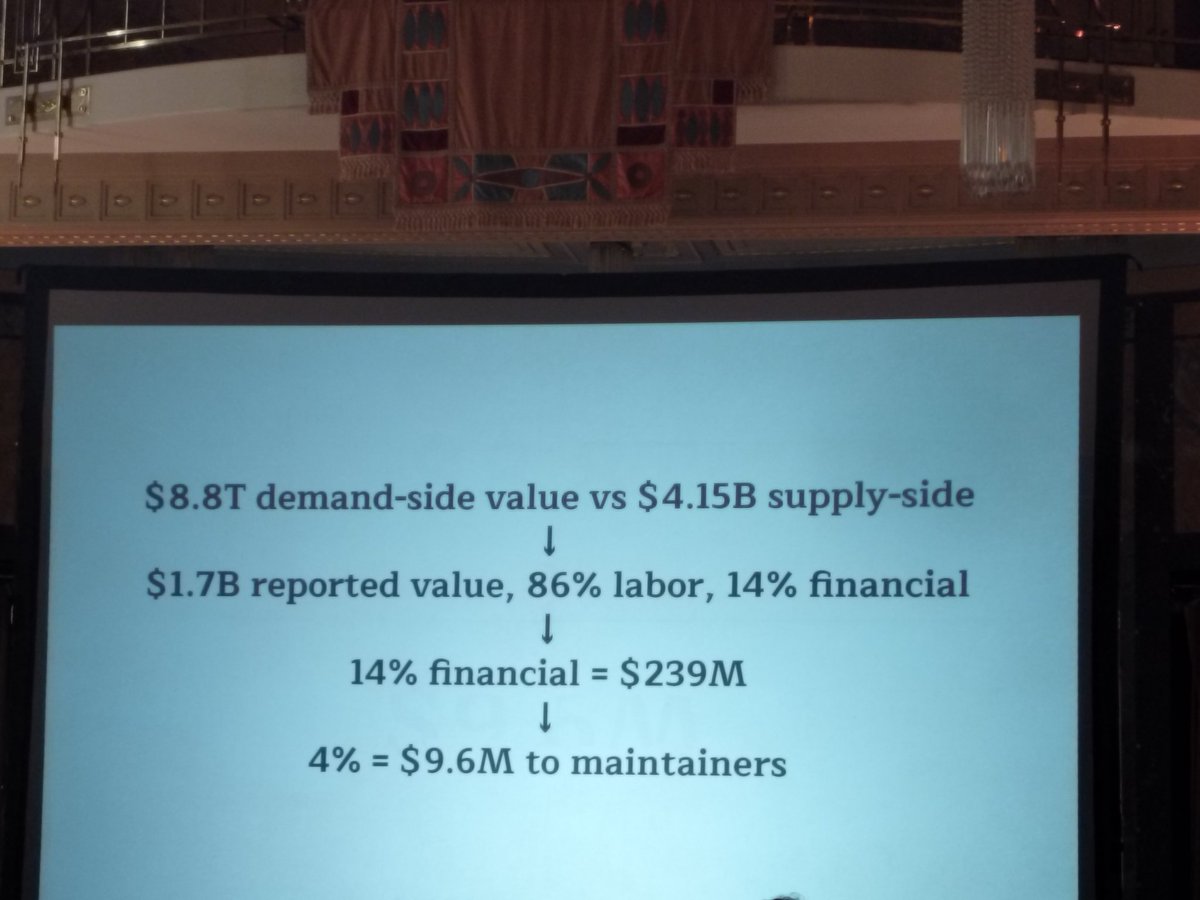
Some other ethconf takeaways specific to Ethereum core protocol funding;
- 2 execution and 3 consensus is minimum for client diversity maintenance
- Beam chain started off as just impacting consensus clients, but the lean roadmap now also affects execution thru zkevm, zk-isa and gas limit increases
- The new clients being developed under lean are all mostly consensus, so long term funding for those need to be thought thru more carefully than execution clients which will mostly be the same ones pre and post lean completion
- Developer projects like integrating execution and consensus clients into a single daemon don't make sense as consensus clients will change after lean
Jun 8
Learnt about the 3 things institutions want to be sure of before coming on Ethereum @ethconf
1. the counterparty they trade with isn't sanctioned
2. they aren't paying a sanctioned entity (such as N korea validating their blocks)
3. they aren't frontrun via mev
There are proposals of separate set of "institutional blocks" that are from attested, US based validators. Apparently adoption of commit boost by validators plays a part in enabling this
I'm still unsure how & whether it affects censorship resistance, if users can start to choose the category of validators they want for their blocks
4
2
22
2,796

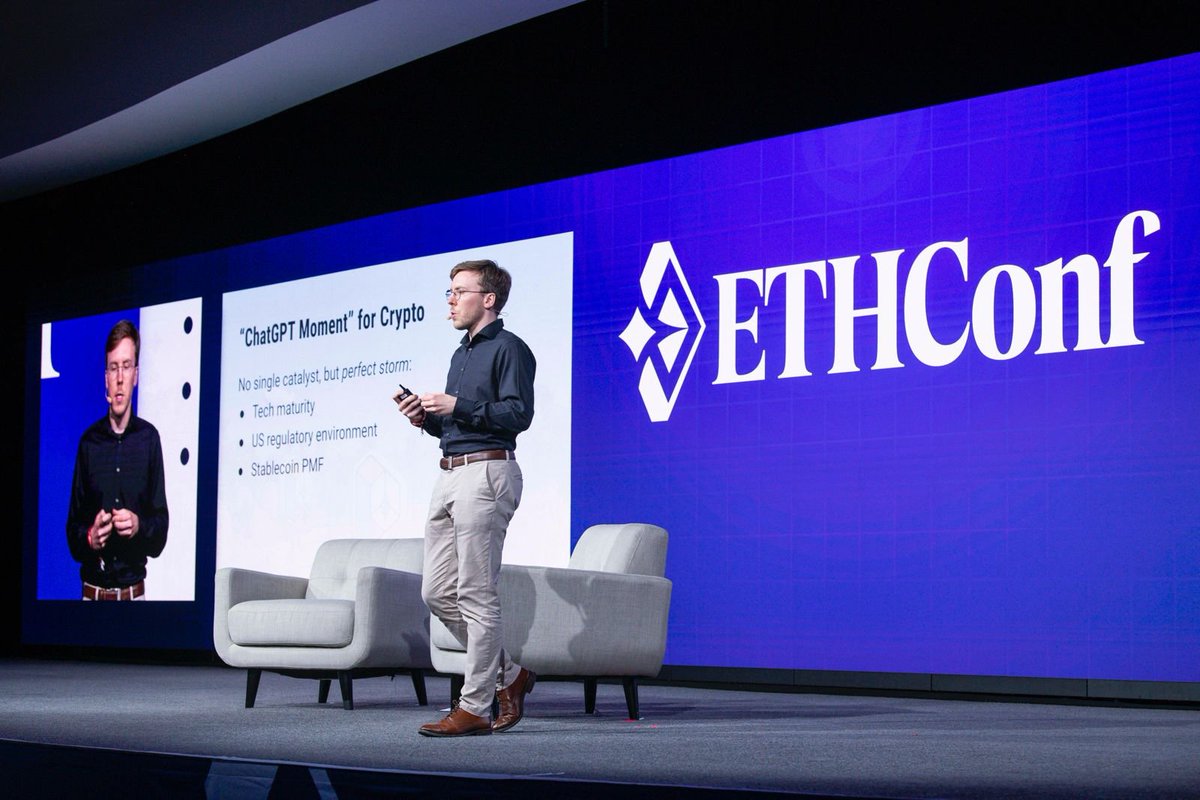
"I really think Ethereum's best time is yet to come."
The first decade of smart contracts was about building the infrastructure. The decade of real-world adoption has started, and Ethereum's role has to change with it.
@adietrichs of @ethereumfndn on the Main Stage at ETHConf.

5
24
199
6,975
Jun 8
Learnt about the 3 things institutions want to be sure of before coming on Ethereum @ethconf
1. the counterparty they trade with isn't sanctioned
2. they aren't paying a sanctioned entity (such as N korea validating their blocks)
3. they aren't frontrun via mev
There are proposals of separate set of "institutional blocks" that are from attested, US based validators. Apparently adoption of commit boost by validators plays a part in enabling this
I'm still unsure how & whether it affects censorship resistance, if users can start to choose the category of validators they want for their blocks
9
2
26
6,138
Jun 8
What type of prediction markets should be created to earn such fees?
Here's one that would really mess with city governments
At any point of time, there are 100s of participatory budgeting experiments going on where citizens vote on which projects should get funded
The simple idea is to create markets on which projects would get approved in these rounds
These markets can be run permissionlessly as its a fully public process with a month long gap b/w public announcement of eligible projects & results
Why would it mess up city governments if we did this?
1st, they don't really have sybil checks on who votes on the project. So by financializing participatory budgeting, we'd see a lot more attacks by traders hoping the market resolves in their outcome
2nd, many city government officials are held captive by activist groups who hate technology & would resent the intrusion of prediction markets into their hold on participatory budgeting where they ensure their rank & file vote for projects they want
Which is also the biggest benefit, that we get a 2nd source of truth (the market) on which projects should get funded. In case of wide discrepancies, we can then investigate
The biggest block to getting started here is just compiling the database on which participatory budgeting experiments are going on in which cities at what point of time
After that markets can be started without any permission from anyone, resolved when the process ends
Jun 7
how prediction markets should do fees
> if you made a loss upon resolution, zero fees
> if you made a profit upon resolution, x% of your profit
based on traders i spoke with, few mind giving up a portion if they are already in the green
esp if those fees go to liquidity
1
8
1,187
Devansh Mehta retweeted

Jun 7
Prediction markets isn’t a positive game unfortunately.
Jun 7
how prediction markets should do fees
> if you made a loss upon resolution, zero fees
> if you made a profit upon resolution, x% of your profit
based on traders i spoke with, few mind giving up a portion if they are already in the green
esp if those fees go to liquidity
1
1
4
1,359
Jun 7
how prediction markets should do fees
> if you made a loss upon resolution, zero fees
> if you made a profit upon resolution, x% of your profit
based on traders i spoke with, few mind giving up a portion if they are already in the green
esp if those fees go to liquidity
12
1
26
5,065
Devansh Mehta retweeted

If you're building a payments tool, this is your chance to shine 👇
Jun 5
Gulp we are only now realising that there is no easy way to distribute money to 4k open source repos at one shot
The ideal flow would be something like;
1. Inform all repos via email or a gh issue of funds received for being a dependency
2. Get them to complete KYB , upon completion of which they receivd a soulbound token
3. Send money to all repos with the soulbound token, if a repo has not gone thru the KYB process by a cutoff date their money gets redistributed to those that have
What we don't have is an entity in the middle that can receive funds from established funders to then allocate to the repos
And the tech for distribution of money to repos is itself quite raw & untested
1
1
1
301
Jun 5
Gulp we are only now realising that there is no easy way to distribute money to 4k open source repos at one shot
The ideal flow would be something like;
1. Inform all repos via email or a gh issue of funds received for being a dependency
2. Get them to complete KYB , upon completion of which they receivd a soulbound token
3. Send money to all repos with the soulbound token, if a repo has not gone thru the KYB process by a cutoff date their money gets redistributed to those that have
What we don't have is an entity in the middle that can receive funds from established funders to then allocate to the repos
And the tech for distribution of money to repos is itself quite raw & untested
Jun 4
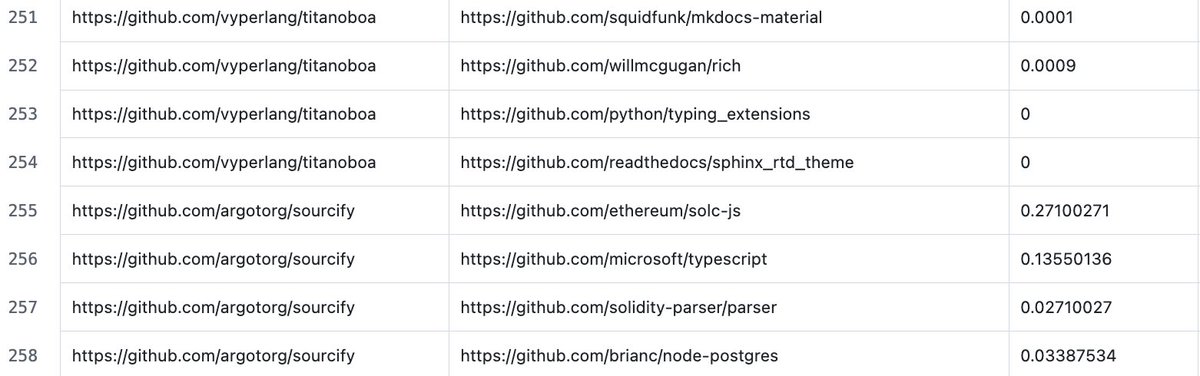
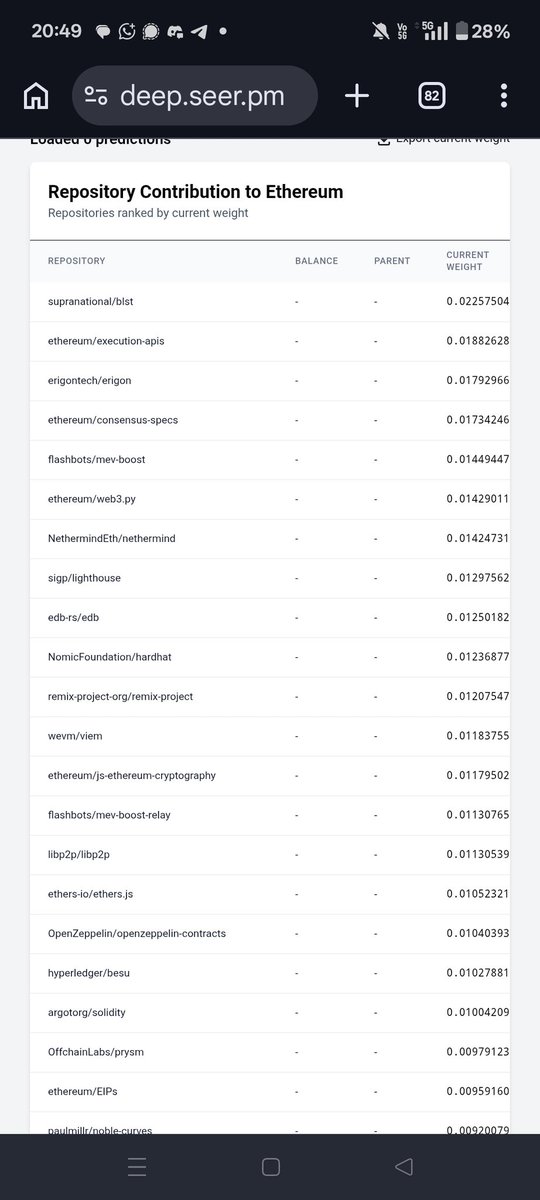
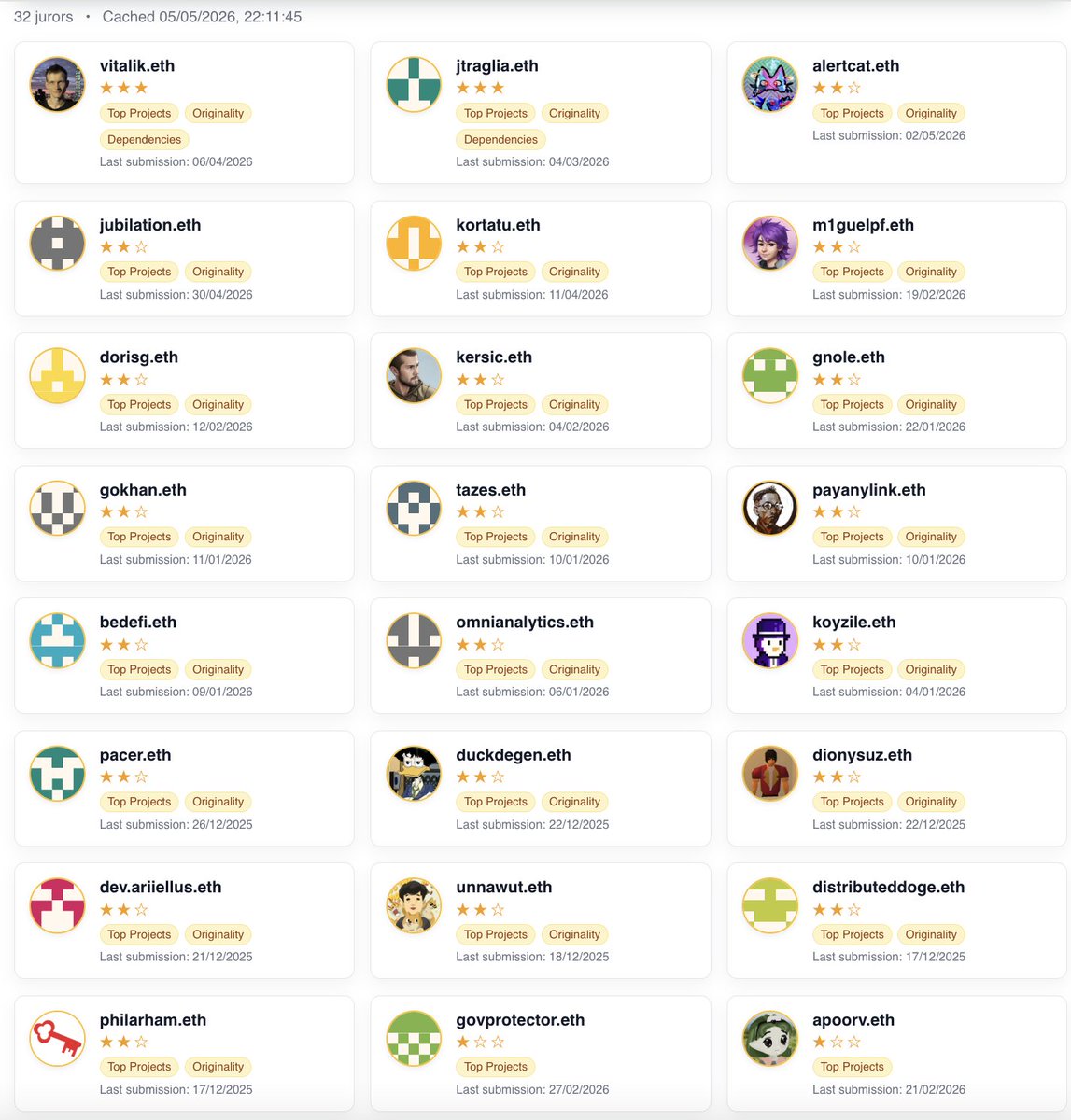
we just posted the data to resolve the level 3 deep funding market!
we got 15 open source repos sharing relative value between 685 of their dependencies
using prediction markets, we scaled their evaluation to 3,677 dependencies across 98 open source repos
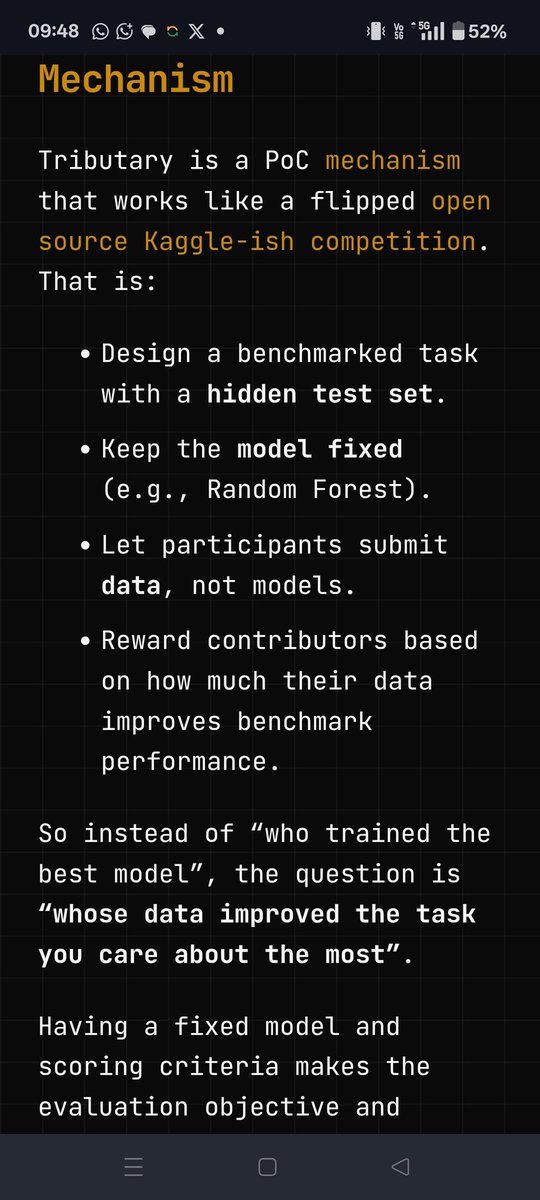
how does this work? using leverage through whats called conditional prediction markets
traders put money across all repos & their dependencies, but their P&L is based on only the ones that did get evaluated.
so if they just trade on 2 markets, one of which is evaluated and one isnt, their leverage is 2x as their entire position is based on the one that did get evaluated
so by evaluating 685 dependencies out of 3,677, our conditional prediction market for value of dependencies in an open source repo traded at a leverage of 5.36
the link with all the data is posted in the tweet below, really hope we start to see more conditional prediction markets & not just the bread and butter binary ones that are the current staple of the space
ongoing markets for originality (how much stays with repo vs its dependencies) and relative value between the 98 repos still available to trade
9
1
30
8,587

The incident aside, Zooko's post is a masterclass of crisis comm. All founders should take notes.
Honesty and directness. Within the first 30 seconds of the read, he gave you the timeline. He talks about the actions that were taken and the direct, honest impact of the problem. His delivery was measured but raw.
"Because of the privacy properties of Orchard, there is no way to cryptographically prove whether the vulnerability was exploited before it was remediated."
Then, throughout the article, he mentions the significant impact continuously, many many times. He didn't shy away from it. He was direct and honest.
In a crisis situation, directness and honesty are extremely critical. It reminds me of Ekram's article "Issue full disclosure," where he very sharply identified that letting all the facts out removes the suspense since there's no more to the story. People are no longer lingering on the issue, continuously anticipating more news.
In some way, the full disclosure creates a bottom for the brand, a bottom from which the future can be built. You want one big bad news instead of a thread of smaller bad news compounding.
From the response of the article and the broader community's reaction to it, it is clear the rebuilding has already started.
On a side note, this is also a good exercise to filter out the tourists with the believers within the community.
Double down with the brand. Zooko posted it from his personal account. He wrote in a personal tone. He is not hiding behind a faceless logo. It shows that he's taking responsibility; and he's also putting his reputation on the line. He's doubling down. Many corpo these days try to associate CEO image to bring more humanness to the brand; so today, it is more important to double down, to "go down with the brand". Not just during the good times because everyone else is doing it.
The future but not too much of it. Zooko mentions the upcoming network upgrade to fully address the issue. He gave hope into the future, but he didn't dwell too much on the future. Most importantly, he doesn't use the future to sugarcoat or downplay the size and the impact, the negative of the current incident. Lastly, by not sharing too much, he creates distance between this negative incident and the positive proposal that will come from about the future.
It is an unfortunate incident but Zooko handled it masterfully. Long Live Zcash.

8
10
91
8,916
Devansh Mehta retweeted

Jun 5
I keep seeing the same line under every Zcash post: a 4-year-old bug that could have minted unlimited counterfeit coins.
It couldn't. One Zcash rule made sure of that.
I read Hornby's writeup. The bug was a single missing constraint in Orchard's circuit: a base point in the scalar-multiplication gadget got witnessed but never bound to the real value, assign_advice where the code needed copy_advice. That let a prover spend the same shielded note under endless different nullifiers. Inside the pool, you really could forge ZEC without limit.
Here's what stopped it. Zcash hides the amount in every shielded transaction, but the total ZEC sitting in the Orchard pool stays public, and one rule guards it: that balance can never go negative. That rule is the turnstile. Forge all the notes you want. The moment you withdraw more than was ever deposited, the network rejects the block. The pool can't pay out money it never took in.
So the ceiling was never infinity. It was the pool itself: about 4.2M ZEC, a quarter of every coin in existence. Total supply could not inflate past that.
The part the turnstile can't fix: the same proofs that cap the theft also hide it. Spending one note twice looks exactly like spending two notes. "No evidence it was exploited" holds only because inside a shielded pool there's no possible evidence either way.
The turnstile held. The privacy held. A quarter of all ZEC sat forgeable and unwatchable for four years anyway.
14
16
143
46,720
Jun 4
we just posted the data to resolve the level 3 deep funding market!
we got 15 open source repos sharing relative value between 685 of their dependencies
using prediction markets, we scaled their evaluation to 3,677 dependencies across 98 open source repos
how does this work? using leverage through whats called conditional prediction markets
traders put money across all repos & their dependencies, but their P&L is based on only the ones that did get evaluated.
so if they just trade on 2 markets, one of which is evaluated and one isnt, their leverage is 2x as their entire position is based on the one that did get evaluated
so by evaluating 685 dependencies out of 3,677, our conditional prediction market for value of dependencies in an open source repo traded at a leverage of 5.36
the link with all the data is posted in the tweet below, really hope we start to see more conditional prediction markets & not just the bread and butter binary ones that are the current staple of the space
ongoing markets for originality (how much stays with repo vs its dependencies) and relative value between the 98 repos still available to trade

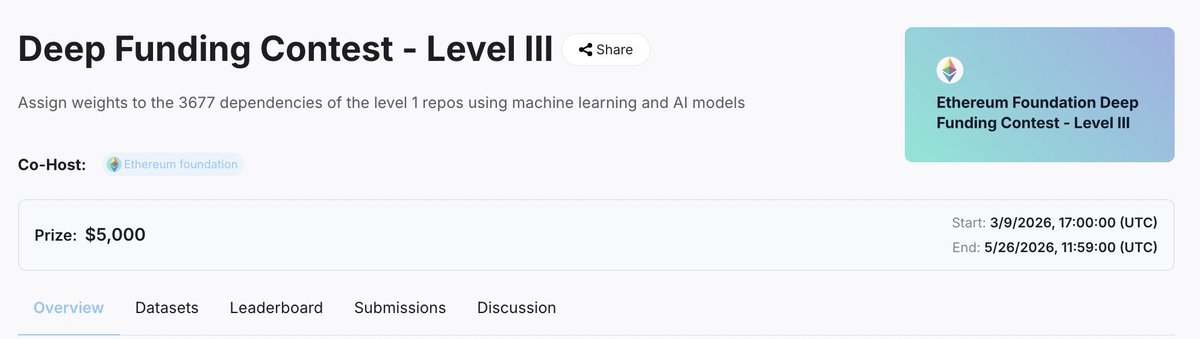
Deep Funding Level III has closed.
$5,000 in prizes, and a leaderboard determined by how closely each model's predicted weights match the scores given by human maintainers.
One of the write-ups, from a participant (Rohith10) who built a model called FWDIS (Frequency-Weighted Dependency Importance Scoring), is worth pulling out as an example of what serious participation in this round actually looks like.
The interesting part is the hypothesis the participant decided to test.
The baseline approach to scoring dependencies treats each one as if its importance lives entirely inside the relationship between that dependency and its parent repo, which means you're scoring web3py's contribution to ethers, web3py's contribution to eth-brownie, and web3py's contribution to every other repo that uses it as if each were a separate question.
Rohith10 noticed that this misses something obvious, a dependency that 20 repos rely on is probably more foundational than one that a single repo uses, and that observation can be turned into a feature the model uses to adjust its weights.
The implementation is three lines of code.
Count how many of the 98 repos use each dependency, normalize by 98, multiply the baseline weight by one plus a tuning coefficient times that frequency score, and renormalize so each repo's dependency weights still sum to 1.
The participant found through grid search that a coefficient of 0.42 produced the best alignment with jury scores, and the model landed in the top tier of the leaderboard with a score of 0.2402 against the baseline's 0.2472.
The reason this is worth sharing is because this participant's process is exactly what the mechanism is built to reward.
They formed a hypothesis about what human jurors actually value when they score dependencies (foundational utility across the ecosystem, not just contribution to one parent), turned that hypothesis into a feature, tested it against the data, and shipped a model that aligned with expert judgment better than the baseline did.
This is what distilled human judgment looks like when it works. Markets reward whoever predicts the jury most accurately, and the path to predicting the jury accurately runs through understanding what experts actually care about.
The contest is open for Level 1 and Level 2 until May 10.

4
3
26
8,056