
Mojobouji-Media,Music, Movie,Mentor; Mc/Event Host🎤DJ;Feel Good Film club founder;ex BBC📻📺Presenter/Producer/Journalist/🎧moi views❤️🧘ev🚗⚽️🎾🏏🇧🇷🇬🇧🇯🇲
Joined July 2012
- Tweets 3,333
- Following 1,048
- Followers 936
- Likes 9,944
508 Photos and videos











Devon Daley retweeted

Jun 15
En 1938, des chercheurs de Harvard ont lancé l’étude la plus ambitieuse de l’histoire en suivant la vie de 724 personnes, de leur adolescence jusqu’à leur décès, afin de découvrir ce qui rend réellement une personne heureuse et accomplie.
Pendant des décennies, ils ont analysé leurs cerveaux, leurs salaires, leurs relations et leurs traumatismes. Après 85 années de données, ils ont mis en évidence une corrélation surprenante, à laquelle personne ne s’attendait.
La réussite professionnelle à l’âge adulte ne dépendait ni du quotient intellectuel, ni de la richesse des parents, ni des notes scolaires. L’un des prédicteurs les plus puissants du succès était quelque chose de très simple : faire des tâches ménagères durant l’enfance.
Sortir les poubelles ou faire la vaisselle n’est pas seulement une question de propreté ; c’est un entraînement du cerveau. L’étude, connue sous le nom de Grant Study, a révélé que les tâches domestiques enseignent une leçon qu’aucune école ne peut reproduire : « l’éthique de la contribution ».
Lorsqu’un enfant doit arrêter de jouer pour mettre la table, il apprend que le monde ne tourne pas autour de lui. Il comprend qu’il fait partie d’un écosystème et que son effort est nécessaire au bon fonctionnement du groupe.
Les chercheurs ont découvert que les enfants qui participaient aux tâches devenaient des adultes qui :
– savent reconnaître ce qui doit être fait et le font sans qu’on le leur demande (initiative) ;
– éprouvent davantage d’empathie pour le travail des autres ;
– gèrent mieux la frustration et le report de la gratification.
À l’ère de la « parentalité hélicoptère », où l’on évite que les enfants s’ennuient ou travaillent, Harvard nous avertit qu’en les protégeant des tâches ennuyeuses, nous leur retirons les fondations de leur future compétence professionnelle.
Si vous voulez que votre enfant devienne un adulte accompli, ne lui achetez pas plus de jouets éducatifs. Donnez-lui un balai.
Source : Harvard Study of Adult Development (Grant Study) et Julie Lythcott-Haims (How to Raise an Adult).
Universo Sorprendente.

70
1,370
3,521
184,299
Devon Daley retweeted

Jun 13
#LatestShows #OnDemand #FreeToStream... Time for something fresh! A new show but from a name you'll know. It's a welcome return to your speakers to the man called @devondcdaley: #LunarSoul 🎧 buff.ly/ORIE9Ah #28GoodReasons #Derbados 발견하다

2
2
52
Devon Daley retweeted

Jun 13
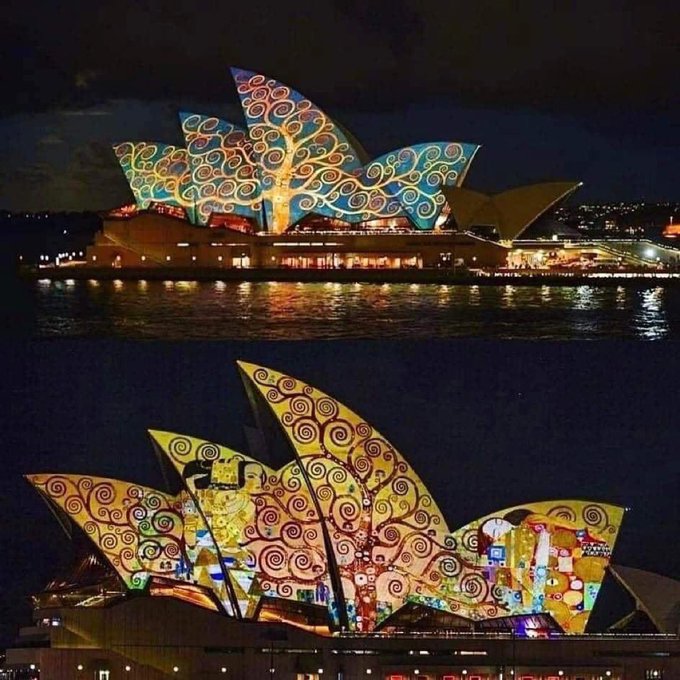
The Sydney Opera House illuminated with Gustav Klimt's The Tree of Life.
85
1,398
8,342
126,985
Devon Daley retweeted
Jun 13
A brand-new show heads to #SoulandJazz later today but not with a new name... Making his S&J debut, the legend that is @devondcdaley! #LunarSoul arrives @ 7p BST/ 2p EDT / 11a PDT / 3a JST / 8p CEST #28GoodReasons #LetsGoBaby #HoldTight

1
2
35
Devon Daley retweeted

Telegraph Sport has combed through 96 years of World Cup drama to compile a list of the top 30 moments:
🥉 Brazil 1 Germany 7
🥈 The duality of Maradona in 1986
🥇 ??
See the full list and have your say ⬇️
telegraph.co.uk/football/202…

5
8
39
20,642
Devon Daley retweeted

When architecture is done right, you do not need a sign telling you the place matters. You feel it before anyone explains it.
4
19
273
15,288
Devon Daley retweeted

"Trees are poems that Earth writes upon the sky."
Khalil Gibran
Ralph Emerson art

40
1,171
5,111
71,651

May 26
Highly talented, humble human…next level footballer wins Premier League player of the season 25/26. @B_Fernandes8 also watch his heart warming interview with @StevenBartlett real life talk n tears… not just football tings ⚽️ 🎙️
25

May 10
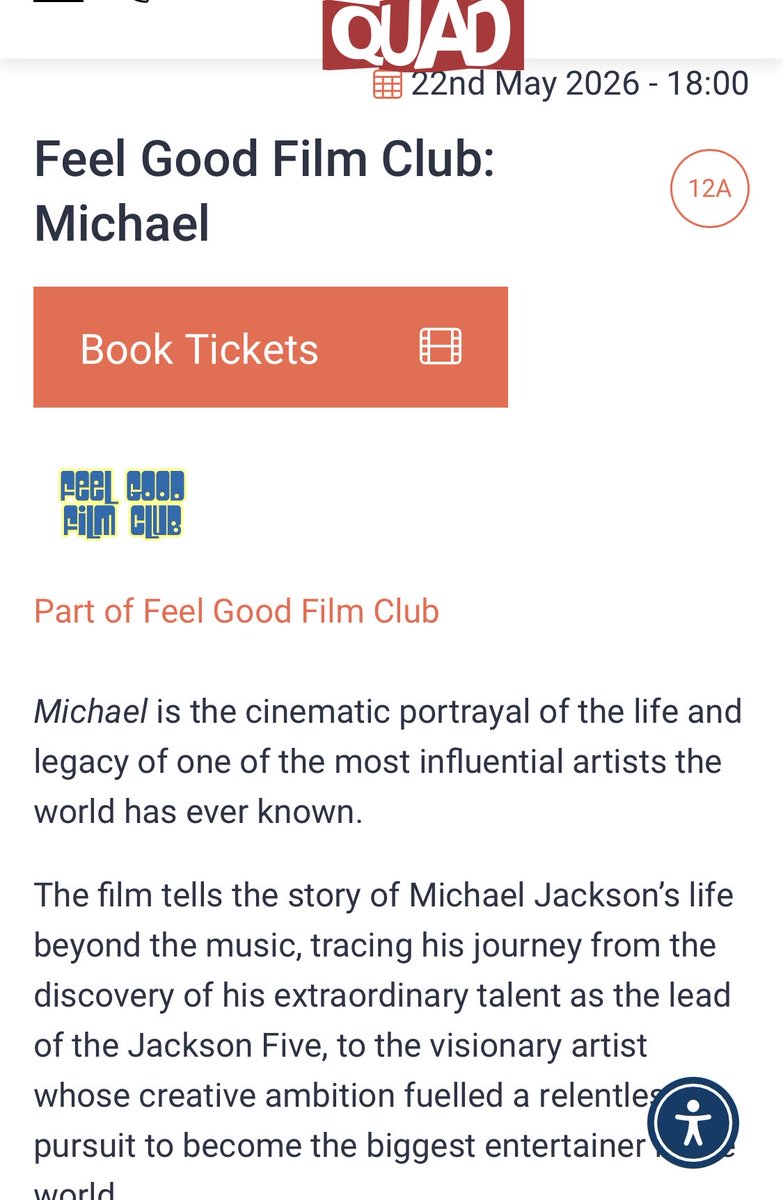
#michaelfilm @michaelmovie Fri 22 May @derbyquad 6pm derbyquad.co.uk/events/fgfcm… plus Q&A post film w/ #jessietsang CEO @solarrecordsuk & former #Michaeljackson History tour magazine Editor @feelgoodfilm @BBCDerby @TheVoiceNews @DerbyCA @DerbyTelegraph #feelgoodfilmclub #mojobouji


121
Devon Daley retweeted

For 50 years, eggs were treated like a cardiovascular threat. The 1960s dietary guidelines capped cholesterol intake at 300mg per day. Two eggs put you at the limit. The advice moved millions away from the food, and away from a nutrient profile we didn't fully appreciate at the time.
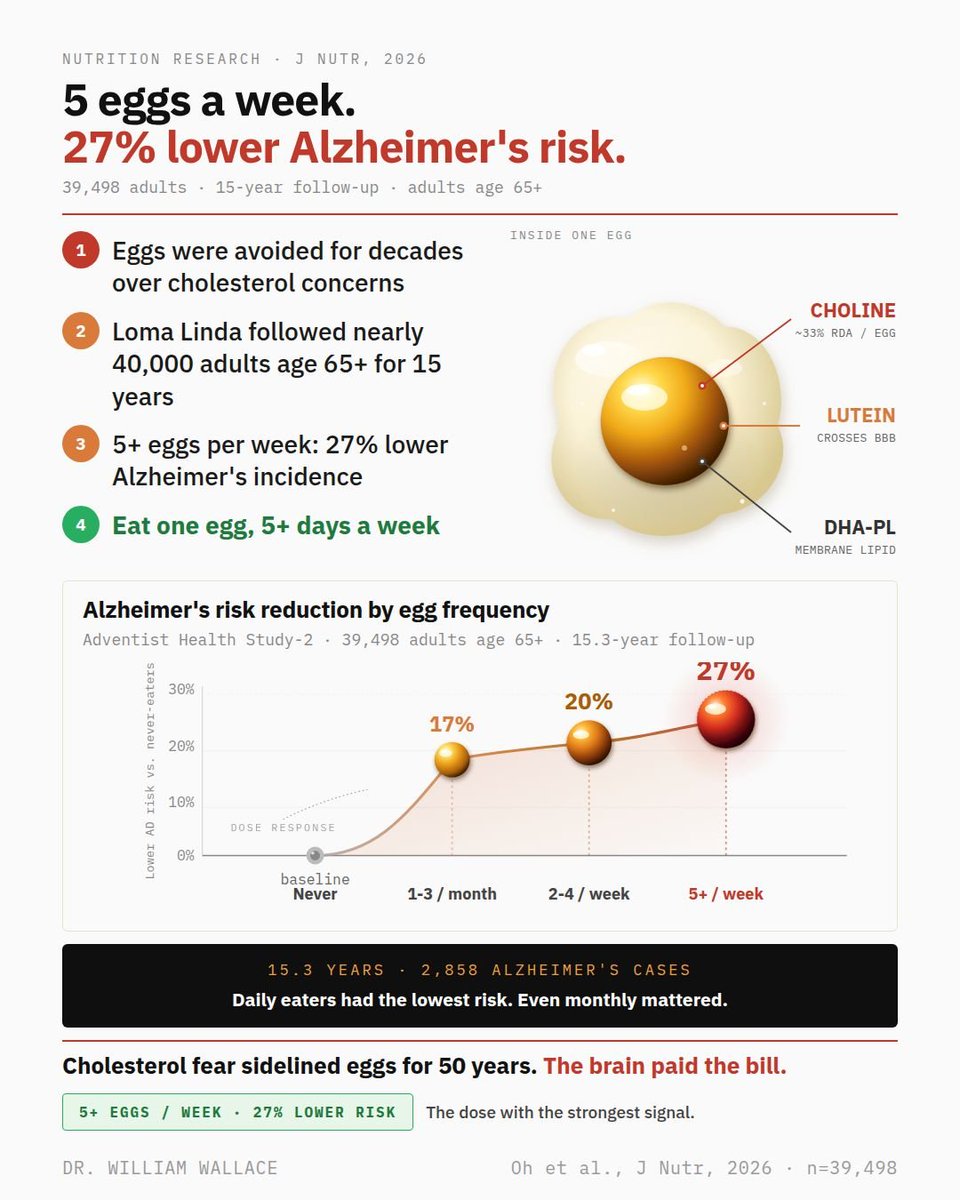
A new study from Loma Linda University followed 39,498 adults age 65 and older for 15.3 years. The team linked Adventist Health Study-2 dietary records with Medicare diagnoses. Over that window, 2,858 participants developed Alzheimer's disease.
The dose-response was clean.
Eating eggs 1 to 3 times a month: 17% lower incidence vs never-eaters.
2 to 4 per week: 20% lower.
5 or more per week, roughly one a day: 27% lower.
The mechanism story isn't new, but the cohort scale and 15-year follow-up are. Eggs are the densest natural source of choline in the American diet. One large egg supplies roughly 33% of the daily choline requirement. Choline is the substrate for acetylcholine, the neurotransmitter that drops in Alzheimer's. Donepezil, the most prescribed Alzheimer's drug, works by blocking acetylcholine breakdown. The disease is partly defined by cholinergic neuron loss.
Egg yolk also delivers lutein and zeaxanthin. These are the only two carotenoids that cross the blood-brain barrier and accumulate in cortical tissue. Higher tissue levels track with better processing speed and memory across multiple older-adult cohorts. Yolk also contains DHA, primarily in phospholipid form. Phospholipid DHA enters the brain more efficiently than DHA in triglyceride form, which is the dominant form in fish oil capsules.
Now the caveats, because they matter.
This is observational. Causation cannot be drawn from a cohort study. The Adventist Health Study-2 cohort skews heavily vegetarian and health-conscious, so people who eat eggs in this cohort do not look like the average American egg-eater. The "never eats eggs" comparison group is largely vegan, which is its own dietary pattern with its own complications. Reverse causation also has to be considered. People in early Alzheimer's often change eating patterns before diagnosis. Some of the apparent protection could be that healthier brains keep eating eggs, not the other way around.
The mechanism story I outlined above is supported by adjacent literature, not by this paper. The study did not measure choline status, lutein levels, or DHA in tissue. It measured eggs in, dementia out.
What we can say honestly: in a 40,000-person cohort followed for 15 years, egg intake tracked with substantially lower Alzheimer's incidence in a dose-response pattern. The mechanism is biochemically plausible, supported by other lines of evidence, and consistent with what we know about acetylcholine and brain carotenoid status. The randomized trial that would prove causation has not been run.
The practical version: if you are over 50 and not allergic, eating an egg most days has stronger evidence behind it for brain health than most products marketed for the same goal. Five days a week was the dose with the lowest risk in this cohort. Even 1 to 3 per month showed measurable benefit.
For 50 years the question was whether eggs were dangerous to your heart. The data behind that fear was always weaker than the guidelines made it sound, which is why the 2015 Dietary Guidelines for Americans quietly removed the 300mg cap. The brain question got asked too late.
Oh et al., J Nutr, 2026 (DOI: 10.1016/j.tjnut.2026.101541)
8
105
297
14,206
Devon Daley retweeted

21 Dec 2024
#OnThisDay 1954: David Attenborough appeared on television for the first time, in Zoo Quest.
In 1984, Miles Kington observed him in his natural habitat of Broadcasting House, Bristol, before discussing the craft and the challenges involved in making wildlife films.
7
55
214
30,408
Devon Daley retweeted

L’hommage du Roi Charles III pour les 100 ans de Richard Attenborough c’est quelque chose ! Réalisé par la @BBC
C’est doux, c’est tendre. C’est plein de potizanimos.
We need this
35
153
639
33,209

Devon Daley retweeted

🦍One of Sir David Attenborough's most memorable moments? This encounter with a group of playful mountain gorillas in Rwanda in 1979.
Happy 100th birthday Sir David! 🎉
🎧 bbc.in/4wnTPtc
33
1,200
4,975
105,515
Devon Daley retweeted
May 8
It's Sir David Attenborough's 100th birthday and in 1980 he faced questions from an audience of young viewers about his life and television career. Lesley Judd hosted the show, and Attenborough talked about making a connection with gorillas, and his concerns for the environment.
44
853
4,380
219,106

A lifetime dedicated to bringing the natural world closer to us all.
Happy birthday, Sir David Attenborough – from Planet Earth 💚🌍
#AttenboroughAt100 #DavidAttenborough100 #DavidAttenborough
43
697
2,372
88,002
Devon Daley retweeted

May 4
TIME IS NOT TREATED THE SAME EVERYWHERE:
1. Germany: Being late is disrespectful. Meetings start to the second. Punctuality here is not a habit. It is a moral standard.
2. Brazil: An invitation for seven means nine. Relationships matter more than schedules. Rigidity kills the atmosphere.
3. Japan: Trains run to the minute. A sixty second delay comes with a formal public apology. Time is a system. The system is everything.
4. India: Events begin when people arrive. The gathering defines the time. Presence matters more than precision.
5. Polynesian cultures: Time was tied to stars, seasons, and the ocean. Circular, not linear. The clock came later and from somewhere else.
6. United States: Time is money. Literally. Every hour is billable. Every minute is scheduled. Rest has to earn its place.
7. Spain: Lunch at three. Dinner at ten. The day bends around the person. Not the other way around.
8. Ethiopia: A different calendar entirely. Thirteen months. New Year in September. A different year than the rest of the world. Time here is a cultural choice, not a global agreement.
9. France: August belongs to rest. Emails go unanswered. Shops close. Nobody apologizes for this. Leisure is a right, not a reward.
10. Kenya: The clock starts at sunrise. Six in the morning is hour zero. Noon is hour six. Time is built around light, not an arbitrary number on a wall.
11. China: One time zone for the entire country. A landmass that should span five. In the far west the sun rises at ten in the morning. Unity was chosen over accuracy.
12.Australia: Aboriginal communities have always read time through seasons, animal movements, and the stars above. For over sixty thousand years the land itself served as the calendar. No clock was ever needed. Nature told them everything.
13. Mexico: Mañana means not right now. Urgency is often self-imposed. The present moment has its own demands and they are considered legitimate.
14. Greece: A guest arrives at any hour. You welcome them fully. The clock adjusts to the person. The person never adjusts to the clock.
15. Scandinavia: Months of darkness then months of endless light. The body follows seasons, not schedules. This is ancient. Science is only now catching up.
16. Nigeria: Start times are a suggestion. What matters is that everyone arrives, connects, and the evening becomes what it was meant to be. The experience always outranks the schedule.
17. Indonesia: Jam karet. Rubber time. Time stretches around mood, traffic, and social obligation. Rigidity is considered uncomfortable, not professional.
18. Russia: Eleven time zones. Vast winters. Long silences. Time here is treated with patience that outsiders often mistake for slowness.
19. Egypt: One of the first civilizations to invent a calendar. Yet modern Egyptian social time is deeply flexible. Hospitality always comes before the clock.
20. Congo: Community shapes the day more than any schedule. Time belongs to the people in the room, not the hands on the clock.
21. Philippines: Filipino time is a known and accepted reality. Six in the evening means seven or eight. Arriving before the host is ready is the real social mistake.
22. Vietnam: Built on endurance and long horizons. Planning here thinks in years and generations. Short deadlines feel foreign to a culture that measured time in struggles spanning decades.
23. Tanzania: Pole pole. Slowly slowly. A phrase that governs daily life. Rushing is not a virtue here. Moving with intention is.
24. Argentina: Dinner at ten. Parties at midnight. The night is its own world. Compressing it into earlier hours would make it something lesser.
25. Turkey: A meeting can become a meal can become a long evening. Nobody considers this a deviation. It is simply what time is for.
26. Iran: Its own solar calendar. New Year on the spring equinox. Time tied to nature, poetry, and a civilization so old that modern urgency feels like a passing trend.
71
1,142
4,938
705,988

Devon Daley retweeted

Apr 16
A simple visual for kids (and adults) to understand delayed gratification.
116
2,559
13,261
846,945