
SHIB advocate, ShibariumNFTs enthusiast. REMEMBER—My tweets aren't financial advice; DYOR always. Watch out for scammers! I won't DM first! ✨Keep Building✨
Joined March 2023
- Tweets 17,564
- Following 557
- Followers 2,285
- Likes 37,582
5,927 Photos and videos













Pinned Tweet

30 Nov 2025
🚨🐕🔥 SHIBARMY SAFETY GUIDE — OFFICIALLY RELEASED! 🔥🐕🚨
Today… we build smarter. We protect harder. We grow stronger. While others chase hopium, we choose wisdom.
This series is for every holder, every newcomer, and every future ShibArmy member who will discover $SHIB years from now.
Introducing the SHIBARMY SAFETY GUIDE - 10 essential rules your wallet, your crypto, and your peace of mind deserve.
And this is only the beginning…
The first of many series in the SHIBARMY SAFETY GUIDE.
Much more to come. Much more to build. Much more to protect.
This is for the present ShibArmy.
This is for the future ShibArmy.
This is our contribution to a safer ecosystem… together.
💥Watch. Learn. Share. Protect each other. Let’s make safety part of our culture. 🛡️🐕💙
Follow for more guides: @dhelSHIB Your safety officer… probably forever. 🤭🔥
‼️ Please share this and help spread safety, wisdom, and protection across the entire ShibArmy.
13
58
266
13,037
dhel.SHIB 🐕💨 retweeted

May 11
SHIB continues to shape capital flows across the entire meme coin market.
Whales accumulate as traders still hunt for “the next SHIB.”
Legacy status remains strong!
Details: chainstreet.io/shib-legacy-s…
1
10
39
643
Apr 29
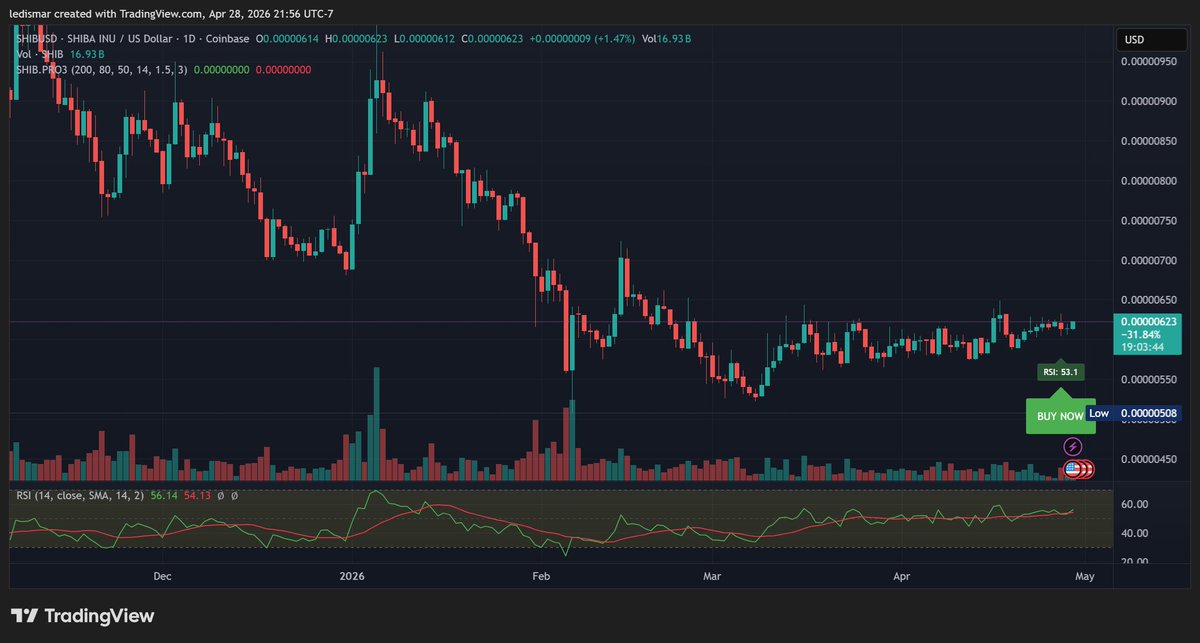
🚨 $SHIB BUY SIGNAL TRIGGERED 🚨
Daily chart just flashed BUY NOW 🟢
Momentum building… RSI pushing strength… structure stabilizing. This isn’t hype. This is setup.
📊 Trend: Bottoming → Reclaim phase
⚡ RSI: Holding above 50 (bullish pressure building)
📈 Volume: Quiet accumulation
Smart money doesn’t chase.
They position early.
$SHIB loading…
🐕🔥
4
23
105
2,310
dhel.SHIB 🐕💨 retweeted

Apr 24
Wallets stacking fast.
$BONE crossed a major milestone.
The quiet moves are getting loud.
Doggy Bytes 105 caught the shift.
Check numbers
magazine.shib.io/wagmi-shib-…
2
20
48
13,153
Apr 19
Apr 18

A new dedicated home for $SHIB has arrived. Dive into the origin story, the mission, and the movement that built the #SHIBARMY.
shibatoken.com/
1
7
52
1,179
Apr 18
$SHIB 🐕 Woof! 🔥🚀
Apr 17

SHIB just broke key whale resistance at $0.0000065, up 5.11% today
Whales have been stacking hard= 2.02 trillion tokens ($12.16M) this month
Exchange reserves dropped another 82.5B SHIB in 24h as big players move to self-custody
Support holding firm at $0.0000060
Next stop $0.0000070 if Bitcoin stays above $74K
Real accumulation or just another meme pump?
Full on-chain breakdown here: chainstreet.io/shiba-inu-bre…
What’s your SHIB target?
9
58
1,432
Apr 11
LFG ShibArmy! Go $SHIB! 🐕🚀
Apr 11
SHIB Army that held through 93% drawdown… this one’s for you
Regulators just dropped SHIB into the digital commodities category with the big boys
Higher-timeframe structure looks cleaner than it has in years
Analyst: “New ATH is not a question. It’s just a matter of time"
Sound familiar? 2020 vibes all over again
Full breakdown chart 👇
chainstreet.io/shiba-inu-new…
Who’s still in? 🔥
1
6
47
1,258
dhel.SHIB 🐕💨 retweeted
Apr 9
A $170 SHIB investment turned into $5.2 billion at peak
That viral wallet is making the rounds again this week, reminding everyone what real asymmetric upside once looked like
In April 2026: fresh whale accumulation of ~2 trillion SHIB
Is 2026 repeating 2021 or just showing the same mechanics in a faster, more mature market?
chainstreet.io/170-→…
RT if you remember the 2021 SHIB legends.
3
20
92
3,463
dhel.SHIB 🐕💨 retweeted
Apr 8
Shiba Inu just got a regulated on-ramp into Japan’s mainstream retail finance
Starting next week, the “Amazon of Japan” with 80 million users will add SHIB for direct JPY spot trading under full FSA oversight
Now comes the real test: can a meme token attract steady capital inside one of the world’s most disciplined retail finance systems?
chainstreet.io/amazon-of-jap…
RT if you’re watching how it plays out.
9
89
312
12,845
Apr 8
$SHIB 🐕🔥
Apr 8
Fintech backed by Walmart made SHIB spendable!
Over 3M users can now buy groceries & everyday goods with Shiba Inu
Seamless fiat conversion at checkout, zero volatility drama for merchants
Real utility just hit retail scale
RT if SHIB Army is eating this up 🔥⬇️
chainstreet.io/walmart-backe…
1
10
60
1,801
Apr 8
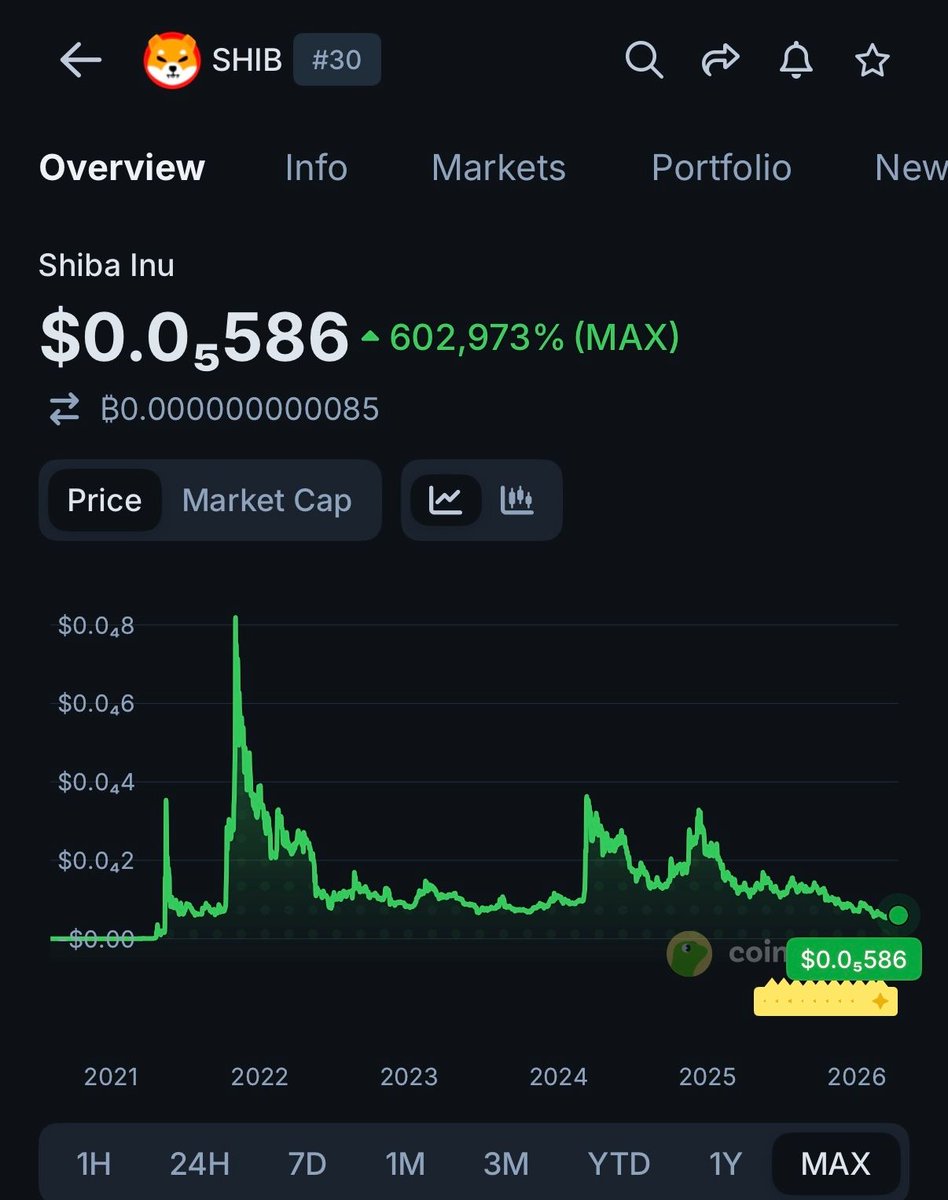
ATH drawdown headlines are easy. Context is harder.
Let’s break it down properly 👇
THE COMPARISON
If we’re talking ATH drawdowns… let’s be consistent:
Doge: down ~85–90%
Pepe: down ~60–80%
SHIB: down ~90%
That’s not a SHIB issue.
That’s the cycle.
MARKET REALITY
Most crypto assets drop 80–95% after peak hype. The real metric isn’t the fall…It’s what happens AFTER.
TECHNICAL ANALYSIS
Current structure on $SHIB :
• Long-term support holding
• Consolidation after macro downtrend
• Volatility compression (pre-move behavior)
• Accumulation zone forming
This is how new cycles begin… quietly.
TA TRANSLATION
Weak hands exited. Strong hands accumulating. This phase doesn’t get headlines…It builds foundations.
FUNDAMENTALS
While others rely on hype cycles…SHIB kept building:
• Shibarium (L2)
• Expanding ecosystem
• Real utility layers
That’s not meme behavior. That’s evolution.
THE UNBREAKABLE FORCE
And then there’s the part you can’t chart…The SHIBARMY.
• Global
• Loyal
• Still here through cycles
That’s not hype. That’s staying power.
THE CYCLE TRUTH
Every cycle separates:
❌ Hype coins
✅ Survivors
Survivors build. Survivors attract real capital next cycle.
CLOSING
Price drawdown ≠ failure.
Structure development community = longevity.
$SHIB checks all three.
This is the part you can’t measure.
👉 The SHIBARMY 👈
Still here. Still building. Still strong.
SHIBARMY STRONG 🐕🔥
They focused on the chart.
We built the army.
$SHIB 🐕💎

1
17
93
3,652
Apr 7
Shiba Inu Holds Japanese Listing Advantage Rare for Meme Assets chainstreet.io/shiba-inu-hol…
Woof! $SHIB
2
13
41
732
Apr 5
Happy Easter, SHIBARMY 🐕🐣🌸
May your day be filled with fresh starts, strong conviction,
and baskets full of wins.
No matter the market…
we stay patient, we stay focused, we stay SHIB.
Because real believers don’t chase hype…we build, we hold, and we grow.
Enjoy the day with family, laughter, and maybe a few hidden gains 🤭
SHIB and ONLY SHIB 🐕💎
Woof! $SHIB
6
22
370
Apr 5
Refreshed the interior of my 2006 Nissan 350Z with a repaint on the door and console panels. I like to keep the OEM vibe on my 350Z…always looks cleaner and more timeless than going full carbon fiber.
2
6
271
Apr 1
‼️Quantum computing will not break Bitcoin or Ethereum today. But it is no longer a distant concern the crypto industry can ignore.
👉Quantum Computing and Crypto. What BTC, ETH, and SHIB holders should understand.
What is actually being discussed?
Bitcoin and Ethereum rely on public-key cryptography built on elliptic-curve systems. In Bitcoin, this includes ECDSA and, in newer Taproot usage, Schnorr signatures. These systems protect wallet ownership and transaction integrity.
In theory, a sufficiently advanced quantum computer using Shor’s Algorithm could derive private keys from public keys and forge valid signatures.
If that capability becomes practical, it would fundamentally change how digital assets are secured.
However, that point has not been reached.
There is currently no quantum computer capable of breaking the cryptography used by Bitcoin or Ethereum in real-world conditions.
When does this become a concern?
The immediate risk is low. The change is in trajectory, not current capability.
Recent research suggests that the quantum resources required to break elliptic-curve cryptography may be lower than previously estimated. At the same time, major institutions have begun accelerating their own timelines for adopting post-quantum cryptography.
This does not mean that Bitcoin or Ethereum will be broken in the near term. It does mean the issue has moved from a distant theoretical discussion to something that requires active monitoring over the coming years.
Why does this matter for BTC, ETH, and SHIB?
For Bitcoin, exposure depends on how funds are used. In many address types, public keys are not revealed until funds are spent, which provides an additional layer of protection. Address reuse and previously exposed public keys increase long-term exposure.
Ethereum faces the same class of cryptographic risk but evolves more rapidly and is actively researching post-quantum migration paths.
🚨SHIB holders should understand that:
SHIB on Ethereum shares Ethereum’s cryptographic exposure.
Activity involving Shibarium also depends on Shibarium’s own architecture and bridge model, although it is designed to leverage Ethereum security.
The broader point is that this is not unique to one asset. It is a system-wide consideration.
How should investors prepare?
Preparation does not require urgency, but it does require awareness.
1. Use hardware wallets such as Ledger or Tangem to keep private keys offline.
2. Avoid unnecessary address reuse.
3. Limit long-term holdings on exchanges.
4. Stay informed about protocol upgrades and be prepared to migrate when post-quantum standards are introduced.
These are prudent steps that improve security today while positioning for future changes.
SHIBARMY - What should you do right now?
👉Stay calm and stay informed. This is not an immediate threat, but it is a developing one.
If you hold long-term positions, prioritize self-custody using trusted hardware wallets. Use fresh receive addresses when possible and avoid reusing old ones unnecessarily. Keep only active trading funds on exchanges and move long-term holdings to cold storage. Pay attention to future updates from Ethereum and the broader ecosystem regarding post-quantum upgrades.
Small, consistent habits today can reduce future exposure.
The most important point is this:
Quantum computing represents a real long-term shift in digital security. The current threat is low, but the direction of progress makes it relevant now.
The correct response is not panic. It is informed preparation.
$SHIB
ALT SHIB
1
4
259
Mar 19
6
29
362
Mar 19
2
11
63
791
Mar 17
2
11
55
848