
193 Photos and videos






Diego retweeted

May 5
Every time I see a team celebrating their new "shared module," I remember this lesson.
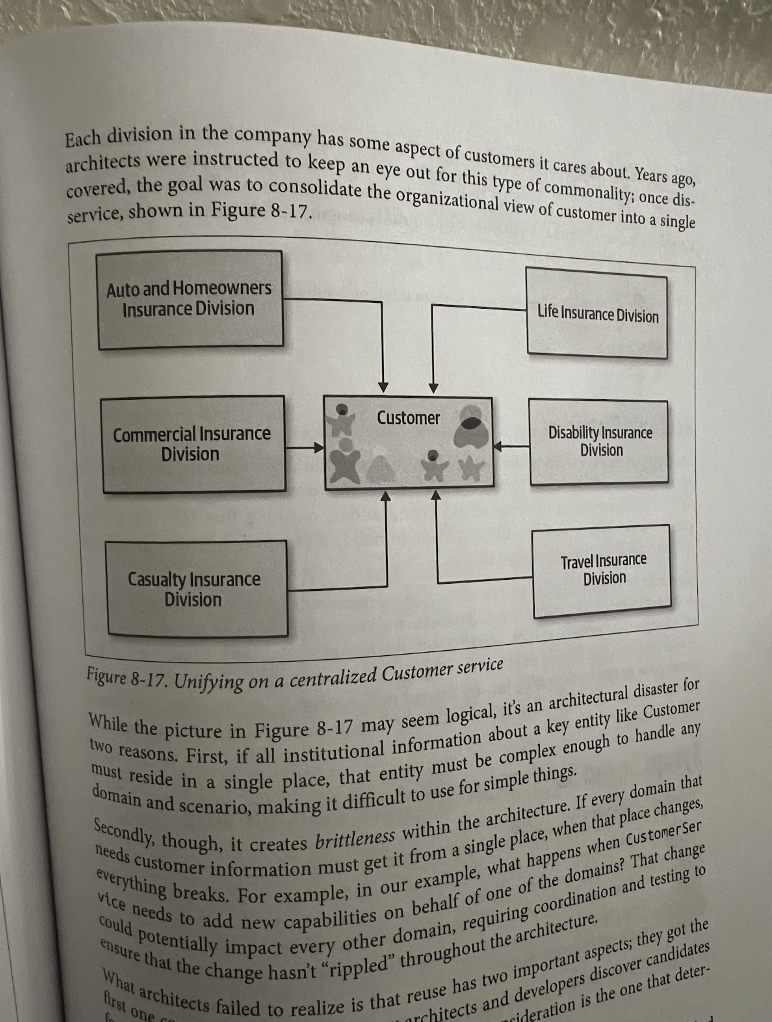
Reuse is a dangerous form of coupling.
They found the same logic in two places and did what good engineers do: put it in one place and called it a win. Clean, responsible, textbook.
Six months later, someone needs to change it.
Suddenly, a small update for one team's requirements breaks three services, blocks two releases, and triggers an emergency meeting between people who've never talked to each other before.
This is the cost nobody preaches about.
DRY is one of those principles that feels unquestionably right until you apply it across team boundaries. The moment you share a module between domains, you're not just sharing code. You're creating a dependency that nobody owns and everyone resents.
Before you reuse, ask:
Will this change often?
Does it belong to one domain?
Are the consumers truly aligned in purpose?
Will one team’s change surprise another team?
If the answer to any of these is "I'm not sure," stop. Duplicate it.
I know how that sounds. It feels lazy. It feels like the thing a junior developer does before they know better. But here's what nobody wants to say out loud: two independent implementations you control are almost always cheaper than one shared one serving masters with different goals.
Duplication is a local problem. Coupling is an organizational problem.
One of them you can fix in an afternoon. The other requires a meeting with five teams and someone's manager.
Reuse isn't free. Treat it like the trade-off it is.
30
68
414
25,605

Today we're introducing conan-py-build: a PEP 517 backend that brings Conan's C/C dependency management directly into pip wheel .
If you ship Python wheels with native code, this might save you a lot of CI glue.
Beta. Feedback welcome.
blog.conan.io/cpp/conan/pyth…
6
13
891
Conan 2.28 is out, and it is big
- New "policies" to fix several long standing issues without breaking
- Better output (started with export cmd) and html graphs
- New "consistent" trait to disambiguate "visible=False"
- Python wheels in PyPI
And many more docs.conan.io/2/changelog.ht…
2
5
709
The annual 2026 global C developer survey is now open, your feedback is important!
isocpp.org//blog/2026/04/202…
1
4
426
🛡️ Secure C packages with Sigstore!
New in Conan 2.26:
✍️ conan cache sign
🔍 conan cache verify
Try our Sigstore plugin example using Cosign to sign/verify artifacts. Feedback welcome! 💡
docs.conan.io/2/examples/ext…
#ConanIO #Sigstore #Cosign #Cpp #DevSecOps
2
5
313
Conan 2.27 is here:
- Fixes and improvements in new CMakeConfigDeps
- Better html graphs
- new "tools.cmake:configure_args" conf
- new "tools.build:rcflags" definition
And many other improvements and fixes, check docs.conan.io/2/changelog.ht… and upgrade!
4
14
1,157
Reproducible and traceable configuration for Conan C and C package manager
- Version and easy update config
- Share it and update to devs and CI
- Easy "conanconfig.yml" bootstrap
- Lockfile reproducibility
- Effect on package-id
blog.conan.io/cpp/conan/conf…
4
6
308
Diego retweeted

Feb 7
I embrace the future, but something will be lost in the process.
nolanlawson.com/2026/02/07/w…
1
1
5
407

Feb 3
The Conan video trainings are complete now!
Practical, hands-on exercises in a self-paced video course, completely for free in the JFrog Academy. More than 4 hrs of high quality material to quickly learn Conan C and C package manager

Conan 2 Essentials and Advanced Training Now Complete on JFrog Academy
blog.conan.io/2026/02/03/Con…
1
5
256
Conan 2.25 is out, and this one is a big release!
- CMakeConfigDeps now available, no more incubating!
- Added experimental xz and zstd compression
- Improved CPS integration
- Optimizing DB access
- New PyEnv with Python versions
- Continued ConanAPI public docs
And many more!
1
2
6
288
Conan 2.24 release is out (sooner than usual)!
- cache check-integrity new json output
- improvements to workspaces
- conan config install-pkg conanconfig.yml file
- More docs for Python ConanAPI
- Improved html outputs
And many more, check docs.conan.io/2/changelog.ht…
2
10
1,169
Diego retweeted

7 Dec 2025
What if your fave OSS tool vanished tomorrow? Happened to @kubernetesio Ingress NGINX—thanks to zero corp backup. Pros/cons, burnout truths, & my @HelmPack fears in my new post. Time to pay the maintainers! 👇
rimusz.net/the-maintainer-me…
1
5
264
🚀New blog post!
Meet the Conan MCP Server — run Conan through ChatGPT or Cursor using natural-language prompts.
Bootstrap projects, search packages, inspect profiles, check vulnerabilities… all from a prompt.
And yes, there are GIFs 😎
👉blog.conan.io/mcp/ai/gpt/con…
5
6
516
Do you want to learn how to work on multiple Conan packages simultaneously in a single mono-repo like super project?
Watch the "workspace" introduction with demos at @nwcpp!
youtube.com/watch?v=RByyxpWo…
2
7
661
Conan 2.23 is out!
- New "conan run" to run executables within venvs
- Support latest VS 2026, OSX 26.1
- Improved "conan report diff"
- Workspaces learned to gather info from packages
- conan install/create can generate .json on fail
And more! See docs.conan.io/2/changelog.ht…
4
7
793
How to Use Compiler Sanitizers in Your C/C Workflow with Conan
Check the new blog post!
blog.conan.io/sanitizers/too…
2
11
850

A good overview! It's definitely worth having a dedicated page on the website. Recently, I gave a talk at Meeting C 2025 on sanitizers and integrating them into build and package systems, particularly with Conan, which could be interesting to check out:
omniverse.ru/talks/meetingcp…
3
5
238
C and C compiler sanitizers are security important tools
Check the new doc: docs.conan.io/2/security/san…
- sanitizers available in different compilers
- how they affect binaries
- how they can be combined
- compiler flags in gcc, clang, msvc
- how to build dependencies sanitized
1
5
11
673
Recall that we are now posting more regular updates about Conan in LinkedIn, for example
linkedin.com/feed/update/urn…
We will be next week in #ROSCon2025 in Singapore. Meet us at the booth (or let us know if you are based in Singapore and want to meet)!
4
11
1,002
8 Oct 2025
Primera y ultima vez que pido en @Glovo_ES, que desastre, me he quedado sin cena de celebracion familiar por su culpa, pedido que nunca llegó pero se marca como entregado, nunca llamo nadie...
1
2
191