Joined January 2011
- Tweets 5,679
- Following 2,697
- Followers 1,797
- Likes 7,166
219 Photos and videos








Pinned Tweet

23 Oct 2022
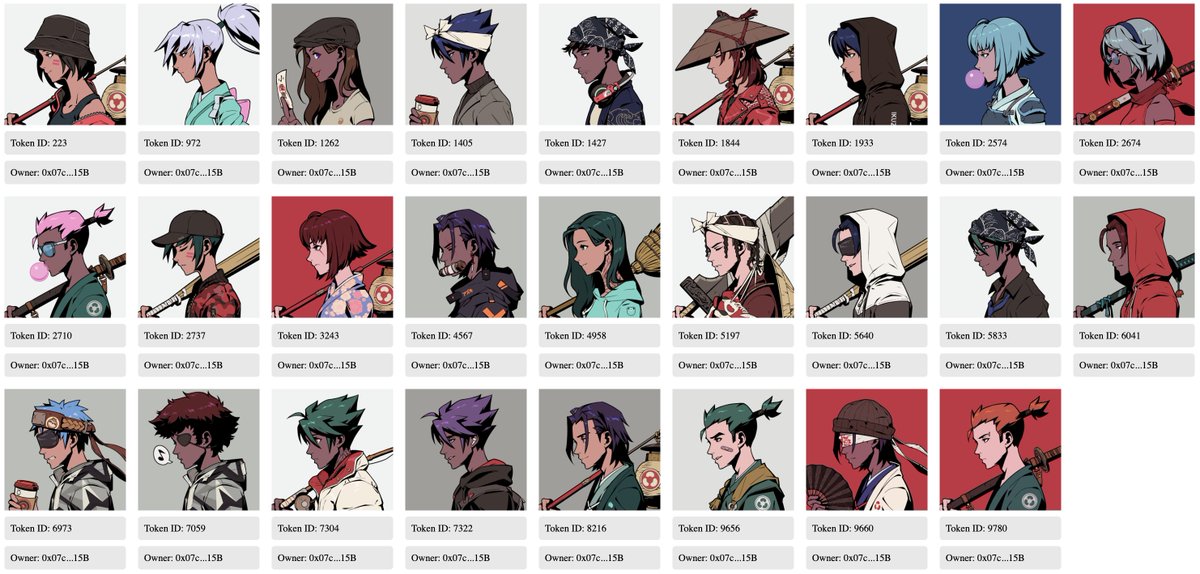
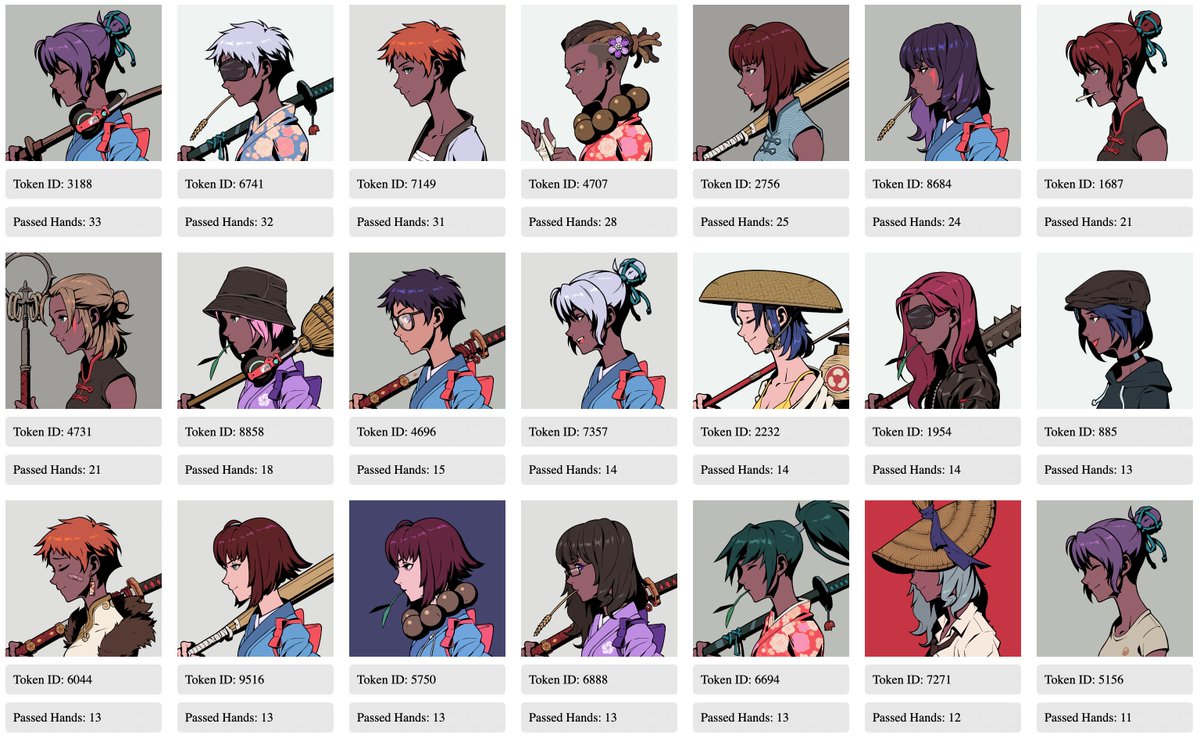
🦖👑📸 Photo Series of KaijuKingz 1st Birthday Party
"I’m not FOMO-ing, you’re FOMO-ing. Partying up this weekend because it’s @KaijuKingz birthday. 🎉"
#KingzOnTop #SGKK @KaijuKingzSG
🧶 1/6




12
39
171

dill.eth retweeted

19 Feb 2025
I'm launching propels.ai - TikTok-style outbound sales video!
Cold email is hard, even for companies like AWS, where I started my career in enterprise outbound sales.
Poor reply rates isn't because you pitched the product incorrectly, but because recipients fail to see the benefits in the emails. As a result, they tend to ignore the message.
That’s why I created propels.ai. Instead of just discussing features, why not demonstrate what you can do directly? Include a video message in the email so recipients can watch and gain a better understanding.
Shoot me a DM or book a demo on the website directly if you're interested in knowing how to generate more revenue in cold emails!
25
5
91
15,021
dill.eth retweeted

10 Jan 2025
Technology should be used to amplify human connection, not replace it — and that’s what we’re doing at GenieFriends @geniefriends_io

2
10
11
715
dill.eth retweeted

2 Jan 2025
How to become a software engineer in 12 weeks (my own story)
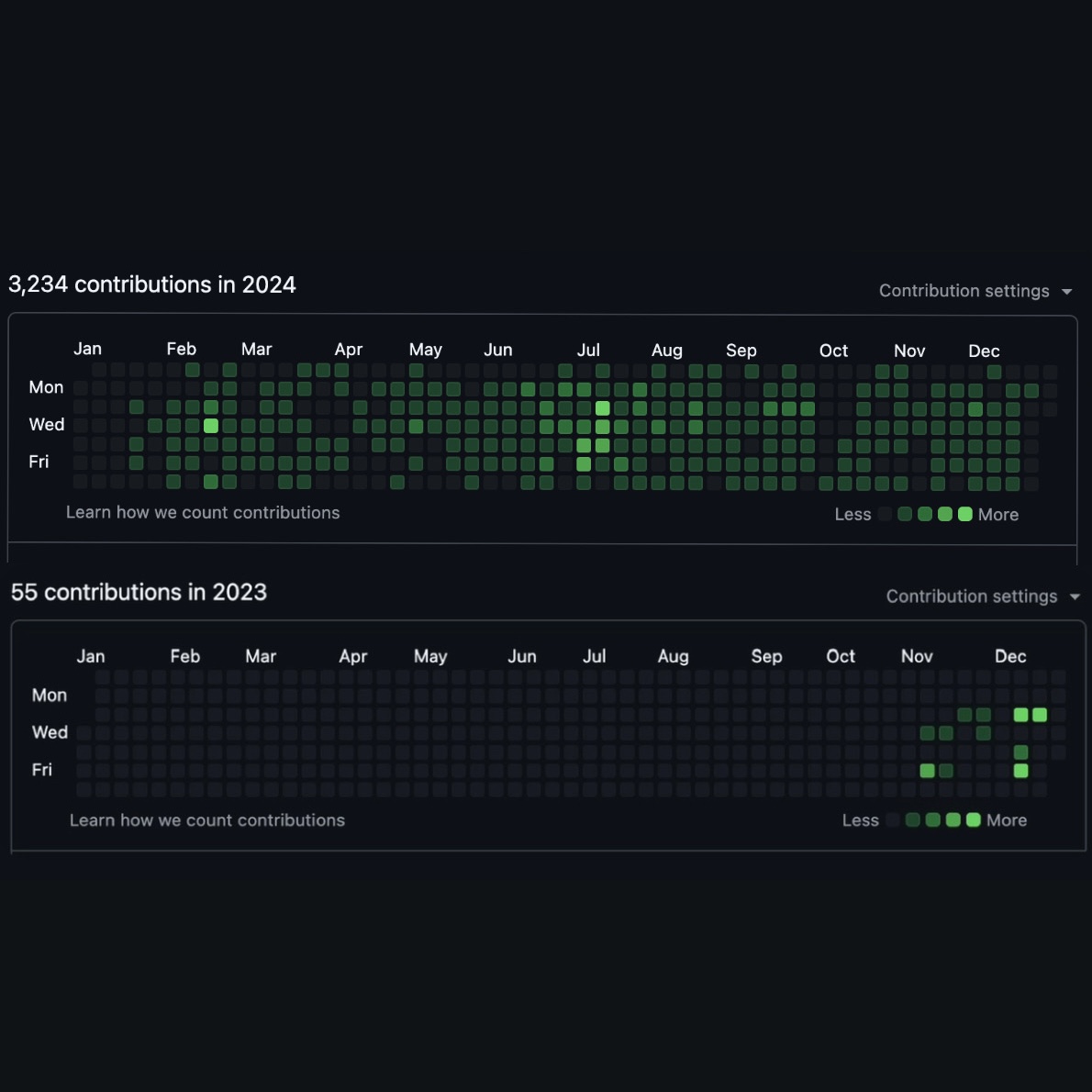
2024 was when I transitioned to a full-time software engineer. And it is the best decision I’ve made. It took me about 3 months to make the transition from a product designer to a software engineer at a Series A AI startup.
Here's how I did it:
---
Week 1️⃣-3️⃣: Learn coding using @Codecademy
Coding was very intimidating for me. So having a guided path makes starting so much easier.
Plus, the course very bit-sized and interactive. So you see your code works instantly.
----
Week 4️⃣-5️⃣: Turn something you already made into an app
As a designer, I have many Figma designs lying around. So I just chose 1 and made it real.
But it can be anything. Automate a workflow u do it manually, make a web version of a slide deck, whatever. Just make it real with code.
---
Week 6️⃣-7️⃣: Go to hackathons/build sth in 24 hours with people
Two emphasis here: build something from scratch quickly, and do it with others.
Building something from scratch helps me learn all the things needed for a piece of software
Building with people pushes me to build and learn something I don’t know, and from people who know those things
Go to lu.ma/ or cerebralvalley.ai/events to find hackathons to go to
---
Week 9️⃣ - 1️⃣2️⃣: Get a job/contract in coding
I didn’t have prior internship/experience before joining my current AI company. I just have some personal and hackathon projects.
I just faked it till I made it, saying that I can do those things, and then learn how to do those things before the interview, and then work really hard to catch up at work.
Start with looking for contractor roles in startups, and then work your way up.
---
Week 1️⃣2️⃣ : Take on a variety of coding work
Building a system from scratch, making animations, refactoring code, writing tests, just do it all.
I made a mistake by pigeonholing myself to frontend work, and it limited my skills and imagination of what I can build.
Now, I am actively seeking projects that are different from my previous ones to learn and figure out what kind of coding I like.
13
7
111
15,101





31 Mar 2024
Thank you Emmy for showering me with 4,000 Diamonds and getting me to shamelessly tweet this out. If you've collected Ethereum NFTs, all the way back to 2017, head to magiceden.io/rewards to claim your taste of Diamonds on the best cross-chain rewards program.
2
2
111
dill.eth retweeted

20 Feb 2024
Attended a content creators’ dinner held by @geniefriends_io tonight — met a bunch of YouTubers, Instagrammers, directors and algo specialists.
My takeaway from dinner with these web2 creators/KOLs with followings from 40k-200k?
Gotta keep grinding. Content never sleeps 💪🏻😤



2
32
11
1,355
dill.eth retweeted

11 Feb 2024
Early results from my AI training runs. I've trained my $200 robot arm on a simple picking task using imitation learning. It has learned to control the robot arm using only camera images and joint states.
87
270
2,329
330,568
dill.eth retweeted

9 Feb 2024
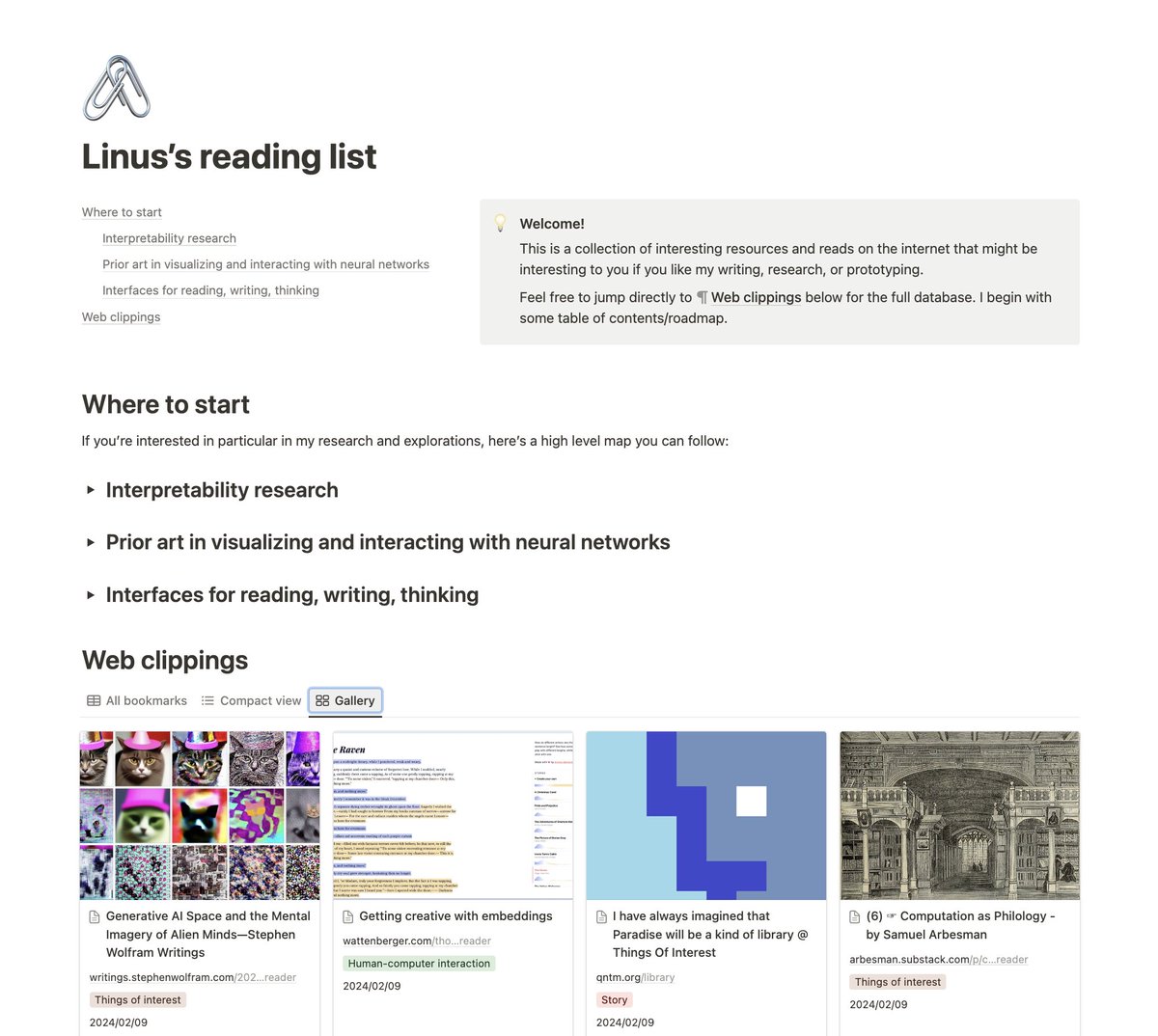
Encouraged by some conversations I've had recently, I put together a list of links/papers/reports you might find interesting if you like my work.
Covers interpretability model visualization, interface thinking, stories/fiction. I'll be adding more.
notion.notion.site/notion/Li…
5
25
227
20,505

🎨 Are you amazed by the latest art styles in Meshy-2's text to 3D?
🌟 Realistic, Cartoon, Low Poly, Voxel – endless possibilities to match your artistic style and spark new creativity!
💻 Try it today on app.meshy.ai
#MeshyAI #TextTo3D #3dmodeling #GenerativeAI
3
11
69
14,210
dill.eth retweeted

7 Feb 2024
With a single CLI command, you can now spin up a full-stack agent server with access to 50 tools in one line of code! 🤖🌐
Our `create-llama` command in @llama_index lets you spin up a FastAPI backend with a @llama_index agent and any tool from LlamaHub. It's a great starting point for any agent project you want to build.
Check out the video below as an example, and get started using create-llama: github.com/run-llama/LlamaIn…
7 Feb 2024

Use create-llama from @llama_index to build an AI agent in seconds. Here's an example using the Wikipedia tool from LlamaHub.
Try it yourself using `npx create-llama@latest`.
7
39
223
42,241
dill.eth retweeted

7 Feb 2024
Naval Ravikant shares the most valuable advice he’s receive
“You’ll hear the same advice whether it’s Warren Buffett telling you about public investing or it’s experienced venture capitalists telling you about private investing or an older entrepreneur telling you about starting a company. They’ll all tell you it’s the people, stupid. And everybody nods and they don’t really understand what that means. And you figure that out ten years later once you’ve worked with enough of the wrong people.”
Source: @gigaom
10
108
511
62,193
dill.eth retweeted

7 Feb 2024
You have to be an optimist about your own product, your own startup, and yourself. That's why when you pitch -- whether to investors, to prospective employees, or partners, it's important to talk about what might happen, not what you are doing today.
There's a whole style to this type of pitch, and it's a futuristic point of view that leans into optimism:
- Emphasize the future, not the past
- What it could be not what it is
- Play up even small bits of proof points
- The big things that might happen, if it works
- The upside rather than risks
- Signs the customers love the product, rather than revenue metrics
- Why this team has the grit and special knowledge to do it, not the credentials and work experience
- A unique narrative about why the world is moving this way
- Why you're starting with a wedge, but your ultimate market is huge
In a previous discussion, I recounted that a few years back, a big group of Nordic founders came by Silicon Valley. When I asked them their biggest learning on the trip so far, they said: We have to learn how to pitch our startup in the “American” way, oriented towards the future and the possibility of success. Unfortunately they told me the investors back home didn’t care for this style. Instead, they are focused on reducing risk, and that starts with asking startups what revenue they have right now, even though the companies were brand new.
The funny thing about this is that this isn't the "American" way of pitching, it's actually specific to the Bay Area tech ecosystem. It's incredibly optimistic and futuristic that founders choose to describe their startups in this way, and furthermore, the people who hear these pitches choose to believe them.
I find this tone admirable, but let me also make the argument that this is the only logical way to convince people to join you on your journey.
First, let's talk about startup investors. a portfolio of startup investments is inherently risky, and the physics of venture math means that the winners have to be really big. It's commonly said that out of a portfolio of ten companies, generally about half the investments will go to zero, three will return a little bit of money, and that the top one or two will return 10x plus and make the fund work. As a result, professional venture investors are trying to understand if you have what it takes to be one of those top two, and if you don't if you'll die trying. A lot of this assessment focused on the market or your numbers, but sometimes the real question is about your ambition.
So they are trying to answer a simple question: Do you WANT to create one of the leading companies in the industry?
Focusing on the future and on the upside shows your will to power. It allows investors to gain a sense of that signal. If you're focused too early on profitability, rather than growth, or retaining your piece of the pie, as opposed to growing the pie as large as possible, that's an important signal. The point of this isn't to mislead investors into thinking that you're trying to do something that you're not, but rather, if you are shooting for something big, you have to really express that in the clearest way possible.
The perspective is often directly reflected (and not) in the slide decks I review at a16z. Does the product slide describe the features of what the app has today, or does it talk about the product roadmap of what's going to be built in the future? Do they user projections or financial forecasts simply show the last year's performance, or does it tell a story about how the business is about to inflect? Oftentimes when founders are too conservative about their story it's hard for investors to understand what they're trying to do in the long run. Instead, I love it when founders tell the big story. Of course I'm going to discount it and round down, and assume that many features are never shipped. But I love to see it.
Second, let's talk about employees. typically when you're hiring your first few employees, you might be able to give out a few percentage points each, particularly for key people (like engineers or designers). but within a few hires, you end up needing to convince people to work for below pay, and for a fraction of a percent of the company. Why would they do this? Why would they work for you instead of either starting their own company or getting a cushy gig somewhere else where they might be paid much more?
The asymmetric advantage of startups compared to many other opportunities, is that they are adventurous and fun. The startup might fail, but the work is generally a lot more interesting than what you can do elsewhere. The responsibility and scope that a junior employee might have might go way beyond what makes sense at any other company.
And of course financially there is upside. For founders to convince high-quality employees to join their outfit, it's often important to lean into a sense of adventure. What's more adventurous than tackling a big huge goal, that might not work, but if it works, it's going to be amazing? For founders to communicate the sense of adventure, they need to be able to weave a narrative. Maybe it's us versus them, or David and Goliath. Perhaps it's exploring the unknown, and going to the frontier when no one else is there. If you can't tell the stories, how can you expect people to follow you? Thus I find it important to tell the futuristic narrative that's ambitious, full of surprises and upside, and has a possibility of failure too. It makes the work meaningful and makes the potential economic upside worth something.
We've talked about investors and employees, but there's actually a long tail of many other constituents that benefit from a futuristic outlook. if you're talking to journalists and pundits, you have to compete with thousands of other companies that they're going to meet this year, and you have to catch their attention. If you're marketing, an event at a conference adjacent to dozens of other events, you have to catch the eye of attendees. An optimistic, futuristic perspective gives you room to tell the story about the problem you're trying to solve, and why your startup will be incredibly important once you get there.
You might say that the world is full of cynics. Perhaps you are from a region or an industry where most people nitpick all the reasons why fail. Maybe they want you to focus on minimizing downside risks, or acknowledging your potential problems, and won't treat you as credible unless you do. If that's your industry network or your social network, I urge to you to escape. Seek out those who share your optimism, and the same values and beliefs about the future. it's one of the reasons why the Bay Area has been such a powerhouse over the last few decades. Yes, there's knowledge and investors here, but more important is the culture.
The last point I make is about yourself. You should talk about what you're working on in an optimistic way to help create meaning for yourself. For those of us who grew up in a generation that adored Steve Jobs, there's always been the goal to put a dent in the universe rather than to sell sugar water. Thinking about the future, and the upside of what you might be able to create, is a great way to give meaning to the nights and blood and tears that we put into our work. If you're simply working on a new product only because it's a good money-making opportunity, I guarantee that your sense of meaning will fade when times get tough. You'll ask yourself, why am I doing this? If you don't have a Northstar to guide you on an inevitably rocky, entrepreneurial journey, you'll inevitably get lost. That's when the FAANG job will seem really appealing.
This is all about the pitch. Of course it's important to simultaneously hold in your mind all the truths about what you're working on. Maybe you don't actually have product market fit yet, or your marketing strategy. Perhaps your unit economics don't yet work, or your team has major gaps. If you're working on a new startup, likely, everything feels constantly broken, and everyone's maybe going to quit.
You have to go and tackle all of those challenges with a clear mind -- while simultaneously keeping a futuristic spirit that motivated people to join you on your journey.
54
142
1,265
260,217
dill.eth retweeted

5 Feb 2024
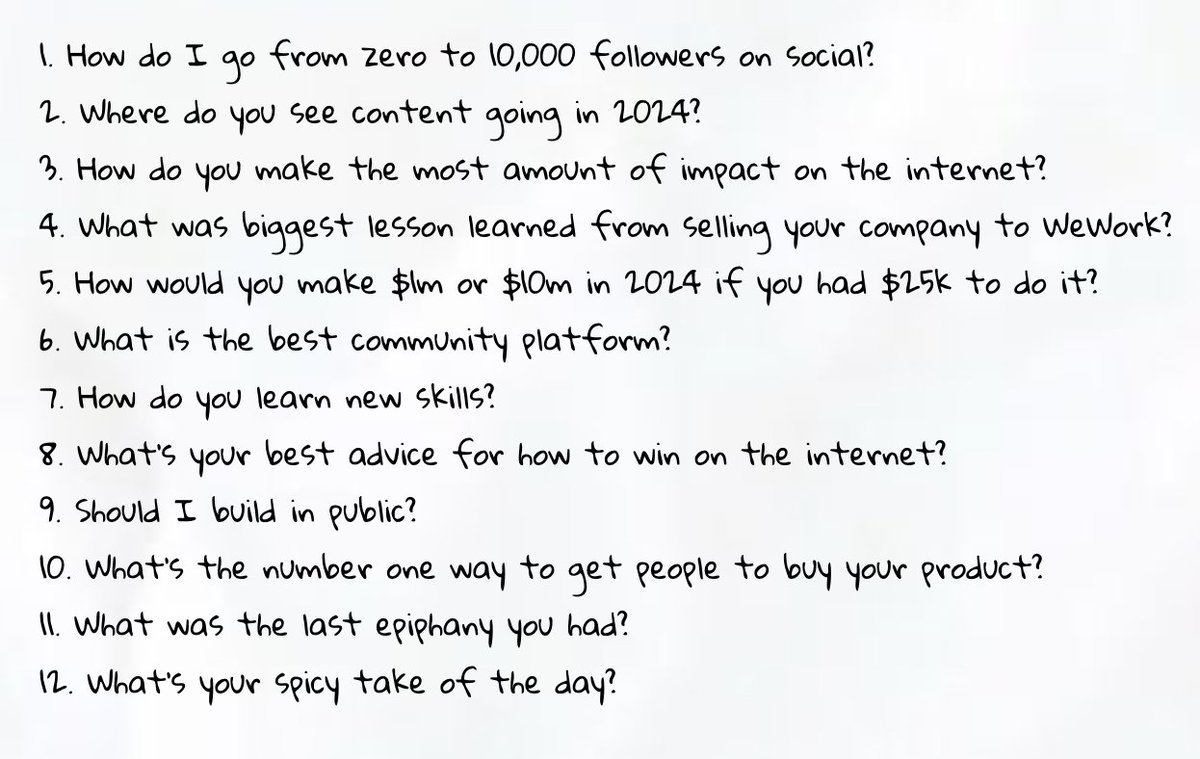
Here are the 12 questions I get asked the most (from building wealth to learning new skills):
1. How do I go from zero to 10,000 followers on social?
The fastest way is through replies.
You literally don't need to post content of your own.
Here's the playbook:
1) You make sure your bio is optimized
2) You set tweet (or IG etc) notifications for people in your space
3) You comment thoughtfully on their posts quickly
4) You gain a few followers daily
5) You do this consistently
This is the sure way to getting a base of followers in a niche.
You can't lose.
2. Where do you see content going in 2024?
Content has been over produced over the last few years and it’s about to go more raw. Especially video. The trend with short form video has been every second amplified with sound effects and zoom ins. Price dings and GIFs. I think you’ll see more creators go raw and see lots of luck there.
Examples include Sam Sulek or the handwritten photos you're starting to see on Instagram. Or this handwritten photo I included in this post.
Content is moving behind the scenes.
Truth is social used to be like that. Everything old is new again.
3. How do you make the most amount of impact on the internet?
1) Pick a worthwhile topic. Nicher the better
2) Write clearly. More clear than anyone else
3) Write regularly. Every single day
4) Collaborate with other writers like you. Help them
5) Open your Twitter DMs. Look for gold
4. What was biggest lesson learned from selling your company to WeWork and being at WeWork at the height of craziness?
When I joined WeWork, something stood out. People referred to "adam" in an almost god-like way. They were referring to Adam Neumann.
It was fascinating to see on a dime how thousands of people went from worshipping Adam to despising him. He went from god to enemy overnight.
Employees thought their stock options were worth millions and ended up being pretty worthless. That's why.
Teaches you a lot about human nature.
5. How would you make $1m or $10m in 2024 if you had to and only had $25k to do it?
Firstly, good things take time. Figma (now worth $20b) took 7 years to reach $1m in revenue. Things move slowly until they move fast.
But if I had to make $1M, I'd follow the ACP funnel (audience, community, product) to build an asset light, profitable business targeting a niche I probably found on Reddit.
So, I'd pick a unique category, something where I'm not competing with anyone. I'd build a social account (partner with creators to pump it with the $25k), convert into a free Whatsapp, Circle or Skool community to get their emails and build them a product. The product probably would start be a lightweight software product or paid community.
6. What is the best community platform?
There is no perfect community platform. Depends on the needs.
First start with building a growing internet audiences, and then pick a home that you think they'll enjoy.
No two communities are the same so they needs change.
7. How do you learn new skills?
A framework for learning any new skill I use:
1) Limit scope (focus)
2) Write learnings every day (memory)
3) Learn with others (accountability)
4) Teach newcomers (practice)
8. What's your best advice for how to win on the internet?
1) Have a bias for action
2) Ignore noise
3) Be obsessed
4) Accept pain, don’t suffer (pain is inevitable, suffering is optional)
5) Find cheerleaders. People above you, people below you, people on your level
6) Don’t follow growth hacks. If someone is telling you about them, it’s too late
7) Don’t trust public revenue numbers on Twitter, LinkedIn etc. They are probably false
8) Your brand should be so good people want to wear it on t-shirts. I call it the t-shirt test
9) Underspend on material possessions, overspend on people, experiences, that move you faster
9. Should I build in public?
Move in silence or move loudly, nothing in between
10. What's the number one way to get people to buy your product?
Besides building an internet audience, If you want someone to want something, tell them they can’t have it or build virality into the product.
11. What was the last epiphany you had?
I had a realization about the type of experiences you have in life:
A toll gets you to somewhere you want to go to. A tax sucks you dry.
Be okay with tolls in your life, they make you better. Taxes on the other hand are a part of life and of course should be paid, but you don't want to live a life with only taxes, no tolls.
You want mostly tolls, some taxes.
12. What's your spicy take of the day?
Reading books is so back right now Stood the test of time with so many new media coming out for hundreds of years.
As people want places away from their phones and eventually Apple Vision Pros (digital detox), old school book sales will increase.
116
65
907
147,234
dill.eth retweeted
4 Feb 2024
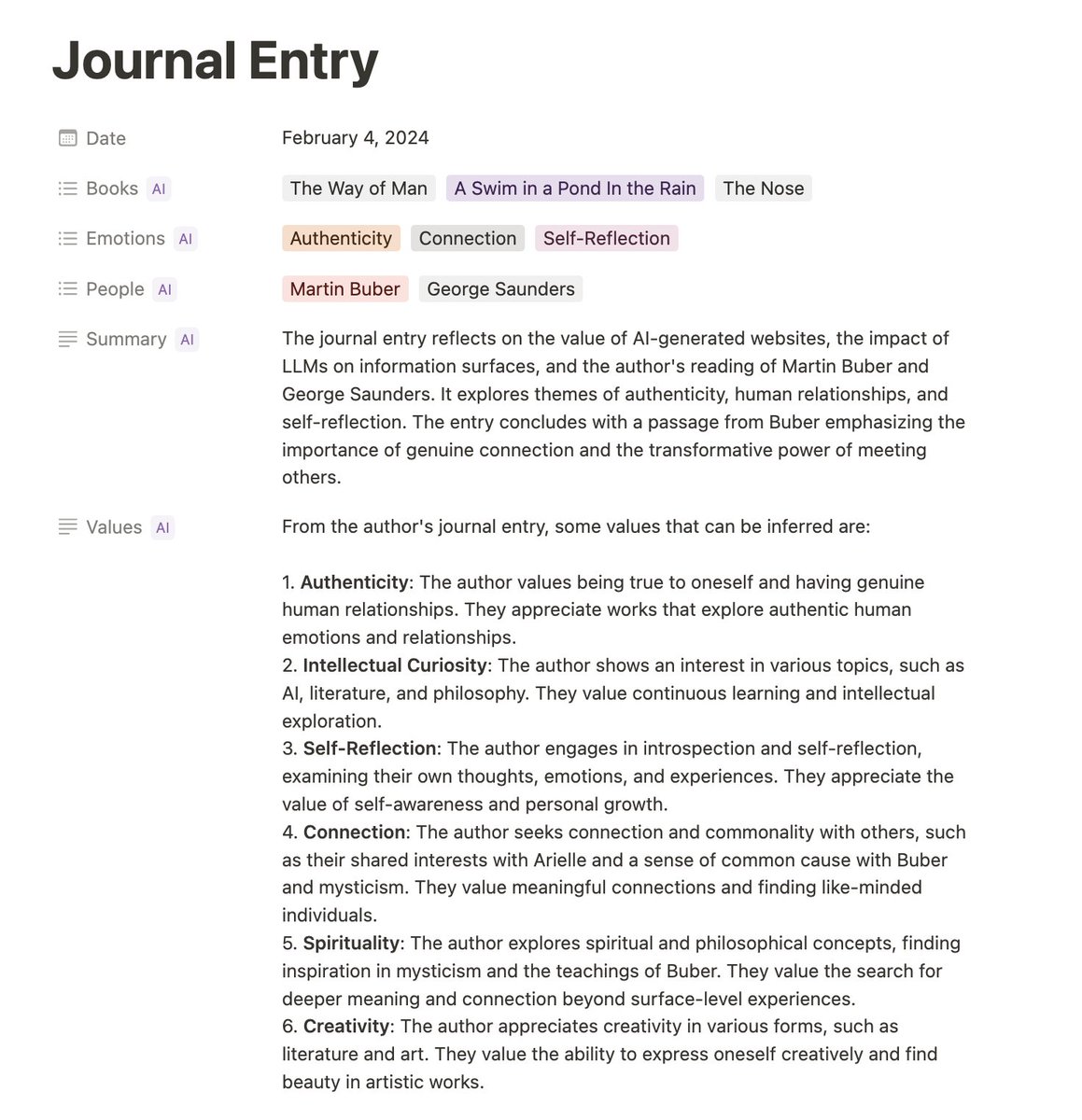
AI 💜 structured data
This allows for some cool patterns, like
- Sort/filter a Notion DB for AI-tagged properties like which people you talked to/mentioned
- Search and filter through summaries in table views
& since Notion Q&A reads these DBs, you can ask AI about your values!
4 Feb 2024

Okay y'all are absolutely SLEEPING on @NotionHQ AI
It can take a journal entry from me and automatically:
- Summarize the entry
- Tag the books and people I mention
- List out the emotions I'm feeling
- Find the values present in my writing
Truly wild:
2
6
92
21,442
dill.eth retweeted

4 Feb 2024
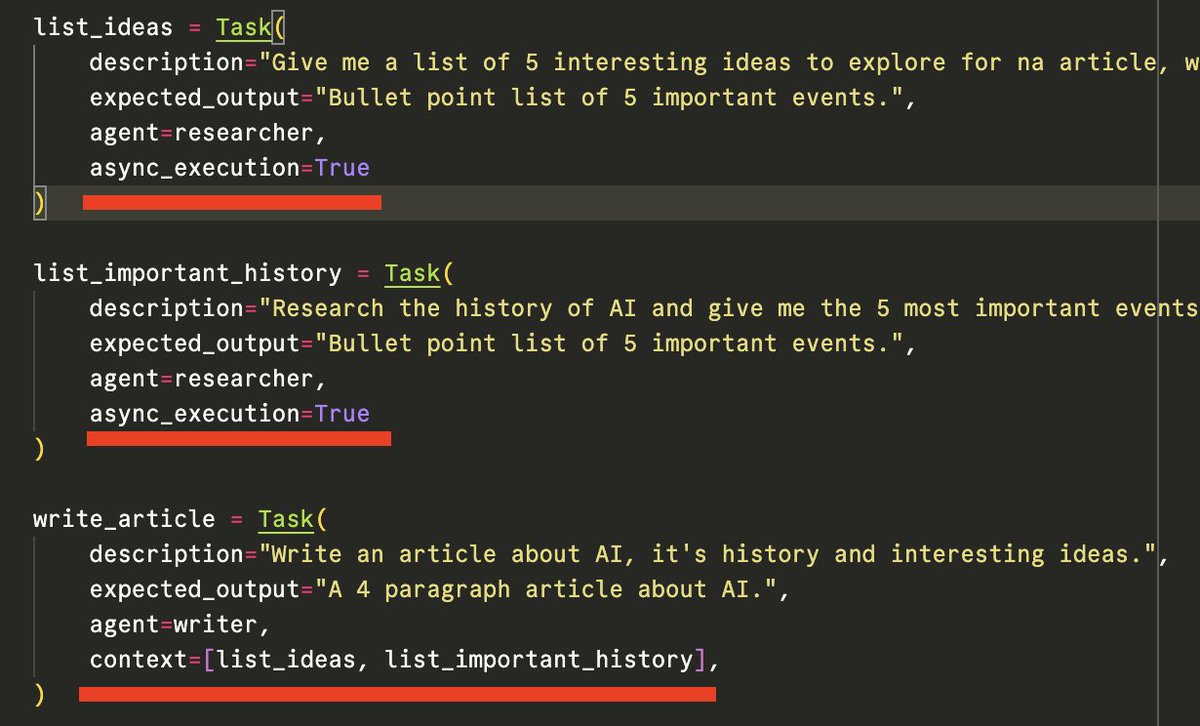
And there we go: two tasks are executed in parallel using multithreading and the third one can reference both later.
Now will write some test and push this badboy up so we can cut this new version tomorrow, oh I guess new docs as well for this now 😅
6
1
91
6,667
dill.eth retweeted

4 Feb 2024
🔥Generative Gaussian Splatting🔥
#ICLR2024 Our 🚀DreamGaussian🚀 is accepted to @iclr_conf as **oral presentation**, enabling high-quality 3D generation in 2 minutes
- Project: dreamgaussian.github.io/
- Code: github.com/dreamgaussian/dre…
- Demo @huggingface: huggingface.co/spaces/jiawei…

DreamGaussian: Generative Gaussian Splatting for Efficient 3D Content Creation
paper page: huggingface.co/papers/2309.1…
Recent advances in 3D content creation mostly leverage optimization-based 3D generation via score distillation sampling (SDS). Though promising results have been exhibited, these methods often suffer from slow per-sample optimization, limiting their practical usage. In this paper, we propose DreamGaussian, a novel 3D content generation framework that achieves both efficiency and quality simultaneously. Our key insight is to design a generative 3D Gaussian Splatting model with companioned mesh extraction and texture refinement in UV space. In contrast to the occupancy pruning used in Neural Radiance Fields, we demonstrate that the progressive densification of 3D Gaussians converges significantly faster for 3D generative tasks. To further enhance the texture quality and facilitate downstream applications, we introduce an efficient algorithm to convert 3D Gaussians into textured meshes and apply a fine-tuning stage to refine the details. Extensive experiments demonstrate the superior efficiency and competitive generation quality of our proposed approach. Notably, DreamGaussian produces high-quality textured meshes in just 2 minutes from a single-view image, achieving approximately 10 times acceleration compared to existing methods.
5
93
409
51,701
dill.eth retweeted

4 Feb 2024
The best models are usually trained by researchers that are willing to inspect 1000's, if not 10,000 samples manually.
No aggregation, no programmed heuristics, straight up rawdogging their data.
15
57
605
77,300
dill.eth retweeted

3 Feb 2024
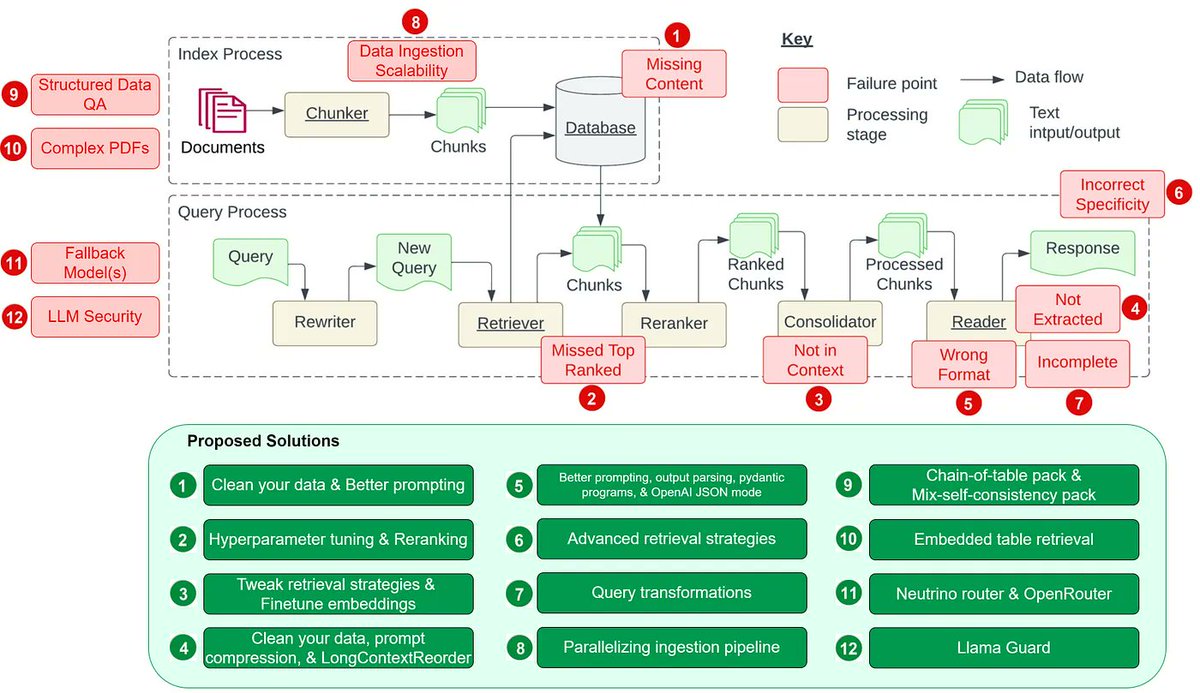
12 RAG Pain Points and Proposed Solutions 💡
Building production RAG is hard. @wenqi_glantz compiled a list of 12 (!!) RAG pain points added a full solution list to each one with @llama_index abstractions 🔥
We’ve put out cheatsheets before, but this one is much more comprehensive. This is a must have mapping if you have pain points in any one of the following listed areas:
1. Context Missing in the Knowledge Base
2. Context Missing in the Initial Retrieval Pass
3. Context Missing After Reranking
4. Context Not Extracted
5. Output is in Wrong Format
6. Output has Incorrect Level of Specificity
7. Output is Incomplete
8. Ingestion Pipeline Can't Scale to Larger Data Volumes
9. Inability to QA Structured Data
10. Document (PDF) Parsing
11. Rate Limit Errors
12. LLM Security (prompt injection)
Check out the blog: medium.com/towards-data-scie…
This builds on the paper “Seven Failure Points When Engineering a Retrieval Augmented Generation System” by Barnett et al. (check it out here: arxiv.org/pdf/2401.05856.pdf).
7
175
713
217,444