
Joined January 2022
- Tweets 2,989
- Following 297
- Followers 336
- Likes 3,582
135 Photos and videos





Pinned Tweet

Jun 11
Ecosystem Scaling
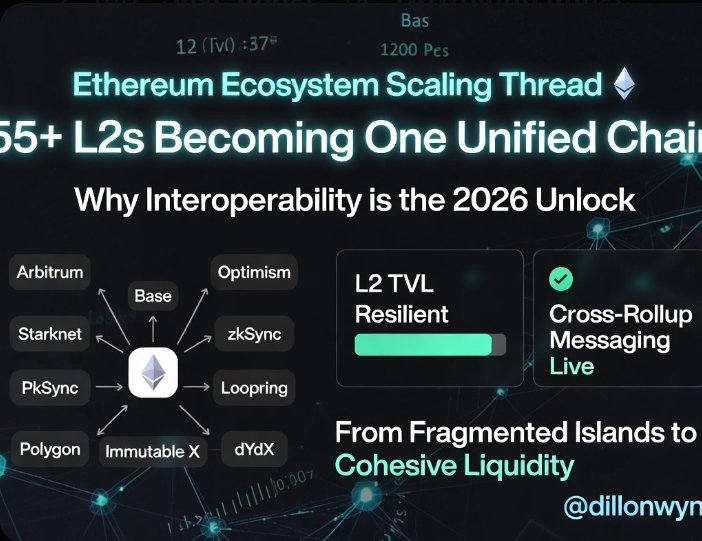
“Ethereum’s 55 L2s just became one chain, Why interoperability is the 2026 scaling unlock”
1/9
Ethereum now has over 55 Layer 2 rollups. The problem is fragmented liquidity and isolated islands. The 2026 solution is full interoperability layers like EIL plus trustless messaging protocols going live.
2/9
What this means for users: Send USDC from Arbitrum to Base in seconds, using the same wallet, with no bridge friction. No more “which L2 am I on?” confusion.
3/9
On-chain progress already visible:
- L2 gas limit on L1 raised significantly
- Cross-rollup communication maturing fast
- Modular architecture becoming the standard
4/9
This shift moves Ethereum from competing on raw TPS to winning on cohesive ecosystem liquidity and network effects.
5/9
Developer metrics remain strong. L2 revenues are climbing while L1 serves as the secure settlement layer. TVL across major L2s is staying resilient even in this market dip.
6/9
My 2026 evaluation framework for L2s:
- Real interoperability, not marketing
- Sustained developer activity and dApp migration
- Healthy fee model without heavy subsidies
7/9
The winners won’t be the cheapest chain. They’ll be the ones that feel like one unified Ethereum.
8/9
Thesis: Scaling in 2026 isn’t about one chain dominating. It’s about all chains working seamlessly together.
9/9
Which L2 are you most bullish on for interoperability this year? Drop your pick and reason below. Follow @dillonwyna for weekly ecosystem scaling breakdowns. #Ethereum #L2 #Web3 #Scaling
1
2
15
157
Dillon Wyna retweeted
Jun 11
Ecosystem Scaling
“Ethereum’s 55 L2s just became one chain, Why interoperability is the 2026 scaling unlock”
1/9
Ethereum now has over 55 Layer 2 rollups. The problem is fragmented liquidity and isolated islands. The 2026 solution is full interoperability layers like EIL plus trustless messaging protocols going live.
2/9
What this means for users: Send USDC from Arbitrum to Base in seconds, using the same wallet, with no bridge friction. No more “which L2 am I on?” confusion.
3/9
On-chain progress already visible:
- L2 gas limit on L1 raised significantly
- Cross-rollup communication maturing fast
- Modular architecture becoming the standard
4/9
This shift moves Ethereum from competing on raw TPS to winning on cohesive ecosystem liquidity and network effects.
5/9
Developer metrics remain strong. L2 revenues are climbing while L1 serves as the secure settlement layer. TVL across major L2s is staying resilient even in this market dip.
6/9
My 2026 evaluation framework for L2s:
- Real interoperability, not marketing
- Sustained developer activity and dApp migration
- Healthy fee model without heavy subsidies
7/9
The winners won’t be the cheapest chain. They’ll be the ones that feel like one unified Ethereum.
8/9
Thesis: Scaling in 2026 isn’t about one chain dominating. It’s about all chains working seamlessly together.
9/9
Which L2 are you most bullish on for interoperability this year? Drop your pick and reason below. Follow @dillonwyna for weekly ecosystem scaling breakdowns. #Ethereum #L2 #Web3 #Scaling
1
2
15
157
Dillon Wyna retweeted

Jun 12
3,398
944
1,472
68,580
Dillon Wyna retweeted

Good afternoon legends 🫡
Watch closely don’t snooze on @GrinniesClub 🔥🔥


Phase 1 flew, Phase 2 is going to be absolute chaos. The Grin Faction and Fud Faction are officially locking horns. Secure your side before the chase begins. 🏃♂️💨

14
23
53
566

Dillon Wyna retweeted
From 0 to 1,000 Active Followers we’re building something real.
Like and comment "Hello 👋" if you need it!
Appreciate every single one of you. More coming soon 🔥
1
3
6
91
Saturday Weekend Read 🧪
This week we broke down:
• The on-chain science behind the BTC 20% shakeout (smart money still loading)
• Why 90% of DAOs fail the real decentralization test (governance autopsy)
• How Ethereum’s 55 L2s are becoming one unified chain through interoperability
• A faith data framework for staying calm in volatile markets
Key takeaway: Real adoption signals (RWA TVL >$30.8B, LTH accumulation, stablecoin growth) remain strong despite the fear.
What was your biggest insight from this week? Or which topic should I dive deeper into next week?
Drop it below 👇
Follow @dillonwyna for weekly scientific Web3 research mindset.
#Web3 #RWA #Decentralization #OnChain
4
44
Jun 12
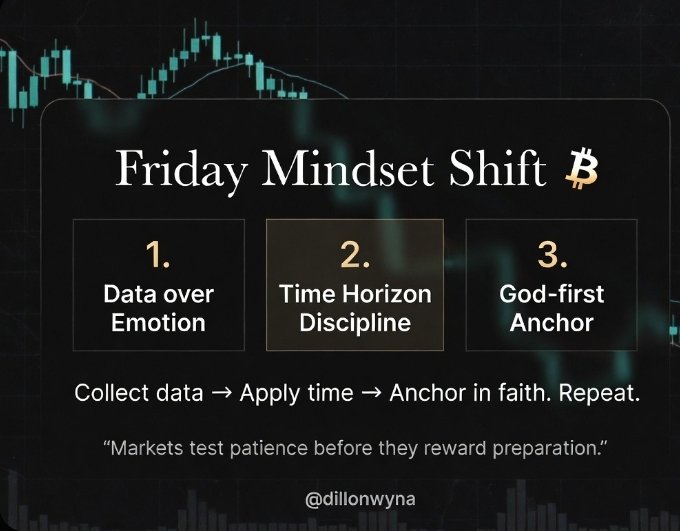
Friday Mindset Shift 🧪
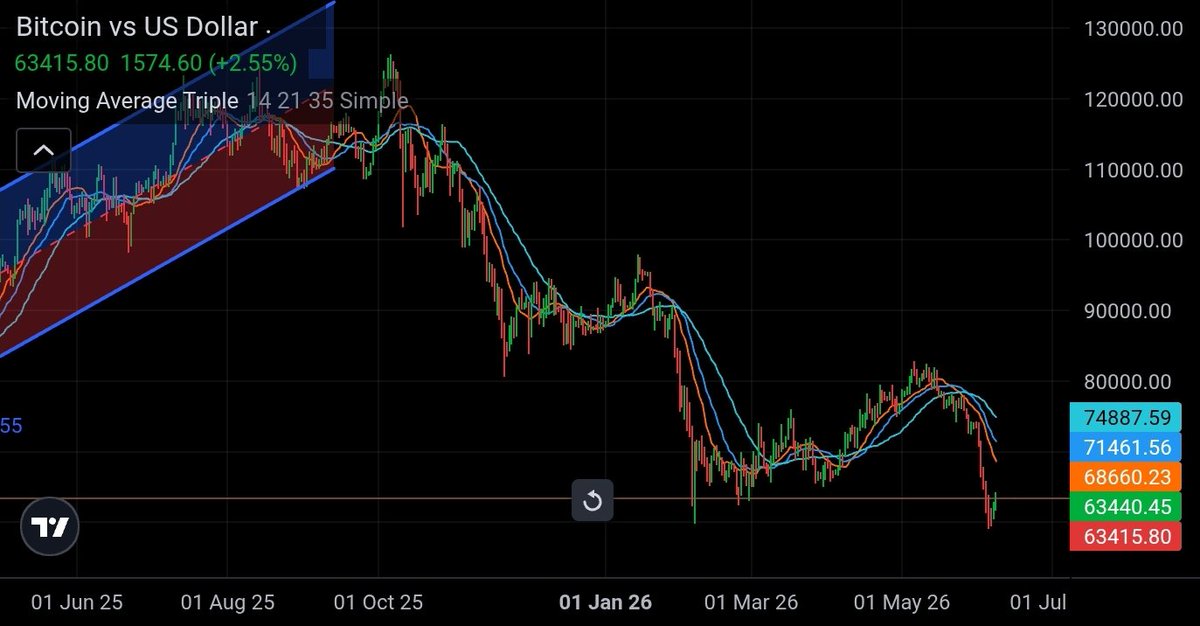
Crypto is bleeding again. BTC near local lows. Extreme fear dominating headlines.
Most retail panic-sells.
The few who win long-term do the opposite.
My 3-step faith data framework that keeps me calm and positioned:
1. Data over Emotion
On-chain signals (RWA TVL >$30.8B, LTH accumulation, stablecoin growth) still show institutional rotation, not capitulation.
2. Time Horizon Discipline
Bear phases are where the next cycle’s 10x–100x opportunities are built. History repeats.
3. God-first Anchor
Markets test patience. Stewardship > speculation. Eternal principles outlast charts.
Collect data → Apply time → Anchor in faith. Repeat.
This isn’t hopium. It’s disciplined preparation.
What’s your personal framework for surviving these dips? Share below 👇
Follow @dillonwyna for more mindset data-driven Web3 insights.
#Web3 #Mindset #RWA #Crypto
2
6
102
Dillon Wyna retweeted
Jun 11
Good morning builders 🧪
Quick reminder: Your X account is one of the best tools in Web3. Post daily, engage genuinely, and watch the network grow.
Follow back if you’re real drop your @
Let’s build together. What’s one goal for your X this month?
2
5
161
Jun 11
Targeting 1,000 followers this month with daily Web3 research.
Drop your @ if you’re active in crypto.
Follow back for genuine accounts only. Let’s run it up 🚀
What’s your biggest 2026 crypto thesis?
#Web3 #BuildInPublic
1
1
4
52
Jun 11
Have you ever seen a soldier go to the battlefield with his loved ones?
3
32
Jun 10
Wednesday hit different this June 10th 🤞
It’s National Iced Tea Day and honestly, nothing screams summer energy like a tall glass with extra lemon 🍋
Whether you’re sipping something sweet, grinding on your goals, or just soaking in that midweek vibe, remember: small rituals like this keep the momentum going.
So tell me what’s your go-to iced tea flavor?
Drop it below 👇
Feeling extra? Pair it with an egg roll or frosted cookie. The calendar said it’s allowed 😉
#IcedTeaDay #NationalDays #MidweekMotivation #SimpleJoys
3
27
Jun 10
Follow me, I follow back immediately. Let’s build the network. 🤝📈
2
6
68
Jun 10
If you’re looking to grow your network in Web3, say “Hi” 👋
Let’s build together.
I follow back every genuine account that engages here.
Together we grow stronger 🧪
#Web3 #RWA #Decentralization #OnChain #grow
5
56
Jun 10
Despite the recent 20% BTC shakeout, RWA TVL continues climbing past $30.8B and stablecoin supply is still expanding.
This tells us institutions aren’t running they’re rotating into real yield.
Quick Poll:
What’s the strongest narrative for the rest of 2026?
RWA / Tokenized Assets
AI Crypto
L2 / Interoperability Scaling True Decentralized Governance
Drop your vote reason below 👇
Follow @dillonwyna for daily scientific Web3 breakdowns
#Web3 #RWA #OnChain #Decentralization
4
53
Jun 9
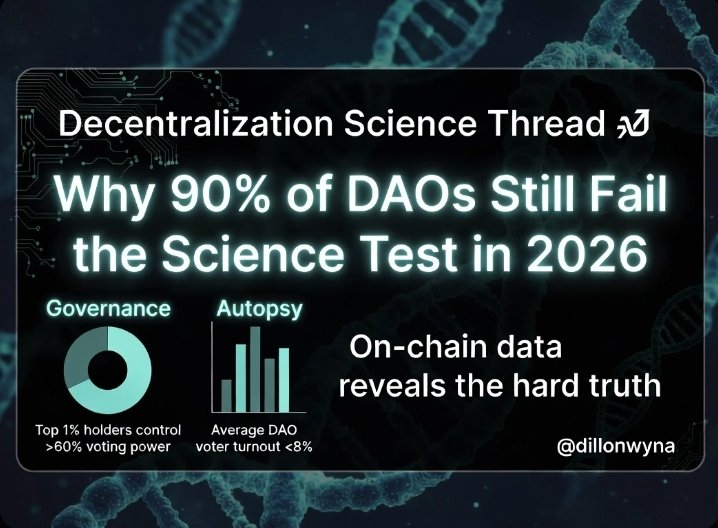
Governance science thread just dropped 🧬
Why 90% of “decentralized” DAOs still fail the real science test in 2026 on-chain data autopsy.
Token-weighted voting, <8% turnout, whale control… here’s the hard truth actual fixes.
Full thread 👇
#Decentralization #DAO #Web3 #OnChain
Jun 9

Decentralization Science
Why 90% of “decentralized” projects still fail the science test in 2026 – A governance autopsy.
1/9
Everyone screams “decentralization” in their whitepaper.
Yet most DAOs are still controlled by 3–5 whales or a founding team wearing multiple hats.
Here’s the hard science behind why true decentralization is still rare in 2026.
2/9
Problem 1: Token-weighted voting = plutocracy with extra steps
In most major DAOs, the top 1% of holders control over 60% of voting power. On-chain data backs this up.
3/9
Problem 2: Low voter turnout
Average participation in DAO proposals sits below 8%.
Reason: rational apathy. Small holders know their vote won’t move the needle. Classic collective action failure.
4/9
2026 reality check
Even “progressive” projects are quietly recentralizing through multisigs and off-chain signaling.
It’s the same pattern that killed early DeFi experiments.
5/9
What the science suggests as fixed
- Quadratic voting
- Sortition / random citizen assemblies
- Modular deliberation layers, on-chain and off-chain
- Separating economic rights from governance rights
6/9
What’s actually working
The projects quietly outperforming right now are testing these hybrid models.
Everyone else is marketing decentralization while running centralized control.
7/9
True decentralization isn’t a buzzword.
It’s an engineering problem that needs rigorous governance design.
8/9
God-first angle
Real power should be distributed the way creation was not hoarded.
9/9
Which project actually passes the decentralization science test in 2026?
Tag them below.
Follow @dillonwyna for more no-fluff governance science.
#Decentralization #DAO #Web3 #OnChain
5
34
Jun 9
Decentralization Science
Why 90% of “decentralized” projects still fail the science test in 2026 – A governance autopsy.
1/9
Everyone screams “decentralization” in their whitepaper.
Yet most DAOs are still controlled by 3–5 whales or a founding team wearing multiple hats.
Here’s the hard science behind why true decentralization is still rare in 2026.
2/9
Problem 1: Token-weighted voting = plutocracy with extra steps
In most major DAOs, the top 1% of holders control over 60% of voting power. On-chain data backs this up.
3/9
Problem 2: Low voter turnout
Average participation in DAO proposals sits below 8%.
Reason: rational apathy. Small holders know their vote won’t move the needle. Classic collective action failure.
4/9
2026 reality check
Even “progressive” projects are quietly recentralizing through multisigs and off-chain signaling.
It’s the same pattern that killed early DeFi experiments.
5/9
What the science suggests as fixed
- Quadratic voting
- Sortition / random citizen assemblies
- Modular deliberation layers, on-chain and off-chain
- Separating economic rights from governance rights
6/9
What’s actually working
The projects quietly outperforming right now are testing these hybrid models.
Everyone else is marketing decentralization while running centralized control.
7/9
True decentralization isn’t a buzzword.
It’s an engineering problem that needs rigorous governance design.
8/9
God-first angle
Real power should be distributed the way creation was not hoarded.
9/9
Which project actually passes the decentralization science test in 2026?
Tag them below.
Follow @dillonwyna for more no-fluff governance science.
#Decentralization #DAO #Web3 #OnChain
2
80
Dillon Wyna retweeted

BIG ANNOUNCEMENT, FAM!
I’m officially partnering with @WEEX_Official one of the most trusted crypto exchanges out there.
Deep liquidity, up to 400x leverage, 1700 trading pairs, copy trading, and that rock solid 1000 BTC Protection Fund? We’re about to make moves together.
Leveling up the game for the community. I want my family to join me on this
Start Here - weex.global/en/register?vipC…
My Invite Code: marjid

242
162
301
870,867