
Award-Winning Hende Beluga Supercar Designer | ZEM Founder | Ex-UZ Lecturer | Economist | Author (Before There Was God, Terror as Liberation, 73 Cmdmts)
Joined June 2009
- Tweets 12,837
- Following 4,823
- Followers 3,075
- Likes 1,571
2,910 Photos and videos





Pinned Tweet
Tagwirei.
Let me say something that most people are afraid to say.
Tagwirei did not invite himself into Zimbabwe’s political system. He was recruited. When the President of a country approaches a businessman and says I have a project and I want your partnership that is not an invitation you decline freely. Not in Zimbabwe. Not under this system.
He came in as a billionaire. That is documented. He built genuine wealth before politics touched him. He created businesses that employed people and moved money through an economy that was collapsing around him.
What happened next is what happens to every successful person in Zimbabwe’s political economy. You are identified. You are approached. You are made a partner in arrangements you did not design and cannot easily exit. You put in the capital. You run the project. You carry the risk. And then when the political winds shift you become the target.
The Chinese have looted Zimbabwe left right and centre. That is documented. They have taken minerals, built infrastructure with their own labour, repatriated profits, and left communities with nothing. Nobody is calling Chinese companies zvigananda. Nobody is threatening them with days of reckoning.
But Tagwirei — a Zimbabwean who built genuine wealth, who employed Zimbabweans, who invested in Zimbabwe when others were leaving — he becomes the face of everything wrong with the economy.
That is not accountability. That is scapegoating.
Chiwenga calls him zvigananda while his own military extracted billions from Marange diamond fields without paying a cent to the national treasury. That is documented by Human Rights Watch and Global Witness. The man threatening businesspeople with bloodshed built his own fortune through documented military looting of national resources.
The jealousy is transparent. The hypocrisy is documented.
Strive Masiyiwa saw this coming and left. He built Econet from outside Zimbabwe because the system makes it impossible to build freely inside it. Zimbabwe lost one of its greatest business minds because the political system cannot tolerate independent success it does not control.
If Zimbabwe drives out Tagwirei the same way it drove out Masiyiwa it will lose another productive mind to another country that knows how to value builders.
Zimbabwe needs to make a choice. Do you want people who build or people who loot in uniform and then attack those who build?
That question has a documented answer written in the history of every business that has left this country.
— Devine Mafa
Zimbabwe Economic Movement. Est. 2017
3
1
2,140
Check out fans2890's video! #TikTok tiktok.com/t/ZTBC6v4YQ/
15
Check out Kwalaz official 🏁's video! #TikTok tiktok.com/t/ZTBC6X71t/
9
Check out zim_podcast_clips's video! #TikTok tiktok.com/t/ZTBC6be4K/
11
Check out SkeLab RED's video! #TikTok tiktok.com/t/ZTBC6xbRf/
8
DEVINE MAFA retweeted
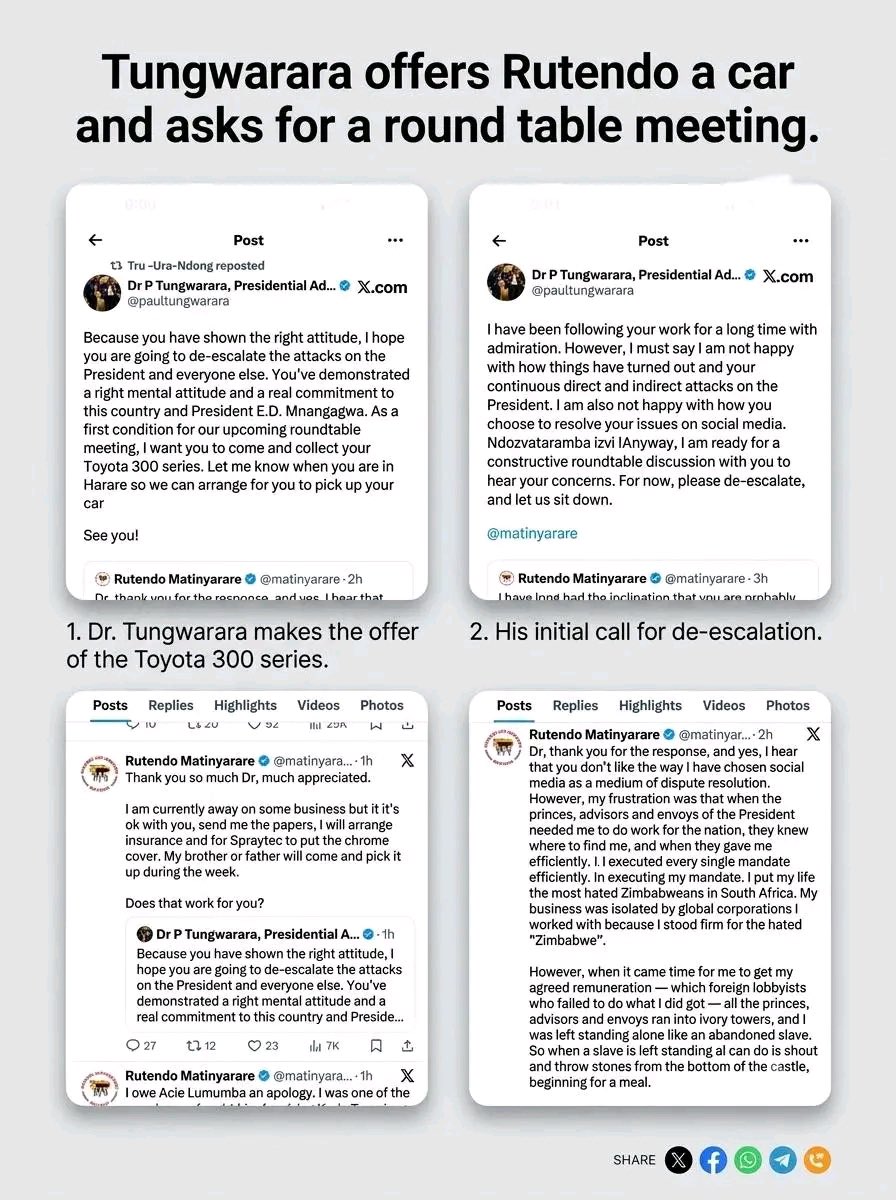
Rutendo gets a Toyota 300 series for agreeing to de-escalate criticism of the President. @paultungwarara
Let me tell you what I got for my work.
In 1993 -1996 (TITLE DEEDS KUMUSHA ORGANIZATION) I provided the architectural formula for land reform to Dr Hunzvi, Reverend Canaan Banana and the generals including Zvinavashe. That became the foundation of what they later called Fast Track Land Reform.
Zimbabwe still uses that framework today. I received nothing.
I proposed the Zimbabwe Gold currency concept. Zimbabwe uses ZiG today. I received nothing.
I worked on sanctions removal from the diaspora alongside Greg Halpern and Rutendo Matinyarare himself in 2021.
That work contributed to Zimbabwe’s improved international standing. I received nothing.
I am the nephew of the President. Born in Shurugwi, raised in Kwekwe — a political heavyweight by blood and by record.
I have never used that relation or any power that comes with it to empower myself. Not once. I received zero. And I have no complaints. We are close.
My father, Senator Dr Felix Mafa Sibanda, is a founding member of the MDC under Morgan Tsvangirai. He served as Senator. He endured imprisonment, harassment and the full brutality of opposition politics. He was removed by Tshabangu’s illegal recalls. He received nothing.
My brother was murdered during Gukurahundi — drowned in the Zambezi River by the Fifth Brigade in 1987.
My family has paid for Zimbabwe’s politics in blood.
And yet Rutendo gets a car for a meeting.
This is exactly how the system works. Patronage over principle. Cars for silence. Roundtables for those who agree to tone it down. Recognition for those who serve power. Nothing for those who serve the people.
I will never play that game.
Not for a car. Not for a position. Not for a roundtable. Not for recognition from people whose recognition means nothing because it is purchased, not earned.
I chose principle over patronage in 1993. I chose it in 2017 when I founded ZEM on the very day of the coup while others celebrated. I choose it today.
My father chose it. My brother paid for it with his life.
That is the Mafa record. Undocumented by those in power. Documented by history.
No to CAB3.
No to patronage politics.
No to military rule in civilian clothes.
Forward to ZEMIA.
— Devine Mafa
Founder and Chairman
Zimbabwe Economic Movement
Republic of Zemia | Est. 2017
1
2,065
‘Zimbabwe deserves better: resign, Chiwenga’ — open letter sparks political storm bulawayo24.com/index-id-news…
56
Icho
Ndicho
My little brother @TembaMliswa
Sabhuku educates @wicknellchivayo on good democracy.
Educating each other is good governance.
All done in love and publicly.
What Temba does not state is that all MPs from Tashabangu are not allowed to vote because they are not legitimate members of parliament since they came through fraud.
#TembaMliswa
#Chivhayo
#Chiwenga
#corruption in #Zimbabwe
#military intelligence
Pasi na General #Chiwenga
1
205
DEVINE MAFA retweeted

Jun 11
Like we have said before, what is happening in Zimbabwe and South Africa is spiritual. The time is coming when corrupt leaders, politicians, thieves, looters, and those who have treated people like modern-day slaves will be forced to answer for their actions.
131
350
1,025
143,041
DEVINE MAFA retweeted
Jun 12
THE BIG SATURDAY READ
ZIMBABWE DOES NOT NEED AN ARMY
By Devine Mafa
Zambezia Economic Movement | 12 June 2026
---
THE ARGUMENT NOBODY WANTS TO HAVE
Zimbabwe has three soldiers running its government. Not one. Three.
The President served in military intelligence during the liberation war. The First Vice President was Commander of the Zimbabwe Defence Forces and led the 2017 military coup. The Second Vice President is also a former military figure. The executive office of Zimbabwe has been militarised continuously since independence in 1980.
This is not a figure of speech. This is the documented reality of the country.
And yet when anyone suggests that Zimbabwe does not need a powerful standing army, the room goes quiet. Opposition figures who claim to want democracy suddenly defend military power. Analysts who correctly identify military involvement in politics as Zimbabwe's core problem still cannot say the logical conclusion out loud.
ZEM will say it plainly.
Zimbabwe does not need the Zimbabwe National Army as it currently exists. The army must be disbanded. What Zimbabwe needs is a small professional border protection force whose only constitutional mandate is guarding Zimbabwe's borders. Nothing else.
That is the argument. Let us make it properly with documented evidence and historical honesty.
---
WHAT THE MILITARY HAS ACTUALLY DONE FOR ZIMBABWE SINCE 1980
The honest answer is documented and devastating.
Gukurahundi, 1983 to 1987. The Fifth Brigade, trained in North Korea and reporting directly to the executive, carried out systematic massacres in Matabeleland and the Midlands. The Catholic Commission for Justice and Peace documented the killings in their 1997 report Breaking the Silence. Villages were burned. Mass graves were dug. Entire families were wiped out. The people who commanded those operations have never been prosecuted. Some of them have been promoted to the highest offices in the land.
Marange Diamond Fields, 2008. Operation Hakudzokwi. The military launched a violent operation against artisanal miners using helicopter gunships and live ammunition. Human Rights Watch documented the killing and torture of over 200 people. The Zimbabwe National Army then took direct control of the diamond fields through companies including Anjin Investments. The Zimbabwe National Army owned 40 percent of Anjin. Not a single cent of that mineral wealth was transparently accounted for to the Zimbabwean people.
2008 Election Violence. Human Rights Watch documented at least 163 people killed and approximately 5,000 tortured or beaten following the March 2008 elections. UNICEF documented at least 10,000 children displaced. The military was deployed as part of a systematic state-sponsored campaign to reverse an election result. Operation Mavhotera Papi — who did you vote for — was not a security operation. It was electoral terror conducted in uniform.
The 2017 Military Coup. On November 13 2017 the Commander of the Zimbabwe Defence Forces appeared on national television flanked by senior officers and announced military intervention in civilian politics. Tanks rolled into Harare. A sitting President was placed under house arrest. Section 208 of the 2013 Constitution which explicitly prohibits military involvement in partisan politics was violated on camera in front of the entire world. The military received the Vice Presidency as its reward. CAB3 is the direct wage of that original constitutional crime.
The DRC Deployment, 1998 to 2002. Zimbabwe deployed its military to the Democratic Republic of Congo not to defend Zimbabwe but to protect Laurent Kabila's government and extract Congolese mineral resources for the benefit of Zimbabwe's military elite. The United Nations documented this deployment as illegal resource extraction. It benefited generals not citizens.
This is the complete documented record of the Zimbabwe National Army since 1980. Gukurahundi. Diamond looting. Electoral terror. Constitutional coup. Foreign resource extraction.
Not one documented example of the military defending Zimbabwe from an external threat. Not one documented example of the military protecting ordinary Zimbabweans from foreign invasion. Not one documented example of the military fulfilling its actual constitutional mandate.
Because Zimbabwe has not faced a serious external military threat since independence. The military has spent 46 years pointing inward. At its own people.
---
THE LIBERATION WAR THAT WAS NOT WHAT THEY TOLD YOU
To understand why Zimbabwe's military is what it is today you must understand what it was built from.
ZANLA, the Zimbabwe African National Liberation Army, was the military wing of ZANU. It fought the liberation war against Ian Smith's Rhodesia from bases in Mozambique and Zambia. The official history says ZANLA liberated Zimbabwe. The honest history is more complicated.
ZANLA was poorly trained. Most fighters had days not months of preparation before deployment. Many had never fired a weapon before crossing into Rhodesia because there were not enough bullets for target practice. They were sent into a sophisticated counterinsurgency environment against one of the most experienced colonial security forces in Africa with inadequate weapons and inadequate training.
The result was that ZANLA could not sustain direct military confrontation with Rhodesian forces. What it could do was control the civilian population.
The pungwe, the all night political education session, was the primary weapon. Not the AK47. Villagers were gathered in the darkness and subjected to hours of nationalist indoctrination. Loyalty to ZANLA was enforced. Those suspected of collaborating with the Rhodesian forces were labelled mutengesi — sellout. That single word was enough to destroy a family. Entire households were wiped out on the basis of an accusation. Cattle were taken. Chiefs were murdered and replaced with men loyal to the party. Communities lived in terror from both sides of the war.
The rapes happened. ZANLA fighters committed sexual violence against the villagers they claimed to be liberating. This was documented at the time by missionaries and human rights observers. The leadership knew. It was tolerated because controlling the civilian population through a combination of genuine political belief and systematic terror was the operational strategy.
ZIPRA, Joshua Nkomo's ZAPU military wing, was different. Soviet trained. Properly equipped. Capable of genuine military confrontation. The competition between ZANLA and ZIPRA was not primarily about defeating Rhodesia. It was about which organisation would control Zimbabwe after Rhodesia fell.
ZANLA won that competition. Not primarily on the battlefield against white Rhodesian soldiers. But in the villages. By building deeper civilian control through a combination of genuine nationalism and systematic intimidation.
That architecture was brought directly into government after independence. The pungwe became the ZANU-PF rally. The mutengesi accusation became the tool used against MDC supporters in 2008 the way it was used against Rhodesian collaborators in the 1970s. Chiwenga's zvigananda in 2026 is the same word in a business suit. Different vocabulary. Same fear. Same purpose. Same power.
The liberation war did not end in 1980. It continued. Against Zimbabweans.
---
THE POWER OF MILITARY NARRATIVE
Chiwenga's greatest weapon has never been a gun. It has been a word.
When Chiwenga calls Tagwirei a zvigananda the whole country repeats it. His power does not come from respect. It comes from fear. The same fear he and his generation used during the liberation war when the word mutengesi was enough to wipe out entire families, take their cattle and replace their chiefs.
Now the word is zvigananda. Economic saboteur. He said it at a national hero's burial. He said it at a business conference. Zimbabwe repeated it. An entire country picked up the vocabulary of a general and used it against businesspeople who have not been charged with any crime in any court.
Now he calls Mnangagwa Hezekia. The biblical king given fifteen extra years who faced severe consequences. Zimbabwe laughs. Zimbabwe repeats it. Zimbabwe does not ask who gave a Vice President the right to decide which sitting president is Hezekia and which deserves consequences.
That is the power of military narrative. It does not require logic. It requires fear. And Zimbabwe has been trained since the liberation war to follow the narrative of whoever carries the gun.
Mugabe himself admitted near the end that he was not truly in charge. He said he was merely a voice. Whose voice he never said openly. But the documented record points to the Joint Operations Command. The JOC. The parallel military structure that operated alongside civilian government from independence. The real power that Mugabe fronted while the generals governed from behind the curtain.
Today the army spends its time attending parades, extracting diamonds, and acting as personal security for the political elite. The JOC architecture has never been dismantled. CAB3 is not dismantling it. CAB3 is completing it.
When Chamisa uses the word zvigananda he is not being independent. He is adopting Chiwenga's narrative. When Mwonzora uses it he is amplifying Chiwenga's frame. When Komichi uses it he is confirming that the civilian opposition has surrendered its intellectual independence to a general's vocabulary.
Leaders shape narratives. They do not follow them.
Zimbabwe's opposition has spent years following military narratives dressed as political analysis. That is not opposition. That is capture without chains.
---
THE ACCOUNTABILITY THAT NEVER HAPPENED
After World War Two the international community established the Nuremberg Trials. Nazi war criminals were prosecuted. The principle of command responsibility was established in international law meaning that military commanders are accountable for atrocities committed by forces under their command.
After apartheid South Africa established the Truth and Reconciliation Commission. Perpetrators could apply for amnesty in exchange for full public disclosure. Victims were heard. A national reckoning happened.
After the 1994 genocide Rwanda established the Gacaca courts, community based tribunals that processed over 1.9 million cases. Justice was imperfect but accountability was real and public.
Zimbabwe had none of this.
After Gukurahundi — nothing. The perpetrators were promoted.
After the 2008 election violence — nothing. The commanders responsible continued in uniform and advanced in rank.
After the 2017 coup — nothing. The coup leader became Vice President.
The names of those who commanded Gukurahundi are known. The names of those who ordered the 2008 terror are known. They walk free. Some hold the highest offices in the land.
Zimbabwe has placed those responsible for documented atrocities in its cabinet and called it governance.
The absence of accountability is not accidental. It is structural. A military that has committed documented atrocities cannot allow accountability because accountability leads directly to prosecution. The military remains in politics precisely to prevent the justice that would follow its removal.
This is the circular trap Zimbabwe is in. And it is why the army cannot simply return to the barracks. It must be disbanded and rebuilt from the foundation.
The British government bears documented responsibility for this trap. The Lancaster House Agreement of 1979 included no accountability mechanism for colonial era violence. The British knew what was happening during Gukurahundi. Their diplomatic cables prove it. They gave Mugabe an honorary degree from the University of Edinburgh in 1984 while the Fifth Brigade was burning villages. They protected their investments and looked away from the mass graves.
Britain must be held accountable through documented legal process. The precedent exists. Caribbean nations are pursuing reparations from Britain for slavery through the CARICOM Reparations Commission. Zimbabwe must join that process formally. ZANLA must be held accountable for its documented crimes against civilians. The Rhodesian security forces must be held accountable. The British government must be held accountable.
Zimbabwe never got its Nuremberg. It is not too late to demand one.
---
COUNTRIES THAT ABOLISHED THEIR MILITARIES AND THRIVED
Costa Rica abolished its military in 1948. Article 12 of its constitution permanently prohibits a standing army. The money that would have funded a military went into education and healthcare instead. Today Costa Rica has the highest literacy rate in Latin America, universal healthcare, and one of the most stable democracies in the Western Hemisphere. It has not been invaded. It has not collapsed. It has thrived for 78 years without an army.
Panama abolished its military in 1994 following the removal of Manuel Noriega. The constitution was amended to permanently prohibit a standing army. Panama has since become one of the most economically dynamic countries in Central America.
Iceland has no military of its own. It relies on a small coast guard for domestic security and NATO for collective defence. It consistently ranks as one of the most peaceful, prosperous and democratic nations in the world.
Mauritius has no military. It has a police force and a coast guard. It is the most stable democracy in Africa and has the highest GDP per capita on the continent outside of island microstates and oil producers.
These are not theoretical examples. These are documented functioning nations that made a deliberate constitutional choice to redirect military spending toward human development and are better for it in every measurable way.
The argument that Zimbabwe needs a large standing army for security is not supported by any documented threat. Zimbabwe shares borders with Zambia, Mozambique, South Africa, Botswana and Namibia. None of these countries has threatened Zimbabwe militarily. None has the intention or the capacity to invade Zimbabwe. The last external military threat Zimbabwe faced was the Rhodesian war which ended in 1980.
In 46 years of independence Zimbabwe has not fought a single war in defence of its own territory.
---
WHAT ZIMBABWE ACTUALLY NEEDS
What Zimbabwe needs for genuine national security is simple and achievable.
A professional border protection force of not more than 5,000 trained personnel whose sole constitutional mandate is guarding Zimbabwe's borders and preventing smuggling, human trafficking and illegal entry. Funded transparently. Accountable to civilian parliament. Constitutionally prohibited from any role in domestic politics, electoral processes or civilian governance.
Switzerland offers a different model worth considering. Every able bodied Swiss citizen receives basic military training and maintains readiness. There is no large standing professional army consuming the national budget. National defence is distributed across the civilian population. The professional security apparatus is small, technically advanced and strictly apolitical.
Zimbabwe can build its own version. Universal basic defence training integrated into secondary school curriculum. A small professional border protection force. A constitutional prohibition on military involvement in politics permanently entrenched and non-amendable without a supermajority referendum.
The remainder of the current military budget redirected to education, healthcare, digital infrastructure and a National Sovereign Wealth Fund that puts mineral revenues into the hands of every citizen equally.
That is genuine national security. Not generals in the cabinet. Not tanks on the streets of Harare. Not soldiers torturing other soldiers at Cranborne Barracks over political leaflets. Not Vice Presidents threatening bloodshed at national hero funerals.
---
THE FEDERATION THAT BECOMES POSSIBLE
Zimbabwe cannot survive alone in the world that is coming.
China's economic footprint across southern Africa is expanding rapidly and is documented. Climate change is destroying agricultural capacity across the region. Global supply chains are restructuring around large economic blocs. Small fragmented nations with weak institutions and captured militaries will be absorbed or become irrelevant.
The answer is a southern African federation. Zimbabwe, Zambia, Mozambique, Malawi, Botswana, Namibia — with a pathway toward South Africa. A unified economic bloc with shared institutions, shared currency, shared border protection and shared mineral wealth management.
That vision is not new. Joshua Nkomo believed in African unity. The original ZAPU vision was pan-African not Shona nationalist. The Tonga people whose ancient name we reclaim for Zemia never recognised the borders that colonialism drew across the Zambezi. Those borders divided one people into multiple states for the convenience of European powers.
A federation built on the Zambezi basin — the ancient heart of the region — is not fantasy. It is the only realistic path to genuine sovereignty against Chinese economic dominance, climate destruction and global marginalisation.
But that federation cannot be built while Zimbabwe has generals fighting over presidential succession in the cabinet. It cannot be built while the army mines diamonds instead of building bridges. It cannot be built while the opposition adopts military narratives instead of civilian vision. It cannot be built while leaders follow Chiwenga's vocabulary instead of shaping their own.
The army that wants sectional power cannot build regional unity.
---
THE SOCIAL CONTRACT OF ZEMIA
ZEM is not just opposing Zimbabwe. ZEM is building Zemia.
The Republic of Zemia takes its name from the ancient Tonga word for the Zambezi River. Zem. The Great River. Named by the Tonga people before the Mutapa Kingdom, before Rhodesia, before Zimbabwe. The river belongs to everyone who has ever lived beside it. No political party owns it. No liberation movement named it. No general can claim it.
Zemia is not a return to the past. It is a construction for the future built on the oldest foundation this land has.
Constitutional Amendment Bill Number 4 is already published on Apple Books. It is documented. It is real. It permanently excludes the military from civilian governance. It establishes direct presidential elections that cannot be transferred to parliament. It limits presidents to two terms of five years. It creates a National Sovereign Wealth Fund that puts thirty percent of all mineral revenues into a publicly audited fund owned equally by every citizen. It commits the state to digital governance, free education and justiciable healthcare rights.
That is the country Zimbabwe can be.
The army of Zemia is not a standing professional military consuming the national budget and threatening its own citizens. The army of Zemia is the people. Every citizen trained. Every border protected by professionals accountable to civilians. Every mineral publicly audited. Every leader term-limited and replaceable.
The people of Zimbabwe are not powerless. They have been trained to believe they are powerless by the same generals who need their passivity to survive.
Stop repeating their narratives. Stop using their words. Stop waiting for their permission to build the country you deserve.
The river was here before any of this. It will be here after all of it.
Build on the river.
No to CAB3. No to military governance. Forward to Zemia.
Devine Mafa
Founder and Chairman
Zambezia Economic Movement
Republic of Zemia. Est. 2017
2
2
3
1,017
DEVINE MAFA retweeted
Jun 12
Confessions by Chiwenga, Constantine - Shona speaking guy from Umtali.
8
1
1
1,051
Jun 12
WHY THE ZIMBABWEAN OPPOSITION STOPPED ORGANISING - WAITING FOR CHIWENGA COUP BY DREAMERS
By Devine Mafa
Zimbabwe Economic Movement | 12 June 2026
In early June 2026 Zimbabwe's attempt at a United Opposition against Constitutional Amendment Bill Number 3 quietly collapsed. The real reason was not lack of resources. It was not state repression alone. It was a mindset that has destroyed Zimbabwean opposition politics before and is destroying it again.
Many opposition figures stopped building serious civilian resistance because they were waiting for General Constantino Chiwenga to act.
That is the honest documented explanation for why CAB3 has moved through parliament largely unopposed by any coordinated civilian resistance. And it must be said clearly before September 4 arrives and the moment is lost entirely.
THE UNITED OPPOSITION COLLAPSE
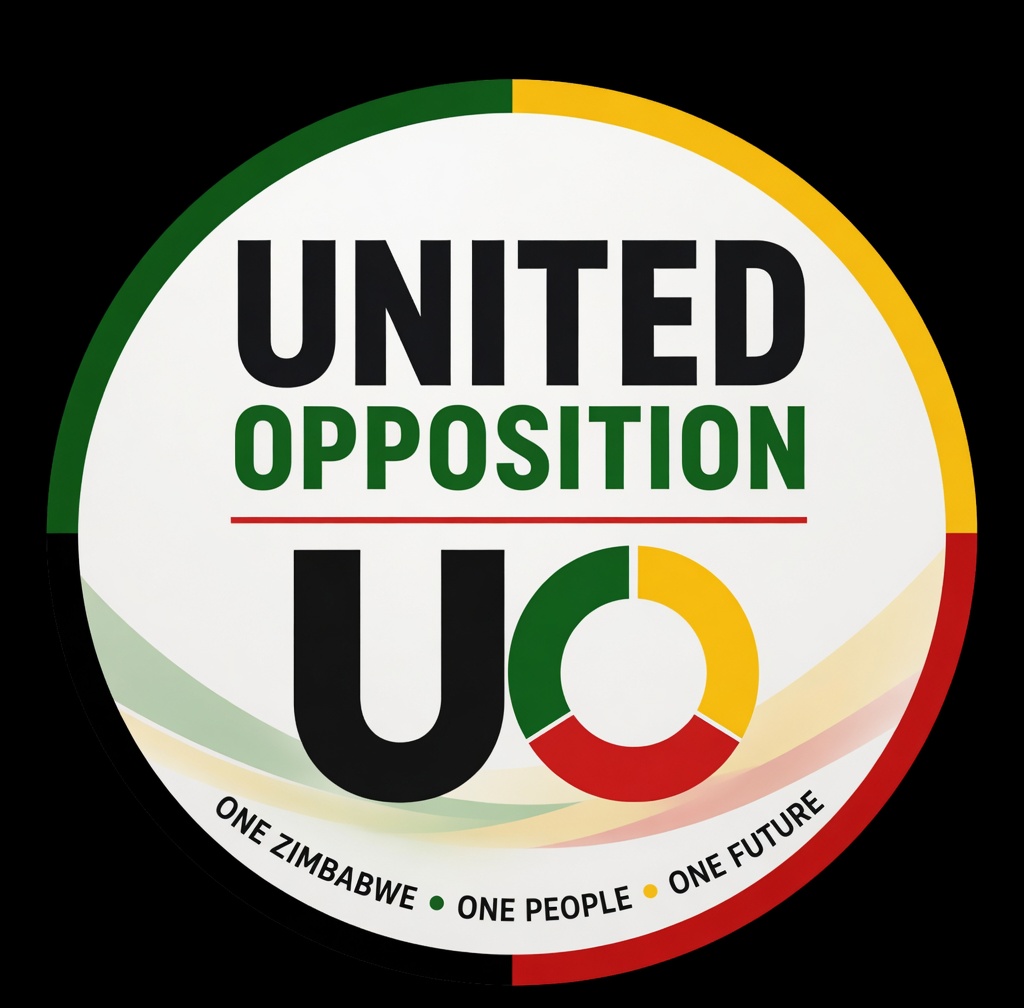
I founded the United Opposition platform. I designed the logo. I arranged the first meetings between opposition leaders who had never sat in the same room. I did that work because I believed that stopping CAB3 required every serious civilian voice united around one demand — no to the removal of the direct presidential vote.
Morgan Komichi was my partner in that work. When the platform fractured it was not over tactics or resources. It was over one fundamental question. Would the United Opposition include General Chiwenga and the military as partners in the resistance to CAB3?
Komichi's own published statement listed General Chiwenga and the military among those working to reject CAB3. That statement is documented. It is in his own words.
ZEM was founded in 2017 on one non-negotiable principle. No military in politics. Under any circumstances. Not Mnangagwa. Not Chiwenga. Not any general wearing any uniform promising any transition.
I refused to accept a coalition that included the military as a partner. I was sidelined. The platform fractured. And the organized civilian resistance that CAB3 required never fully materialized.
THE WAITING GAME
What replaced organized civilian resistance was a waiting game.
Some opposition leaders privately concluded that ZANU-PF's manufactured parliamentary majority — built through Tshabangu's illegal recalls, Chamisa's resignation, and the vacation of seats by Mahere and Markham — made civilian victory through constitutional means impossible.
Having reached that conclusion they stopped building ground structures. They stopped organizing mass submissions to parliament. They stopped sustained senator targeting. They stopped coordinated street demonstrations. They stopped diaspora economic pressure campaigns.
Instead they positioned themselves for whatever move Chiwenga might make against Mnangagwa.
The United Opposition's own slogan became Eyes open about what comes after. That was not a resistance slogan. That was a succession positioning slogan. It signalled that the primary strategic calculation had shifted from stopping CAB3 to being on the right side when the military moved.
The cost of that waiting game is now visible. While opposition factions waited for a palace coup CAB3 continued its journey through parliament. Fewer than 3,000 public submissions were made against a constitutional amendment that removes fifteen million people's right to directly elect their president.
Three thousand submissions. In a country of fifteen million people with a diaspora of several million more.
That number does not reflect public indifference. Millions of Zimbabweans oppose CAB3. That is documented. The number reflects organizational collapse. You cannot generate 300,000 submissions without structures on the ground in every constituency explaining to ordinary people what is being taken from them and how to formally oppose it.
Those structures were never built. Because the people who should have built them were waiting for a general instead.
THE 2017 REPETITION
This is not a new pattern. It is the exact same calculation that failed Zimbabwe in 2017.
When Chiwenga rolled tanks into Harare in November 2017 large sections of the opposition quietly welcomed it. They attended the inauguration. They celebrated in the streets alongside ordinary Zimbabweans who genuinely felt relief at Mugabe's departure. They hoped the military intervention would open a pathway to genuine democracy.
Nine years later the wages of that hope are CAB3. The Tshabangu recalls. The captured parliament. The $31 million bribery fund. The systematic dismantling of the 2013 Constitution that was only four years old when the tanks arrived.
The opposition that celebrated 2017 spent nine years learning that military transitions do not produce democracy. They produce the next military transition.
And now in 2026 significant sections of that same opposition are making the same calculation again. Chiwenga opposes CAB3 because it blocks his presidential succession pathway. Therefore support Chiwenga. Therefore wait for Chiwenga. Therefore position yourself for the transition Chiwenga will deliver.
The people making this calculation are not stupid. They are not traitors. They are people who have watched civilian resistance fail repeatedly and concluded that the only force capable of removing Mnangagwa is the military.
But that conclusion surrenders the principle that makes any future democratic Zimbabwe possible.
If the precedent is established that constitutional crises in Zimbabwe are resolved by military intervention then every future constitutional crisis will be resolved the same way. The generals will always be the final arbiters of political outcomes. Civilian governance will always be conditional on military permission.
That is not democracy. That is permanent military occupation with democratic branding.
THE CHAMISA DIMENSION
Chalton Hwende has documented the organizational consequences of Chamisa's January 2024 resignation with precision. The MPs who stayed in parliament were vilified as sellouts. The organizational structures were dissolved. The legal challenge filed by Thabani Mpofu was dismissed on a technical defect without the substance ever being heard.
The same people who called MPs sellouts are now circulating their debate clips as evidence CAB3 can be stopped. That is not strategy. That is the politics of convenience replacing the politics of principle.
Chamisa attended the 2017 inauguration. He resigned in January 2024 abandoning recalled legislators. He told people not to take to the streets against CAB3. He has produced no documented legal strategy and no documented organizational strategy to stop it.
And yet he remains positioned as the opposition's primary alternative.
The cult of personality around one leader whose documented record at critical moments has consistently failed Zimbabwe is itself part of the organizational problem Hwende identifies. A movement that cannot function without one person's permission is not a movement. It is a following.
THE PATH THAT REMAINS
The Senate vote has not happened. September 4 has not arrived. The fight is not over.
But winning what remains requires honesty about what was lost and how.
The organizational infrastructure was destroyed. The submission process was not mobilized. MPs were abandoned and then celebrated. Legal papers were filed defectively. The United Opposition fractured over whether to include the military as a partner.
Those failures are documented. They must be named before they can be corrected.
What can still be done before September 4 is specific and achievable.
Every non-ZANU-PF senator must be contacted directly and their position put on public record before the vote. The $31 million bribery evidence confirmed by retired generals must be submitted formally to the African Union, SADC, and international media. Zimbabweans in every city with a Zimbabwean embassy must organize coordinated demonstrations on one date with one demand. Legal challenges currently active must be pursued with properly filed applications.
None of that requires waiting for a general. All of it requires organized civilian action.
THE PRINCIPLE THAT DOES NOT MOVE
ZEM was founded on November 24 2017 — the day others attended the coup inauguration. Our position has not moved in nine years.
No military in politics. The people elect their president directly. Those principles exist independently of any individual leader, any political moment, and any tactical calculation about what is achievable.
The painful lesson of June 2026 is simple and must be stated plainly.
Waiting for a saviour in barracks is not resistance. It is surrender. It is the same surrender that produced CAB3. And it will produce the next constitutional crisis after this one if Zimbabwe's opposition does not learn it.
True resistance is built by organized people. Not by organized hope for the next general.
The river was here before any of this. The Zambezi does not ask a general's permission to flow.
Build on the river.
No to CAB3. No to military solutions. Forward to Zemia.
— Devine Mafa Founder and Chairman Zimbabwe Economic Movement Republic of Zemia | Est. 2017
144
DEVINE MAFA retweeted
Jun 12
THE STRUCTURAL COLLAPSE OF ZIMBABWE'S OPPOSITION AND THE CAB3 CRISIS
By Devine Mafa Zimbabwe Economic Movement | 12 June 2026
Chalton Hwende has said something that needed to be said publicly and he deserves credit for saying it honestly even though it implicates people he has worked alongside.
His argument is precise. When CCC dissolved its structures and Chamisa resigned in January 2024 the opposition did not just lose members. It destroyed the organizational infrastructure that a constitutional resistance movement requires to function. The consequences of that destruction are now visible in the CAB3 fight. Fewer than 3,000 public submissions against a constitutional amendment that removes the people's direct presidential vote. MPs who accepted this is their last term and stopped fighting. No coordinated party structure to mobilize citizens, hold senators accountable, or build sustained pressure before September 4.
That is not bad luck. That is the documented consequence of specific decisions made by specific leaders at specific moments.
ZEM has been saying this since January 2024. The timing and the manner of Chamisa's resignation were not just personally damaging to him. They were structurally catastrophic for Zimbabwe's democratic resistance at the worst possible moment.
THE SEQUENCE THAT DESTROYED THE OPPOSITION'S CAPACITY
To understand where Zimbabwe's opposition finds itself today you have to follow the sequence honestly without the emotional framing that has surrounded every step of it.
The Tshabangu recalls began in 2023. The constitutional challenge was that Tshabangu had no legitimate basis to recall CCC legislators because CCC had a constitution — documented and in parliament's possession — that did not give him that authority. Parliament and Speaker Mudenda ignored the documented evidence and proceeded with the recalls on instructions from above.
The correct response to illegal recalls was to contest them from inside parliament. To remain. To fight every legal avenue. To mobilize citizens to understand what was being taken from them. To submit en masse to every consultation process. To hold every MP publicly accountable.
Instead Chamisa told legislators to leave parliament. He then resigned in January 2024 abandoning every recalled legislator including Senator Felix Sibanda. Fadzai Mahere and Rusty Markham vacated their seats following his direction. Those seats went directly to ZANU-PF. The two thirds majority that is now being used to push CAB3 was consolidated not by ZANU-PF's electoral strength alone but by the voluntary vacation of opposition seats.
That is the documented record. The two thirds majority that threatens to remove Zimbabwe's direct presidential vote was partially built by the opposition's own actions.
THE MPOFU FAILURE
Thabani Mpofu filed the legal challenge against the Tshabangu recalls. He is one of Zimbabwe's most prominent lawyers. He had represented Chamisa in the 2018 election petition. He understood constitutional law.
The application was dismissed on a technical defect without the substance ever being examined by the court.
A case that could have exposed the illegal nature of the recalls and potentially reversed the parliamentary majority that now threatens CAB3 was lost not on its merits but on a filing error.
No accountability followed. No explanation was given to the legislators whose parliamentary careers ended because of that defect. No alternative legal strategy was developed.
The recalled legislators were abandoned twice. First by Chamisa's resignation. Then by defective legal representation that never gave their case a hearing on its merits.
THE VILIFICATION CYCLE HWENDE IDENTIFIES
Hwende's most important observation is about the psychological and political dynamic that followed.
The MPs who stayed in parliament after the recalls were labelled sellouts. Daily. Publicly. By the same people who are now circulating their debate clips against CAB3 as evidence the bill can be stopped.
Think about what that means in practice.
An MP who stayed in parliament to fight from the inside was told every day that nobody wanted to see them return after their term. That they were traitors. That they had chosen ZANU-PF over the people. That their presence in parliament legitimized the recalled majority.
Under that sustained pressure many of those MPs made a rational calculation. If this is my last term regardless of what I do then I have nothing to lose by accepting whatever ZANU-PF offers. The vilification campaign did not produce principled resistance. It produced exactly the opposite. MPs who concluded that fighting was pointless because even their own supporters had abandoned them.
And now those same supporters are circulating clips of those same MPs speaking against CAB3 in debate as if that proves the bill can be stopped.
It proves nothing of the sort. A speech against CAB3 in a parliament where the votes are already secured is not resistance. It is performance. Hwende is correct to distinguish between MPs making speeches and MPs having the votes and the organizational backing to actually defeat the bill.
THE SUBMISSION FAILURE
Constitutional Amendment processes in Zimbabwe require public consultations. Citizens can make submissions. Those submissions form part of the parliamentary record.
Fewer than 3,000 submissions were made against CAB3.
In a country of fifteen million people with a diaspora of several million more fewer than 3,000 people submitted formal opposition to a constitutional amendment that removes their right to directly elect their president.
That number reflects organizational collapse not public indifference. Zimbabweans in their millions oppose CAB3. The documented polling and public sentiment make that clear. But opposing something and formally submitting opposition through constitutional processes are different things. The second requires organization. It requires structures that can explain the process to ordinary citizens, help them formulate submissions, coordinate timing and volume, and ensure the submissions actually reach the relevant parliamentary committees.
CCC had those structures. They were dismantled. The result is 3,000 submissions where there should have been 300,000.
Hwende is correct that this organizational failure is directly traceable to the decision to dissolve party structures. You cannot run a constitutional resistance campaign from social media posts and daily attacks on individual MPs. You need structures on the ground in every constituency explaining to ordinary Zimbabweans what is being taken from them and how they can formally oppose it.
That infrastructure was destroyed and it cannot be rebuilt in the weeks remaining before September 4.
THE CHAMISA PARADOX
Nelson Chamisa remains the most popular opposition figure in Zimbabwe. That is documented and nobody serious disputes it. His name recognition, his ability to draw crowds, his emotional connection to millions of Zimbabweans who see him as representing a genuine alternative to ZANU-PF — these are real political assets.
But popularity without organizational infrastructure is not political power. It is celebrity.
Chamisa attended the 2017 inauguration. That is documented. He resigned in January 2024 abandoning recalled legislators. That is documented. His lawyer filed defective papers on the recalls challenge. That is documented. He has told people not to take to the streets against CAB3. That is documented.
And yet he remains positioned as the opposition's primary hope.
Hwende's analysis reveals why that positioning is so dangerous. The same people who celebrate Chamisa's popularity are the same people who vilified the MPs and structures that could have built the organized resistance CAB3 required. The cult of personality around Chamisa actively undermined the organizational capacity that Zimbabwe's democratic resistance needed.
A movement built around one person's charisma rather than documented principles and organizational structures is fragile by design. When that person makes poor decisions — and the documented record shows Chamisa has made several at critical moments — the entire movement suffers because there is no organizational foundation independent of the personality.
THE LESSON ZEM DRAWS
ZEM was founded in 2017 on a principle not a personality. No military in politics. The people elect their president directly. Those principles exist independently of any individual including Devine Mafa. They cannot be resigned away. They cannot be vilified into irrelevance. They cannot be dissolved by a decision made at the top.
That is what organizational principles grounded in documented positions provide that personality cults cannot.
Hwende's analysis confirms what ZEM has argued since 2017. Zimbabwe's democratic resistance cannot be built around any single leader. It must be built around documented principles that any citizen can understand, adopt, and act on independently.
The Senate vote has not happened. September 4 has not arrived. The fight is not over.
But winning what remains of this fight requires honesty about what was lost and how it was lost. The organizational infrastructure was destroyed. The submission process was not mobilized. MPs were vilified and then celebrated. Defective legal papers ended a crucial challenge before it was heard.
Those are the documented failures that must be acknowledged before they can be corrected.
Zimbabwe deserved better. The MPs who stayed and fought deserved better. The recalled legislators deserved better. The millions of Zimbabweans whose direct presidential vote is now genuinely at risk deserved better.
That is what Hwende said. It needed to be said.
— Devine Mafa Founder, Zimbabwe Economic Movement Republic of Zemia | Est. 2017
1
1
3
411
DEVINE MAFA retweeted

Jun 12
I don’t post for likes because I am not monetized. When we initially raised opposition and concern over moves to dissolve structures and do away with our constitution, the same individuals who attack me daily were busy cheering the party into a grave. When the party was eventually folded, they started lying that in three months a new party would be formed without us sellouts. Three months became nine months, then one year, then two years, etc. They kept cheering and demonizing those of us who chose to remain in parliament.
What they didn’t know was that without party structures and a constitution, there was no chance of effectively mobilizing citizens to resist attempts to amend the constitution. This is why those opposing managed fewer than 3,000 submissions you can’t do such an exercise without structures and a party. This meant that ZANU PF would be able to amend the constitution without an opposition because there was no party and no structure to oppose them.
When the same cheerleaders were daily labeling and condemning MPs who remained in parliament as sellouts, I personally requested them to think it through, as the MPs would become important in the future. But no one listened. Most of the MPs are daily told that this is their last term and that no one wants to see them back again. This is so sad. No wonder many of the MPs who are supporting the bill have accepted that this is their last term. This was self-defeating and fatal to the strategy of stopping the bill as the opposition.
Now I see the same leaders resorting to circulating clips of MPs who are opposing the bill during debate, falsely creating an impression that the bill can be stopped. The same cheerleaders failed to even submit email submissions. They think daily attacking or asking MPs their position on CAB 3 will stop the bill. No, far from it. We need to self-introspect."
292
27
111
71,446
DEVINE MAFA retweeted

Jun 12
Elon Musk just became the world's first trillionaire. This needs to be a wake up call.
36,871
2,164
9,673
5,282,881