
Utopian code typer. Proud member of @java_champions. Chilango 🇲🇽 I know nothing Find me also bsky.app/profile/domix.codes
Joined April 2008
- Tweets 31,871
- Following 3,008
- Followers 4,765
- Likes 8,308
2,488 Photos and videos







Domingo Suarez Torres retweeted

Jun 8
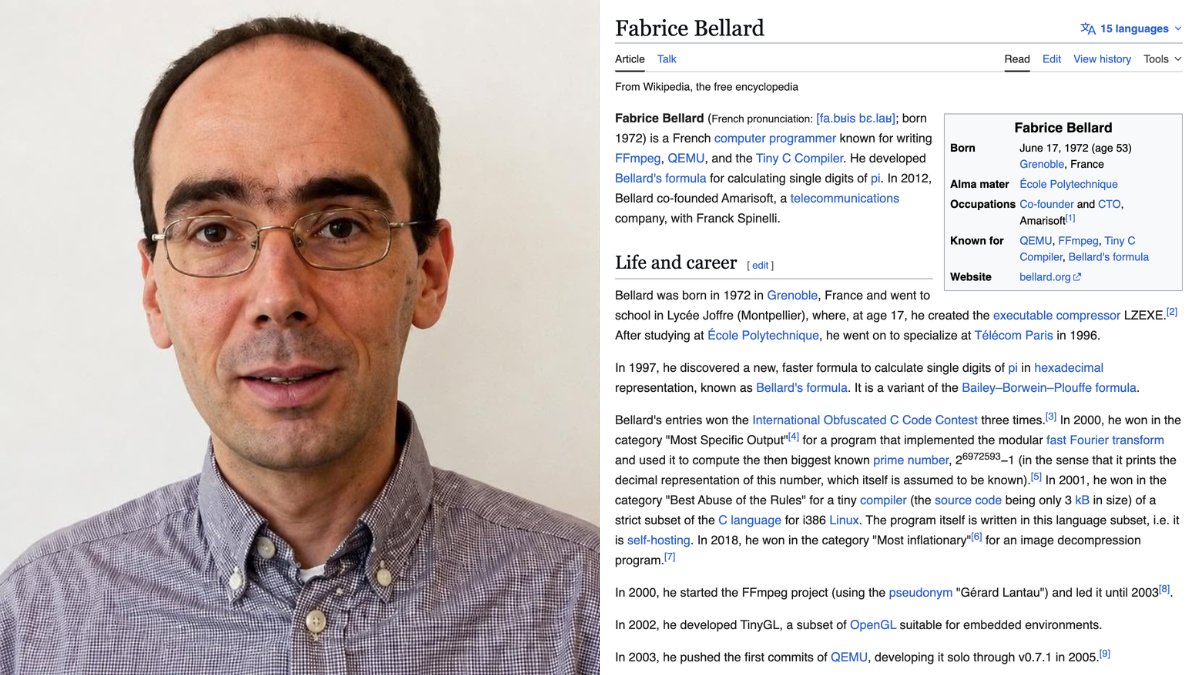
A French engineer who lives quietly in Paris has spent 30 years writing software that the entire internet now runs on without knowing his name.
He wrote the code that streams every YouTube video, every Netflix show, every TikTok clip. He wrote the code that runs the virtual servers underneath AWS, Google Cloud, and Microsoft Azure. He calculated more digits of pi than anyone in history. He has no Twitter. He has no marketing. He just keeps shipping.
His name is Fabrice Bellard.
Here is the story, because almost nobody outside the systems programming world knows what one man has built.
Fabrice was born in 1972 in Grenoble, France. He studied at École Polytechnique, the top French engineering school. He never went to Silicon Valley. He never built a startup empire. He just wrote code.
In 2000 he started a project called FFmpeg, an open-source multimedia framework for encoding, decoding, and streaming video. He was 28. The project did one thing nobody else had done well. It handled every video and audio format that existed, in one library, on every operating system. He led it himself for years.
Today FFmpeg is the invisible engine of the internet. YouTube uses it. Netflix uses it. VLC uses it. Chrome and Firefox use parts of it. Every Android phone, every iPhone, every smart TV, every video editing tool you have ever touched runs FFmpeg somewhere underneath. If you have watched a video on a screen in the last 20 years, Fabrice's code processed it.
He was not done.
In 2003 he started QEMU, a machine emulator and virtualizer. He wrote it solo until version 0.7.1 in 2005. QEMU lets you run any operating system on any other operating system. It became the foundation of modern virtualization. KVM, the Linux kernel hypervisor, runs on top of QEMU. Every major cloud provider, AWS, Google Cloud, Microsoft Azure, IBM Cloud, runs virtual machines on infrastructure built around it. The Quick Emulator is the most cited piece of cloud infrastructure code on Earth.
He kept going.
In 2001 he won the International Obfuscated C Code Contest with a small C compiler that grew into TCC, the Tiny C Compiler. TCC can compile and boot a Linux kernel from source in under 15 seconds. In 2004 he calculated the most digits of pi ever computed at the time, using a personal desktop computer and an algorithm he derived himself called Bellard's formula. In 2011 he wrote a complete PC emulator in pure JavaScript that runs Linux in your browser, a project called JSLinux that engineers still cannot believe is real.
In 2019 he released QuickJS, a small but complete JavaScript engine that fits where V8 cannot. In 2021 he released NNCP, a neural network based lossless data compressor that immediately took the lead on the Large Text Compression Benchmark.
Then he turned his attention to large language models. He built TextSynth Server, a web server with a REST API for running LLMs locally. He released ts_zip and ts_sms, compression utilities that use language models to compress text and short messages at ratios traditional algorithms cannot reach. He released TSAC, a very low bitrate audio compression system. In December 2025 he released Micro QuickJS, a new JavaScript engine for microcontrollers, separate from QuickJS, designed for environments with almost no memory.
Fabrice co-founded a telecom company called Amarisoft in 2012, where he serves as CTO. Amarisoft builds 4G and 5G base station software used by carriers and labs around the world. He has been running it for over a decade while continuing to ship personal projects from his own home page at bellard dot org
He has no Twitter. He has no Instagram. He gives almost no interviews. His personal website is a flat list of projects with no styling, no fonts, no marketing copy. Just titles and links.
A quiet French engineer who never moved to Silicon Valley wrote the code that quietly runs the internet.
He is still shipping.
379
4,508
25,139
3,048,539
Domingo Suarez Torres retweeted

May 28
l've never seen anything more accurate
531
63,760
305,598
7,213,726

tldr: ClickUp is hosting a company-wide Hunger Games where if you can figure out how the hell to make AI work you’ll win a million dollars.
May 21

Today we reduced headcount by 22%. The business is the strongest it's ever been. So I think it's important to be direct about what I'm seeing and why.
First, I made this decision and I own it. I did it because the way to operate at the highest level of productivity is changing, and to win the future, ClickUp needs to change with it.
Second, this wasn't about cutting costs. Most savings from this change will flow directly back into the people who stay. We'll be introducing million-dollar salary bands. If you create outsized impact using AI, you'll be paid outside of traditional bands.
Most importantly, I have the deepest gratitude for those affected. We're doing this from a position of strength specifically so we can take care of people properly. Everyone affected receives a package aimed at honoring their contributions and easing the transition.
I only see two options: wait for this to play out gradually in the market or be honest about what I'm seeing and act proactively.
THE 100X ORGANIZATION
The primary change is that we're restructuring around what I call 100x org. The goal is 100x output. The roles required to build at the highest level are fundamentally different than they were a year ago.
Incremental improvements to existing systems won't get us there. We need new ones. That means creating enough disruption to rebuild rather than iterate on what's already broken.
The common narrative is that AI makes everyone more productive. It doesn't. Many of the workflows of today, if left unchanged, create bottlenecks in AI systems.
These roles will evolve. But waiting for that to happen naturally means falling behind now.
The 100x org is actually heavily dependent on people - infinitely more than today. This is only possible with 10x people that have embraced and adopted new ways of working.
THE BUILDERS, AGENT MANAGERS, AND FRONT-LINERS
— THE BUILDERS: 10X ENGINEERS
I don't think most companies have internalized what's actually happening with AI in engineering. The common narrative is that AI makes all engineers more productive. That may be true in isolation, but at an organization level - that is the farthest thing from reality.
Here's what we've validated recently at ClickUp: the great engineers, the ones who can orchestrate, architect, and review, are becoming 100x engineers. They're not writing code. They're directing agents that write code. The skill is judgment.
AI makes the best engineers wildly more productive, and everyone else using AI slows these engineers down.
Think about it - the bottlenecks are (1) orchestration - telling AI what to do, and (2) reviewing - what AI did. Everything is leapfrogged and no longer needed.
So who do you want orchestrating and reviewing code?
And how do you want your best engineers to spend their time?
If your best engineers are spending time reviewing other people's code, then this is inherently an inefficient bottleneck. These engineers can review their agent's code much faster than reviewing human code.
The new world is about enabling your 10x engineers to become 100x.
The wrong strategy is to push every engineer to use infinite tokens. Companies doing this are celebrating 500% more pull requests. But customer outcomes don't match the volume of code being generated.
I call this the great reckoning of AI coding, and every company will face this soon if not already.
More code is just another bottleneck to the best engineers, and ultimately to your company's impact as well.
— THE BUILDERS: 10X PRODUCT MANAGERS
Product management and design roles are merging.
Designers that have customer focus, become more like product managers.
And product managers that have intuition for UX become more like designers.
The bottleneck of user research is gone. It takes us just one mention of an agent to kickoff research and analyze results.
The bottleneck of product <> design iteration is also gone. The product builder iterates on their own, along with agents and skills that ensure alignment with quality and strategy.
Also controversial today - I believe that the wrong strategy is to have your PMs shipping code - that just introduces another bottleneck that the best engineers will waste their time on.
To be clear, PMs should be coding but they should do this in a playground to iterate, validate, and scope. That code should not go to production.
Everything outside of managing systems, orchestrating AI, and reviewing output becomes a bottleneck.
That's why the other roles that are critical along with these are the systems managers (to reduce bottlenecks) along with a bottleneck you can't replace - customer meeting time.
— THE SYSTEM MANAGERS
Ironically, the people that automate their jobs with AI will always have a job. They become owners of the AI systems - agent managers. We have many examples of these people at ClickUp.
The underlying systems in which we operate are absolutely critical to get right. I think most companies are delusional to think they can iterate on existing systems and compete in this new world.
You must create enough disruption so that old systems are deprecated entirely. If there's any definition for 'AI native' that's what it is.
— THE FRONT-LINERS
In a world that will become saturated with AI communication, the human touch will matter more than anything to customers.
This is a bottleneck that you shouldn't replace - even when agents are high enough quality to do video meetings.
One-on-one meeting time with customers is something that shouldn't be automated. The systems around the meetings should be - so that front-liners spend nearly 100% of their time with customers.
REWARDING 100X IMPACT
In a world where companies are able to do so much more with less, where does that excess money go?
In our case, much of the savings in this new operating model will flow directly back to those that enabled it.
We must reward people that create productivity accordingly. This aligns incentives on both sides. Plus, in a world where your best people create 100x impact, you can't afford to lose them.
You should aim to retain these employees for decades. The context they have and their ability to efficiently orchestrate and review will be nearly impossible to replace.
Compensation bands of today should be thrown out the door. We're introducing $1 million cash/year salary bands with a path available to nearly everyone in the company if they produce 100x impact by creating or managing AI systems.
THE FUTURE
Nearly every company will make changes like these. The ones that do it proactively will define what comes next.
The future is not fewer people. It's different work, new roles, and better rewards for those who embrace it. We're already seeing entirely new roles emerge, like Agent Managers, that didn't exist a year ago.
ClickUp is positioning to lead this shift, not just internally, but for our customers too. I've never been more certain about where we're headed.
109
169
3,164
260,044
Domingo Suarez Torres retweeted

May 19
He was already a Senior Java Developer.
But he had no clear path to Staff level.
After building that clarity, he increased his salary by 17%.
Apply for a free career diagnosis:
bit.ly/4rxYCpb
3
4
783
Domingo Suarez Torres retweeted

¡Llegó el día! 🔥 Hoy a las 08:00 PM (GMT-5) nos vemos en vivo en nuestro canal para la charla: "Programación funcional en Java: El pilar de la arquitectura moderna". Preparen su café y todas sus preguntas para @domix.
☕💻 Nos vemos esta noche aquí: youtube.com/watch?v=_wEr0cKu…
5
10
523
I’ve just published the release notes for dmx-fun 0.0.15.
Quarkus JTA transaction propagation, new HTTP/Jakarta/Micrometer modules, plus BOM and SBOM support.
Making functional programming in Java more practical, one release at a time.
domix.github.io/dmx-fun/blog…
2
6
294
Domingo Suarez Torres retweeted

🚨Claude 800 bug’ı 45 saniyede çözerek aylık 50.000 usd alan senior dev ile 13 yaşındaki şu çocuğu eşit hale getirdi🤯
Community note
Videodaki çocuk, Codeforces'taki 800 zorluk problemini kendi C becerisiyle 45 saniyede çözüyor. Claude AI kullanılmıyor, video genç programcının kendi yeteneğini gösteriyor.
Kaynaklar: youtube.com/@mameeewin codeforces.com/profile/mameee…
55
162
4,545
726,594
Domingo Suarez Torres retweeted

Behind every iPhone. His compiler.
Behind every Android. His compiler.
Behind every NVIDIA GPU. His compiler.
One American. Billions of devices. 🤯
Meet Chris Lattner 🇺🇸
> Started LLVM in late 2000 at UIUC as part of his graduate research.
> LLVM is a compiler infrastructure ~ the software that turns code into machine instructions.
> Apple hired him in 2005. He stayed 12 years.
> His toolchain now powers iPhone, iPad, Mac, PlayStation, Android NDK, and NVIDIA's CUDA.
> Also built Clang ~ the C/C compiler used by Google, Microsoft, and Sony.
> Built Swift in secret. Nights and weekends. While leading a 40 person Apple team by day.
> Apple leadership was skeptical. He shipped it anyway. 🚀
> Swift now powers the vast majority of iOS apps on earth.
> Won the ACM Software System Award ~ same as Unix, Java, and TCP/IP.
> 2017 ~ Tesla VP of Autopilot. Worked in Elon's orbit. Left in 5 months.
> Joined Google Brain. Built MLIR ~ the compiler infrastructure behind TensorFlow.
> 2020 ~ joined SiFive to build open-source chips competing with Intel and ARM.
> 2022 ~ left Big Tech entirely. Founded Modular AI.
> Built Mojo ~ a new AI language that runs Python up to 35,000x faster.
> LLVM, Clang, Swift — all open-source. Mojo follows in 2026.
> Targeting NVIDIA's $4.8 trillion CUDA dominance. Raised $380M. Valued at $1.6B.
> Still writes code. Still answers GitHub issues himself.
He spent over 25 years building the compilers Big Tech is built on.
Now he's openly building the one that could break NVIDIA.
What a mind. Compiler GOAT. 🧠🐐


56
222
2,061
91,685
Domingo Suarez Torres retweeted
¡Empezamos la semana con un súper anuncio! 🚀 Este 14 de mayo a las 8 PM (GMT-5) hablaremos de PF en #Java con @domix. Aprenderemos a usar @vavr_io y dmx-fun para llevar nuestras arquitecturas al siguiente nivel.
☕🔥 Activa tu recordatorio en el canal 👇 youtube.com/watch?v=_wEr0cKu…

4
11
277
Domingo Suarez Torres retweeted

22 Dec 2025
When you deploy network policy and break your cluster
3
54
11,391
Domingo Suarez Torres retweeted

Apr 27
🚨 ¡EL COCHE MÁS RÁPIDO DEL MUNDO ES CHINO! 🇨🇳NUEVO RÉCORD
El BYD Yangwang U9 Xtreme acaba de pulverizar el récord: 496,22 km/h en pista certificada (Alemania).
Y Es 100% eléctrico !
Superó al Bugatti Chiron Super Sport 300 y se corona como el hypercar de producción más rápido del planeta. Casi 3000 HP eléctricos, 0 emisiones y tecnología que deja atrás a Europa.
¿El futuro? Ya llegó de China.
¿Quién necesita gasolina cuando tienes esto? 😎
511
3,515
18,345
1,533,586

Apr 24
dmx-fun 0.0.14! Mientras que las versiones anteriores desarrollaban el sistema de tipos principal, esta se conecta con los frameworks e infraestructuras sobre los que se ejecutan las aplicaciones Java en producción: Spring Boot, Micrometer y Resilience4J.
domix.github.io/dmx-fun/blog…
2
5
16,256
Apr 24
dmx-fun 0.0.14 Released. Where previous milestones built out the core type system, this one connects to the frameworks and infrastructure that production Java applications actually run on: Spring Boot, Micrometer, and Resilience4J.
domix.github.io/dmx-fun/blog…
1
4
3,316

> Obsidian: $350M company
> 9 employees
> 3 engineers
> revenue per employee: ~$2,800,000/year
> for comparison:
> Goldman Sachs: $600,000
> Apple: $500,000
> Google: $300,000
> the 9th employee is a cat named Sandy
> Sandy contributes $0 in revenue
> Sandy is still outperforming your entire org chart
No all-hands meetings. No performance reviews. Just three engineers and a cat who doesn't care about your roadmap.

The Obsidian team is growing from three engineers to four engineers.
Competitive SF salary. Fully remote, live anywhere. Apply below.
102
353
9,466
1,313,681
Domingo Suarez Torres retweeted

Apr 1
¡Tenemos 2 entradas para Talent Land en CDMX cortesía de nuestros amigos de @McDonalds_Mx!
Participa en el giveaway mañana Jueves 2 de Abr a las 16:00 hrs por Tiktok Live, en el perfil de tiktok.com/@javamexico
Además, regalaremos 2 licencias para cualquier IDE de JetBrains 🙂

6
7
566

life before this tweet………….
30 Nov 2022

today we launched ChatGPT. try talking with it here:
chat.openai.com
140
21,753
223,103
2,926,459

🚨 ¿Entiendes lo que acaba de pasar en el Pentágono?
Anthropic dijo “no construiremos armas”… el Pentágono los puso en una lista negra… los etiquetó como un riesgo para la cadena de suministro… la primera empresa estadounidense en la historia… esa etiqueta solo se había usado antes contra adversarios extranjeros…
15 días después… entregaron todo el sistema de IA militar a Palantir…
la misma Palantir que ayudó a ICE a rastrear inmigrantes por 30 millones de dólares… la misma Palantir que se hizo cargo del Proyecto Maven… el programa de drones con IA que Google abandonó porque sus propios empleados protestaron… la misma Palantir cuyo fundador escribió “ya no creo que la libertad y la democracia sean compatibles”…
y acaba de recibir las llaves del mayor ejército del mundo… por 10.000 millones de dólares
Yo diría que el Pentágono no está comprando IA… está comprando obediencia… y acaban de mostrarle a todas las empresas del mundo el precio.
Mar 21

PENTAGON TO ADOPT PALANTIR AI AS CORE MILITARY SYSTEM: REUTERS
16
411
2,136
265,725