
I am a simple person.
Joined August 2019
- Tweets 566
- Following 305
- Followers 174
- Likes 894
23 Photos and videos
Dona retweeted

4 Nov 2025
Pick a random number 👀
1
2
3
4
5
6
7
8
9
10
11
12
13
14
15
16
17
18
19
20
21
22
23
24
25
26
27
28
29
30
31
32
33
34
35
36
37
38
39
40
41
42
43
44
45
46
47
48
49
50
51
52
53
54
55
56
57
58
59
60
61
62
63
64
65
66
67
68
69
70
2 lucky numbers hide special $MMT tokens as a gift. Check your DM later 🫡
3,248
977
4,567
481,967
Dona retweeted

15 Oct 2025
招商 BNB

CMB International, a subsidiary of China Merchants Bank, has launched its $3.8B Money Market Fund on BNB Chain, represented by the CMBMINT and CMBIMINT tokens.
Here’s why this matters 🧵👇
1,336
416
3,552
791,447

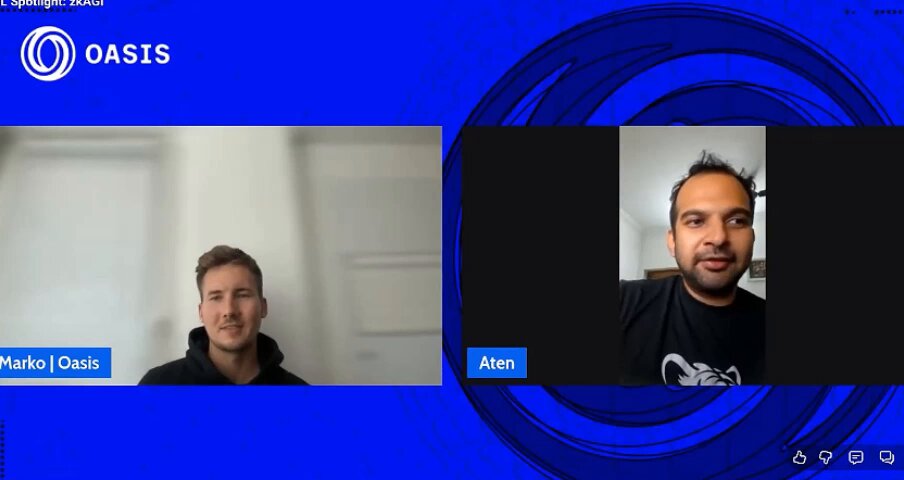
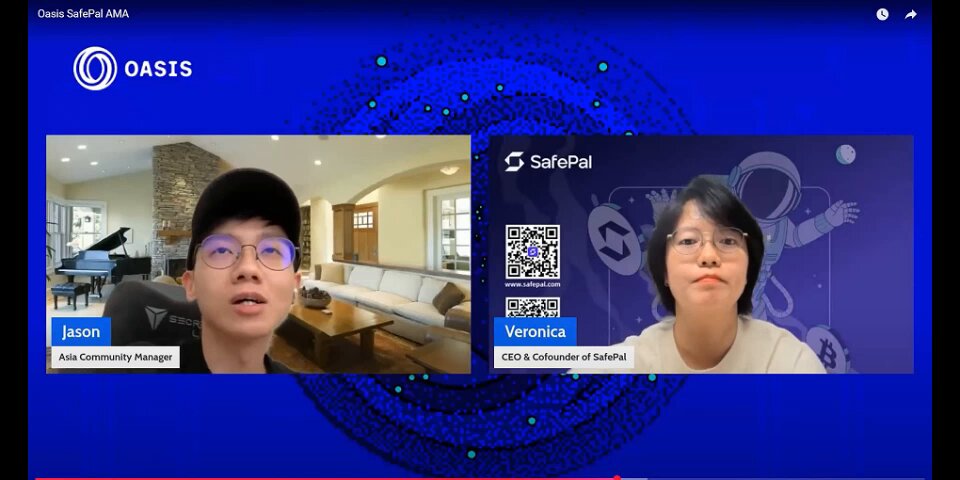
Aten, co-founder of ZkAGI, introduces his project and explains the importance of the privacy that @OasisProtocol provides.
3
346
1/
🚀 Big news for privacy-preserving AI!
@huralyaco , a company focused on emotional well-being and intelligent decision-making, has received a grant from the @OasisProtocol Protocol Foundation to build HURA AI — a secure, personalized AI assistant powered by Sapphire and ROFL. 🧵
2/
💡 What is @huralyaco building?
HURA AI is a next-gen personal assistant for emotional wellness and self-growth —
built to understand you, protect your data, and adapt privately.
Launching soon on iOS and Android as a standalone app. 📱
3/
🔒 Privacy by design
Unlike traditional AI assistants, HURA AI runs on Oasis Sapphire, the confidential EVM runtime.
That means your personal growth data and insights stay encrypted, verifiable, and under your control — not stored or mined by anyone else.
4/
🧠 Powered by ROFL (Runtime Off-chain Logic)
ROFL enables verifiable compute in Trusted Execution Environments (TEEs).
This gives HURA AI guaranteed integrity — your AI runs the code it promises to, without tampering.
In other words: you can trust the output, not the operator.
5/
💰 Grant structure
The @OasisProtocol Foundation grant supports development through achievement-based milestones —
from prototype → beta → mainnet launch.
Targets include 20,000 app downloads and full integration with Sapphire-powered onchain services.
6/
🌐 Onchain integration
HURA AI isn’t just another app.
It’s designed for seamless onchain interaction — where services, rewards, and user data can be accessed securely through Sapphire smart contracts.
Crypto and traditional payments both supported.
7/
⚙️ Open-source for builders
In line with Oasis’s open innovation principles, Huralya will release key Sapphire and ROFL integration components under the Apache 2.0 license.
This allows devs to build privacy-preserving AI tools while Huralya retains its proprietary AI stack.
8/
❤️ Why it matters
AI is becoming deeply personal.
But without privacy, “personal” means “exposed.”
Huralya Oasis are proving that wellness and privacy can go hand-in-hand —
setting new standards for ethical, verifiable, and user-centric AI.
9/
🌱 The bigger picture
This partnership highlights Oasis’s growing role as the privacy layer for the agentic web —
supporting real-world apps that connect secure compute, AI, and Web3 payments.
10/
✨ Huralya x @OasisProtocol = Private Intelligence for Personal Growth.
Stay tuned for the HURA AI beta,
and watch how privacy-first AI begins to reshape the way we grow, learn, and connect. 🌸
3
400
1/
We’ve talked about autonomous agents for years — but everyone built their own silos.
Different schemas. Incompatible marketplaces. No shared discovery layer.
That’s changing.
Meet ERC-8004, the first open standard for agent discovery and trust on @ethereum . 🧵
2/
It started with Google’s A2A (Agent-to-Agent) protocol, later donated to the Linux Foundation.
A2A was designed for trusted, internal org settings.
But what happens when agents must operate outside those boundaries — in open, trustless networks?
That’s where ERC-8004 comes in.
3/
ERC-8004 defines a lean, onchain discovery framework for autonomous AI agents.
Built on A2A, it introduces just three registries that let agents find, evaluate, and interact with each other — trustlessly.
No heavy logic. No forced implementation.
Just the minimum needed to bootstrap an agent economy.
4/
🔹 Identity Registry
Each 8004 agent gets a unique ID address domain pointer.
Capabilities, protocols, and trust models live in an off-chain JSON file.
The chain only maintains the immutable link between your ID and your latest metadata.
5/
🔹 Reputation Registry
When agents complete jobs, clients can leave feedback.
The data is off-chain, but authorization events are onchain —
creating a verifiable audit trail that anyone can crawl to build reputation models.
Open feedback → open reputation.
6/
🔹 Validation Registry
Agents can verify computations in two ways:
1️⃣ Crypto-economic — validators stake & re-execute; wrong = slashed.
2️⃣ Cryptographic — using TEEs or ZK proofs to guarantee correct execution (with confidentiality).
Flexible trust for any use case.
7/
The beauty of ERC-8004?
It’s agnostic about how validation is done.
For low-stakes tasks → social trust may be enough.
For DeFi bots → crypto-economic validation.
For critical infra → cryptographic proofs.
Security scales with the stakes. ⚖️
8/
But that flexibility comes with challenges:
MEV-style domain sniping
Feedback manipulation
Spam from unbounded validation calls
ERC-8004 intentionally keeps these at the implementation layer —
so the ecosystem can evolve organically.
9/
And this is where ROFL (Runtime Off-chain Logic) of @OasisProtocol comes in.
ROFL is a TEE-based framework that guarantees compute integrity.
Agents run inside secure enclaves that produce cryptographic attestations,
verifiable onchain.
Trust the code — not the developer.
10/
ROFL also handles:
✅ Decentralized key management
✅ Confidential compute for AI workloads
✅ Decentralized marketplaces for agent execution
It’s not just validation — it’s trustless autonomy.
11/
Next up for ERC-8004 → a stable v2 spec:
MCP support for cross-compatibility
ERC-721 agent ownership
Flexible reputation storage
Clean integration with x402 payment protocol
And x402 already has huge traction.
12/
x402 is being championed by the x402 Foundation, with Coinbase and Cloudflare backing.
Cloudflare alone powers ~20% of all websites.
That means 8004-compatible agents could transact over internet-scale infra — instantly. 🌐
13/
ERC-8004 x402 =
✅ Open discovery
✅ Verifiable identity
✅ Standardized payments
Together, they form the backbone of the coming agentic web —
where AI agents transact, validate, and build trust autonomously.
14/
The first production 8004 agents are already in the works —
from DeFi trading bots to code reviewers to gaming AIs.
Each one helps refine the standard and prove new trust models.
The agent economy is no longer theory. It’s shipping. 🚀
15/
TEEs are here.
ZK is maturing.
x402 is live.
All that was missing was the glue —
a protocol to tie identity, validation, and reputation together.
That’s ERC-8004.
And the window to set a decentralized agent standard is now.
16/
🧠 Follow @OasisProtocol for deep dives into ROFL, Sapphire, and verifiable AI compute.
#ERC8004 #AgenticWeb #Ethereum #ROFL #TEE #ZK #DeAI
2
389


Spotlight on how Binance listings actually work.
Here are benefits we are pleased to provide to the project team:
1️⃣ Binance does not make money from the listing process. All project token allocations go 100% to users through marketing campaigns, including Alpha Airdrops, Launchpool, Hodler Airdrops, trading events, Earn APR campaigns, and more.
👉 Our business model is simple: small trading fees, not listing revenue.
2️⃣To protect users, Binance requires a refundable security deposit from projects. It acts as a safeguard against short term exploitation and ensures the project team stays committed post listing. Once a project meets its commitments, the full deposit is returned.
👉 User protection remains at the core of everything we do.
3️⃣If you’re in the early stages of your project, Binance Alpha is the best go-to-market path. No listing fees, just visibility, education, and growth. Alpha connects real users with promising projects through airdrops, Booster Programs, Pre-TGEs, and TGEs, building transparency and trust ahead of exchange listings.
👉 As of Oct 2025, 217 projects have joined Alpha, 103 listed on Futures and 36 on Spot after proving growth and meeting standards.
Join us! If you’d like to learn more about our listing process and apply to have your project listed.
Further details on Binance Listing and Requirements 👇
binance.com/en/support/annou…
1,952
747
3,042
2,126,043
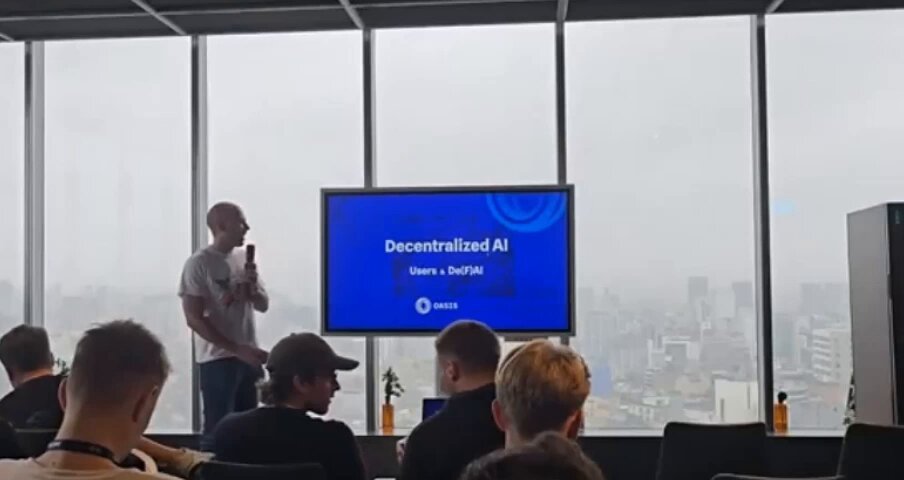
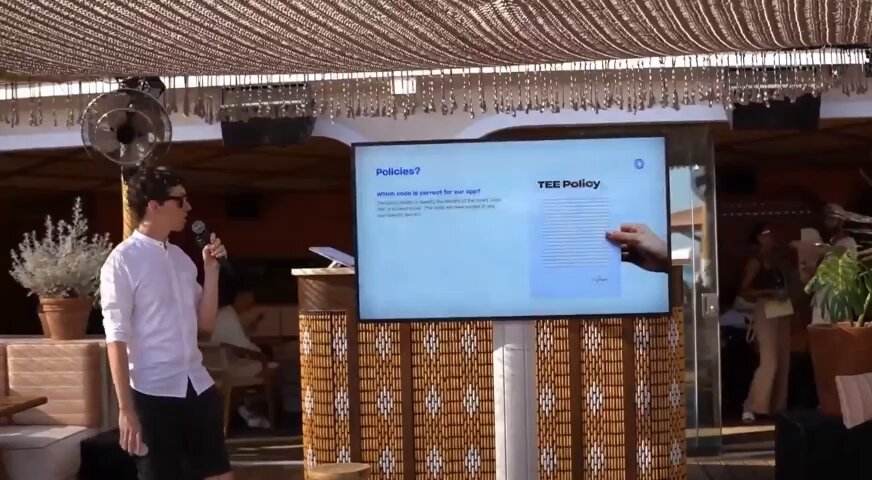
Matej from @OasisProtocol explained the current AI landscape, where big tech companies control our data.
2
231
1/ 💥 Someone just locked 1 Bitcoin inside a black box.
@OasisProtocol has launched a public challenge on its Sapphire network — a confidential EVM running inside Trusted Execution Environments (TEEs).
The rules?
If you can break it, you keep the BTC.
2/ 🧱 Unlike a typical bug bounty, this one has no reports, no triage, no payouts.
It’s live. On mainnet.
A real smart contract controls the funds.
Anyone who extracts them wins — and proves they broke the TEE itself.
3/ 🧠 Recent research revealed new hardware-level exploits against SGX-based enclaves.
Oasis claims Sapphire was built to resist exactly those.
This experiment isn’t about promises — it’s about proof.
4/ 🔐 Here’s what’s known:
⚙️ The contract lives at 0xc1303edbFf5C7B9d2cb61e00Ff3a8899fAA762B8
💰 The BTC (wrapped) sits at 0xCEAf9abFdCabb04410E33B63B942b188B16dd497
🧩 The private key exists only inside the enclave
🧱 No extract function. No off-chain keygen. No shortcuts.
If the BTC moves, it means the TEE was actually breached.
5/ 🛡️ All standard Sapphire defenses are on:
🔄 Ephemeral key rotation
👥 Restricted compute committee
🔑 Isolated key manager nodes
🧭 Continuous CPU attestation
This isn’t a staged demo. It’s production infrastructure under fire.
6/ 🧩 The challenge is simple — and brutal.
Smart contract exploits? Blocked.
On-chain logic? Sandboxed.
The only path to the funds is breaking through the hardware.
A live test of trust itself.
7/ ⏳ The timer runs until December 31, 2025.
During that time, anyone can try.
No permission, no approval — just public code, public stakes, public proof.
8/ 💬 Oasis says the goal is to demonstrate “confidence through action.”
Critics of confidential computing argue that TEEs are a single point of failure.
Sapphire is betting one Bitcoin that they’re wrong.
9/ 🌐 The contract is verified via Sourcify and viewable on the Oasis Explorer.
Curious? Join their Discord and watch in real time as the world tries to crack the vault.
10/ 🧊 Until the end of 2025, one $BTC sits sealed inside Sapphire.
Every hacker, researcher, and skeptic has the same question:
Can anyone really break a TEE?
Oasis just put real money on the line to find out. 💥
#Oasis #Sapphire #TEE #Bitcoin #Web3Security #ConfidentialCompute
3
9
42
2,300
Happy to listen to Matej from @OasisProtocol explaining about Decentralized AI !
$ROSE
1
8
52
1,654
Dona retweeted

2 Sep 2025
Test your trading skills with the @dYdX x Onchain Royale
Win a share of the 20,000 USDC prize pool 👇
782
1,863
18,666
32,141
1/
🛡️ Privacy on blockchain isn’t a luxury — it’s a requirement.
That’s why @OasisProtocol built the Oasis Privacy Layer (OPL) — a plug-and-play privacy solution for any EVM chain.
Here’s how it works 👇
2/
💡 What is OPL?
Oasis Privacy Layer lets any dApp — on any EVM chain — integrate confidential compute without leaving its native chain.
No migrations.
No new wallets.
No $ROSE required.
Just smart privacy — seamlessly.
3/
🔗 How it works:
OPL connects EVM chains to Sapphire, the world’s first confidential EVM.
Transactions are relayed through a privacy relayer — meaning the user experience stays the same, but the data gets encrypted end-to-end.
4/
🧠 Under the hood:
Privacy in OPL is powered by Trusted Execution Environments (TEEs) — secure enclaves that protect data while it’s being computed.
Think: Encrypted in → Confidential compute → Encrypted out.
Even node operators can’t peek inside.
5/
🧩 Why it matters:
Transparency is great — until it isn’t.
Private DeFi strategies
Confidential NFTs
Sealed-bid auctions
Private DAOs
AI agents with hidden “thoughts”
All made possible with OPL Sapphire.
6/
🌐 Cross-Chain Privacy, Simplified
With OPL, Oasis becomes the privacy layer of Web3 — not just for EVM, but soon for Cosmos, Injective, and beyond (via @oraichain).
7/
🚀 Use Cases Live Today:
🔒 Private trading — @illumineXwallet
🗳️ Secret voting — BlockVote
🤖 AI x Privacy — @Oceanprotocol @Oraichain
Privacy isn’t theoretical anymore. It’s deployable.
8/
💬 “Smart Privacy” means privacy when needed.
Oasis doesn’t make everything private — it lets you choose what to keep confidential and what to keep transparent.
Selective disclosure → Compliance-ready privacy.
2
135
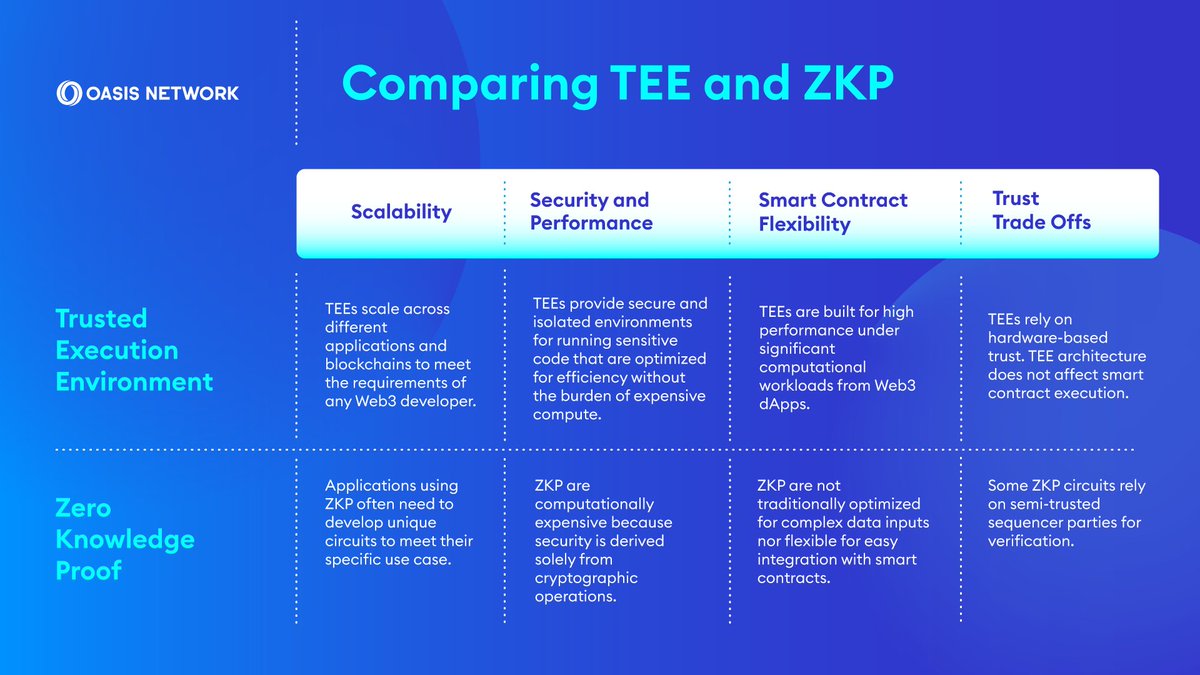
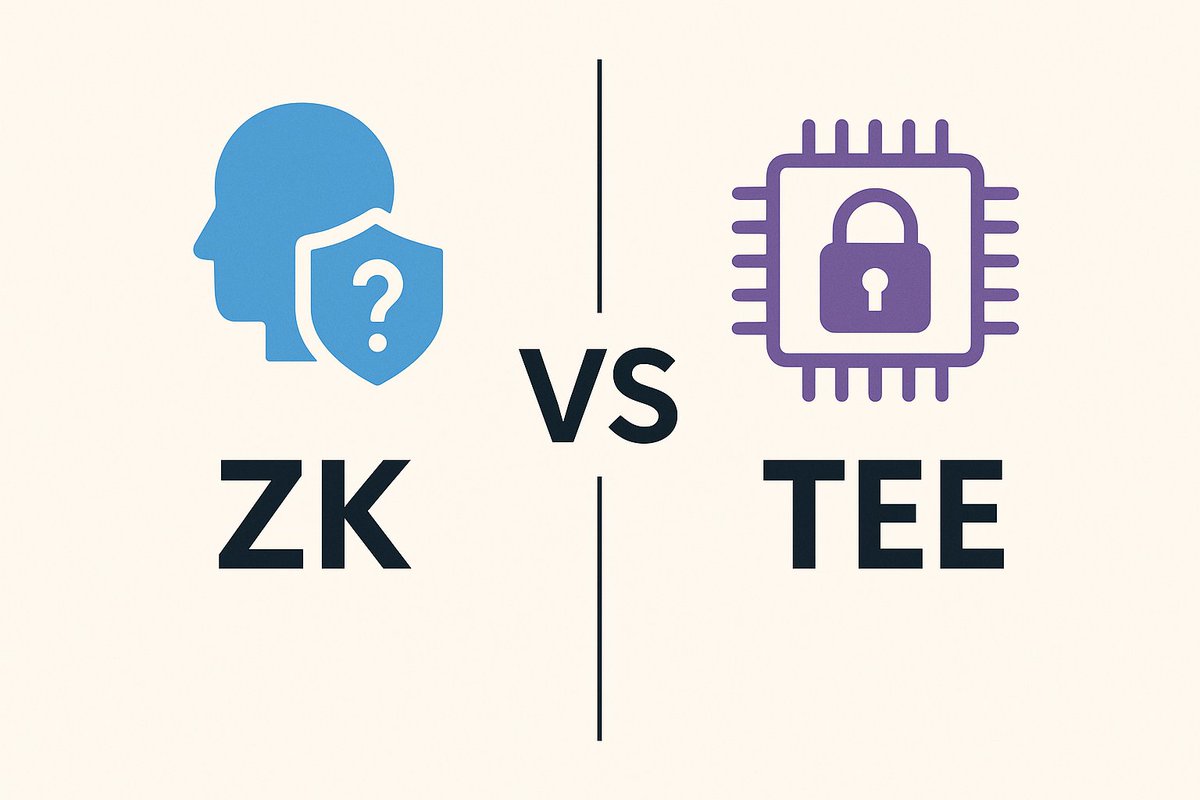
ZK vs TEE: The Two Paths to Confidential Computing and Why Oasis Leads the Way
In the new age of decentralized technology, privacy has become more than a feature, it’s a necessity. As blockchain and AI applications grow in scale and sensitivity, developers are faced with a central question: how can we process and verify data without exposing it? Two dominant solutions have emerged , Zero-Knowledge Proofs (ZKPs) and Trusted Execution Environments (TEEs). Both achieve privacy, but through very different means.
🔢 Zero-Knowledge Proofs (ZKPs)
ZKPs are a cryptographic method that allows one party to prove that a computation or statement is true without revealing the underlying data. In blockchain systems, this means verifying a transaction or computation on-chain while keeping the data private.
✅ Mathematical Trust: ZKPs rely purely on cryptography , there’s no need to trust hardware or third parties.
✅ Public Verifiability: Anyone can verify the proof, ensuring transparency without compromising data.
✅ Decentralized by Design: No external dependencies, making ZKPs ideal for censorship-resistant systems.
⚠️ Heavy Computation: Generating proofs can be slow and resource-intensive.
⚠️ Limited Flexibility: Difficult to handle dynamic or non-deterministic workloads like AI inference.
⚠️ Complex Development: Writing zk circuits requires specialized languages and expertise.
⚠️ No True Confidential Execution: Computations themselves aren’t private , only the proof is.
🧠 Trusted Execution Environments (TEEs)
TEEs take a hardware-based approach to privacy. A TEE is an isolated, secure area within a processor that executes code and processes data privately, even from the system’s owner or operator.
✅ Confidential Compute: Data remains encrypted even while being processed.
✅ Real-Time Performance: Computations execute at
near-native speeds, enabling low-latency applications.
✅ Hardware-Verified Integrity: Through remote attestation, TEEs can prove that they’re running trusted, untampered software.
✅ Supports Complex Workloads: Perfect for confidential AI inference, oracles, and cross-chain logic.
✅ EVM Compatibility: Oasis’ Sapphire ParaTime allows developers to use familiar Solidity and Hardhat tools inside TEEs.
⚠️ Hardware Dependency: Relies on secure chips like Intel TDX or AMD SEV. ⚠️ Potential Vulnerabilities: Requires constant firmware updates and transparent audits.
💎 @OasisProtocol : The TEE-Powered Privacy Platform
The Oasis Network has pioneered the real-world integration of TEEs into blockchain. Instead of treating privacy as an optional add-on, Oasis builds it into the core protocol. Its architecture blends confidentiality, scalability, and usability , powered by two key technologies: Sapphire and ROFL.
🔐 Sapphire – The Confidential EVM Sapphire is the first and only confidential EVM in production. It enables Ethereum-compatible smart contracts to run inside TEEs, where both code and data are encrypted. Each contract uses a unique encryption key, managed through Oasis’ decentralized key manager. This means developers can deploy standard Solidity contracts while gaining end-to-end encryption — no custom zk circuits required.
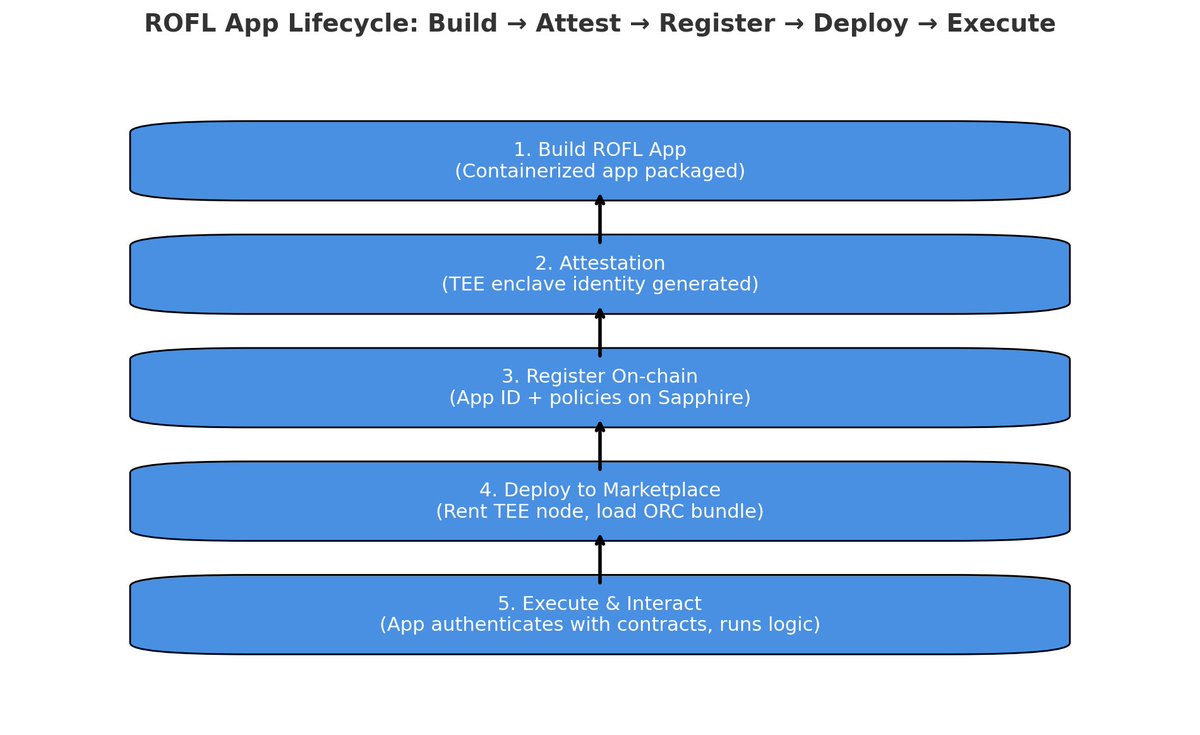
💭 ROFL – Runtime Off-chain Logic ROFL extends Oasis’ confidentiality beyond the blockchain. It allows containerized apps, such as AI agents, bots, oracles, and machine learning models, to run securely inside TEEs while interacting verifiably with on-chain smart contracts. Each ROFL app can attest its integrity on-chain using Sapphire, combining the trust of blockchain with the power of confidential off-chain computation.
🌉 Oasis Privacy Layer (OPL) The Oasis Privacy Layer brings these privacy guarantees to other EVM chains. Any dApp on Ethereum, Polygon, or BNB Chain can integrate confidential transactions without migrating or rewriting code. Users don’t even need to hold Oasis tokens — transactions are relayed seamlessly in the background.
🚀 Why TEE and Oasis Win in Practice
💡 Smart Privacy Architecture: Oasis’ modular Paratime design separates compute layers, improving scalability and security.
💡 Confidential EVM: Sapphire allows encrypted transactions and private contract states without changing the Ethereum developer experience.
💡 Cross-Chain Privacy: OPL brings Oasis’ confidentiality to any EVM chain, enabling seamless interoperability.
💡 Verifiable Compute: Remote attestation ensures that every computation is running inside a verified enclave.
💡 AI-Ready Infrastructure: With Intel TDX and NVIDIA GPU TEEs, Oasis supports AI inference and training in a verifiable way.
💡 Developer Simplicity: From Hardhat to Docker, Oasis integrates with familiar Web3 tools , privacy without complexity.
🌍 The Future: Privacy That Works
Zero-Knowledge Proofs are elegant, trustless, and mathematically sound. Trusted Execution Environments are fast, verifiable, and practical. The real breakthrough comes when privacy technology becomes usable at scale — and that’s where Oasis stands apart.
Oasis doesn’t just promise confidential computing , it delivers it. By combining Sapphire’s on-chain encryption, ROFL’s off-chain compute, and OPL’s cross-chain privacy, Oasis transforms the abstract idea of trustless privacy into a working, scalable reality.
ZK ensures you can trust the math. TEE ensures you can trust the machine. @OasisProtocol ensures you can trust the system.
Oasis website: oasis.net/
1
3
389
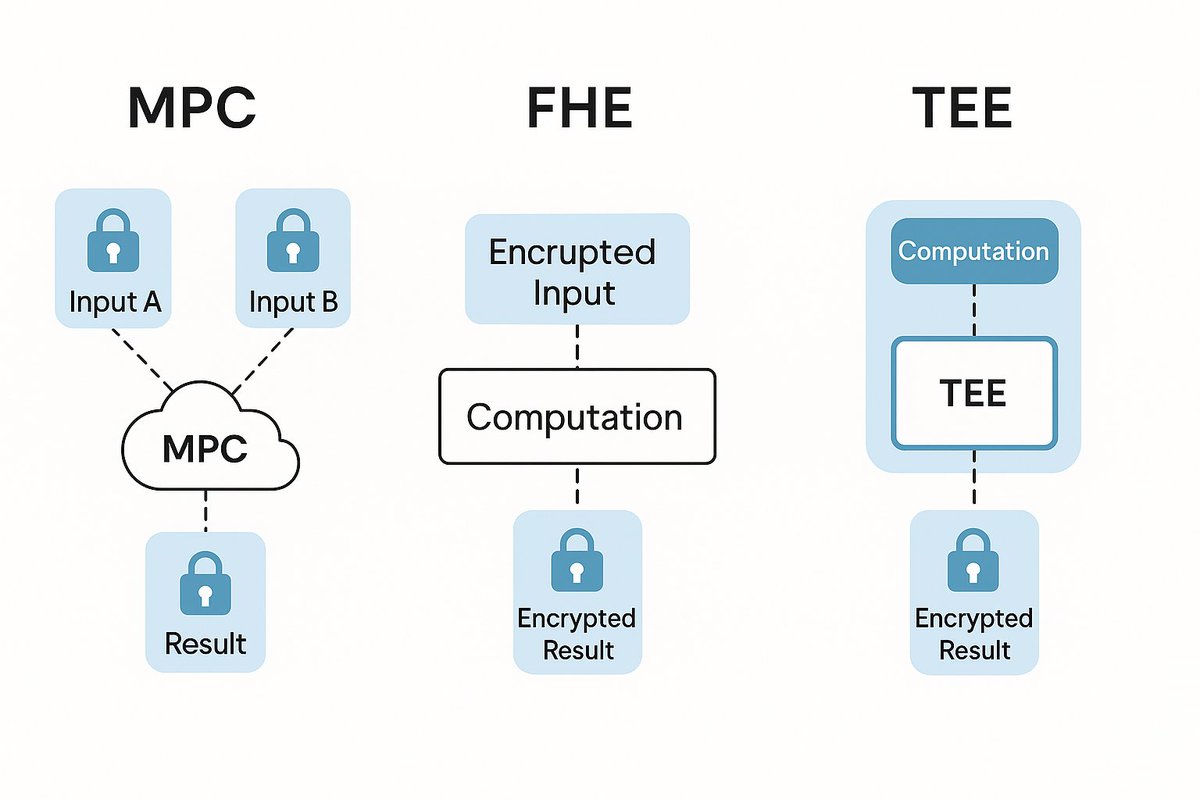
🧠 TEEs vs MPC vs FHE: The Real Battle for Confidential Computing
Privacy-preserving computation is becoming a cornerstone of modern computing - from Web3 to AI.
As sensitive data increasingly needs to be processed securely, three major technologies are shaping the space:
1️⃣ Trusted Execution Environments (TEE)
2️⃣ Multi-Party Computation (MPC)
3️⃣ Fully Homomorphic Encryption (FHE)
All three aim for the same goal - compute on private data without revealing it.
But only one is truly practical at scale today: TEE.
🔒 Trusted Execution Environments (TEE)
A TEE is a secure enclave inside your CPU that isolates code and data from the rest of the system - even from the OS or node operator.
Think of it as a hardware-based black box for computation.
Encrypted data goes in → computation happens privately → encrypted results come out.
No one, not even the operator, can see inside.
Examples: Intel SGX, AMD SEV-SNP, ARM TrustZone.
TEE guarantees:
🔹 Confidentiality - memory inside the enclave is encrypted
🔹 Integrity - code and data can’t be modified
🔹 Remote attestation - anyone can verify the enclave is genuine
This is the foundation of systems like Oasis Sapphire and ROFL, enabling confidential smart contracts and verifiable off-chain AI workloads.
🤝 Multi-Party Computation (MPC)
MPC is a purely cryptographic approach where multiple parties jointly compute a function over their data -without revealing it to one another.
Each participant splits their input into secret shares, distributes them to others, and performs computation collectively.
The result is combined to reveal only the final output, not any individual input.
Advantages:
🔹 No trusted hardware required
🔹 Strong cryptographic guarantees
🔹 Perfect for cross-organization collaboration
Limitations:
⚠️ 100–1000× slower than normal compute
⚠️ Complex coordination between participants
⚠️ Hard to maintain persistent secure state
MPC is excellent for private analytics, custody, and voting - but not for high-throughput smart contracts or real-time AI.
🔐 Fully Homomorphic Encryption (FHE)
FHE is the holy grail of privacy: it allows computation directly on encrypted data.
You can add, multiply, or evaluate functions - all without ever decrypting.
When the result is finally decrypted, it matches the output as if computed on plaintext.
But there’s a catch:
🚫 It’s 10,000–1,000,000× slower than normal compute
🚫 Extremely complex to implement
🚫 Limited to specific operations
FHE is still largely confined to research and specialized sectors like healthcare and finance, where privacy outweighs performance.
⚙️ Quick Comparison
TEE → Hardware-based, near-native performance
MPC → Cryptographic, secure but slow
FHE → Absolute privacy, but extremely inefficient
TEE delivers the best tradeoff between security, speed, and practicality.
🌹 Why TEEs Lead in Real-World Confidential Computing
1️⃣ Performance
TEE workloads run at near-native speed - fast enough for confidential EVMs, AI inference, and private DeFi.
2️⃣ Verifiability
Remote attestation provides cryptographic proof that the code is genuine and running in trusted hardware.
3️⃣ Developer-friendly
Supports mainstream languages (Rust, Go, Python) - no need to rewrite apps as cryptographic circuits.
4️⃣ Blockchain AI synergy
In @OasisProtocol, Sapphire executes private smart contracts inside TEEs, and ROFL extends this to off-chain confidential AI and services - all verifiable on-chain.
🔮 The Future: Layered Privacy
The future isn’t “TEE vs MPC vs FHE” - it’s TEE MPC FHE, each solving a different layer of the privacy stack:
🔥 TEE → Real-time private computation
🤝 MPC → Distributed trust across parties
🧮 FHE → Long-term encrypted data processing
But today, only TEEs combine performance, verifiability, and scalability - powering confidential computing at production scale.
🧩 TL;DR
TEE → Fast, verifiable, and production-ready
MPC → Trustless but complex and slow
FHE → Perfect privacy, impractical today
That’s why TEEs - like those powering Oasis Sapphire and ROFL - are the backbone of real-world confidential computing, where privacy, performance, and decentralization truly coexist.
#Web3 #AI #Privacy #ConfidentialComputing #OasisNetwork #TEE #MPC #FHE #Sapphire #ROFL
3
506
1/
Last week, two new physical attacks — Battering RAM and Wiretap — were disclosed, compromising Intel SGX and AMD SEV-SNP protections.
The fallout impacted multiple networks including Phala, Secret, Crust, and IntegriTEE.
@OasisProtocol ? Unaffected.
🧵
2/
The vulnerabilities exploited deterministic encryption in Intel SGX and AMD SEV-SNP, allowing attackers to extract attestation keys and decrypt sensitive data inside TEEs.
With those keys, attackers gained full access to encrypted smart contracts and cluster keys across affected networks.
3/
So why was @OasisProtocol not vulnerable?
Because years ago, the architecture was designed specifically to defend against this class of hardware-level compromise.
Oasis separated key management, governance, and compute — ensuring no single component ever has full access.
4/
The Oasis Key Manager and Sapphire runtime operate on Intel SGX v1, which uses a fundamentally different encryption design — unaffected by these attacks.
Oasis' design philosophy: Defense in depth — multiple independent layers of protection, both inside and outside the TEE.
5/
Key additional safeguards:
🔹 On-chain governance: Committee membership & validator participation require governance approval and ≥5M $ROSE staked — enforced by protocol, not by TEEs.
🔹 Ephemeral keys: Transaction keys rotate every epoch. Past data remains encrypted even if a TEE were compromised.
6/
🔹 Adaptive policy: Oasis maintains a CPU blacklist system for rapid mitigation of new vulnerabilities.
Following private disclosure of the attacks, we added extra governance checks for key manager committees — proactive, not reactive.
7/
This multi-layered model means TEE access alone is insufficient to compromise Oasis.
Attackers would also need on-chain governance rights, stake, and validator approval — impossible to fake, even with attestation keys.
8/
While others scramble to patch, Oasis continues to operate as designed — secure, private, and uninterrupted.
No user data compromised. No downtime. No emergency forks.
This validates the architecture Oasis has built since day one.
9/
For Oasis users and developers:
✅ No action required
✅ No keys rotated
✅ No updates needed
The network remains secure and fully operational.
10/
Last week’s events highlight a simple truth:
🧠 Smart privacy requires smart architecture.
Hardware alone isn’t enough — it’s about how you layer, isolate, and govern trust.
That’s what sets Oasis apart. 🌹
3
253