
Joined February 2021
- Tweets 4,011
- Following 4,719
- Followers 776
- Likes 7,146
69 Photos and videos







Pinned Tweet

10 Feb 2022
I have decided to start giving medical, legal and financial advice:
1. Take full command of your own situation
That is the list
1
20
29
RT @TheAliceSmith: Make sure every child in the UK knows it was the was Labour Party that banned them from YouTube and X.
Brand a hatred f…
15

If pharmaceutical companies cured you, they'd go bankrupt.
if banks helped you get out of debt, they'd collapse.
if politicians actually solved all your problems, nobody would elect them again.
If Tom kills Jerry the show is over.
It's all a big show.
Everything is fake.
234
2,735
11,429
176,776
I am Einherjer, a Nomadic Norse! retweeted

🚨 THEY CALLED HIM CRAZY… BUT PUTIN WAS RIGHT ALL ALONG! The Biolabs Bombshell Just Exploded! 😱🧪☢️
In 2022, Vladimir Putin dropped a truth bomb on the world: Ukraine was riddled with secret U.S.-backed bio-labs cooking up God knows what in the shadows near Russia’s border.
The mainstream media, global elites, and fact-checker mafia immediately branded him insane, delusional, and a conspiracy theorist spreading disinformation to justify the invasion. Nothing to see here, folks. Just innocent public health labs! they sneered while silencing anyone who dared ask questions.
Fast forward to 2026. The United States itself, under DNI Tulsi Gabbard, has now declassified and confirmed the existence of these very labs. Over 120 U.S.-funded biolabs across 30 countries, including dozens in Ukraine, handling dangerous pathogens like anthrax, plague, Ebola, and more. Vulnerable in a war zone. Risk of leaks, seizures, or worse.
They lied. They covered it up. They smeared Putin as the madman while the real story was buried.
What were they REALLY doing in those labs? Gain-of-function experiments? Ethnic-specific bioweapons? Releasing plagues for control? Why the frantic denials for years? Why the sudden transparency now?
This is not just labs. This is the Deep State playing God with humanity’s future and getting caught red-handed.
The people deserve the FULL truth. Share this before it is memory-holed again.
49
1,040
2,287
23,709
I am Einherjer, a Nomadic Norse! retweeted

Remember that time they tried to hype up Hantavirus and make it the next big pandemic?
Then we caught them faking it…
Then it randomly just disappeared the next day like nothing happened!
263
8,298
22,570
273,966
I am Einherjer, a Nomadic Norse! retweeted

Jun 14
Iranian who escaped Sharia law warns the West:
"I'm Iranian. I went to prison under Islamic law.
I know how it starts… and it always starts with the Left uniting with Islamists.
I came to Canada for freedom. now I’m watching the exact same pattern.
They appease. Weakness invites more. They will never stop."
This man lived it.
The West is sleepwalking into the same nightmare.
300
13,914
44,985
622,201
I am Einherjer, a Nomadic Norse! retweeted

Jun 14
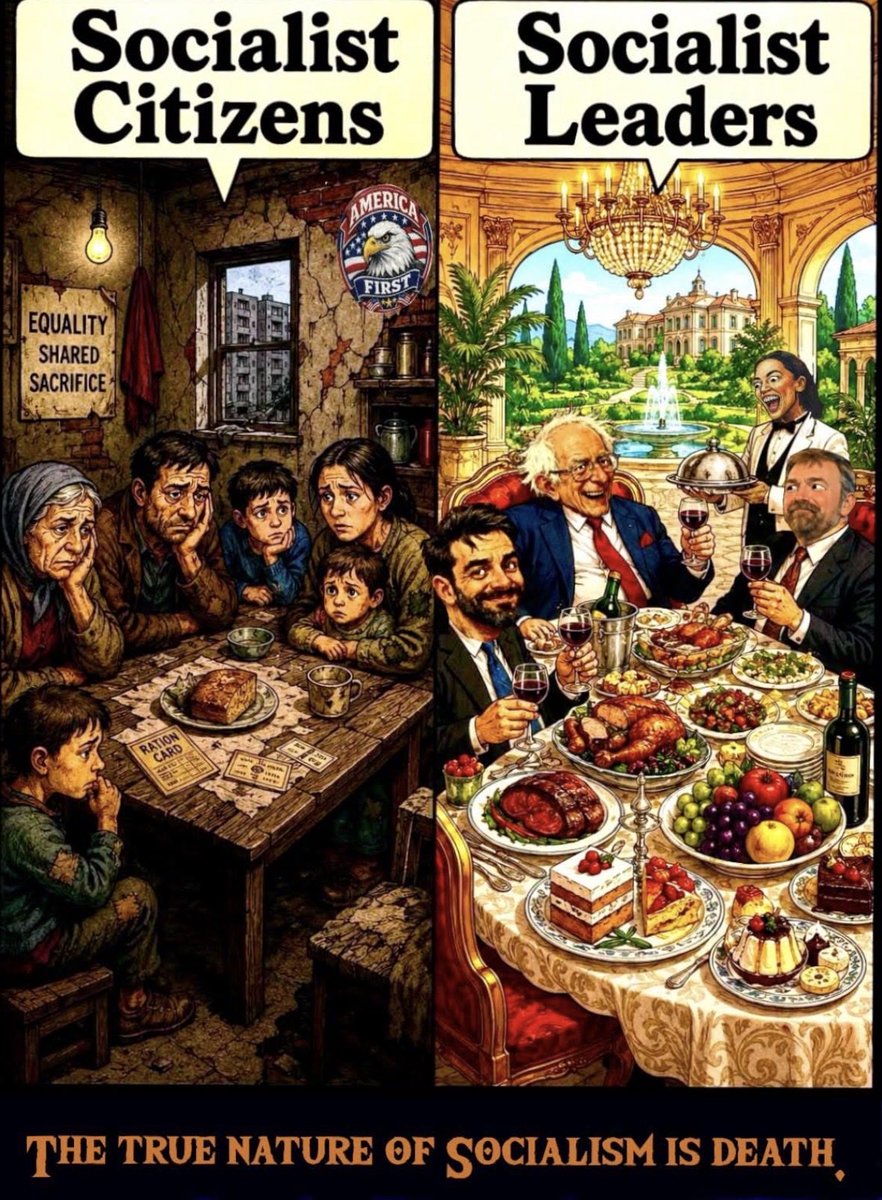
Notice how socialists never talk about seizing the wealth of George Soros or any of the other multi-billionaires who bankroll their operations. They would be praising Elon to the sky, and vigorously protecting his wealth, if he were politically on their side.
772
9,316
43,821
420,602
I am Einherjer, a Nomadic Norse! retweeted

Jun 14
“I am so old that I can remember when other people’s achievements were considered to be an inspiration, rather than a grievance.”
— Thomas Sowell
43
2,410
14,979
116,443
I am Einherjer, a Nomadic Norse! retweeted

I do not understand, in 2026, why anyone is shorting anything, and I have, over the last several years, watched a generation of intelligent, well-credentialed, technically sophisticated investors set fire to their capital on the short side of a market that has been telegraphing its direction with the subtlety of a marching band, and the only explanation I have ever been able to construct is that none of these people have read a single page of monetary history written before 1990.
The setup is not subtle. The federal government is running a 7% structural deficit with no political coalition in either party willing to address it. The Treasury is issuing debt at a pace that will push publicly held debt-to-GDP past 130% within five years, which is the level at which, historically, every government in recorded history has either inflated its way out, defaulted, or both. The Fed is, regardless of what it says in public, the marginal buyer of that debt, and the only mechanism it has to fund the purchases is the creation of new dollars. The money is being printed. The debt is being monetized. The currency is being debased. And asset prices, which are denominated in the currency being debased, are doing the only thing they have ever done in any country that has ever tried this, which is going up.
Every country that has run this experiment has produced the same chart. Weimar Germany in 1922 and 1923 produced one of the most violent equity bull markets in recorded history in nominal terms, as the mark collapsed and the Berlin exchange repriced upward by orders of magnitude. Argentina, across four separate inflationary cycles since 1975, produced in each cycle a nominal rally that outran every short thesis published, while the peso lost 99.9% of its purchasing power. Zimbabwe in 2007 and 2008 produced an equity market that rose so violently the exchange had to be closed because the calculations could not keep up. Turkey, right now, in front of the entire world, has produced a Borsa Istanbul up 1,400% in lira terms while the lira has lost 85% against the dollar, and every short of Turkish equities has been carried out in nominal terms even when they were right in real terms.
The lesson is not that asset prices are going up because the businesses are getting better. The lesson is that asset prices are going up because the unit they are measured in is getting smaller, and any investor who positions short against this dynamic is betting against the will and capacity of a government to debase its own currency, which is the single most reliable bet you can lose in 4,000 years of recorded monetary history. The government always wins. The government always debases. The currency always loses purchasing power. The assets always reprice upward in nominal terms, on a path the shorts always insist is unsustainable and that always, somehow, sustains.
You can short individual frauds. You cannot short the market. You cannot short the currency itself without being on the wrong side of the largest force in modern capital markets, which is the slow, politically inevitable destruction of the dollar’s purchasing power against everything that cannot be printed. The shorts have been wrong for five years. They will be wrong for the next five. The only investors who will, in real terms, preserve and grow their wealth are the ones who understood, early, that the game is not about being right on valuation, it is about being on the right side of monetary debasement, and the right side has always been owning real assets, productive businesses, scarce commodities, and the one monetary metal that has functioned as money continuously for 5,000 years, while the people on the other side continue to insist this time is different. This time has never been different. The math is the math. The shorts will continue to lose. The owners will continue to win.
118
220
1,667
184,254
I am Einherjer, a Nomadic Norse! retweeted


98
3,606
22,401
173,526

elon could solve world hunger literally this second
all he has to do is full stack dump all his shares, cause a stock market recession, wipe out trillions, delete tens of thousands of jobs, and then he'll be able to fund the federal government for about 18 minutes
398
1,518
22,085
365,271
I am Einherjer, a Nomadic Norse! retweeted

It is now being reported that X will be banned for children under 16 in Britain.
But that the woke platform BlueSky will not be banned.
This is obviously political.
325
3,196
18,442
105,461

I am Einherjer, a Nomadic Norse! retweeted

Just had a quick browse on Bluesky, the only social media site that won’t be included in the under 16s social media ban. The Starmer government clearly wants kids to lose the will to live.
169
384
3,248
30,959
Want some truth?
We weren’t supposed to know about Henry Nowak…
If we did find out about Henry we were supposed to think he was the racist aggressor.
They were caught.
The People are rising up.
X did that.
Now Starmer wants to stop it from ever happening again.
Simple.
222
7,031
33,353
177,431
I am Einherjer, a Nomadic Norse! retweeted

The UK social media ban for under-16s will be circumvented by Nostr, @GrapheneOS, @mullvadnet, @torproject and Linux.
Get in touch if you need help.

🚨 NEW: The UK social media ban for under-16s will be enforced through facial recognition, digital IDs, credit cards, open banking, passports, mobile provider checks or email age estimation
22
127
863
55,800
I am Einherjer, a Nomadic Norse! retweeted

🎯
122
2,734
6,796
51,983
I am Einherjer, a Nomadic Norse! retweeted

18h
BREAKING: Elon Musk just reposted this video of Tulis Gabbard exposing Biolabs to his 240 million Followers
‘We The People’ deserve to know the truth
193
5,151
20,335
138,522
I am Einherjer, a Nomadic Norse! retweeted

Neil Oliver underscores how Net Zero rhetoric has gone quiet now that technocratic elites need dependable energy for vast data centres, which he describes as "the building blocks of a digital cage".
He says the sudden return to oil and gas, after years of promoting wind and solar, exposes the "climate crisis hoax" for all to see.
70
1,864
4,637
61,489
I am Einherjer, a Nomadic Norse! retweeted

Australia ban on social media for u16s:
- exempts Bluesky
UK ban on social media for u16s:
- exempts Bluesky
The establishment wants to control the rapid shift to the right while promoting a far-left platform as its replacement (fortunately, no one is interested).
399
4,583
28,839
342,383
I am Einherjer, a Nomadic Norse! retweeted

I don't think anybody really grasps how desperate this situation is.
University professors are now saying they are unable to teach history because reading long books and passages is how a person learns history. College kids are incapable of reading more than a few pages.
Some classes don't assign any reading at all now, only lectures.
There is an assumption among the people managing this decline that reading is just a way of receiving information. It isn't. Proper reading is how we build the mental muscle to synthesize ideas and evaluate them.
If the catastrophic decline in reading and literacy is not addressed now, we risk losing everything.
Western civilization cannot survive the death of reading because it was built by people with the kind of cognitive depth that a culture of deep reading brings:
Complex reasoning, extended internal dialogue, the capacity to hold opposing ideas in tension. Our systems and institutions are complex, and they require well ordered minds to maintain them.
Reading forms minds, and the West was built by the richest minds in history.

Elite university students are now incapable of reading a book.
Instead of fixing this, universities are simply reducing reading requirements to shorter and shorter excerpts.
This is no mere literacy crisis. It is a civilizational one.
To fight back, we started an online book club to study the great texts of Western Civilization — if the schools and universities won't teach the great books, we must form reading groups to study them ourselves.
Every month, we read a new great work. We've covered texts like Augustine's Confessions, Dante's Inferno, The Count of Monte Cristo, Don Quixote.
We're now reading Aristotle's Nicomachean Ethics.
We must study the ideas upon which the West was built if we are to preserve it. It takes effort to read these texts, and even more to read them well. Thats what we're doing, slowly, in dialogue with each other.
If you'd like to be part of this, please join our reading group and consider a paid subscription. It makes a HUGE difference to the time and resources we can dedicate to this project. We are entirely funded by our members.
You'll get:
- Live book club discussions (biweekly)
- Access to our incredible community chat
- Essays to guide you through the Great Books
- All past recordings, essays, and podcasts
- Ability to vote on what we read next
athenaeumbooks.com/welcome
Welcome!
462
3,759
10,433
384,279