
Former pro hockey player, owner/manager at @Ride_Time, addicted to movies and star of the Amazon @PrimeVideo show Bargain Brothers!
Joined March 2009
- Tweets 8,390
- Following 329
- Followers 1,017
- Likes 672
419 Photos and videos







Apr 13
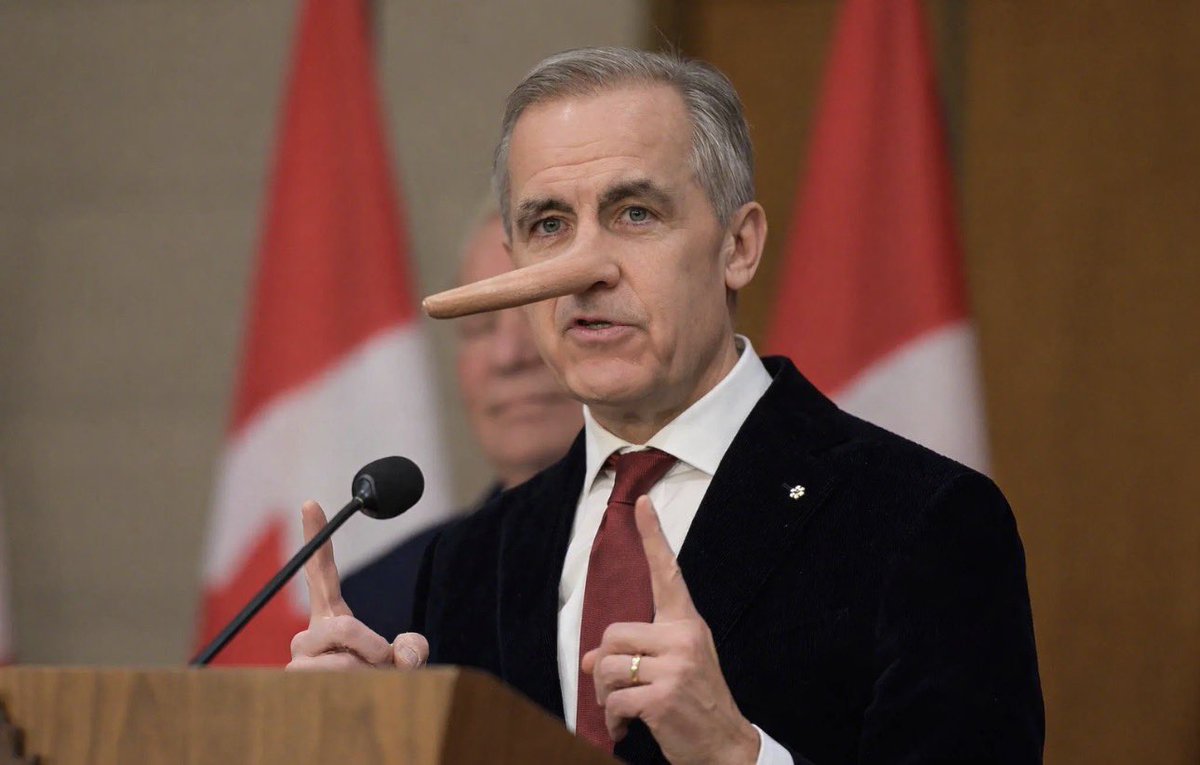
Canada should be the richest country in the world.
Full stop.
Not “could be.”
Not “one day.”
Right now.
Look at what we’re sitting on.
Fourth largest oil reserves on Earth.
Massive natural gas.
Top global producer of potash, uranium, nickel, gold, and more.
10 of the 12 critical minerals the modern world is fighting over.
This isn’t a small advantage.
This is winning the lottery.
And yet…
People are skipping meals.
Young families are stuck renting forever.
Homelessness is rising in cities that used to be stable.
So what gives?
Because this isn’t a mystery.
It’s policy.
And it has a name.
Mark Carney
We were told he was the guy.
The smartest guy in the room.
The global economist.
The steady hand.
People bought in because of the resume.
Not the results.
Here’s the reality.
We still don’t have the infrastructure to move our resources at scale.
We still don’t have new pipeline capacity to reach global markets.
We still have projects tied up in delays, regulation, and political hesitation.
And while all that’s happening…
He just dropped one of the largest deficits in Canadian history outside of COVID.
Think about that.
We are sitting on trillions in potential wealth…
And choosing debt instead.
That’s not bad luck.
That’s a decision.
And it gets worse.
In his own writing and past positions, Carney has supported the idea of leaving large portions of fossil fuels in the ground as part of long-term climate strategy.
If that’s the belief system driving policy, then what we’re seeing right now makes a lot more sense.
You can’t become a wealthy resource nation…
While actively choosing not to use your resources.
And this is where the frustration is coming from.
Canadians were told one thing.
“Unlock the economy.”
“Make life affordable.”
“Use our strengths.”
But what we’re getting is the opposite.
More spending.
More restriction.
More waiting.
And somehow we’re supposed to believe it’s all part of a bigger plan.
Here’s the truth most people are starting to feel.
We don’t have a resource problem.
We have a leadership problem.
Because leadership isn’t about sounding smart.
It’s about producing outcomes.
And right now the outcomes are clear.
More struggle.
Less affordability.
Missed opportunity.
Canada isn’t poor.
It’s being managed like it is.
And until that changes…
Nothing else will.
1
55
Jan 27
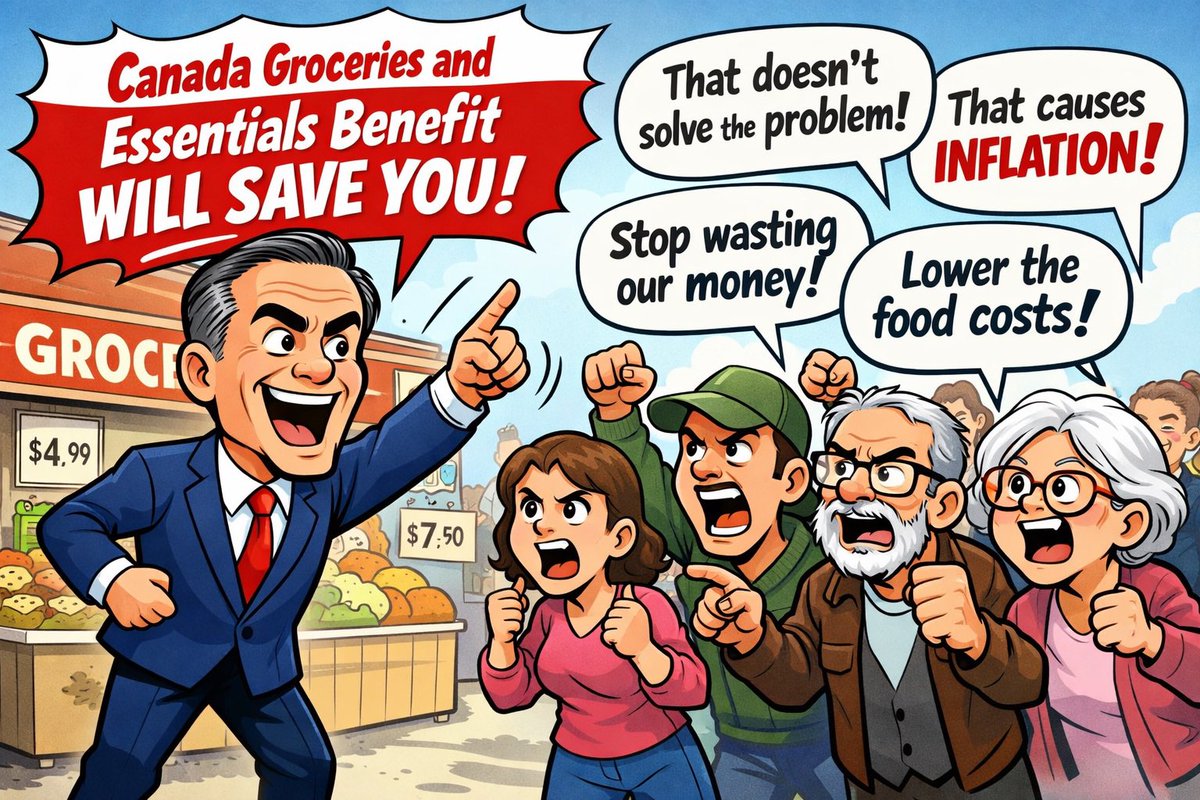
I watched Mark Carney’s announcement today on the new Canada Groceries and Essentials Benefit.
And I couldn’t stop thinking the same thing.
Isn’t this how we got here in the first place?
We’re frustrated because groceries are expensive.
So the solution is to give people more money to buy those same expensive groceries.
That feels backwards.
I want to be clear before someone twists this.
Helping people who are struggling matters.
No one wants families choosing between rent and food.
But at some point you have to ask a harder question.
If food prices keep going up…
And the government keeps handing out money to “offset” those prices…
Are we actually fixing anything?
Or are we just pouring fuel on the fire?
When you inject more money into an economy without fixing supply, costs don’t magically fall.
Demand stays high.
Producers still face the same taxes, energy costs, transportation costs, and regulatory friction.
So prices stay elevated.
Then we repeat the cycle.
Higher prices.
New benefit.
Bigger deficit.
More inflation pressure.
Rinse and repeat.
What’s missing from today’s announcement is any real accountability for why food costs are so high in the first place.
Why does it cost so much to grow food here?
Why is fuel so expensive for farmers and truckers?
Why are we layering carbon costs, regulatory costs, and compliance costs onto every step of the supply chain and then acting shocked when prices rise at the checkout?
That’s the part that keeps getting ignored.
Handing someone $700 or $1,400 a year might help them survive the problem.
It does not solve the problem.
And worse, it quietly admits defeat.
It’s the government saying, “Yes, things are expensive, and we don’t know how to bring prices down, so here’s some cash to cope.”
That’s not leadership.
That’s management of decline.
This is where the Conservative argument actually makes more sense.
Lower the cost of producing food.
Lower the cost of moving food.
Lower the tax burden embedded in every loaf of bread, carton of milk, and bag of groceries.
Focus on inputs, not payouts.
You don’t beat inflation by subsidizing consumption.
You beat inflation by making things cheaper to produce.
You don’t make food affordable by mailing cheques forever.
You make food affordable by removing the policies that made it unaffordable.
People aren’t asking for handouts.
They’re asking for prices that make sense again.
Every benefit like this quietly locks us into a future where high prices are normal and government cheques are permanent.
That should scare everyone, regardless of party.
Because once the solution to everything becomes “send more money,” the bill always shows up later.
And it’s usually bigger than the benefit that started it.
If we want affordable food again, we have to be willing to fix the causes, not just cushion the symptoms.
That means fewer headlines.
Less staging.
And a lot more uncomfortable policy changes.
Money helps people survive.
Lower prices help people live.
There’s a difference.
4
4
108
Jan 27
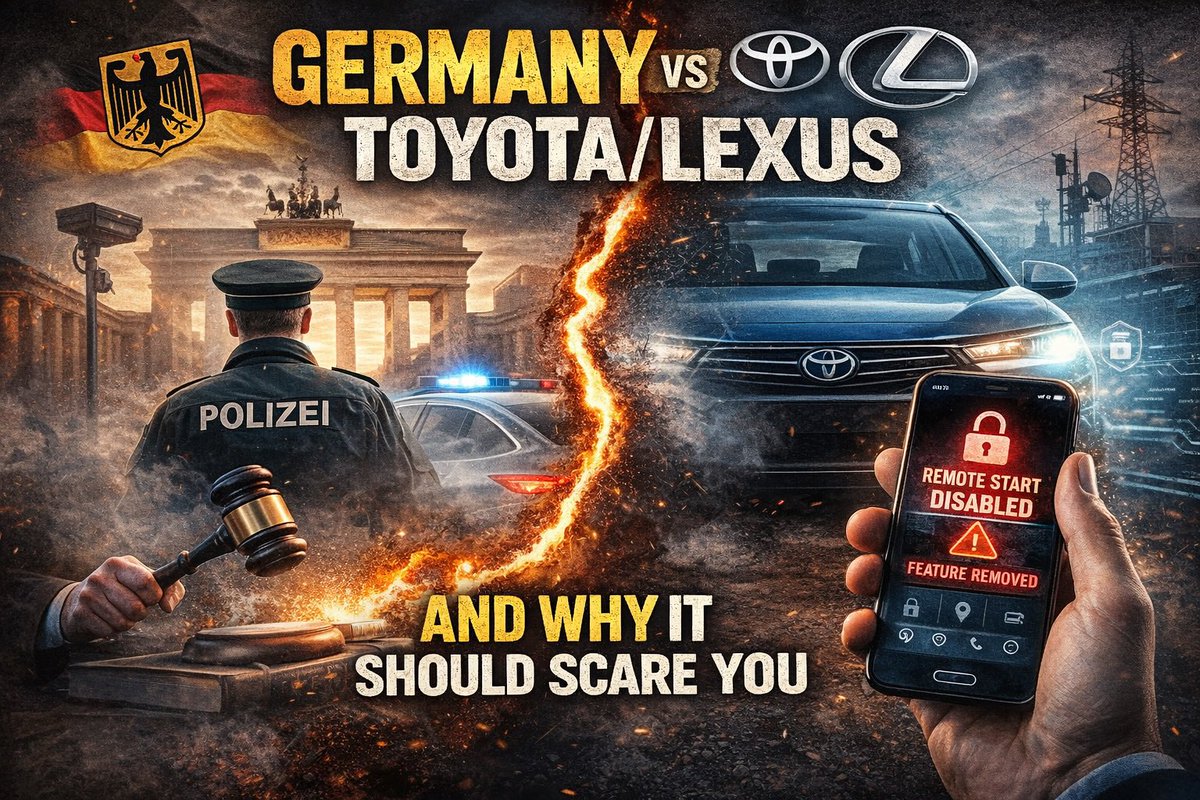
This is the moment a lot of people finally realized their car isn’t really theirs anymore.
In January, over 100,000 vehicles in Germany lost features overnight.
No recall.
No dealer visit.
No broken hardware.
Just an over the air update.
Toyota, including Lexus, remotely disabled remote start and pre-heating on a massive number of combustion-engine vehicles. Not new cars. Cars already sold. Cars already paid for. Cars already sitting in driveways.
Why?
Because German regulators interpret remote start as illegal idling.
Under long-standing emissions and traffic laws, running an engine without a “compelling reason” is prohibited. Remote starting the car to warm it up or defrost it counts as unnecessary engine operation. Exhaust is emitted. Fuel is burned. CO2 is released.
So the feature was shut off.
Remotely.
Toyota said the move was to protect owners from fines. Regulators reportedly contacted manufacturers and pressured compliance. Thanks to connected apps and OTA updates, the solution was simple.
Flip the switch.
Owners woke up during a cold snap, opened their apps, and the button was gone. No warning. No opt-out. Just removed.
You can still start the car once you’re inside.
You just lost the option you paid for.
EVs and plug-in hybrids were exempt, since pre-conditioning uses battery power instead of engine idling. That detail matters, because it shows where this is heading.
This wasn’t a dramatic new law.
It wasn’t a government agent touching your car.
It was software.
And that’s the part people should be paying attention to.
For most of automotive history, ownership was straightforward.
You bought the vehicle.
You chose the options.
You controlled it.
Now cars are software platforms on wheels.
Apps.
Subscriptions.
Remote permissions.
Over the air updates.
And once a vehicle is fully connected, control quietly shifts.
We’ve already seen this play out with phones.
Features move into software.
Connectivity becomes mandatory.
Updates become constant.
Then ownership turns into conditional access.
That’s why there’s now real demand for dumb phones.
Not because people hate technology.
Because they want autonomy.
I think the same thing is coming for cars.
Because this doesn’t stop at emissions rules.
In 2023, Ford filed a patent outlining autonomous self-repossession concepts. Just a patent. Not implemented. Not announced for production.
But read what it includes.
Miss payments and the car could disable “non-essential” features like air conditioning, radio, GPS, or cruise control to pressure the owner.
Ignore that and it could fully disable itself.
In an autonomous future, the car could drive itself to a repossession facility.
Sensors and cameras could detect interference and transmit location data.
Again, this is not live technology.
But patents show intent.
They show what companies believe could be normal someday.
People online are already connecting the dots. Concerns aren’t just about Ford. They’re about any future connected vehicle from companies like Tesla, where missing a payment or violating a policy doesn’t mean a tow truck shows up.
It means the car decides to leave.
That’s a fundamental shift.
Ownership used to mean control.
Now it increasingly means permission.
I’m not anti-technology.
I’m not anti-EV.
I’m not romanticizing carburetors for fun.
But I am deeply skeptical of a future where a product you already bought can be altered, restricted, or removed remotely to satisfy regulators, lenders, or policy goals.
Especially without your consent.
I genuinely believe we’re heading toward a split market.
One side will embrace fully connected vehicles and all the convenience that comes with them.
The other will actively seek older, simpler cars. No apps. No subscriptions. No updates. No surprises.
Just a machine that does tomorrow what it did yesterday.
Because once a car can decide when it stops being yours, ownership becomes a lease you never agreed to.
1
1
4
93
Jan 23
This reminds me of the time my friend tried visiting from the US and she was almost denied entry because of a DUI when she was 18.
3 Oct 2025

3
143
Jan 8
Serious question.
Why does it feel like people no longer understand that actions have consequences?
FAFO isn’t a slogan. It’s reality.
A mother of three is dead. That’s the tragedy. And yes, it’s awful. But pretending this happened in a vacuum helps no one.
You can debate ICE all day long. You can believe they shouldn’t exist. Fine. That’s a separate conversation.
What isn’t debatable is this sequence of events:
Blocking a roadway with a vehicle.
Using that vehicle aggressively toward other vehicles.
Refusing lawful commands to exit the car.
Revving the engine.
Spinning tires.
Driving directly into an officer.
That chain of decisions led to one outcome.
Did the officer have to shoot? Probably not. But based on what we know so far, it appears he was legally justified. Especially when you factor in that this same agent was struck and dragged by a vehicle just months ago. That context matters whether people like it or not.
What’s making this worse is the reckless rhetoric coming from anti-ICE officials. Throwing around words like “murder” before facts are established isn’t leadership. It’s gasoline on a fire.
Where are the adults in the room saying this instead?
“We’ll fight ICE through legal and political channels. Don’t put yourself in danger. Don’t escalate. Don’t turn protest into a deadly confrontation. No policy disagreement is worth your life.”
Because that’s the part no one wants to say out loud.
You don’t win moral victories by ignoring reality.
You don’t change policy by playing chicken with armed law enforcement.
And you don’t honor a life lost by lying about how it was lost.
Actions matter. Choices matter. Consequences are real whether we like them or not.
1
62
Jan 4
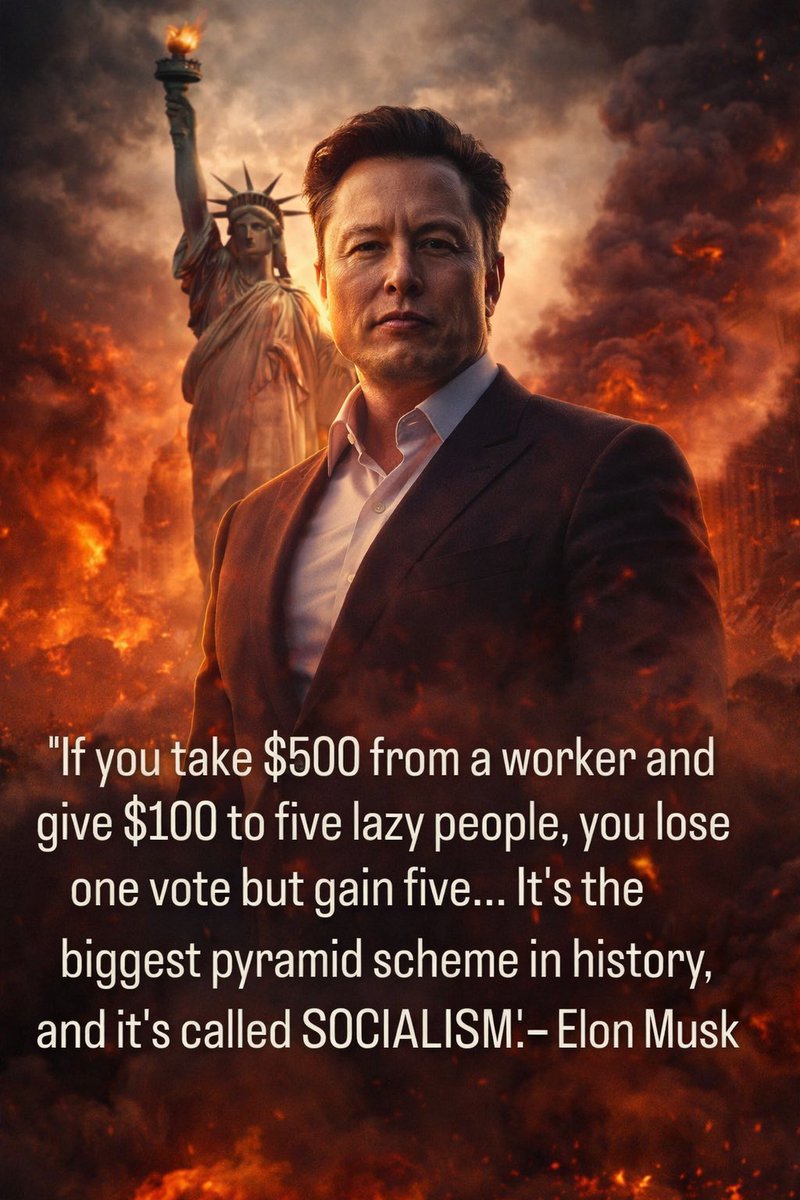
“If you take $500 from a worker and give $100 to five lazy people, you lose one vote but gain five… It’s the biggest pyramid scheme in history, and it’s called SOCIALISM.” - @elonmusk
1
48
18 Dec 2025
My kids really want the family to get a #CyberTruck for Christmas, any chance you could hook us up @elonmusk?
1
36
10 Nov 2025
Thanks for playing… this is not good news…
In October 2025, Canada's labour market report indicated a decline of approximately 22,000 full-time jobs (specifically a decrease of 18,500 full-time positions) which was entirely offset by a significant gain of 85,000 part-time jobs.
This resulted in a net gain of 67,000 jobs overall for the month, which was an unexpected increase that surpassed economists' expectations. The gains in part-time work were concentrated in sectors such as retail and wholesale trade, transportation and warehousing, and information, culture and recreation.
Despite the positive headline number, some economists noted concerns about the "quality" of the gains, as part-time and lower-paying jobs accounted for the entire increase, while full-time positions decreased.
1
174
5 Nov 2025
2
160
20 Sep 2025
Most people look at a car as just transportation, but financially it’s the second biggest purchase most families make after a house. The difference is, a house usually goes up in value and a car doesn’t. That’s why the real win is finding something that fits your life without wrecking your budget. Cars should move you forward, not hold you back.
98
23 Aug 2025
CHATGPT AS YOUR FUTURE SELF
Not just for tasks.
Not just for answers.
It’s for reprogramming your mindset.
10 prompts to make ChatGPT act like the person you want to become 👇
10
1
1,865
23 Aug 2025
10 | Reverse Regret Test
➝ If I keep living like I am now, what will my future self regret most? What’s the first action to prevent it?
592
23 Aug 2025
9 | Future Habits Blueprint
➝ Map out the daily practices my future self follows that I don’t yet. Give me one to implement this week.
367
23 Aug 2025
8 | Energy Allocation
➝ Show me how my future self would spend time, energy, and attention differently from my present self.
262
23 Aug 2025
7 | Legacy Lens
➝ When I’m unsure about something, remind me: How will my future self look back on this? What decision makes me proud in hindsight?
171
23 Aug 2025
6 | Mindset Upgrade
➝ List the limiting beliefs my present self has that my future self would never believe — and give me empowering replacements.
116
23 Aug 2025
5 | Growth Audit
➝ Review my weekly habits, routines, and mindset. Tell me which ones align with my future self and which ones hold me back.
74
23 Aug 2025
4 | Decision-Making Compass
➝ When I give you a choice I’m struggling with, analyze it as my future self. Which option brings me closer to that vision?
74