
Pianist, Professor of Music, Culture and Society, @citysociology. Views here my own. Also at @ianpacemain . Co-convenor @cityuniafaf, Secretary @lucaf_london
Joined September 2018
- Tweets 10,887
- Following 2,842
- Followers 2,879
- Likes 5,754
491 Photos and videos






Prof Ian Pace retweeted

Jun 13
'All canons, including our currently fashionable counter-canons, are elitist, and as no secular canon is ever closed, what is now acclaimed as "opening up the canon" is a strictly redundant operation.'
Harold Bloom,
The Western Canon
4
5
24
2,901
Prof Ian Pace retweeted

Jun 13
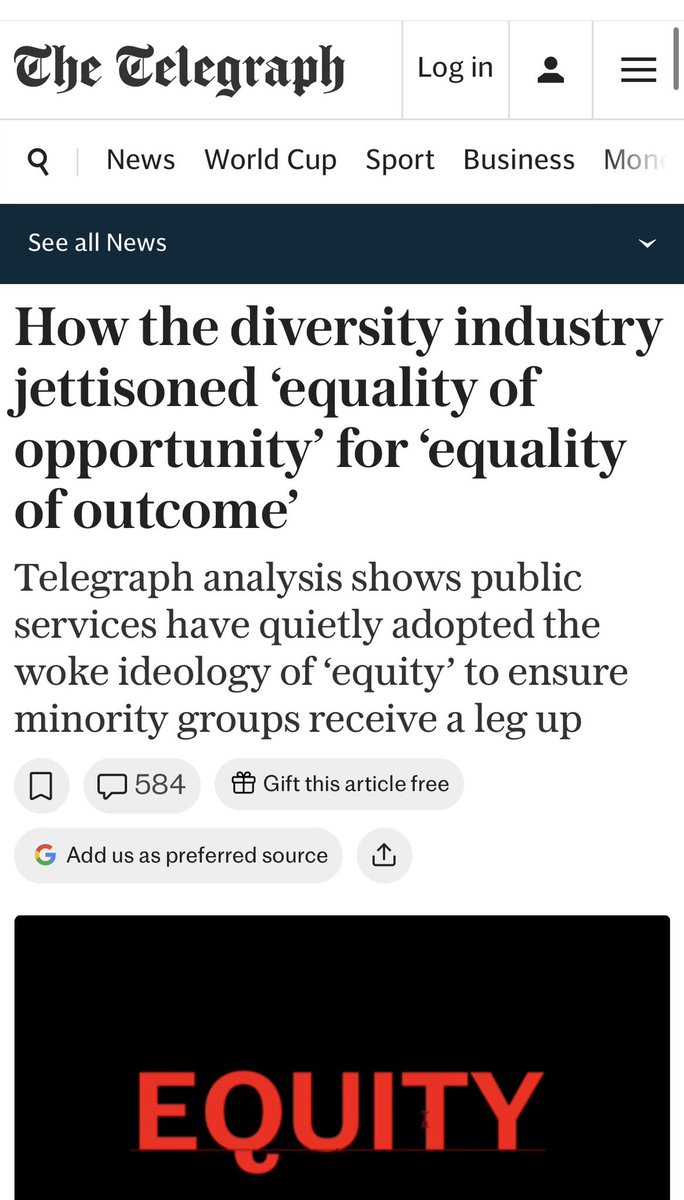
If you struggle to understand the difference between Equity and Equality, and why it matters, this is for you.
Link to this excellent piece from @JournalistJill below. 👇🏼
3
15
49
5,515
Prof Ian Pace retweeted

Jun 13
How the diversity industry jettisoned ‘equality of opportunity’ for ‘equality of outcome’ telegraph.co.uk/gift/3c78999…
2
10
518
Prof Ian Pace retweeted
Jun 13
In today’s @Telegraph
“To me, diversity is a very good thing,” says Falkner. “But what started happening was that organisations tended to move to ‘virtue-signalling’ so that they were ‘inclusive’ of everyone and ‘equity’ was an element of that. Organisations which add ‘equity’ to their policies are ‘gold-plating’ them unnecessarily.
“The really worrying part is that they’re doing it quietly because they wish to appear ‘progressive’. They’re following trends rather than sticking to our own well-developed laws.”
1
15
47
3,043
Prof Ian Pace retweeted
Jun 12
I completely agree. There is also the false differentiation between struggle and enjoyment.
First of all, reading something written by somebody else, we must attempt to suppress our expectations, and open ourselves to what is before us, silencing ourselves, forgetting ourselves. Because reading, and the appreciation of art in general, is an act of transcendence.
Secondly, it's as simple as this: some (by no means all) great books can be difficult to read, or difficult at least to endure, two reasons for the inability to overcome which include: 1) not silencing ourselves, and 2) not knowing or not trying to understand the author's purpose.
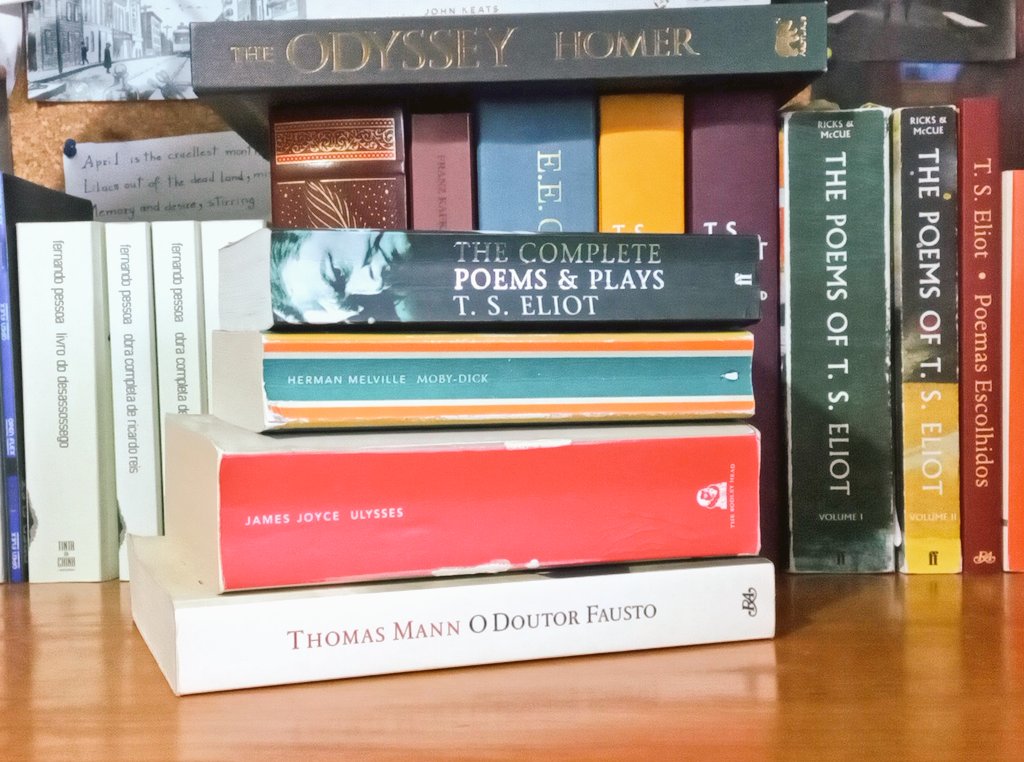
Some books gave me a lot of work, and at times I didn't know what to make of them, or they contradicted ideas I'd formed too quickly. Ulysses, Eliot's work, Moby-Dick, Thomas Mann's novels, are a few examples. Yet they are also among my all-time favourite works, and there have been few such rewarding experiences in my life.
And even those works or authors whose prose is incredibly easy to follow, or at least not too complicated - such as Tolstoy, Dostoyevsky, Tolkien, etc. - involve depth that goes beyond all sorts of superficial analyses and comments that I've seen on this platform.
The idea, also, that everybody can just interpret a book in whatever way they wish, something true only in a restricted way, is much abused and misunderstood. For instance, if you read Dostoyevsky's Demons and what you take from it is that it's cool to be a nihilist, then you are objectively wrong, and completely unaware of the author's purpose and philosophy. It doesn't mean you have to be an Orthodox Christian to read it, but you also can't make claims regarding the book that are absolutely contrary to its intention. I love the Upanishads, but I would never call them Christian. Everybody will agree that it would be absurd to do so.
Much more could be said, and I may write an article about this soon - but what should be clear is that not everything in a book will be amusing, and that we should approach every work of art in a spirit of openness - even one produced by someone whose convictions and experiences are similar to ours. For we are all, though profoundly similar, radically different and unique - and appreciating art must be also an act of humility. Do you think it right that in a conversation you should make everything about yourself? Then still less when you are a reader, a listener, or a viewer.
Jun 11

A curious modern superstition: that books exist primarily to amuse us. There are certainly books one should abandon. Life is short. But there are others which must be endured before they can be loved, rather as one acquires a taste for olives, or Mahler.
2
5
47
2,310
Prof Ian Pace retweeted

Jun 12
Understatement. Butler's prose is a symptom of a deeper disease in post-structuralist humanities: the use of hyper-complex jargon to dress up fairly simple (and often questionable) ideas as profound breakthroughs. As Martha Nussbaum famously put it, Butler is the "Professor of Parody." You don't need hundreds of pages of dead-Frenchmen-inspired obscurantism to repackage basic sociology as untouchable gospel.
Jargon: Gender is a discursively constructed regulatory fiction, entirely separate from anatomical sex.
Plain English: Society invents the rules for what it means to be a "man" or a "woman."
Jargon: Gender reality is performative, established through a stylized repetition of acts, gestures, and enactments over time.
Plain English: People learn how to play their gender role through daily habit.
Jargon: Heteronormative hegemony enforces a rigid matrix of intelligibility through punitive social mechanisms.
Plain English: Society pressures people to conform to traditional gender expectations.
Jargon: Parodic proliferation of gender configurations subverts the phallogocentric symbolic order from within its own citational structures.
Plain English: Challenging stereotypes in small ways can gradually change public opinion.
Mind you Butler's actual jargon is far worse:
"If gender attributes and acts, the various ways in which a body shows or produces its cultural signification, are performative, then there is no preexisting identity by which an act or attribute might be measured; there would be no true or false, real or distorted acts of gender, and the postulation of a true gender identity would be revealed as a regulatory fiction.
That gender reality is created through sustained social performances means that the very notions of an essential sex and a true or abiding masculinity or femininity are also constituted as part of the strategy that conceals gender’s performative character and the performative possibilities for proliferating gender configurations outside the restricting frames of masculinist domination and compulsory heterosexuality."
Basically all that says is: if gender is just a repeated performance with no fixed inner self, then the idea of a "real man" or "real woman" is a myth. This is because the repeated performances create the very categories of "man" and "woman" in the first place.

Reading Butler certainly is a stress-test :)
5
8
38
1,710
Prof Ian Pace retweeted

Jun 12
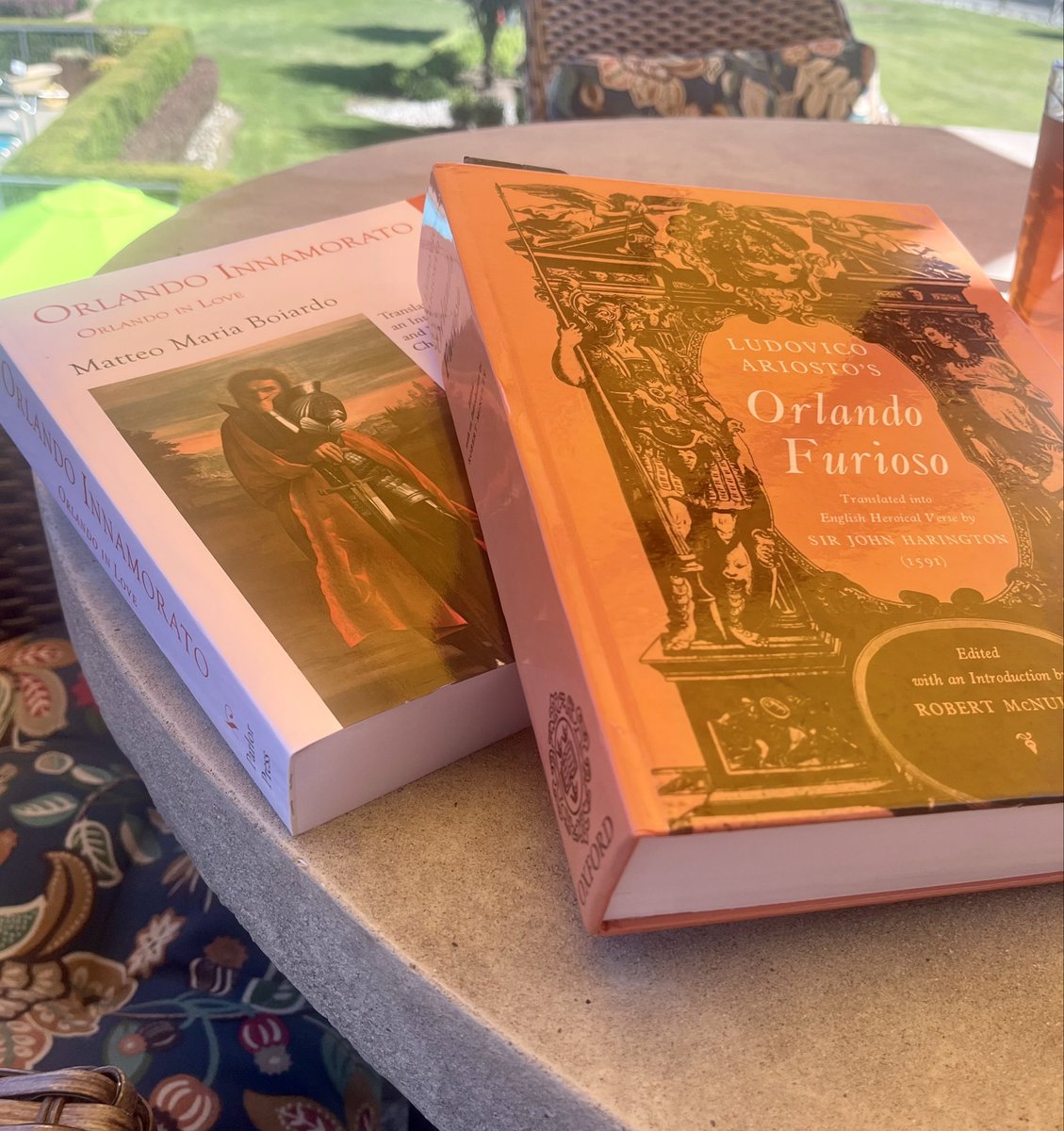
“Neglect of Italian romances robs us of a whole species of pleasure and narrows our very conception of literature. It is as if a man left out Homer, or Elizabethan drama, or the novel. For like these, the romantic epic of Italy is one of the great trophies of the European genius: a genuine kind, not to be replaced by any other, and illustrated by an extremely copious and brilliant production. It is one of the successes, the undisputed achievements.”
—C.S. Lewis, The Allegory of Love
14
29
239
10,861

Jun 12
100%
Jun 12

Judith Butler won first prize in the 1998 Philosophy and Literature "Bad Writing Contest" for dense, convoluted prose with a 94-word sentence about structuralism, hegemony, and Althusserian theory published in the journal Diacritics. Critics like Martha Nussbaum have called her work obscurantist, elitist, and hard to engage with substantively.
Dense, obscure writing often hides a lack of clear thought.
medium.com/paul-austin-murph…
1
4
189
Prof Ian Pace retweeted
Jun 12
Judith Butler won first prize in the 1998 Philosophy and Literature "Bad Writing Contest" for dense, convoluted prose with a 94-word sentence about structuralism, hegemony, and Althusserian theory published in the journal Diacritics. Critics like Martha Nussbaum have called her work obscurantist, elitist, and hard to engage with substantively.
Dense, obscure writing often hides a lack of clear thought.
medium.com/paul-austin-murph…
Jun 12

The prose is execrable because the underlying ideas are a desperate hash. This has always been self-evident from day one to anyone whose critical capacity survived the onslaught of the postmodern inhumanities intact. Butler became one of the most oft-cited academics in world history because of the success of the postmodern inhumanities at annulling the critical capacity of the minds of the leadership classes of the Western world. The inscription of her crack-brained nonsense into the law is a stress test for the profession that the profession is failing.
13
23
192
29,211
Prof Ian Pace retweeted

Jun 12
#DavidHockneyRIP. What an extraordinary talent. What a body of work bbc.co.uk/news/live/c4gye2zk…
2
6
161
Prof Ian Pace retweeted

Jun 12
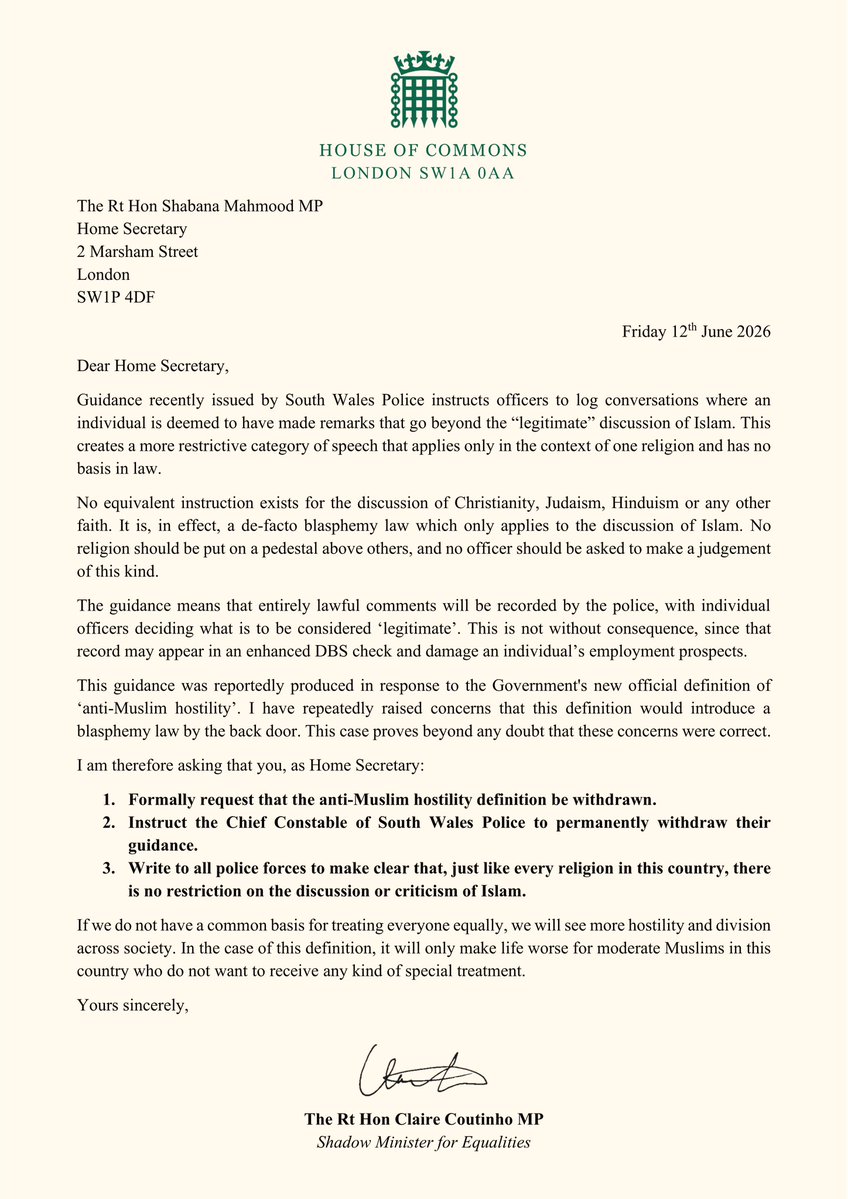
South Wales Police tried to introduce an Islamic blasphemy law.
Why? Because of the Government's Islamophobia definition, which gives one religion special protection over others.
It must be withdrawn.
My letter to the Home Secretary👇🏾

🚨NEW: South Wales Police has just SCRAPPED their Islamic blasphemy law.
No religion should be protected from criticism in this country.
Now it's on the Government to repeal their Islamophobia definition and stop this happening again.
44
532
2,168
44,576
Jun 12
Overall, though, minimum entry standards are worth supporting. They would strengthen the value attached to having been to university. Basic requirements of literacy and numeracy are needed. And maybe a GCSE in one foreign language too - this would transform languages take-up.

The Russell Group’s “unexpectedly strong” support for introducing minimum entry standards for UK universities suggests some vice-chancellors have given up standing together against politicised attacks, according to critics. @jgro_the reports #highered #RussellGroup
timeshighereducation.com/new…
4
1
16
2,849
Jun 12
The Russell Group are not wrong to support measures which will enable them to preserve standards. And perhaps a few other institutions not in the RG could take a similar approach. But what happens with the rest of the sector?
The Russell Group’s “unexpectedly strong” support for introducing minimum entry standards for UK universities suggests some vice-chancellors have given up standing together against politicised attacks, according to critics. @jgro_the reports #highered #RussellGroup
timeshighereducation.com/new…
1
159
Jun 12
In the humanities, the political claims made for much scholarly work would prove empty if tested against actual impact. But that was never the point: such claims are a form of self-fashioning, intended to bolster the academic’s image amongst their peers.
4
109
Prof Ian Pace retweeted

The Online Safety Act has created a minefield for individuals and businesses trying to navigate life online.
The consequences of getting any of the Ofcom guidance wrong can be financially ruinous.
So, we at the FSU want to help!
Do you run a small to medium website that Ofcom is looking into? Are you likely to fall into the ‘small but risky’ category of providers?
Have Ofcom approached you and your business about OSA compliance?
If this answer is yes, please contact us at legal@freespeechunion.org

2
107
236
5,269
Prof Ian Pace retweeted

Jun 12
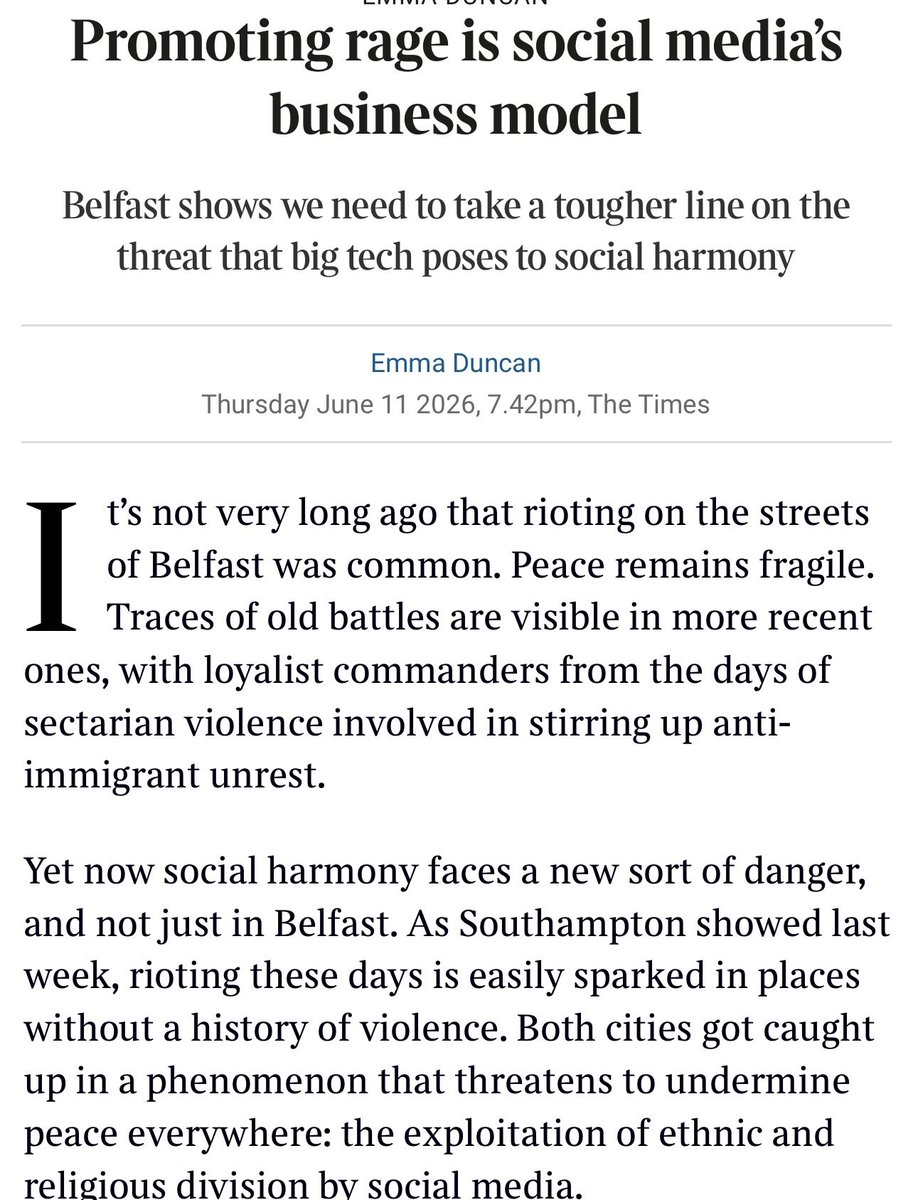
Posh Emma (PPE at Oxford, natch) knows everything about matters digital and psychological.
So of course she wants to curb free speech… thetimes.com/article/d2fb83b…

3
7
23
706
Prof Ian Pace retweeted

A convicted Palestinian terrorists is an analyst of Israeli affairs on the BBC… and you are surprised. BBC business as usual.
Jun 11

Palestinian terrorist Ismat Mansour murdered a civilian in 1993 and served 20 years in prison. He's now a contributor to @BBCArabic and is introduced as an “analyst” of Israeli affairs. This is the BBC's idea of impartial, public service broadcasting.
thejc.com/news/world/bbc-ara…
1
46
171
3,480
Prof Ian Pace retweeted

Jun 12
Here's my latest Substack, 'Harriman must be removed from the Southbank Centre'
simplysaid.substack.com/p/ha…
Today’s Times reports that “the Charity Commission and the Arts Council are reviewing allegations that the chair of the Southbank Centre shared antisemitic posts on social media. Lisa Nandy, the culture secretary, said she had contacted the agencies to ensure “urgent investigations” of Misan Harriman’s conduct. The Southbank is conducting its own investigation and is due to send findings to the commission next week, Nandy said.”
Over the past few months, the unearthing of various posts by Harriman have led to calls for his resignation or removal. Harriman has a habit of posting conspiracies which can easily be seen as antisemitic, most notably last month in response to the stabbings in Golders Green: “Wait, so there was a third victim on the same day who was Muslim?! And our press isn’t reporting it? Even the Met Police didn’t mention the Muslim victim in its X post?”
A ten second Google search shows that this is simply wrong; the first victim, a friend of the alleged assailant, was widely reported. But for Harriman, the undoubted focus on the Jewish victims was symbolic of the supposed downplaying of ‘Islamophobia’ – rather than the more obvious fact that that the first stabbing was not racially or religiously motivated, and so did not raise the same issues as the Golders Green attack.
Now he is at it again. Harriman has reposted on Instagram a claim that Ivanka Trump and her husband Jared Kushner, who are both Jewish, are “selling off the Albanian coastline to Jewish billionaires and [an] Israeli military project”. The project he appears to be referring to is for luxury resorts, financed by investors including Saudi Arabia, Qatar and the United Arab Emirates. The account Harriman reposted the claim from, geopolitics._.7889, has a history of posting antisemitic, pro-Russia, pro-China and pro-Iran content.
You have to wonder if Harriman is now deliberately going out of his way to make some sort of point. The chair of any major public institution needs to behave with a level of dignity and propriety. Does it really need to be said that repeatedly posting antisemitic conspiracy theories is wrong for anyone, let alone the chair of the Southbank Centre?
The list goes on. In response to the Reform surge in last month’s local elections, Harriman wrote this, comparing its popularity with German attitudes to the Holocaust:
“[T]he first thing that really comes to mind for me is the conversation Kurt Vonnegut had with Susan Sontag when he asked Susan Sontag on her thoughts on the Holocaust, and she said that when thinking about the Holocaust, she said ten per cent of people in any population are cruel no matter what, and ten per cent is merciful no matter what. And the other, this is important, the other remaining eighty per cent could be moved in either direction. It’s such a profound way to look at us. And in the context of yesterday’s election results, it’s something that I think is really topical. The surge of Reform is real. No one should deny it.”
Other videos he has reposted include one which claims that synagogues in Britain are used to sell “Palestinian land” as an “immigration package” for Jews in the UK, while another alleges that Israel is attempting to create a “Greater Israel” in Iran and across the Middle East. Earlier this year he posted one of himself after the US-Israeli attack on Iran, saying that he had had “so many messages from my friends from Iran” who were hoping it would lead to the toppling of the regime. These messages were, he said, “really quite alarming” because “many of the folks that are DMing me videos and talking points to post have incredibly pro-Zionist leanings from their own social media pages.” And he refers to Israel as “that entity”.
A petition in response to the coverage of Harriman’s posts has been circulated, organised – of course! – by the Good Law Project and signed by the likes of Greta Thunberg, Mark Ruffalo, Susan Sarandon and Gary Lineker. The petition says that Harriman is the victim of a smear campaign.
It’s remarkable how often the accusation of a smear is levelled when someone’s own words and deeds are reported. This was exactly what the Corbynites said of the reporting of his words and views when he was Labour leader.
There is, I’m sure, a long German word for the phenomenon in which someone rails against a supposed conspiracy against them, oblivious to the fact that they are themselves one of the worst promoters of conspiracy theories. Since my German is limited, let’s give it an English name. We can call it the Harriman Effect.
The Harriman Effect turns reality on its head, accusing those who are reporting someone’s words and actions of themselves being the problem.
Harriman is clearly unfit to chair any public body. He appears to have no intention of resigning. The onus is now on his fellow board members to act – and then on the government if they don’t.
5
34
1,655
Jun 12
It’s good to see a media focus on really important stories.
Jun 12

Sienna Miller has had three engagements, but never been a bride.
After a string of high-profile heartbreaks, perhaps her 29-year-old fiancé can be her happy ending?
🔗 telegraph.co.uk/news/2026/06…

1
173
Prof Ian Pace retweeted

If you had to pick a Film Noir to show someone for the first time -what would be your choice?

284
43
349
22,405