
New Econometrics papers from arxiv.org: econometric theory, micro-econometrics. Thank you to arXiv for use of its open access interoperability.
- Tweets 100,888
- Following 1
- Followers 3,325
- Likes 1






ALT We estimate the causal price elasticity of gas demand on Ethereum mainnet (L1) and Arbitrum One (L2), a quantity necessary for calibrating fee mechanism simulations, evaluating resource pricing reforms, and explaining observed usage patterns. A two-way fixed effects panel regression instrumented by each wallet's own lagged base fee removes the congestion-driven endogeneity that causes naive regressions to substantially underestimate demand sensitivity. On Ethereum mainnet (full year 2025), the pooled IV elasticity is -0.006, near-inelastic: a 10% fee increase reduces total gas demand by approximately 0.06%. On Arbitrum One (October 2025–April 2026), the pooled IV elasticity is -0.036. Both chains are inelastic in the aggregate, with L2 measurably more responsive than L1. A per-resource decomposition of L2 demand reveals elasticities ranging from modestly elastic computation (-0.027) to -0.27* for refunds, with storage growth (-0.15) and calldata (-0.06) in between. Behavioral clusterin
ALT We propose a semiparametric local projection estimator of nonlinear impulse response functions for a broad class of structural dynamic models relevant for applied macroeconomics, including models with nonlinearly transformed regressors, state dependent coefficients, and nonlinear interactions between shocks and state variables. The estimator is based on a doubly robust moment condition that identifies the average response function as a linear functional of a nonparametric conditional mean, augmented by a density ratio that captures the effect of shifting the shock of interest. We combine this moment condition with cross-fitting that handles serial dependence. The resulting estimator is √T-consistent and asymptotically normal. We examine the finite-sample performance of the estimator across a range of nonlinear data generating processes and illustrate its use in two empirical examples.
ALT This paper provides a practical guide to estimating semiparametric and nonparametric fixed-effects panel data models using the mgcv package in R. The focus is implementation: handling fixed effects with unit indicators, first differencing, or penalized unit effects; specifying smooth terms; and conducting cluster-robust inference. Monte Carlo experiments compare codemgcv::bam estimators with linear and fixed-series spline estimators. Simulations suggest that penalized splines adapt to unknown smoothness and estimate functions accurately in the designs studied here. A penalty-adjusted cluster-robust covariance estimator yields tests with near-nominal size for finite-dimensional parameters, and confidence bands provide accurate coverage for centered unknown functions.
ALT Economic decisions often depend on many noisy estimates of neighborhood effects, school quality, and hospital performance. Shrinkage estimation can reduce this noise by pooling information across related units. When units are related through geography, adjacency, or shared characteristics, the main challenge is not only how much to shrink, but which relationships should guide pooling. We use Stein's Unbiased Risk Estimate (SURE) to select among and average over flexible shrinkage estimators, allowing researchers to compare candidate definitions of relatedness without treating any one prior, covariance model, or adjacency rule as the true model for the latent parameters. Under regularity conditions stated directly on the estimator maps, SURE selection performs nearly as well as the best rule in a candidate class. The SURE-chosen weighted average likewise performs nearly as well as the best fixed weighted average of trained candidates, including nonlinear shrinkage rules whose fitted val
ALT The package rbreak implements methods for detecting structural breaks and estimating break locations for linear multiple regression models under general linear restrictions on the coefficient vector. Restrictions can be within regimes, across regimes, or both, and are supported in two forms: an affine parameterization (Form A: delta = Stheta s) and explicit linear constraints (Form B: Rdelta = r). It provides break date estimation with confidence interval, a restricted sup-F test for the null of no structural change, simulation of critical values by Monte Carlo, and a bootstrap restart procedure to reduce the risk of convergence to spurious local optima. It also implements a generalized regression tree (linear model tree) procedure where each leaf contains a linear regression rather than a local average. This note explains the methods and illustrates them with applications.
ALT We develop new inference procedures for a linear IV model that are robust to identification strength and heteroskedasticity of unknown form, and nonparametric with respect to the first-stage equation. Our first test is tailored for inference on parameters of endogenous explanatory variables. Our new statistic modifies that of Antoine and Lavergne (2003) to directly account for heteroskedasticity of unknown form. As a result, it is asymptotically pivotal, so that inference is greatly facilitated in practice. We also develop (i) an identification-robust subvector inference procedure that does not rely on the knowledge of identification strength for the remaining parameters, and (ii) a pure specification test. In both cases, the tests are conservative but powerful. We show that our procedures are computationally friendly and competitive with existing ones in simulations and an application.
ALT This paper develops a new toolbox for estimation and inference in panel data threshold regression models with interactive fixed effects and a fixed number of time periods, T. The toolbox is designed to be simple, accurate and computationally efficient. It is based on a simple least squares style estimator of the model parameters, and includes a number of inferential procedures for testing hypotheses regarding not only the threshold but also other parameters. The new toolbox is applied to study the impact of inflation on economic growth.
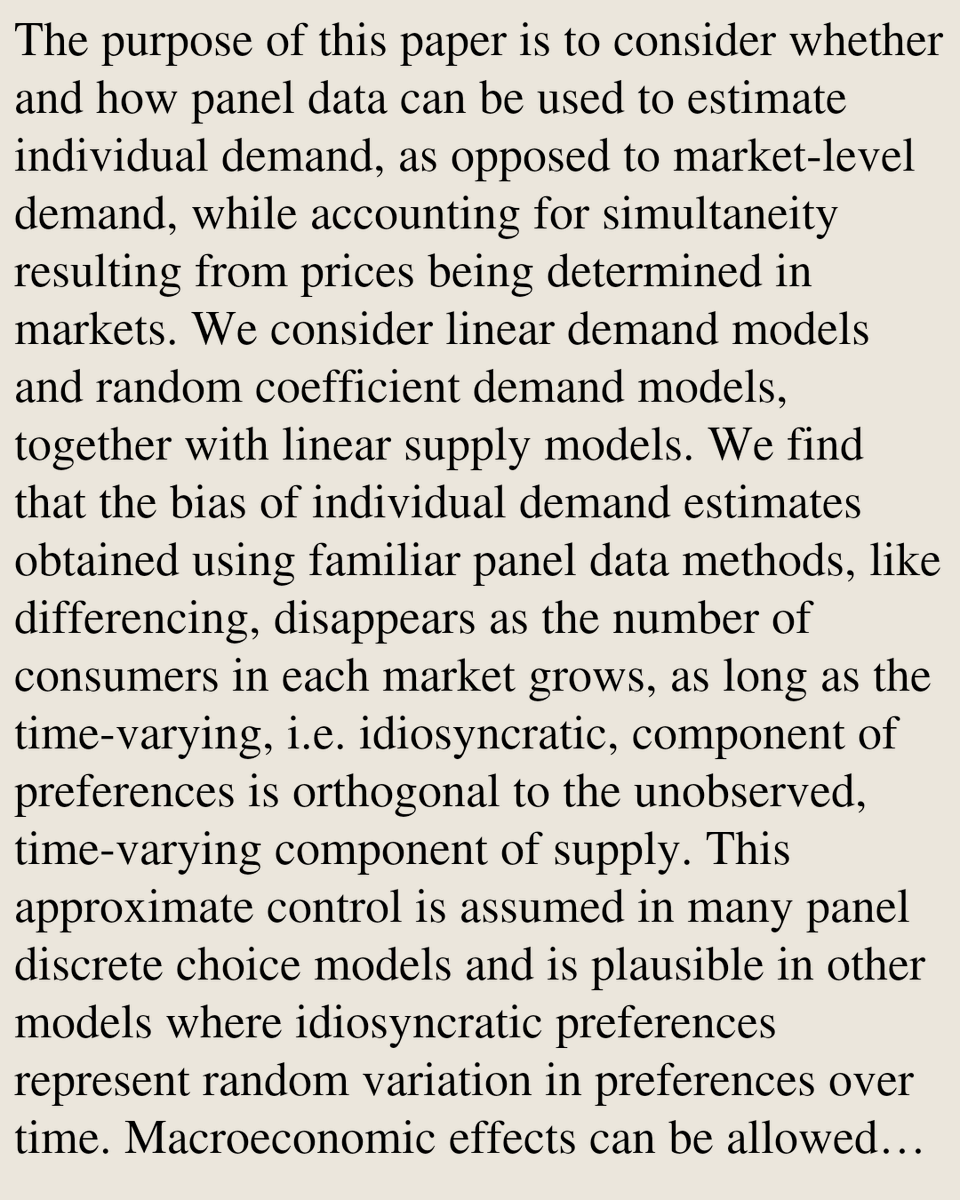
ALT The purpose of this paper is to consider whether and how panel data can be used to estimate individual demand, as opposed to market-level demand, while accounting for simultaneity resulting from prices being determined in markets. We consider linear demand models and random coefficient demand models, together with linear supply models. We find that the bias of individual demand estimates obtained using familiar panel data methods, like differencing, disappears as the number of consumers in each market grows, as long as the time-varying, i.e. idiosyncratic, component of preferences is orthogonal to the unobserved, time-varying component of supply. This approximate control is assumed in many panel discrete choice models and is plausible in other models where idiosyncratic preferences represent random variation in preferences over time. Macroeconomic effects can be allowed for by including regressors characterizing time effects, such as trends and time period dummies, or fixed time effect
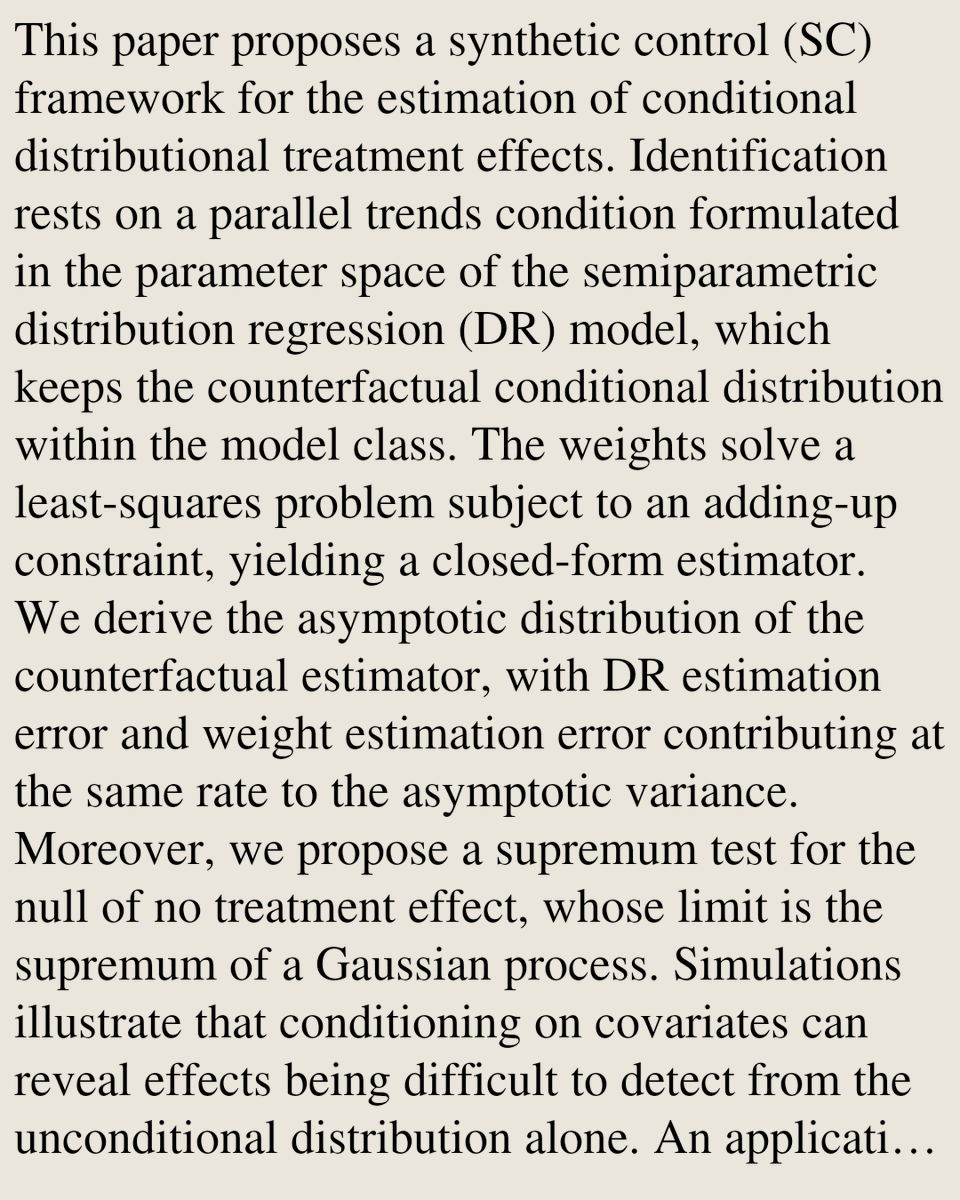
ALT This paper proposes a synthetic control (SC) framework for the estimation of conditional distributional treatment effects. Identification rests on a parallel trends condition formulated in the parameter space of the semiparametric distribution regression (DR) model, which keeps the counterfactual conditional distribution within the model class. The weights solve a least-squares problem subject to an adding-up constraint, yielding a closed-form estimator. We derive the asymptotic distribution of the counterfactual estimator, with DR estimation error and weight estimation error contributing at the same rate to the asymptotic variance. Moreover, we propose a supremum test for the null of no treatment effect, whose limit is the supremum of a Gaussian process. Simulations illustrate that conditioning on covariates can reveal effects being difficult to detect from the unconditional distribution alone. An application to the 1992 New Jersey minimum wage increase using CPS data finds effects co
ALT We generalize the convergence results of an explosive autoregression, pioneered in Anderson (1959), in three ways: First, we demonstrate that the centered least-squares estimator converges geometrically to a ratio of limits, even in settings where the innovations are correlated and not centered around zero. Secondly, we demonstrate that the requirement of independent innovations in Anderson (1959), Theorem 2.3, can be relaxed to α-mixing. Third, we provide an autocorrelation-robust feasible test statistic for the explosive parameter under Gaussian ARMA innovations.
ALT This paper provides partial identification and inference for treatment effects in nonparametric sample selection models with endogenous treatment and (weak) sample selection monotonicity. Outcomes are observed only for a non-randomly selected subsample and treatment is endogenous because of noncompliance with assignment. The proposed bounds for intensive margin treatment effects among compliers are sharp and tighter than those of Chen and Flores (2015). For inference, we develop semiparametrically efficient orthogonal moments and a debiased machine learning procedure that permits valid root-n inference under high-dimensional covariates and/or flexible functional forms. Simulation results indicate good finite sample performance. Applications to Job Corps and the Oregon Health Insurance Experiment show that the method can deliver substantially tighter effect bounds and confidence intervals than existing alternatives.
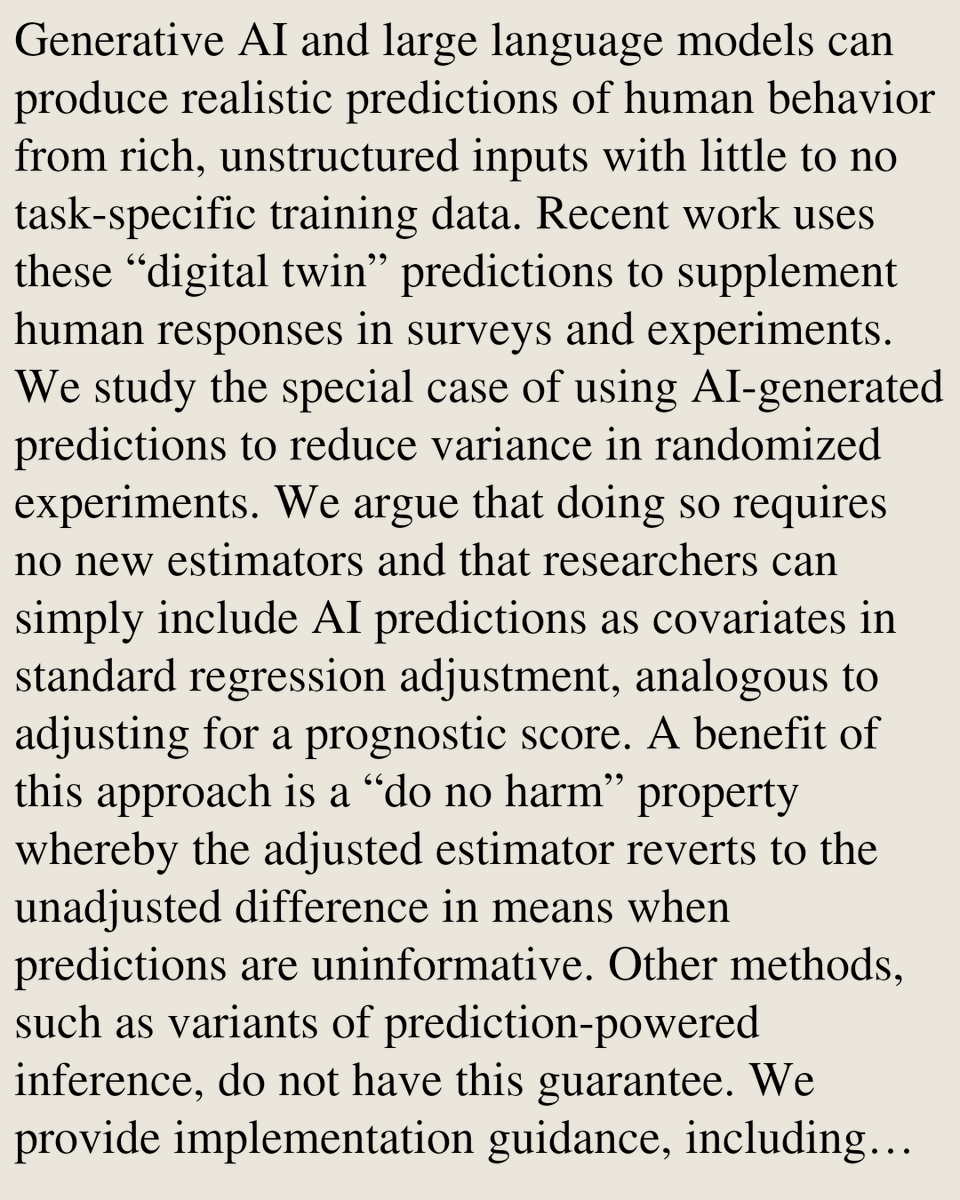
ALT Generative AI and large language models can produce realistic predictions of human behavior from rich, unstructured inputs with little to no task-specific training data. Recent work uses these “digital twin” predictions to supplement human responses in surveys and experiments. We study the special case of using AI-generated predictions to reduce variance in randomized experiments. We argue that doing so requires no new estimators and that researchers can simply include AI predictions as covariates in standard regression adjustment, analogous to adjusting for a prognostic score. A benefit of this approach is a “do no harm” property whereby the adjusted estimator reverts to the unadjusted difference in means when predictions are uninformative. Other methods, such as variants of prediction-powered inference, do not have this guarantee. We provide implementation guidance, including how to obtain continuous scores from discrete LLM outputs and how to use LLMs to featurize unstructured input
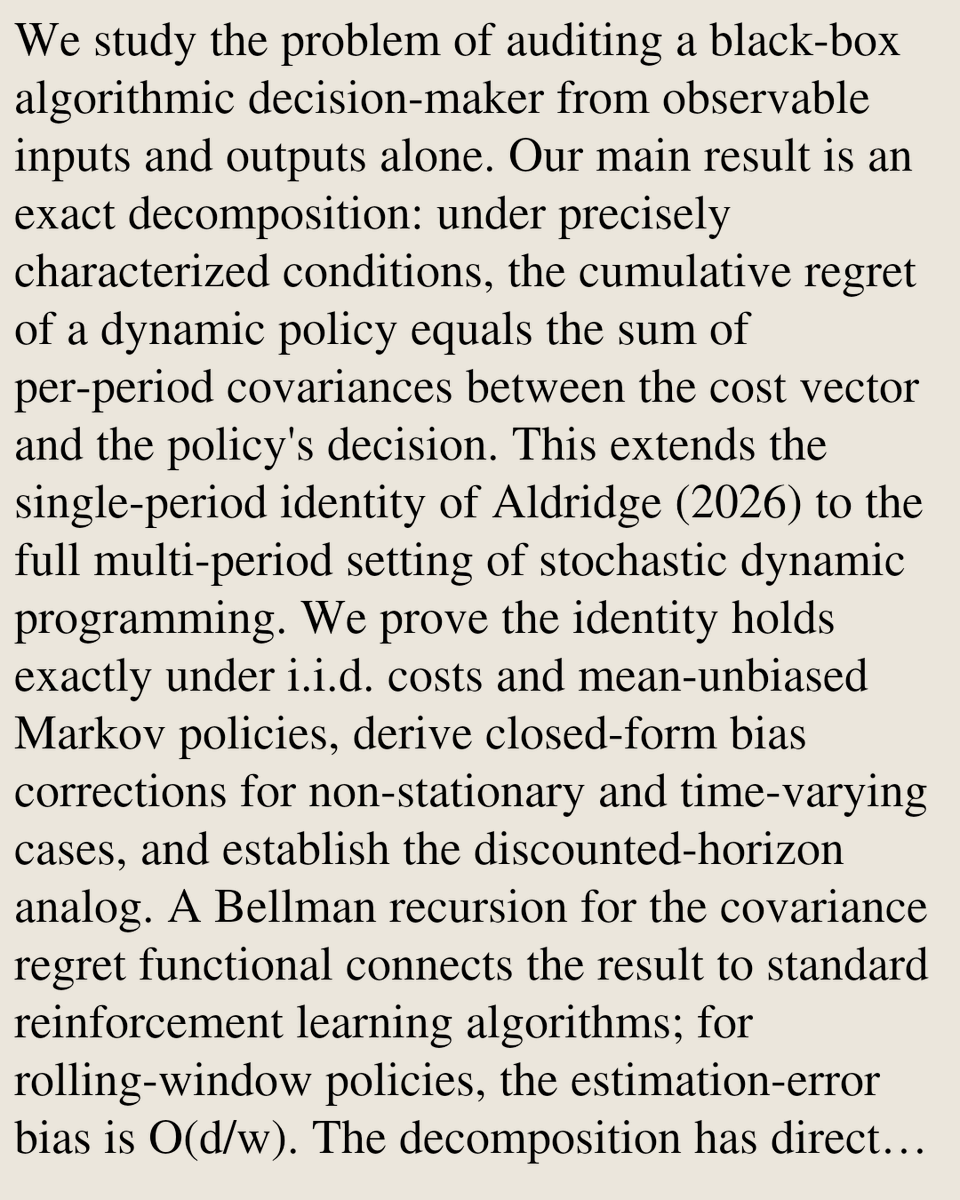
ALT We study the problem of auditing a black-box algorithmic decision-maker from observable inputs and outputs alone. Our main result is an exact decomposition: under precisely characterized conditions, the cumulative regret of a dynamic policy equals the sum of per-period covariances between the cost vector and the policy's decision. This extends the single-period identity of Aldridge (2026) to the full multi-period setting of stochastic dynamic programming. We prove the identity holds exactly under i.i.d. costs and mean-unbiased Markov policies, derive closed-form bias corrections for non-stationary and time-varying cases, and establish the discounted-horizon analog. A Bellman recursion for the covariance regret functional connects the result to standard reinforcement learning algorithms; for rolling-window policies, the estimation-error bias is O(d/w). The decomposition has direct implications for algorithmic auditing in strategic environments: in platform mechanism design, it provides
ALT This paper considers a semiparametric difference-in-differences (DID) framework for identifying and estimating treatment effects on the treated (ATT) when outcomes are missing not at random (MNAR), and a fully observed shadow variable is available. The shadow variable is assumed to be associated with the outcome evolution but independent of the missingness process, conditional on covariates and the possibly unobserved outcome evolution. We establish the identification conditions, derive the corresponding identification results and estimation algorithm, and evaluate the finite-sample performance of the proposed estimator through simulation studies and a real data application.
ALT We show analytically and via simulation that cross-sectional aggregation can substantially attenuate regime-switching signals in time-series data, making regime switches harder to detect. Building on this, we develop regime-switching models and an estimation algorithm which allow for autoregressive dynamics and grouped heterogeneity. We apply the approach to a U.S. macroeconomic dataset of 94 series, covering components of real gross domestic product, industrial production, capacity utilization, employment, and hours worked. The estimates give sharper business cycle classifications than those typically found in the literature. Monte Carlo simulations show that the computation is practical for datasets with a few hundred time series.
ALT We develop a covariate-assisted approach to partially identified parameters that are solutions to an under-identified system of linear equations with known coefficients. Examples include bounds on treatment effects, models of unemployment with state dependence, choice-theoretic models of IV, and random utility models. The boundary (i.e., support function) of the proposed identified set is represented as an average of intersections of regression functions, aggregated over the covariate distribution. We show that the boundary is a regular parameter, propose asymptotic theory, and demonstrate using an empirical application to Jobs First.

ALT This paper proposes a Structural Matrix Autoregressive (SMAR) model for the joint analysis of asset returns, realized volatility, and trading volume in a large-dimensional setting. This framework simultaneously captures dynamic spillovers across financial variables and cross-sectional dependence across assets while preserving a parsimonious parameterization relative to conventional vector autoregressive models. The model is estimated on daily data for the constituents of the Dow Jones Industrial Average over the period 2021-2025 and is structurally identified through restrictions consistent with the Mixture of Distributions Hypothesis and efficient market theory. The empirical findings indicate that volatility is the primary driver of trading activity, suggesting that informational shocks are predominantly incorporated into markets through price variability. Forecast error variance decompositions further reveal that, although internal shocks dominate short-term volume dynamics, cross-a
ALT This study investigates a statistical property of Lagrange multipliers in constrained Maximum Likelihood Estimation (MLE) and Least Squares (LS) problems from the perspective of numerical optimization. Building on large-sample theory, we show that the associated Lagrange multipliers converge to zero as the sample size increases, provided the distribution is correctly specified in MLE or the residuals are normally distributed in LS. Although this asymptotic behavior has long been recognized in statistics, it has received little explicit attention in numerical optimization and has rarely been exploited in algorithmic design. Importantly, the insight extends beyond classical low-dimensional settings: even in modern high-dimensional applications, such as deep learning, where the number of parameters may exceed the sample size, the same reasoning applies provided the generalization performance is good. This observation has two main implications. First, many constrained optimization algorith
ALT Traditional inference on the coefficient in an instrumental variables regression does not retain size when the instrument set is weak. With constant treatment effects or one instrument, the Anderson and Rubin (1949) AR test, the Klieibergen (2002)-Moreira (2003) LM test, and the Moreira CLR test provide robust alternatives which retain validity. Under treatment effect heterogeneity, no valid inference procedure exists in the overidentified setting. This paper develops the TSLS likelihood ratio (TLR) statistic, for performing inference on the TSLS estimand. When combined with a two-step procedure in the spirit of Berger and Boos (1994), it retains uniform validity across both the weak- and strong-instrument regimes. The procedure retains power with small choices of first-step level, hence the test can be constructed to numerically coincide with the Wald test in the strong-instrument limit.
ALT How efficiently do markets update beliefs when public information arrives in rapid sequence? We use a real-time prediction market setting that combines binary payoffs, precisely observed public signals, and high-frequency market data, allowing us to compare market price changes with changes in a benchmark probability implied by publicly available information. We first show that prices are informative and become more accurate as resolution approaches. During the event, prices respond rapidly to public signals and move in the expected direction. However, directional responsiveness is not the same as efficient updating. Relative to an out-of-sample benchmark probability model, a one-minute change in the benchmark probability is associated with only about a 0.64-for-one contemporaneous change in market prices. The missing adjustment predicts future price drift over the following several minutes, including drift net of subsequent changes in the benchmark probability. We then study the mecha