
Saving lives with well implemented technology
Joined September 2010
- Tweets 6,283
- Following 3,042
- Followers 2,901
- Likes 1,280
407 Photos and videos
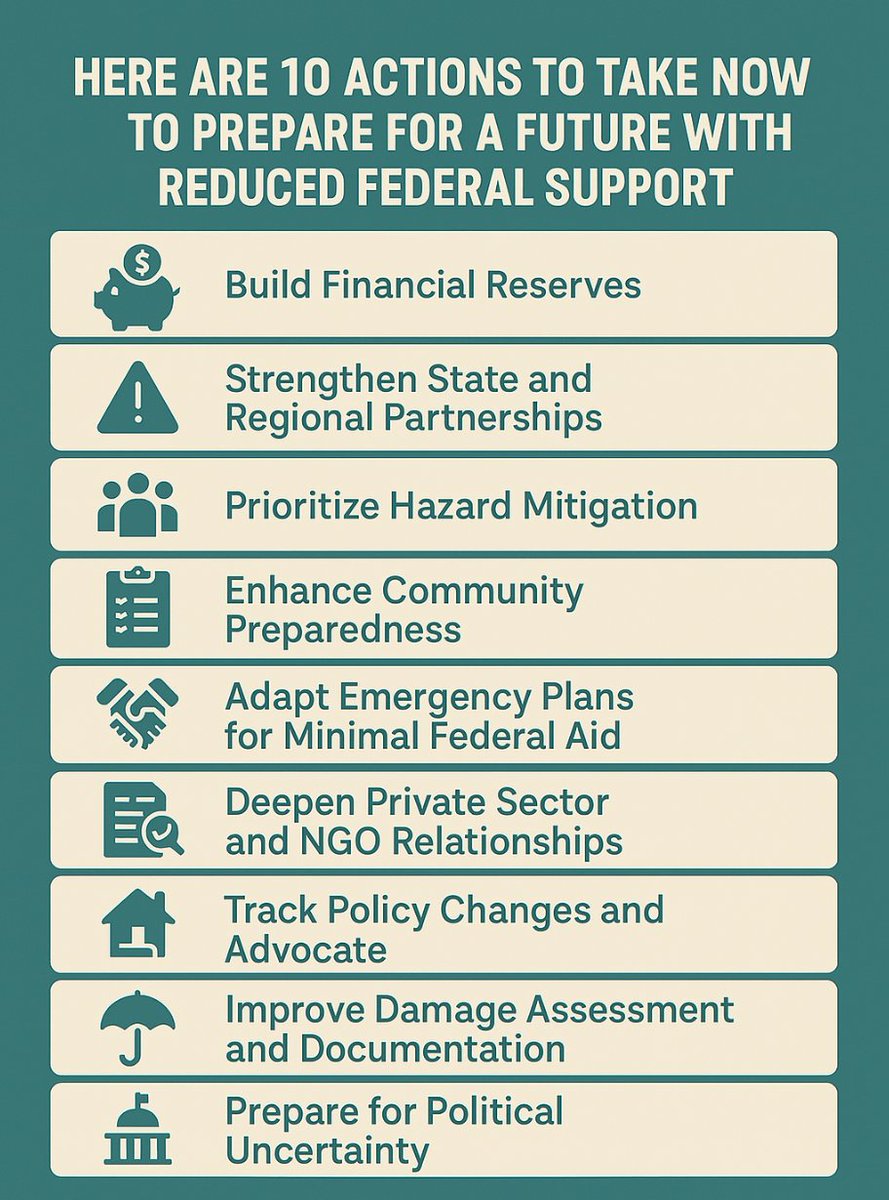




10 Actions Local Emergency Managers Can Take Now to Prepare for the elimination of FEMA. When the DHS Secretary says publicly “we're going to eliminate FEMA,” we should believe her. Posted last month, these recommendations. become more relevant by the day.
Hoping the status quo, pay-to-play committees, lobbying, associations, advisory groups, or whitepapers will save us is a fantasy.
As local emergency managers, we don’t have the luxury of waiting for help that’s never coming.
Our job is to plan for every outcome, especially the uncomfortable ones.
Here are 10 Actions Local Emergency Managers Can Take Now to Prepare for a Future with Reduced Federal Support.
●Adapt Emergency Plans for Minimal Federal Aid – Plan for disasters where federal assistance is delayed or unavailable. Conduct capabilities based modeling.
●Build Financial Reserves – Plan for the possibility of reduced federal reimbursement. Work with leadership to establish or rebuild a local disaster relief fund.
●Strengthen State and Regional Partnerships – Advocate for increased state funding and formalize mutual aid agreements with neighboring areas. Learn how to request EMAC mission-ready packages.
●Prioritize Hazard Mitigation – Keep resilience projects moving, even without federal grants. Invest in local flood control, fire prevention, and strengthening critical infrastructure. Explore private funding options.
●Enhance Community Preparedness – Train the public to be more self-reliant during the first 72–96 hours of a disaster. Expand CERT programs and local response networks. These efforts are already in place—now it’s time to scale them up.
●Deepen Private Sector and NGO Relationships – Strengthen partnerships with businesses, nonprofits, and faith-based organizations that can offer shelter, food, and recovery resources.
●Track Policy Changes and Advocate – Stay informed about changes to FEMA policies and state or federal legislation. Push for local needs and alternative funding solutions. Contacting representatives may help, but results could vary.
●Improve Damage Assessment and Documentation – If federal aid thresholds rise, detailed damage assessments will be critical to justify requests for assistance.
●Encourage Private Insurance and Risk Transfer – With possible changes to NFIP and disaster relief funding. Explore options like parametric insurance, resilience bonds, and private-sector risk transfer to build a sustainable disaster funding model that ensures recovery.
●Prepare for Political Uncertainty – The one constant in emergency management is that disasters will continue to occur. Be ready to respond, regardless of political or policy changes.
True resilience starts at the local level, empowering communities to tackle challenges head-on and build a stronger, safer future.
If you thought this was helpful, join the movement. Local Emergency Managers Alliance (LEMA) is where local EM come together to lead, not wait.
forms.office.com/r/pxUGxHHXX…
2
67
Call for Founding Members: U.S. Local Emergency Managers Alliance. Emergency management doctrine has long recognized one fundamental truth: All Disasters Are Local.
Yet local emergency managers, the frontline professionals who respond first and leave last, still lack a unified national platform.
The recent Executive Order explicitly emphasizes this reality, stating clearly that preparedness is best "owned and managed at the State, local, and even individual levels."
The lack of leadership, support, and relevance from existing associations is clear and will not change.
Why Now?
The latest Executive Order makes it clear:
"Federal policy must rightly recognize that preparedness is most effectively owned and managed at the State, local, and even individual levels."
It’s time to "shift from an all-hazards approach to a risk-informed approach."
This is our opportunity to end the cycle of being undervalued, fragmented, and under-resourced.
Introducing the US Local Emergency Managers Alliance:
We aim to create a formal alliance dedicated specifically to the needs of local emergency managers, giving them a powerful, unified voice.
Our alliance will:
●Advocate for resources, recognition, and realistic federal support.
●Facilitate the sharing of best practices, planning templates, drills, coordination methods, and standards-based data.
●Ensure local/regional level emergency management needs are accurately represented in national conversations and policy-making.
Our community sees the need clearly:
"Would love the opportunity to be a part of this!" – Tiffany Doria MS, CHEP, CEDP, PMP, Emergency Management Specialist
"Would love to be part of seeing how I can be involved from the healthcare side perspective, coordination, etc." – Healthcare EM Manager
"We tried this locally in my area and got very little traction...We need a community of local EM practitioners." – Richard Pereira MDEM, CEM®
"I think this sounds like a great idea and would love to spitball ideas with you about it." – Wyatt M. Peters
Take Action:
We need your voice. Become a founding member of the US Local Emergency Managers Alliance and help shape the future of emergency management from the ground up.
Due to the overwhelming and encouraging response from the community, we need to become more efficient in coordinating our efforts.
To help manage this, please take a moment to complete this quick sign-up form:
lnkd.in/ercP7-hr
No Spam, No Membership (time & effort is how we contribute), No outside influence.
We'll make sure to reach out to everyone who commented previously or reached out to Alex.
Together, let's ensure that local emergency managers finally have a seat at the national table.
53
This RAND report, Streamlining Emergency Management: Issues, Impacts, and Options for Improvement, correctly identifies the challenges FEMA faces, overlapping constructs, fragmented data systems, inefficiencies in grants management, and the lack of a unified operational framework.
However, this issue is not theoretical, it has real technical ramifications, as it highlights how FEMA’s fragmented frameworks and poor data integration negatively impact emergency management.
This aligns with GAO Report GAO-20-480 (2020), which states that “FEMA has not fully implemented an enterprise-wide strategy for modernizing its IT systems,” resulting in critical gaps in real-time data sharing and coordination.
Additionally, GAO Report GAO-21-127 (2021) emphasizes that FEMA’s grant management processes remain fragmented and inconsistent, leading to delays in distributing recovery funds and increasing administrative burden on state and local agencies. @FEMA_Cam @elonmusk @DOGE_FEMA @Sec_Noem
rand.org/pubs/research_repor…
60
Eric Kant retweeted

20 Feb 2025
.@GovAndyBeshear joined @politico's 2025 Governors Summit this morning and discussed working with FEMA and encouraged thoughtful dialogue to fix some of the issues facing states and territories. politico.com/live-events/202…
4
1
3
806
More recently at FEMA attention has shifted to staff involved in DEI and climate-related programs. According to an internal FEMA email reported by Bloomberg News on February 19, 2025, managers were instructed to compile lists of employees with “significant involvement” in climate change, environmental justice, equity, and DEI initiatives. The email, from a senior FEMA official, noted that these reductions would extend “far beyond the probationary list” and could impact the “majority of our staff,” given how embedded these priorities were in FEMA’s operations under its 2022-2026 strategic plan. That plan, set during the Biden administration, listed “instilling equity” as its top goal and “leading climate resilience” as its second, shaping much of FEMA’s staffing and programming.
1
82
Eric Kant retweeted

19 Feb 2025
eenews.net/articles/fema-ema…
“Direction is to make a list of anyone who worked on or works on climate, environmental justice, equity, DEIA,”
1
2
158
Eric Kant retweeted

19 Feb 2025
The jobs of Federal Emergency Management Agency employees tied to climate change and related hazards are next on the chopping block trib.al/vfNke6d
2
2
1,044
Create a Combined Grants Management System:
GAO Report GAO-21-127 (2021) highlights that “FEMA’s grant management processes remain fragmented and inconsistent,” which contributes to delays in distributing recovery funds. The report emphasized that consolidating these processes “would simplify workflows for state and local governments and improve oversight,” supporting a shift toward more efficient disaster recovery operations.
30

.@DOGE_FEMA @FEMA_Cam All disasters are local. Shifting FEMA’s role is not just a theory, it’s a direction supported by GAO findings and emerging policy recommendations.
Modernize Information Technology Systems:
GAO Report GAO-20-480 (2020) noted that “FEMA has not fully implemented an enterprise-wide strategy for modernizing its IT systems,” underscoring that outdated infrastructure “impedes real-time data sharing and coordination.” Transitioning to unified, cloud-based platforms is critical to overcoming these barriers and ensuring rapid, coordinated disaster response.
Create a Combined Grants Management System:
GAO Report GAO-21-127 (2021) highlights that “FEMA’s grant management processes remain fragmented and inconsistent,” which contributes to delays in distributing recovery funds. The report emphasized that consolidating these processes “would simplify workflows for state and local governments and improve oversight,” supporting a shift toward more efficient disaster recovery operations.
Utilize DI Modeling and Simulations:
GAO-20-480 highlights that current data analytics are “insufficient for real-time decision-making.” By replacing manual planning with decision intelligence (DI) tools, FEMA can identify bottlenecks, predict outcomes, and optimize resource allocation, shifting its focus to strategic coordination.
Enhance Cross-Communication:
Legacy systems IMS still cannot communicate effectively. As DHS S&T’s Enhancing Data Interoperability for Emergency Management (2023) report notes, “Integrated communications platforms are essential” for seamless data sharing. Upgrading interoperability is crucial in today’s environment.
Scale EMAC and EMAP:
Strengthening frameworks like EMAC and EMAP is vital. These programs facilitate state-to-state aid and standardize local practices, ensuring consistent quality in disaster response.
Establish a National Resilience Agency:
Proposals have emerged for creating a new agency housed in the White House under the Chief of Staff—tentatively named the National Resilience Agency or Federal Emergency Management and Resilience Agency (FEMRA).
This agency would assume a strategic role in coordinating national disaster management while empowering local agencies.
2
66
.@FEMA_Cam @elonmusk Modernize Information Technology Systems: GAO Report GAO-20-480 (2020) noted that “FEMA has not fully implemented an enterprise-wide strategy for modernizing its IT systems,” underscoring that outdated infrastructure “impedes real-time data sharing and coordination.” Transitioning to unified, cloud-based platforms is critical to overcoming these barriers and ensuring rapid, coordinated disaster response.
66
.@FEMA_Cam @elonmusk What does @fema spend on out dated incident management systems? I would like to know! Recent disasters, such as Hurricanes Helene and Milton, have exposed critical deficiencies in FEMA's emergency management systems, notably the WebEOC platform. A 2021 report by the Department of Homeland Security's Office of Inspector General highlighted that WebEOC contained unreliable data, leading to misinformed allocation decisions during the COVID-19 response.
oig.dhs.gov
In 2024, FEMA failed to answer nearly half of the calls for assistance during Hurricanes Helene and Milton, underscoring systemic issues in crisis response.
politico.com
To address these challenges, it's imperative that FEMA leadership prioritize the modernization of WebEOC and related systems.
This includes integrating real-time data analytics, enhancing user interfaces for better accessibility, and ensuring interoperability with state and local emergency management platforms. Investing in these technological advancements will not only streamline disaster response but also restore public trust in FEMA's ability to manage crises effectively.
1
93
.@FEMA_Cam @elonmusk will you publish the one line justification, as a former local emergency manager this will be enlightening.
FEMA has been ordered to deliver a plain-language review of its contracts by Tuesday (Today) evening, identifying which are “non-essential” and should be terminated or reduced.
36
Improve your intelligence analysis with @BobGourley’s Sherman Kent GPT on @OpenAI chat.openai.com/g/g-cgTsg2Kg…
1
4
442
2
56
Eric Kant retweeted

13 Jul 2022
Those #Maxararitas though 🍹 Thank you @maxar for a maptastic #EsriUC social @HardRockSD 🌍📍 missed you @JohnDombzalski 💙💚 Curtis says hello 🖐 @NYMapper @eTechOps @Geo_Fletch #EsriUC



3
1
9