
Founder, Applied Brand Science. Teaching you the "secret" science of brand growth. ehd.appliedbrandscience.com
Joined November 2008
- Tweets 9,968
- Following 1,831
- Followers 2,906
- Likes 30,027
2,425 Photos and videos


23 Sep 2025
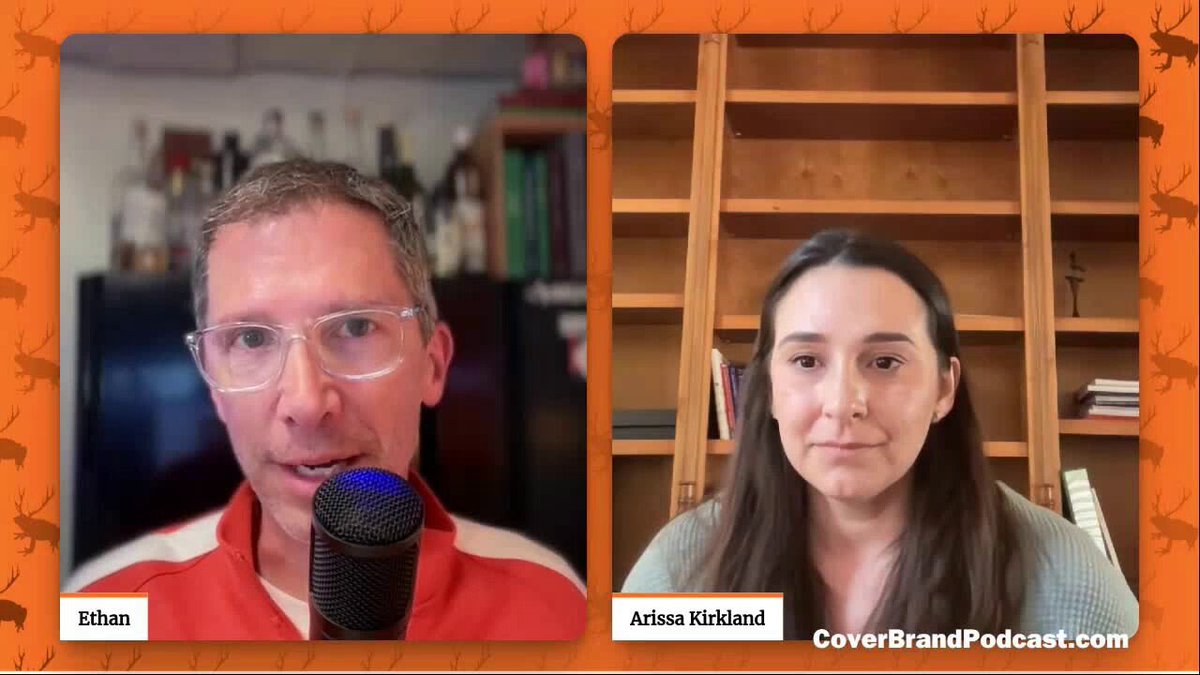
How do you know when it’s time to refresh your brand — and how much should you change?
In this episode of Cover Brand, I chat with Arissa Kirkland of cybersecurity firm Bishop Fox, as she wrestles with the perennial question of when (and how) to update a company’s branding.
We explore Arissa’s real-world experience leading the evolution of her company's previous brand update, and more recently, steering a brand refresh that tries to put a human face on heartless high-tech services. We break down the ping-pong between “Big B” brand (reputation) and “little b” brand (design elements), and cover tips on using both internal vision and external feedback to guide your next steps.
Listen to Cover Brand on Spotify, Apple, IHeartRadio, YouTube, Belchcast, and anywhere you pod.
#marketingpodcast #brandscience #brandrefresh
3
215
19 Sep 2025
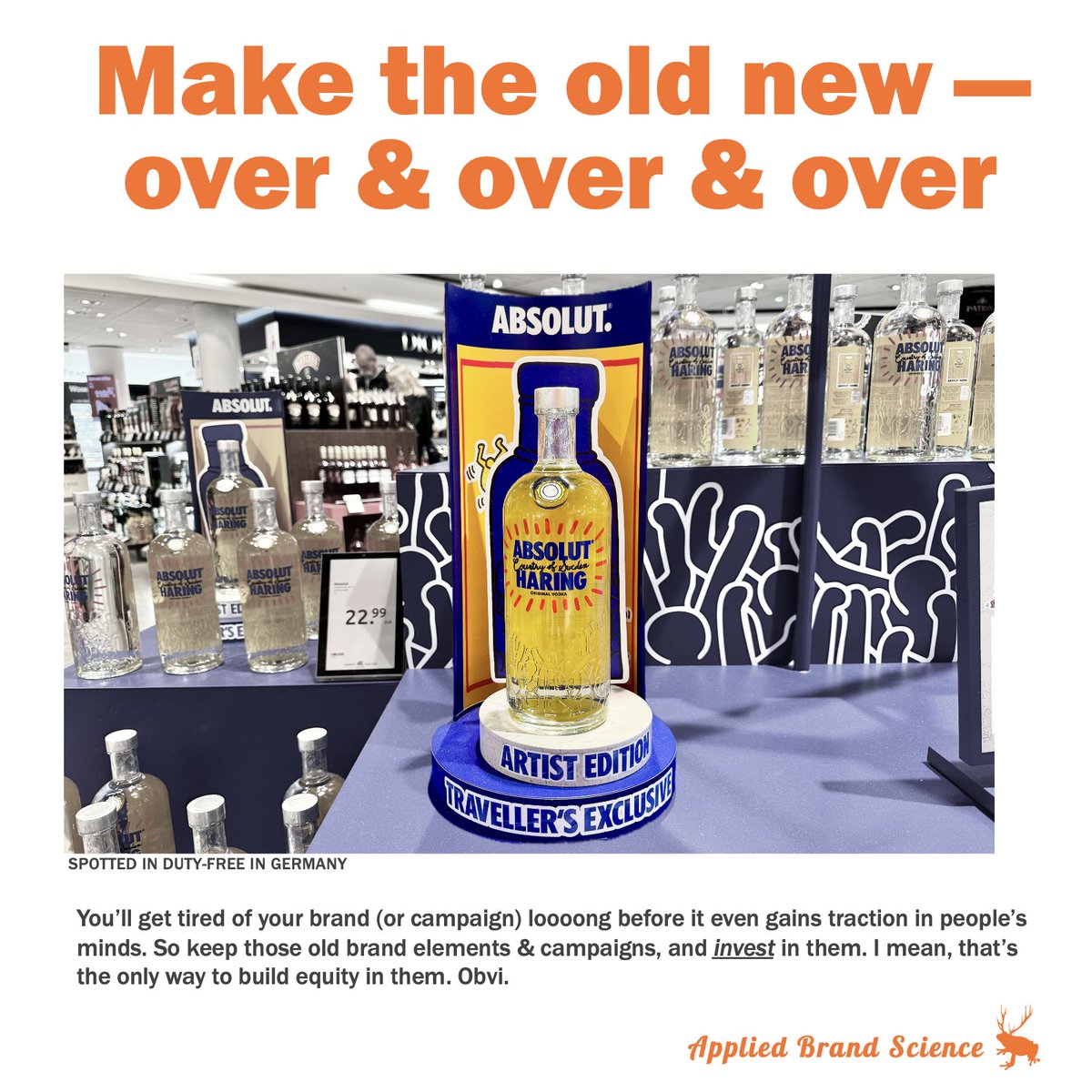
Make the old new — over & over & over.
You’ll get tired of your brand (or campaign) loooong before it even gains traction in people’s minds.
So keep those old brand elements & campaigns, and invest in them.
I mean, that’s the only way to build equity in them.
Obvi.
(Spotted in duty-free in Frankfurt.)
(PS: you should be so lucky to have a 44-yr-old campaign to work with.)
3
139
18 Sep 2025
WHY IS IT USEFUL TO THINK ABOUT A "SPHERICAL SHOPPER"?
Ok, so you might know about this mathematical, academic model of shoppers & brands & categories called the NBD-Dirchlet. You might’ve read about it in "How Brands Grow" by Byron Sharp. And if you’ve read the original paper from 1984, you _might_ know it makes all these crazy, wild assumptions about shoppers & brands & whatnot.
F’rinstance, it assumes people’s brand preferences don’t change. And that what brand you buy last time doesn’t influence what brand you buy this time. And that there are no subcategories. And — get this — that brands’ market shares don’t change. LIke, at all.
These sound insane. We know preferences change, that Tito’s booms, and Red Lobster boils. Is this theory just naïve & useless?
One way I like to think about the NBD-Dirichlet is like the SPHERICAL COW.
Let me explain. See, when trying to come up with big-T “Theories” in science, it’s useful to simplify. A LOT.
F’rinstance, when Newton figured out his famous laws of motion, he assumed things are in a vacuum with no air. And there’s zero friction between things. And the mass of any object is all at a point in its middle. Etc etc. This seriously helped with working out the laws.
"Simplifying assumptions" like these have become the basis of a joke. It goes like this:
A farmer is having trouble with her dairy cow: it isn’t producing milk like it used to. So she tells her neighbor, who happens to be a physicist. He offers to help. After doing some measurements & some math, he shares his findings.
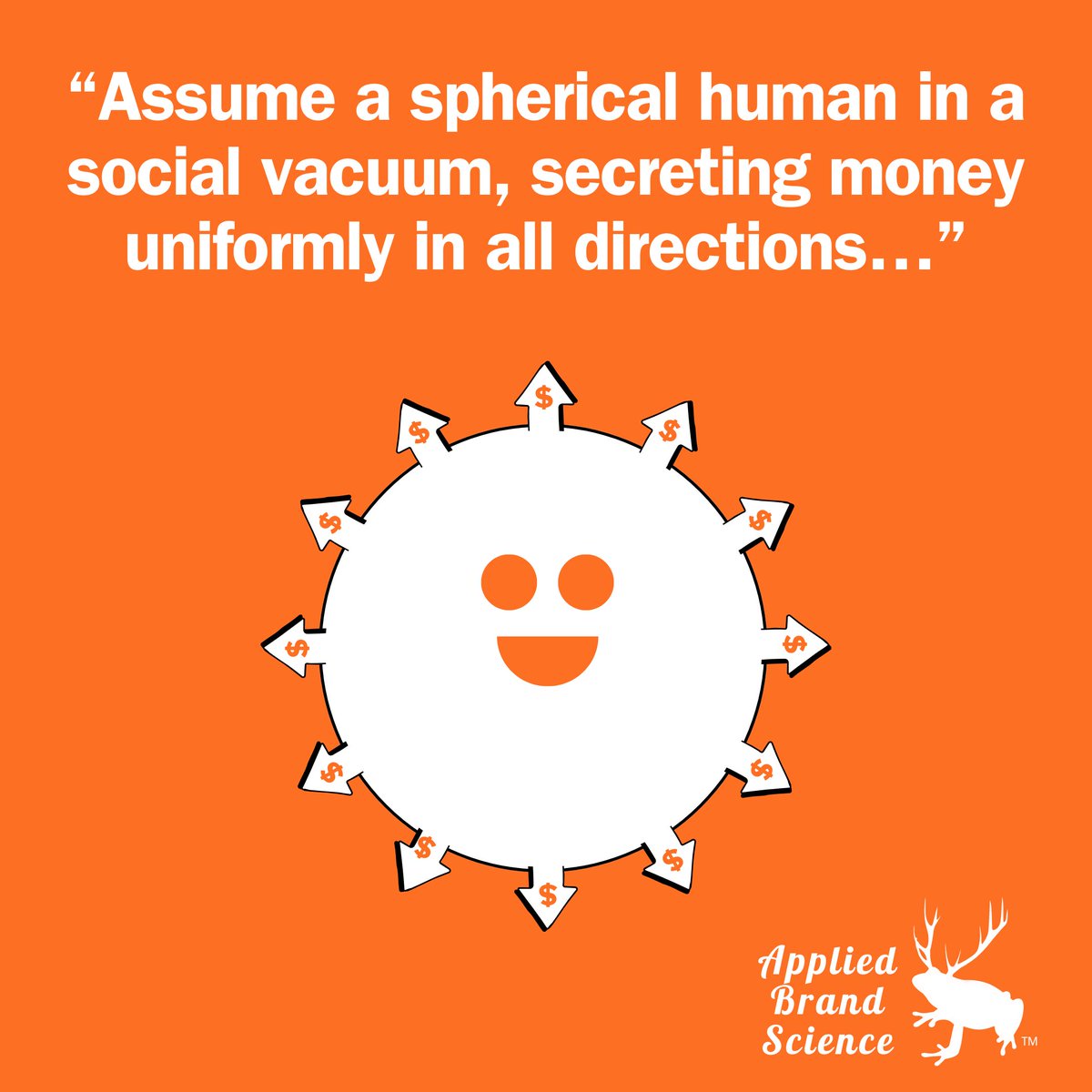
“Ok,” he says, “Consider a spherical cow in a vacuum, secreting milk uniformly in all directions….”
Ha ha. But here’s the kicker: even with all these crazy assumptions, Newton’s laws work amaaazingly well, for everything from planets to peanuts. And when they don’t work, it means something else is going on — that some assumptions are being violated.
So when you drop a feather and a fish, you don’t say Newton’s laws are wrong because the feather floats and the fish flattens (his laws say they both fall at the same rate). No: you realize that something else, namely air resistance, is at play.
The same is true with the NBD-Dirichlet. It basically assumes a “spherical shopper” in a social vacuum, extruding money uniformly to all brands in its repertoire (so to speak ha ha). AND YET, it still does an amazing job of predicting all kinds of things about shoppers, brands, and markets.
And then when you see a Tito’s, it doesn’t mean the model’s broken: it means something else is going on. Maybe changing preferences. Or product differences. Or retailer dynamics. All kinds of stuff.
Some lessons:
🔸. Understand a theory’s assumptions.
🔸. Look at what it’s good at describing, explaining, & predicting.
🔸. When the data doesn’t fit the model, see if any assumptions are being broken. Look for something else at play.
🔸. Don’t live in a vacuum.
---------
Get the Irregular News at
AppliedBrandScience. com/signup
1
116
16 Sep 2025
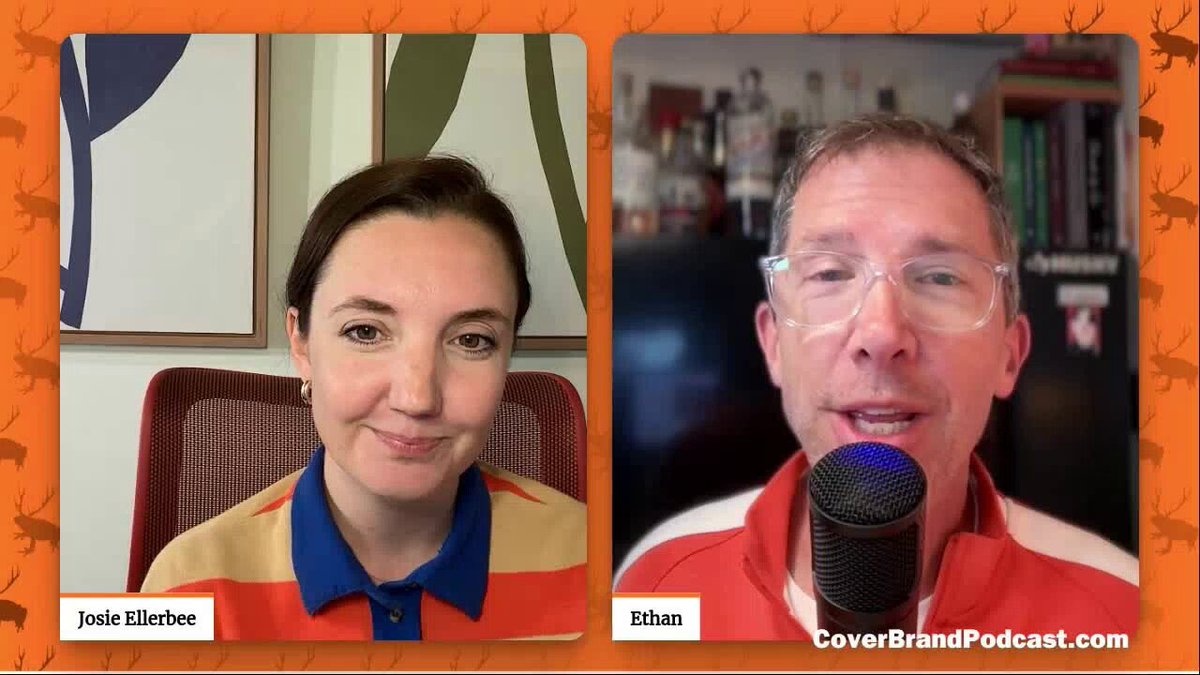
How do you keep your brand from being too boring — or too chaotic?
In this episode of Cover Brand, I chat with badass brand strategist Josie Ellerbee about the tightrope walk between staying true to a brand’s core & keeping things fresh in the AI era.
We talk about the pitfalls of overly templated branding, the risks of chasing novelty for shock value, and how brands like KFC and Cards Against Humanity deftly balance the predictable with the surprising. (And of course we gotta mention Raymond Loewy.)
Tune in whether you’re leading a CPG giant or building a B2B business.
Stream everywhere you listen to podcasts: Apple, Spotify, IHeartMedia, YouTube, Burpio, and more.
#marketingpodcast #AIMarketing #brandscience
1
1
2
131
11 Sep 2025
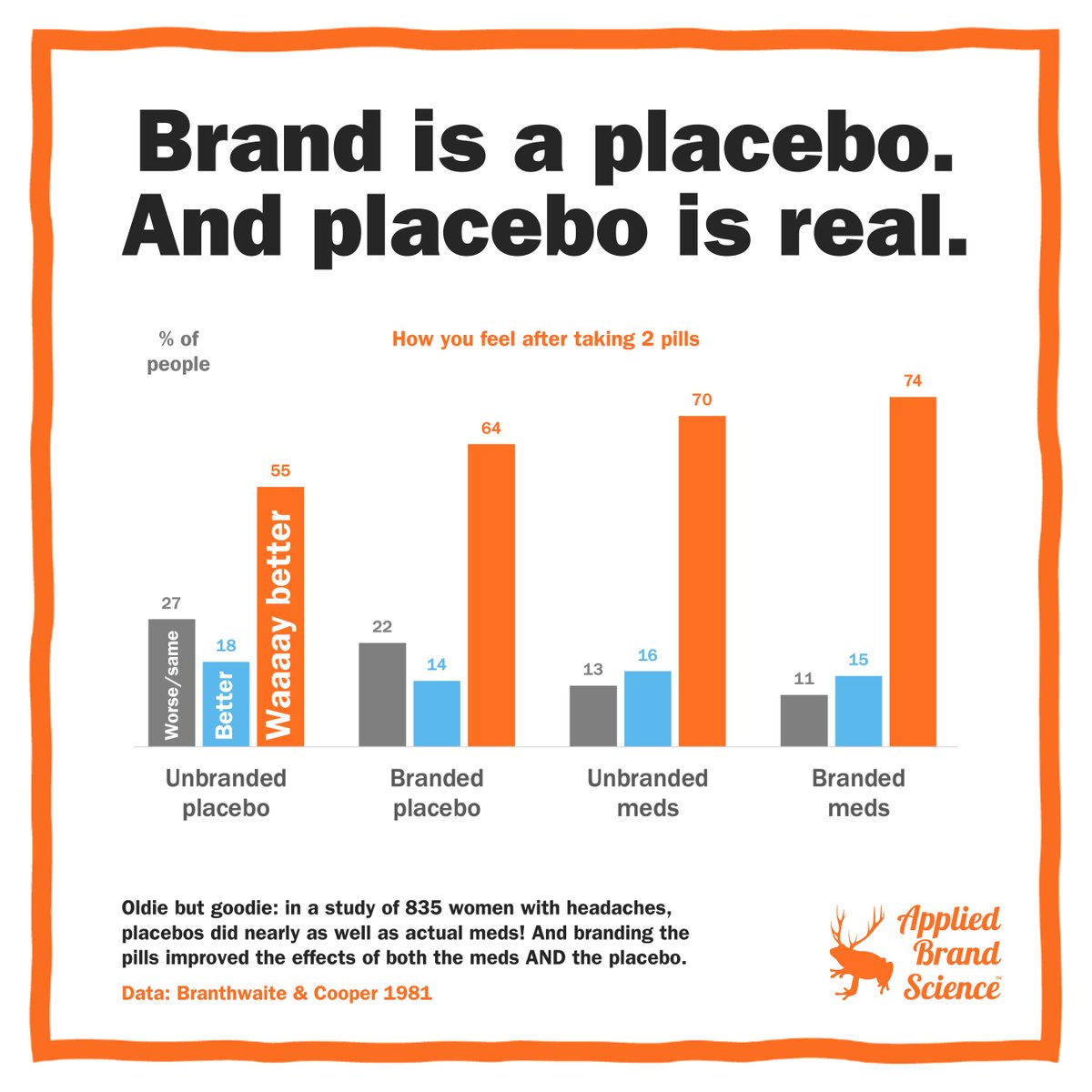
IF YOU BRAND A PLACEBO, DOES IT WORK BETTER?
Like, isn't a brand kind of a placebo anyway?
This is an oldie but goodie. In a study of 835 women with headaches, Branthwaite & Cooper set out to see if a) placebos work at all, and b) if branding them made any difference. The results are fascinating.
a) Placebos did nearly as well as actual meds. Srsly. A whopping 55% taking unbranded placebos felt waaay better vs. 70% taking unbranded meds! And while 74% taking branded meds felt way better, another whopping 64% felt better taking branded placebos.
b) Branding the pills did indeed give a bump to relief — 9% for placebo, and 4% for meds. Not huge, but still significant. Which is pretty cool.
This research has been replicated a lot, since randomized controlled trials (RCTs) are the gold standard in medical science. Over & over, these two findings hold up: placebos often work, though not as well as real treatment. And branding something makes it work better than the same thing unbranded.
Some lessons:
🔸 A huge chunk of what we do is psychology. Objective truth is very often impacted by how we think & feel about a product or service. Or in reverse: placebo is not zero; it’s a real effect.
🔸 A brand can be seen as having a placebo effect — it changes the impact of the thing. So be sure to build a brand that *increases* the perceived value of your stuff.
🔸 Learn brand science! It helps your team make smarter decisions that lead to growth.
----
Get the Irregular Newsletter! Weekly-ish!
AppliedBrandScience. com/signup
1
153
11 Sep 2025
This is so fun! I enhanced some old family pics!
Also, buhbye objective reality!
9 Sep 2025

Gemini's new state-of-the-art image generation and editing is here! And it’s free for everyone.
Try a new hairstyle. Restore an old photo. Combine two photos into one. Go nano bananas.
40
10 Sep 2025
MAKE MARKETING GREAT AGAIN!
THANK YOU TO ALL THE TRUE MARKETING PATRIOTS WHO ARE HELPING BRING BACK THE "VERY STABLE CAMPAIGNS" AND ALSO FOR THE NEW "SCIENCE" OF BRANDS. NOT LIKE THOSE LOSERS WHO TALK ABOUT LOYALTY (SO MUDDY), OR THE RADICAL FRAMEWORK FRINGE WHO KEEP ADDING P'S TO THE FOUR P'S. FOUR IS ENOUGH! ISAAC NEWTON HIMSELF INVENTED IT (VERY SMART!). AND MAYBE WE SHOULD LOCK UP ALL THE "FAKE ADS" FRAUDSTERS IN PERFORMANCE MARKETING. IT "PERFORMS"
IS BY SKIMMING 60 CENTS OFF EVERY MEDIA DOLLAR! TOTAL RIP-OFF! (POOP FUNNEL!) I'LL BE DEPLOYING BRAND SCIENCE TO MAINTAIN SANITY & EFFECTIVENESS IN CUCKOO COMPANIES. I WILL LEAD THE CHARGE! MAYBE FOR ANOTHER FOUR YEARS, MAYBE EIGHT (WHO KNOWS). THANK YOU FOR YOUR ATTENTION TO THIS MATTER! - EHD (PHD).
1
86
9 Sep 2025
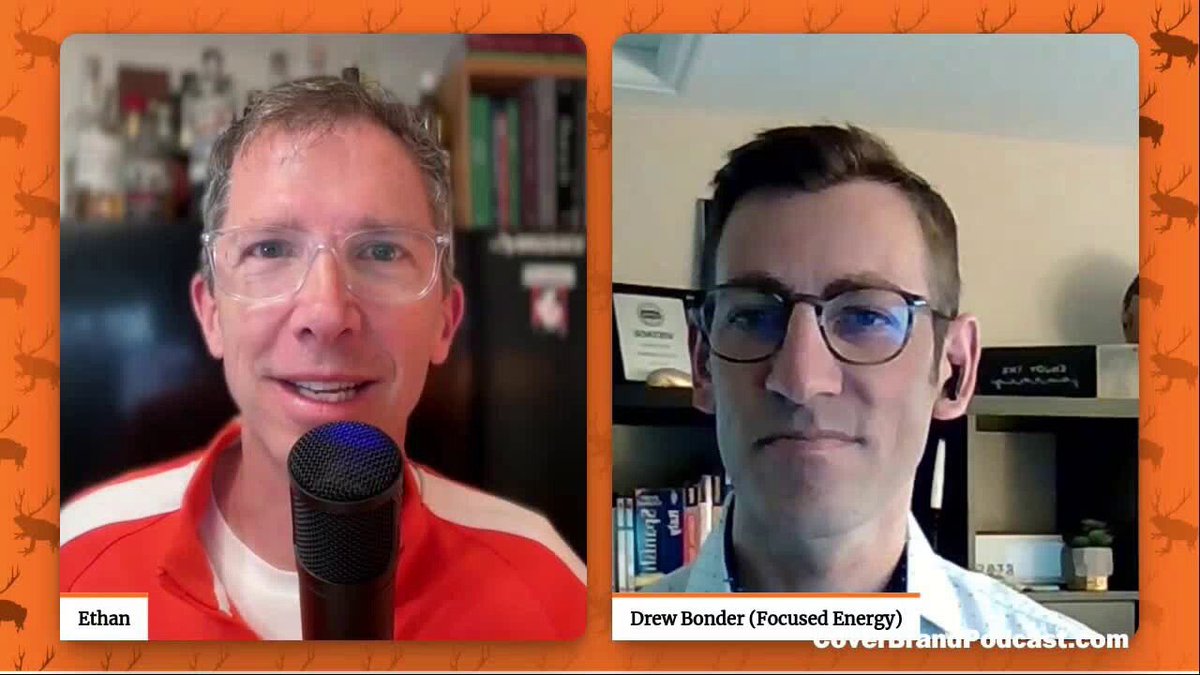
How do you make your business memorable when your brand sounds like everyone else’s?
In this episode of Cover Brand, I chat with Drew Bonder, founder of Focused Energy, who shares his struggle to explain what his fractional CFO firm *really* does vs other firms. We dig into stuff like:
🔸 Why precise messaging often stinks
🔸 How to shift from features to benefits
🔸 And some tricks for distilling your difference into a sticky, simple message.
Give a listen if you’ve ever wondered how to move past generic business jargon and make your brand resonate.
Find Cover Brand anywhere you pod.
#marketingpodcast #branding #marketingscience
85
4 Sep 2025
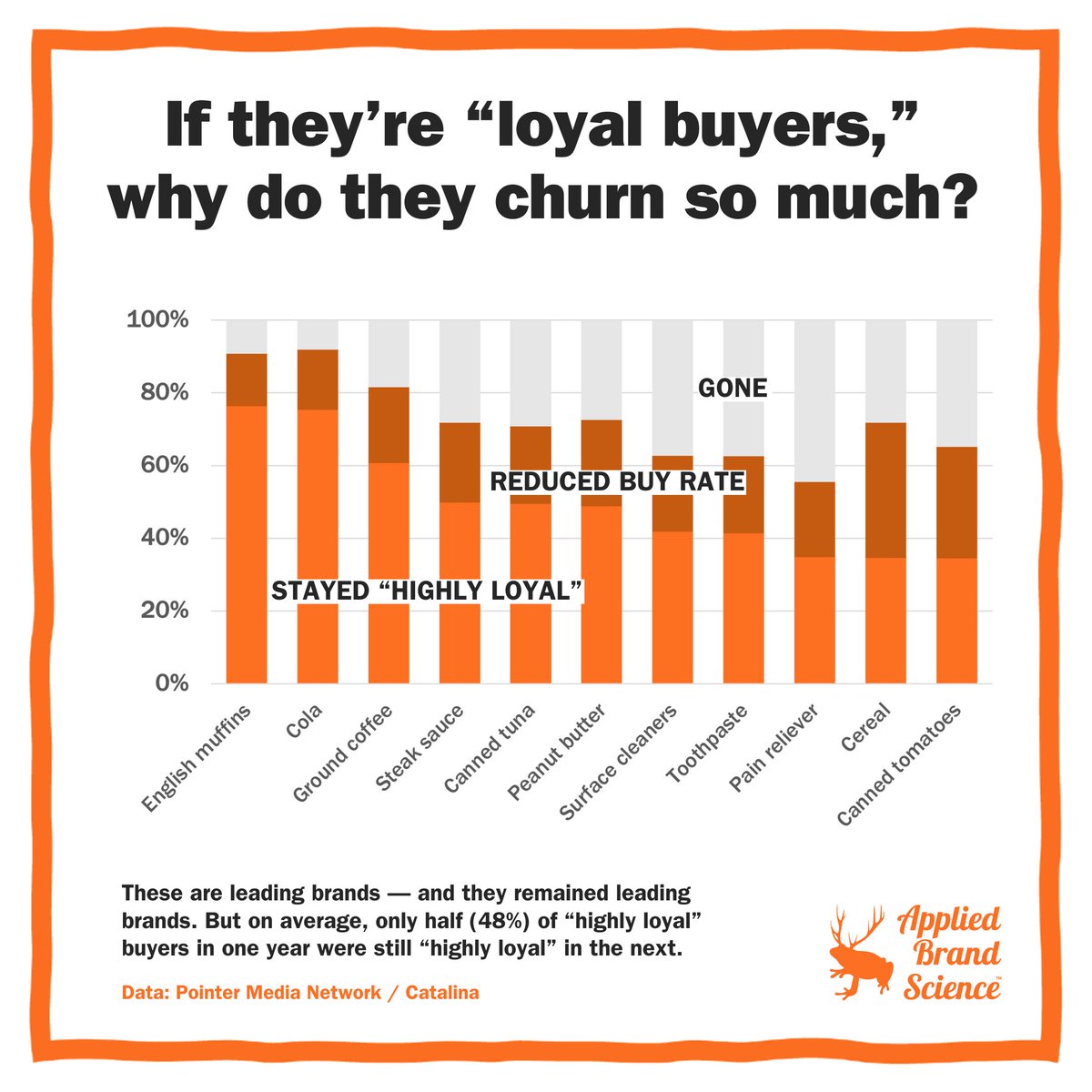
IF THEY'RE "LOYAL" BUYERS, WHY DO THEY CHURN SO MUCH?
A few years ago, Pointer Media looked at the actual purchases of 32MM people across 658 leading brands in the US. Then they checked out whether “highly loyal” customers in one year (let’s call them HLCs) were still highly loyal in the next year.
They found what looked like a paradox: most brands, including the leading brands in each category, had TONS of churn in their HLCs. And yet market share changed very little.
On average, 48% of HLCs in year one were still HLCs the next year. 19% reduced their buying of the brand. And 33% — one third! — didn’t buy the brand at all. Cola brands retained 76% of HLCs, but cereal? Only 35%. Yowza!
But if market share is barely changing, what the heck’s going on?
Well, a few things, actually:
1. HLCs were defined as people who spent 70% of their category dollars on a single brand. But that could be someone who bought 4 items total that year (3 from one brand) or 40.
2. The time window was one year. This *seems* like enough time to get a read on someone’s behavior. But actually, even for these staples, it might be way too short. See, people regularly buy 2 or 3 brands in a category & switch them up kinda at random. So they’re “defecting” to another brand in their repertoire.
3. Aaaaand they measured loyalty to a *product*, not to a total brand. So an HLC could’ve “defected” from Crest to…. Crest.
Some key lessons for us all:
🔸 Lots of these “crises” are really due to measuring the wrong things, or measuring them in the wrong way. So step 1 is, always know what the heck you’re actually measuring.
🔸 “Loyalty” is a craptastically sloppy word. Use “share of wallet”, or “buy rate”, or “heavy buyers”.
🔸 Know the brand science! Then you’ll understand all these dynamics and not get spooked by the wrong things. (And you’ll learn how to grow.)
Sign up & never miss a post at
AppliedBandScience. com/signup
1
121
3 Sep 2025
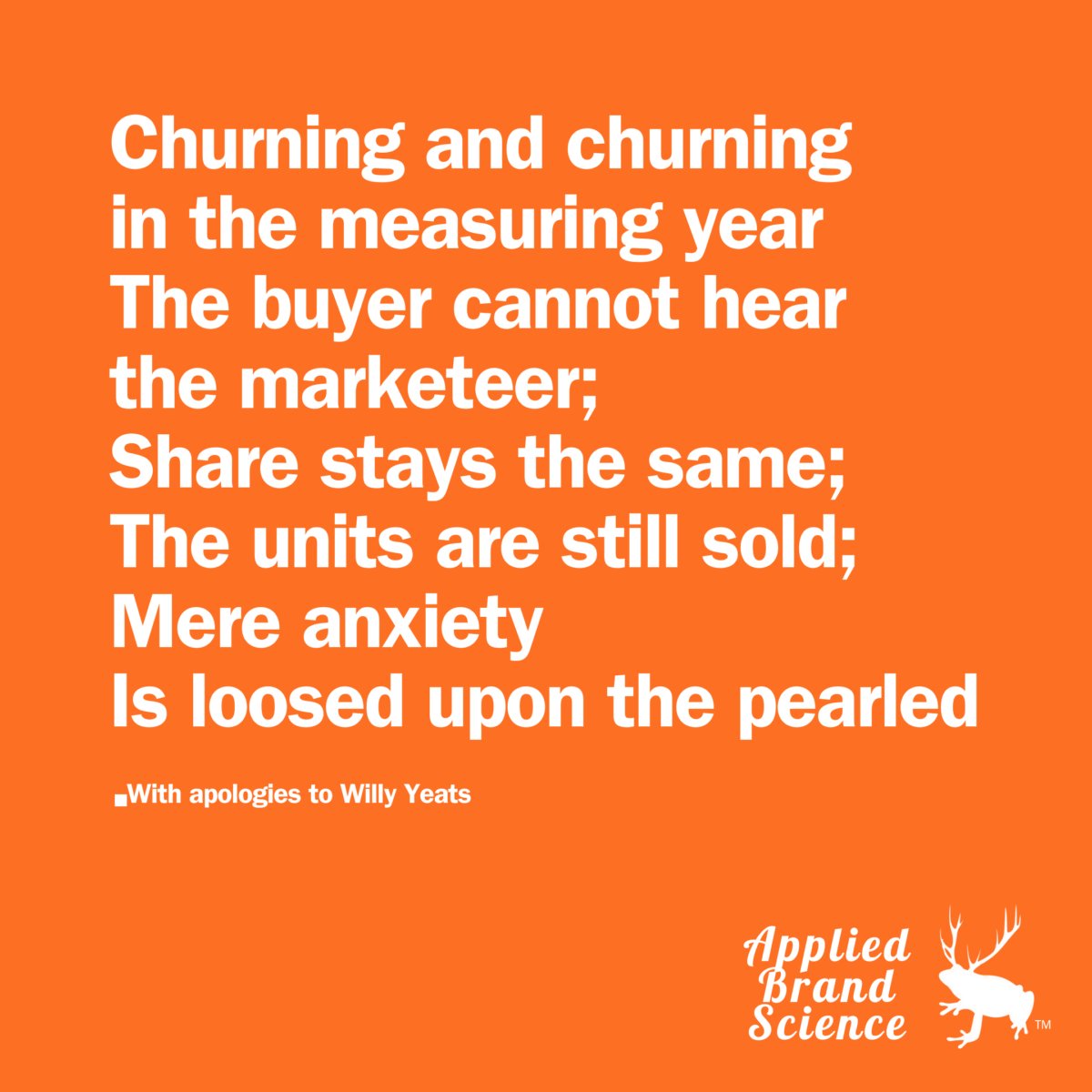
Churning and churning in the measuring year
The buyer cannot hear the marketeer;
Share stays the same; the units are still sold;
Mere anxiety is loosed upon the pearled.
(With apologies to Willy Yeats.)
But still; 'tis true: shoppers will churn. Heavy buyers will become light, or defect. And yet share won't change (much if at all).
If you don't know the science of brand growth — the physics of brands — you'll be anxious about it.
But if you DO know brand science, it re-tunes your intuition about what matters, what doesn't, and what to do about it.
89
2 Sep 2025
How does an introvert who hates self-promotion promote themselves without feeling nauseous?
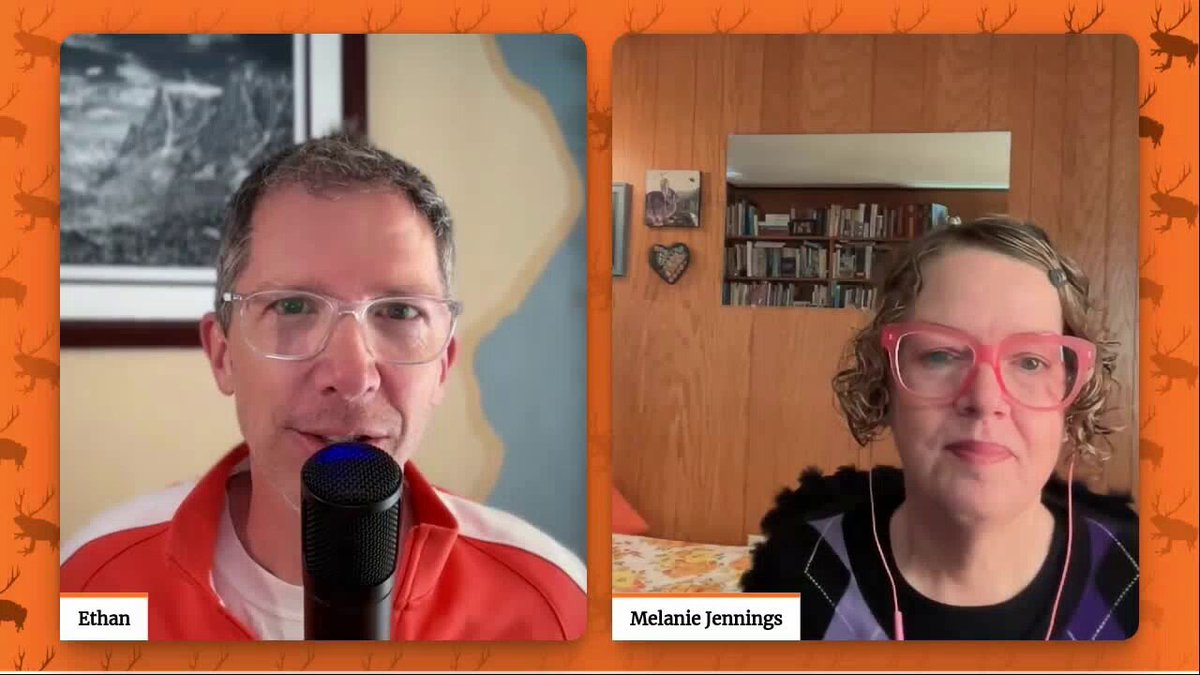
On this episode of Cover Brand, I sit down with multi-talented novelist, poet, and technical writer Melanie Jennings to talk about building a platform as an emerging author.
I share some practical tips on growing a following, experimenting with new channels, and embracing the awkwardness of putting yourself out there.
If you’re a small 'brand' trying to build your audience, tune in.
Find Cover Brand anywhere you pod.
94
30 Aug 2025
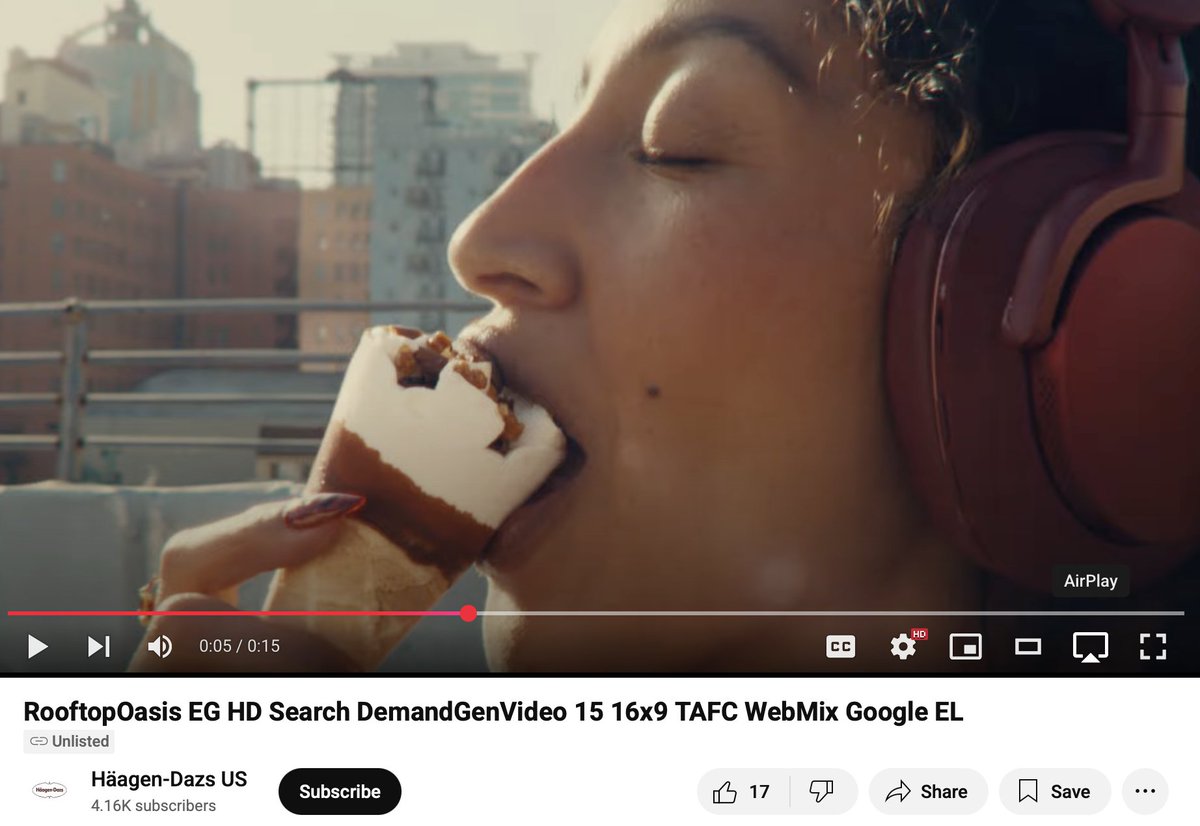
this Häagen-Dazs ad has TONS of taste appeal (it's food, natch), but it was clearly never meant to be watched on its own: look at the video title lolz.
2
268
29 Aug 2025
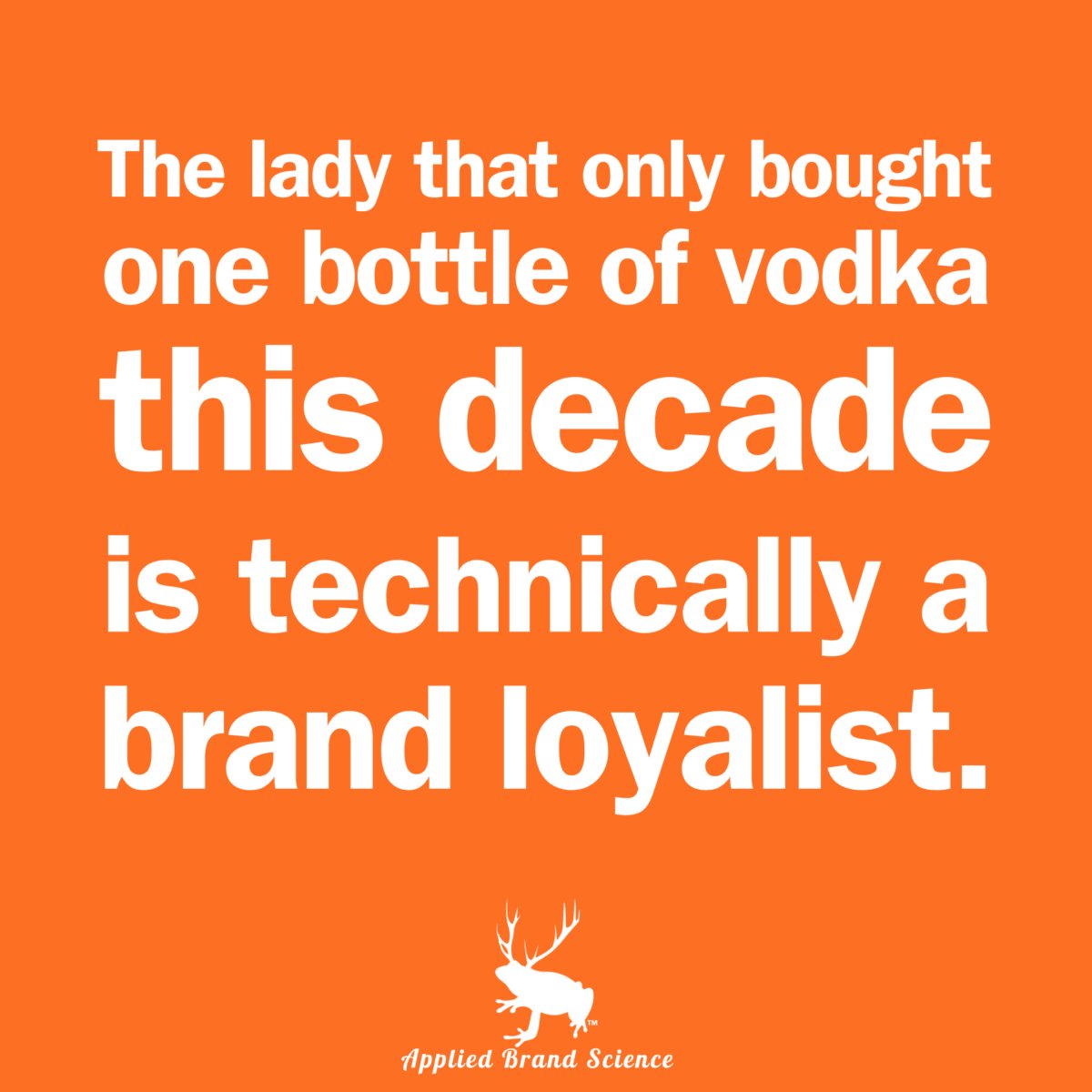
The lady that only bought one bottle of vodka this decade is technically a brand loyalist.
I mean, 100% of her category purchases went to that one brand. She never strayed. She never switched.
If that's the case, what the hell does 'loyal' mean?
This is part 45 in my ongoing project to kill the concept of 'brand loyalty' and move us on to alllllll the other concepts that are so much more precise & useful in describing how we buy brands, or how we feel about them.
(Odds are it's Tito's, too. #brandscience)
#marketingscience #thatbusinessofvodka
1
81
28 Aug 2025
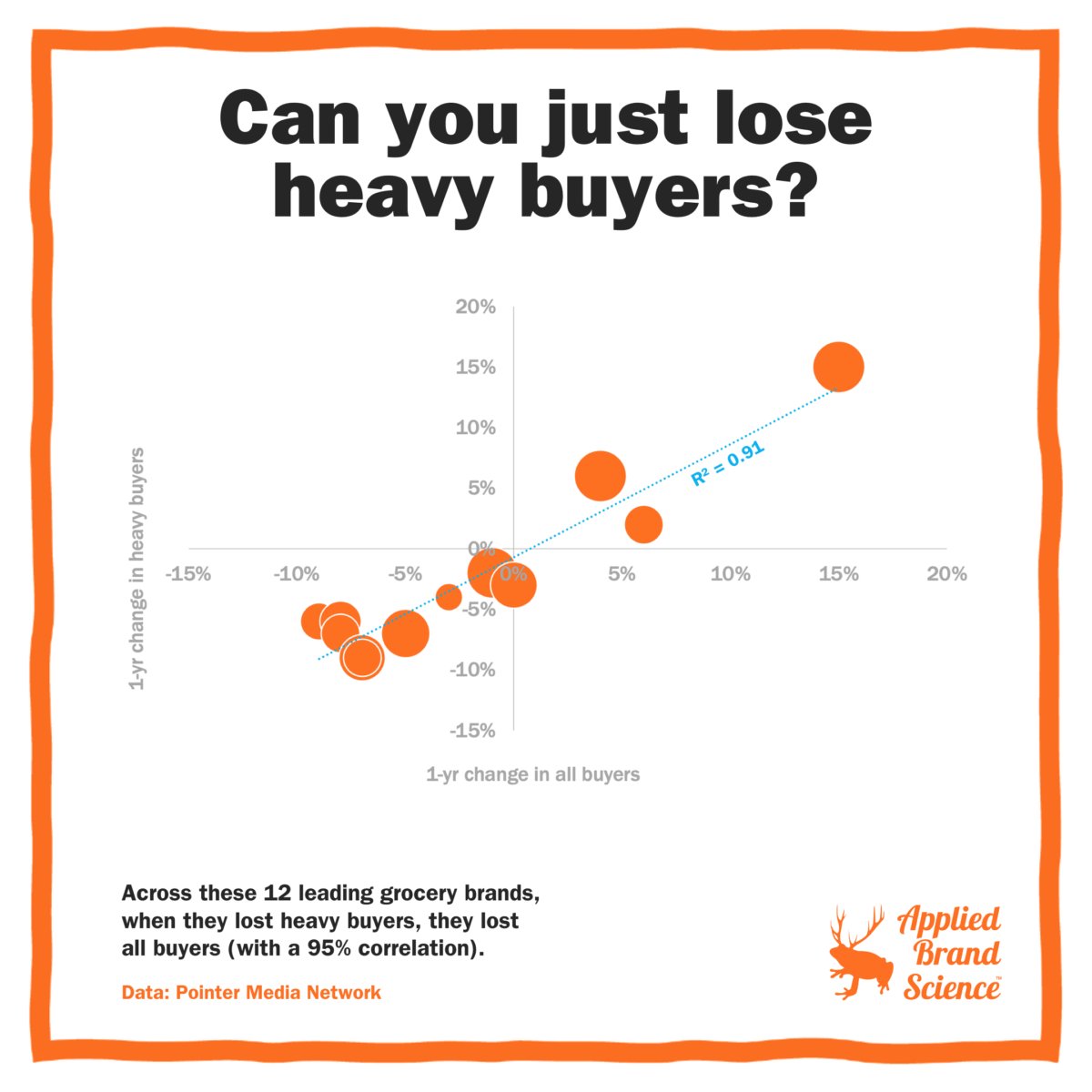
IS THERE SUCH A THING AS A "LOYALTY CRISIS"?
F’rinstance, can you lose your loyal customers and not other types of customers?
A few years ago, Pointer Media (they do the coupon printers at the grocery checkout) — looked at the purchases of 32MM people across 658 leading brands.
(Dumb aside: Catalina, who owned Pointer Media, was partly owned by Berkshire. Then it merged with Nielsen in 2010 to create NCSolutions. Then Catalina went bankrupt. Meanwhile, IRI and The NPD Group merged & became Circana. Then this year, Catalina sold NCSolutions to Circana. Maybe. I think. #CouponLife.)
Anyway, then-Pointer saw that many brands, including these category leaders (unnamed to protect the innocent) were losing their “high loyals” — people who spent 70% of their category dollars on a single brand.
In this chart, only 3 of 12 leading brands increased their number of “high loyals”; the other 9 lost from 2% to 9%! *Gasp*!
Oddly, they even showed how many TOTAL buyers these leaders gained or lost. It turns out that there’s a 95% correlation between losing high loyals & losing all buyers. (The chart says 0.91 because that’s r2 of the regression, not r of the correlation. #StatsLife)
But this fact was lost on them, because they didn’t know brand science. If they had, they would’ve realized that when brands grow or decline, they tend to lose ALL kinds of buyers. Because, as Wiemer Snijders says, “It’s the banana curve, silly.”
Caveats galore. But some lessons:
1. Learn the brand science! It makes results like these a whole lot less shocking.
2. Know that when you lose heavy buyers, you probably lose all other kinds of buyers too.
3. Stop calling them loyals! In this case, someone who bought 3 frozen pizzas from one brand out of 4 that year total was categorized the same as someone who bought 14 from one brand out of 20 total. Srsly?
=====
Sign up for the Irregular News & get this & more weekly(ish) in your inbox:
AppliedBrandScience. com/signup
1
1
109
26 Aug 2025
What if nonprofits brought the sizzle, not just the steak?
In this episode of Cover Brand, Chris Barge talks with me about the struggles of being a small foundation and the challenges to growth.
In particular, we discuss what nonprofits could learn from some of the biggest cause marketing campaigns of the century: the ice bucket challenge, Project(red), Livestrong, and the Met Gala.
As the brilliant Sarah Carter says, sometimes it's a lot easier to get people to do the right thing for the wrong reason ;-).
Cover Brand is everywhere you pod.
#marketingpodcast #marketing #nonprofits
67
25 Aug 2025
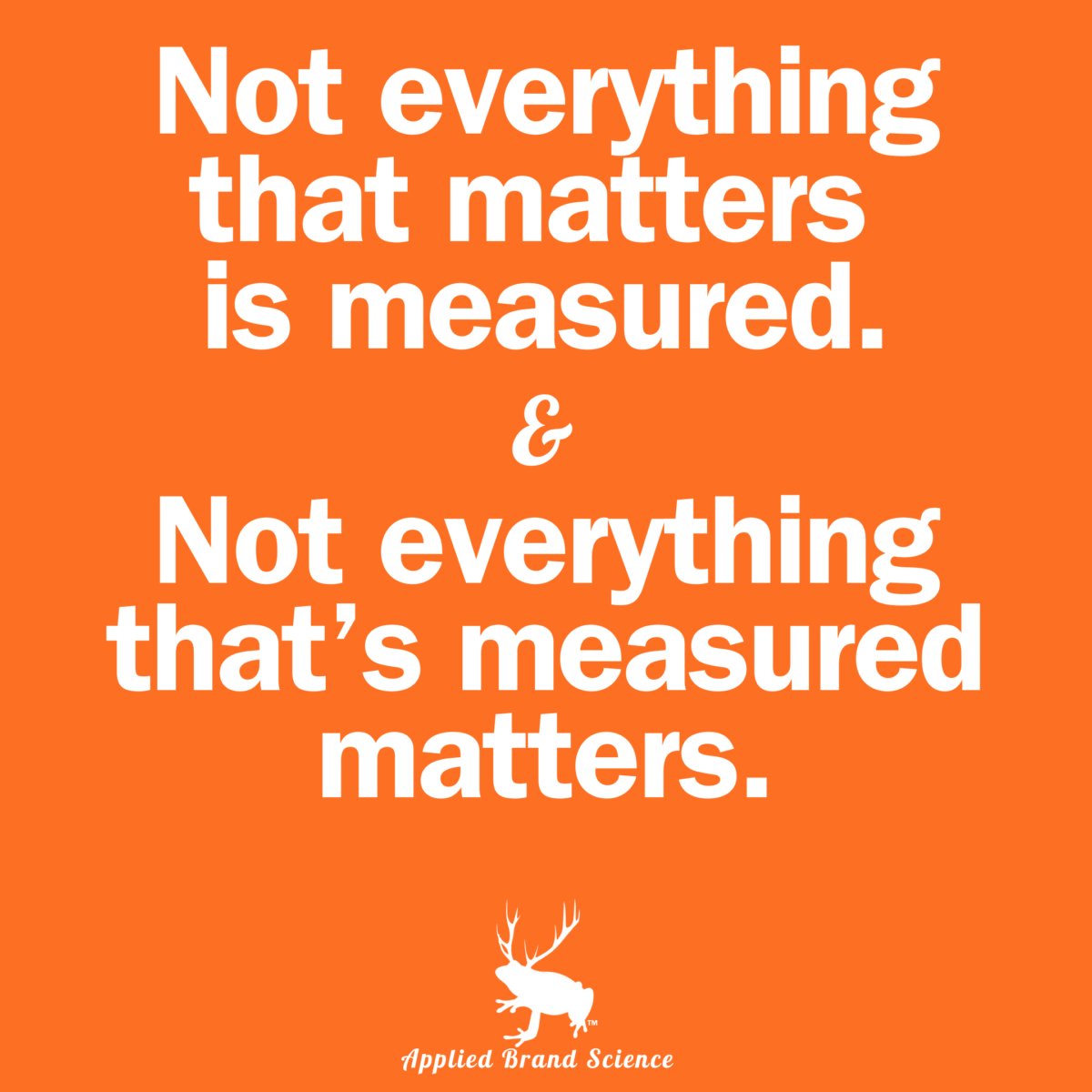
Not everything that matters is measured.
&
Not everything that's measured matters.
F'rinstance, what's the value of cuddling with your dog? $70?
Can you really quantify it?
Would you even want to?
OTOH, what's the value in measuring CTR if it's not correlated to any meaningful business result? (Hint hint.)
This is doubly challenging with predicting the future. And in particular predicting the future of some kind of marketing decision or strategy. Sometimes you can't measure the future suitably enough to make a decision.
------
Get the Irregular News weekly(ish):
AppliedBrandScience. com/signup
1
98
22 Aug 2025
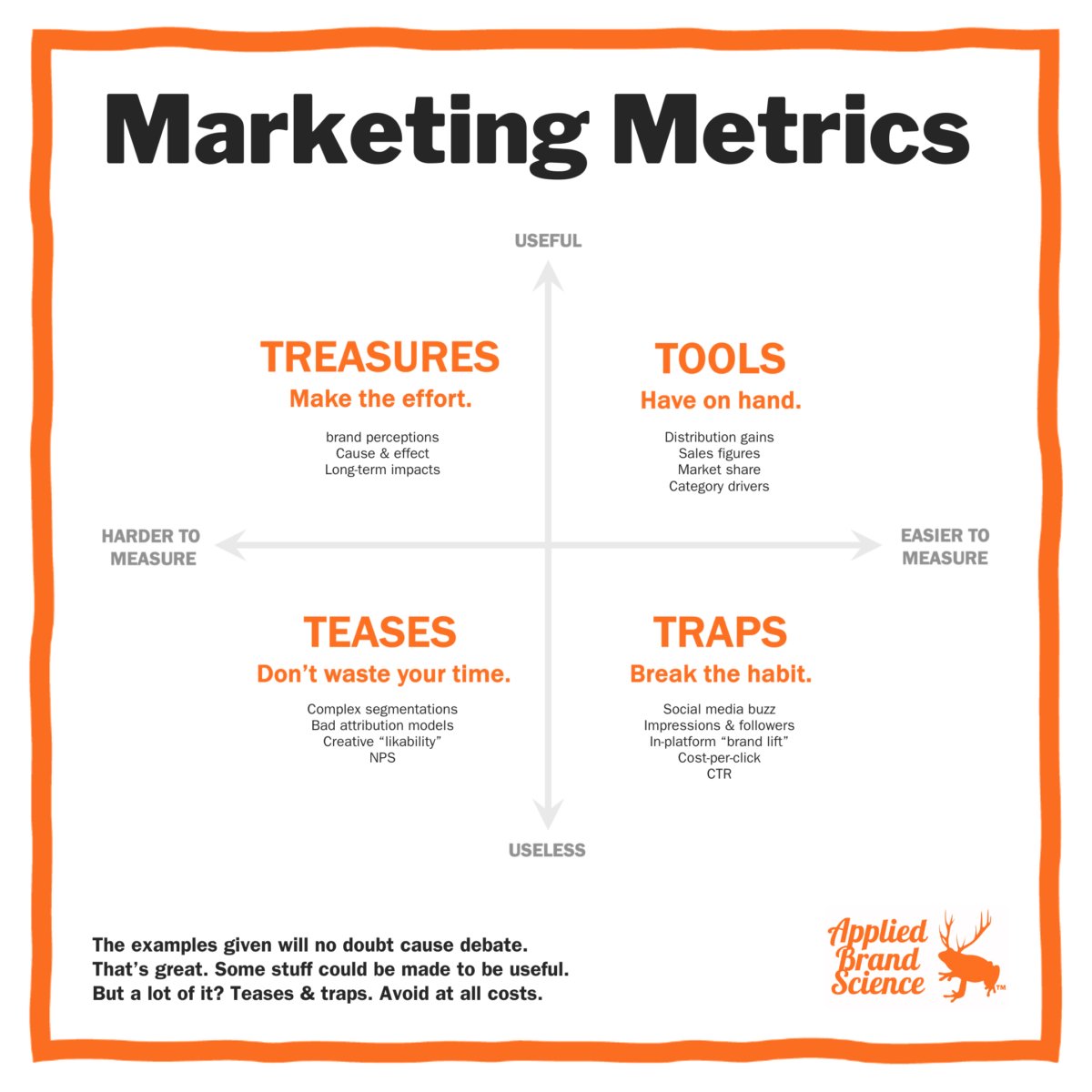
WHICH METRICS ARE TRAPS, AND WHICH ARE TREASURES?
Like, given there are about 525,600 marketing metrics, which ones are good and which are bad?
Granted, this is a hard thing to ask, for lots of reasons. Metrics are complicated.
That said, there is an easy way to classify metrics that helps show you where to spend your time and money, and where it would be wasted.
On one axis, you have how USEFUL the metrics are.
On the other axis, you have how HARD they are to measure.
We end up with four quadrants:
🔸 TOOLS: useful & easy things to have on hand.
🔸 TREASURES: useful & hard things you should make the effort for.
🔸 TRAPS: useless but easy things you’re probably addicted to & should break the habit.
🔸 TEASES: useless but hard things you (hopefully) aren’t tempted to waste time on.
Three big things you can do with this grid:
1. Discuss & debate what’s useful & what’s useless — for YOUR business. There are debates and hype about plenty of these.. So look for credible experts to guide you.
2. Wean yourself from the Traps. They’re addictive & suck up your time & energy.
3. Reinvest those resources to the Treasures. Because even though they’re hard to measure, they’re really really useful. Besides, as the post-it on my bathroom mirror says, “You can do hard things.”
_________
Subscribe to the Irregular News to get this & other goodies once a week.
AppliedBrandScience. com/signup
1
113
19 Aug 2025
How different are B2B buyers from B2C consumers?
In this episode of Cover Brand, Priscilla McKinney of Little Bird Marketing has a LOT to say about how "rational" B2B buyers are. And she brings the science — she's an anthropologist with a nasty habit of cognitive science.
if you want to understand how to really connect to B2B buyers, this episode is for you. From the sunk cost fallacy to luxurious thinking, learn how to make it easy for your buyers to buy you.
Everywhere you pod (Apple, Spotify, IHeartMedia, YouTube, etc.)
Linktree at appliedbrandscience com/coverbrand
#marketingpodcast #b2b #marketing
1
96
15 Aug 2025
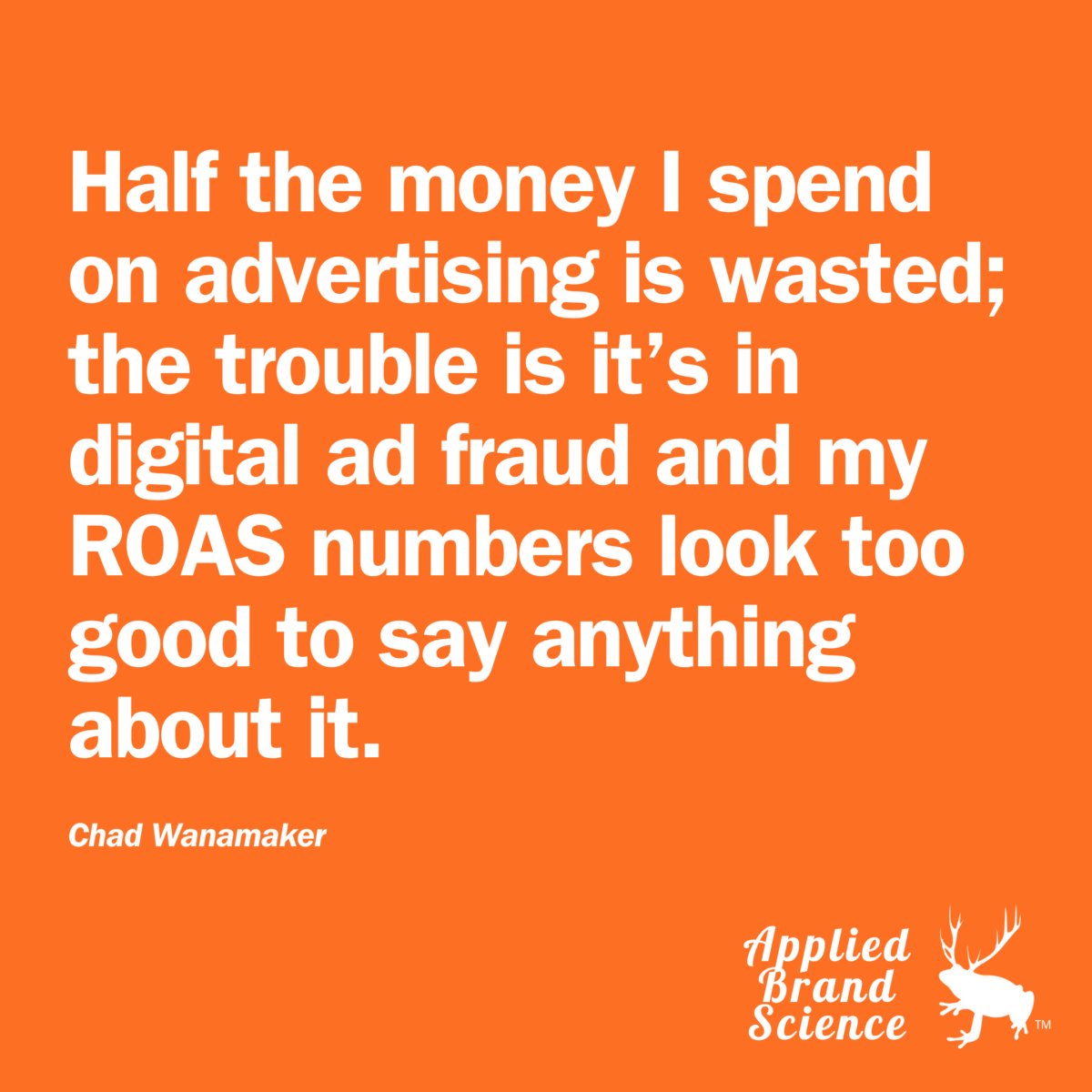
"Half the money I spend on advertising is wasted; the trouble is it’s in digital ad fraud and my ROAS numbers look too good to say anything about it."
— Chad Wanamaker
First, this is obvi a reference to that old saw by legendary titan of retail John Wanamaker, inventor of the department store, the price tag, and the money-back guarantee: "Half the money I spend on ads is wasted; the trouble is I don't know which half."
Second, it's a jab at the massive, rampant digital ad fraud that folks like Dr. Augustine Fou and Bob "The Ad Contrarian" Hoffman have exposed and written about now for YEARS. I mean, we're talking 40% to 80% of your digital ad dollars being WASTED via grift, scams, bots, and middlemen.
Digital advertising was supposed to eliminate the supposed "waste" in advertising (a topic for another post). With its thousands of data points per customer, billions of customers, and trillions of touchpoints, it was supposed to provide an omniscient view of the most effective and efficient way to spend ever advertising penny.
But that's not what happened.
And as they've both said (and others have echoed), it's a well-known problem that the entire industry completely ignores. It's like everyone continues to get the food at a restaurant when they KNOW it's full of bones, rats, plastics, and dog sh*t. And then they still say, "Mmm, I love their cobb salad!"
Why the big blind eye?
Well, to paraphrase James Carville, "It's the incentives, stupid." The purveyors of the sh*t cobb are raking it in. And the buyers love it too because their short-term KPIs (mostly ROI and ROAS but maybe a 'brand lift' pseudometric) look great. As long as their bosses or colleagues don't scrutinize the numbers, they can say, "Look at how BIG the salad is today!"
This is BILLIONS of dollars and euros and yen in waste.
Look: this is a hard problem to solve. it requires honesty. And challenging these DSPs and platforms. And spending more on high-quality inventory. And auditing. (PS: this is what I'd recommend. It's expensive & hard, but the ROI will be phenomenal, darling. MILLIONS.)
Unfortunately, it's a lot easier to save a few pennies by using AI to replace the creative people at agencies who might actually make your ads & PR stunts & ltd-editions & packaging & other marketing stuff decent and not blandtastic, ignorable, forgettable wallpaper.
Now if you'll excuse me, I've got a salad to finish.
1
1
4
422
14 Aug 2025
What's the true cost of being a BORING brand?
That's a new talk I'm building.
One place I'll share it is SXSW in Austin in March, if I get selected.
If you want to see it (I'll record it too), vote for it at the SXSW Panel Picker.
Voting ends Sunday Aug 24.
☞ Vote at tinyurl. com/ehdsxsw
1
88