
Senior Lead Frontend Engineer (mainly @angular) currently at rechtspraak.nl. Also pitlane and start official at Circuit Zandvoort.
Joined January 2009
- Tweets 708
- Following 328
- Followers 202
- Likes 885
43 Photos and videos












Elmar Beckmann 🎛️ 🏁 retweeted

Google to scan your entire photo library to build what it calls “Personal Intelligence.” What this means in plain English is that your images are no longer just stored, they are analyzed and integrated into a broader behavioral profile.
Google openly admits the system can use actual images of you and your loved ones to generate AI content, eliminating the need for users to manually upload reference photos.

133
2,666
5,693
282,138


Elmar Beckmann 🎛️ 🏁 retweeted

Feb 12
Great article on the hidden cost of high-velocity engineering in the AI era.
We talk about how AI tools make individual tasks faster, but there's constant context-switching and decision fatigue.
siddhantkhare.com/writing/ai…
2
7
60
4,996
Elmar Beckmann 🎛️ 🏁 retweeted

Feb 6
Over the last year I’ve gone through the 5 stages of grief.
1. Denial - “AI writes slop.”
2. Anger - “AI is trained on stolen data. I worked 20 years for these skills.”
3. Bargaining - “If I ignore it, maybe it will pass.”
4. Depression - “I don’t feel like working.”
5. Acceptance - “AI makes me quicker, more creative, and more capable. It automates the drudgery so I can focus on key decisions instead of syntax.”
Relieved to be at step 5.

I don't know why this week became the tipping point, but nearly every software engineer I've talked to is experiencing some degree of mental health crisis.
64
47
562
86,446
Elmar Beckmann 🎛️ 🏁 retweeted

Feb 6
Sounds incredible until you read the fine print. The compiler generates less efficient code than GCC with all optimizations disabled. It doesn’t have its own assembler or linker. It can’t produce a 16-bit x86 code generator. And Carlini himself says it has “nearly reached the limits of Opus’s abilities.” New features and bugfixes kept breaking existing functionality.
So what did $20,000 and two weeks actually buy? A compiler that passes 99% of GCC’s torture tests but can’t match the output quality of a tool that’s had 37 years of human engineering. That’s the constraint nobody’s pricing in.
The real story is in the cost curve, not the capability demo. $20,000 for 100,000 lines means $0.20 per line of generated code. A senior compiler engineer costs roughly $150/hour. At maybe 50 polished lines per hour for something this complex, that’s $3/line. AI just did it at 15x cheaper, and it will only get cheaper from here.
But the code isn’t equivalent. The AI version needs a human to finish the assembler, fix the linker, optimize the output, and prevent regressions. Those are the hardest 20% of the problem, and they represent 80% of the engineering value. Anthropic built the demo. Shipping the product still requires humans.
This tells you exactly where we are in the autonomous software timeline. AI can now produce impressive first drafts of complex systems at trivial cost. Turning those drafts into production software still requires the judgment that costs $300K per year in compiler engineer salary. The gap between “compiles the Linux kernel” and “replaces GCC” is measured in decades of accumulated engineering wisdom that no model has internalized yet.
The companies that understand this will use agent teams to generate the 80% and hire engineers to finish the 20%. The companies that don’t will ship $20,000 compilers that produce slower code than a free tool from 1987.
Feb 5

New Engineering blog: We tasked Opus 4.6 using agent teams to build a C compiler. Then we (mostly) walked away. Two weeks later, it worked on the Linux kernel.
Here's what it taught us about the future of autonomous software development.
Read more: anthropic.com/engineering/bu…
186
308
2,316
374,564

Elmar Beckmann 🎛️ 🏁 retweeted
17 Dec 2024
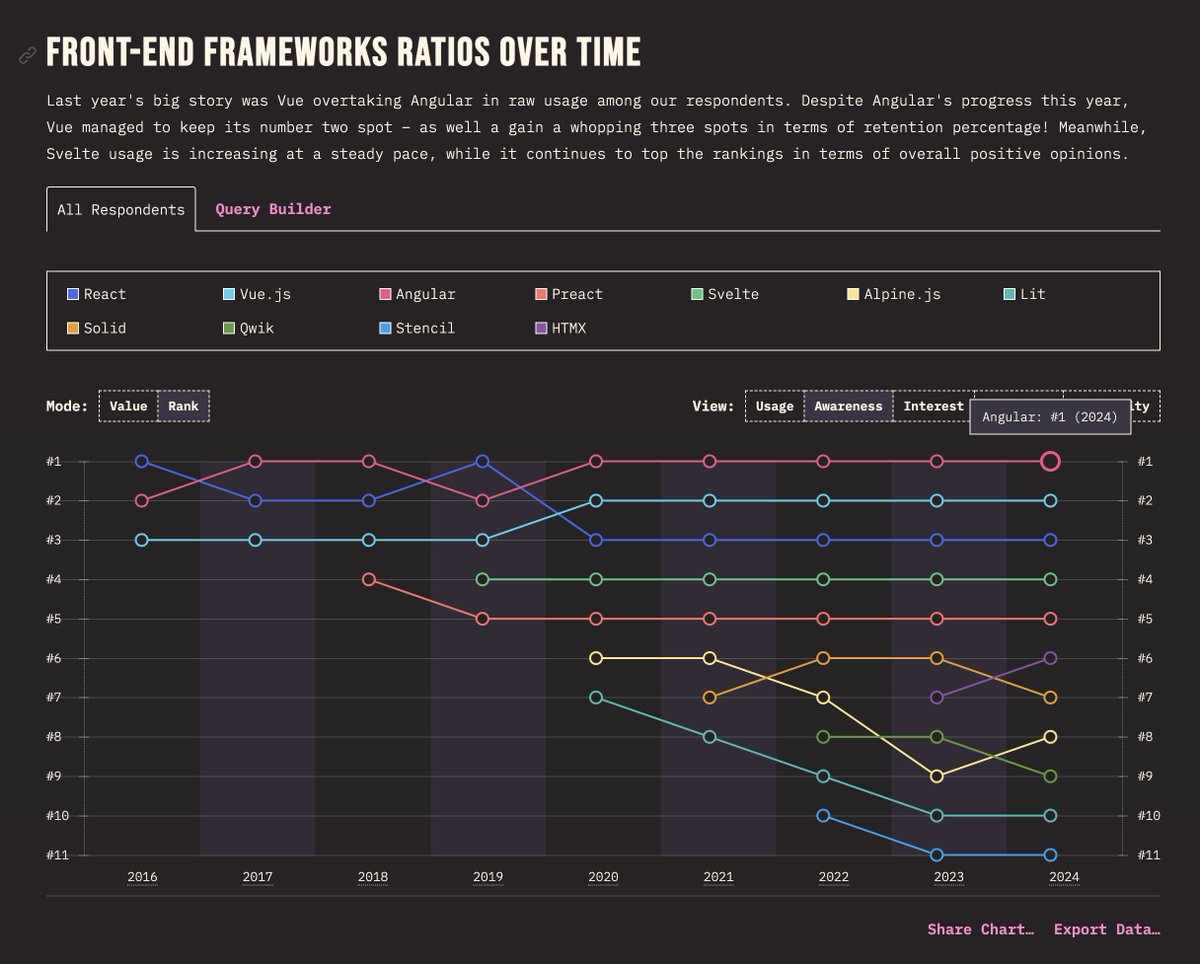
It has been wonderful to see the growth of Angular in the "State of JavaScript"
12% retention
5% usage
5% positivity
This means a lot coming from a React-heavy audience 🙏
In our Angular specific survey we saw a major satisfaction improvement thanks to signals and more!
19
26
206
8,165


10 Nov 2023
Hey @albertheijn . Deze mail krijg ik van jullie, maar dit lijkt zo erg op een spam/fishing mail. Is het niet slimmer om volgende keer te vragen om naar de website te gaan ipv de login knop er onder te zetten? Dit is niet erg handig.
67
1 Nov 2023
One of the best vids I’ve seen all year
31 Oct 2023

77

Angular’s renaissance is coming.
goo.gle/angular-event
101
387
1,771
492,189
Elmar Beckmann 🎛️ 🏁 retweeted

12 Oct 2023
Stem geen vvd

93
262
1,377
444,566
Elmar Beckmann 🎛️ 🏁 retweeted

3 Oct 2023
Introducing an AI Emoji Generator
Turn your ideas into emojis in seconds. Generate your favorite Slack emojis with just one click.
→ emojis.alexandru.so/ ← 100% free and open source
52
151
1,078
267,709
Elmar Beckmann 🎛️ 🏁 retweeted

29 Sep 2023
A solar filament erupts out into space with Earth to scale (size not distance)
Credit: NASA/GSFC/SDO

40
311
2,640
268,377
Elmar Beckmann 🎛️ 🏁 retweeted

12 Aug 2023
Hele filmpje gekeken
12 Aug 2023

7
7
62
48,175
Elmar Beckmann 🎛️ 🏁 retweeted

10 Aug 2023
This might be my favourite 2 minutes of tv ever.
@GeorgeMonbiot getting straight to the heart of what we need to do: system change.
#degrowth
240
2,815
6,925
978,944
19 Jul 2023
@NOSsport, @NOSwielrennen wat is dat toch met die nep vogelgeluiden als we helikoptershots met bos zien en jachtvogelgeluiden als we een hoger helmshot zien tijdens de Tour?
2
37
19 Jul 2023
En riviergeluiden die netjes in en uitfaden als er een beekje of waterval in beeld is.
1
33